Can You Drive to Hawaii? The Honest Answer and What to Do Instead
No road, bridge, or tunnel reaches the islands, but millions of people still get their own car there. Here is exactly how, what it costs, and how to drive once you land.
It is a funny question to type into a search bar, and you are far from the first to ask it. Maybe you just accepted a job in Honolulu and your car is the one thing you cannot imagine leaving behind. Maybe you are planning a cross-country adventure and wondered how far the road really goes. Or perhaps a map made the Pacific look a little smaller than it is.
Whatever brought you here, the plain answer is that you cannot drive to Hawaii. There is no highway, causeway, bridge, or tunnel connecting the Hawaiian Islands to anywhere else, and none is ever likely to exist. The good news is that people take their cars to Hawaii every single day, just not on their own wheels. This guide walks through the geography, the shipping process, the paperwork, and the realities of driving once you arrive, so you can make a smart decision about your own vehicle.
As an Amazon Associate, we earn from qualifying purchases made through links on this page.
Quick answer
Can you drive to Hawaii? No. The islands sit roughly 2,400 miles from the nearest point on the U.S. West Coast, with deep open ocean in between and no land route of any kind.
Can you bring your car? Yes. Cars travel to Hawaii by roll-on, roll-off cargo ship from West Coast ports, typically in about one to three weeks counting drop-off and pickup. Expect a bill that often runs into four figures, plus registration and inspection steps once you land.
Is it worth it? That depends on the age and value of your car, how long you are staying, and how much a rental or a local purchase would cost. The decision section below breaks it down.
The Short Answer: There Is No Road to Hawaii
Let us settle the main question right away. Hawaii is an archipelago in the middle of the Pacific Ocean, and the only ways to reach it are by air or by sea. No continuous land connection exists. You cannot drive there from California, you cannot drive there from Alaska, and you cannot drive there from anywhere else on Earth.
The confusion is understandable because Hawaii feels so American in daily life. It is a U.S. state, it uses U.S. dollars, it has Costco and Target, and it even has Interstate highways. In fact, Oahu is home to Interstate H-1, H-2, and H-3, which are signed and funded just like highways on the mainland. They do not connect to the rest of the country, of course. They simply carry traffic around a single island, which makes them one of the great pieces of road trivia in the United States.
This matters for anyone who loves a long drive. If your mental picture is a road trip that ends with a palm tree and a beach, the actual route is a road trip to a West Coast port, a few days for your car on a ship, and a flight for you. That is not a bad deal when you understand how it all fits together, and the rest of this article shows you how.
The three honest ways to get a car to Hawaii
- Ship your own vehicle. You drop it at a mainland port, it travels by ocean carrier, and you collect it at a Hawaiian port.
- Rent on arrival. You fly in and rent from an agency, a local company, or a peer-to-peer platform.
- Buy locally. You pick up a used vehicle in Hawaii, which is common for longer stays, though prices tend to run higher than on the mainland.
Each option has real trade-offs, and we cover them in detail later. For now, remember the headline: the road ends at the water, and everything after that is logistics.
How Far Hawaii Really Is From the Mainland
Maps often shrink the Pacific, tucking Hawaii into a corner of the frame as though it were a quick hop from the coast. In reality, the islands are among the most remote populated landmasses on the planet. The distance from the West Coast to Honolulu is roughly the same as driving from Los Angeles to New York, except it is entirely over open water.
| Departure point | Approx. distance to Honolulu | Typical nonstop flight |
|---|---|---|
| Los Angeles, California | About 2,550 miles | Roughly 5.5 to 6 hours |
| San Francisco, California | About 2,400 miles | Roughly 5 to 5.5 hours |
| Seattle, Washington | About 2,680 miles | Roughly 6 hours |
| Portland, Oregon | About 2,600 miles | Roughly 6 hours |
| Denver, Colorado | About 3,400 miles | Roughly 8 hours |
| New York City | About 4,960 miles | Roughly 11 hours |
Those numbers are straight-line approximations, and actual flight and sailing times vary with weather, routing, and season. The point is the scale. Even if the ocean were frozen solid and perfectly flat, you would face a drive of more than a full day at highway speed, with nowhere to stop for fuel, food, or sleep.
How the islands are spread out
Hawaii is not a single place, either. The state is a chain of islands stretching about 1,500 miles across the Pacific, though most visitors and residents focus on the eight main islands. Oahu holds the capital and the most people. Maui, Kauai, and the Big Island of Hawaii each have their own personalities, and Lanai, Molokai, Niihau, and Kahoolawe round out the group. Deep channels separate every one of them, which is why a car that lands on Oahu cannot simply roll over to Maui. We cover that wrinkle in the island hopping section.
If you want a feel for how compact a single island can be, our guide to driving around Oahu shows a full lap in surprising detail. Check out the Oahu drive time, traffic, and itinerary guide to see how much ground you can cover on one island, and why many people find that one car on one island is plenty.
Why No Bridge or Tunnel Will Ever Connect Hawaii
Every so often, someone online wonders whether engineers could eventually build a bridge to Hawaii. It makes for a fun thought experiment, but the practical answer is a firm no. Several independent obstacles stack on top of one another, and any one of them would be enough to kill the idea.
The ocean is incredibly deep
The seafloor between California and Hawaii typically lies several thousand meters below the surface, with abyssal plains that run deeper than the tallest mountains on land are high. Bridge piers have been driven into shallow coastal waters and a few deeper straits, but nothing resembling a continuous structure across open deep ocean has ever been attempted. A floating or submerged tunnel across that distance would be an engineering project beyond anything humanity has built.
The weather and sea conditions are brutal
The Pacific produces large swells, storm systems, and the occasional hurricane. A structure thousands of miles long would face constant wave loading, corrosion, and maintenance demands. Even the longest bridges in the world cross sheltered bays and gulfs measured in tens of miles, not thousands.
The economics make no sense
Ships already carry cargo, vehicles, and fuel to Hawaii efficiently. Planes handle most passenger travel. A fixed link would cost an astronomical sum to build and maintain, for a trip that few people would want to make by car anyway. Nobody wants to spend more than a day driving over open sea with no exits.
Hawaii also protects its remoteness
The islands are famous for fragile ecosystems and native species that evolved in isolation. Strict agricultural inspections exist to keep invasive pests and plants out, and a land connection would make that kind of protection practically impossible. Isolation is not just a geographical fact, it is part of how Hawaii manages its environment and economy.
Fun fact: The island chain was built by volcanic hotspot activity far from any continent. It never had a land connection to anywhere, so there is no ancient causeway or sunken route for anyone to rebuild.
The takeaway is simple. If you want to bring a vehicle to Hawaii, shipping is the only realistic method, and it is well established. Understanding how it works takes most of the mystery out of it.
The Real Solution: Shipping Your Car to Hawaii
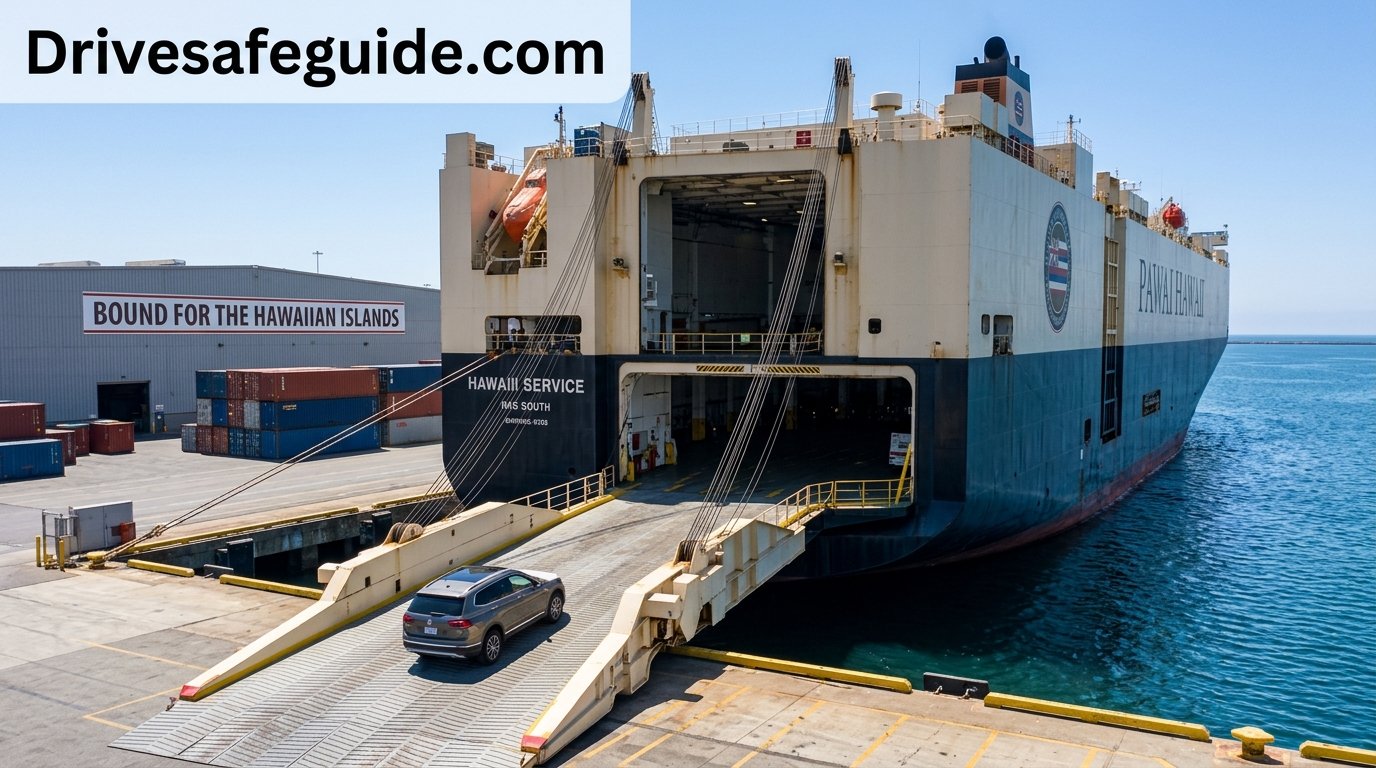
If you cannot drive to Hawaii, the next best thing is to send your car across on a ship. Several established carriers operate regular service from West Coast ports to Honolulu and other island harbors, and a whole industry of brokers and auto transporters exists to help with the mainland leg. Most personal vehicles travel as roll-on, roll-off cargo, which means the car is driven aboard, secured on a deck, and driven off at the destination.
Roll-on, roll-off versus container shipping
Roll-on, roll-off, often shortened to RoRo, is the standard method for ordinary cars, trucks, and SUVs. It is generally the most affordable option because the vehicle is driven directly onto the vessel. Container shipping places the car inside a steel container, sometimes along with household goods. It can protect the vehicle from the elements and may allow extra items to travel with it, but it usually costs more and involves more handling.
| Feature | Roll-on, roll-off | Container shipping |
|---|---|---|
| Typical cost | Lower | Higher |
| Protection from weather | Decks are covered or semi-covered, but the car is exposed to some salt air | Fully enclosed |
| Personal items inside | Usually not allowed | Often allowed, check carrier rules |
| Best for | Standard daily-driver cars | Classics, high-value cars, or moves with household goods |
| Handling | Driven on and off | Loaded and secured inside a box |
Where your car sails from and where it lands
Common departure ports on the mainland include Long Beach in Southern California, Oakland in the Bay Area, and ports in the Pacific Northwest, depending on the carrier. On the Hawaiian side, Honolulu is the busiest destination, with additional harbors serving Maui, Kauai, and the Big Island. Service schedules and the list of ports can change, so always confirm current options directly with the carrier or a reputable broker.
Who actually handles the shipment
You will see two types of providers. Ocean carriers own the vessels and terminals, and you can book with them directly. Brokers and auto transporters arrange the whole chain for you, including trucking your car to the port if you do not want to drive it. Brokers add a markup but may save hassle, especially if you are moving from far inland.
If you do drive yourself to the port, take the mainland leg seriously. A tune-up and inspection before a long haul is smart, and our walkthrough on how to prepare your car for a road trip covers the checks worth doing before any big drive.
How the Shipping Process Works From Start to Finish
The process looks intimidating on paper, but it breaks into a handful of predictable stages. Most people find the hardest part is simply gathering the right paperwork in time, not the ocean crossing itself.
| Stage | What happens | Typical timing |
|---|---|---|
| Quote and booking | You request quotes, choose a carrier or broker, and reserve a sailing | Several weeks before your move |
| Documents | You gather title or lien holder authorization, registration, and ID | Start as early as possible |
| Vehicle prep | You clean the car, reduce the fuel level, and photograph its condition | A few days before drop-off |
| Port drop-off | You deliver the car to the terminal and complete inspection paperwork | By the carrier’s cutoff date |
| Ocean transit | The vessel sails to Hawaii | Often under a week to Honolulu, longer to outer islands |
| Pickup | You collect the car at the Hawaii terminal after it is discharged | Soon after arrival, storage fees may apply if delayed |
| Registration | You register and inspect the car under local rules | Shortly after arrival, confirm your county’s deadline |
A realistic timeline
The sailing itself often takes less than a week to Honolulu, but that is only part of the story. Add drop-off cutoffs, loading, discharge, and the pickup window, and most people should plan around one to three weeks of being car-less. Outer-island destinations may take longer because cargo can be transferred in Honolulu before moving on.
Many travelers choose to fly out a few days after dropping off the car and arrive at the same time the vessel does. Others plan a rental for the first week. Either way, build in a buffer. Weather, port congestion, and paperwork delays do happen.
Tracking and communication
Most carriers provide tracking or status updates so you can see when your car departs and arrives. Save every confirmation number and keep digital copies of your documents on your phone. If something goes wrong, a paper trail makes it much easier to resolve.
Plan for slack. Do not schedule an important appointment for the same day your car is due to arrive. Ships can run late, and discharge and pickup sometimes take an extra day or two.
What It Costs and What Changes the Price
Shipping a car to Hawaii is not cheap, and the price can move around quite a bit. As a very rough guide, a standard sedan sent from the West Coast often lands somewhere in the neighborhood of fifteen hundred to three thousand dollars once everything is added up, but that range is only a starting point. Always ask for a current, itemized quote before you commit, because rates, surcharges, and fuel adjustments change over time.
Main factors that drive the price
| Factor | How it affects cost |
|---|---|
| Vehicle size and weight | Larger trucks and SUVs generally cost more than compact cars |
| Departure port | Different ports and routes carry different base rates |
| Destination island | Outer-island deliveries usually add transfer costs |
| Shipping method | Containers typically cost more than roll-on, roll-off |
| Season and demand | Peak moving periods can tighten capacity and raise prices |
| Fuel and other surcharges | Variable add-ons can change the final total |
| Trucking to the port | If you do not drive it yourself, inland transport adds a separate charge |
| Insurance | Carrier liability may be limited, so extra coverage can be an added expense |
The hidden costs people forget
The shipping bill is rarely the whole story. Your flight, a temporary rental while the car is at sea, any storage charges if you are late to pick it up, the cost of registering and inspecting the car in Hawaii, and possible repairs or maintenance that Hawaii’s roads and climate demand can all add up. Meanwhile, everyday costs like fuel, parking, and insurance tend to be higher in Hawaii than on much of the mainland.
When shipping stops making sense
A useful rule of thumb is to compare the shipping total, plus registration and the cost of a short-term rental, against what you would pay to sell your car and buy a similar one in Hawaii. If your car is older and worth less than the shipping bill, selling it is often the smarter financial move. If it is a newer vehicle you still owe money on, a classic you love, or a car that is well suited to island life, shipping can be well worth it.
One more consideration is your insurance. Confirm that your current policy covers your vehicle during ocean transit, or purchase a transit policy. If your lender holds the title, they will need to approve the shipment in writing, so contact them early.
Paperwork, Rules, and Inspections You Need to Know
Rules about shipping and registering a vehicle in Hawaii can change, and details vary by carrier and county, so treat the following as a planning guide and confirm the specifics with the carrier and with your county’s vehicle registration office. The overall categories, though, are consistent.
Documents carriers typically ask for
- Proof of ownership. This is usually the title or current registration in your name.
- Lien holder authorization. If you are financing or leasing, the lender must usually give written permission to ship the car to Hawaii.
- Government-issued photo ID. Carriers need to confirm who is dropping off and picking up the vehicle.
- Booking confirmation and shipping paperwork. Keep copies of all forms on your phone and in print.
- Authorization for a third party. If someone else will drop off or collect the car, ask the carrier what written authorization they require.
Agricultural and cleanliness requirements
Hawaii takes invasive species very seriously. Soil, plant material, insects, and seeds can introduce pests that threaten native ecosystems and agriculture. Cars arriving in the islands may be inspected, and vehicles that arrive dirty can be turned away or held until they are cleaned. Wash the exterior thoroughly, vacuum the interior, and pay special attention to wheel wells, the undercarriage, and the cargo area.
Registering and inspecting in Hawaii
Once your car lands, you will need to register it in the county where you will live. Hawaii also requires vehicles to pass a periodic safety inspection, and newcomers typically need to get that done as part of the process. Counties may require proof of ownership, proof of insurance, and a bill of lading from the shipment, plus fees and taxes. Deadlines for registration after arrival exist, so do not let paperwork linger.
Insurance in Hawaii
Hawaii is a no-fault insurance state, which means your own policy typically pays for your injuries after a crash regardless of who caused it. If you are moving permanently, you will need a policy that meets Hawaii’s requirements, and some mainland insurers handle this smoothly while others require you to switch. Ask for a written confirmation of coverage before your car sails so there is no gap. For a broader look at coverage that protects you from other drivers, our overview of uninsured motorist coverage is a good companion read.
Tip: Call the specific county registration office a few weeks before you move. Counties handle plates, safety checks, and tax questions differently, and a five-minute call can save you a second trip.
Preparing Your Car for the Ocean Voyage
A little preparation protects both your car and your wallet. Carriers publish their own requirements, and those rules are strict, so always follow the checklist your carrier provides. The items below reflect the most common expectations.
- Wash and vacuum thoroughly. A clean car passes agricultural checks and makes your condition photos far more useful.
- Lower the fuel level. Carriers typically require the tank to be low, often no more than about a quarter full. Confirm the exact limit with your carrier.
- Remove personal belongings. Most roll-on, roll-off carriers do not allow household goods or valuables in the car. Take out everything that is not part of the vehicle.
- Photograph every angle. Take dated, high-resolution photos of the exterior, interior, odometer, and any existing damage.
- Check the battery and tires. The car needs to start, drive, and roll properly at the port, and again at pickup.
- Fix leaks and fluid issues. Carriers may refuse a vehicle that leaks significant fluids.
- Disable or note the alarm. A blaring alarm during transit is a problem for everyone, so ask how to handle it.
- Remove toll transponders and loose accessories. Roof racks, bike carriers, and aftermarket extras may need to come off or be declared.
- Leave one key set. The carrier needs a key to move the car, so plan to hand one over and keep a spare.
- Note your odometer reading. It helps resolve any disputes about mileage during transit.
Treat salt air as a real enemy
Hawaii’s climate is wonderful for people and surprisingly hard on cars. Salt-laden air, humidity, and strong ultraviolet sunlight can speed up rust and paint damage. Before you ship, consider giving the undercarriage some attention. Our guide to the best rust-proofing methods for the undercarriage explains your options, and a protective finish can help too. If you are comparing paint protection, ceramic versus wax car coating breaks down what lasts. For sun in particular, see how to protect car paint from sun damage.
Do a quick tire and fluid check
Before drop-off, check your tire pressure and tread. A reliable gauge is inexpensive, and our comparison of digital versus analog tire gauges can help you choose. Top off fluids, replace worn wipers, and make sure your lights work. Hawaii’s heavy tropical rain makes good wipers and tires more important than most newcomers expect.
Should You Ship, Rent, or Buy a Car When You Get There?
This is the question that matters most, and the right answer depends on how long you will be in Hawaii, what kind of car you own, and what your budget looks like. There is no universal winner, so compare the three realistic paths side by side.
| Factor | Ship your car | Rent in Hawaii | Buy in Hawaii |
|---|---|---|---|
| Best for | Permanent moves, newer or beloved cars | Vacations and short stays | Long stays with an older or low-value car at home |
| Upfront cost | Shipping plus registration | Daily or weekly rate | Purchase price plus taxes and fees |
| Hassle level | Moderate to high | Low | Moderate |
| Availability | Depends on sailing schedule | Can be tight in busy seasons | Used inventory can be limited and pricey |
| Time without a car | One to three weeks | None after booking | None after purchase |
| Risk | Transit damage, delays | Fees and restrictions | Overpaying, hidden mechanical issues |
The case for shipping
Pros
- You keep a car you know and trust
- You avoid Hawaii’s often inflated used car prices
- It makes sense for newer, financed, or sentimental vehicles
- Your insurance and maintenance history stay continuous
Cons
- Shipping costs can rival the car’s value
- Paperwork and timing take effort
- Small risk of transit damage or delay
- You are without a car for a stretch
The case for renting
Pros
- Zero logistics for a short trip
- You can match the vehicle to each island
- No registration, no salt-air wear on your own car
- Easy to skip a car entirely on some days
Cons
- Costs add up fast on longer stays
- Peak-season shortages can push prices up
- Contracts may restrict certain rough roads
- Fees, taxes, and parking charges are common
The case for buying locally
Pros
- No shipping bill or transit risk
- You can pick a vehicle suited to island roads
- Great for a move where your mainland car is old
- You can resell it when you leave
Cons
- Used car prices can be high
- Inventory is limited on a small island market
- You need a trusted mechanic and a careful inspection
- Sale and resale take time and effort
If you are only visiting for a vacation, renting is almost always the right call. If you are staying for several months to a year, run the numbers on each path. And if you are moving permanently, ask whether your current car is worth the investment, because the best financial move is sometimes to sell at home and buy fresh in Hawaii.
Driving in Hawaii Once You Arrive
Driving in Hawaii is easy to love and a little different from the mainland. Roads are generally in good shape on the main routes, but they are narrower, slower, and more scenic than most people expect. The pace is also different. Locals tend to drive with a relaxed attitude, and honking is considered rude rather than normal.
Island by island
- Oahu. Home to the H-1, H-2, and H-3 highways and the heaviest traffic in the state. Honolulu rush hours can be slow, and parking in Waikiki is expensive. Outside the city, the coastal loops are scenic and easier.
- Maui. Famous for the winding Road to Hana, with hundreds of curves and dozens of one-lane bridges. Go early, go slow, and pull over for locals who want to pass.
- The Big Island. Distances are long, and the mix of lava fields, mountains, and coastline means long stretches between services. Fuel up before heading across the island.
- Kauai. A small road network with limited alternate routes, which means one accident can back up traffic for a while. Be patient and plan around peak times.
Rules and etiquette that surprise newcomers
Hawaii restricts handheld phone use while driving, and it is a good idea to treat that as a firm rule. A mount and hands-free setup are easy to arrange, and our roundup of the best car phone mounts can help you pick one. Wearing headphones while driving is another gray area in many places, so check our guide on driving with headphones on. Open container laws apply too, and you can read more in our overview of open container laws by state. Tint rules vary, so if your car has dark windows, review window tint darkness limits before you register.
Footwear is a favorite question for visitors, since slippers, or flip-flops, are practically the state shoe. Rules on footwear behind the wheel are generally relaxed, but safety still matters, and our explainer on driving in flip-flops covers the practical risks. Pull-over etiquette also matters, and our guide to move over law requirements is a useful refresher.
Weather and road hazards
Hawaii’s tropical weather can change quickly. Rain can turn roads slick, and flash flooding is a real hazard in valleys and near streams. Our tips for driving safely in heavy rain and the guide to flash flood vehicle safety are worth reading before your first storm. Low sun at sunrise and sunset creates intense glare, and sun glare visor solutions can make a big difference. If you are driving after dark on unlit island roads, tips for driving at night will help you stay sharp.
National parks and scenic stops
Haleakala on Maui and Hawaii Volcanoes on the Big Island both charge entrance fees, and a few spots require advance reservations for certain activities. Read up on national park vehicle passes to see whether an annual pass would save money, and use our guide to scenic byway route planning to map your favorite drives.
Check your rental contract. Some agreements prohibit specific rough or unpaved roads, such as certain summit and remote coastal routes. Driving them anyway can void your coverage.
Island Hopping With a Car: What Is and Is Not Possible
Here is a detail that surprises many first-timers. Even after you have shipped your car to Hawaii, you cannot simply drive it to another island. Each island is separated by deep channels, and there are no bridges between them. Moving a vehicle from one island to another requires a separate shipment.
Inter-island ferries are limited
For a short period, a high-speed car ferry connected Oahu with Maui and Kauai, but that service ended years ago, and nothing like it currently replaces it. Small passenger ferries exist for certain short crossings, but they do not typically carry vehicles. Always check current schedules before you plan around any ferry.
Barges and inter-island cargo
Inter-island cargo services can move vehicles between islands, but they are built for commercial freight rather than convenience. Scheduling, pricing, and drop-off requirements vary, and the cost often makes it impractical for a short trip. If you are relocating permanently from Oahu to another island, it may be worth the expense, but for most visitors, it is not.
The practical solution: one vehicle per island
Most visitors and residents simply use a different vehicle on each island. Fly between islands, then rent a car at the destination airport. The inter-island flights are short, frequent, and fairly affordable compared to moving a vehicle. If you plan to visit several islands, build your budget around multiple rentals and compare options early to avoid shortages in busy seasons.
| Option | Works for cars? | Notes |
|---|---|---|
| Driving between islands | No | No bridges or tunnels exist |
| Passenger ferry | Usually no | Typically foot passengers only, service is limited |
| Inter-island barge or cargo service | Sometimes | Commercial arrangement, schedules and costs vary |
| Fly and rent at destination | Not applicable | The most common approach for visitors |
If you are planning to rent on each island, consider what you actually need. Oahu’s city and coastal highways work with a compact car, while rugged routes on the Big Island or Kauai may call for something with more ground clearance. And if you plan to bring luggage-heavy gear such as surfboards, a safe roof setup matters, so read our guide on rooftop cargo carrier safety.
Satisfying the Road Trip Itch: Great Alternatives to Driving to Hawaii
If what you really wanted was a big, memorable road trip, you do not have to give up the idea. You just need to point it somewhere your tires can actually reach. Here are a few ways to turn the Hawaii dream into a drive worth taking.
Drive to Alaska instead
If an epic highway adventure is the goal, Alaska is the closest thing to a bucket-list drive that you can do from the lower forty-eight. It requires crossing Canada, so passports, border rules, and planning matter. Our guide on whether you can drive to Alaska covers the route, and the pages on border crossing vehicle inspection and international driving permit requirements explain what to expect at the line.
Make the drive to the port part of the trip
If you are shipping a car to Hawaii from the mainland, you have a built-in road trip to the departure port. Treat it like a farewell tour. Our cross-country driving checklist and road trip essentials checklist will help you plan, and the safety checklist before a road trip covers the last-minute checks that prevent breakdowns.
Use a smart navigation and safety setup
Phones and apps make route planning easier, and dedicated safety tools help in the unexpected moments. Browse our list of safe driving apps for smartphones, and keep a proper car emergency kit in the trunk. For documenting the trip and protecting yourself, a good dash cam is one of the best upgrades you can make, and a reliable portable jump starter turns a dead battery from a crisis into a minor delay.
A quick note on myths
- Myth: A secret road or causeway exists. It does not. No route has ever connected Hawaii to another landmass.
- Myth: An amphibious car can make the trip. Even the most capable amphibious vehicles are not built for thousands of miles of open ocean, and the legal, safety, and fuel obstacles are enormous.
- Myth: Shipping a car is only for the rich. It is expensive, but plenty of ordinary families do it because it beats buying a pricey used car or paying for months of rentals.
- Myth: You can pack your car with household goods and ship it. Most carriers prohibit loose items in a vehicle, so ask about container options if you need to move belongings too.
Frequently Asked Questions About Driving to Hawaii
Can you drive from California to Hawaii?
No. No road, bridge, or tunnel connects California to Hawaii. The islands lie roughly 2,400 miles away across the open Pacific, and the only practical ways to get there are by air or by ship. You can drive to a West Coast port and ship your car, but you cannot drive across the ocean.
How do people get their cars to Hawaii?
Most people ship them aboard cargo vessels that sail from West Coast ports. The most common method is roll-on, roll-off, where the car is driven onto the ship and secured on deck. Others use container shipping for added protection or to send belongings with the vehicle. Many people also hire a broker to manage the process.
How much does it cost to ship a car to Hawaii?
Prices vary by vehicle size, departure port, destination island, shipping method, and season. A standard car from the West Coast often costs somewhere between fifteen hundred and three thousand dollars all in, but you should confirm with a current quote because rates and surcharges change. Remember to budget for flights, a temporary rental, and registration fees too.
How long does it take to ship a car to Hawaii?
The ocean crossing to Honolulu often takes under a week, but the whole process, including drop-off deadlines, loading, discharge, and pickup, usually takes around one to three weeks. Deliveries to outer islands can take longer because cargo may be transferred through Honolulu. Build in extra time for weather and port delays.
Is it worth shipping a car to Hawaii?
It depends. If your car is newer, financed, or well suited to island life, shipping often makes sense. If it is older and worth less than the total shipping and registration cost, selling it and buying a car in Hawaii may be smarter. For short stays, renting is usually the better value.
Can you ship a car with stuff inside it?
Usually not on roll-on, roll-off service. Most carriers prohibit personal belongings, household goods, and valuables inside the vehicle. Container shipping may allow extra items, but rules vary, so ask your carrier for their exact policy before you pack anything.
Do you need to register your car in Hawaii?
If you are becoming a resident, yes. You will need to register the car in your county, pass the required safety inspection, and provide proof of ownership and insurance. Deadlines and fees depend on the county, so contact the local registration office before your car arrives.
Can you drive from one Hawaiian island to another?
No. The islands are separated by deep ocean channels, and no bridges or tunnels connect them. Most visitors fly between islands and rent a car at each destination. Moving a vehicle between islands requires a separate cargo shipment, which is usually only worthwhile for permanent moves.
Are there real highways in Hawaii?
Yes. Oahu has Interstate H-1, H-2, and H-3, which are officially part of the Interstate system even though they do not connect to the mainland. Other islands have state highways and scenic routes, but they are generally smaller and slower than mainland freeways.
Is renting a car in Hawaii a good idea?
For most visitors, yes. Renting avoids shipping, registration, and long-term maintenance. Book early in busy seasons because availability can tighten and prices can rise. Read your rental contract carefully, since some agreements restrict certain rough or unpaved roads.
Can an amphibious car drive to Hawaii?
Not realistically. Even capable amphibious vehicles are built for short water crossings, not thousands of miles of open ocean. Fuel capacity, sea conditions, safety rules, and regulations make the trip impractical. Shipping by cargo vessel remains the only dependable option.
Can you drive to Alaska instead?
Yes, you can drive to Alaska from the lower forty-eight, but you must travel through Canada, so you will need proper documents and should be ready for border inspections. If you want a legendary road trip and you cannot reach Hawaii by road, Alaska is the closest thing you can actually drive to.
Conclusion: You Cannot Drive to Hawaii, but You Can Absolutely Drive in Hawaii
The honest answer to the question is that no road leads to Hawaii and none ever will. The islands are thousands of miles from the nearest mainland coast, separated by deep, stormy ocean, and the only ways to reach them are by plane and by ship. That one fact shapes every decision after it.
If you want your own car in the islands, shipping is the proven path. Plan early, gather your documents, choose between roll-on, roll-off and container service, prepare the vehicle carefully, and build a realistic budget that covers more than just the freight bill. If your car is old or your stay is short, renting or buying locally may serve you better, and there is no shame in choosing the cheaper, simpler route.
Once you arrive, you will find driving in Hawaii to be a pleasure, with scenic coastlines, relaxed etiquette, and some of the most beautiful roads in the country. Respect local rules, watch the weather, drive patiently, and the islands will reward you. And if the big road trip itch is still there, remember that the open highway to Alaska is waiting.
Safe travels, and enjoy every mile, wherever the road ends.
You May Also Like
Keep exploring our driving guides, safety checklists, product reviews, and legal explainers.