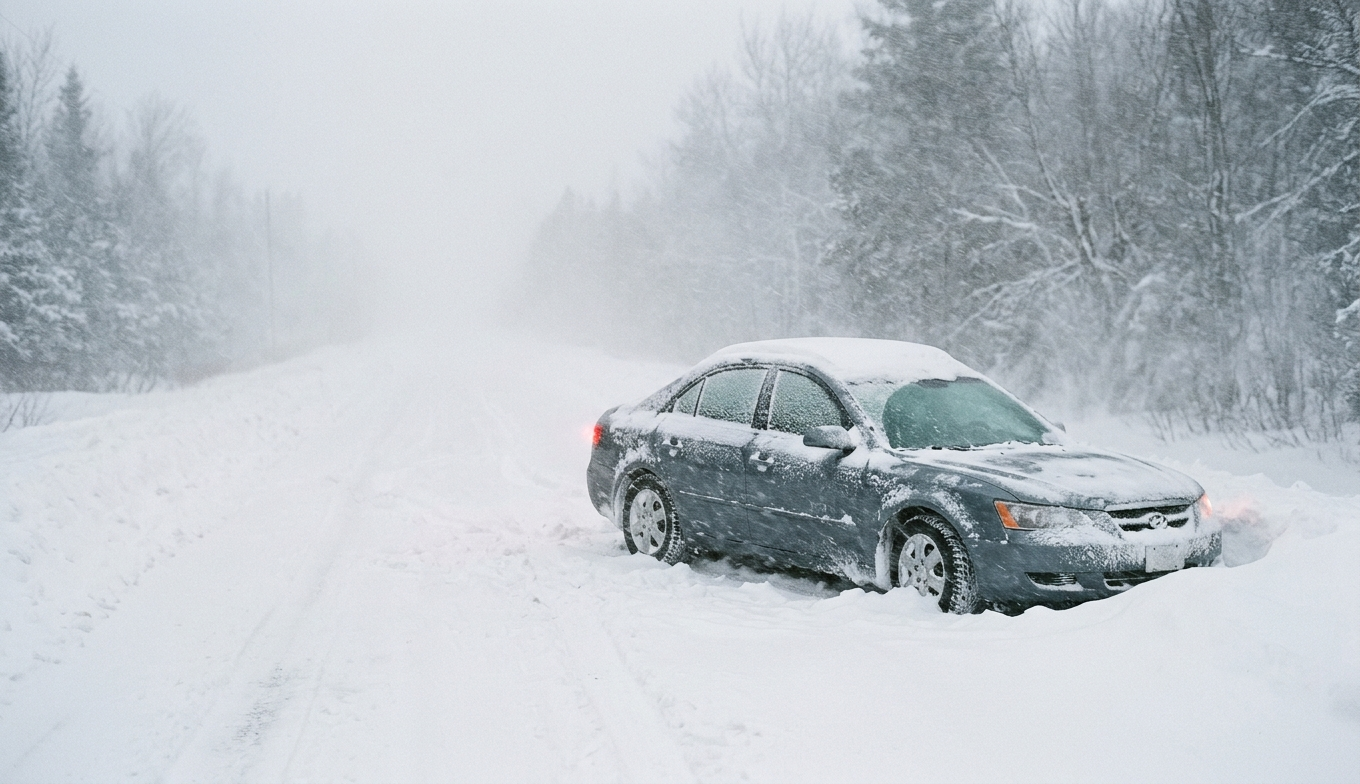
Blizzard Stranded Survival: Expert Tips to Keep You Safe
What to do in the first ten minutes, how to stay warm without running out of fuel, and how to get rescued safely if you’re stuck in a snowstorm.
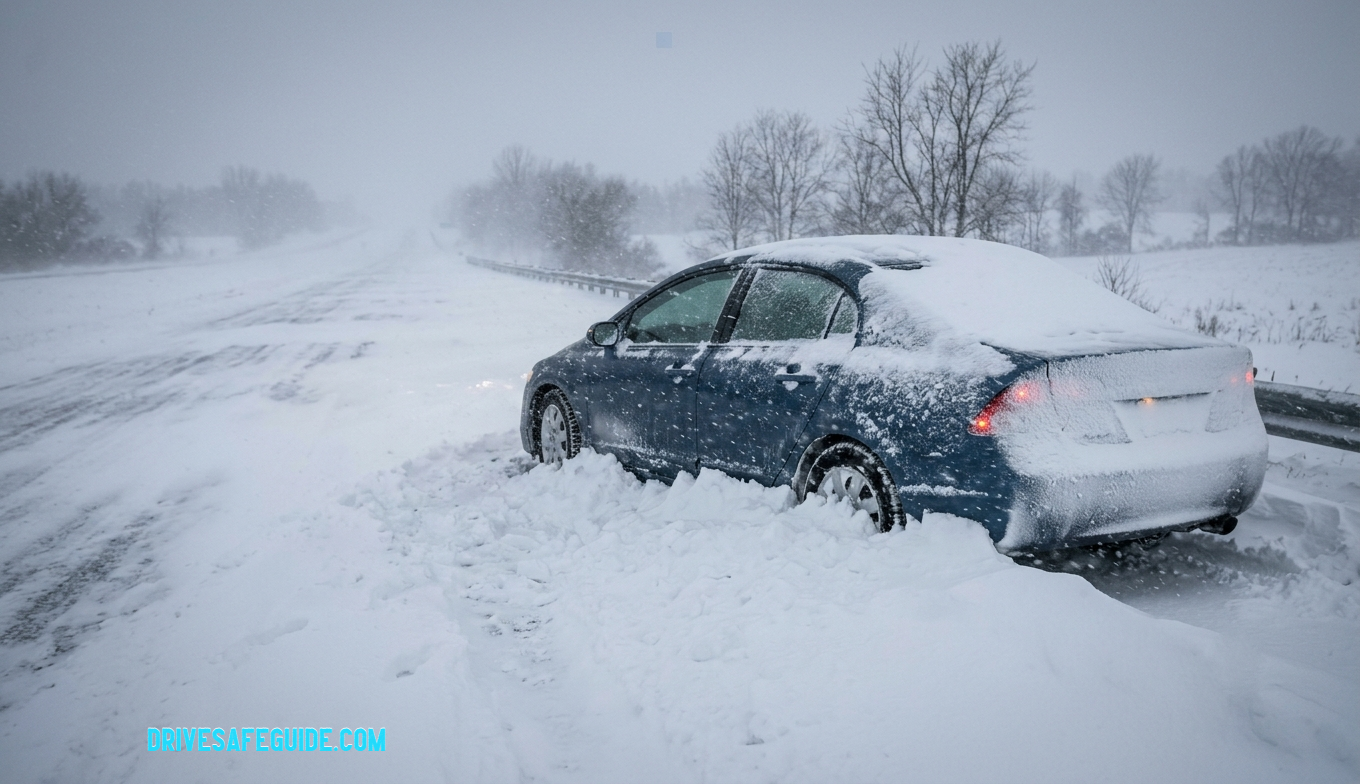
Every winter, drivers become stranded in blizzard conditions with little warning — knowing the right steps in advance is what keeps a bad situation from becoming a dangerous one.
There’s a specific kind of dread that sets in when the snow stops being scenery and starts being a wall. Visibility drops to a few feet, the road disappears under drifting powder, and somewhere in the middle of that whiteout, your car slows, slides, and stops moving — not by choice. Getting stranded in a blizzard is one of the more genuinely dangerous situations a driver can face, not because any single moment is dramatic, but because cold, isolation, and time work against you slowly and quietly if you don’t respond correctly.
This guide walks through exactly what to do if you find yourself stuck in a snowstorm: the first actions that matter most, how to manage warmth and fuel over hours (or longer), the carbon monoxide risk that catches far too many stranded drivers off guard, and how to make sure rescuers can actually find you. None of this requires expert-level survival training — it requires a plan, a properly stocked vehicle, and knowing what not to do just as much as what to do.
If you haven’t yet built out your cold-weather emergency supplies, our winter car emergency kit checklist is worth reading alongside this guide, since preparation before the storm is what makes everything covered here actually work in practice.
What makes blizzard survival different from most other roadside emergencies is the element of time. A flat tire or dead battery is usually resolved within an hour or two, and the discomfort involved is minor and short-lived. A blizzard stranding can stretch across many hours, sometimes into the next day, and the decisions you make early — how much fuel you use in the first hour, whether you clear the exhaust before or after starting the engine, how quickly you establish contact with emergency services — compound over that entire timeline. A small mistake made in the first ten minutes can still be affecting your situation eight hours later, which is exactly why a calm, methodical approach from the outset matters so much more here than in most other driving emergencies.
1. Why Blizzards Are Uniquely Dangerous for Stranded Drivers
A blizzard is officially defined by sustained winds, heavy blowing snow, and visibility reduced to a quarter mile or less for an extended period — conditions that combine to make both driving and walking extremely hazardous at the same time. That combination is what separates a blizzard from ordinary snowfall: it’s not just that the roads are slick, it’s that you often can’t see well enough to safely navigate them, and once stopped, you can’t easily see far enough to know how close help actually is.
Cold alone is dangerous, but wind chill dramatically accelerates heat loss from exposed skin and can drop the effective temperature far below what the thermometer reads. A vehicle stranded in open, wind-exposed terrain — a rural highway, an exposed mountain pass, a flat stretch of prairie — faces far more aggressive cooling than the same vehicle stuck in a more sheltered urban environment, which is part of why location matters as much as temperature when assessing how urgent your situation actually is.
Isolation compounds everything. Blizzards frequently coincide with reduced traffic, closed roads, and delayed emergency response times, since plows, tow trucks, and rescue crews are often overwhelmed or unable to reach remote locations quickly. Assuming help will arrive within an hour or two, the way you might after a routine breakdown, is a dangerous assumption during a major winter storm — realistic timelines can stretch to many hours, and in severe or remote situations, into the next day.
Wind and cold interact with each other in ways that make simple temperature readings misleading. A calm day at 10°F is meaningfully more survivable than a windy day at 20°F, because sustained wind strips heat away from exposed surfaces — including a vehicle’s cabin, once the engine stops running — far faster than still air at a colder actual temperature. This is part of why experienced winter travelers pay close attention to wind chill forecasts, not just the raw temperature, when assessing how much urgency a given stranding situation deserves.
Road conditions during a blizzard also complicate rescue logistics well beyond what most drivers expect. Plows are often prioritized for major routes first, meaning secondary roads and rural highways — precisely where many stranding incidents occur — can go unplowed for extended periods. Tow trucks and emergency vehicles face the same hazardous driving conditions that caused your own vehicle to become stranded in the first place, which is why a dispatcher’s estimated arrival time during a major storm should be treated as optimistic rather than guaranteed.
2. The First 10 Minutes: Immediate Actions
What you do in the first few minutes after realizing you’re stuck sets the tone for everything that follows. Panic and wasted effort — repeatedly gunning the engine to break free of snow, for example — burn fuel and energy you may need later, so a calm, sequential response matters more than speed.
- 1Stay in the vehicle. Your car is a far more visible, insulated shelter than you are on foot in blowing snow. Unless you can see a confirmed safe structure within very close range, staying put is almost always the safer choice.
- 2Turn on hazard lights immediately and, if you have one, activate any interior dome light briefly to boost visibility while you assess the situation.
- 3Check your exhaust pipe. Before running the engine for heat, get out briefly (if conditions allow) and confirm the tailpipe isn’t blocked by snow — this single check prevents the majority of carbon monoxide incidents in stranded vehicles.
- 4Call for help or send your location while you still have phone signal and battery, even if you’re not certain anyone can reach you immediately. An early call establishes a timestamp and last-known location that matters enormously if conditions worsen.
- 5Assess your supplies — fuel level, water, food, blankets, and warm clothing — so you know what you’re working with before making any decisions about rationing.
Resisting the urge to repeatedly try to drive out of deep snow is genuinely important. Spinning tires dig a vehicle in deeper, waste fuel, and in the case of some all-wheel-drive systems, can generate enough heat to cause mechanical damage. One or two measured attempts to rock the vehicle free are reasonable; beyond that, it’s usually better to stop, conserve resources, and wait for help or safer conditions.
It’s worth taking a moment in these first minutes to mentally separate what you can control from what you can’t. You can’t control how quickly the storm passes or how fast a plow reaches your road, but you can control how efficiently you use fuel, how well you’re insulated, how visible your vehicle is, and how clearly you’ve communicated your location. Focusing energy on those controllable factors, rather than on frustration at the situation itself, tends to produce calmer, more effective decision-making throughout what can be a genuinely stressful wait.
If you’re traveling with others, briefly assign informal roles once the initial checks are done — one person monitoring the phone and communication, another managing the exhaust check and visibility markers, and so on. This isn’t necessary for a solo driver, but for families or groups, having a loose plan reduces the chance that important tasks get missed simply because everyone assumed someone else was handling them.

3. Staying Warm Without Running Out of Fuel
Fuel is your most limited heat source, and rationing it correctly can be the difference between a manageable wait and a genuine emergency. The widely recommended approach is to run the engine for roughly 10 minutes each hour, using that window to warm the cabin, rather than idling continuously. This dramatically extends how long your fuel supply can sustain usable warmth — often stretching a half tank of gas across many hours or more, depending on the vehicle and outside temperature.
| Strategy | Fuel Impact | Best Used When |
|---|---|---|
| Continuous idling | Fastest fuel depletion | Only in severe cold with plenty of fuel remaining |
| 10 minutes per hour cycling | Significantly extends fuel supply | Standard approach for most stranded situations |
| Insulation-first, minimal engine use | Lowest fuel use | Low fuel remaining or extended stranding expected |
| Body heat + blankets only | No fuel use | Emergency fuel conservation, multiple occupants |
Layering matters as much as engine time. Loose layers of dry clothing trap warm air far more effectively than one thick layer, and a blanket or sleeping bag adds a meaningful insulating barrier between your body and the cold cabin air. Covering your head and neck — where a large proportion of body heat is lost — with a hat or hood makes a noticeable difference even in a relatively short amount of time.
Cracking a window slightly whenever the engine is running is a small habit that protects against the carbon monoxide risk covered in the next section, and the minor heat loss from doing so is a worthwhile tradeoff for the safety margin it provides.
For drivers who frequently travel through cold, remote regions, a dedicated heated blanket or hand warmers designed for vehicle use can meaningfully reduce how often you need to run the engine at all. Our comparison of best heated car blankets for cold-weather comfort covers 12V options that plug directly into the vehicle’s power outlet.
Chemical hand and foot warmers deserve a specific mention, since they’re inexpensive, require no battery or fuel, and provide several hours of steady, low-level warmth to extremities, which are typically the first areas to suffer in cold conditions. Keeping several pairs in the emergency kit — rather than relying solely on engine heat — extends how long you can maintain reasonable comfort without touching the fuel gauge at all.
Physical movement, done carefully within the confines of the vehicle, also helps generate body heat. Gentle isometric exercises — clenching and releasing muscle groups, small controlled movements of the arms and legs — increase circulation without requiring you to exit the vehicle or expend significant energy. This is a useful supplementary strategy, particularly during the stretches of each hour when the engine isn’t running and cabin temperature is gradually dropping.
Seat and floor insulation is another overlooked factor. Cold radiates upward from an unheated vehicle floor and through seat cushions surprisingly effectively. Placing a folded blanket or even seat cushions between your body and these cold surfaces creates a meaningful thermal barrier, and this simple adjustment often makes a bigger difference to comfort than an extra ten minutes of engine running time would.
4. Ventilation and Carbon Monoxide: The Silent Killer
Carbon monoxide poisoning is one of the most under-recognized dangers of being snowbound in a vehicle, precisely because it’s invisible, odorless, and produces symptoms — drowsiness, headache, confusion — that are easy to mistake for simple cold and fatigue. A blocked or partially blocked exhaust pipe, caused by drifting or accumulating snow, can force exhaust gases back into the cabin instead of venting away from the vehicle, and this has caused fatalities in vehicles that otherwise appeared to have plenty of fuel and functioning heat.
A snow-packed tailpipe forces exhaust gases back into the cabin, while a cleared exhaust vents safely away from the vehicle.
- Check and clear the exhaust pipe of snow before and periodically during any period of engine idling.
- Always crack a window slightly — roughly an inch — whenever the engine is running, even briefly, to allow air exchange.
- Never run the engine in an enclosed or heavily snow-drifted space, including if the vehicle becomes partially buried.
- If you feel drowsy, dizzy, nauseated, or develop a headache while the engine is running, turn it off immediately and get fresh air.
- A battery-powered carbon monoxide detector, kept in the emergency kit, adds a real safety margin for very little cost or space.
Exhaust blockage risk increases the longer a vehicle sits stationary in falling or drifting snow, since accumulation around the rear of the vehicle continues even after the initial check. A vehicle that had a perfectly clear tailpipe at the start of a stranding can have it fully packed with snow within an hour or two of heavy drifting, particularly if the vehicle is positioned with its rear facing into prevailing wind. This is the primary reason exhaust checks need to be repeated periodically throughout a stranding, not performed once and considered complete.
Passengers in the rear seats deserve particular attention regarding carbon monoxide symptoms, since drowsiness in someone already trying to nap or rest can be harder to distinguish from ordinary sleep. Establishing a habit of briefly checking on all occupants — a light touch, a verbal question — each time the engine is restarted helps catch early symptoms before they progress, particularly for children who may not recognize or communicate early warning signs themselves.
5. Making Your Vehicle Seen by Rescuers
A vehicle buried or partially covered by drifting snow can become nearly invisible to plow drivers, passing traffic, and search teams, which is a serious risk both for rescue speed and for the immediate danger of being struck by a plow that doesn’t see the vehicle in time. Visibility measures should be treated as a priority alongside warmth and fuel management, not an afterthought.
- Tie a brightly colored cloth — a scarf, flag, or dedicated distress marker — to the radio antenna or a rolled-down window, positioned as high as possible above expected snow accumulation.
- Keep hazard lights on when the engine is running, and use them intermittently rather than continuously if battery conservation becomes a concern.
- Clear snow from the roof and windows periodically if it’s safe to exit the vehicle briefly, since a fully snow-covered vehicle can look like a drift rather than a car from a distance.
- Use a flashlight or road flare at intervals rather than continuously, to conserve battery or flare life while still periodically signaling your location.
- Keep the dome light on briefly at intervals after dark, since interior light is often visible through snow-covered windows even when the vehicle’s exterior blends into the surroundings.
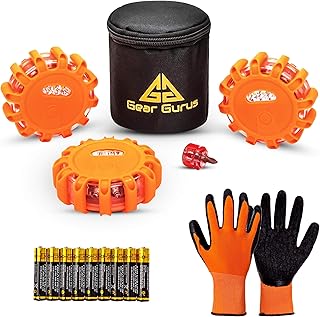
LED road flares are a meaningfully better option than traditional combustion flares in blizzard conditions, since they don’t rely on a flame that wind and snow can extinguish, and many models run for many hours on a single charge or battery set. Our review of the most durable, crushproof, and waterproof LED road flares covers models built specifically for harsh winter conditions.
Positioning matters as much as the tool itself. Flares or reflective markers placed too close to the vehicle offer little advance warning to approaching traffic or plows, while markers placed too far away in low-visibility conditions risk becoming separated from the vehicle they’re meant to indicate. A reasonable approach in blizzard conditions is to keep visibility aids closer to the vehicle than you would in clear weather — since sightlines are so drastically reduced anyway — while still elevating them as high as safely possible above expected snow accumulation.
Color contrast is worth considering deliberately. Bright orange, red, and certain shades of pink or magenta stand out more effectively against a white, snow-covered landscape than blue or green markers, which can blend into shadows cast across snowbanks. If you’re purchasing a distress flag or marker specifically for winter use, prioritizing high-contrast colors over the standard reflective triangle colors used for daytime, dry-road breakdowns will meaningfully improve visibility in a snow-dominated environment.
6. Building a Blizzard-Ready Emergency Kit
The single biggest factor separating a manageable blizzard-stranding from a genuine emergency is almost always what’s already in the vehicle before the storm hits. A well-stocked kit turns a stressful wait into a controlled one.
| Category | Essential Items | Why It Matters |
|---|---|---|
| Warmth | Insulated blanket, extra gloves/hat, hand warmers | Reduces reliance on engine heat and fuel |
| Visibility | LED flares, brightly colored cloth, reflective triangle | Helps rescuers and plows locate the vehicle |
| Nutrition | Non-perishable food, bottled water | Sustains energy and hydration over hours or longer |
| Power | Portable jump starter/power bank, phone charging cable | Keeps communication devices functional |
| Tools | Snow shovel, ice scraper, sand or traction mats | Assists with clearing exhaust and attempting safe extraction |
| Medical | First aid kit, any personal medications | Addresses injuries or health conditions without outside help |
For a broader breakdown of what belongs in a year-round roadside kit, our guide on building a car safety kit covering tires, battery, and first aid pairs well with the winter-specific items above.
Storage placement inside the vehicle deserves some thought, since a kit that’s technically present but buried under luggage in the trunk during an emergency is far less useful than one that’s genuinely accessible. Keeping a smaller, cabin-accessible subset of the kit — flashlight, hand warmers, a phone charging cable — within reach of the driver’s seat, with the larger bulk items in the trunk, ensures the most time-critical supplies are available even if reaching the trunk becomes difficult due to snow accumulation around the vehicle.
Seasonal kit checks are worth building into your routine rather than assuming a kit assembled one winter remains fully stocked the next. Batteries lose charge over months of storage, food items can expire, and water bottles may have been used or forgotten during an unrelated summer road trip. A five-minute inventory check at the start of each winter season — ideally before the first significant storm forecast — catches these gaps while they’re still easy to fix.
7. Food, Water, and Hydration During a Prolonged Stranding
It’s easy to underestimate hydration needs in cold weather, since the urge to drink is often less pronounced than in summer heat, even though the body still loses fluid through breathing and, if the heater is running, through a drier cabin environment. Dehydration also reduces the body’s ability to regulate temperature effectively, which makes staying hydrated a genuine part of staying warm, not a separate concern.
Keep water accessible but be aware that it can freeze in extreme cold — storing bottles closer to the cabin floor or wrapped in a blanket helps delay freezing longer than leaving them against a window or exterior door panel. If water does freeze, body heat (holding a bottle inside a coat layer) can slowly thaw a usable amount.
For food, calorie-dense, non-perishable options that don’t require preparation are ideal: nuts, protein bars, dried fruit, and similar shelf-stable snacks. Rationing matters if the stranding extends beyond the first several hours — eating small amounts periodically maintains energy and body heat production more effectively than either skipping food entirely or consuming a large portion early and having little left later.
Rationing math is simpler than it sounds. A reasonable baseline is to plan for enough water to allow small, regular sips throughout each waking hour rather than large infrequent servings, since steady intake supports circulation and temperature regulation more effectively than sporadic large amounts. If your kit includes a realistic multi-day water supply, treat the first day generously and only shift into stricter rationing if the stranding clearly extends beyond initial expectations.
Caffeine and alcohol both work against you in a cold-exposure situation, even though a warm coffee or a sip of something stronger might feel comforting in the moment. Caffeine has a mild diuretic effect that can worsen dehydration over time, and alcohol causes blood vessels near the skin to dilate, creating a temporary sensation of warmth while actually accelerating core heat loss. Water and calorie-dense snacks remain the more reliable choices for genuinely managing a prolonged cold-weather stranding.
8. Recognizing Hypothermia and Frostbite
Cold-related injuries progress in stages, and recognizing the early signs gives you time to respond before the situation becomes serious. Both hypothermia (whole-body cooling) and frostbite (localized tissue freezing) are real risks in a stranded vehicle, particularly if heat management has been imperfect or supplies are limited.
Hypothermia Warning Signs
- Uncontrollable shivering that later stops even though the person is still cold — a concerning progression, not a sign of improvement
- Slurred speech, confusion, or difficulty with simple tasks
- Drowsiness or a strong urge to sleep despite the danger of doing so
- Slow, shallow breathing and a weak pulse in more advanced cases
Frostbite Warning Signs
- Numbness or a hard, waxy appearance to skin, most often on fingers, toes, ears, and nose
- Skin that appears white, grayish-yellow, or unusually pale compared to surrounding areas
- A prickling or aching sensation followed by complete numbness in the affected area
If hypothermia is suspected, focus on gradual rewarming — dry clothing, blankets, and shared body heat if there are multiple occupants — rather than aggressive methods like hot water or vigorous rubbing, which can cause additional harm to already-stressed tissue. Frostbitten areas should not be rubbed, and direct high heat should be avoided, since numb tissue can burn without the person feeling it happen. Both conditions warrant medical attention as soon as it becomes accessible, even after initial rewarming appears successful.
Age and individual health factors change how quickly cold-related injuries develop. Older adults often have reduced ability to sense and respond to cold, meaning symptoms can progress further before becoming subjectively noticeable. People with circulatory conditions, diabetes, or those taking certain medications may also be at elevated risk for frostbite specifically, since reduced peripheral circulation is often already a factor before cold exposure begins. Being aware of these individual risk factors within your group — rather than assuming everyone experiences cold exposure identically — helps prioritize warming efforts appropriately if resources like blankets or hand warmers are limited.
Monitoring should be ongoing rather than a one-time assessment. Cold-related injuries can develop gradually over hours, and a person who seemed fine at the start of a stranding may show clear warning signs several hours later. Periodically checking in on each occupant — asking simple orientation questions, observing speech clarity, checking extremities for numbness or discoloration — creates an early warning system that catches problems while gradual rewarming and supportive care are still likely to be effective.
9. When to Stay With the Vehicle vs When to Move
The default, and by far the safest, choice in almost all blizzard-stranded situations is to stay with the vehicle. It’s larger, easier for rescuers to spot than a person on foot, provides shelter from wind, and can be used intermittently for heat. Leaving the vehicle to seek help on foot is a decision that has led to tragic outcomes in past storms, largely because distances and conditions are far harder to judge accurately in a whiteout than they appear.
Reasons to Stay With the Vehicle
- Visible landmark for rescuers and plow drivers
- Shelter from wind and direct snowfall
- Access to remaining fuel, supplies, and communication tools
- Reduces risk of disorientation and getting lost on foot
Rare Situations That May Require Moving
- A confirmed, visible structure is a very short, safe distance away
- The vehicle poses an active danger (fire risk, unstable position near a cliff or water)
- You have clear, verified knowledge of the route and conditions to safety
- Remaining in place has become medically unsafe and rescue is confirmed unreachable
If moving genuinely becomes necessary, tell someone your plan if you have any communication ability left, mark your path if possible, and move as a group rather than splitting up. But absent a clear, confirmed reason to do otherwise, staying with the vehicle remains the standard, expert-recommended approach.
10. Communicating Your Location and Calling for Help
Getting an accurate location to emergency services is often the single biggest factor in how quickly help arrives. Blizzard conditions frequently obscure road signs and landmarks, so relying on visual description alone can slow down a rescue considerably.
- 1Call emergency services as early as possible, even if you’re unsure whether the situation is severe enough — dispatchers can advise on timing and priority.
- 2Share GPS coordinates from your phone’s map application rather than relying solely on nearby mile markers or landmarks, which can be hard to spot in low visibility.
- 3Conserve phone battery by reducing screen brightness, closing unused apps, and only turning the phone on periodically if a full charge isn’t available.
- 4If you lose signal, periodically retry rather than continuously searching, since intermittent signal is common in storm conditions and continuous searching drains the battery faster.
- 5Let a friend or family member know your route and expected arrival time before departing on any trip through an area with storm potential, so someone can raise an alarm if you don’t check in.
A number of driver safety apps include offline map caching and emergency location sharing features that function even with limited signal. Our roundup of apps every driver should use highlights several tools worth installing before winter travel season, not during an active storm.
It’s worth understanding the difference between having no signal and having weak signal, since your phone’s behavior differs meaningfully between the two. A completely dead zone means calls and texts simply won’t go through regardless of how many attempts you make, while weak or intermittent signal may allow short text messages to eventually send even when a voice call repeatedly fails, since texts require far less continuous bandwidth. If a call won’t connect, switching to a text message to a known contact or emergency services (where text-to-911 is available in your area) is worth trying before assuming communication is impossible.
Downloading offline maps of your planned route before departing on any winter trip through remote or storm-prone areas is a small step that pays off disproportionately if you do lose signal, since it allows you to continue reading your GPS coordinates and general location even without active data connectivity. This is a five-minute preparation step that costs nothing and requires no special equipment, yet it’s skipped by the majority of drivers who later find themselves stranded without a clear way to describe their location.

11. Special Considerations: Children, Pets, and Medical Conditions
Traveling with children, pets, or individuals with medical conditions adds important considerations to blizzard preparedness and response, since their needs and risk factors differ from a solo adult driver’s.
Children lose body heat faster relative to their size than adults, and their smaller lung capacity means carbon monoxide exposure affects them more quickly. Prioritize their warmth first when rationing blankets or clothing layers, and keep them close to the center of the vehicle away from cold windows and door panels. Keeping a familiar comfort item and simple activities on hand also helps manage the psychological stress of a prolonged, frightening wait.
Pets are similarly vulnerable to cold and to the same ventilation risks as human occupants. Keep pets inside the vehicle rather than allowing extended time outside, bring a blanket sized for them specifically, and pack a small amount of pet food and water as part of the emergency kit if regular winter travel with animals is common for your household.
Medical conditions — diabetes, heart conditions, respiratory issues — deserve specific planning. Keep a several-day supply of essential medication in the vehicle during winter travel season rather than relying solely on what’s carried for the trip itself, since a delay of even one extra day can matter significantly for certain conditions. If you or a passenger has a medical device requiring power, factor that into your power bank and fuel conservation planning from the outset.
Families managing broader accessibility or medical driving considerations may also find our guide on driving laws and accommodations for deaf drivers a useful complementary read, since both topics deal with planning ahead for situations that require extra preparation beyond the average driver’s checklist.
12. Buying Guide: Best Gear for Blizzard Survival Kits
Not all emergency gear performs equally well in genuine blizzard conditions. Here’s how the major product categories compare when choosing equipment specifically for winter stranding scenarios.
| Product Type | Best For | Key Feature to Look For |
|---|---|---|
| 12V heated blanket | Reducing engine idling time | Auto shut-off timer, durable cord, adjustable heat settings |
| LED road flares | Long-duration visibility signaling | Weatherproof housing, magnetic base, long battery life |
| Portable jump starter/power bank | Phone charging and emergency vehicle starts | Cold-weather rated battery, built-in flashlight |
| Compact folding snow shovel | Clearing exhaust and attempting extraction | Durable blade, telescoping handle for storage |
| Battery-powered CO detector | Ongoing carbon monoxide safety monitoring | Loud audible alarm, long battery shelf life |
What to Prioritize
- Gear rated specifically for cold-weather/low-temperature performance
- Compact, durable items that store well without taking up excess trunk space
- Multi-use tools — a shovel that also breaks ice, a light that also charges devices
- Items with long battery shelf life for gear that sits unused most of the year
What to Avoid
- Cheap combustion flares that extinguish easily in wind and blowing snow
- Bulky gear that discourages actually keeping it in the vehicle year-round
- Standard (non-cold-rated) battery packs that lose significant capacity in freezing temperatures
- Any single “all-in-one” kit that skips genuinely essential categories like warmth or visibility
For drivers who want a more complete, checklist-driven approach to year-round preparedness, our road trip essentials checklist and winter driving safety guide covering traction, braking, and snow handling both pair well with the blizzard-specific gear covered here.

Frequently Asked Questions
Should I stay in my car or try to walk for help during a blizzard?
Stay with your vehicle in almost all situations. It’s a larger, more visible landmark for rescuers, provides shelter from wind and snow, and reduces the risk of becoming disoriented or lost, which has led to tragic outcomes for stranded drivers who tried to walk in whiteout conditions.
How often should I run my engine to stay warm without running out of fuel?
A widely recommended approach is running the engine for about 10 minutes each hour rather than idling continuously, which meaningfully extends how long your fuel supply can sustain usable warmth over an extended stranding.
How do I prevent carbon monoxide poisoning while stranded?
Check and clear the exhaust pipe of snow before and periodically during engine use, always crack a window slightly while the engine runs, and treat any unexplained drowsiness or headache as a signal to turn off the engine and get fresh air immediately.
Can I eat snow for water if I run out?
Eating unmelted snow directly can lower your core body temperature and worsen cold exposure. If water genuinely runs out, snow should be melted first using body heat in a sealed container, and only as a last resort after other water sources are exhausted.
What are the earliest signs of hypothermia to watch for?
Uncontrollable shivering, slurred speech, confusion, and difficulty with simple tasks are early warning signs. Shivering that suddenly stops while the person is still cold is a concerning progression that indicates worsening, not improving, hypothermia.
How do I make my car visible to rescuers in a blizzard?
Tie a brightly colored cloth to the antenna or window as high as possible above expected snow accumulation, use hazard lights and LED flares intermittently, and periodically clear snow from the roof and windows if it’s safe to briefly exit the vehicle.
What should be in a blizzard emergency car kit?
A well-rounded kit includes an insulated blanket, extra warm clothing, LED flares or a reflective triangle, non-perishable food, bottled water, a portable jump starter or power bank, a folding snow shovel, and a basic first aid kit with any needed medications.
How long can I realistically be stranded before help arrives?
Response times during major winter storms can be significantly delayed compared to routine breakdowns, sometimes stretching to many hours or into the next day in remote or severely impacted areas, which is why rationing fuel and supplies from the start is important.
Is it safe to run the heater all night if I have plenty of fuel?
Even with ample fuel, continuous idling still carries carbon monoxide risk if the exhaust becomes blocked by drifting snow, so periodic checks of the tailpipe and a cracked window remain necessary regardless of how much fuel is available.
What should I do differently if I’m stranded with children or pets?
Prioritize their warmth when rationing blankets and clothing, since children and pets lose body heat faster relative to their size, keep them centered in the vehicle away from cold windows, and pack extra supplies specific to their needs in advance of winter travel.
How do I share my exact location if I don’t know street names in a whiteout?
Share GPS coordinates directly from your phone’s map application rather than relying on visual landmarks or road signs, which are frequently obscured or unreadable in heavy snow and low visibility conditions.
Should I try to dig my car out myself during the storm?
Limited attempts to clear snow from around the tires and exhaust are reasonable, but sustained heavy digging in extreme cold and wind increases exposure risk and calorie expenditure. Prioritize conserving energy and warmth over aggressive self-rescue attempts once conditions are clearly severe.
Conclusion: Preparation Turns Panic Into a Plan
Being stranded in a blizzard is frightening precisely because it feels unpredictable — but the actual survival priorities are consistent and learnable: stay with the vehicle, manage fuel and warmth deliberately, guard against carbon monoxide at every engine restart, stay visible, and communicate your location as early and clearly as possible. None of these steps require special equipment beyond a modest, well-chosen emergency kit and a clear head under pressure.
The best time to prepare for this scenario is well before the forecast turns severe. Review your winter car emergency kit checklist, check your cold-weather car battery before the season starts, and make sure every driver in your household knows the core steps covered in this guide before the next storm rolls in.
🛡️ Be Prepared
Every Car Needs an Emergency Kit
Breakdowns happen without warning. A well-stocked car emergency kit can keep you safe until help arrives — don’t drive without one.
🏗 Shop Emergency Kits on AmazonAffiliate link — we earn a small commission that keeps DriveSafeGuide running. Thank you!