High-Impact Upgrades: The Ultimate Guide to Budget-Friendly Car Gadgets
As an Amazon Associate, we earn from qualifying purchases. This guide is packed with our favorite high-value finds. When you buy through our links, we may earn a commission at no extra cost to you.
There’s a pervasive myth in the car world that a meaningful upgrade has to come with a hefty price tag. We see commercials for brand-new cars with giant touchscreens and futuristic features, and we assume that level of convenience and tech is out of reach. I’m here to tell you that’s completely wrong. You don’t need a new car loan to dramatically improve your daily drive. You just need to be a savvy shopper.
As a car enthusiast who has always had more passion than cash, I’ve made it my mission to hunt down the hidden gems—the low-cost gadgets that punch way above their weight class. I’ve sifted through a mountain of cheap junk to find the products that offer 80% of the performance of their premium counterparts for 20% of the price. This guide is the treasure map. We’ve compiled the absolute best budget-friendly car gadgets that solve real problems, from modernizing an old stereo to taming cabin clutter to keeping you safe on the road. Prepare to upgrade your driving experience for less than the cost of a tank of gas.
What follows isn’t just a list. It’s a philosophy for how to spend money on your car intelligently. Over the years I’ve bought — and returned — dozens of gadgets that promised the world and delivered a flimsy piece of plastic that broke within a week. That trial and error is baked into every recommendation below. Rather than simply telling you what to buy, I want to walk you through why each of these categories matters, how to evaluate options within them even beyond the specific products I’ve picked, and how to avoid the common traps that separate genuinely useful budget gear from cheap junk that ends up in a landfill.
Car technology has accelerated at a remarkable pace over the last two decades, and that acceleration has created an unusual gap in the market. New vehicles roll off the lot with adaptive cruise control, wireless charging pads built into the console, and infotainment systems that rival a home theater setup. Meanwhile, the average car on American roads today is over twelve years old, according to industry data — meaning millions of drivers are piloting vehicles that predate smartphones, USB-C, and even, in many cases, Bluetooth. That gap between what modern life demands and what older vehicles provide is exactly the space that budget car gadgets exist to fill. And because the underlying components — Bluetooth radios, small charging circuits, injection-molded plastic — have become dramatically cheaper to manufacture over the past decade, it’s now possible to buy something that would have been a luxury item in 2010 for the price of a large pizza in 2026.
What are the best car gadgets on a budget?
The best budget-friendly car gadgets deliver maximum impact for minimal cost. For under $30, the top five high-value upgrades are a Bluetooth FM transmitter to modernize any car stereo, a high-speed multi-port USB charger to keep devices powered, a simple magnetic phone mount for safe navigation, a universal cleaning gel to detail tight spaces, and a car seat gap filler to prevent items from getting lost. These gadgets solve the most common daily driving annoyances for a fraction of the cost of premium solutions.
HOW WE TESTED AND SELECTED THESE GADGETS
Before diving into the individual picks, it’s worth explaining the standard we hold every product to. Every gadget in this guide had to pass three tests. First, the “annoyance test” — does it solve a problem that a large percentage of drivers actually experience on a regular basis, rather than a niche inconvenience that only affects a small slice of people? Second, the “installation test” — can an average person get it working correctly in under five minutes without needing tools, a manual, or a call to customer support? Third, the “regret test” — after using it daily for at least a month, would we still recommend it, or did the initial excitement wear off once we discovered a hidden flaw?
A huge number of products that look great in a two-minute unboxing video fail one of these three tests. Cheap dash cams, for example, often pass the annoyance and installation tests but fail the regret test once you realize the footage is too grainy to read a license plate. Novelty air fresheners might pass installation and regret but fail the annoyance test because they solve a problem most people don’t actually have. The gadgets that made this list passed all three, and in most cases, they’ve been in continuous use in the cars of the person writing this guide for months or years, not days.
We also weighed each product against its category average on Amazon and other retailers, factoring in verified purchase reviews, return rates where publicly available, and how the product held up over repeated use rather than a single test drive. A gadget that scores well in a lab environment but falls apart after three weeks of daily bumps and temperature swings inside a parked car isn’t a good recommendation, no matter how cheap it is.
THE “MODERNIZE YOUR RIDE” TECH UPGRADES (MOSTLY UNDER $50)
This category is all about bridging the technology gap. These gadgets bring essential modern features like Bluetooth streaming, hands-free calling, and voice assistance to cars that didn’t come with them from the factory.

1. Nulaxy Bluetooth FM Transmitter
The single best upgrade for an older car. Period.
If the car you’re driving doesn’t have built-in Bluetooth, this is the first thing you should buy. It’s a small device that plugs into your 12V power outlet (the “cigarette lighter”) and performs two key functions: it connects to your phone via Bluetooth, and then it broadcasts that audio over a clean, unused FM radio station that you tune your car stereo to. The result? You can stream Spotify, podcasts, and audiobooks and take hands-free calls through your car’s speakers.
The Value Proposition:
For less than the price of a pizza, you get the core functionality of a brand-new infotainment system. I’ve used Nulaxy transmitters in multiple older vehicles, and the sound quality is shockingly good. Modern versions like this one have excellent noise-cancellation for calls and often include fast-charging USB ports, adding even more value. It’s an easy, plug-and-play solution that makes any commute more enjoyable and safer, as it’s a key tool for using safe driving apps without fumbling with your phone.
Bluetooth FM Transmitters: A Deeper Dive
Because this is the single most impactful gadget on this list, it deserves a more thorough explanation of how it works and how to get the best possible results from it. An FM transmitter doesn’t magically inject audio into your stereo’s wiring — it’s actually broadcasting a low-power FM radio signal from a tiny built-in antenna, and your car’s factory radio receives it exactly the way it would receive any local radio station. That means signal quality depends heavily on two things: how close the transmitter’s frequency is to an actually “empty” station in your area, and how strong the transmitter’s signal is relative to nearby broadcast towers.
In dense urban areas, the FM dial can be crowded, and it may take some trial and error to find a frequency with no interference. Most quality transmitters, including the one recommended above, let you cycle through multiple frequency presets so you can quickly switch if you drive into an area where your usual station suddenly picks up interference from a stronger broadcast signal. A good rule of thumb is to test three or four frequencies in the 88.1–88.9 or 107.1–107.9 range, since the extreme ends of the FM band tend to be reserved for public radio and are less likely to be occupied by strong commercial stations.
One frequent point of confusion is the difference between an FM transmitter and an auxiliary (AUX) adapter. If your older car actually has a 3.5mm AUX input jack, you can skip the FM broadcast step entirely and use a Bluetooth receiver that plugs directly into that jack, which will always sound better than an FM transmission because it avoids the radio compression and interference altogether. However, a huge number of cars from the mid-2000s and earlier have neither Bluetooth nor an AUX jack, which is exactly the gap the FM transmitter fills. If you’re not sure which category your car falls into, check the owner’s manual or simply look at the stereo faceplate for a small jack labeled “AUX” or “Line In.”
Installation tips that make a real difference: mount the transmitter so the cable to your phone (if it has one) doesn’t dangle across the dash where it can catch on the steering wheel. Many modern units also support USB-A to USB-C or Lightning charging cables threaded through the same port, meaning you can charge your phone and stream audio through a single device instead of juggling two separate 12V accessories. If your car has more than one 12V outlet, consider dedicating one exclusively to the transmitter so you never have to unplug it to charge something else.

2. Anker Mini Aluminum Alloy 24W Car Charger
Tiny Size, Full-Speed Power
The freebie USB charger you got at a trade show is not your friend. Most cheap chargers provide a pathetic trickle of power that can’t even keep up with a phone running Google Maps. A quality charger is a must, and thankfully, they are incredibly affordable.
The Value Proposition:
Anker is the king of reliable, budget-friendly charging. This mini charger is fantastic because it sits almost completely flush in the 12V socket, giving your dash a clean, factory look. Despite its tiny size, its dual ports deliver a full 2.4A each, which is powerful enough to charge two devices at full speed simultaneously. For a tiny investment, you eliminate the “my phone is dying faster than it’s charging!” anxiety forever. This is a perfect example of a unique gift for car lovers that’s both thoughtful and incredibly affordable.
USB Charging Explained: Amps, Watts, and Why Your Old Charger Is Failing You
To understand why a cheap giveaway charger performs so poorly, it helps to understand a little bit of the underlying electrical math, without getting too deep into engineering. Charging speed is a function of both voltage and current (measured in amps). Most USB ports operate at 5 volts, so the real variable that determines how fast a device charges is the current the port can supply. A basic charger might supply 1A (5 watts total), which was sufficient for phones a decade ago but is now barely enough to keep a modern smartphone’s battery from draining while the screen is on and the GPS is running. A quality charger supplying 2.4A per port (12 watts) roughly doubles that speed, and many current-generation devices can pull even more through USB-C Power Delivery or Qualcomm Quick Charge protocols, sometimes exceeding 20 or 30 watts on a single port.
This matters enormously for road trips. If you’re relying on your phone for turn-by-turn navigation, streaming music, and taking calls simultaneously, the screen and GPS radio combined can draw more power than a weak charger provides, meaning your battery percentage actually drops even while it’s plugged in. A charger that can comfortably outpace your phone’s power draw is the difference between arriving with 80% battery and arriving with 15%.
When shopping for a car charger beyond the specific pick above, look for a few key indicators of quality: the wattage or amperage printed clearly on the packaging (avoid anything that doesn’t disclose this), a reputable brand with a track record of quality control (Anker, Anker’s sub-brand Aukey, Belkin, and RAVPower are generally considered reliable), and, if possible, reviews that specifically mention the charger still working after six months or a year of daily use, since some 12V chargers are prone to overheating and failing after extended exposure to a hot car interior in summer.
“The smartest upgrades aren’t always the most expensive. They’re the ones that solve the most frequent annoyances for the lowest cost.”
KEEPING YOUR EYES ON THE ROAD: PHONE MOUNTING AND NAVIGATION
Even the best FM transmitter and fastest charger won’t help you if your phone is sliding around the passenger seat every time you brake. A stable, well-positioned phone mount is arguably as important for safety as it is for convenience, since it keeps your eyes closer to the road while glancing at a map or podcast controls.
Magnetic mounts have become the dominant style for good reason: they use a small metal plate (usually adhered discreetly to the back of your phone case) and a strong magnet embedded in the mount itself, allowing you to snap your phone into place with one hand in under a second, without needing to fumble with adjustable claws or clips that can scratch your phone or fail to grip a case properly. The best magnetic mounts use an array of small magnets (sometimes called an N52 magnet array) rather than a single large magnet, which distributes holding force more evenly and prevents the phone from sagging or rotating over a bumpy road.
When choosing where to mount your phone, air vent mounts are popular because they put the phone at eye level near the dashboard, but they can restrict airflow on hot days and put stress on plastic vent fins over time — cheaper vent clips have been known to snap after repeated use. Dashboard mounts that use a strong adhesive or a suction cup avoid that issue but require a flat, clean surface to adhere to, and can leave a faint residue mark if moved frequently. CD-slot mounts are a clever option for anyone whose car has a still-functional but rarely-used CD player, since they don’t require any adhesive or vent clip at all and hold surprisingly firm.
A note on legality and safety: several states have specific laws about where a phone mount can be placed on the windshield, since mounts positioned in the driver’s direct line of sight or too close to the airbag deployment zone can be a citation risk and, more importantly, an actual safety hazard in a crash. Checking your local regulations before choosing a windshield-mounted option is a five-minute task that can save you a ticket down the line.
THE “CHAOS TAMER” ORGANIZATION HACKS (MOSTLY UNDER $30)
Car clutter is a universal struggle. These inexpensive but ingenious gadgets create a dedicated place for everything, turning a chaotic cabin into an organized and stress-free environment.
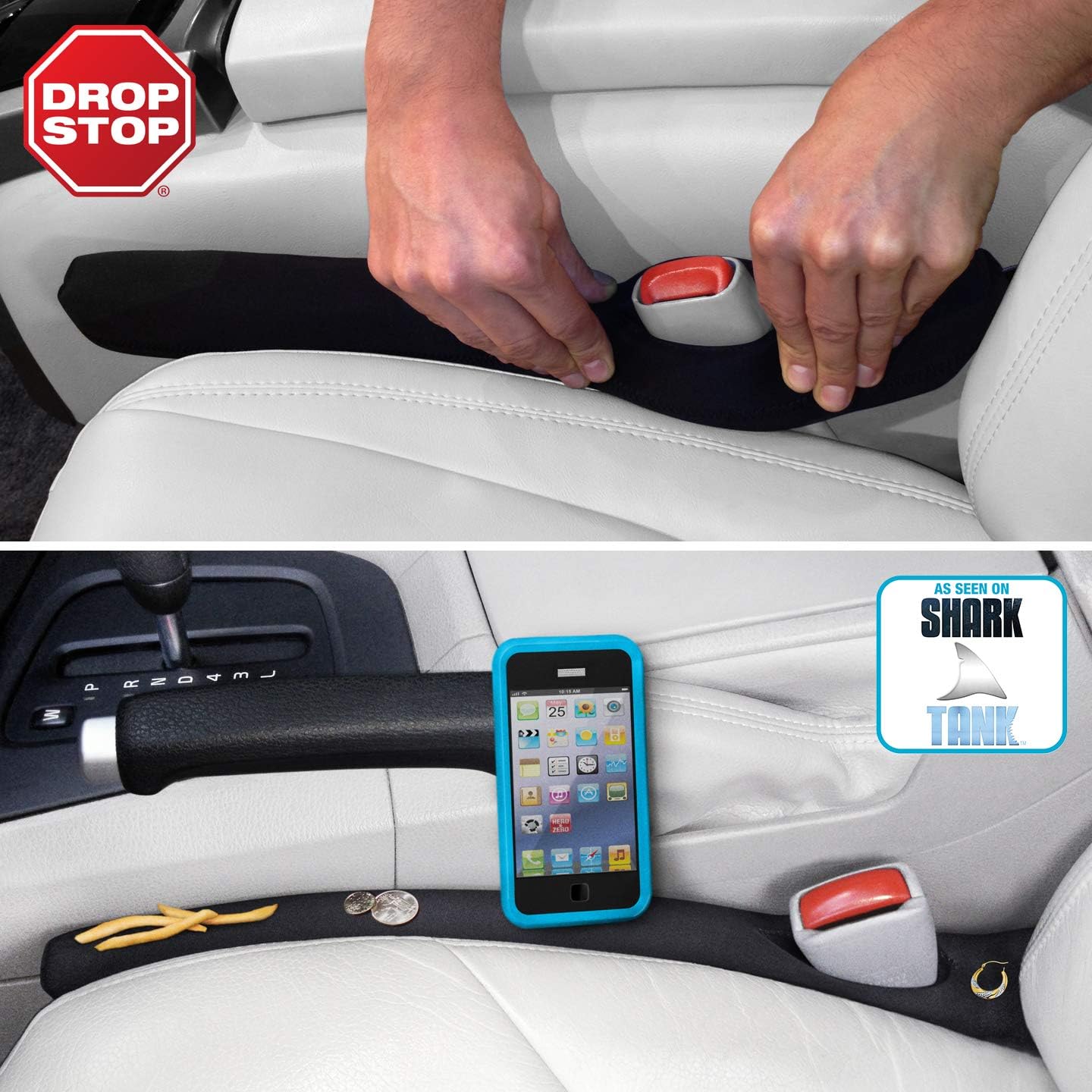
3. Drop Stop – The Original Car Seat Gap Filler
Banish the Black Hole Between Your Seats
You know the feeling. Your phone slips out of your pocket, and you watch in horror as it disappears into the dark abyss between your seat and the center console. The “Drop Stop” is the brilliantly simple, patented solution that was made famous on Shark Tank.
The Value Proposition:
This product solves one problem perfectly, and it will save you from countless moments of frustration and dangerous reaching while driving. I bought these years ago, and I can’t imagine having a car without them. They fit snugly in the gap, and because they attach to the seatbelt catch, they move with the seat so you never have to adjust them. It’s a true “install it and forget it” gadget that provides daily peace of mind for less than the cost of lunch. It’s one of the first things we recommend for our graduation gifts for new drivers guide.
The Psychology of Car Clutter — And Why Small Fixes Matter So Much
It might seem excessive to devote this much attention to a strip of foam that fills a gap between two seats, but the underlying principle applies far beyond this one product. Behavioral researchers who study environment and habit formation have long noted that small, persistent frictions — the kind we barely register consciously — accumulate into meaningful stress over time. Reaching blindly into a seat gap while stopped at a red light, patting down the passenger seat looking for your phone, or shuffling loose receipts and parking tickets off the dashboard before a passenger gets in are all “micro-frictions” that individually take seconds but collectively add up to a noticeably more stressful daily commute.
The gadgets in this organization category are effective precisely because they eliminate these micro-frictions permanently rather than requiring ongoing effort. A gap filler doesn’t need to be remembered or maintained — once installed, the problem it solves simply stops happening. That “set it and forget it” quality is a useful filter to apply to any potential car gadget purchase: does this require ongoing behavior change to be useful, or does it passively solve the problem going forward? Products in the second category tend to have far higher long-term satisfaction rates, because human beings are notoriously bad at maintaining new habits, even ones that would clearly benefit them.
Beyond seat gap fillers, the broader organization category includes trunk organizers with rigid, collapsible side walls that keep grocery bags from tipping over during turns; seatback organizers with pockets sized for tablets, water bottles, and tissue boxes that are especially popular for parents managing kids in the back seat; visor organizers that hold sunglasses, registration paperwork, and a garage door opener in one place instead of scattered across the dashboard; and console organizer trays that sit inside the center console or cupholder and add small dedicated compartments for coins, USB cables, and toll transponders. The common thread across all of them is the same principle: create one obvious, dedicated home for a category of item so you’re never hunting for it while trying to keep your eyes on the road.
THE “DIY DETAILER” CLEANING TOOLS (MOSTLY UNDER $25)
You don’t need a professional detailer’s budget to keep your car looking sharp. These affordable tools help you achieve a pro-level clean with minimal effort and cost.

4. Universal Dust Cleaning Gel
The Secret Weapon for Immaculate Vents and Crevices
Air vents, cupholders, and the seams around your gear shifter are dust magnets that are impossible to clean with a simple cloth. This colorful, reusable gel is the answer. It looks like a toy, but it’s a serious cleaning tool.
The Value Proposition:
For less than a fancy coffee, you get a tool that makes a tedious job incredibly easy and satisfying. You simply press the gel into dusty areas, and when you peel it away, it lifts all the dust and debris with it, without leaving any residue. I was skeptical, but it works wonders on keyboards, vents, and all the awkward plastic trim in a car’s interior. It’s a cheap, fun, and surprisingly effective way to get your car looking showroom-clean. It makes a fantastic stocking stuffer or a great addition to a gift basket for car accessories gifts for women or men.
Building a Complete Budget Detailing Kit
Cleaning gel is a great start, but pairing it with a handful of other inexpensive tools turns an occasional wipe-down into a genuine mini detailing routine you can complete in about twenty minutes on a Saturday morning. A small handheld car vacuum, often available for well under $40, is the next logical addition — corded models that plug into the 12V outlet tend to be more powerful and reliable long-term than cordless rechargeable versions, whose batteries degrade over a year or two of use. Look for one with a HEPA filter if anyone in the household has allergies, since a cheap vacuum without proper filtration can actually recirculate fine dust back into the cabin air.
Microfiber towels are another category worth investing a small amount in rather than buying the cheapest possible option. Low-quality microfiber can shed lint or, worse, contain small abrasive particles left over from manufacturing that can create fine scratches (called “swirl marks”) on glossy dashboard trim or paint. A pack of quality automotive-grade microfiber towels, kept exclusively for car use and washed separately from household laundry (fabric softener degrades the fibers’ ability to trap dust), will last for years and consistently outperform paper towels or old t-shirts.
Rounding out the kit: a small detailing brush with soft bristles for dashboard vents and buttons where the cleaning gel can’t quite reach every angle, an all-purpose interior cleaner spray formulated specifically for automotive plastics and vinyl (household glass cleaners can leave streaks or, on certain trim finishes, cause discoloration over time), and a UV-protectant spray for the dashboard, which prevents the sun-bleaching and cracking that’s especially common in hot, sunny climates and is one of the most visible signs of an aging, uncared-for car interior.
A reasonable cadence for this kind of maintenance is a quick vacuum and wipe-down every two weeks, with a more thorough vent, crevice, and trim detail using the cleaning gel once a month. Sticking to that schedule prevents dust and grime from building up to the point where it requires serious elbow grease to remove, which is really the whole point of budget-friendly maintenance: little and often beats occasional and exhausting.
SAFETY-FIRST GADGETS WORTH THE EXTRA FEW DOLLARS
While most of this guide focuses on convenience, a handful of categories straddle the line between convenience and genuine safety, and they deserve a section of their own because skimping too far on quality here carries real consequences.
A tire pressure gauge is one of the cheapest, most overlooked safety tools you can keep in a glovebox. Underinflated tires reduce fuel economy, wear unevenly, and significantly increase stopping distance and blowout risk, particularly at highway speed in hot weather. A digital gauge costing well under $15 is far more accurate and easier to read at a glance than the analog dial gauges that were common a decade ago, and checking pressure once a month takes less than two minutes per tire.
A basic OBD2 scanner is another category that has become dramatically more affordable. These small devices plug into the diagnostic port typically located under the driver’s side dashboard and can read the “check engine light” codes your car is generating, connecting via Bluetooth to a smartphone app that translates cryptic codes into plain-language explanations. Instead of driving straight to a mechanic and paying a diagnostic fee just to find out you have a loose gas cap (an extremely common cause of a check engine light), a $20–$30 Bluetooth OBD2 scanner lets you check first and decide whether a shop visit is actually necessary.
Roadside emergency kits, jumper cables or a compact lithium jump starter, and a basic first aid kit round out the safety category. These aren’t glamorous purchases, but a $30–$50 investment in a decent lithium jump starter — small enough to fit in a glovebox yet powerful enough to start a stalled V6 engine — has saved countless drivers from an expensive tow truck call after simply leaving the headlights on overnight.
SEASONAL CONSIDERATIONS: MATCHING GADGETS TO THE WEATHER
Not every gadget on this list delivers equal value year-round, and being strategic about seasonal purchases can stretch a small budget even further. In winter climates, an ice scraper with an integrated snow brush and a foldable snow shovel that fits in the trunk are inexpensive purchases that prevent a genuinely miserable ten minutes of scraping with a credit card on a freezing morning. A 12V heated seat cushion, often under $30, is a popular add-on for older cars whose factory heated seats either never existed or have stopped working, and it draws far less power than running the cabin heater on full blast for the first several minutes of a cold start.
In hot-weather climates, a reflective windshield sunshade is one of the single best returns on investment in this entire guide, often costing less than $15 while measurably reducing interior cabin temperature and protecting the dashboard from UV-related cracking and fading over time. A 12V portable fan or a small evaporative cooler can make a real difference for anyone whose air conditioning takes a while to kick in, and cooling seat cushions (as opposed to heated ones) have become increasingly common and affordable for exactly this reason.
Rainy climates benefit from rain-repellent treatments applied directly to the windshield, which cause water to bead and roll off at highway speed, improving visibility during downpours without needing to run the wipers constantly, and silicone door seal conditioner, a small bottle that costs only a few dollars and prevents the rubber door seals from drying out and cracking, which is a leading cause of water leaks and wind noise in older vehicles.
COMMON MISTAKES WHEN BUYING CHEAP CAR GADGETS
Not every inexpensive gadget is a good value, and there’s an important distinction between “budget-friendly” and simply “cheap.” Budget-friendly means a product delivers strong functional performance relative to its price. Cheap, in the pejorative sense, means a product cuts corners in ways that compromise its core function or safety. Here are the most common mistakes shoppers make when trying to save money on car gadgets, based on years of both personal experience and combing through thousands of verified purchase reviews.
Ignoring the wattage or amperage rating on chargers. As covered earlier in this guide, a charger’s actual charging speed depends on its power output, not its price tag or attractive packaging. Always check the printed specifications rather than assuming “car charger” means all options are functionally identical.
Buying phone mounts with weak or single-point magnets. A mount that can’t securely hold a phone over a pothole is worse than no mount at all, since a phone flying loose during a sudden stop is a genuine hazard. Multi-magnet arrays or mounts with a mechanical locking mechanism as a backup tend to perform far more reliably than a single cheap magnet.
Underestimating heat exposure. A car’s interior can reach temperatures well over 150°F on a sunny day, even in moderate outdoor temperatures. Cheap plastics and adhesives that aren’t rated for that kind of heat cycle can warp, discolor, or lose their grip within weeks. Reading reviews specifically for mentions of heat-related failure is one of the most useful due-diligence steps before buying any adhesive-mounted or dashboard-based gadget.
Skipping the reviews that mention long-term use. A five-star review written the day a product arrived tells you almost nothing about durability. Filtering reviews to show the most recent ones, or specifically searching within reviews for terms like “months later” or “still works,” gives a far more accurate picture of how a gadget performs after the initial excitement wears off.
Assuming all “universal fit” claims are accurate. Products marketed as universally compatible — vent clips, cupholder-based mounts, seat gap fillers — can still vary meaningfully based on your specific vehicle’s interior dimensions. Checking the product’s Q&A section for confirmation from owners of the same make and model as yours is a quick way to avoid a frustrating return process.
BUDGET GADGET MAINTENANCE AND LONGEVITY TIPS
Buying the right gadget is only half the equation — how you use and maintain it plays a huge role in whether it lasts six months or six years. A few simple habits go a long way. Unplugging chargers and transmitters when the car is parked for extended periods in extreme heat or cold reduces thermal stress on the internal electronics, even though most modern units are designed to handle being left in place. Wiping down magnetic phone mount plates periodically prevents dust and grime from reducing the magnet’s holding strength over time. Storing seasonal items like sunshades or heated cushions properly during their off-season, rather than leaving them balled up in the trunk, prevents creasing and material fatigue that shortens their usable life.
For anything with a rechargeable battery, such as a cordless vacuum or a portable jump starter, following the manufacturer’s guidance on charge cycles matters more than most people realize. Letting a lithium battery sit fully depleted for extended periods, or conversely leaving it on a charger indefinitely past a full charge, both accelerate capacity loss. A quarterly top-up charge for infrequently used battery-powered gadgets is a good general practice.
FREQUENTLY ASKED QUESTIONS
Do Bluetooth FM transmitters work in every car?
They work in any vehicle with a functioning FM radio and a 12V power outlet, which covers the vast majority of cars on the road, including nearly every vehicle manufactured from the 1990s onward. The only situations where they won’t work are cars with a completely digital-only stereo system that lacks a standard FM tuner, which is rare, or vehicles where the 12V outlet has been disabled or damaged.
Will a cheap car charger damage my phone?
A poorly made charger is more likely to charge slowly or fail entirely than to actively damage a modern phone, since most smartphones have built-in circuitry that regulates how much power they draw. That said, extremely low-quality chargers with inadequate internal components carry a small but real risk of electrical issues, which is another reason to stick with reputable brands rather than the cheapest unbranded option available.
How often should I clean my car’s air vents and crevices?
A light cleaning gel treatment once a month is sufficient for most drivers, though anyone with pets, frequent food consumption in the car, or allergy sensitivities may benefit from a biweekly routine. Dust and allergens accumulate faster in vents than in almost any other part of the cabin, since they’re constantly circulating air.
Are magnetic phone mounts safe for my phone’s internal compass or wireless charging?
Modern magnetic mounts are engineered specifically to avoid interfering with a phone’s compass, wireless charging coil, or NFC chip, using magnet arrays calibrated to a strength that’s strong enough to hold the phone securely but well below the threshold that would affect internal components or stored data on credit cards in a wallet case. This wasn’t always true of early magnetic mount designs, so if you’re using an older mount purchased more than five or six years ago, it may be worth upgrading to a current-generation product.
What’s the single best first purchase for someone driving an older car with no modern features?
Almost universally, the answer is a Bluetooth FM transmitter. It solves the single biggest quality-of-life gap — the inability to stream audio or take hands-free calls — and does so for a lower price than nearly any other gadget on this list, while requiring zero installation beyond plugging it in.
WHEN TO SAVE VS. WHEN TO SPLURGE
Being a budget-conscious shopper also means being smart about where you invest your money. While the gadgets on this list offer incredible value, there are a few areas where spending a bit more can pay off in performance and safety.
Save on: Organizers, simple cleaning tools, basic chargers. These items are often simple in design, and the budget versions usually perform their core function perfectly well.
Consider Splurging on: Key safety equipment and high-performance tech. For example, while a basic dash cam is better than nothing, a premium model will offer much clearer video and more reliable features. Similarly, while you can find many cheap jump starters, a reputable brand like NOCO offers proven reliability and safety features that are worth the extra cost. If you’re looking for those premium options, our guide to luxury driving gifts for men has some excellent high-end ideas that are great for anyone.
| Category | Budget Approach | Where a Splurge Pays Off |
|---|---|---|
| Audio / Bluetooth | FM transmitter, under $25 | Built-in AUX Bluetooth receiver for cleaner sound |
| Charging | Dual-port 24W car charger | USB-C PD charger for newer fast-charging phones |
| Dash Cameras | Single-lens 1080p budget model | Dual-lens 4K model with better low-light recording |
| Jump Starters | Generic lithium jump starter | Reputable brand (e.g., NOCO) with safety certifications |
| Organization | Basic seat gap filler, trunk organizer | Rarely necessary to splurge in this category |
CONCLUSION: DRIVE SMARTER, NOT RICHER
Upgrading your car doesn’t have to be a major financial decision. By focusing on smart, high-value gadgets, you can solve daily problems, add modern functionality, and make your time on the road safer and more enjoyable. These budget-friendly finds prove that a better driving experience is accessible to everyone, regardless of the age of your car or the size of your wallet.
The key is to identify your biggest daily driving annoyance and find a low-cost solution. Start with one or two items from this list, and you’ll be amazed at the impact they can have. A smarter, more convenient drive is just a few clicks away.