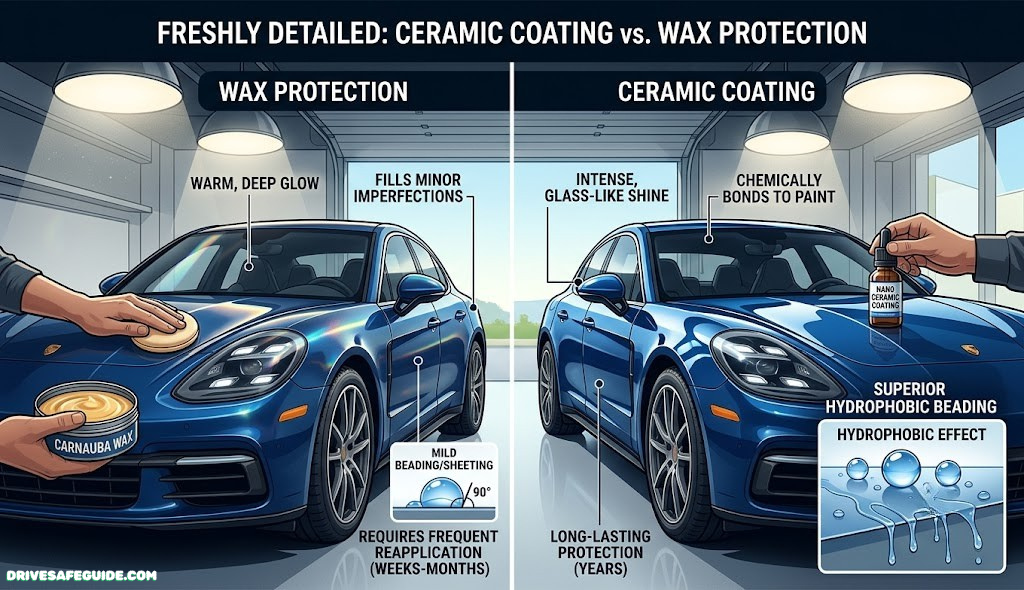
Ceramic vs. Wax Car Coating: The Ultimate Comparison for Vehicle Protection
Two of the most trusted ways to protect your paint — one is a modern chemical shield, the other a decades-old ritual. Here’s exactly how they compare, and which one actually deserves space in your garage.
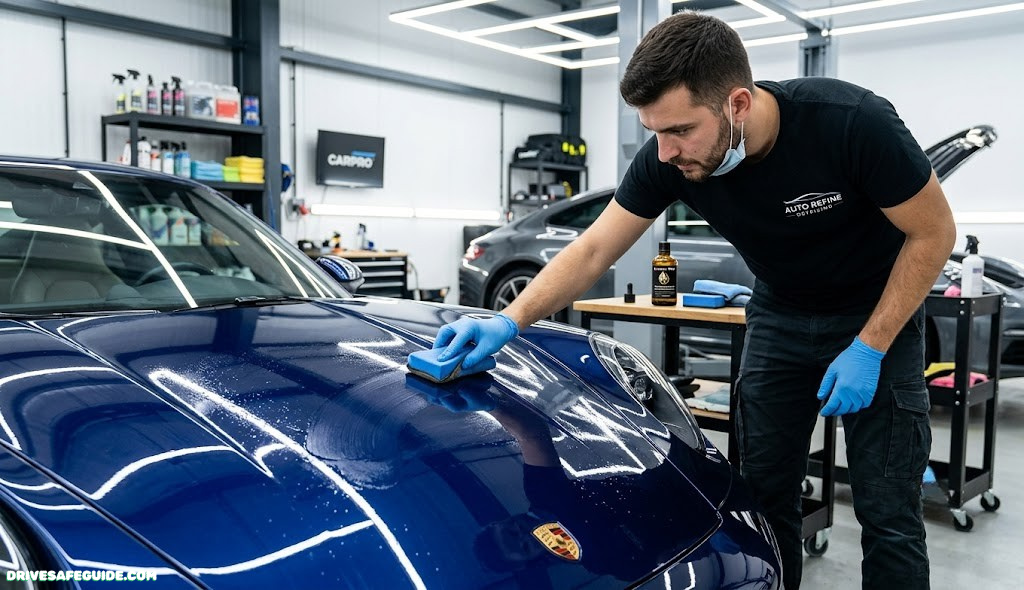
Two Roads to the Same Shine — But Very Different Journeys
Stand in the detailing aisle of any auto shop and you’ll see the same debate playing out: a wall of carnauba paste waxes on one side, a shelf of ceramic coating kits promising “years of protection” on the other. Both promise a glossy, protected finish. Both claim to be the smarter buy. Only one of them is usually right for your specific car, your budget, and how much time you’re willing to spend in the driveway.
This guide breaks down ceramic coating and traditional car wax across every dimension that actually matters — durability, real-world protection, gloss quality, cost over time, and how much upkeep each one demands. By the end, you’ll know exactly which one belongs on your paint, and you’ll understand the tradeoffs well enough to explain them to anyone else standing in that same aisle, confused.
Paint protection isn’t just cosmetic. A compromised clear coat lets UV rays, road salt, bird droppings, and oxidation attack the metal underneath, which is part of why paint care in hot climates has become such a common concern for drivers who want their vehicle to hold its value. Whether you’re prepping for a long road trip or just trying to keep a daily driver looking sharp, the coating you choose today shapes how your car ages over the next several years.
It also helps to understand that “protection” isn’t a single property. A coating can be judged on chemical resistance, physical hardness, UV stability, water behavior, and how it ages under real-world stress — sun, salt, pollen, bird droppings, and the occasional run through an automatic car wash. Wax and ceramic coating score very differently across those categories, which is exactly why a side-by-side comparison matters more than a simple “which one is stronger” question. A coating that excels at gloss but fades in six weeks solves a different problem than one that lasts years but costs several hundred dollars to apply correctly.
There’s also a practical, almost psychological dimension to this decision that’s easy to overlook. Detailing has always had two camps: people who treat it as routine maintenance, similar to rotating tires or changing oil, and people who treat it as a hobby in its own right — a weekend ritual involving foam cannons, microfiber towels, and the smell of carnauba warming in the sun. Ceramic coating, by contrast, appeals more to an “install it and move on” mindset, which is part of why its popularity has grown alongside busier lifestyles and the rise of mobile detailing services. Neither mindset is wrong; they’re simply solving for different priorities, and understanding which camp you fall into is often the fastest way to know which product is right for you before you even read the technical comparisons below.
1. What Car Wax Actually Is
Car wax is the original paint protection product, and it’s remained popular for one simple reason: it works, it’s affordable, and almost anyone can apply it in an afternoon. Traditional car wax is typically made from natural carnauba wax (harvested from the leaves of the carnauba palm), synthetic polymers, or a blend of both. When applied to a clean, dry painted surface, wax forms a thin sacrificial layer that sits on top of the clear coat.
That word — sacrificial — is the key to understanding wax. It’s designed to take the brunt of environmental damage so your actual paint doesn’t have to. UV rays, oxidation, light bird dropping acid, and minor road grime attack the wax layer first, and once that layer breaks down, it needs to be reapplied. This is why detailers have historically recommended waxing every one to three months, depending on how the car is stored and driven.
Types of Car Wax
| Type | Composition | Typical Lifespan | Best For |
|---|---|---|---|
| Carnauba Paste Wax | Natural palm wax, oils, solvents | 4–8 weeks | Deep warm gloss, show cars |
| Synthetic Polymer Wax | Lab-created polymers | 8–12 weeks | Easier application, longer bonding |
| Spray Wax | Diluted polymer or carnauba blend | 2–4 weeks | Quick touch-ups between full waxes |
| Hybrid Wax | Carnauba + synthetic polymers + SiO2 | 10–16 weeks | Balance of gloss and durability |
Wax has an undeniable emotional appeal, too. There’s a reason detailing enthusiasts still hand-buff carnauba paste on weekend mornings even though faster options exist — the ritual of it, and the deep, warm, almost liquid-glass look that carnauba produces, is something synthetic products still struggle to fully replicate.
Part of what makes wax so approachable is its long history. Carnauba wax has been used in polishes and coatings for over a century, originally prized for its high melting point and natural shine long before it ever touched a car. That track record is reassuring to a lot of owners: there’s no guesswork about how it behaves, no curing chemistry to worry about, and no risk of a botched application leaving a permanent mark. If you apply it incorrectly, the fix is simply to wash the panel and try again.
Synthetic waxes emerged later as chemists tried to solve carnauba’s biggest weakness — its short lifespan. By blending polymers with natural wax, or replacing it entirely with lab-formulated sealants, manufacturers created products that could survive more wash cycles and resist UV breakdown for longer. This synthetic evolution is really the bridge between old-school wax and modern ceramic coating; many “hybrid” wax products marketed today already contain small amounts of SiO2, blurring the line between the two categories and hinting at where the entire market is heading.
2. What Ceramic Coating Actually Is
Ceramic coating is a liquid polymer, most commonly built around silicon dioxide (SiO2) or titanium dioxide (TiO2), that chemically bonds to your vehicle’s clear coat rather than simply sitting on top of it. Once cured, it forms a semi-permanent, glass-like layer that becomes part of the paint’s surface chemistry instead of a removable film.
This bonding process is what separates ceramic coating from every wax product on the market. Wax is additive — it adds a layer that eventually washes or wears away. Ceramic coating is transformative — it alters the surface properties of the clear coat itself, making it harder, more chemically resistant, and dramatically more hydrophobic.
How the Bond Actually Forms
When ceramic coating is applied, the SiO2 molecules cross-link with the microscopic pores in your clear coat. Over several hours (and fully over several days), this creates a cured film that’s measured in microns but behaves almost like a sacrificial layer of quartz glass. That’s why professionally applied ceramic coatings can carry warranties of two, five, or even nine years, while wax rarely promises more than a season.
| Type | Hardness (approx.) | Typical Lifespan | Application Method |
|---|---|---|---|
| Consumer DIY Ceramic Spray | 6-7H pencil hardness | 3–8 months | Spray-on, wipe |
| DIY Ceramic Coating Kit | 7-8H | 1–2 years | Applicator block, cure time |
| Professional Ceramic Coating | 9H+ | 2–9 years | Multi-stage, paint correction first |
| Ceramic + Graphene Hybrid | 9H+ | 3–7 years | Professional, thermal-resistant |
It’s worth noting that ceramic coating protects the clear coat — it does not replace the need for paint correction. If your paint already has swirl marks, oxidation, or scratches, coating over them locks that damage in rather than hiding it, which is why most professional installs start with polishing.
Another distinction worth understanding is the difference between “ceramic coating” and “ceramic wax” or “ceramic spray,” terms that get used loosely in marketing. True ceramic coatings are multi-layer, professionally applied products with genuine cross-linking chemistry and multi-year durability claims. Ceramic-infused sprays and consumer-grade “ceramic boosted” waxes, on the other hand, contain small amounts of SiO2 blended into an otherwise conventional wax or sealant formula. They can genuinely improve gloss and water behavior compared to plain wax, but they don’t achieve the same hardness or multi-year bonding as a true professional coating. Reading the fine print on a product label — specifically looking for SiO2 percentage and cure-time instructions — is the easiest way to tell which category you’re actually buying into.
Graphene-infused ceramic coatings represent the newest evolution in this space. By incorporating graphene oxide alongside SiO2, manufacturers claim improved thermal conductivity (which helps the coating dissipate heat rather than trap it against the paint) and even greater hydrophobic performance. Early adopters report these hybrid coatings hold their gloss and beading longer than traditional SiO2-only formulas, though they typically come at a higher price point reflecting the added material cost.

Ready to try a professional-grade ceramic coating kit at home?
Check Price on Amazon3. Application Process Compared
This is where the two products diverge the most in practical terms. Waxing a car is something almost anyone can do in a driveway with no prior experience. Ceramic coating, especially at the professional level, is closer to a controlled chemistry procedure than a weekend chore.
Applying Wax: The Straightforward Route
- Wash and dry the car thoroughly to remove surface contaminants.
- Apply a small amount of wax to an applicator pad in thin, even coats.
- Let the wax haze over (usually 5–15 minutes depending on product and temperature).
- Buff off with a clean microfiber towel until the surface is clear and glossy.
Total time investment is typically 30 minutes to two hours for an entire vehicle, and there’s very little risk of “ruining” anything if you’re a first-timer, since wax can simply be reapplied or removed with more washing.
Applying Ceramic Coating: The Precision Route
- Full decontamination wash, clay bar treatment, and iron removal.
- Paint correction (machine polishing) to remove swirls and oxidation.
- Panel wipe-down with an isopropyl alcohol solution to strip oils.
- Coating applied in small sections using an applicator suede, working quickly before it flashes.
- High-flash removal within the manufacturer’s working window (often 1–5 minutes).
- Curing period of 24–72 hours where the car must avoid water and dust.
DIY ceramic kits simplify this somewhat, but professional-grade coatings genuinely reward experience — rushing the removal step can leave visible high spots or streaking that are difficult to correct once cured. If you’re already comfortable maintaining your vehicle and building out a proper car safety and maintenance kit, ceramic application is a natural extension of that same hands-on mindset.
Environmental conditions matter far more for ceramic application than for wax. Temperature, humidity, and even airflow in the workspace all affect how quickly the coating flashes and how evenly it cures. Most manufacturers recommend applying in a climate-controlled garage between roughly 60°F and 80°F, away from direct sunlight and dust. Applying ceramic coating outdoors on a windy day is one of the most common causes of a bumpy, uneven cured finish, since airborne dust particles land in the wet coating and become permanently embedded once it hardens.
Wax, by comparison, is remarkably forgiving of environment. While direct sun and extreme heat aren’t ideal, most wax products can be applied in a driveway, garage, or even a parking lot without any serious risk of a compromised result. This flexibility is a large part of why wax remains the entry point for so many first-time detailers — it lowers the barrier to trying paint care at all.
4. Durability & Longevity
Durability is the single biggest differentiator between these two products, and it’s not particularly close. Wax, even the best synthetic hybrid formulas, is built to break down. Ceramic coating is built to last.
| Factor | Wax | Ceramic Coating |
|---|---|---|
| Average lifespan | 1–3 months | 1–9 years (product dependent) |
| Resistance to washing | Degrades noticeably after 2–4 washes | Withstands 100+ washes |
| Resistance to heat | Can soften and streak above ~140°F | Stable well above 200°F |
| Reapplication frequency | Every 4–12 weeks | Every 1–9 years, plus a maintenance spray topper |
The reason for this gap comes back to chemistry. Wax molecules are held to the surface by weak physical adhesion, meaning they’re easily stripped by detergents, hot water, and UV degradation. Ceramic coating’s covalent bonding is far more resistant to being washed, scrubbed, or baked away, which is exactly why it holds up through years of exposure that would demolish a wax layer in weeks.
It’s useful to think of the two products on different timescales entirely. Wax operates on a weekly-to-monthly cycle, closer to how you’d think about topping off windshield washer fluid or checking tire pressure. Ceramic coating operates on a yearly-to-multi-year cycle, closer to how you’d think about a timing belt or a set of tires. Neither timescale is inherently better; they simply require different planning. Someone who enjoys frequent hands-on maintenance may actually prefer wax’s shorter cycle, since it gives them regular opportunities to inspect the paint closely and catch small issues — a chip, a scratch, early oxidation — before they become bigger problems.
One durability factor that’s often overlooked is mechanical wear from washing itself. Even a gentle hand wash involves friction, and over dozens of wash cycles that friction slowly erodes a wax layer. Ceramic coating’s hardness (commonly rated on the pencil hardness scale between 6H and 9H+) makes it dramatically more resistant to this kind of repeated mechanical stress, which is a major reason it maintains both its protective qualities and its gloss over a much longer washing history.
5. Protection Level Compared
Both products protect paint, but the type and degree of protection differ substantially.
Ceramic Coating Strengths
- High resistance to chemical etching from bird droppings, tree sap, and bug acid
- Strong UV resistance that slows oxidation and fading
- Adds meaningful scratch resistance against light swirling (not deep scratches)
- Resists water spotting and hard-water mineral staining better than wax
Wax Strengths
- Provides an immediate sacrificial layer, so light contamination hits the wax, not the paint
- Easy to strip and reapply if the surface becomes contaminated
- Fills minor imperfections temporarily for a smoother look
- Lower risk if the product is misapplied
Neither product protects against rock chips, deep key scratches, or significant impact damage — that level of protection requires paint protection film (PPF), a separate category entirely. Ceramic coating and wax are both surface-level shields, not armor. This distinction matters for drivers who are already thinking about broader vehicle protection strategies, similar to how durable roadside safety gear protects you in an emergency without claiming to prevent every possible scenario.
Chemical etching deserves special attention because it’s one of the most common causes of permanent paint damage that owners don’t see coming. Bird droppings are mildly acidic and, left on paint for even a day or two in hot weather, can etch into unprotected clear coat, leaving a dull spot that no amount of washing will fix. The same is true for tree sap and certain insect residues, which contain enzymes that react with clear coat over time. Ceramic coating’s chemical resistance genuinely shines here, giving owners a wider window to notice and clean off contamination before it causes lasting damage. Wax offers some buffer too, but its sacrificial layer breaks down faster under sustained acidic exposure, meaning the safe window is shorter.
6. Gloss & Finish Quality
Gloss is genuinely subjective, and this is one area where wax still holds a loyal following. Carnauba wax is known for a warm, deep, “wet look” gloss that many detailers describe as having more depth and richness than ceramic coatings, particularly on darker paint colors.
Ceramic coatings tend to produce a slightly different type of shine — often described as more reflective, sharper, and glass-like, sometimes with a slightly cooler or more clinical appearance compared to carnauba’s warmth. High-end ceramic products have closed much of this gap in recent years, and many professional installers now layer a wax or spray sealant on top of a cured ceramic coating specifically to combine ceramic’s durability with wax’s aesthetic warmth.
Quick Gloss Comparison
| Attribute | Wax (Carnauba) | Ceramic Coating |
|---|---|---|
| Depth of shine | Warm, deep, “wet look” | Sharp, glassy, high reflectivity |
| Best paint colors | Dark colors (black, navy, maroon) | Works well across all colors |
| Consistency over time | Fades gradually within weeks | Stays consistent for years |
Lighting conditions actually change how each finish reads to the eye. Under direct sunlight, ceramic coating tends to show off its reflectivity most dramatically, throwing back sharp, almost mirror-like highlights. Under softer, overcast light or in the evening, carnauba wax’s warmth becomes more apparent, giving the paint a rounded, almost buttery glow that many owners describe as looking “wetter” than a ceramic-coated panel in the same lighting. Neither is objectively superior — it largely comes down to personal taste and the color of the vehicle itself.
7. Water Behavior & Self-Cleaning
If you’ve ever seen a car where water beads up into tight, marble-like droplets and rolls straight off the hood, you’ve probably seen a freshly ceramic-coated vehicle. This is hydrophobicity in action, and it’s one of ceramic coating’s most visually satisfying benefits.
Wax is also hydrophobic, but typically to a lesser degree and for a shorter window. Fresh wax can produce impressive beading for the first few weeks, but that effect diminishes steadily as the layer wears down from washing and UV exposure. Ceramic coating’s hydrophobic behavior remains strong for a much longer stretch of its lifespan, which has a genuinely practical benefit: water, road grime, and dust have a harder time clinging to the surface, making the car easier to rinse clean and slightly more resistant to water spotting.
This “easier to clean” quality is especially useful for drivers who put serious mileage on their vehicles, whether that’s regular commuting or long-distance travel like the kind covered in guides to multi-stop road itineraries, where the car accumulates dust, insects, and grime across many hours of driving.
There’s also a functional safety angle to strong hydrophobic behavior that’s easy to overlook. A surface that sheds water quickly also sheds it evenly, reducing the streaking and water-spotting that occurs when droplets sit and evaporate unevenly on a hood or roof. For drivers who care about visibility, a windshield treated with a hydrophobic sealant (a close cousin of ceramic coating chemistry) can noticeably improve how quickly rain clears during a downpour, which pairs naturally with broader habits covered in guides to rain driving safety.
Beading quality also serves as a simple, free diagnostic tool. Detailers often judge how much protective coating remains on a surface simply by observing how water behaves during a rinse: tight, fast-rolling beads suggest the coating is still active, while flat sheeting or water that clings and spreads suggests the layer has broken down and needs to be reapplied or topped up. This visual cue works for both wax and ceramic coating, giving owners an easy way to self-monitor their protection without any special tools.
8. Cost Comparison
Sticker price tells a misleading story here. Wax is cheap upfront; ceramic coating is expensive upfront. But cost-per-year flips the picture entirely once you account for how often each product needs to be reapplied.
| Product Type | Typical Upfront Cost | Reapplications Per Year | Approx. Annual Cost |
|---|---|---|---|
| Basic Carnauba Wax | $15–$40 | 6–10 | $90–$300+ |
| Synthetic Polymer Wax | $20–$60 | 4–6 | $80–$240 |
| DIY Ceramic Coating Kit | $50–$150 | Once every 1–2 years | $25–$100 |
| Professional Ceramic Coating | $500–$2,000 | Once every 2–9 years | $55–$500 (amortized) |
Labor is the other half of the cost equation. Waxing takes an hour or two of your own time each session; professional ceramic installation can take an entire day at a detail shop, plus the paint correction that typically precedes it. Whether that time-for-money tradeoff makes sense depends heavily on how long you plan to keep the vehicle and whether you value your own weekends over lower recurring cost.
It’s also worth factoring in resale value into the cost conversation, even though it’s harder to quantify. A vehicle with a documented professional ceramic coating history, especially one with a transferable warranty, can be a meaningful selling point to a detail-conscious buyer, since it signals the paint has been protected and likely well-maintained overall. Wax leaves no lasting trace once it wears off, so it doesn’t carry the same documentable value at resale time, even if the car has genuinely been well cared for throughout ownership.
A useful way to frame the decision is to ask how many years you expect to own the vehicle. Owners who keep cars for two years or less rarely recoup the cost premium of professional ceramic coating, making wax (or a DIY ceramic spray) the more sensible financial choice. Owners who keep vehicles for five, eight, or more years — particularly those who care about resale condition — tend to see the clearest value from a full professional application.

Prefer the classic route? A quality carnauba wax still delivers a stunning finish.
Shop Carnauba Wax9. Maintenance Requirements
Owning either product comes with an ongoing relationship, not a one-time purchase. The maintenance profile of each, though, is quite different.
Maintaining a Waxed Finish
- Hand wash with pH-neutral soap; avoid automated brush washes that strip wax faster
- Reapply every 4–12 weeks depending on climate and parking conditions
- Use a spray wax topper between full applications to extend beading
- Avoid waxing in direct sun or on a hot hood, which causes streaking
Maintaining a Ceramic-Coated Finish
- Use a dedicated ceramic-safe soap to avoid stripping the coating’s hydrophobic properties
- Apply a ceramic booster spray every 1–3 months to refresh slickness and gloss
- Avoid automated car washes with harsh brushes for the first few months after application
- Inspect periodically for water spotting, which should be treated promptly with a proper decontamination wash
Neither coating eliminates the need for regular washing. In fact, keeping either surface clean is part of what makes it perform well — a similar principle to how a well-stocked car cleaning kit keeps your interior and exterior maintenance consistent instead of reactive.
Timing your maintenance around the seasons can also extend either product’s performance. Applying a fresh coat of wax right before winter, for example, gives your paint an extra buffer against road salt during the months it needs it most. Ceramic-coated vehicles benefit from a booster spray applied in early spring, after winter grime and salt residue have been fully washed away, to refresh the hydrophobic layer heading into pollen and bug season. Building small seasonal habits like this around your existing car-care routine tends to produce far better long-term results than waiting until the paint already looks dull to take action.
10. Which One Should You Choose?
There’s no universal winner here — the right choice depends on how you use your car, how long you plan to keep it, and how much hands-on maintenance you actually enjoy.
Choose Ceramic Coating If…
- You plan to keep the car for several years
- You want minimal recurring maintenance
- You drive in harsh sun, road salt, or high-UV climates
- You’re comfortable with a higher upfront cost for long-term value
Choose Wax If…
- You enjoy the hands-on ritual of detailing
- You want the deepest, warmest gloss possible on dark paint
- You’re working with a tighter budget right now
- You lease your vehicle or plan to sell it soon
Many experienced detailers actually use both: a ceramic coating as the long-term base layer, topped periodically with a wax or spray sealant for that extra warmth of gloss. This layered approach gives you ceramic’s durability with wax’s classic aesthetic — the best of both worlds, if you’re willing to maintain the routine.
11. Common Mistakes to Avoid
Wax Mistakes
- Applying wax over dirty or contaminated paint, which traps grit and causes micro-scratching
- Waxing in direct sunlight, causing the product to dry too fast and streak
- Using too much product per application — a thin, even layer always outperforms a thick one
Ceramic Coating Mistakes
- Skipping paint correction, which locks in existing swirls and imperfections permanently
- Exposing the coating to water or rain during the curing window, which can cause water spotting in the uncured resin
- Using automated brush washes too soon after application
- Assuming ceramic coating means “no maintenance” — it still needs regular washing and periodic boosters
These mistakes mirror a broader theme in vehicle care: protection products only work as well as the routine behind them. It’s the same reasoning behind building good defensive driving habits — the tool or product matters less than the consistency of how it’s used.
12. Climate & Environmental Factors
Where you live and how you park your car should genuinely influence this decision. Climate stress accelerates the breakdown of both products, but not equally.
| Condition | Effect on Wax | Effect on Ceramic Coating |
|---|---|---|
| Intense UV / desert heat | Breaks down within weeks | Holds up for years with minor gloss fade |
| Coastal salt air | Requires frequent reapplication | Resists salt-driven oxidation well |
| Heavy winter road salt | Degrades quickly; needs monthly touch-ups | Provides stronger, longer barrier against salt corrosion |
| Garage-kept vehicles | Lasts longer than average due to less UV/weather exposure | Minimal difference, but coating still recommended for the times it’s driven |
Drivers in extreme climates — hot, salty, or heavy snowfall regions — tend to see the clearest return on investment from ceramic coating, simply because their paint is under near-constant assault. This is closely related to the broader challenge of keeping a car looking new in hot climates, where UV exposure alone can visibly dull paint within a single season if it’s left unprotected.

Give your paint a durable, long-term shield built for tough climates.
Browse Ceramic SpraysFrequently Asked Questions
Is ceramic coating actually better than wax?
Ceramic coating outperforms wax in durability, chemical resistance, and long-term cost efficiency, but wax still offers a warmer gloss and a lower upfront price. “Better” depends on whether you prioritize longevity or that classic hand-waxed look.
Can I apply wax over a ceramic coating?
Yes. Many detailers apply a wax or spray sealant on top of a fully cured ceramic coating to add extra gloss and a sacrificial layer, without compromising the ceramic layer underneath.
How long does ceramic coating really last?
Consumer sprays typically last 3–8 months, DIY kits 1–2 years, and professionally applied coatings anywhere from 2 to 9 years depending on the product and how well the car is maintained.
Does wax protect paint from scratches?
Wax offers minimal scratch protection. It can slightly reduce the impact of very fine swirl marks from washing, but it will not prevent scratches from keys, branches, or road debris.
Is ceramic coating worth it for an older or leased car?
Usually not. Ceramic coating’s value comes from long-term durability, so it makes more financial sense for vehicles you plan to keep for several years rather than cars you’ll return or sell soon.
Do I still need to wash my car after ceramic coating?
Yes. Ceramic coating reduces how easily dirt sticks and makes washing easier, but it does not eliminate the need for regular cleaning, since dust, pollen, and grime still accumulate on the surface.
Can I apply ceramic coating myself, or do I need a professional?
DIY ceramic kits exist and can be applied at home with careful prep work, but professional-grade coatings require proper paint correction and controlled application conditions that are difficult to replicate in a driveway.
Which one produces a glossier finish?
This is subjective. Carnauba wax tends to produce a warmer, deeper gloss, especially on dark paint, while ceramic coating produces a sharper, more reflective, glass-like shine.
Does ceramic coating prevent rock chips or major scratches?
No. Ceramic coating adds some resistance to light swirling and chemical etching, but it does not protect against rock chips or deep scratches. Paint protection film is the appropriate solution for that level of impact protection.
How much does professional ceramic coating typically cost?
Professional applications generally range from around $500 to $2,000 depending on the vehicle size, coating brand, and whether paint correction is included beforehand.
Is wax cheaper in the long run?
Not usually. While wax has a lower upfront cost, its frequent reapplication schedule often makes its annual cost comparable to or higher than a professionally applied ceramic coating amortized over several years.
Can ceramic coating turn yellow or fail over time?
Lower-quality ceramic products can degrade unevenly or lose hydrophobic performance over time, which is why choosing a reputable product and maintaining it with booster sprays helps preserve consistent performance.
Final Verdict: Which Should Protect Your Paint?
If you’re chasing long-term durability, lower recurring maintenance, and stronger resistance to sun, salt, and chemical staining, ceramic coating is the clear long-term investment. If you love the process of detailing, want that deep, old-school gloss, or you’re not planning to keep the car long enough to justify a bigger upfront cost, wax remains a completely valid, time-tested choice.
Either way, the real losing move is doing nothing. Unprotected paint oxidizes, fades, and stains faster than most drivers expect, and the cost of correcting that damage later is almost always higher than the cost of protecting it now. Whichever route you choose, pair it with a consistent washing routine and the right road trip and vehicle care essentials so your protection actually lasts as long as it’s designed to.
Shop Top-Rated Paint Protection on Amazon🚗 Recommended for Drivers
Drive Safer Every Day
Explore our top picks for car safety gear — from dashcams to emergency kits — all hand-picked to help you stay safe on the road.
🚗 Shop Car Safety EssentialsAffiliate link — we earn a small commission that keeps DriveSafeGuide running. Thank you!