Mastering Dust Storm Driving Protocol for Safe Travels
A wall of blowing sand can turn a clear desert highway into a zero-visibility trap in under a minute. Here is the exact protocol drivers, truckers, and desert road-trippers rely on to see it coming, react correctly, and get everyone home.
Understanding Dust Storms: Formation, Types, and Danger Zones
Dust storms are not a single weather event with one predictable shape. They range from a slow, grinding haze that builds over an hour to a towering wall of sand that swallows a highway in under sixty seconds. Knowing which kind you are dealing with changes how much warning you actually get.
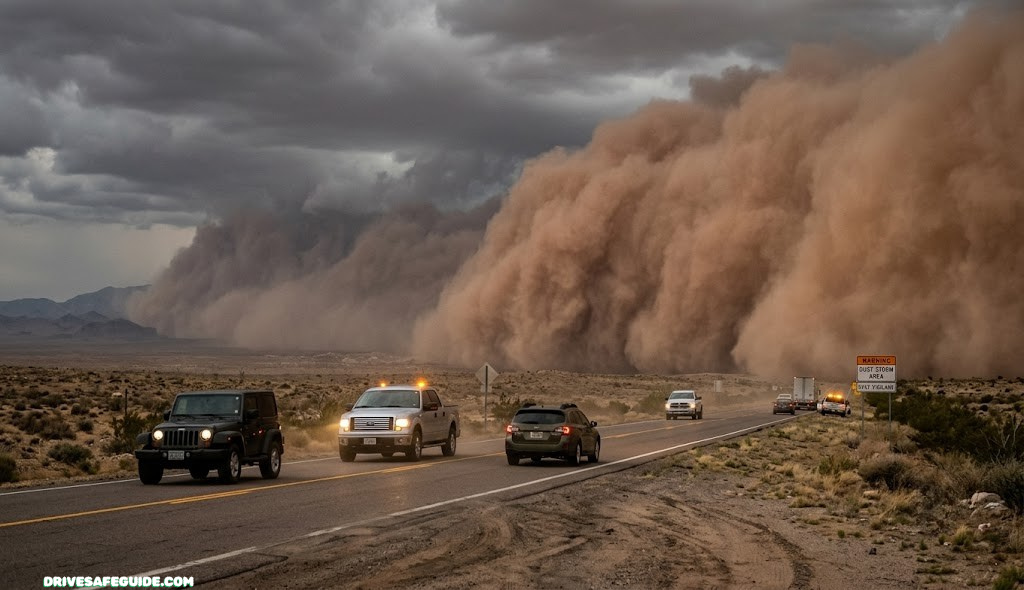
The most dramatic and dangerous variety is the haboob, a term borrowed from Arabic that describes a dense wall of dust and sand pushed outward by the collapsing downdraft of a thunderstorm. When a storm cell dies, the cold air inside it sinks and spreads out along the ground, scouring up loose soil as it goes. The result can be a moving wall thousands of feet tall, traveling 30 to 60 miles per hour, visible on the horizon for only a few minutes before it arrives.
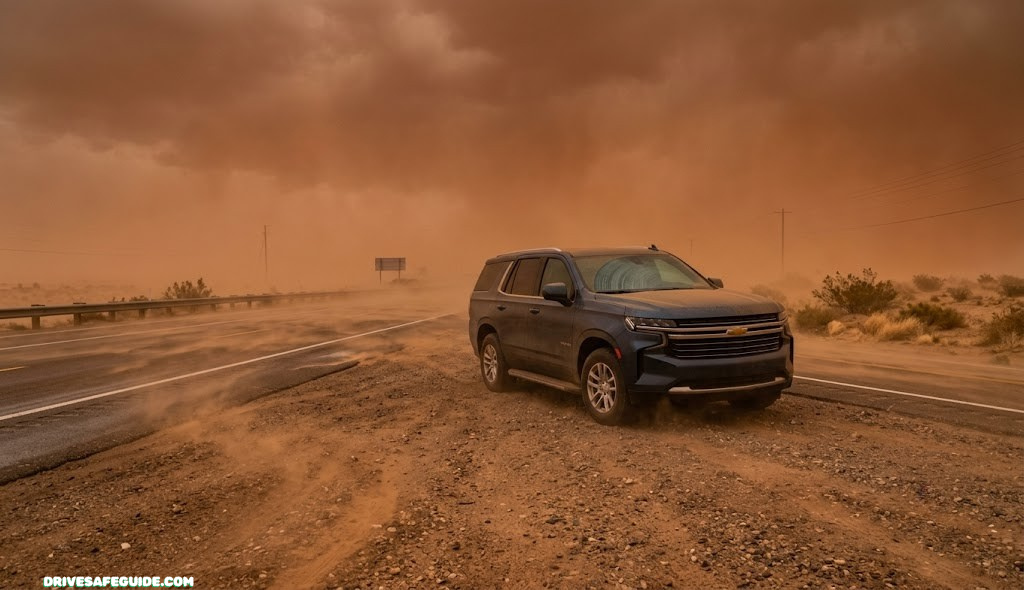
A second, quieter type builds from sustained frontal winds moving across dry, loosely packed soil, often agricultural land stripped of vegetation or a drought-stricken plain. These storms tend to develop more gradually, giving drivers more lead time, but they can also linger for hours and stretch across dozens of miles of highway.
Geography matters enormously. The classic dust corridors in the American Southwest, including stretches of Interstate 10 near Phoenix and Interstate 8 through California’s Imperial Valley, see recurring closures during the summer monsoon season when thunderstorm outflow winds are common. Similar corridors exist wherever arid or semi-arid land meets a major transportation route: parts of the Texas Panhandle, eastern Colorado, and the high plains all see comparable events, and even non-desert farmland can generate dangerous blowing dust after prolonged drought strips topsoil of moisture and cover.
| Storm Type | Typical Warning Time | Visibility Drop Speed | Common Regions |
|---|---|---|---|
| Haboob (thunderstorm outflow) | 5–20 minutes | Seconds to under a minute | Southwest deserts, monsoon corridors |
| Frontal / sustained wind dust storm | Hours, via forecast | Gradual, over 10–30 minutes | Plains, agricultural drought zones |
| Localized dust devil / gusty pocket | Seconds | Brief, isolated | Anywhere with loose, dry surface soil |

Keep Particulate Masks in the Glovebox
A sealed pack of N95 masks takes up almost no space and protects your lungs if you need to step outside during or after a dust event.
Check Price on AmazonBefore You Drive: Monitoring Weather and Route Planning
The best dust storm survival strategy happens before you ever start the engine. Drivers who get caught off guard almost always skipped one of three simple checks: the forecast, the corridor history, and the vehicle’s own readiness.
Check the Right Kind of Forecast
A standard weather app tells you rain probability and temperature, but it often buries the specific alert you need: a blowing dust advisory or dust storm warning issued by the National Weather Service. These are typically tied to wind speed thresholds and visibility forecasts along specific highway segments, and they update far more precisely than a general forecast icon. Before any desert crossing, it is worth a direct check of the regional weather service page for active advisories rather than relying on a generic app summary.
Time Your Trip Around Peak Risk Windows
In monsoon-prone regions, afternoon and early evening are the highest-risk windows because that is when daytime heating fuels the thunderstorms whose outflow produces haboobs. If your route crosses a known dust corridor and your schedule is flexible, an early morning departure meaningfully lowers your odds of encountering a wall of blowing sand.
Plan for Reduced Connectivity
Remote desert highways often have unreliable cell coverage, which means a live radar check might not be possible once you are already on the road. Downloading offline maps and checking conditions before you lose signal is a habit shared by experienced long-haul drivers, and it pairs well with the broader guidance in our road trip essentials checklist.
It also helps to build weather-awareness into your broader trip preparation rather than treating it as an afterthought. Reviewing your vehicle systems, tire condition, and emergency supplies as part of a standard pre-trip safety check ensures dust storm readiness is baked into every desert drive, not just the ones where a warning happens to be active.
Recognizing the Warning Signs on the Road
Even with a perfect forecast check, conditions change fast in dust corridors. Learning to read the environment in real time gives you the extra minutes that make the difference between a controlled pullover and a panicked one.
- A brown or tan wall on the horizon. Unlike a rain shaft, which usually appears gray or blue-black and hangs beneath a visible cloud, a dust wall often looks solid, low, and earth-toned, sometimes described as looking like a sepia-tinted fog bank rolling across the land.
- A sudden wind shift or gust spike. Outflow winds ahead of a haboob frequently arrive before the visible dust does. If your vehicle is suddenly buffeted by a strong, gusty crosswind on an otherwise calm day, treat it as an early warning, not just an annoyance.
- A rapid temperature drop. Thunderstorm outflow is cool air spreading outward, so a sharp, sudden temperature drop on your dashboard display can precede visible dust by several minutes.
- Brake lights bunching ahead. Traffic slowing unexpectedly on an open highway, especially in a known dust corridor, is often the first visible sign that vehicles ahead of you have already entered reduced visibility.
- Dust storm warning signage or highway advisory boards. Many dust-prone corridors have permanent electronic signs that activate automatically when a storm is detected, similar to signage used for black ice conditions in colder climates.
Recognizing these signs early is what separates a controlled, deliberate pullover from a last-second scramble. The goal is never to outrun the storm. It is to be safely stationary before the wall of dust ever reaches your position.
The Golden Rule Protocol: Pull Aside, Stay Alive
Transportation safety agencies across dust-prone states converge on the same core message, often branded as “Pull Aside, Stay Alive.” It is short enough to remember under stress and specific enough to actually follow. Here is the full sequence, broken into the order that matters most.
Recognize the Threshold and Decide Early
The moment visibility starts dropping and you can no longer clearly identify the vehicle two car lengths ahead, the decision window is already closing. Do not wait for zero visibility to start looking for a place to stop.
Signal, Slow Down, and Move Right
Use your turn signal, ease off the accelerator gradually, and steer toward the shoulder or an exit ramp. Sudden braking in low visibility is one of the leading causes of chain-reaction collisions in these events.
Get Completely Off the Paved Roadway
A partial pullover, with even a portion of your vehicle overlapping the travel lane, is not sufficient. Pull as far right as terrain safely allows: onto the full shoulder, a frontage road, or a rest area if one is close enough to reach before visibility collapses.
Turn Off All Lights, Including Headlights
This is the step drivers most often get backward. Once you are stopped off the road, switch off your headlights and taillights entirely. Drivers still moving through the dust frequently steer toward any visible light, assuming it marks the lane ahead, and that instinct is exactly what causes rear-end collisions into parked vehicles.
Set the Parking Brake and Take Your Foot Off the Brake Pedal
Brake lights are just as misleading as headlights in zero visibility. Set your parking brake so you do not need to keep pressure on the brake pedal, which keeps your taillights dark.
Stay Buckled and Stay Put
Keep your seatbelt fastened and remain inside the vehicle with hands off the wheel and feet off the pedals until visibility clearly improves. Do not attempt to exit and wait outside; a stationary vehicle is safer than a pedestrian on an unlit shoulder in a sandstorm.

LED Road Flares for Post-Storm Visibility
Once you’re safely stopped, magnetic LED flares placed a safe distance behind your vehicle can alert slow-moving traffic without the misleading glow of headlights. See our full durable LED road flare comparison.
Check Price on AmazonIf You’re Already Caught Mid-Storm: Emergency Driving Protocol
Sometimes the wall arrives faster than the window to reach a shoulder allows, and you find yourself already inside reduced visibility with no obvious place to stop. This is the highest-risk scenario, and it calls for a different, more conservative set of actions.
Slow Down Gradually, Never Slam the Brakes
An abrupt stop invites a rear-end collision from the vehicle behind you, which may have even less visibility than you do. Ease off the throttle steadily and increase your following distance well beyond the usual guidance covered in our safe following distance rule, since stopping distances become unpredictable in low-traction, low-visibility conditions.
Turn On Hazard Lights, Not High Beams
High beams reflect off airborne particulate and can actually worsen your own visibility, similar to the effect drivers experience in dense fog driving conditions. Low beams plus hazard lights give other drivers the clearest signal that you are present and moving cautiously.
Do Not Follow Taillights Blindly
It is tempting to lock onto the taillights ahead of you as a visual anchor, but that driver may be making the same mistake you are, and if they stop suddenly or veer off the road, following too closely compounds the danger. Use taillights as one data point, not a steering guide.
Look for Any Safe Exit Point
Continue scanning for reflective delineator posts, mile markers, or a break in the shoulder line that indicates an exit ramp or wide gravel pull-off. The instant a viable stopping point appears, execute the full Pull Aside, Stay Alive sequence described above.
Drivers who have experienced sudden zero-visibility events involving other hazards, such as high crosswinds or heavy downpours, often describe the same core lesson: the instinct to keep moving toward a destination has to be consciously overridden in favor of getting stationary and safe.
Vehicle Preparation: Equipment and Systems Check
A dust storm tests systems you might not think about on a clear day: your air intake, your wiper blades, your tire pressure monitoring, and even your door seals. Preparing the vehicle itself is just as important as knowing the driving protocol.
Air Intake and Cabin Filtration
Fine particulate is abrasive and can accelerate wear on an engine’s internal components if it bypasses a clogged or degraded air filter. Before dust season in a known corridor, it is worth inspecting your engine air filter and following the guidance in our cabin air filter replacement guide so cockpit air stays clean even if you have to run the ventilation system while stopped.
Tire Pressure and Visibility of Tread
Loose sand and grit reduce traction similarly to loose gravel, and correctly inflated tires matter more, not less, in these conditions. Confirm your tire pressure monitoring system is functioning and consider the guidance in our TPMS sensor replacement guide if you have seen intermittent warnings.
Wiper Blades and Washer Fluid
After a dust event, a windshield coated in fine grit can turn ordinary wiper use into a scratching hazard. Top off washer fluid before any desert trip and avoid running dry wipers across a dust-caked windshield; flood the glass with fluid first.
Cooling System Readiness
Dust storms frequently occur during the hottest parts of the year, and idling with the engine running while stopped for an extended period puts extra load on cooling systems already working hard in high ambient heat. A quick check against our coolant leak detection guide before a desert trip is a smart addition to your pre-drive routine, alongside broader guidance in our extreme heat engine care resource.
| System | Pre-Season Check | Why It Matters in Dust |
|---|---|---|
| Engine air filter | Inspect / replace | Fine grit accelerates clogging and intake wear |
| Cabin air filter | Inspect / replace | Keeps in-cabin air breathable during stops |
| Tire pressure & tread | Verify against door-jamb spec | Loose sand reduces available traction |
| Wiper blades & fluid | Top off, inspect edges | Prevents scratching dust-caked glass |
| Cooling system | Check coolant level and hoses | Idling in heat adds thermal load |

Portable Tire Inflator for Desert Routes
A compact inflator lets you correct pressure loss from heat and rough shoulders without hunting for a gas station. Our tire inflator buying guide breaks down duty cycle and CFM ratings.
Check Price on AmazonVisibility Technology and Gear That Helps
Modern driver-assist technology and a handful of low-tech tools can each buy you meaningful reaction time in a dust event, though none of them replace the core protocol above.
Dash Cameras for Documentation and Situational Awareness
A dash cam with strong low-light performance can help you review exactly when visibility dropped and confirm your account if a collision does occur nearby. Our best 4K dash cams for night driving roundup covers sensor options that hold up in low-contrast, particulate-heavy conditions.
Polarized Eyewear for Post-Storm Glare
Once a storm clears, low sun angle combined with a dust-hazed atmosphere can create intense glare. Keeping a pair of quality polarized glasses in the car, as covered in our polarized driving sunglasses guide, helps restore clear vision faster once you resume driving.
GPS and Offline Navigation
Because dust corridors often overlap with weak cellular coverage, having offline maps downloaded ahead of time, alongside a dedicated GPS tracker for remote-area location sharing, gives you a way to identify the nearest safe pullout even if live traffic data disappears.
OBD2 Monitoring for Engine Stress
Extended idling in extreme heat can push engine temperatures higher than normal driving would. A simple OBD2 scan tool with real-time monitoring lets you keep an eye on coolant temperature while stopped, so you can make an informed decision about running the engine versus shutting it off during a long wait.
Stop vs. Continue vs. Follow Taillights: Comparing the Options
Every dust storm eventually forces a driver to choose between three instinctive responses. Only one of them holds up under real-world collision data.
Pull Completely Off the Road
- Removes you from the highest collision-risk zone entirely
- Lights-off protocol prevents misleading following traffic
- Recommended by transportation safety agencies in every dust-prone state
Trade-Offs to Plan For
- Requires finding a genuinely clear shoulder or exit, which takes a few extra seconds
- You lose travel time waiting out the storm
- Not always possible on narrow roads with no usable shoulder
| Approach | Collision Risk | When It’s Appropriate |
|---|---|---|
| Pull fully off, lights off | Lowest documented risk | Any visibility drop below roughly a quarter mile |
| Continue slowly with hazards on | Moderate, rising fast as visibility drops | Only while actively searching for a safe pullout |
| Follow the taillights ahead closely | High, unpredictable | Not recommended under any dust storm condition |
| Stop partially on the shoulder, lights left on | Very high, common pile-up pattern | Never; always clear the travel lane fully and go dark |
The data-backed conclusion mirrors advice given for other sudden zero-visibility hazards, including driving through wildfire smoke and dense fog banks: get off the road early, go dark, and wait it out rather than gambling on threading through reduced visibility at speed.
Post-Storm Vehicle Care: Engine, Filters, Paint, and Undercarriage
The moment visibility returns and traffic resumes moving is not the moment to relax entirely. A dust storm leaves residue in places you cannot see from the driver’s seat, and addressing it soon after prevents small issues from becoming expensive ones.
Inspect the Air Filter Within a Few Days
Even a short exposure can meaningfully load a standard paper air filter with fine particulate. If your commute regularly crosses dust corridors, shortening your normal filter inspection interval during dust season is a reasonable precaution.
Rinse, Don’t Wipe, Dust-Caked Paint
Wiping dry dust across a painted surface grinds abrasive particles into the clear coat. A gentle rinse first, then a proper wash, protects your finish far better than a quick wipe-down; our ceramic vs. wax car coating comparison covers longer-term protection options for vehicles that see frequent dust exposure.
Check the Undercarriage for Accumulated Grit
Sand and grit can pack into wheel wells and suspension components, gradually accelerating corrosion in ways covered in our undercarriage rust-proofing guide. A periodic undercarriage rinse is worthwhile for any vehicle that regularly drives through dust-prone regions.
Test Headlights, Sensors, and Cameras
Fine grit can dull headlight lenses and cake over backup camera housings or radar-based safety sensors. A quick wipe-down and visual check ensures these systems are performing at full capability before your next drive, especially if your vehicle relies on features covered in our blind spot monitoring systems overview.

Microfiber Cloths for Safe Dust Removal
Keep a dedicated pack in the trunk so you’re never tempted to wipe dry grit across paint, glass, or lenses.
Check Price on AmazonSpecial Considerations for Different Drivers
Commercial and Long-Haul Truckers
Higher center of gravity and longer stopping distances make early decision-making even more critical for commercial drivers. Many fleets build dust corridor checkpoints directly into dispatch routing, delaying departures rather than risking a loaded trailer in zero-visibility crosswinds, a discipline that pairs well with the broader habits described in our defensive driving habits guide.
RV and Trailer Towing
A towed trailer amplifies the effect of sudden crosswinds and can fishtail if a driver brakes too hard while transitioning from clear road into a dust wall. Reducing speed earlier and more gradually than you would in a standard passenger vehicle gives a towed setup more margin.
Motorcyclists
Riders face the added risk of airborne grit directly impacting exposed skin and eyes, along with the sudden traction loss dust creates on pavement. A full-face helmet with a sealed visor and an early, decisive pullout are essential; open-face setups offer far less protection in these conditions.
Families and First-Time Desert Travelers
If you are new to desert road-tripping, treat any dust storm warning the same way you would treat a winter storm warning: as a signal to adjust plans, not push through them. Reviewing general readiness alongside our safe road trip essentials by scenario resource helps first-time desert travelers plan for conditions they may not have encountered before.
Building Your Dust Storm Emergency Kit
A dedicated dust-season kit does not need to be elaborate, but it should live in the vehicle permanently during the months your region sees these events, not get assembled after the first warning of the season.
| Item | Purpose |
|---|---|
| N95 or P100 masks | Protects lungs if you must exit the vehicle |
| Sealed eye protection or goggles | Prevents grit-related eye irritation outside the vehicle |
| LED road flares or reflective triangles | Improves your visibility to other drivers without misleading headlight glow |
| Bottled water, at least one gallon per person | Covers extended waits in remote, hot corridors |
| Phone charger and offline maps | Maintains navigation and communication if signal drops |
| Microfiber cloths | Safely clears grit from glass and lenses after the storm |
| Basic first aid supplies | Covers minor injuries during unplanned roadside stops |
Much of this overlaps with a broader all-season emergency kit. If you have not assembled one yet, our complete car safety kit guide and car emergency kit checklist walk through the full list, with dust-specific additions layered on top as described above. Drivers who split time between hot and cold climates may also want to cross-reference our winter car emergency kit checklist to keep a single kit relevant year-round.

All-in-One Roadside Emergency Kit
A pre-assembled kit covers most of the basics in one purchase, which you can then supplement with dust-specific items like masks and goggles.
Check Price on AmazonFrequently Asked Questions
What is the single most important rule during a dust storm while driving?
Pull off the roadway as far as possible, turn off your lights, take your foot off the brake, and set your parking brake. This sequence, often called Pull Aside, Stay Alive, prevents other drivers from mistaking your taillights for lane markings and rear-ending you.
Should I keep my headlights on if I stop during a dust storm?
No. Once you are safely off the roadway, turn off all lights, including headlights and taillights. Drivers behind you may instinctively steer toward visible lights, assuming they mark the travel lane, which can lead them straight into your parked vehicle.
Is it safer to keep driving slowly through a dust storm than to stop?
Generally no. Once visibility drops significantly, continuing to drive, even slowly, increases collision risk because following distances collapse and depth perception fails. Pulling completely off the pavement is almost always the safer option.
What is a haboob and how is it different from a regular dust storm?
A haboob is an intense wall of dust and sand pushed forward by the outflow of a collapsing thunderstorm, often arriving suddenly as a visible dark wall on the horizon. Ordinary dust storms tend to build more gradually from sustained wind over dry, loose soil.
How far in advance can you usually see a dust storm coming?
A haboob wall may be visible ten to twenty minutes before it reaches your position, though it can move at 30 to 60 miles per hour, so that window closes fast. Weather alerts and dust corridor knowledge give you far more warning than sight alone.
Can dust storms damage my car’s engine or air filter?
Yes. Fine airborne particulate can clog a standard air filter quickly, infiltrate the cabin ventilation system, and accelerate wear on exposed components. A post-storm inspection of both the engine air filter and cabin air filter is strongly recommended.
What should I keep in my car for dust storm season?
A basic kit includes a flashlight or LED road flares, N95 or P100 masks, eye protection, drinking water, a printed map or downloaded offline route, a phone charger, and a microfiber cloth to clear windshields and mirrors after the storm passes.
Do dust storms only happen in desert regions?
They are most common in arid and semi-arid regions with loose, dry soil and strong seasonal winds, but dust events can also occur in drought-stricken agricultural areas far from classic desert terrain whenever ground cover is thin and gusts are strong.
What visibility distance should trigger pulling over?
Many transportation agencies use roughly one-quarter mile as an early caution threshold, and near-zero visibility, sometimes described as zero-zero conditions, as the point where stopping off the roadway becomes essential rather than optional.
Is it legal to stop on the shoulder during a dust storm?
Most jurisdictions permit stopping on the shoulder during hazardous weather emergencies, and many actively encourage it through official dust storm safety campaigns. The key is to get as far from the traveled lanes as the terrain safely allows.
How do I know if I’m driving into a dust storm warning area?
Check National Weather Service alerts, state transportation department dust warning corridors, and connected vehicle or phone weather apps before a desert or plains road trip, and watch highway signage in known dust-prone stretches.
What should I do if I’m caught mid-storm and cannot find a safe place to stop?
Slow down gradually, turn on hazard lights, sound your horn occasionally at long intervals to alert nearby vehicles, and look for any shoulder, exit ramp, or wide gravel area to move onto as soon as it becomes visible, staying alert for other stopped vehicles.
Conclusion: Build the Habit Before You Need It
A dust storm rewards preparation and punishes hesitation. The protocol itself is simple: watch for the warning signs, decide early, pull completely off the road, and go dark. What separates drivers who handle it calmly from those who end up in a pile-up is not luck, it is whether the sequence was already a habit before the wall of sand appeared on the horizon.
Treat your next desert or plains road trip as an opportunity to actually build that habit. Check the forecast for blowing dust advisories the night before, confirm your emergency kit is stocked, and mentally rehearse the pullover sequence so it is automatic rather than improvised. Pair this guide with our broader road trip risk elimination checklist for a complete pre-departure routine.
🚗 Recommended for Drivers
Drive Safer Every Day
Explore our top picks for car safety gear — from dashcams to emergency kits — all hand-picked to help you stay safe on the road.
🚗 Shop Car Safety EssentialsAffiliate link — we earn a small commission that keeps DriveSafeGuide running. Thank you!