Driving in Hail: Protection and Safety Tips
A hailstorm can turn a clear afternoon into a whiteout of ice in under a minute. Here’s exactly where to go, what to do inside the cabin, and how to protect your windshield, your passengers, and your claim before the next cell rolls through.
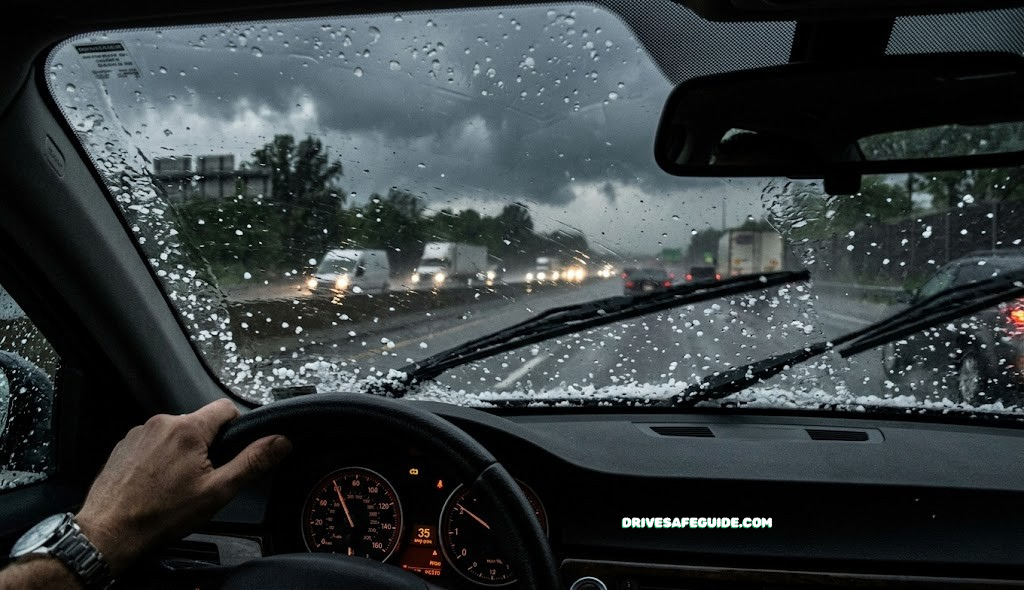
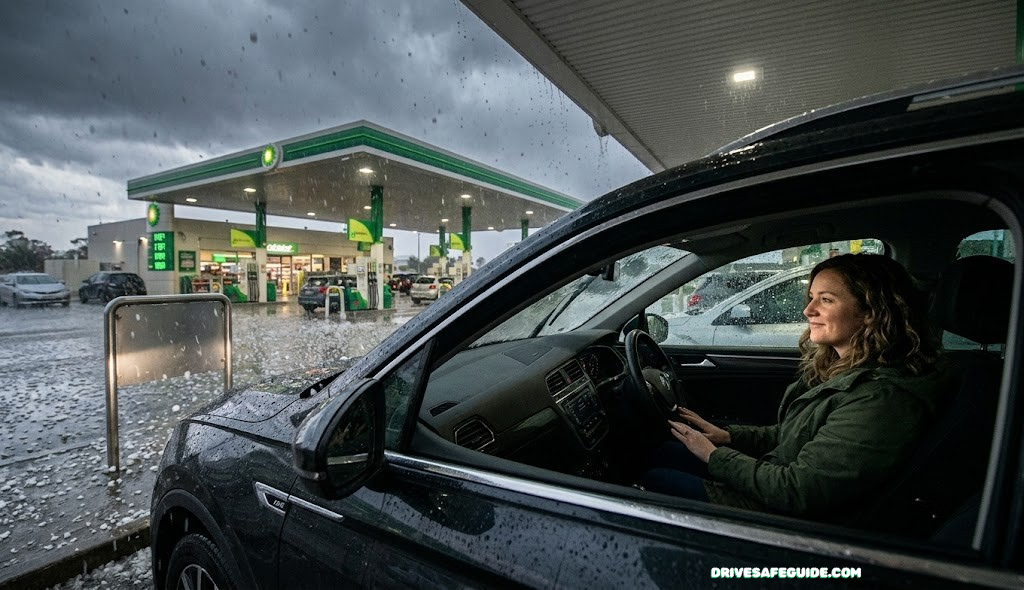
Pulling under solid, fixed cover — like a gas station canopy — within the first minute of hail is the single biggest factor in avoiding both a wrecked windshield and a rear-end collision.
Hail is one of the few weather hazards that can turn from a nuisance into a genuine safety emergency in less than a minute. Unlike rain or fog, which tend to build gradually, a hail core can go from a few scattered pellets to a deafening, windshield-cracking barrage almost instantly, and it usually arrives with almost no advance warning beyond a darkening sky and a sudden drop in temperature. Understanding what to do — and what not to do — the moment hail starts falling is the difference between a stressful five minutes and a cracked windshield, a fender full of dents, or a collision caused by someone else panicking beside you.
This guide walks through the entire experience in order: recognizing a hailstorm before it hits, deciding where to shelter, protecting yourself and your vehicle during the impact, and handling the aftermath with your insurer. Along the way you’ll find a practical hail size chart, a shelter-options comparison table, and a rundown of the gear that actually earns its place in a glovebox during storm season.
1. How Hail Forms and Why It’s Dangerous to Drivers
Hail forms inside strong thunderstorms when updrafts carry water droplets high enough to freeze, then repeatedly cycle them up and down through the storm, adding new layers of ice each time — much like an onion growing rings. The stronger the updraft, the longer a stone stays airborne and the larger it can grow before gravity finally wins and it falls to the ground. That’s why the most severe hail tends to come from the most intense, fast-moving thunderstorm cells, the same storms capable of producing damaging wind gusts, torrential rain, and occasionally tornadoes.
For a driver, the danger isn’t just the ice itself. A hailstorm typically arrives bundled with a sudden drop in visibility, a hard gust front, and pavement that goes from dry to slick in seconds. Add the noise of stones hammering the roof and windshield — genuinely startling the first time it happens — and you get a scenario where panic braking, swerving, and rear-end collisions become far more likely than actual hail-strike injuries. Most of the real risk in a hailstorm comes from how drivers react to it, not from the ice on its own.
If you want the bigger picture on how different severe-weather hazards compare, our guide to dust storm driving protocol covers a similarly fast-onset hazard where visibility collapses in seconds, and our guide to driving in high winds is worth reading since hail-producing storms often carry damaging gusts of their own.
2. Reading the Warning Signs Before Hail Hits
You rarely get a formal alert in time to reroute a whole trip, but the sky gives you clues if you know what to look for. Learning to read them buys you the 60 to 90 seconds you actually need to find shelter.
- A greenish or sickly-yellow tint to dark clouds — often associated with large amounts of suspended moisture and ice, a classic (though not universal) hail signal.
- A sudden, noticeable temperature drop as the storm’s outflow reaches you, sometimes ten degrees or more within a couple of minutes.
- An abrupt calm followed by a strong gust — the classic “gust front” that frequently precedes both hail and heavy rain.
- A wall of rain or a visibly flat, anvil-shaped cloud base ahead of you on the highway, especially if it’s moving perpendicular to your direction of travel.
- Weather radio or phone alerts — severe thunderstorm warnings frequently mention hail size explicitly; treat any mention of quarter-size or larger as a shelter-immediately cue.
If you’re on a long-distance trip and storms are in the forecast, building weather checks into your prep routine pays off. Our pre-road-trip safety checks guide and list of driver apps worth using both cover tools that push severe weather alerts before you’re already inside the storm.
3. The Golden Rule: Find Shelter, Don’t Try to Outrun It
The single most important habit to build is this: the moment you confirm hail, start looking for solid, fixed cover — not a faster route around the storm. Hail cores are usually wider across than they are deep along the direction a storm is moving, which means that by the time you’d clear the edge of the cell at highway speed, you’ve often already taken the worst of the impact. Speeding up simply adds crash risk on top of hail risk.
Pulling Over to Shelter
- Removes the added force of your own vehicle speed from every impact
- Lets you keep full attention on the storm instead of the road
- Dramatically lowers collision risk from panicked nearby drivers
- Gives you time to reposition away from windows if hail is large
Trying to Outrun the Storm
- Hail cores are often too wide to clear before the worst hits
- Speed adds kinetic energy to every stone that lands on you
- Wet, hail-covered pavement sharply cuts your braking traction
- Sudden whiteout conditions can hide stopped traffic ahead
The exception is a very short final stretch — if a gas station or parking structure is genuinely seconds away and you can see it clearly, it’s reasonable to cover that last bit of distance carefully. Beyond that, treat “just a little further” as the instinct to override, the same way you would with black ice or any other sudden-onset hazard where the safest move is almost always to stop reacting to the road ahead and start reacting to the one you’re actually on.

NOAA Weather Alert Radio
A dedicated weather radio picks up severe thunderstorm and hail warnings even when cell signal drops out during a storm — handy backup for rural driving.
Check Price on Amazon4. What To Do If You’re Caught on the Open Road
Sometimes there simply isn’t a structure nearby when hail starts. Here’s the priority order that actually keeps you safest when your options are limited.
- 1Slow down immediately and turn on your hazard lights so trailing traffic can see you’re changing behavior.
- 2Scan for any fixed structure within easy, safe reach — gas station canopy, parking garage, drive-through awning, or even a large commercial overhang.
- 3If nothing is available, pull fully onto the shoulder or into a parking lot, angling the car so the windshield — not a side window — faces into the wind and hail if possible, since windshields are typically laminated and more impact-resistant than tempered side glass.
- 4Stay inside the vehicle with your seatbelt on. A car’s roof and frame offer real protection even against large hail; standing outside does not.
- 5If stones grow larger than a quarter, duck below window level and use a jacket, floor mat, or seat cushion to shield your head and the back of your neck from any glass that might give way.
Avoid stopping directly beneath large trees, power lines, or unsecured signage, since the same storm producing hail is often producing damaging wind gusts capable of dropping branches or debris. If you’re traveling with a pet, a quick look at our car ride with a dog guide covers keeping animals calm and secured during sudden loud weather events like this one.
5. Protecting Your Windshield and Windows During Impact
Windshields are built from laminated glass — two layers bonded around a plastic interlayer — which is why they crack and spiderweb rather than shatter outright. Side and rear windows are usually tempered glass instead, designed to crumble into small, relatively blunt pieces if they fail. That difference matters when you’re deciding how to position the car and yourself.
Before hail arrives, if you have even 15–20 seconds
- Angle the vehicle so the windshield faces the wind and hail direction rather than a side window.
- If you’re stopped and it’s safe to do so briefly, a thick blanket, moving pad, or car cover draped over the hood and windshield can meaningfully reduce pitting and cracking — but only attempt this before hail starts, never while it’s actively falling.
- Check whether any existing windshield chips are present; a chip under hail impact is dramatically more likely to spread into a full crack than clean glass.
If your windshield already has visible cracking from a prior impact, treating it before storm season is worth the ten minutes it takes — our guide on driving with a cracked windshield explains both the legal risk and how quickly small chips can spread under stress like a hail impact or a hot defroster blast on cold glass.
| Glass Type | Typical Location | Behavior Under Hail Impact |
|---|---|---|
| Laminated glass | Windshield | Cracks and spiderwebs but generally stays in one piece, holding its shape even when badly damaged |
| Tempered glass | Side and rear windows | Can shatter into small rounded fragments under a hard enough direct hit, especially from large hail |
| Sunroof glass (usually tempered or laminated) | Roof panel | Varies by manufacturer; some late-model sunroofs use laminated glass specifically for hail resistance |
6. Body Positioning and Passenger Safety Inside the Cabin
For hail up to about golf-ball size, staying seated with your seatbelt fastened is almost always the safest option — the roof and pillars of a modern vehicle are engineered to handle far more force than most hailstorms deliver. Once stones start approaching the size of a baseball, which is rare but does happen in severe supercell storms, it’s worth adding an extra layer of protection.
- Move children and pets away from window seats toward the center of the vehicle if space allows.
- Recline seats slightly and lean toward the vehicle’s centerline, away from glass.
- Use jackets, blankets, or seat cushions over heads and necks as a buffer against any glass fragments, not as protection from the hail impact itself.
- Keep everyone belted; sudden gusts and nearby traffic movement are still a risk even while parked.
If you’re navigating a hearing or communication difference during a loud, chaotic weather event, our resources on deaf drivers and driving laws and driving with ADHD, dyslexia, or dyspraxia include practical strategies for staying oriented and calm when sudden sensory overload hits mid-drive.

Heavy-Duty Emergency Blanket / Moving Pad
Doubles as hood and windshield protection before a storm and as cabin insulation if you’re stranded roadside afterward.
Check Price on Amazon7. Hail Size Chart: What Different Sizes Mean for Your Car
Meteorologists typically describe hail by comparing it to everyday round objects, which is a useful shorthand for drivers deciding how urgently to react.
| Common Comparison | Approx. Diameter | Typical Vehicle Risk |
|---|---|---|
| Pea | ~0.25 in | Minimal; mostly noise and light surface marks |
| Marble / Mothball | ~0.5 in | Low, but conditions can escalate quickly |
| Penny / Nickel | ~0.75–0.9 in | Light cosmetic dimpling possible on soft body panels |
| Quarter | ~1 in | Reliable dent threshold; shelter immediately |
| Golf ball | ~1.75 in | Significant body dents, windshield cracking likely |
| Baseball | ~2.75 in | Severe damage, broken glass, roof caving possible |
Once you cross roughly the quarter-size threshold, prioritize covered shelter over anything else, including continuing your route. It’s also worth remembering that hail size can escalate within a single storm as the updraft strengthens, so a storm that starts as pea-sized hail isn’t guaranteed to stay that way.
8. Tire Traction and Braking on Hail-Covered Roads
Accumulated hail behaves a lot like a layer of marbles or loose gravel underfoot — it reduces the contact patch your tires actually have with the pavement, even after the stones themselves have started to melt. Braking distances increase, and abrupt steering inputs are more likely to break traction than on dry or even wet pavement.
- Increase following distance well beyond your normal buffer the moment hail starts accumulating on the road surface.
- Brake earlier and more gradually; hard braking on hail-covered pavement is a common trigger for skids.
- Avoid sharp steering corrections — smooth, deliberate inputs keep tires closer to their traction limit.
- If you do feel the rear end start to slide, ease off the brake and steer gently toward the direction you want to go, the same fundamentals used for any low-traction skid.
These are the same core principles covered in our winter driving traction and braking guide, since hail accumulation and light snow create surprisingly similar traction challenges. If you’re driving a front-wheel-drive vehicle, our front-wheel-drive safety checklist covers weight-transfer habits that also apply well to a hail-slicked road.
Tire condition matters more than usual here. Worn tread has less ability to channel water and ice pellets away from the contact patch, so if you’re due for a check, our comparisons of summer versus all-season tires and notes on tire balance and highway shaking are good starting points before storm season arrives.

Digital Tire Tread Depth Gauge
A quick, accurate way to confirm your tread has enough life left to handle a hail-slicked or wet road before severe weather season starts.
Check Price on Amazon9. Visibility Tactics: Lights, Wipers, and Hazards in a Hailstorm
Hail dramatically cuts visibility, both from the volume of ice in the air and from the sheer noise and distraction of it hitting the car. A few habits make a real difference:
- Headlights on, always — even in daylight, low-beam headlights make you far easier for other drivers to spot in a whiteout.
- Hazard lights once you slow or stop — this is the clearest signal to trailing traffic that your behavior has changed.
- Wipers on a fast intermittent or continuous setting once melting hail and rain start accumulating on the glass, but expect reduced effectiveness — hail can overwhelm wiper capacity briefly.
- Avoid high beams, which tend to reflect off falling hail and airborne moisture and worsen glare rather than help.
These same fundamentals apply broadly any time visibility collapses suddenly. Our guides to fog driving strategies and rain driving safety at highway speeds both go deeper into visibility-specific habits worth building into your routine, and our night driving safety checklist covers headlight and glare management in more detail.
10. After the Storm: Immediate Steps and Documentation for Insurance
Once the hail stops, resist the urge to immediately pull back onto the road. Give it a minute — hail cores are sometimes followed by a second, smaller burst as the storm cell finishes passing.
- 1Do a slow walk-around once it’s safe, checking the roof, hood, trunk lid, and mirrors for dents, and the windshield and windows for cracks or chips.
- 2Photograph everything from multiple angles in good light, including a wide shot showing the whole vehicle and close-ups of individual dents or cracks.
- 3Note the date, time, and rough location of the storm — insurers often cross-reference claims against regional weather data.
- 4Check comprehensive coverage specifically; liability-only policies typically won’t cover hail damage since it’s a weather event rather than a collision with another vehicle.
- 5File promptly. Many insurers have a claim window, and hail damage assessors are often busier immediately after a widespread regional storm, so earlier filing tends to mean a faster inspection.
A dash cam running continuously can also capture useful before-and-after footage, and cabin audio of the storm itself sometimes helps corroborate a claim’s timeline. Our roundup of best 4K dash cams and dedicated dash cam buying guide both cover models with reliable parking-mode recording, which is exactly the feature that matters here.

4K Dash Cam With Parking Mode
Continuous recording that captures the storm itself, useful for both insurance documentation and peace of mind.
Check Price on Amazon11. Hail-Resistant Gear and Protective Products Worth Owning
None of this gear prevents hail from falling, but the right items on hand make the difference between minor cosmetic damage and a much larger repair bill — or between a stressful ten minutes and a genuinely dangerous one.
| Item | Best For | Notes |
|---|---|---|
| Purpose-built hail car cover | Parked vehicles with advance warning | Padded, multi-layer covers absorb impact far better than a standard car cover |
| Heavy moving blanket | Quick, improvised hood/windshield protection | Effective in a pinch; needs securing so wind doesn’t blow it off |
| Dash cam with parking mode | Post-storm documentation | Captures footage useful for insurance claims and timeline verification |
| NOAA weather alert radio | Rural or low-signal areas | Works when cell networks are overloaded or down during severe storms |
| Tire tread depth gauge | Pre-storm-season prep | Confirms tires can still handle reduced-traction, hail-slicked roads |
If you’re building out a broader emergency kit rather than shopping item by item, our guides on how to build a full car safety kit and the essentials in our car emergency kit checklist are a faster starting point, and our roundup of durable, crushproof LED road flares is worth a look if you’re regularly driving remote routes where storms can strand you well away from services.

Padded Hail-Protection Car Cover
Multi-layer padding designed specifically to absorb hail impact on a parked vehicle, rather than a general-purpose cover.
Check Price on Amazon12. Common Hail-Driving Mistakes and Myths Debunked
Myth: “It’s just small hail, I can keep driving normally.”
Small hail escalates fast, and reduced traction plus reduced visibility start affecting your driving well before the stones themselves get large enough to cause body damage. Treat any hail as a cue to slow down and reassess, not necessarily to stop entirely.
Myth: “Standing under a tree is safer than staying in the car.”
A vehicle’s roof and frame provide meaningfully more protection than tree cover, and trees add their own risk from falling branches in the same wind gusts that typically accompany hail-producing storms.
Myth: “Overpasses are always the safest shelter.”
Overpasses block hail reasonably well, but they’re a well-documented cause of secondary collisions, since multiple panicked drivers converge on the same limited space with poor visibility and short following distances. A parking structure or canopy is almost always the better first choice.
Myth: “Hail damage is always obvious right away.”
Some dents and chips are subtle, especially on light-colored paint or textured panels, and windshield stress cracks can take hours or days to fully propagate. A careful walk-around in good light after any hailstorm is worth the five minutes it takes.
Myth: “My insurance rate will spike no matter what, so there’s no rush to file.”
Weather-related comprehensive claims are typically treated differently than at-fault collision claims for rate purposes, and delaying a claim mainly risks a slower inspection queue and more difficulty documenting the exact damage, not a lower premium.
For a broader look at building habits that hold up across all kinds of sudden hazards — not just hail — our defensive driving habits guide is a solid next read, along with our core safe driving habits resource.
Related Severe-Weather Driving Guides
Frequently Asked Questions
Is it safe to keep driving if the hail is light?
Can hail actually crack a windshield while you’re driving?
Should I pull under a bridge or overpass during a hailstorm?
What size of hail actually causes real damage to a car?
Does car insurance cover hail damage that happens while driving?
Can hail cause an accident even if it never touches my car?
Is it legal to stop on the highway shoulder during hail?
Should I cover my car with a blanket during a hailstorm?
How long does the average hailstorm last?
Does hail damage a moving car more than a parked one?
What’s the real difference between hail and sleet for driving?
Should I drive faster to try to escape a hailstorm?
The Short Version
Hail is fast, loud, and genuinely startling the first time it catches you on the road — but it’s also one of the more predictable hazards once you know the playbook. Slow down the moment you spot it, head for real fixed shelter rather than trying to outrun it, keep your body away from the glass if stones get large, and document everything carefully once it’s over. Build that sequence into muscle memory now, before the next storm forces you to improvise it.
For the rest of your severe-weather prep, our winter car emergency kit checklist and road trip essentials checklist are worth bookmarking alongside this guide.
Shop Hail-Season Essentials on Amazon🚗 Recommended for Drivers
Drive Safer Every Day
Explore our top picks for car safety gear — from dashcams to emergency kits — all hand-picked to help you stay safe on the road.
🚗 Shop Car Safety EssentialsAffiliate link — we earn a small commission that keeps DriveSafeGuide running. Thank you!