Summer Tire vs All-Season: Choosing the Right Tires for Safe Driving
The tires you pick affect braking distance, cornering grip, and how your car behaves in the rain more than almost any other single upgrade you can make.
Tire shopping is one of those decisions that feels simple until you actually start comparing options, and then the terminology piles up fast: summer, all-season, ultra-high-performance, touring, grand touring. Two of the most common categories drivers get stuck choosing between are summer tires and all-season tires, and the difference between them is a lot more than marketing language. It affects how quickly your car stops in the rain, how it handles through a curve, and whether you’ll be caught off guard the first cold morning of the year.
This guide breaks down exactly how summer and all-season tires differ, where each one genuinely outperforms the other, and how to match your choice to your climate and the way you actually drive. Whether you’re replacing a worn set or upgrading a factory setup, understanding these differences up front will save you money and, more importantly, keep you safer on the road.
1. What Makes a Tire “Summer” or “All-Season”
Every tire is a compromise between grip, wear resistance, temperature range, and handling in different weather conditions. Tire manufacturers design each category around a specific set of priorities, and the labels aren’t arbitrary — they reflect real differences in rubber compound chemistry and tread geometry.
Summer tires, sometimes called “performance” tires, are built around one goal: maximizing grip in warm and wet-but-not-cold conditions. Every design choice, from the rubber softness to the tread pattern, sacrifices some versatility in favor of outright traction and responsiveness when temperatures are above roughly 45°F.
All-season tires take the opposite approach. Rather than optimizing for one condition, they’re engineered to perform adequately across a broad range of temperatures and weather, including light snow, using a rubber compound that stays more stable across a wider temperature range. The tradeoff is that they rarely match a summer tire’s peak performance in ideal warm-weather conditions.
If tire wear and vibration issues are also on your radar, our guide on car shaking at highway speeds and tire balance is a useful companion to this comparison.
2. How Summer Tires Are Engineered for Performance
Summer tires use a softer, stickier rubber compound that stays pliable in warm conditions, which allows the tread to conform more closely to the road surface and generate significantly more friction. This is the same underlying principle that makes racing slicks so grippy — softer rubber grips better, at the cost of durability and cold-weather performance.
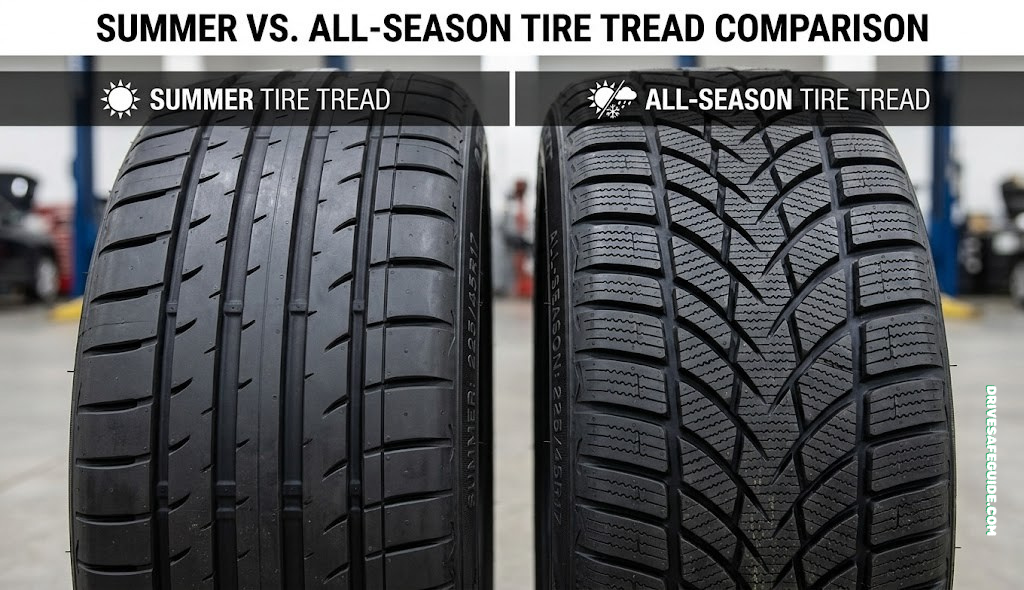
The tread pattern on a summer tire also reflects this focus. You’ll typically see wider, more continuous tread blocks with less intricate siping (the small slits cut into tread blocks), which maximizes the amount of rubber in contact with the road during dry and warm-wet conditions. Circumferential grooves are still present for water evacuation, but the overall design favors stability and responsiveness over versatility.
This combination is why summer tires are the standard choice on sports cars, performance sedans, and any vehicle where cornering grip and braking distance are prioritized above all-weather capability.
3. How All-Season Tires Are Engineered for Versatility
All-season tires start from a different set of priorities. Their rubber compound is formulated to resist hardening in cold temperatures better than summer rubber, which keeps a meaningful amount of grip available even as temperatures drop toward freezing. This same compound sacrifices some of the outright stickiness that makes summer tires so responsive in warm weather.
Tread design also reflects the broader mission. All-season tires typically feature more aggressive siping and a more varied tread block pattern, which helps bite into light snow and slush while still channeling water effectively in rain. Many carry an M+S (mud and snow) rating on the sidewall, signaling this broader weather capability.
The result is a tire that performs reasonably well across most conditions a typical driver encounters throughout the year, without excelling dramatically in any single one of them. For most daily commuters in moderate climates, this balance is exactly the point.
4. Key Differences at a Glance
| Factor | Summer Tires | All-Season Tires |
|---|---|---|
| Rubber Compound | Softer, temperature-sensitive | Firmer, temperature-stable |
| Tread Pattern | Continuous blocks, less siping | Varied blocks, more siping |
| Cold Weather Grip | Poor below ~45°F | Moderate to good |
| Dry Handling | Excellent | Good |
| Wet Traction | Very Good | Good to Very Good |
| Snow/Ice Capability | Not recommended | Light snow only |
| Tread Life | 20,000–30,000 miles | 50,000–70,000 miles |
5. Performance Comparison: Dry Handling, Wet Traction, Cold Weather
In dry, warm conditions, summer tires have a clear and consistent edge. Independent tire testing organizations regularly show summer tires producing shorter braking distances from highway speeds and higher lateral grip in cornering tests compared to all-season equivalents on the same vehicle. This gap is most noticeable during hard braking and aggressive cornering, less noticeable during ordinary commuting.
In wet conditions, the gap narrows considerably. Modern all-season tires are specifically engineered with water-channeling tread designed for rain, and many perform close to summer tires in wet braking and hydroplaning resistance. If rain is a bigger factor in your climate than sustained heat, this narrows the practical performance gap significantly. Our guide on hydroplaning recovery steps is worth reviewing regardless of which tire type you choose.
Cold weather is where the comparison becomes lopsided in the other direction. Summer tire rubber stiffens meaningfully once temperatures drop below roughly 45°F, and that stiffness translates directly into reduced grip, even on dry roads. All-season tires maintain noticeably more flexibility and traction in these conditions, though neither category is a substitute for dedicated winter tires in true snow and ice conditions. See our winter driving safety guide for more on that distinction.
6. Summer Tires: Pros and Cons
Pros
- Shortest braking distances in warm, dry-to-wet conditions
- Sharper, more responsive cornering feel
- Better high-speed stability
Cons
- Unsafe in cold temperatures, snow, or ice
- Faster tread wear than all-season options
- Requires a seasonal swap in most climates
7. All-Season Tires: Pros and Cons
Pros
- Usable year-round in most moderate climates
- Longer tread life and lower long-term cost
- No seasonal swap required
Cons
- Lower peak grip than summer tires in warm weather
- Not a substitute for winter tires in heavy snow
- Handling feels less sharp on performance vehicles

Whichever tire type you choose, keeping accurate pressure readings matters even more once temperatures start shifting seasonally.
Shop Tire Pressure Gauges on Amazon8. Which Tire Is Right for Your Climate and Driving Style
If you live somewhere with genuinely warm weather year-round, and temperatures rarely if ever drop below the mid-40s, summer tires can be run all year without meaningful downside, and many performance-minded drivers in these climates never consider anything else.
If you live somewhere with real seasonal variation — hot summers and cold winters — an all-season tire is the more practical single-set solution for most daily drivers, particularly if winter conditions in your area stay relatively mild (light snow, occasional frost, but not sustained heavy snowfall or ice).
If your region sees genuinely severe winters, neither summer nor all-season tires are the ideal answer for the coldest months; a seasonal switch to dedicated winter tires alongside either summer or all-season tires for the rest of the year is the safest approach. Our front-wheel-drive winter safety checklist covers this seasonal planning in more depth.
Driving style matters too. If you regularly push your vehicle’s handling limits, autocross, or simply enjoy spirited driving in warm weather, the performance gap summer tires offer is worth the tradeoffs. If your priority is low-maintenance, predictable performance across a wide range of conditions without thinking about it, all-season tires remain the better fit.
9. Safety Risks of Using the Wrong Tire Type
Running summer tires through a cold winter is one of the more common and preventable tire-related safety mistakes. As temperatures drop, the rubber compound hardens and loses grip, sometimes dramatically, which increases stopping distances and reduces cornering control even on roads that look perfectly dry. Many drivers don’t realize how much of this grip loss happens well before snow or ice ever enters the picture.
On the other end, running worn all-season tires through genuinely severe winter conditions, expecting winter-tire-level performance, is another common risk. All-season tires provide a reasonable middle ground, but they are not engineered to match a true winter tire’s ice and deep snow performance. If you regularly encounter black ice conditions, our guide on black ice driving survival is essential reading regardless of tire type.
Mismatched tires across axles — for example, summer tires on the front and all-season on the rear — create uneven grip characteristics that can produce unpredictable handling during braking or cornering, and should always be avoided.
10. Tire Maintenance Tips for Longevity and Safety
Regardless of which tire type you choose, a few maintenance habits meaningfully extend tread life and preserve safety margins. Check tire pressure monthly and before long trips, since both over- and under-inflation accelerate uneven wear and reduce grip. Cold weather in particular causes tire pressure to drop, so seasonal transitions are a good reminder to check levels.
Rotate tires roughly every 5,000 to 7,000 miles to promote even wear across all four positions, and get wheel alignment checked periodically, especially after hitting a significant pothole or curb. Misalignment causes uneven tread wear that shortens tire lifespan regardless of tire type.
Inspect tread depth regularly using the penny test or a dedicated tread depth gauge, and keep an eye out for irregular wear patterns, which often signal alignment, balance, or suspension issues rather than a tire defect. If you notice a consistent vibration at highway speeds, it’s worth reading our guide on tire balance and highway vibration before assuming it’s the tires themselves.

A portable inflator makes seasonal pressure adjustments and unexpected slow leaks a five-minute fix instead of a trip to the shop.
Shop Tire Inflators on Amazon11. How to Know When It’s Time to Switch or Replace
Beyond seasonal switching, tires themselves eventually need replacement regardless of type. Tread depth below 2/32 of an inch is the widely recognized legal and safety minimum, but many safety advocates recommend replacing well before that point, particularly for wet-weather performance, which degrades noticeably once tread depth drops below 4/32.
Sidewall cracking, uneven wear patches, or visible bulges are all signs a tire needs replacing regardless of remaining tread depth, since these indicate structural rather than simple wear issues. Tires also degrade with age even with light use — most manufacturers recommend replacement around six years from the manufacture date, which is printed on the sidewall as a four-digit code.
If you’re unsure whether a seasonal switch or full replacement is the better move, our tire storage checklist covers how to properly store an off-season set so it stays usable for years rather than degrading in storage.
12. Cost Comparison and Long-Term Value
On a per-set basis, summer and all-season tires are often similarly priced within the same performance tier, so the real cost difference comes down to longevity and whether a seasonal second set is needed. Because summer tires wear faster and typically require a winter or all-season backup set in most climates, the total cost of ownership over several years often runs higher than a single all-season set used year-round.
All-season tires, with their longer tread life and single-set simplicity, generally offer better long-term value for drivers in moderate climates who aren’t chasing peak performance. That said, drivers in consistently warm regions who can run summer tires year-round without a second set often find the value equation flips back in favor of summer tires, since there’s no seasonal purchase to offset the shorter tread life.
| Cost Factor | Summer Tires | All-Season Tires |
|---|---|---|
| Typical Tread Life | 20,000–30,000 mi | 50,000–70,000 mi |
| Seasonal Second Set Needed | Usually, in variable climates | Rarely |
| Best Long-Term Value | Warm, consistent climates | Moderate, variable climates |
Frequently Asked Questions
What is the main difference between summer and all-season tires?
Summer tires use a softer rubber compound and tread pattern optimized purely for dry and wet grip in warm temperatures, while all-season tires use a harder, more temperature-stable compound designed to perform reasonably well across a wider range of conditions, including light snow and cold weather.
Can I use summer tires all year round?
Not safely in climates that see temperatures consistently below about 45°F. Summer tire rubber stiffens significantly in cold weather, which drastically reduces grip and increases stopping distances, even on dry roads.
Are all-season tires good enough for winter driving?
All-season tires can handle light snow and cold temperatures reasonably well, but they are not a substitute for dedicated winter tires in regions with heavy snowfall or frequent ice, where winter-specific tread and compounds provide meaningfully better traction.
Do summer tires really perform that much better than all-season tires?
Yes, in warm and dry-to-wet conditions. Summer tires typically offer noticeably shorter braking distances, sharper cornering response, and better high-speed stability than all-season tires, which is why they’re standard on performance and sports vehicles.
How much shorter is the tread life of a summer tire?
Summer tires generally wear faster than all-season tires because their softer compound, while grippier, is less resistant to abrasion. Many summer tires last 20,000 to 30,000 miles compared to 50,000 to 70,000 miles for a typical all-season tire.
Will all-season tires void my performance car’s warranty?
Switching to all-season tires generally won’t void a vehicle warranty on its own, but it can noticeably change the handling characteristics the car was tuned for, and some manufacturers note this in owner documentation. Check your specific vehicle’s guidance if you’re unsure.
How do I know if my current tires are summer or all-season?
Check the tire sidewall. All-season tires typically display an M+S (mud and snow) marking, while summer tires usually do not carry this symbol and may be labeled specifically as “summer” or “performance summer” tires.
Is it worth switching between summer and winter tire sets seasonally?
In climates with distinct seasons, many drivers find that running summer tires in warmer months and dedicated winter tires in colder months outperforms all-season tires year-round, though it requires storage space and the cost of an extra tire set.
Do all-season tires save money over summer tires long term?
Often yes, due to longer tread life and not needing a seasonal swap, but the comparison depends on your climate. Drivers in consistently warm regions may get better overall value from summer tires paired with careful driving habits.
Can mixing summer and all-season tires on the same vehicle be dangerous?
Yes. Mismatched tire types create uneven grip and handling characteristics between axles, which can cause unpredictable behavior during braking or cornering. Tires should always be matched in type and, ideally, in wear level across an axle.
What temperature should I switch from summer to all-season or winter tires?
A commonly cited threshold is around 45°F (7°C). Below this, summer tire compounds begin losing meaningful grip, making it a reasonable point to plan a seasonal tire swap if your climate drops below it regularly.
Do all-season tires perform worse than summer tires in the rain?
Not necessarily. Many all-season tires are specifically engineered with wet-weather tread channels and can perform comparably to summer tires in rain, even though summer tires often edge ahead in dry-condition cornering and braking.
The Bottom Line
There’s no universal “better” tire between summer and all-season — only a better fit for your specific climate and driving priorities. If you live somewhere warm year-round or want the sharpest possible handling and are willing to manage a seasonal swap, summer tires deliver a real, measurable performance advantage. If you want one set of tires that handles the realistic range of conditions most drivers actually face without much thought, all-season tires remain the more practical and often more economical choice.
Whichever you choose, pair it with regular pressure checks, timely rotations, and honest tread-depth monitoring, and consider our TPMS sensor guide if your dashboard warning light has been acting up during the transition.

Match your next tire purchase to your actual climate and driving habits, not just the sticker price.
Compare Tire Options on Amazon🔧 Recommended Tool
Read Your Car’s Fault Codes at Home
An OBD2 scanner lets you diagnose check engine lights, clear fault codes, and monitor your car’s health — without paying a mechanic every time.
🔧 Shop OBD2 Scanners on AmazonAffiliate link — we earn a small commission that keeps DriveSafeGuide running. Thank you!