Best Air Compressor for Car Tires: Review & Guide
Few things are as frustrating—and potentially dangerous—as discovering a flat tire right before a morning commute or in the middle of a highway journey. While roadside assistance is an option, waiting hours for a tow truck is never ideal. This is why a reliable portable air compressor is one of the most critical tools you can own.
Keeping your tires properly inflated isn’t just about avoiding flats; it’s about safety and efficiency. Proper pressure improves gas mileage, ensures better handling—especially if you’re wondering is front-wheel drive good in snow—and prolongs the life of your tires. Yet, gas station air pumps are notoriously unreliable, often broken, or inaccurate.
Whether you need a heavy-duty unit for off-road adventures or a compact gadget for your glovebox, we’ve tested and reviewed the top models on the market. In this guide, we break down the airflow, durability, and features of the best air compressors for car tires to help you complete your safety checklist before a road trip.
A portable air compressor is more than just a convenience — it is an essential safety tool that belongs in every vehicle. According to the National Highway Traffic Safety Administration (NHTSA), underinflated tires are a contributing factor in approximately 11,000 tire-related crashes each year in the United States. When tires are even 10% below the recommended pressure, they become more susceptible to overheating, which can lead to tread separation and catastrophic blowouts at highway speeds. Having a reliable compressor in your trunk means you can address pressure issues immediately, before they become emergencies.
The modern portable air compressor market has evolved significantly over the past decade. Early models were bulky, slow, and unreliable. Today’s units range from ultra-compact cordless inflators that fit in a glovebox to heavy-duty compressors capable of filling off-road tires in minutes. The technology has improved to the point where even budget models can reliably inflate car tires, though premium units offer faster speeds, better accuracy, and additional features that justify their higher price tags.
Quick Picks: The Top Contenders
If you are in a rush, here are our top recommendations based on performance, value, and reliability.
- Best Overall: Viair 88P Portable Compressor – Rugged, powerful, and connects directly to the battery.
- Best Value & Digital: EPAuto 12V DC Portable Air Compressor – Affordable, auto-shutoff, and perfect for sedans.
- Best Cordless: Fanttik X8 Apex – Sleek, battery-powered, and great for topping up quickly.
- Best Heavy Duty: Viair 300P – For trucks, Jeeps, and large SUVs.
Why Tire Pressure Matters More Than You Think
Before diving into specific compressor reviews, it is essential to understand why tire pressure is such a critical safety factor. Many drivers view tire inflation as a minor maintenance task, but the reality is that proper tire pressure affects nearly every aspect of your vehicle’s performance, safety, and operating cost.
Safety Implications
Underinflated tires generate excessive heat due to increased flexing of the sidewall. This heat can cause the tire’s internal structure to degrade, leading to tread separation and blowouts. The risk is particularly high during highway driving, where sustained speeds generate even more heat. If you have ever wondered what to do if your brakes fail, you know that losing control of a vehicle is terrifying — a tire blowout at highway speed is similarly dangerous and entirely preventable with proper pressure maintenance.
Overinflated tires present their own dangers. A tire inflated beyond the recommended pressure has a smaller contact patch with the road, reducing traction. This means longer stopping distances, especially in wet conditions. Overinflated tires also transmit more road impact to the suspension, potentially causing damage over time. Finding the correct pressure — not too low, not too high — is essential for safe driving.
Fuel Economy Impact
The Department of Energy estimates that underinflated tires can reduce fuel economy by 0.2% for every 1 PSI drop in pressure below the recommended level. For a vehicle that gets 25 miles per gallon and drives 12,000 miles per year, tires that are 10 PSI low could cost you an extra $100 or more in fuel annually. Properly inflated tires reduce rolling resistance, meaning your engine does not have to work as hard to move the vehicle forward. Over time, this adds up to meaningful savings.
Tire Longevity
Tire manufacturers design their products to operate at specific pressures. When tires are consistently underinflated, the edges of the tread bear more load than the center, causing uneven wear. This premature wear can reduce tire life by 15 to 25%, meaning you will need to replace your tires sooner than expected. Given that a set of quality tires costs $400 to $800 or more, extending their life through proper pressure maintenance is a sound financial decision.
Handling and Braking
Correct tire pressure ensures optimal contact between the tire and the road surface. This contact patch is what provides the grip needed for cornering, braking, and acceleration. Underinflated tires feel mushy and unresponsive, while overinflated tires feel harsh and skittish. If you are interested in skid control techniques or maintaining safe following distances, proper tire pressure is the foundation that makes these skills effective.
For a comprehensive approach to vehicle safety, consider also reading our guides on defensive driving habits and building a complete car safety kit that includes tire maintenance tools alongside other emergency equipment.
Understanding Tire Pressure: The Complete Guide
Knowing what pressure to inflate your tires to is the first step in using an air compressor effectively. This section covers everything you need to know about reading tire placards, understanding PSI ratings, and accounting for variables that affect optimal pressure.
Where to Find Your Recommended Pressure
Every vehicle has a tire information placard, typically located on the driver’s side door jamb. This sticker lists the manufacturer’s recommended pressure for both front and rear tires when cold. The number printed on the tire sidewall (e.g., “Max Press 44 PSI”) is the maximum pressure the tire can safely hold — it is NOT the recommended operating pressure. Always use the vehicle manufacturer’s recommendation, not the tire’s maximum rating.
Some drivers make the mistake of inflating tires to the maximum pressure printed on the sidewall. This is incorrect and potentially dangerous. The maximum pressure is a safety limit, not an operating target. Overinflating to this level reduces the contact patch, decreases ride comfort, and can actually increase the risk of damage from road hazards. The vehicle manufacturer’s recommendation accounts for the vehicle’s weight, suspension characteristics, and handling requirements.
PSI Charts by Vehicle Type
While you should always check your specific vehicle’s placard, here are typical pressure ranges for common vehicle categories:
| Vehicle Type | Typical Front PSI | Typical Rear PSI | Notes |
|---|---|---|---|
| Sedans / Compact Cars | 30-35 PSI | 30-35 PSI | Usually same front/rear |
| SUVs / Crossovers | 32-36 PSI | 32-36 PSI | May differ if loaded |
| Half-Ton Trucks | 35-40 PSI | 35-45 PSI | Higher rear when towing |
| Heavy-Duty Trucks | 50-80 PSI | 50-80 PSI | Varies greatly by load |
| Motorcycles | 28-36 PSI (front) | 32-42 PSI (rear) | Consult owner’s manual |
| Trailers / RVs | 50-110 PSI | 50-110 PSI | Depends on tire type |
How Temperature Affects Tire Pressure
Tire pressure changes with temperature — approximately 1 PSI for every 10°F change. This means tires inflated to 35 PSI on a 70°F autumn day could drop to 30 PSI during a 20°F winter morning. This natural pressure loss is why checking tire pressure seasonally — and especially before winter — is critical. For more cold weather driving strategies, see our guides on driving on black ice and winter driving safety fundamentals.
Heat generated by driving also increases tire pressure. After 30 minutes of highway driving, tire pressure can rise 3 to 5 PSI above the cold reading. This is normal and expected — it is why you should always check and adjust pressure when tires are cold (before driving or after sitting for at least three hours). If you check pressure immediately after driving, you will get a falsely high reading and may underinflate the tires.
Nitrogen vs Regular Air
You may have noticed some tire shops offering nitrogen inflation. Nitrogen molecules are larger than oxygen molecules, so they permeate through the tire rubber more slowly. This means nitrogen-inflated tires lose pressure more gradually — perhaps 1-2 PSI per month versus 3-5 PSI per month with regular air. The practical benefit is that nitrogen-inflated tires maintain proper pressure longer between checks.
However, the difference is marginal for most drivers. If you check your tire pressure monthly (as recommended), regular air is perfectly adequate. Nitrogen is most beneficial for commercial fleets, race cars, and heavy equipment where maintaining precise pressure is critical. For the average driver, the cost and inconvenience of nitrogen inflation outweigh the modest pressure retention benefit. Either way, having a portable air compressor ensures you can maintain proper pressure regardless of what gas is in your tires.
How to Use a Portable Air Compressor: Step-by-Step Guide
Using a portable air compressor is straightforward, but following the correct procedure ensures accurate inflation and protects both your tires and the compressor. This step-by-step guide applies to all types of portable inflators.
Step 1: Determine the Correct Pressure
Before connecting the compressor, check your vehicle’s tire information placard on the driver’s door jamb. Note the recommended PSI for both front and rear tires. If you are inflating a trailer tire, check the trailer’s placard or the tire sidewall. Write down or photograph the numbers so you have them handy.
Step 2: Connect the Compressor
For 12V socket models: Plug the power cord into your vehicle’s cigarette lighter or accessory outlet. Ensure the engine is running to prevent draining the starter battery. Route the air hose to the tire you intend to inflate.
For battery-clamp models: Open the hood and connect the alligator clamps to the battery terminals — red (positive) to the positive terminal, black (negative) to a ground point on the engine block. Start the engine before powering on the compressor.
For cordless models: Ensure the unit is charged. Remove the air hose from storage and attach the appropriate nozzle to the tire valve stem.
Step 3: Attach the Air Chuck
Remove the valve cap from the tire’s valve stem. Press the air chuck firmly onto the valve stem and lock it in place (most chucks have a lever or twist-lock mechanism). If air hisses when you connect, the chuck is not seated properly — remove it and try again. A poor seal wastes time and can damage the valve core.
Step 4: Inflate to Target Pressure
Set the target pressure on your compressor’s gauge (if it has auto-shutoff) or simply inflate while monitoring the gauge. For digital models, use the buttons to set the desired PSI, then press start. For analog models, inflate in short bursts and check the pressure periodically with a separate digital or analog tire gauge for accuracy.
Most compressors will make more noise and vibrate more as the tire approaches full inflation. This is normal — the compressor is working harder against increasing back-pressure. If the compressor begins to smell hot or makes unusual grinding noises, turn it off immediately and let it cool for at least 15 minutes before continuing. This prevents overheating damage to the compressor’s motor.
Step 5: Check and Adjust
After the compressor stops (auto-shutoff) or you estimate the tire is full, disconnect the air chuck and immediately replace the valve cap. Use a separate tire gauge to verify the pressure. If the tire is overinflated, press the valve core briefly to release air, then recheck. Getting the pressure exactly right — within 1-2 PSI of the target — maximizes tire performance and longevity.
Step 6: Repeat for All Tires
Don’t forget the spare tire! Most spare tires — especially temporary “donut” spares — require higher pressure (typically 60 PSI). Check the spare’s sidewall for its recommended pressure. A flat spare is useless in an emergency, so include it in your regular pressure checks. For a complete emergency preparedness approach, see our car emergency kit checklist.
Step 7: Store the Compressor
After use, coil the air hose neatly, retract the power cord, and return the compressor to its storage location. If you used a battery-clamp model, ensure the clamps are insulated and will not contact each other in storage. For cordless units, recharge the battery if it dropped below 50% during use. Proper storage extends the compressor’s lifespan and ensures it is ready when you need it next. For storage tips in extreme conditions, see our guide on how to store tires and seasonal equipment.
Detailed Reviews
We analyzed these units based on inflation speed, ease of use, build quality, and extra features. Whether you are looking for budget-friendly car gadgets or a professional-grade tool, there is something here for you.
1. Viair 88P Portable Compressor – The Enthusiast’s Choice

The Viair 88P is widely regarded as the gold standard for portable tire inflators under $100. Unlike smaller units that plug into the cigarette lighter (12V accessory port), the 88P connects directly to your car battery using alligator clamps. This allows it to draw more power without blowing your vehicle’s fuses, making it capable of inflating tires up to 33 inches.
The build quality is substantial. It feels like a piece of machinery rather than a plastic toy. While the analog gauge requires you to pay attention (no auto-shutoff here), it is incredibly accurate. For anyone preparing their vehicle for harsh conditions, such as driving in high winds or rough terrain, reliability is key, and Viair delivers.
The Viair 88P uses a permanent-magnet motor that delivers consistent airflow without the performance degradation common in cheaper units. The motor is oil-lubricated, which reduces friction and heat buildup, extending the unit’s operational life. The duty cycle — the amount of time the compressor can run before needing a cool-down — is rated at 25 minutes at 30 PSI. For context, inflating a typical sedan tire from 25 to 35 PSI takes approximately 3 to 5 minutes, meaning the 88P can handle all four tires plus a spare in a single session without overheating.
One of the standout features is the 16-foot air hose combined with a 10-foot power cord. This 26-foot total reach means you can comfortably reach all four tires on most vehicles, including long-wheelbase trucks and SUVs, without repositioning the compressor or the vehicle. The hose is made of reinforced rubber that resists kinking, and the fittings are brass rather than plastic, ensuring a secure, leak-free connection.
For off-road enthusiasts who air down their tires for traction on sand or rocks and then need to re-inflate for highway driving, the 88P is an excellent companion. It can fill a 33-inch tire from 15 PSI to 35 PSI in approximately 8 to 10 minutes — fast enough to be practical at the trailhead but not so fast that it compromises build quality or reliability. If you need even more power for larger tires, consider the heavy-duty equipment in our emergency toolkit guides.
Key Features
- Max Pressure: 120 PSI
- Power Source: Battery Clamps (Direct)
- Duty Cycle: 25 mins @ 30 PSI
- Cord Length: 16 ft air hose + 10 ft power cord
- Weight: 4.5 lbs
- Noise Level: ~72 dB (moderately loud)
| Pros | Cons |
|---|---|
|
|
2. EPAuto 12V DC Portable Air Compressor – Best for Daily Drivers
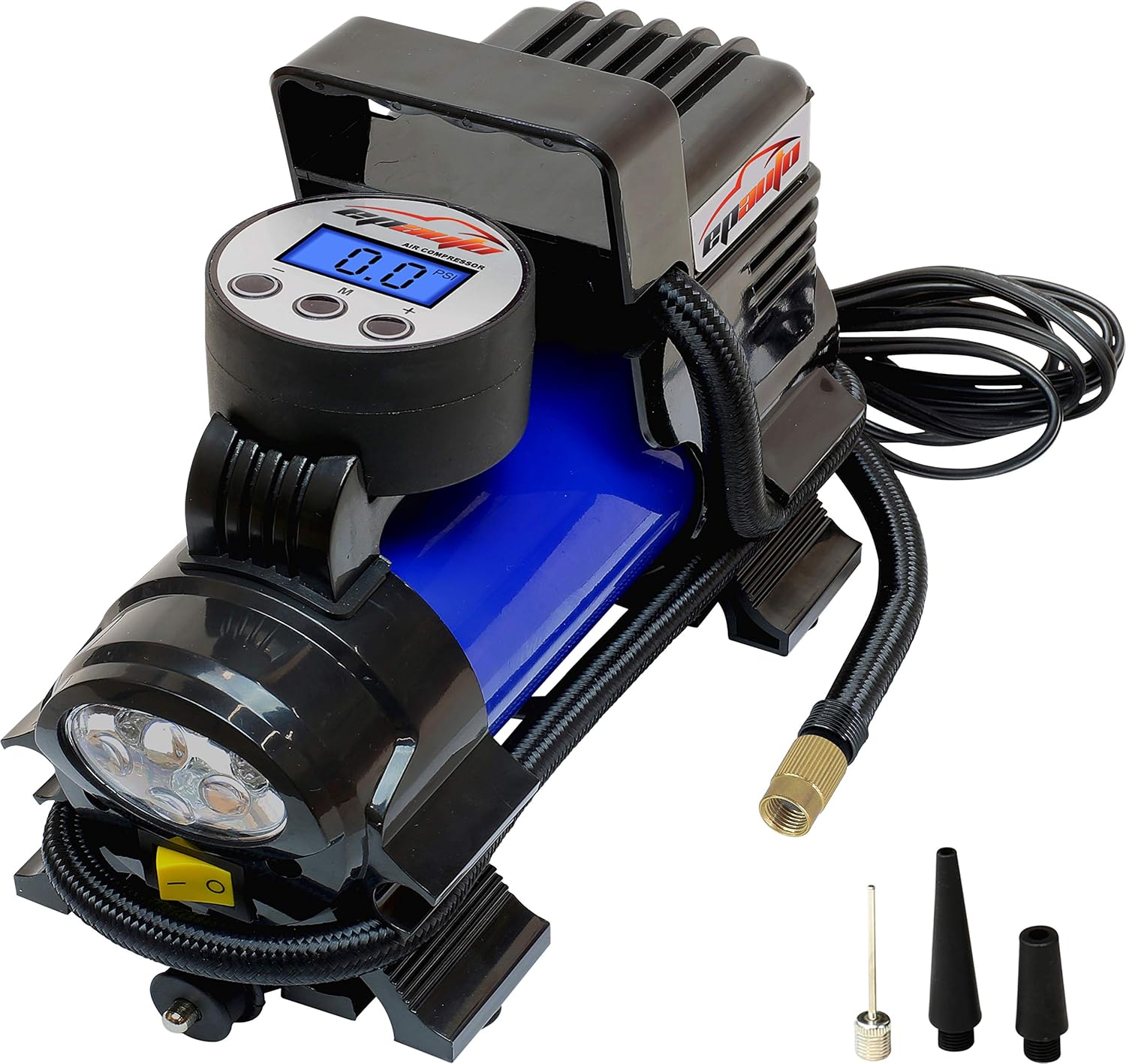
If you drive a standard sedan or compact SUV and just want something easy to use, the EPAuto 12V is the perfect solution. It plugs directly into your cigarette lighter socket, so you don’t need to mess with battery clamps. Its standout feature is the digital display with auto-shutoff. You simply set your desired PSI, turn it on, and wait—it stops automatically when the tire is full.
This convenience makes it one of the must-have car gadgets for long drives. It also features a built-in LED flashlight, which is invaluable if you are stuck trying to figure out what to do or inflate a tire on a dark roadside. While it isn’t fast enough for massive truck tires, it is perfect for the average commuter.
The EPAuto’s digital gauge is accurate to within 0.5 PSI, which is impressive for a unit in this price range. The auto-shutoff feature eliminates the guesswork of inflation — you set the target pressure once and the unit handles the rest. This is particularly valuable for drivers who are not confident about checking tire pressure manually. The unit also includes a 12V fuse protection circuit that prevents damage to your vehicle’s electrical system in case of a power surge.
In terms of inflation speed, the EPAuto is slower than battery-clamp models like the Viair 88P. It takes approximately 8 to 12 minutes to inflate a standard sedan tire from flat to 35 PSI. This is acceptable for topping off tires or addressing slow leaks, but it is not ideal for inflating multiple completely flat tires. For drivers who primarily need to maintain pressure rather than recover from flats, the EPAuto’s convenience and accuracy make it an excellent choice. For more budget-friendly car upgrades, check our comprehensive guide.
Key Features
- Max Pressure: 70 PSI (working pressure)
- Power Source: 12V Cigarette Lighter Socket
- Display: Digital with Auto-Shutoff
- Extras: LED Flashlight, adapters for balls/inflatables
- Weight: 1.8 lbs
- Noise Level: ~78 dB
| Pros | Cons |
|---|---|
|
|
3. Fanttik X8 Apex – Best Cordless Premium Option

The Fanttik X8 Apex represents the modern era of car accessories. It looks more like a high-tech speaker than a tool. This cordless inflator runs on an internal rechargeable battery, meaning you don’t need to plug it into the car at all. This makes it incredibly versatile—you can use it for your car, bike, or motorcycle without tangling cords.
It charges via USB-C and acts as a power bank for your phone, similar to the devices we cover in our portable jump starter review. For those looking for luxury driving gifts for men or tech-savvy drivers, this is the top pick. Just remember to keep it charged; a dead battery in the inflator means you’re out of luck.
The X8 Apex features a 7800mAh lithium-ion battery that provides enough power to inflate approximately four car tires from flat on a single charge. The unit heats up during extended use, but the built-in thermal protection automatically shuts it down before damage occurs. After a cool-down period of 10 to 15 minutes, it is ready to continue. This safety feature is essential for a cordless unit that cannot rely on the vehicle’s electrical system for thermal regulation.
The large LCD display provides real-time pressure readings and allows you to preset target pressure with 0.5 PSI precision. The unit includes multiple nozzle attachments for cars, motorcycles, bicycles, sports balls, and inflatable toys. For motorcycle and bicycle enthusiasts who need to maintain tire pressure without a power source nearby — such as at a trailhead, bike rack, or parking lot — the X8 Apex is unmatched. If you are interested in cold weather driving comfort, pairing this inflator with other emergency gear creates a comprehensive winter preparedness kit.
Key Features
- Max Pressure: 150 PSI
- Power Source: Internal Battery (Cordless)
- Battery: 7800mAh Li-ion
- Speed: Inflates a car tire in ~5 minutes (top-up in 1 min)
- Tech: Large LCD screen, USB-C fast charging, power bank function
- Weight: 1.5 lbs
| Pros | Cons |
|---|---|
|
|
Comparison: Tech Specs Breakdown
Choosing the right compressor depends on your vehicle type. A small inflator that works for a Honda Civic might burn out trying to fill the tires of a Ford F-150. Use this table to compare capabilities.
| Model | Power Type | Max PSI | Gauge Type | Weight | Best For |
|---|---|---|---|---|---|
| Viair 88P | 12V Battery Clamps | 120 PSI | Analog | 4.5 lbs | SUVs, Trucks, Reliability |
| EPAuto 12V | 12V Lighter Plug | 70 PSI | Digital | 1.8 lbs | Sedans, Daily Use |
| Fanttik X8 Apex | Cordless Battery | 150 PSI | Digital | 1.5 lbs | Convenience, Motorcycles |
| Viair 300P | 12V Battery Clamps | 150 PSI | Analog | 8.5 lbs | Off-Road, 33″+ Tires |
Buying Guide: What Matters in a Tire Inflator?
Before you buy, it’s essential to understand the terminology. A wrong choice can leave you stranded with a half-inflated tire and an overheated compressor.
1. Power Source: 12V Socket vs. Battery Clamps vs. Cordless
Standard car power outlets (cigarette lighters) generally output a maximum of 10-15 amps. Small compressors work fine here. However, faster, more powerful compressors draw 20+ amps. These must connect directly to the car battery terminals. If you plug a high-draw unit into the cigarette lighter, you will blow a fuse. If you are comfortable popping the hood—perhaps you’ve already learned how to protect car paint and do basic maintenance—the clamp style is far superior in performance.
Cordless units offer the ultimate convenience — no cords, no car connection needed. But they are limited by battery capacity. A cordless inflator might fill four car tires on a single charge, but if all four are completely flat, you may run out of battery before finishing. Cordless units are best suited for topping off tires that have lost a few PSI, not for recovering from complete flats. For more on emergency preparedness, see our winter car emergency kit checklist.
2. Duty Cycle
This is the most overlooked spec. Duty cycle represents how long a compressor can run before it needs to cool down. A 100% duty cycle means it can run continuously. A 33% duty cycle (common in cheaper units) means if you run it for 15 minutes, it needs 30 minutes to cool. If you have a large truck, a low duty cycle unit will take hours to fill all four tires.
The duty cycle is determined by the compressor’s motor size, cooling design, and materials. Higher-quality compressors use oil-lubricated motors, metal cylinders, and heat-sink fins that dissipate heat more efficiently. Budget units use oil-free designs with plastic components that overheat faster. When comparing compressors, look for the duty cycle rating at a specific PSI — a unit rated “30 minutes at 30 PSI” may only run for 10 minutes at 100 PSI.
3. Inflation Speed (CFM)
Cubic Feet per Minute (CFM) tells you how much air the compressor moves. High PSI (pressure) is easy to achieve, but high CFM (volume) is what actually fills the tire quickly. Don’t be fooled by a cheap unit claiming “150 PSI” if it has low CFM—it will take forever to reach that pressure. For comparison, the Viair 88P delivers approximately 1.47 CFM at 0 PSI, while the Viair 300P delivers 2.30 CFM — nearly 60% more airflow. This difference is noticeable when filling large truck tires.
For sedans and compact SUVs, 1.0 to 1.5 CFM is adequate. For trucks and SUVs with larger tires, look for 1.5 to 2.5 CFM. For heavy-duty applications with 35-inch or larger tires, 2.5+ CFM is recommended. Understanding CFM helps you avoid the frustrating experience of waiting 20 minutes to fill a single truck tire.
4. Cord Length
Ensure the power cord plus the air hose is long enough to reach all four tires, especially the rear ones on a long vehicle. If you are towing, you might need an extension. This is a crucial part of your winter car emergency kit checklist—you don’t want to be fighting short cables in the snow.
Measure the distance from your vehicle’s power source (cigarette lighter or battery) to the farthest tire. Add a few feet of margin for comfortable positioning. Most quality compressors include at least 15 feet of air hose and 10 feet of power cord, providing 25 feet of total reach. If your vehicle is longer than this — such as a dually truck with a long bed — consider a model with extended cords or purchase a 12V extension cord separately.
5. Gauge Accuracy and Type
The accuracy of the pressure gauge directly affects how well your tires perform. Digital gauges are typically accurate to within 0.5 PSI, while analog gauges may have a margin of error of 2 to 3 PSI. For everyday use, this difference is minor. But if you are performance-oriented or need precise pressure for towing loads, a digital gauge is preferable. Some compressors include both an on-board gauge and the ability to connect an external gauge for verification.
6. Noise Level
Portable air compressors are not quiet. Most produce between 70 and 85 decibels during operation — roughly equivalent to a vacuum cleaner or garbage disposal. If you plan to inflate tires in a residential area early in the morning or late at night, noise level may be a consideration. Cordless units tend to be quieter than corded models because they operate at lower speeds. For a silent option, consider a manual foot pump, though these are impractical for car tires.
Compressor Types: Diaphragm vs Piston vs Rotary
Understanding the internal mechanics of air compressors helps you appreciate the performance differences between models. Portable tire inflators generally use one of three compressor technologies, each with distinct advantages and limitations.
Diaphragm Compressors
Diaphragm compressors use a flexible membrane that oscillates back and forth, drawing air in on the intake stroke and pushing it out on the compression stroke. They are lightweight, compact, and relatively inexpensive. Most budget 12V tire inflators — including the EPAuto — use diaphragm technology. The main limitation is lower airflow (typically 0.5 to 1.0 CFM) and shorter duty cycles due to heat buildup in the small motor. For sedans and compact cars, a diaphragm compressor is perfectly adequate.
Piston Compressors
Piston compressors use a traditional piston-and-cylinder arrangement, similar to an internal combustion engine. They deliver higher airflow (1.0 to 3.0+ CFM) and longer duty cycles than diaphragm models. The Viair 88P and 300P use piston technology, which is why they can handle larger tires and longer inflation sessions. Piston compressors are heavier and more expensive, but the performance advantage is substantial for trucks, SUVs, and off-road vehicles. They are also more durable long-term, with many lasting 5 to 10 years with proper maintenance.
Rotary Screw Compressors
Rotary screw compressors use two intermeshing helical rotors to compress air continuously. They offer the highest airflow and can run for extended periods without overheating. However, they are typically found in commercial and industrial applications rather than portable tire inflators. Some high-end portable units designed for fleet use incorporate rotary screw technology, but they are significantly larger, heavier, and more expensive than piston or diaphragm models.
For most consumer applications, the choice is between diaphragm (budget, compact, adequate for sedans) and piston (premium, more powerful, better for trucks and SUVs). The Fanttik X8 Apex uses a miniature piston design powered by its internal battery, offering a blend of piston performance with cordless convenience.
Why You Need Your Own Compressor
Many drivers rely on the “Low Tire Pressure” light (TPMS) on their dashboard. But did you know that light often only comes on when the tire is already 25% below the recommended level? That is dangerous.
Driving on under-inflated tires causes:
- Poor Handling: Your car becomes sluggish, similar to the feeling when you ask why does my car shake at highway speeds.
- Increased Braking Distance: Critical if you ever face a situation where you need to know what to do if your brakes fail.
- Tire Blowouts: The sidewalls overheat and can burst.
- Wasted Fuel: Soft tires create more rolling resistance.
- Uneven Wear: Underinflated tires wear faster on the edges, reducing tire lifespan.
- Reduced Load Capacity: Properly inflated tires can carry their rated load; underinflated tires cannot.
Owning a portable compressor is an investment in safety. It also makes for one of the most practical graduation gifts for new drivers or gifts for new car owners.
TPMS: What Your Dashboard Light Really Means
Modern vehicles are equipped with Tire Pressure Monitoring Systems (TPMS) that alert you when pressure drops below a threshold. However, TPMS has significant limitations. Most systems only trigger when pressure is 25% below the recommended level — meaning a tire recommended at 35 PSI might not trigger the warning until it drops to approximately 26 PSI. At that point, the tire is dangerously underinflated and may have already suffered heat damage.
Direct TPMS systems use sensors inside each tire that transmit real-time pressure data to the vehicle’s computer. These are more accurate but expensive to replace (each sensor costs $30 to $100). Indirect TPMS systems use the wheel speed sensors to estimate pressure changes based on tire diameter. These are less accurate and may not detect slow leaks that occur gradually over weeks.
Neither system replaces regular manual pressure checks. A portable air compressor with a built-in gauge allows you to verify and correct pressure at any time, without relying on a potentially inaccurate dashboard warning. For drivers who want to monitor tire pressure proactively, consider adding a TPMS sensor replacement guide to your maintenance knowledge.
Compressor Maintenance: Making Your Unit Last
A quality air compressor can last five to ten years or more with proper maintenance. Neglecting basic care, however, can cause premature failure and leave you without a working inflator when you need it most. Here are the essential maintenance practices for portable tire inflators.
Keep It Clean
Dust, dirt, and debris can clog the air intake filter, reducing airflow and causing the motor to work harder. After each use, wipe the exterior with a dry cloth and inspect the air intake for obstructions. If your compressor has a removable air filter (common in piston models like the Viair 88P), clean it monthly with compressed air or replace it annually. A clean filter improves performance and extends motor life.
Check Connections and Hoses
Inspect the air hose and power cord for cracks, kinks, or damage before each use. A damaged hose can leak air, reducing inflation speed and accuracy. Check the air chuck for wear — a worn chuck may not seal properly on the valve stem, causing air loss during inflation. Replace any damaged components immediately; operating a compressor with a compromised hose or chuck wastes time and can damage the unit.
Store Properly
Store your compressor in a dry, temperature-controlled environment when possible. Extreme heat (such as a car trunk in summer) can degrade rubber hoses, damage battery cells in cordless units, and accelerate wear on electronic components. Extreme cold can make plastic components brittle and reduce battery performance. If you must store the compressor in your vehicle, choose a location that avoids direct sunlight and temperature extremes. For seasonal storage tips, see our guide on storing seasonal equipment.
Lubricate Piston Compressors
Piston compressors with oil-lubricated motors (like the Viair 88P) require periodic oil changes. Check the oil level before each use and change the oil every 50 hours of operation or annually, whichever comes first. Use the manufacturer-recommended oil type — typically a non-detergent 30-weight motor oil. Low or dirty oil causes increased friction, overheating, and premature motor failure.
Test Regularly
Run your compressor for 2 to 3 minutes once a month, even if you don’t need to inflate tires. This keeps the motor lubricated, prevents seals from drying out, and lets you verify the unit is working properly. If you notice decreased performance, unusual noises, or overheating during these test runs, address the issue before you need the compressor in an emergency. For comprehensive vehicle maintenance, see our guides on DIY maintenance tasks and understanding engine oil.
Compressor for Specific Vehicle Types
Different vehicles have vastly different tire inflation needs. A compressor that works perfectly for a sedan may be inadequate for a truck, and vice versa. Here is a breakdown of compressor recommendations by vehicle type.
Sedans and Compact Cars
For vehicles like the Honda Civic, Toyota Corolla, or Hyundai Elantra, the EPAuto 12V is ideal. These vehicles typically have tire pressures between 30 and 35 PSI, and the EPAuto’s 70 PSI capacity provides ample margin. The auto-shutoff feature is particularly valuable for drivers who are not confident about checking tire pressure manually. The compact size means it stores easily in a trunk or glove compartment.
SUVs and Crossovers
Vehicles like the Toyota RAV4, Honda CR-V, or Ford Explorer benefit from the Viair 88P. These vehicles have larger tires that require more air volume, and the 88P’s direct battery connection provides the power needed for efficient inflation. The longer hose and cord also help reach the rear tires on longer vehicles. For SUVs used for car camping or carrying rooftop cargo, proper tire pressure is especially important due to the additional weight.
Full-Size Trucks
For vehicles like the Ford F-150, Chevrolet Silverado, or RAM 1500, the Viair 300P or a similar heavy-duty unit is recommended. These trucks have larger tires (often 32 to 33 inches) that require significantly more air volume. The 88P can handle these tires but takes longer. The 300P’s higher CFM rating reduces inflation time substantially. When towing, tire pressure requirements increase, making a powerful compressor even more critical. For towing safety, see our guide on trailer hitch classes and driving with a trailer in high winds.
Off-Road Vehicles
Off-road enthusiasts who air down their tires for traction on sand, rocks, or mud and then re-inflate for highway driving need a fast, reliable compressor. The Viair 300P is the go-to choice for this application. It can fill 33-inch tires from 15 PSI to 35 PSI in approximately 6 to 8 minutes per tire. For even larger tires (35 inches and up), consider a dual-cylinder compressor or a portable 12V unit with a built-in air tank.
Motorcycles and ATVs
Motorcycle and ATV tires have smaller volumes but often require higher pressures (especially rear tires). The Fanttik X8 Apex is excellent for these applications due to its cordless convenience — you can inflate tires at a trailhead, motorcycle rally, or parking lot without needing a power source. The precision digital gauge ensures accurate pressure, which is critical for motorcycle handling. For motorcycle safety, also see our guide on blind spot awareness.
Trailers and RVs
Trailer and RV tires typically require higher pressures (50 to 110 PSI depending on the tire) and larger volumes. Standard 12V compressors may struggle with these applications. For trailers and RVs, look for a compressor with at least 150 PSI maximum pressure and a high CFM rating. The Viair 300P can handle most trailer applications, but for large fifth-wheel trailers or motorhomes, a dedicated heavy-duty compressor may be necessary. For RV-specific safety, see our guides on cross-country driving preparation and national park vehicle requirements.
Emergency Inflation Scenarios: Being Prepared
A portable air compressor is not just for routine maintenance — it is an essential emergency tool. Here are the most common scenarios where having a compressor in your vehicle can save the day.
Slow Leak Detection
Many tire punctures do not cause immediate flats. A nail or screw embedded in the tread may cause a slow leak that drops tire pressure by 5 to 10 PSI per day. If you check your tire pressure regularly, you can detect these leaks early and inflate the tire to maintain safe driving while you arrange a repair. Without a compressor, you might not notice the leak until the tire is dangerously low. This scenario is particularly dangerous because slow leaks often worsen suddenly, leading to blowouts at highway speeds. For more on safe driving practices, maintaining proper tire pressure is fundamental.
Seasonal Pressure Drops
As discussed earlier, tire pressure drops approximately 1 PSI for every 10°F decrease in temperature. The transition from fall to winter can cause a significant pressure drop — potentially 5 to 10 PSI in northern climates. Without a compressor, you would need to visit a gas station or tire shop to correct this. Having your own compressor lets you address seasonal pressure changes immediately, ensuring your tires are properly inflated for winter driving conditions. For winter driving strategies, see our comprehensive winter driving safety guide.
Roadside Flat Recovery
After changing a flat tire with a spare, the spare is often only partially inflated. A portable compressor lets you inflate the spare to the correct pressure, ensuring safe driving to the nearest tire shop. Temporary “donut” spares are typically rated for 60 PSI and should be inflated to that pressure. Driving on an underinflated spare is dangerous and can damage the spare tire. For roadside safety equipment, also consider LED road flares for visibility during nighttime repairs.
Off-Road Recovery
Off-road enthusiasts routinely air down their tires to 15-20 PSI for improved traction on soft surfaces. After returning to pavement, they need to re-inflate to highway pressures (30-35 PSI). A portable compressor is essential for this transition — driving on underinflated tires at highway speeds is dangerous and damages the tires. For off-road adventures, pair your compressor with a portable jump starter for complete trail-side self-reliance.
Pre-Trip Preparation
Before any long road trip, checking and adjusting tire pressure is a critical safety step. A portable compressor lets you ensure all tires — including the spare — are at the correct pressure before departure. This is especially important when carrying heavy loads, towing a trailer, or driving in extreme temperatures. For comprehensive trip preparation, review our road trip essentials checklist and how to eliminate road trip risks before departure.
Remote Area Travel
When traveling through remote areas with no gas stations or tire shops for miles, self-reliance becomes critical. A flat tire in a remote area without a compressor means you either use your spare and hope it holds air, or wait for assistance that may be hours away. A portable compressor ensures you can maintain proper tire pressure anywhere, anytime. For remote travel preparation, see our cross-country driving checklist.
Compressor Safety Tips
While portable air compressors are generally safe, following basic safety precautions prevents accidents and equipment damage.
- Never exceed the maximum PSI rating. Overinflating a tire beyond its rated pressure can cause a dangerous blowout. Always inflate to the vehicle manufacturer’s recommended pressure, not the tire’s maximum pressure.
- Run the engine while using 12V compressors. This prevents draining the starter battery and ensures maximum voltage to the compressor. If the engine is off, the compressor may draw enough current to leave you unable to restart the vehicle.
- Let the compressor cool between sessions. If the compressor overheats (indicated by a hot casing, burning smell, or automatic shutoff), let it cool for at least 15 to 20 minutes before continuing. Operating an overheated compressor can damage the motor and create a fire risk.
- Inspect the air chuck before each use. A worn or damaged air chuck may not seal properly on the valve stem, causing air leakage and inaccurate pressure readings. Replace worn chucks promptly.
- Keep the compressor away from water. Most portable compressors are not waterproof. Exposure to water can damage the motor and electronics, and creates an electrical shock risk.
- Store with the power disconnected. For 12V compressors, disconnect the power cord and secure the clamps. For cordless units, turn off the power switch to prevent accidental activation.
For a complete approach to roadside safety, also consider adding emergency escape tools and a car fire extinguisher to your vehicle’s emergency kit.
Portable vs Stationary vs Gas Station Air
Understanding the differences between inflation options helps you appreciate why owning a portable compressor is valuable.
Gas Station Air Pumps
Gas station air pumps are free or low-cost, but they come with significant drawbacks. They are frequently broken, inaccurate, or have broken gauges. The air hoses are often dirty, damaged, or too short to reach all four tires. In busy areas, you may wait in line behind other drivers. And when you need air most — during an emergency on the roadside — there may not be a gas station nearby. A portable compressor eliminates all of these limitations.
Home Garage Compressors
Stationary garage compressors (typically 6 to 20 gallons) are powerful and fast, but they are not portable. They require a 120V electrical outlet and are too large and heavy to carry in your vehicle. While excellent for home use, they cannot help you on the roadside. Many drivers own both a home garage compressor and a portable unit for this reason. For garage setup ideas, see our guide on car cleaning and maintenance equipment.
Portable 12V Compressors
Portable compressors offer the best balance of power, convenience, and accessibility. They are small enough to store in your vehicle, powerful enough to inflate car and truck tires, and available whenever and wherever you need them. The trade-off is speed — portable units are slower than home garage compressors. But for emergency and routine use, the convenience of having a compressor in your vehicle far outweighs the speed disadvantage.
Cordless Compressors
Cordless units like the Fanttik X8 Apex offer ultimate portability — no cords, no vehicle connection needed. They are perfect for topping off tires in parking lots, at trailheads, or anywhere without a power source. The limitation is battery life, which restricts the number of tires you can inflate from flat on a single charge. For most drivers, a cordless unit supplements a corded model rather than replacing it.
Understanding Compressor Noise Levels
Noise is an unavoidable aspect of portable air compressors, but the level varies significantly between models. Understanding noise levels helps you set expectations and choose a unit that meets your tolerance.
How Loud Are They?
Most portable tire inflators produce between 70 and 85 decibels (dB) during operation. For reference, 70 dB is approximately the volume of a vacuum cleaner, while 85 dB is roughly equivalent to a garbage disposal or lawn mower. Sustained exposure to sounds above 85 dB can cause hearing damage, but since you typically only run a compressor for 5 to 15 minutes, hearing protection is usually unnecessary.
Factors Affecting Noise
Noise level depends on several factors: motor type (piston compressors are louder than diaphragm models), operating pressure (higher pressure = more noise), cooling fan design, housing materials, and the surface the compressor is resting on. Placing the compressor on a rubber mat or carpeted surface can reduce vibration noise by 5 to 10 dB.
Quieter Options
Cordless units tend to be quieter than corded models because they operate at lower RPMs. Some manufacturers have developed noise-reduction features like insulated housings, vibration-dampening mounts, and variable-speed motors. If noise is a primary concern, read user reviews specifically mentioning noise levels before purchasing.
For drivers in noise-sensitive environments (residential areas, campgrounds, early morning departures), consider scheduling tire inflation during reasonable hours or using a quieter cordless unit. For camping and car camping setups, a quiet compressor is particularly valuable to avoid disturbing fellow campers.
How to Read a Tire Placard
The tire information placard is your definitive source for correct tire pressure. Understanding what each number means ensures you inflate your tires correctly.
Reading the Placard
The placard typically displays four numbers: front cold pressure, rear cold pressure, spare tire pressure, and sometimes a maximum load rating. The “COLD” designation means the pressure should be checked and adjusted before driving — not after the tires have been heated by driving. Some vehicles have different pressures for the driver’s side and passenger’s side, especially in vehicles with asymmetric weight distribution.
When to Adjust for Loads
If you are carrying heavy cargo or towing a trailer, the vehicle manufacturer may recommend higher tire pressures. Check the owner’s manual for load-adjusted pressure recommendations. Typically, the rear tires require more pressure when loaded because they bear more weight. Failure to adjust pressure for heavy loads can cause overheating, uneven wear, and blowouts. For towing safety information, see our guide on trailer hitch classes and towing capacity.
Spare Tire Pressure
Don’t neglect the spare! Temporary “donut” spares typically require 60 PSI — significantly higher than standard tires. Full-size spares should match the pressure of the other tires. A flat or underinflated spare is useless in an emergency. Include the spare in your regular pressure checks and inflate it to the specified pressure. For complete emergency preparedness, see our car emergency kit checklist.
Aftermarket Tires
If you have installed aftermarket tires that differ from the original equipment, the vehicle manufacturer’s placard may not apply. Consult the tire manufacturer’s recommendations for the correct pressure based on the tire’s load rating and your vehicle’s weight. Aftermarket tire pressure is typically found on the tire manufacturer’s website or in the tire’s documentation.
Tire Sealant vs Air Compressor
Some emergency tire repair kits include tire sealant — a liquid that plugs punctures from the inside. While sealant can temporarily repair a flat, it is not a substitute for a proper repair or replacement. Here is how the two approaches compare.
Tire Sealant
Tire sealant is injected into the tire through the valve stem. It coats the inside of the tire and plugs small punctures (typically up to 1/4 inch in diameter). The sealant is a temporary fix — you should drive to a tire shop as soon as possible for a proper repair. Sealant can damage TPMS sensors and may void some tire warranties. It is messy to clean up and can corrode the wheel if left in the tire for extended periods.
Air Compressor
An air compressor does not repair punctures — it simply re-inflates the tire. If the puncture is small (such as a nail), the tire may hold air long enough to reach a repair shop. If the puncture is large or the sidewall is damaged, the tire will not hold air regardless of how much you inflate it. A compressor is most useful when combined with a plug kit for temporary repairs, or when you need to inflate a spare tire after a change.
The ideal emergency kit includes both: a tire sealant for small punctures and a compressor for inflation. After using sealant, you will need to reinflate the tire — and only a compressor can do that. For a comprehensive emergency kit, see our guide to building a complete car safety kit.
Brand Comparison: Viair vs EPAuto vs Fanttik vs Others
The portable air compressor market includes several established brands, each with different strengths and target audiences. Understanding the brand landscape helps you make an informed choice.
Viair
Viair is the gold standard for portable air compressors. Based in the United States, Viair focuses exclusively on compressor technology and has earned a reputation for reliability, durability, and performance. Their product line ranges from compact 12V units to heavy-duty compressors for commercial applications. The main disadvantage is price — Viair compressors cost more than budget alternatives. However, the quality and longevity justify the premium. For most drivers, a Viair compressor is a buy-it-for-life investment.
EPAuto
EPAuto specializes in affordable automotive accessories. Their tire inflators offer excellent value — digital displays, auto-shutoff, and LED flashlights at budget-friendly prices. The quality is good for the price, but not at Viair’s level. EPAuto compressors are ideal for drivers who need a basic, reliable inflator without paying premium prices. They are also excellent gifts for driving instructors and new drivers.
Fanttik
Fanttik is a newer entrant focused on premium cordless technology. Their X8 Apex and similar models offer sleek design, USB-C charging, and power bank functionality. Fanttik products appeal to tech-savvy drivers who value aesthetics and versatility. The premium pricing reflects the advanced features, and the quality is competitive with established brands.
Other Notable Brands
Milton produces professional-grade inflators with dual-head chucks for both Schrader and Presta valves. CGEARY and AstroAI offer budget options with digital gauges. Kensun provides AC/DC dual-power models for home and car use. Bonvoish and VacLife compete in the budget cordless segment. Each brand has its niche, but for most consumers, the choice narrows to Viair (premium performance), EPAuto (best value), or Fanttik (cordless convenience).
For more comparisons and reviews, see our guide to comparing automotive accessories and our comprehensive car safety accessories overview.
Compressor for Professional and Fleet Use
Professional automotive shops, fleet managers, and roadside assistance operators have different requirements than consumer users. Understanding these requirements helps commercial buyers choose appropriate equipment.
Fleet Management Considerations
Fleet managers responsible for multiple vehicles need compressors that can handle frequent use across different vehicle types. The priority shifts from portability to durability, speed, and duty cycle. Heavy-duty compressors with 100% duty cycles and high CFM ratings are essential for keeping fleet vehicles on the road. Consider investing in multiple units — one per service truck or maintenance bay — to minimize downtime.
For fleet managers, integrating tire pressure monitoring into routine maintenance schedules reduces emergency situations. Regular pressure checks combined with a reliable compressor prevent the costly consequences of underinflated tires across a fleet. For fleet management tools, see our guides on GPS tracking systems and Bluetooth OBD2 diagnostics.
Roadside Assistance
Roadside assistance operators need the fastest, most reliable compressors available. Speed is critical — customers waiting on the side of the road want their tires inflated quickly. Heavy-duty piston compressors with high CFM ratings and long duty cycles are the standard. Many operators carry backup compressors to handle unexpected breakdowns. The Viair 300P and similar models are popular choices for roadside assistance applications.
Automotive Shops
Professional automotive shops typically use stationary shop compressors rather than portable units. However, portable compressors remain valuable for mobile service calls, test drives, and situations where the shop compressor is not accessible. A quality portable unit in the service vehicle ensures technicians can inflate tires anywhere.
Environmental Considerations for Compressor Storage
Where and how you store your air compressor significantly impacts its lifespan and performance. Understanding environmental factors helps you maximize the value of your investment.
Temperature Effects
Extreme temperatures affect compressor components differently. High heat can damage rubber hoses, degrade battery cells in cordless units, and cause lubricating oil to thin. Extreme cold can make plastic components brittle, reduce battery performance, and cause moisture to freeze inside the air lines. The ideal storage temperature is 40°F to 80°F (5°C to 27°C). If you must store the compressor in your vehicle, choose a location that avoids direct sunlight and extreme temperature swings.
Humidity and Moisture
Moisture is the enemy of air compressors. Humid air contains water vapor that condenses inside the compressor and air lines, promoting corrosion and potentially freezing in cold weather. After each use, run the compressor for 30 seconds with the air chuck disconnected to purge moisture from the system. Store the compressor in a dry location, and if you live in a humid climate, consider adding a desiccant packet to the storage case.
Dust and Debris
Dust and debris can clog the air intake, reduce performance, and accelerate wear on internal components. Store the compressor in a clean environment, and cover it with a cloth or bag when not in use. Clean the air intake filter regularly (see maintenance section above) to prevent buildup. For drivers who frequently travel on dirt roads or in dusty environments, more frequent filter cleaning is essential.
For comprehensive vehicle storage tips, see our guides on storing seasonal tires and protecting your vehicle from environmental damage.
Frequently Asked Questions (FAQ)
You should check your tire pressure at least once a month and before any long road trips. Temperature changes affect pressure significantly—tires lose about 1 PSI for every 10°F drop in temperature. Regular checks are a vital part of road trip preparation.
Digital gauges are generally easier to read, offer better precision (often within 0.5 PSI), and frequently come with an auto-shutoff feature. Analog gauges, however, don’t require batteries and can be more durable long-term. For most drivers, digital is the better choice due to accuracy and convenience.
Yes, but you need a unit with a higher duty cycle and airflow (CFM). Small 12V inflators may overheat filling large truck tires. Look for compressors like the Viair 88P or 300P that connect directly to the battery terminals for sufficient power.
They can if the engine isn’t running. It is highly recommended to keep your engine idling while using a 12V compressor to ensure the inflator gets maximum voltage and to prevent draining your vehicle’s starter battery.
Cordless inflators offer unmatched convenience since you aren’t tethered by a cord. They are perfect for topping off tires quickly. However, they are limited by battery life. If you have four completely flat tires, a corded model is safer.
PSI (Pounds per Square Inch) measures air pressure — how forcefully the air pushes against the tire. CFM (Cubic Feet per Minute) measures airflow volume — how much air the compressor delivers per minute. High PSI is needed to reach the target pressure, but high CFM is what fills the tire quickly. A compressor with high PSI but low CFM will take a long time to inflate a tire.
Always inflate tires when they are cold — meaning the vehicle has been sitting for at least three hours or has been driven less than a mile. Driving heats the air inside the tires, increasing pressure by 3 to 5 PSI. If you check pressure when tires are hot, you will get a falsely high reading and may underinflate the tires.
Yes, it is possible to overinflate tires, especially with analog-gauge compressors that lack auto-shutoff. Overinflation reduces the contact patch, decreases traction, and increases the risk of damage from road hazards. Always check pressure with a separate gauge after inflating, and use compressors with auto-shutoff features when possible to prevent overinflation.
With proper maintenance, a quality portable compressor can last 5 to 10 years or more. Budget units may last 2 to 4 years with regular use. Factors affecting lifespan include build quality, usage frequency, storage conditions, and maintenance practices. Oil-lubricated piston compressors typically last longer than oil-free diaphragm models.
Yes, most portable compressors can inflate bicycle tires. However, you may need a Presta valve adapter for road bike tires (most compressors come with a Schrader chuck, which is the standard car tire valve). The Fanttik X8 Apex is particularly good for bicycles due to its cordless design and precision digital gauge. For bicycle-specific accessories, see our guide to car phone mounts for navigation.
Duty cycle is the percentage of time a compressor can run continuously before needing to cool down. A 50% duty cycle means the compressor can run for 15 minutes, then needs 15 minutes to cool. A 100% duty cycle means it can run indefinitely. For filling multiple tires, a higher duty cycle is essential — low duty cycle units may overheat before completing all four tires. The Viair 88P’s 25-minute duty cycle at 30 PSI is sufficient for most passenger vehicles.
Yes. A compressor re-inflates tires, but it does not repair punctures. A tire repair plug kit (typically $10 to $20) allows you to temporarily seal small punctures in the tread area. After plugging the puncture, use your compressor to re-inflate the tire. This combination gets you to a tire shop for a permanent repair. For a complete emergency kit, see our guide to building a comprehensive car safety kit.
Final Verdict: Which One Should You Buy?
After testing the noise levels, speed, and ease of use, our verdict is clear:
For most drivers who want a “just in case” tool for their trunk, the EPAuto 12V Digital Compressor is the best value. It’s cheap, effective, and the auto-shutoff feature prevents over-inflation. It is also lightweight enough to store permanently in your vehicle without sacrificing trunk space.
However, if you own an SUV, truck, or simply want a tool that will last a lifetime, the Viair 88P is unbeatable. Its direct-battery connection provides the power needed for difficult situations, ensuring you aren’t left stranded. For off-road enthusiasts or those with large vehicles, the Viair 300P offers even more power and faster inflation.
And for those who value convenience and portability above all else, the Fanttik X8 Apex represents the future of tire inflation — cordless, fast, and versatile enough for cars, motorcycles, and bicycles alike.
Ensure your tires are ready for the road. Pick up a compressor today, toss it in your trunk, and drive with peace of mind. For more expert automotive advice, check out our guides on safe driving habits and car safety accessories.