
Safety Gear & Driver Essentials
Best Car Safety Accessories Every Driver Should Have
From dash cams that record every mile to jump starters that get you moving again — this is your complete, no-fluff guide to the gear that could save your life, your car, and your wallet.
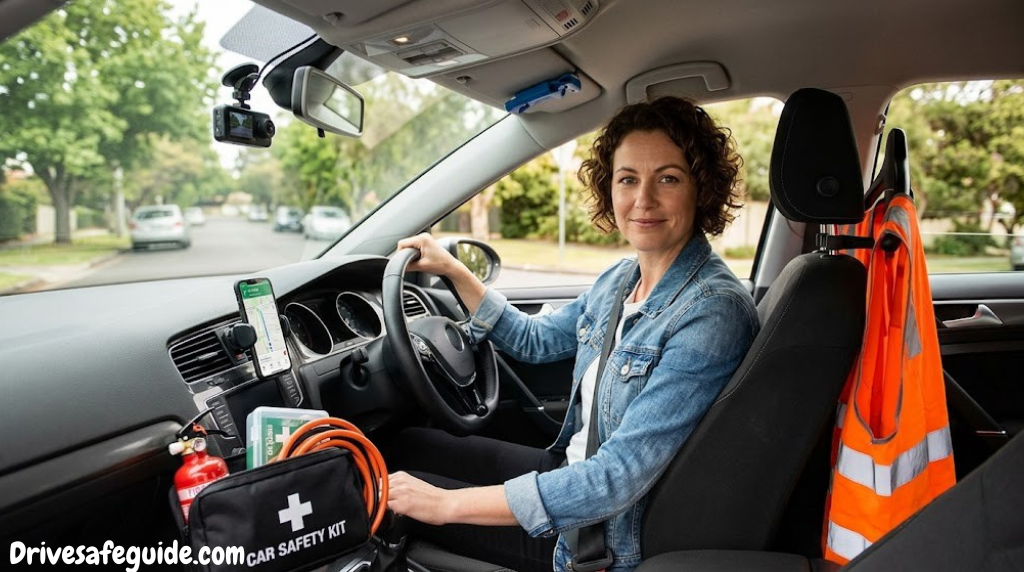
Most drivers don’t think about car safety accessories until something goes wrong — a dead battery on a dark highway, a fender-bender with no camera footage, a blowout thirty miles from the nearest service station. The reality is that the right set of accessories doesn’t just add convenience; it can mean the difference between a minor inconvenience and a catastrophic outcome.
This guide breaks down the most important car safety accessories available today, organized by category, with honest assessments of what each type does, who needs it most, and what features actually matter when you’re shopping. Whether you’re building your first car emergency kit or upgrading your existing gear, you’ll find everything you need to make a confident, informed decision right here.
1 Why Car Safety Accessories Actually Matter
Car safety accessories span a wide spectrum — from the nearly invisible (a tire pressure gauge tucked into the glove box) to the highly visible (a dash cam mounted prominently on the windshield). What unites them all is a simple principle: they either prevent an incident from occurring or dramatically improve your ability to respond when one does.
Modern roads are more complex than ever. Traffic volumes are higher, distracted driving has reached epidemic proportions, and vehicles themselves are getting more technologically advanced — meaning that breakdowns, when they happen, are often beyond the ability of an unprepared driver to resolve without help. The accessories covered in this guide address the full risk profile of everyday driving, from the mundane (a weak battery on a cold morning) to the genuinely dangerous (a tire blowout at highway speed, or a collision requiring documented evidence).
According to roadside assistance data, the most common reasons drivers need help are dead batteries (28%), flat tires (24%), and lockouts (10%). A jump starter and a tire inflator alone would handle more than half of all roadside emergencies. That’s the practical case for this gear in a single sentence.
Before investing in accessories, think about your specific driving profile. Long highway commuter? A dash cam and jump starter are non-negotiables. City driver in a dense area? Blind spot mirrors and a parking sensor become high priorities. Regular road tripper? Build out a full road trip essentials checklist including the gear in this guide.
The Layers of Road Safety
Think of car safety accessories in three layers. The first layer is preventive — gear that helps you avoid an emergency in the first place. This includes tire pressure gauges (preventing blowouts), blind spot mirrors (preventing lane-change collisions), and phone mounts (preventing distracted driving). The second layer is responsive — tools that help you manage an emergency once it starts, like jump starters, tire inflators, and fire extinguishers. The third layer is evidentiary — accessories that document incidents for insurance, legal, and personal safety purposes, most notably dash cams and GPS trackers.
The strongest safety setups combine all three layers. You don’t just prepare for one type of failure — you build a system that covers the most probable risks with the least amount of money, weight, and hassle. With that philosophy in mind, let’s get into the specific categories.
It’s also worth noting that defensive driving habits are the foundation that all accessories build on. Gear amplifies your ability to drive safely — it doesn’t replace the fundamentals of attention, awareness, and good judgment.
2 Dash Cams: Your Silent Witness on Every Drive
A dash cam is one of the most impactful single purchases a driver can make. It sits quietly behind your rearview mirror, running continuously in the background, recording everything in front of (and with a dual-channel system, behind) your vehicle. When something happens — and statistically, it will — you have inarguable video evidence of exactly what occurred.
The insurance implications alone justify the cost. Fraudulent insurance claims (staged accidents, “brake checking,” false pedestrian incidents) have been rising steadily, and a clear 4K recording can immediately exonerate you or establish fault. But the benefits extend far beyond insurance fraud. Dash cams capture near-misses that help you review and improve your own driving, document road hazards for local authorities, and — in jurisdictions that permit it — provide evidence in legal proceedings.
For comprehensive coverage, explore the complete dash cam buyer’s guide or if you’re specifically focused on night driving performance, the best 4K dash cams with STARVIS night vision are in a class of their own.
What to Look for in a Dash Cam
Resolution
4K captures license plates at distance. 1080p is acceptable; 1440p is the sweet spot for most budgets.
Night Vision
Sony STARVIS or IMX sensor-equipped cams deliver dramatic improvements in low-light recording quality.
GPS Logging
Embeds location and speed data into footage — critical for insurance disputes and incident reconstruction.
Loop Recording
Automatically overwrites oldest footage when the card fills, ensuring continuous recording without manual management.
Parking Mode
Records impacts and motion while parked. Essential for covered parking lots and street-parked vehicles.
Wi-Fi / App
Wireless connectivity lets you review and download footage directly to your phone without removing the memory card.
Front vs. Dual Channel Dash Cams
A front-only dash cam covers the most common collision scenario — rear-end impacts and front-angle collisions. But a dual-channel (front + rear) system eliminates the blind spot behind you, which matters enormously for hit-and-runs in parking lots, rear-end accidents on highways, and documenting tailgating behavior. If budget allows, a dual-channel system is always the better choice. The full comparison of front vs. dual channel dash cams explains the trade-offs in detail.
| Model Tier | Resolution | Night Vision | GPS | Parking Mode | Best For |
|---|---|---|---|---|---|
| Budget (e.g., Garmin Mini 2) | 1080p | Basic | ✗ | ✗ | Entry-level users |
| Mid-Range (e.g., Vantrue E1 Lite) | 1440p | STARVIS | ✓ | ✓ | Daily commuters |
| Premium (e.g., BlackVue DR900X) | 4K | STARVIS 2 | ✓ | ✓ | Insurance, legal protection |
| Dual 4K (e.g., Vantrue N4 Pro) | 4K+1080p | Excellent | ✓ | ✓ | Full-coverage protection |
✓ Pros of Dash Cams
- Irrefutable incident evidence
- Insurance fraud deterrent
- Passive — no action required
- Can lower insurance premiums
- Documents parking lot damage
- Captures scenic footage automatically
✗ Cons of Dash Cams
- Requires hardwiring for parking mode
- Memory cards need occasional replacement
- Heat can affect models in hot climates
- Good 4K models cost $150–$350+

STARVIS night vision, GPS logging, app connectivity, and parking mode in a compact form factor. Exceptional value for daily commuters and highway drivers.
View on Amazon3 Portable Jump Starters: Never Be Stranded Again
A dead battery is the single most common reason drivers call roadside assistance. Cold weather, age, a forgotten interior light, or simply a battery that’s reached the end of its service life — any of these can leave you stranded at the worst possible time. A portable jump starter changes that equation completely. Instead of waiting for roadside assistance (which can take 45 minutes to over two hours in busy periods), you can restart your vehicle in under five minutes without needing a second car.
Modern lithium-ion jump starters are remarkably compact — some fit in a jacket pocket — while delivering enough cranking amps to restart diesel pickup trucks. They also double as power banks for charging phones and USB devices, which is an increasingly important feature when you’re stranded and your phone battery is low. Before buying, read the full guide to jump starter amp requirements by engine type.
Lithium vs. Lead-Acid Jump Starters
The traditional debate in the jump starter market — lithium vs. lead-acid — has largely been settled in lithium’s favor for personal vehicle use. Lithium units are 60–80% lighter, retain charge significantly longer between uses (months vs. weeks), and work better in cold temperatures where you most need them. Lead-acid packs still have advantages for very high-amperage applications and extreme cold environments, but for most drivers, lithium is the clear choice.
| Engine Type | Min. Peak Amps | Recommended Unit | Price Range |
|---|---|---|---|
| 4-cylinder gas (up to 2.5L) | 1,000A | NOCO Boost Plus GB40 | $80–$120 |
| V6 gas (2.5L–3.5L) | 1,500–2,000A | NOCO Boost HD GB70 | $140–$200 |
| V8 gas / small diesel | 2,000–2,500A | NOCO Boost Max GB500 | $200–$280 |
| Large diesel (truck/RV) | 3,000A+ | HALO Bolt 58830 | $120–$180 |
For a direct side-by-side comparison of the top units, the NOCO vs. HALO jump starter comparison is worth reading before you buy. And if you’re still considering jumper cables as an alternative, the jump starter vs. jumper cables breakdown explains exactly when cables fall short.
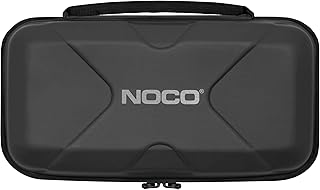
Starts up to 6-cylinder engines. Ultra-safe spark-proof clamps, built-in flashlight/SOS mode, and USB charging output. Holds charge for over a year.
View on Amazon4 Complete Emergency Road Kit: What You Actually Need
Most commercial “car emergency kits” are disappointing — padded with cheap components, missing critical items, and sized for the box rather than for real emergencies. Building your own, or selecting a truly comprehensive commercial kit, is the better path. The goal is to cover the ten or twelve scenarios most likely to leave a driver stranded, injured, or in danger, with gear that’s actually capable of addressing them.
The build-your-own car safety kit guide covers the exact selection process in depth, but the core contents of a solid emergency kit can be summarized in three tiers.
Tier 1: Non-Negotiable Essentials
- Portable jump starter (lithium, minimum 1000A)
- LED road flares or collapsible reflective triangles (3-pack minimum)
- Heavy-duty jumper cables (8-gauge, 20ft minimum)
- Tire inflator / portable compressor
- Tire plug/patch kit for temporary fixes
- First aid kit (ANSI Class B compliant, 100+ piece)
- Emergency blanket (space/mylar blanket, or a heated car blanket for cold climates)
- Seatbelt cutter + window breaker (2-in-1 tool)
- Flashlight with spare batteries (or rechargeable magnetic base model)
- Basic tool kit: screwdrivers, pliers, zip ties, duct tape, electrical tape
Tier 2: High-Value Additions
- Water bottles (1 gallon minimum, rotated every 6 months)
- High-calorie non-perishable snacks
- Traction boards or traction mats (invaluable in mud/snow)
- Waterproof matches / lighter / fire starter
- Disposable gloves and dust mask
- Portable phone charger / power bank (10,000mAh+)
- Pen and notepad (for accident documentation)
- Copies of insurance cards and registration
Tier 3: Scenario-Specific Additions
Road conditions, geography, and personal circumstances should drive your tier-3 choices. Winter drivers should add hand warmers, an ice scraper with telescoping handle, and kitty litter for traction — see the complete winter emergency kit checklist for a full list. For road trips, supplement with the road trip safety essentials and consider scenario-specific additions from the safe road trip essentials by scenario guide.
LED road flares are visible up to one mile in daylight and from much greater distances at night — far outperforming passive reflective triangles. Look for crushproof, waterproof models rated for at least 60 hours of operation. The most durable LED road flares review covers the top options in detail.
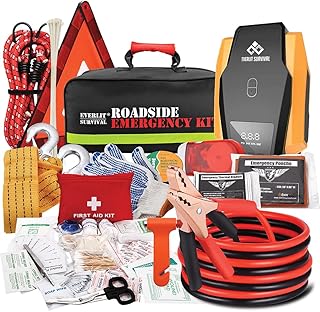
Jumper cables, first aid, rain poncho, reflective triangle, tow rope, and more — in a heavy-duty bag sized for any trunk. Excellent starting point to supplement with jump starter and flares.
View on Amazon5 Blind Spot Mirrors: The $15 Upgrade That Prevents Crashes
Every vehicle has blind spots — areas around the car that side mirrors don’t cover, creating invisible zones where pedestrians, cyclists, and other vehicles can hide. Lane-change collisions account for tens of thousands of accidents annually, and a significant portion of them involve a vehicle that the driver genuinely never saw. Blind spot mirrors are small, convex glass attachments that mount to the outer corner of your existing side mirrors, dramatically expanding your field of view for about the price of a lunch.
For SUVs and trucks, which have substantially larger blind spots than sedans, the improvement is particularly noticeable. The complete guide to blind spot mirrors for trucks and SUVs includes adjustment techniques that maximize their effectiveness on larger vehicles. Active electronic systems like BSM (blind spot monitoring) offer the gold standard in blind spot protection, but for drivers whose vehicles lack factory BSM, a mirror upgrade delivers meaningful safety improvement at minimal cost.
Most blind spot mirrors use 3M adhesive tape and install in under two minutes per mirror. The critical step is adjustment — the convex mirror should show the side of your car in the inside 10–20% of the lens, with the rest of the view extending out and back to cover the blind zone.

Shatter-resistant HD glass with 360° adjustable mount. Fits cars, trucks, and SUVs. Includes 3M adhesive tape. Under $15 for a pair — one of the best safety investments per dollar.
View on Amazon6 Tire Inflators & Digital Gauges: Blowout Prevention Starts Here
Underinflated tires are responsible for an enormous percentage of blowouts and poor vehicle handling, yet surveys consistently show that the majority of drivers either don’t check tire pressure regularly or don’t know how to do it correctly. This is one of the easiest, cheapest safety problems to solve — a quality digital tire gauge costs under $15, and a portable tire inflator that connects to your 12V outlet runs $30–$80.
Understanding the difference between digital and analog tire gauges helps you pick the right tool for your needs. For a deep dive into inflator specifications, the tire inflator buying guide covering duty cycle and CFM explains exactly what the numbers mean in practical terms. And for winter drivers, knowing that cold air causes tires to lose 1–2 PSI for every 10°F temperature drop is critical — front-wheel drive winter safety covers tire pressure management alongside traction considerations.
What a Tire Inflator Should Have
- Auto-shutoff at preset PSI (prevents over-inflation)
- Digital backlit display (readable in all conditions)
- 12V DC power via cigarette lighter AND/OR built-in battery
- Sufficient duty cycle for full tire inflation (read the spec sheet)
- Nozzle attachments for bikes, sports balls, air mattresses (bonus)
- Carrying case or bag for clean storage
For those who spend significant time on unpaved roads or in remote areas, a higher-capacity inflator with a longer duty cycle prevents overheating mid-job. TPMS (tire pressure monitoring system) sensors give real-time in-dash alerts, but they trigger warnings at 25% below recommended pressure — by then, you’ve been driving on a tire that’s compromised for miles. Regular manual checks using a gauge catch problems earlier. Learn more about TPMS sensor care and replacement to keep your car’s built-in system reliable.

Auto-shutoff at preset PSI, dual-power (12V and AC), backlit display, and comes with multiple nozzle attachments. Compact enough for the glovebox, powerful enough for full tires.
View on Amazon7 Car Phone Mounts: The Distracted Driving Solution
Distracted driving kills more than 3,000 people annually in the United States alone. Glancing at a phone for just 5 seconds at 55 mph means traveling the length of a football field with your eyes off the road. A quality car phone mount eliminates the temptation and physical necessity of holding your phone by placing it at eye level, in a stable position, where navigation and controls are always visible without looking away from the road.
Not all mounts are equal. The best car phone mounts for safe driving feature one-handed clamping, a fully adjustable arm, and either a suction cup base (for dashboard or windshield) or a vent clip (for air vents — though these can interfere with HVAC flow). Magnetic wireless charging mounts that combine MagSafe or strong magnet attachment with Qi charging are the current gold standard, keeping the phone powered and accessible simultaneously. The safe driving car phone mounts guide covers current top picks and installation advice in full.
| Mount Type | Stability | Installation | Visibility | Best For |
|---|---|---|---|---|
| Dashboard Suction Cup | Excellent | 5 min, no tools | High | Long commuters, navigators |
| Air Vent Clip | Good | 1 min | Medium-High | Quick use / budget option |
| CD Slot Mount | Very Good | 2 min | Medium | Vehicles with unused CD slot |
| Magnetic Wireless Charging | Excellent | 10 min | High | Modern smartphones / MagSafe |
Several U.S. states restrict windshield-mounted devices as obstructions to the driver’s forward view. Check your local regulations — if your state restricts windshield mounts, opt for a dashboard or vent mount instead. This is also relevant to understanding windshield obstruction laws more broadly.

One-touch locking mechanism, telescoping arm, 360° rotation. Compatible with all smartphones. Strong suction base holds through heavy vibration and temperature changes.
View on Amazon8 Car Fire Extinguisher: A Life-Saving Item Most Drivers Ignore
Vehicle fires kill hundreds of people annually and injure many more. They can start from fuel leaks, electrical shorts, overheated engines, or post-collision scenarios — and they escalate from a small flame to a fully involved vehicle in as little as 90 seconds to 3 minutes. Having a properly rated fire extinguisher within arm’s reach in the cabin can mean the difference between walking away and being trapped.
The complete guide to choosing and mounting a car fire extinguisher covers classification, sizing, and mounting in detail. For most personal vehicles, a 2.5 lb ABC dry chemical or clean agent extinguisher is the minimum. Halon replacement (clean agent) extinguishers are preferred because they don’t coat the engine bay and electrical components with residue — critically important if the car is salvageable.
Fire Extinguisher Classes for Vehicles
- Class A: Ordinary combustibles (wood, fabric, paper) — minimal relevance in most vehicle fires
- Class B: Flammable liquids — gasoline, oil, brake fluid — critical for vehicle fires
- Class C: Electrical fires — relevant to wiring, battery, and alternator fires
- ABC Rated: Covers all three — the standard recommendation for personal vehicles
Mounting matters as much as selection. A loose extinguisher in the trunk is useless in a fire — you need it accessible from inside the cabin, securely mounted in a bracket. Under the driver’s seat or just behind the front seat are common mounting positions.

Commercial-grade ABC rated, includes mounting bracket, pressure gauge for quick visual checks. Meets DOT standards. The 2.5 lb model is the right balance of effectiveness and cabin storage size.
View on Amazon9 Seatbelt Cutters & Window Breakers: Emergency Escape Tools
If your vehicle goes off the road and into water, submerges, or is crushed in a collision, the ability to escape within seconds can be the difference between life and death. In water-submersion scenarios — which happen more often than most people realize — windows become nearly impossible to open once the vehicle is submerged due to water pressure, and door handles require equalized pressure to operate. The sequence changes drastically: you need to break the window before it’s fully submerged, and cut a locked or jammed seatbelt simultaneously.
The emergency car escape tools review compares the best multi-function devices currently available. The vehicle submersion escape guide outlines the complete protocol, but every second matters — having a spring-loaded window punch and blade seatbelt cutter within reach of the driver at all times is non-negotiable once you understand the physics involved.

Spring-loaded window punch activates with 1 lb of pressure. Seatbelt cutter blade is recessed for safe storage. Clips to sun visor or keychain for instant access. Trusted by first responders.
View on Amazon10 OBD2 Scanners: Decode Your Check Engine Light
Every vehicle manufactured after 1996 has an OBD2 (On-Board Diagnostics II) port, typically located under the dashboard near the steering column. When your check engine light comes on — a moment of anxiety familiar to every driver — an OBD2 scanner can immediately tell you what the problem is, whether it’s something safe to monitor or requires immediate attention, and whether you need to visit a mechanic or just tighten a loose gas cap.
Without a scanner, the only option is to take your car to a mechanic or parts store for a code read, which can cost $50–$100 for diagnostic time alone. A dedicated OBD2 scanner pays for itself after a single use. The full OBD2 scan tool guide covers the spectrum from basic code readers to advanced units with live sensor data. For smartphone-based options, the Bluetooth OBD2 app comparison with live data is essential reading — pairing a $30–$80 Bluetooth dongle with a free or low-cost app gives you capabilities that professional scan tools had a decade ago.
When a flashing check engine light appears vs. a solid one, the response protocol differs completely. An OBD2 scanner gives you the immediate context to make the right call — keep driving, pull over, or call a tow.

Reads and clears all OBD codes, live sensor data, freeze frame, emissions readiness. Works with the BlueDriver app (iOS/Android). One of the most capable consumer-grade Bluetooth scanners available.
View on Amazon11 GPS Trackers: Theft Prevention, Fleet Monitoring & Peace of Mind
Vehicle theft rates have climbed significantly in recent years, and modern relay attacks on keyless entry systems have made even late-model vehicles vulnerable in seconds. A hidden GPS tracker gives law enforcement a real-time location when a vehicle is stolen, dramatically increasing recovery rates. But GPS trackers serve multiple other purposes beyond theft — monitoring teen drivers’ speed and location, tracking fleet vehicles for business use, and providing real-time data for insurance programs that reward low-risk driving.
The complete GPS tracker guide covers the major categories in depth. Key features to evaluate are update frequency (real-time vs. every-few-minutes polling), subscription cost, geofencing capabilities (alerts when the vehicle leaves a defined zone), battery life for self-powered units vs. hardwired options, and covertness of installation. For teen drivers especially, pairing a GPS tracker with the right driving safety apps creates a layered monitoring system that promotes accountability while keeping young drivers safer.
Real-Time Tracking
Live location updates every 3–10 seconds. Essential for theft recovery.
Geofence Alerts
Get notified instantly when the vehicle enters or exits a defined area.
Speed Monitoring
Alerts when your vehicle exceeds a set speed — key for teen driver monitoring.
Long Battery Life
Hardwired units never die; battery models need charging every 2–6 weeks.

Real-time tracking updates every 15 seconds, trip history, geofence alerts, OBD2 plug-in installation. $8/month flat fee with no contracts. Excellent for families and small fleet owners.
View on Amazon12 Master Comparison: All Safety Accessories at a Glance
Making sense of a crowded category is easier with a side-by-side view. The tables below summarize each accessory category by cost tier, difficulty of installation, and who benefits most — giving you a prioritized shopping path based on your specific situation.
Overall Safety Accessory Priority Matrix
| Accessory | Priority | Est. Cost | Install Difficulty | Saves From |
|---|---|---|---|---|
| Portable Jump Starter | Essential | $60–$200 | None (plug-in) | Dead battery stranding |
| Dash Cam (1440p+) | Essential | $80–$350 | Easy (adhesive mount) | Insurance fraud, evidence loss |
| Emergency Roadside Kit | Essential | $40–$150 | None (storage) | Multiple breakdown scenarios |
| Tire Inflator + Gauge | Essential | $20–$80 | None (plug-in) | Blowouts, fuel waste, poor handling |
| Car Phone Mount | Essential | $15–$60 | Easy (clip/suction) | Distracted driving collisions |
| Seatbelt Cutter / Window Punch | Essential | $10–$30 | None (clip-on) | Entrapment, submersion scenarios |
| Blind Spot Mirrors | Recommended | $8–$25 | Very Easy (adhesive) | Lane-change collisions |
| LED Road Flares (3-pack) | Recommended | $25–$60 | None | Secondary collision when stopped |
| Car Fire Extinguisher | Recommended | $25–$60 | Easy (bracket mount) | Vehicle fires, engine fires |
| OBD2 Scanner | Recommended | $30–$120 | None (plug-in OBD port) | Unnecessary repair costs, misdiagnosis |
| GPS Tracker | Upgrade | $40–$150 + sub | Easy (OBD or hardwire) | Theft, unsafe teen driving |
| Polarized Driving Sunglasses | Upgrade | $20–$200 | None (wear them) | Glare-induced accidents, eye fatigue |
Safety Accessories by Driver Profile
| Driver Profile | Top 3 Priority Accessories | Bonus Additions |
|---|---|---|
| Daily Highway Commuter | Dash cam (dual-channel), jump starter, phone mount | OBD2 scanner, polarized sunglasses |
| City Driver / Urban | Phone mount, blind spot mirrors, dash cam (parking mode) | GPS tracker, escape tool |
| Road Tripper / Long Distance | Full emergency kit, jump starter, tire inflator | GPS tracker, first aid upgrade, LED flares |
| Winter / Cold Climate Driver | Jump starter, tire inflator, winter emergency kit | Heated seat cushion, traction mats |
| New / Teen Driver | Dash cam, phone mount, emergency kit | GPS tracker, OBD2 scanner, escape tool |
| Rideshare / Taxi Driver | Dual-channel dash cam (interior view), phone mount, fire extinguisher | GPS tracker, jump starter, OBD2 |
| Rural / Off-Road Driver | Full emergency kit, high-capacity jump starter, tire inflator (heavy-duty) | Traction boards, satellite communicator, fire extinguisher |
Car safety accessories make excellent, practical gifts for new drivers, graduates, and road-trip enthusiasts. See the practical graduation gifts for teen drivers, gifts for new car owners, and car lover gift ideas used daily for curated, safety-focused gift lists.

Shop jump starters, dash cams, road flares, first aid kits, and more — all with fast Prime shipping. Use the link below to start your kit with verified top-rated products.
Shop Car Safety AccessoriesAdditional Safety Accessories Worth Knowing About
Beyond the core twelve categories covered in depth above, several additional accessories are worth mentioning for specific use cases. Polarized driving sunglasses reduce glare dramatically — a legitimate safety upgrade, not just a comfort item. Night-specific dash cams designed for low-light performance are worth the premium for drivers who commute in darkness. Backup cameras — whether factory-fitted or aftermarket — virtually eliminate the risk of backing over objects or children; the backup camera selection guide covers aftermarket installation options clearly.
For drivers with specific physical considerations, high-density gel seat cushions reduce driver fatigue on long hauls — fatigue is a genuine safety risk, not just a comfort concern. Similarly, orthopedic car neck pillows and proper lumbar support help drivers maintain alertness over extended periods. Drowsy driving is responsible for around 100,000 crashes annually, and anything that keeps a driver physically comfortable and alert is a meaningful safety contribution.
The night driving safety checklist and rain driving safety guide cover the operational habits that make all of these accessories work together effectively. Gear without skill has limits — the combination of the right accessories and good safe driving habits is what genuinely transforms your risk profile on the road.
Frequently Asked Questions
A portable jump starter is widely considered the most universally critical safety accessory because a dead battery can strand you anywhere — including in dangerous locations. Combined with a basic roadside emergency kit, these two items cover the most common roadside emergencies drivers face.
Yes. A dash cam provides irrefutable video evidence in accidents, protects against fraudulent insurance claims, and deters aggressive drivers. 4K models with night vision are especially useful for capturing clear footage in low-light conditions. The cost of a good dash cam is a fraction of a single disputed insurance claim.
A complete car emergency kit should include a portable jump starter, LED road flares or reflective triangles, a first aid kit, tire inflator or tire plug kit, emergency blanket, water and non-perishable snacks, a seatbelt cutter/window breaker tool, a flashlight with spare batteries, and jumper cables.
Yes. Blind spot mirrors designed for larger vehicles with a convex or wide-angle lens are highly effective for SUVs and trucks, significantly reducing the risk of lane-change accidents. They are a low-cost, high-impact safety upgrade. Proper adjustment is key — the lens should show a sliver of your own vehicle’s side on the inner edge, maximizing coverage of the blind zone.
For most personal vehicles, a Class B and C rated dry chemical extinguisher rated at a minimum of 2.5 lbs is recommended. Class B covers flammable liquids like gasoline, and Class C covers electrical fires — both common in vehicle fires. Clean agent (halotron) extinguishers are preferred if the vehicle’s value justifies the higher cost, as they don’t leave damaging residue.
Absolutely, especially for theft prevention, fleet tracking, or monitoring teen or elderly drivers. Modern GPS trackers offer real-time location, geofence alerts, speed notifications, and trip history accessible from a smartphone app. The monthly subscription cost ($5–$25) is modest for the security benefit provided.
A dedicated car phone mount — ideally a vent-clip or dashboard suction cup style with one-touch clamping — keeps your phone at eye level and hands-free. This significantly reduces distraction compared to holding your phone or placing it in a cupholder. Always configure navigation and music before moving, and use voice controls while driving.
Tire pressure should be checked at least once a month and before any long road trip. Tires lose approximately 1 PSI per month naturally, and temperature changes can cause rapid pressure fluctuations — a digital tire gauge makes this quick and accurate. Always check cold pressure (before the car has been driven).
For winter driving, essentials include an ice scraper and snow brush, traction mats, a portable jump starter (cold weakens batteries), a winter-specific emergency kit with extra blankets and hand warmers, and tire chains or snow socks if you drive in heavy snow regions. See the full winter car emergency kit checklist for a comprehensive list.
Match peak amp output to your engine size: 1000–1500A for small 4-cylinder engines, 2000–2500A for V6 engines, and 3000A+ for diesel or large V8 engines. Lithium-ion models are lighter and hold charge longer than lead-acid equivalents. Also look for built-in safety features like reverse polarity protection and spark-proof clamps.
An OBD2 scanner connects to your car’s onboard diagnostic port and reads fault codes, sensor data, and system status. It lets you diagnose the reason for a check engine light before visiting a mechanic, potentially saving hundreds in unnecessary diagnostic fees. Every vehicle since 1996 has an OBD2 port, and basic code readers start at under $30.
Potentially, yes. Some insurers offer discounts for dash cameras (which deter fraud), anti-theft GPS trackers, and backup cameras. Programs like Progressive’s Snapshot and State Farm’s Drive Safe & Save use OBD2 or mobile app monitoring to reward low-risk drivers directly. Contact your insurer to ask which accessories or monitoring programs apply to your policy.
Final Verdict: Build Your Kit, Drive With Confidence
The beauty of car safety accessories is that they don’t require mastery — they work quietly in the background, ready when you need them. A dash cam doesn’t need any input from you to capture footage of a hit-and-run. A jump starter doesn’t require mechanical knowledge to jump a dead battery. A seatbelt cutter doesn’t need you to remember anything under pressure — it’s right there, clipped to your visor.
Start with the non-negotiables: a quality jump starter, a 1440p+ dash cam, and a proper emergency kit. Add a tire inflator, blind spot mirrors, and a car phone mount. Then build out from there based on your specific driving profile and environment. Each layer you add expands the scenarios you’re prepared for without complicating your day-to-day driving experience.
If you’re ever unsure whether a specific driving scenario or accessory configuration is safe and appropriate for your situation, resources like the safe driving habits guide, the highway safety tips, and the road trip safety hub are excellent, free resources to build your knowledge base alongside your gear arsenal.
🛒 Shop All Safety Accessories on Amazon