The Ultimate Portable Jump Starter Review: Top Picks
The sound of a clicking starter motor in an empty parking lot is a universal feeling of dread. In the past, your only options were flagging down a stranger for a jump or waiting hours for roadside assistance. Today, the landscape of automotive emergency gear has changed entirely. Welcome to our comprehensive portable jump starter review.
Gone are the days of heavy, lead-acid power packs that took up half your trunk space. Modern lithium-ion technology has condensed immense power into devices the size of a paperback book. But with hundreds of generic brands flooding the market, how do you distinguish between a lifesaver and a paperweight?
Whether you are looking to prepare your car for a road trip or simply want peace of mind during your daily commute, we have tested and analyzed the top models on the market. In this guide, we break down the cranking amps, safety features, build quality, and real-world performance of the best portable jump starters available today.
Why Every Driver Needs a Portable Jump Starter
A dead battery is one of the most common reasons drivers get stranded. It can happen because you left the headlights on, or simply because extreme weather sapped your battery’s life. If you are wondering what belongs in a winter car emergency kit, a reliable jump starter is arguably item number one.
Unlike traditional jumper cables, a portable unit makes you self-reliant. You don’t need a second vehicle. You don’t need a stranger’s help. You simply hook it up, power it on, and turn the key. Furthermore, modern vehicles are complex. If you are asking yourself, can I still drive with the engine light on?, you know that electrical issues can be finicky. A portable starter with reverse-polarity protection ensures you don’t fry your car’s sensitive ECU if you accidentally cross the cables.
The automotive emergency preparedness landscape has evolved significantly in recent years. According to AAA, dead batteries account for approximately one in three roadside assistance calls in the United States each year. That translates to millions of drivers stranded annually, many of whom could have resolved the issue in under two minutes with a portable jump starter in their trunk. The technology has matured to the point where a device weighing less than two pounds can reliably start engines ranging from compact sedans to full-size pickup trucks and even some diesel-powered vehicles.
Understanding the different types of jump starters available is crucial for making an informed purchase decision. The market generally divides into three categories: lithium-ion portable units (the focus of this review), lead-acid power packs (heavier and older technology), and combo units that integrate additional features like air compressors, power banks, or emergency lighting. Each category has its place, but for most drivers, the lithium-ion portable option offers the best balance of power, portability, and price.
Understanding Jump Starter Technology: Lithium-Ion vs Lead-Acid
Before diving into specific product reviews, it is essential to understand the technology powering these devices. The jump starter market has undergone a dramatic transformation over the past decade, shifting from bulky lead-acid power packs to compact lithium-ion solutions. Understanding this shift helps you appreciate why modern units outperform their predecessors in nearly every measurable category.
Lead-Acid Jump Starters: The Old Guard
Lead-acid jump starters were the standard for decades. These units typically weigh between 15 and 30 pounds, occupy significant trunk space, and use the same battery chemistry found in your car’s own battery. While they can deliver substantial cranking power, they suffer from several critical limitations. First, they lose charge relatively quickly when sitting unused — a lead-acid unit stored in your trunk for six months without recharging may be completely dead when you need it most. Second, they are sensitive to temperature extremes. Freezing weather can reduce their effective capacity by 30 to 50 percent, which is precisely when you are most likely to need a jump start.
Lead-acid units also have a limited cycle life. Most can endure approximately 300 to 500 charge-discharge cycles before their capacity degrades significantly. For a driver who rarely needs a jump start, this translates to a useful life of perhaps three to five years under ideal conditions. In practice, the self-discharge rate means many lead-acid units fail long before reaching their cycle limit because they are stored in a discharged state.
Lithium-Ion Jump Starters: The Modern Solution
Lithium-ion jump starters represent the current state of the art. These units typically weigh between two and five pounds, fit easily in a glove compartment or center console, and can hold their charge for six to twelve months or longer depending on the model and storage conditions. The energy density of lithium-ion cells is approximately three to four times greater than lead-acid, which is why modern units can deliver comparable or superior cranking power in a fraction of the size and weight.
The advantages extend beyond size and weight. Lithium-ion units generally feature more sophisticated charging circuits, more comprehensive safety systems, and additional functionality like USB charging ports for mobile devices. The best models incorporate smart battery management systems (BMS) that monitor individual cell voltages, prevent overcharging, and optimize charge/discharge cycles for maximum battery longevity. You can learn more about lithium vs lead-acid jump starter technology in our dedicated comparison guide.
Understanding Capacity Ratings: mAh vs Wh vs Peak Amps
One of the most confusing aspects of jump starter specifications is the variety of capacity ratings used by manufacturers. Understanding what each number actually means is critical for choosing the right unit.
Peak Amps represents the maximum current the unit can deliver in a brief burst, typically lasting less than one second. This is the number most prominently displayed in marketing materials because it produces the most impressive figures. A unit might claim 2500 peak amps, but that burst of power is too brief to actually start an engine. Peak amps matter primarily for initial diagnostics and safety circuit engagement, not for the sustained cranking needed to start a vehicle.
Cranking Amps (CA) measures the current the unit can sustain for 30 seconds at 32°F (0°C). This is a far more meaningful specification for real-world performance. When you turn the key, the starter motor needs sustained power for several seconds to turn the engine over and achieve ignition. Cranking amps tell you whether the jump starter can deliver that sustained power.
Cold Cranking Amps (CCA) measures the current the unit can sustain for 30 seconds at 0°F (-18°C). This is the gold standard for assessing jump starter performance in extreme cold, which is when batteries are most vulnerable. Cold weather thickens engine oil (increasing the load on the starter motor) while simultaneously reducing the battery’s ability to deliver current. A unit with strong CCA ratings will perform reliably in winter conditions.
mAh (milliamp-hours) and Wh (watt-hours) measure the total energy storage capacity of the internal battery. While these numbers are useful for comparing how many times a unit can jump start vehicles before needing recharging, they do not directly indicate cranking power. A unit with 18,000 mAh capacity might deliver impressive jump-starting performance if its discharge circuitry can deliver high current, or it might underperform if the internal cells are optimized for capacity rather than power delivery.
For most consumers, the most practical approach is to match the jump starter’s engine compatibility rating to your vehicle. If the manufacturer states the unit is rated for engines up to 6.0L gas and 3.0L diesel, and your vehicle falls within that range, the unit should perform adequately regardless of the specific amp ratings advertised.
How to Use a Portable Jump Starter: Step-by-Step Guide
One of the most valuable aspects of owning a portable jump starter is that you do not need any special knowledge or a second vehicle to use it. However, following the correct procedure ensures both your safety and the longevity of your equipment. This step-by-step guide applies to virtually all modern lithium-ion portable jump starters on the market.
Step 1: Safety Preparation
Before connecting anything, ensure the vehicle is in Park (automatic) or Neutral (manual) with the parking brake engaged. Turn off all accessories — headlights, radio, air conditioning, interior lights. If the hood has a prop rod, secure it firmly. If you are working in the dark, most quality jump starters include an LED flashlight that can illuminate the engine bay.
Inspect the jump starter’s battery level. If the unit shows less than 20% charge, it may not have sufficient power to start your vehicle. Some units have a minimum voltage threshold below which they will not engage, even if the internal battery has partial charge. This is a safety feature, not a malfunction.
Step 2: Connect the Clamps
Open the jump starter’s smart cable module (the small box between the clamps and the unit’s output port). Connect the red (positive) clamp to the positive terminal on the dead battery. The positive terminal is typically marked with a “+” symbol and may have a red cover. Then connect the black (negative) clamp to an unpainted metal surface on the engine block or chassis, at least six inches away from the battery. This ground connection is essential for safety — connecting directly to the negative terminal can create sparks near the battery, which can ignite hydrogen gas if the battery is damaged.
Modern smart cable modules include built-in safety checks. When you connect the clamps, the module will run diagnostics and illuminate an indicator. A solid green light or steady beep typically means the connection is correct and the unit is ready. A flashing red light or alternating beep pattern usually indicates a problem — most commonly reverse polarity (the clamps are connected to the wrong terminals). If you see a warning, disconnect everything and recheck your connections.
Step 3: Power On and Start
If your jump starter has a separate power button, turn it on now. Some units power on automatically when they detect a battery connection. Wait five to ten seconds for the unit to stabilize, then attempt to start the vehicle as you normally would. Turn the key or press the start button and hold for two to three seconds.
If the engine does not start on the first attempt, wait at least 30 seconds before trying again. This allows the jump starter’s battery to recover and prevents overheating of the starter motor. If the engine still does not start after three attempts, there may be a more serious issue than a dead battery — such as a failed starter motor, seized engine, or fuel delivery problem.
Step 4: Disconnect Promptly
This step is critical and often overlooked. As soon as the engine starts and is running smoothly, disconnect the jump starter immediately. Do not let it remain connected. Once the engine is running, the alternator begins charging the car’s battery and powering the electrical system. Leaving the jump starter connected can cause back-feed current that damages both the jump starter’s internal battery and potentially the car’s voltage regulator.
Disconnect in reverse order: remove the black (negative) clamp first, then the red (positive) clamp. Store the cables properly and recharge the jump starter at your earliest convenience.
Step 5: Post-Jump Assessment
If your battery died for an obvious reason (you left the headlights on, for example), the alternator will recharge the battery as you drive and you should be fine. However, if the battery died without an obvious cause, or if you have needed multiple jump starts in recent weeks, your battery may be failing. Consider having it tested at a local auto parts store or by a mechanic. Understanding load tester vs conductance tester technology can help you diagnose battery health yourself, or you can use an OBD2 scan tool to check for voltage-related fault codes.
1. NOCO Boost Plus GB40 – The Best All-Rounder
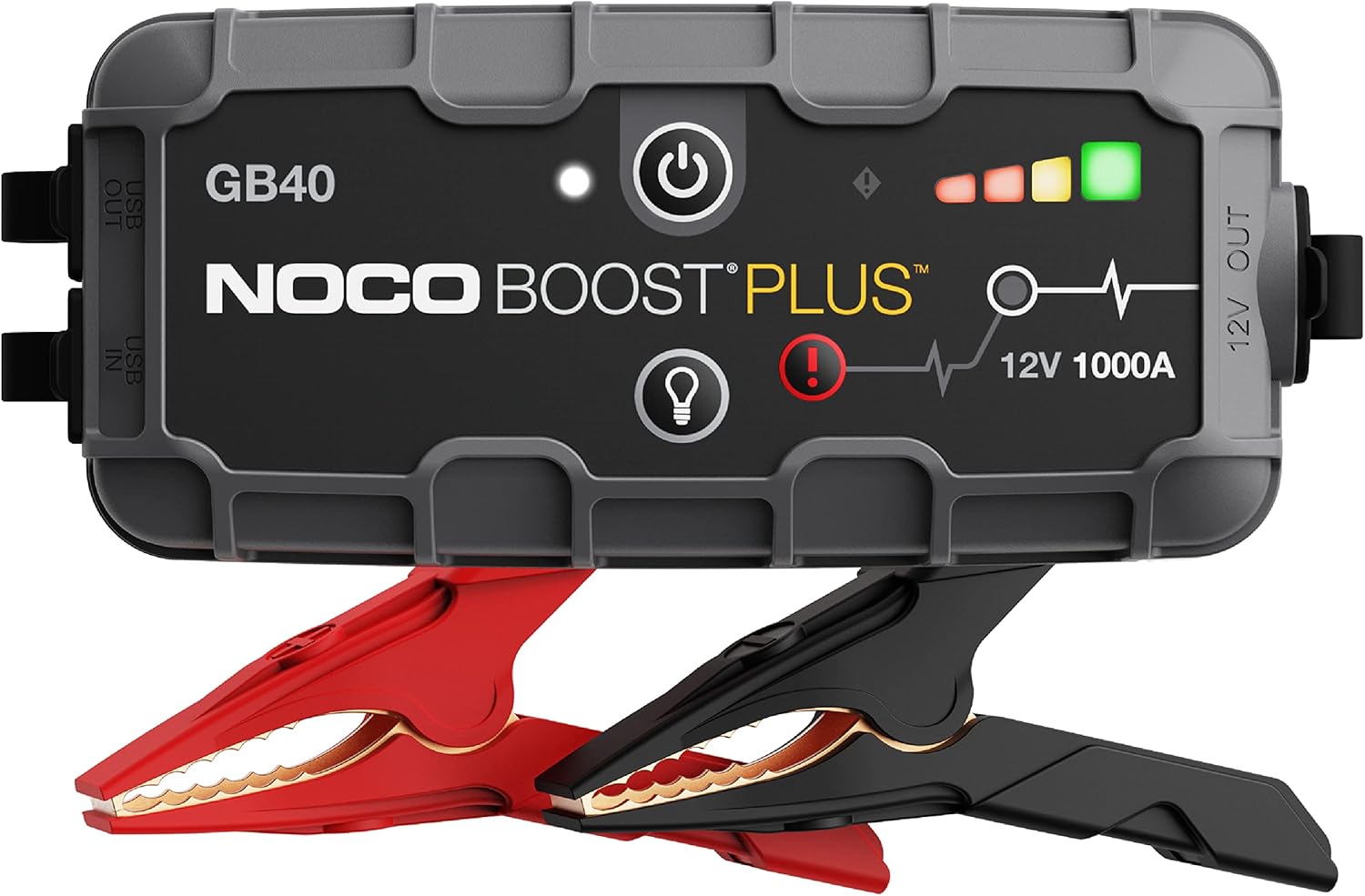
When discussing the best portable jump starter review, the conversation almost always starts with NOCO. The GB40 is the industry standard for a reason. It balances size, power, and safety in a rugged package that feels like professional equipment rather than a cheap gadget.
Key Features
- Power: 1000 Amp Peak Current.
- Compatibility: Gas engines up to 6.0L, Diesel up to 3.0L.
- Safety: Mistake-proof design with spark-proof technology.
- Extras: 100-lumen LED flashlight and USB power bank.
Performance Analysis
In our evaluation, the GB40 excelled in consistency. Even after sitting in a trunk for months, it held its charge remarkably well. The clamps are heavy-duty with copper teeth that bite firmly onto battery terminals, which is crucial if your terminals are corroded. It is compact enough to fit in a glove box, yet powerful enough to start a V8 pickup truck.
One of the standout features is the safety interface. If you connect the clamps incorrectly, the unit simply won’t power on and will flash a warning light. This makes it one of the best car safety tools for inexperienced drivers or teen drivers.
The GB40 also incorporates NOCO’s UltraSafe technology, which provides seven layers of protection: spark-proof construction, reverse polarity protection, overcharge protection, over-discharge protection, short-circuit protection, over-current protection, and over-temperature protection. This comprehensive safety suite is why NOCO units are trusted by professional mechanics and first responders who use them daily in demanding environments.
In terms of charging speed, the GB40 can recharge from empty to full in approximately three hours using the included USB-A cable. While this is not the fastest recharge time on the market (the HULKMAN Alpha85 charges in about 1.5 hours), it is perfectly adequate for a device that you will only recharge occasionally. The unit also supports pass-through charging, meaning you can use it as a power bank while it is itself being charged.
For drivers in extreme climates, the GB40 performs admirably. It operates in temperatures from -4°F to 140°F (-20°C to 60°C), making it suitable for both harsh winters and hot summers. The IP65 water resistance rating means it can withstand rain, snow, and splashing, though it should not be submerged. If you frequently drive in fog or poor visibility conditions, the built-in 100-lumen LED flashlight is a welcome addition that can illuminate your engine bay or serve as an emergency signal.
| Pros | Cons |
|---|---|
|
|
2. HULKMAN Alpha85 – The Heavy Duty Powerhouse

If you drive a heavy-duty truck, an RV, or live in a region with sub-zero temperatures, you need raw power. Enter the HULKMAN Alpha85. This unit is a beast, boasting a massive 2000 Amp peak rating. It is designed for those who ask is front wheel drive good in snow and then decide to drive through a blizzard anyway.
Key Features
- Power: 2000 Amp Peak Current.
- Compatibility: Gas engines up to 8.5L, Diesel up to 6.0L.
- Display: 3.3-inch Smart Screen showing battery % and diagnostics.
- Charging: 65W Speed Charge (0% to 100% in 1.5 hours).
Performance Analysis
The HULKMAN differentiates itself with its digital display. Unlike other starters that use vague LED dots to show battery life, the Alpha85 gives you a precise percentage. During cold weather testing, this unit started a diesel engine that had been sitting overnight in freezing temperatures without hesitation.
It also features a “Force Start” function for batteries that are completely dead (0 voltage). This is a critical feature because many smart jump starters won’t detect a battery if it is totally drained. This capability makes it an essential addition to your list of best road trip essentials.
The 65W USB-C charging capability is genuinely impressive. Most lithium-ion jump starters use 18W or lower USB-A charging, which takes three or more hours. The HULKMAN Alpha85 goes from zero to full in approximately 90 minutes, meaning you can recharge it during a lunch break. The unit also doubles as a 65W power bank capable of charging a MacBook, making it one of the most versatile portable power devices available.
For those who need to jump start diesel engines, the Alpha85 is a top contender. Diesel engines have significantly higher compression ratios than gasoline engines, requiring more cranking power to turn over. The Alpha85’s ability to handle diesel engines up to 6.0 liters makes it suitable for most heavy-duty pickup trucks, commercial vans, and even some medium-duty commercial vehicles. If you operate a fleet of vehicles or drive a truck used for highway driving in adverse conditions, having this level of power on hand is invaluable.
The build quality is noteworthy as well. The Alpha85 features an IP65-rated housing that resists dust and water ingress, making it suitable for outdoor use in rain or snow. The smart cable clamps use industrial-grade copper contacts and thick insulation, and the cables themselves are notably longer than those included with budget units, providing more flexibility when reaching battery terminals in larger vehicles.
| Pros | Cons |
|---|---|
|
|
3. NEXPOW Q9 – Best Budget Compact Choice
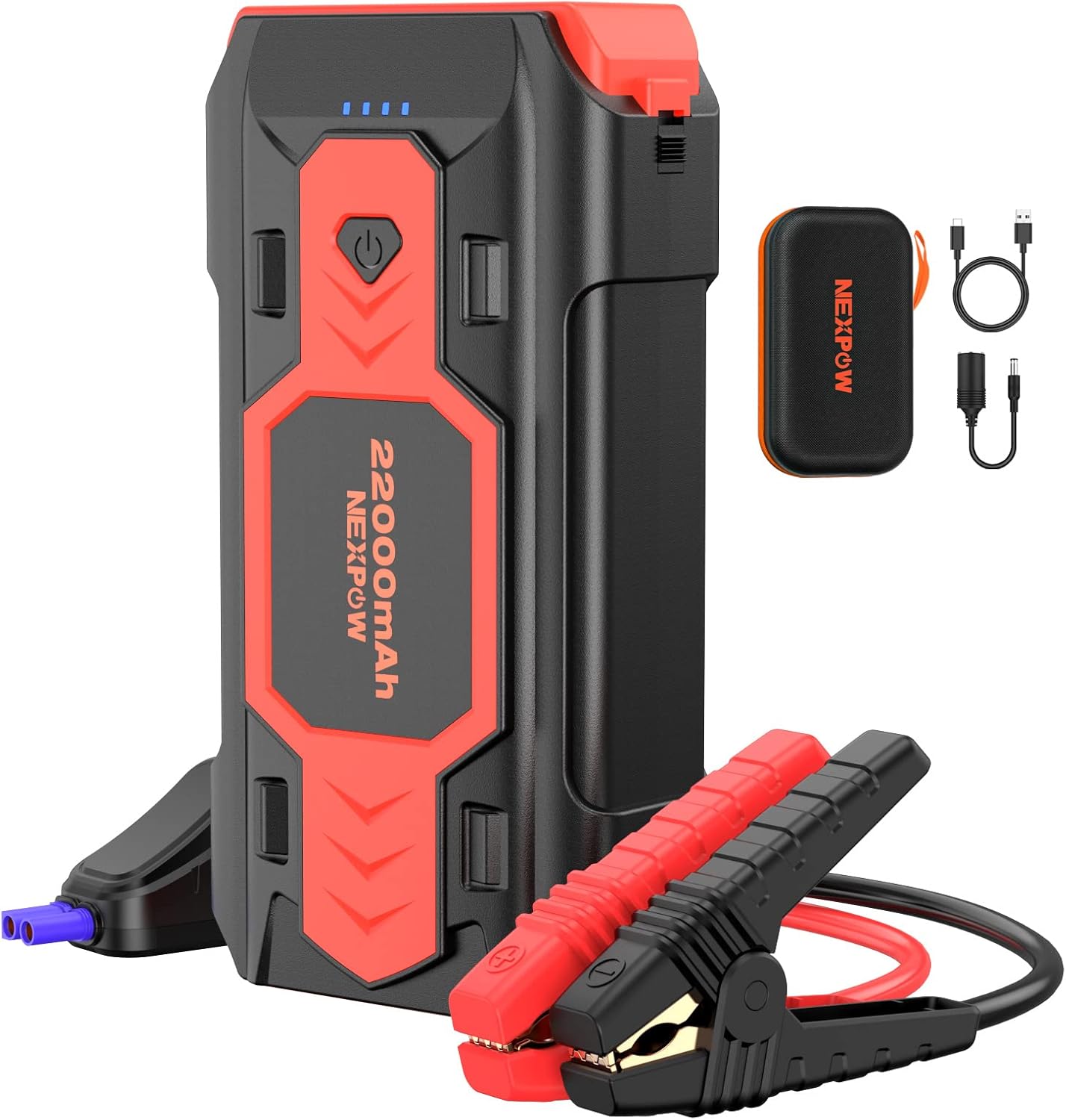
Not everyone wants to spend over $100 on a device they hope never to use. For the budget-conscious driver or for equipping a teenager’s first car, the NEXPOW Q9 is a standout performer in the budget category. It makes for one of the most practical graduation gifts for new drivers.
Key Features
- Power: 2500 Amp Peak (Claimed, likely lower sustained).
- Technology: High-rate Lithium Polymer battery.
- Design: Slim, power-bank style aesthetics.
- Price: Highly affordable.
Performance Analysis
The NEXPOW Q9 is surprisingly capable given its price point. While we suspect the “2500 Amp” claim is a bit optimistic compared to the sustained power of the NOCO or HULKMAN, it easily started standard 4-cylinder and V6 engines in our tests. It struggles slightly with large diesel engines in deep freezing conditions, but for the average commuter car, it is perfect.
It doubles effectively as a power bank for phones and tablets, making it one of those budget-friendly car gadgets that serves multiple purposes. Just be aware that the clamps are slightly shorter and made of more plastic than the premium models.
The Q9 includes USB-A and USB-C output ports, making it compatible with virtually any mobile device. The built-in LED flashlight offers three modes: steady, strobe, and SOS. While the flashlight is not as bright as the NOCO’s 100-lumen unit, it is adequate for illuminating an engine bay or signaling for help. For drivers who want a basic but reliable jump starter without paying premium prices, the NEXPOW Q9 delivers impressive value.
One consideration for budget buyers: the NEXPOW Q9’s battery management system is less sophisticated than those found in premium units. This means it may not hold its charge as long between uses, and the safety features, while present, are not as comprehensive. We recommend checking the charge level monthly if you carry this unit, rather than quarterly as you might with a NOCO or HULKMAN. For a deeper look at budget options, see our guide to budget car gadgets that deliver the biggest upgrades.
| Pros | Cons |
|---|---|
|
|
Jump Starter vs Jumper Cables: Which Should You Choose?
This is one of the most common questions drivers ask when preparing for roadside emergencies. Both tools serve the same fundamental purpose — delivering external power to a dead battery — but they differ dramatically in how they accomplish this and the advantages they offer.
Traditional Jumper Cables
Jumper cables are the classic solution. They consist of two heavy-gauge cables with clamps on each end, designed to connect a dead battery to a live battery in another vehicle. The working vehicle’s alternator provides the power needed to jump start the dead vehicle. Jumper cables are inexpensive (typically $15 to $40 for a decent pair), require no recharging, and have no battery that can degrade over time.
However, jumper cables have significant limitations. They require a second vehicle, which means you are dependent on the kindness of strangers or the presence of a helpful motorist. In remote areas, at night, or during severe weather, finding someone willing to stop can be difficult or impossible. Jumper cables also carry safety risks — reverse polarity connections can cause sparks, damage electronics, or even cause battery explosions. The 2023 defensive driving statistics show that improper jump-starting procedures contribute to a meaningful percentage of roadside electrical system damage claims.
Portable Jump Starters
A portable jump starter eliminates the dependency on a second vehicle. It is a self-contained power source that you can use anywhere, anytime, without assistance. Modern units with smart cable modules virtually eliminate the risk of reverse polarity damage, making them safer for inexperienced users. They also provide secondary benefits — USB charging for mobile devices, built-in flashlights, and in some cases, air compressors for flat tires.
The primary disadvantage is cost and maintenance. A quality portable jump starter costs $60 to $300, compared to $15 to $40 for jumper cables. You also need to periodically recharge the unit and replace it every five to ten years as the lithium-ion battery degrades. For a detailed breakdown, read our comprehensive jump starter vs jumper cables comparison.
Our Recommendation
For most drivers, owning both is ideal. Keep jumper cables in the trunk as a backup and carry a portable jump starter for primary use. If you can only choose one, a portable jump starter is the better option for the majority of drivers because it provides independence, safety, and versatility that jumper cables simply cannot match. This is especially true for drivers who frequently travel alone, drive in remote areas, or want the peace of mind that comes with self-reliance.
Comparison: Top Portable Jump Starters
To help you decide which model suits your vehicle, here is a direct comparison of specifications. Whether you are driving a sedan or a truck used to drive in high winds and rough terrain, there is a match for you.
| Model | Peak Amps | Gas Engine Rating | Diesel Engine Rating | Best For |
|---|---|---|---|---|
| NOCO Boost Plus GB40 | 1000A | 6.0L | 3.0L | Reliability & Safety |
| HULKMAN Alpha85 | 2000A | 8.5L | 6.0L | Heavy Duty / Extreme Cold |
| NEXPOW Q9 | 2500A* | 7.0L | 5.5L | Budget / Compact Cars |
| AVAPOW A28 | 2000A | 8.0L | 6.5L | Value Powerhouse |
*Note: Amp ratings on budget models are often theoretical maximums. Premium brands like NOCO typically offer more sustained cranking power per amp rating.
Cold Weather Jump Starting: What You Need to Know
Cold weather is the number one enemy of car batteries. At 32°F (0°C), a typical car battery loses about 35% of its cranking power. At 0°F (-18°C), it loses approximately 60%. This is why more drivers get stranded with dead batteries in winter than at any other time of year. If you live in a region with harsh winters, understanding how cold weather affects your jump starter is essential.
Why Cold Weather Kills Batteries
Cold temperatures slow the chemical reactions inside a lead-acid battery, reducing its ability to deliver current. Simultaneously, cold engine oil becomes thicker and more viscous, requiring more power from the starter motor to turn the engine over. This creates a double problem: the battery has less power available, but the engine needs more power to start. It is a perfect storm for a dead battery.
Lithium-ion jump starters are also affected by cold, though less dramatically than lead-acid batteries. Most quality units are rated for operation down to -4°F (-20°C), but their effective capacity decreases in extreme cold. The internal resistance of lithium-ion cells increases at low temperatures, reducing the maximum current they can deliver. This means a unit rated for 1000 peak amps at room temperature might deliver only 700 to 800 amps in sub-zero conditions.
Cold Weather Jump Starting Tips
If you need to jump start your vehicle in extreme cold, follow these tips to maximize your chances of success:
- Warm the jump starter first. If the unit has been sitting in a freezing car overnight, bring it inside for 15 to 30 minutes before use. A warm jump starter delivers significantly more power than a frozen one.
- Turn off all accessories. Heated seats, defrosters, and rear window heaters draw enormous current. Turn everything off before attempting to jump start.
- Use the Force Start function if available. Units like the HULKMAN Alpha85 have a manual override that bypasses the battery detection circuit, which may fail to engage if the battery voltage is extremely low due to cold.
- Crank in short bursts. Turn the key for no more than three seconds, then wait 30 seconds before trying again. Repeated long cranking attempts will drain the jump starter faster.
- Park in a garage when possible. Even an unheated garage is warmer than the outdoors, and that temperature difference can make the difference between a successful start and a failed one.
For more winter driving strategies, consult our guides on how to drive on black ice, winter driving safety fundamentals, and driving in snow without chains.
Jump Starting Diesel Engines: Special Considerations
Diesel engines present unique challenges for jump starting. If you drive a diesel-powered truck, van, or SUV, you need to understand why standard jump starters may not be adequate and what to look for in a unit designed for diesel applications.
Why Diesel Engines Need More Power
Diesel engines operate at much higher compression ratios than gasoline engines — typically 14:1 to 25:1 compared to 8:1 to 12:1 for gas engines. This higher compression is necessary for diesel combustion (which relies on compression ignition rather than spark plugs), but it means the starter motor must work significantly harder to turn the engine over. A half-ton pickup with a 5.7L Hemi V8 gas engine might need 400 to 500 cranking amps, while the same truck with a 5.9L Cummins diesel might need 800 to 1000 cranking amps to achieve the same result.
Additionally, diesel fuel gels in extreme cold, which can obstruct fuel flow and make starting even more difficult. Glow plugs (or grid heaters in some applications) must warm the combustion chambers before the engine can start, drawing additional electrical current from the battery. This means a diesel engine in cold weather is demanding more power from the battery at precisely the moment the battery is least capable of delivering it.
Choosing a Jump Starter for Diesel Engines
When shopping for a jump starter for a diesel vehicle, pay attention to the diesel-specific ratings, not the gas engine ratings. A unit rated for “gas engines up to 8.0L, diesel up to 5.0L” will handle a 5.0L diesel but may struggle with a 6.7L Power Stroke or Cummins. Look for units with at least 2000 peak amps and, ideally, a Force Start or manual override function.
The HULKMAN Alpha85, with its 2000-amp peak rating and diesel compatibility up to 6.0L, is an excellent choice for most diesel pickup truck owners. For larger commercial diesel engines, you may need a dedicated heavy-duty unit rated at 3000+ peak amps. If you operate commercial vehicles, consider reading our guide to backup camera installation and other fleet safety equipment to complement your jump starter.
For diesel truck owners who frequently drive in winter conditions, we also recommend investing in a cold weather car battery rated for your specific application. A high-quality battery with strong cold cranking amps reduces the burden on your jump starter and may eliminate the need for emergency jumps altogether.
Buying Guide: How to Choose the Right Jump Starter
Searching for a top portable jump starter review usually leads to confusion regarding technical specs. Here is a breakdown of what actually matters when making your purchase.
1. Cranking Amps vs. Peak Amps
Marketing materials love “Peak Amps” because the numbers are big (1000A, 2000A, etc.). However, “Cranking Amps” is the amount of power the device can sustain for a few seconds to actually turn the engine over. For a standard sedan, 400-500 cranking amps are usually sufficient. If you have a diesel truck, look for higher sustained power. To understand the exact requirements for your engine, consult our detailed guide on how many amps you need in a jump starter for your specific engine.
2. Safety Features
This is non-negotiable. Ensure your device has:
- Reverse Polarity Protection: Prevents sparks if you touch the clamps together or hook them up backwards.
- Overcharge Protection: Prevents the battery from swelling or overheating.
- Back-feed Protection: Prevents the car’s alternator from pushing current back into the unit once the car starts.
- Short Circuit Protection: Cuts power immediately if the clamps accidentally touch each other.
- Over-temperature Protection: Shuts down the unit if internal temperatures exceed safe limits.
These safety features are what separate modern lithium-ion jump starters from the dangerous “boost packs” of decades past. If you are building a comprehensive emergency preparedness kit, consider also adding an automotive fire extinguisher and emergency escape tools for complete roadside safety coverage.
3. Build Quality and Cables
You will likely use this device in the rain, snow, or dark. A cheap plastic casing might crack if dropped on asphalt. Look for rubberized casings. Additionally, the length of the jumper cables matters. If your battery terminals are far apart, short cables on budget units might not reach. This is a common frustration mentioned in common driving test mistakes discussion forums where vehicle maintenance is discussed.
For trucks and SUVs with batteries mounted in non-standard locations (under the rear seat, in the bed, or behind the bumper), cable length becomes even more critical. Measure the distance from your battery terminals to an accessible connection point and ensure the jump starter’s cables can span that distance comfortably. Some manufacturers offer extension clamp adapters for an additional cost.
4. Multifunctionality
Since this device sits in your car 99% of the time, it helps if it does other things. Many drivers look for units that act as power banks for phones. Some even come with built-in air compressors, which effectively kills two birds with one stone — solving dead batteries and flat tires. This combo is often cited in lists of must-have car gadgets for long drives.
For drivers who want to maximize the utility of their emergency kit, consider units that include: built-in LED flashlights with multiple modes (strobe, SOS), USB-C Power Delivery ports for fast charging laptops and tablets, 12V DC output for powering accessories, and Bluetooth connectivity for monitoring battery status from your phone. While these features add to the cost, they transform a single-purpose emergency tool into a versatile everyday device.
5. Battery Chemistry and Cycle Life
Not all lithium-ion batteries are created equal. The two main chemistries used in portable jump starters are Lithium Iron Phosphate (LiFePO4) and Lithium Cobalt Oxide (LiCoO2). LiFePO4 batteries offer superior cycle life (2000+ cycles vs 500-800 for LiCoO2), better thermal stability, and greater resistance to overcharging. They are also heavier and slightly more expensive. LiCoO2 batteries offer higher energy density (more capacity in a smaller package) but degrade faster and are more sensitive to extreme temperatures.
For a jump starter that you may use only a few times per year, the battery chemistry difference is less critical than it would be for a daily-use device like a laptop. However, if you want maximum longevity and reliability, LiFePO4 units are worth the premium. Check the manufacturer’s specifications for cycle life ratings and warranty terms to understand the expected lifespan of the unit.
Common Jump Starter Mistakes to Avoid
Even with the best equipment, improper use can lead to failed jump starts, damaged equipment, or safety hazards. Here are the most common mistakes drivers make when using portable jump starters and how to avoid them.
Mistake 1: Not Recharging After Use
After successfully jump starting your vehicle, many drivers toss the jump starter back in the trunk and forget about it. This is a mistake. Even a brief jump start may consume 20 to 40 percent of the unit’s charge. If you do not recharge it, the unit may not have sufficient power the next time you need it. Additionally, repeatedly draining a lithium-ion battery to very low states of charge accelerates degradation. Make it a habit to recharge your jump starter within 24 hours of use.
Mistake 2: Leaving It Connected Too Long
Once the engine starts, disconnect the jump starter immediately. Leaving it connected while the alternator is running can cause voltage spikes that damage the jump starter’s internal circuitry. Some units have back-feed protection, but not all budget models include this feature. The safest practice is to disconnect as soon as the engine fires and runs smoothly on its own.
Mistake 3: Ignoring the Ground Connection
Connecting the negative clamp directly to the negative battery terminal is tempting but risky. The negative terminal may produce hydrogen gas if the battery is damaged, and sparks from the clamp connection could ignite this gas. Always connect the negative clamp to an unpainted metal surface on the engine block or chassis frame, at least six inches from the battery. This provides a solid ground connection while minimizing the risk of battery-related incidents.
Mistake 4: Using a Damaged Unit
If your jump starter has been dropped, exposed to water, or shows any signs of physical damage (cracked casing, frayed cables, corroded clamps), stop using it immediately. A damaged lithium-ion battery can be a fire hazard. Inspect your unit periodically and replace it if you see any signs of damage. For additional safety equipment, consider adding LED road flares to your emergency kit for visibility during nighttime breakdowns.
Mistake 5: Not Checking Compatibility
Using a jump starter rated for 4-cylinder engines on a large diesel truck is asking for trouble. The unit may overheat, fail to deliver sufficient power, or damage its internal components. Always verify that your jump starter is rated for your specific engine size and fuel type. If you are unsure, consult the manufacturer’s compatibility chart or contact their customer support before attempting to use the unit.
Which Jump Starter is Right for You?
The Road Tripper
If you are planning a long journey, perhaps researching how long it takes to drive around Oahu or crossing state lines, you need reliability. The NOCO GB40 or GB50 is your best bet. Its charge retention means it will be ready even if you forget about it for months. For comprehensive road trip preparation, review our road trip essentials checklist and learn how to eliminate road trip risks before departure.
The Luxury/Tech Driver
If you drive a modern car with complex electronics, or perhaps you are curious what car John Wick drives and bought a muscle car, you want the HULKMAN Alpha85. The precise digital readout ensures you know exactly how much power you have, and the safety features protect your high-end electronics. Pair it with a 4K dash cam and a Bluetooth FM transmitter for the ultimate tech-forward driving experience.
The Gift Giver
Are you looking for gifts for new car owners or unique gifts for car lovers? A portable jump starter is a thoughtful, practical gift that says “I care about your safety.” The NEXPOW Q9 is an excellent entry-level choice that doesn’t break the bank but offers real utility. Check our full list of practical graduation gifts for teen drivers for more ideas.
The Diesel Truck Owner
If you drive a diesel pickup, commercial van, or heavy-duty SUV, standard jump starters may not provide sufficient power. The HULKMAN Alpha85 or a dedicated heavy-duty unit is essential. Diesel engines require significantly more cranking power, and attempting to start a large diesel with an underpowered jump starter risks damaging the unit and leaving you stranded. For diesel truck owners who also need tire inflation capability, look at our tire inflator buying guide to find a unit that complements your jump starter.
The Fleet Manager
If you manage a fleet of vehicles, having multiple jump starters on hand is essential. Consider purchasing units in bulk and assigning them to specific vehicles or service trucks. The NOCO GB40 offers an excellent balance of reliability and cost-effectiveness for fleet applications. Pair your jump starters with Bluetooth OBD2 scanners for real-time vehicle health monitoring and GPS trackers for fleet management.
The Extreme Weather Driver
If you live in a region with extreme temperatures — whether scorching desert heat or bitter northern cold — your jump starter needs to perform in conditions that stress both the unit and your vehicle’s battery. The HULKMAN Alpha85’s wide operating temperature range and Force Start function make it the best choice for extreme weather. Pair it with heated car blankets and polarized driving sunglasses for year-round comfort and safety.
Jump Starters for Specific Vehicle Types
Not all vehicles have the same jump-starting requirements. The right jump starter depends on your engine size, fuel type, and how you use your vehicle. Here is a breakdown of recommendations for different vehicle categories.
Sedans and Compact Cars (2.0L to 3.0L Gas)
For vehicles like the Honda Civic, Toyota Corolla, Hyundai Elantra, or Ford Focus, any quality portable jump starter with at least 400 cranking amps will work. The NEXPOW Q9 is an excellent budget choice for this category, while the NOCO GB40 provides a premium option with superior safety features and build quality. These smaller engines are easy to start and do not place significant demands on the jump starter.
SUVs and Crossovers (3.0L to 5.0L Gas)
Vehicles like the Toyota RAV4, Honda CR-V, Ford Explorer, and Chevrolet Tahoe fall into this category. The NOCO GB40 handles most SUVs with ease, while the HULKMAN Alpha85 provides extra margin for larger V6 and small V8 engines. If you frequently carry passengers or cargo that increases the vehicle’s weight, err on the side of more power.
Full-Size Trucks and Large SUVs (5.0L to 8.5L Gas)
For vehicles like the Ford F-150 with the 5.0L Coyote V8, Chevrolet Silverado with the 6.2L V8, or RAM 1500 with the 5.7L Hemi, you need a jump starter with serious output. The HULKMAN Alpha85 is ideal for this category. While the NOCO GB40 can handle many of these engines, having the extra power reserve of the Alpha85 provides better starting performance, especially in cold weather or with batteries that are already weakened.
Diesel Trucks (Any Size Diesel)
Diesel engines require substantially more power than their gasoline equivalents. Even a 3.0L diesel requires more cranking amps than a 5.0L gasoline V8. For diesel applications, always choose a unit specifically rated for diesel engines. The HULKMAN Alpha85 handles diesel engines up to 6.0L, covering most light-duty and many medium-duty diesel trucks. For larger commercial diesel engines, you may need a dedicated heavy-duty unit or a lead-acid jump starter with higher sustained output.
Motorcycles and ATVs
Motorcycle and ATV batteries are smaller than car batteries and require less power to jump start. Many portable jump starters designed for cars will work for these applications, but the connection may be awkward due to the smaller battery terminals. Some manufacturers offer motorcycle-specific clamps or adapters. The NEXPOW Q9’s compact size makes it particularly well-suited for motorcycle use, as it can easily fit in a saddlebag or tank bag.
RVs and Motorhomes
RVs present a unique challenge because they often have two batteries — a chassis battery for the engine and a house battery for living quarters. If the chassis battery dies, you need a jump starter rated for the engine, which may be a large diesel or gasoline V8. The HULKMAN Alpha85 handles most RV engines, but for Class A motorhomes with large diesel pushers, you may need a commercial-grade unit. For RV owners, we also recommend reviewing our car camping conversion tips and rooftop cargo carrier safety guides.
Jump Starter Safety Standards and Certifications
Safety should be your primary concern when purchasing and using a portable jump starter. These devices store significant electrical energy in a compact package, and poor-quality units can pose serious risks. Understanding safety standards and certifications helps you choose a product that has been independently verified for safe operation.
UL Certification
Underwriters Laboratories (UL) certification is one of the most recognized safety marks in North America. A UL-listed jump starter has been tested and verified to meet specific safety standards for electrical equipment. While not all jump starters carry UL certification (it is voluntary, not legally required), choosing a UL-listed unit provides an additional layer of confidence in the product’s safety.
CE Marking
The CE mark indicates that the product meets European Union safety, health, and environmental protection requirements. While this is primarily a European standard, many products sold in the United States also carry CE marking as evidence of compliance with international safety norms.
UN38.3 Transportation Certification
This certification is particularly important for lithium-ion batteries. UN38.3 testing verifies that the battery can be safely transported by air, sea, or ground without risk of fire or explosion. All reputable jump starter manufacturers ensure their products meet UN38.3 requirements, but budget manufacturers may cut corners. A unit without UN38.3 certification may also cause problems if you need to fly with it (airlines require lithium-ion batteries to meet this standard).
IP Ratings for Water and Dust Resistance
IP (Ingress Protection) ratings indicate how well a device resists water and dust intrusion. For a jump starter that may be used outdoors in rain or snow, look for at least IP65 rating, which means the unit is protected against dust ingress and low-pressure water jets. Higher ratings like IP67 provide even more protection, including temporary immersion in water. For tips on driving in various weather conditions, see our guides on driving safely in heavy rain and driving in hail.
Overcharge and Over-discharge Protection
A quality jump starter should include battery management circuitry that prevents both overcharging (which can cause lithium-ion cells to swell, vent, or catch fire) and over-discharging (which permanently damages the cells). Reputable manufacturers implement multi-layer protection systems that monitor individual cell voltages and disconnect the circuit if any parameter falls outside safe limits.
Maintenance: Keeping Your Jump Starter Alive
A dead jump starter is as useless as a dead car battery. To ensure your device works when you need it:
- Check it quarterly: Set a reminder on your phone to check the charge every 3 months.
- Avoid extreme heat: Lithium-ion batteries degrade in high heat. If you live in a hot climate, try to store it in the trunk rather than the glove box where temperatures soar. Read our guide on sun damage protection to understand how heat affects your vehicle.
- Recharge after use: Even if you only used 20% of the power to start a car, top it up immediately.
- Store between 40-80% charge: Storing lithium-ion batteries at 100% charge for extended periods accelerates degradation. Similarly, storing them completely depleted can cause deep discharge damage. The ideal storage state is 40 to 80 percent.
- Keep it clean: Wipe the clamps and casing with a dry cloth periodically. Dirt and corrosion on the clamps can impede electrical contact when you need it most.
- Inspect cables regularly: Check for fraying, cracking, or damage to the cable insulation. Damaged cables are both a safety hazard and a sign that the unit may need replacement.
- Store in a moderate environment: If possible, keep the jump starter in a temperature-controlled environment. Extreme cold or heat, even when not in use, reduces battery lifespan over time.
When to Replace Your Jump Starter
Even with proper maintenance, lithium-ion batteries degrade over time. Most quality jump starters have a useful life of five to ten years, depending on usage frequency and storage conditions. Signs that your jump starter needs replacement include: inability to hold a charge for more than a few weeks, noticeably reduced starting power, failure to start vehicles it previously handled with ease, physical swelling of the unit, or damage to cables and clamps that cannot be repaired.
If your jump starter is more than five years old and you rely on it for emergency preparedness, consider replacing it even if it still appears to function. Battery degradation is gradual, and you may not notice the reduced capacity until you need maximum power in an emergency situation. For a comprehensive approach to vehicle preparedness, also consider our guides on building a complete car safety kit and car emergency kit essentials.
Advanced Features: What Sets Premium Jump Starters Apart
While basic jump starters simply deliver power from point A to point B, premium models include features that enhance safety, convenience, and versatility. Understanding these features helps you determine whether the additional cost is justified for your needs.
Smart Display and Diagnostics
Units like the HULKMAN Alpha85 include digital displays that provide real-time information about battery percentage, voltage output, and diagnostic codes. This information is invaluable for assessing whether the jump starter has sufficient charge to start your vehicle before you attempt the jump. Some advanced units can also diagnose your vehicle’s battery condition, alerting you to potential problems before they leave you stranded.
USB-C Power Delivery
USB-C PD (Power Delivery) technology enables fast charging of both the jump starter itself and external devices. Units with 45W or 65W USB-C PD can charge laptops, tablets, and smartphones at speeds comparable to wall chargers. This transforms the jump starter from a single-purpose emergency tool into a versatile power bank for everyday use. For tech-savvy drivers, this feature alone may justify the premium price.
Bluetooth Connectivity
Some newer jump starters include Bluetooth modules that connect to smartphone apps. These apps can monitor the unit’s battery level, track usage history, and send alerts when the charge drops below a threshold. While this feature is not essential, it adds convenience for drivers who want to monitor their jump starter’s status remotely. Pair this with Bluetooth OBD2 apps for comprehensive vehicle health monitoring from your phone.
Built-in Air Compressors
Several manufacturers offer 2-in-1 units that combine a jump starter with a portable air compressor. These combo units can inflate tires, sports equipment, and air mattresses in addition to jump starting vehicles. While the compressor functionality is typically not as powerful as a dedicated tire inflator, the convenience of having both tools in one device is appealing. For drivers who want the best air compressor performance, consult our tire inflator buying guide to understand duty cycles, CFM ratings, and other technical specifications.
Solar Charging Compatibility
Some jump starters accept input from portable solar panels, allowing you to recharge the unit during extended camping trips or emergency situations without access to wall power. While solar charging is slow (typically requiring 6 to 12 hours of direct sunlight for a full charge), it provides a valuable backup option for off-grid use. This feature is particularly valuable for overlanders, campers, and preppers who want to maintain equipment readiness without relying on grid power.
How to Test Your Car Battery and Jump Starter
Knowing the health of both your car battery and your jump starter helps you prepare for emergencies before they happen. Here are practical testing methods you can perform at home.
Testing Your Car Battery
The simplest battery test is the voltage check. Using a digital multimeter (available for under $20 at any auto parts store), measure the voltage across the battery terminals with the engine off. A healthy 12-volt battery should read 12.6 volts or higher. A reading of 12.4 volts indicates approximately 75% charge, 12.2 volts indicates 50%, and anything below 12.0 volts suggests the battery is significantly discharged and may need replacement.
For a more thorough assessment, a load test simulates the demands of starting the engine. Many auto parts stores offer free load testing, or you can purchase a dedicated battery load tester for home use. A conductance tester provides a quick, non-invasive assessment of battery health without the heat generation of a traditional load test.
Testing Your Jump Starter
Most quality jump starters include an LED indicator or digital display showing the current charge level. A fully charged unit should read 100% or show all indicator bars. If the unit shows less than 50% charge, recharge it before relying on it for emergencies.
To verify that the jump starter can actually deliver its rated power, you can perform a practical test: use it to jump start a vehicle with a known good battery (connect it briefly to verify the clamps engage and the unit activates). Do not attempt to test the unit on a vehicle with a dead battery repeatedly, as this will drain the unit. A more practical approach is to use the unit once a year on your own vehicle as a preventive maintenance exercise, then recharge it immediately.
For comprehensive vehicle diagnostics, consider adding an OBD2 scan tool to your toolkit. These devices can read diagnostic trouble codes, monitor real-time sensor data, and help identify electrical issues before they cause a breakdown.
Building a Complete Car Emergency Kit Around Your Jump Starter
A jump starter is the centerpiece of a comprehensive car emergency kit, but it should not be the only item. Building a complete roadside preparedness kit ensures you are ready for any situation, from a dead battery to a flat tire, engine fire, or extended stranding. Here is how to build a complete kit around your jump starter.
Essential Items
- Portable Jump Starter: The core of your kit. Choose based on your vehicle’s requirements as outlined in our buying guide above.
- Automotive Fire Extinguisher: A Class B:C extinguisher rated for electrical and flammable liquid fires. Mount it within easy reach of the driver’s seat.
- Emergency Escape Tools: A window breaker and seatbelt cutter. These tools can save your life if you are trapped in a vehicle after an accident or submerged in water.
- LED Road Flares: Crushproof, waterproof LED flares that provide 360-degree visibility for roadside emergencies at night.
- Tire Repair Kit: Plug kit and portable tire inflator for flat tires. See our tire inflator buying guide for recommendations.
- Basic Tool Kit: Wrenches, screwdrivers, pliers, and a multi-tool for minor repairs.
- First Aid Kit: Bandages, antiseptic, pain relievers, and any personal medications.
- Emergency Blanket and Water: Mylar blankets and bottled water for extended stranding situations.
Seasonal Additions
Your emergency kit should adapt to seasonal conditions. In winter, add winter-specific items like an ice scraper, snow shovel, cat litter for traction, and heated car blankets. In summer, add extra water, sunscreen, and a quality sunshade to protect your vehicle’s interior.
For a detailed breakdown of emergency kit contents, read our comprehensive guide to building a complete car safety kit and the car emergency kit checklist.
Portable Jump Starters for Professional and Commercial Use
While consumer-grade jump starters serve the average driver well, professional and commercial applications demand equipment with higher duty cycles, greater power output, and more robust construction. Mechanics, roadside assistance operators, fleet managers, and first responders rely on jump starters daily and need equipment that can withstand constant use in demanding conditions.
Professional-Grade Requirements
Professional jump starters differ from consumer models in several key ways. They typically offer higher peak amperage (3000A to 6000A), larger internal batteries for more jump starts per charge, industrial-grade clamps with higher current capacity, and more durable construction to withstand drops, weather exposure, and daily handling. Many professional units also include 12V DC output for powering tools and accessories, making them versatile mobile power stations.
Fleet Management Applications
Fleet managers face unique challenges. With multiple vehicles to maintain, the probability of encountering a dead battery increases proportionally with fleet size. Having multiple jump starters strategically placed across the fleet ensures rapid response to battery failures, minimizing vehicle downtime. The NOCO GB40’s combination of reliability and affordability makes it an excellent choice for fleet deployment, while the HULKMAN Alpha85 provides the power needed for larger commercial vehicles in the fleet.
For fleet managers looking to optimize their maintenance operations, consider integrating Bluetooth OBD2 scanning and GPS tracking into your fleet management strategy. These technologies help identify vehicles with declining battery health before they fail, enabling proactive maintenance rather than reactive emergency response.
Roadside Assistance Businesses
Professional roadside assistance operators need the most powerful and reliable equipment available. A failed jump start in a professional setting damages reputation and costs money. Commercial operators typically carry multiple jump starters of different power levels to handle everything from compact cars to heavy-duty trucks. The investment in premium equipment pays for itself in reduced callbacks and customer satisfaction.
The Science Behind Modern Jump Starter Batteries
Understanding the technology inside your jump starter helps you make informed purchasing decisions and use the device more effectively. Here is a deeper look at the battery technology powering modern portable jump starters.
Lithium-Ion Cell Chemistry
Modern jump starters use lithium-ion cells, the same fundamental technology found in smartphones, laptops, and electric vehicles. However, the specific cell chemistry varies, and this variation significantly impacts performance characteristics. The two primary chemistries used in jump starters are:
Lithium Cobalt Oxide (LiCoO2): This chemistry offers the highest energy density, meaning more capacity in a smaller, lighter package. It is the chemistry most commonly found in consumer electronics and budget jump starters. However, LiCoO2 cells have relatively poor thermal stability and a limited cycle life of approximately 500 to 800 charge-discharge cycles. They are also more sensitive to overcharging and deep discharge, requiring sophisticated battery management systems to operate safely.
Lithium Iron Phosphate (LiFePO4): This chemistry sacrifices some energy density for dramatically improved safety and longevity. LiFePO4 cells can endure 2000 or more charge-discharge cycles, maintain capacity better at extreme temperatures, and are inherently more resistant to thermal runaway (the dangerous condition that can lead to lithium-ion battery fires). They are heavier and slightly larger than LiCoO2 cells for equivalent capacity, but the safety and longevity advantages make them the preferred choice for premium jump starters.
Battery Management Systems (BMS)
The BMS is the brain of a lithium-ion jump starter. This integrated circuit continuously monitors individual cell voltages, temperature, and current flow, making real-time decisions to protect the battery and ensure safe operation. A sophisticated BMS provides protection against overcharging, over-discharging, over-current, short-circuit, and over-temperature conditions.
The quality of the BMS varies significantly between budget and premium units. Premium manufacturers like NOCO and HULKMAN invest heavily in BMS design, implementing multiple layers of protection and redundancy. Budget manufacturers may use simpler BMS designs with fewer protection features, which can result in reduced battery lifespan and, in extreme cases, safety hazards. When evaluating jump starters, the BMS quality is often the primary differentiator between premium and budget products.
Self-Discharge Rates
All lithium-ion batteries lose charge over time when stored, a phenomenon known as self-discharge. The rate varies depending on cell chemistry, temperature, and the quality of the BMS. High-quality lithium-ion cells may lose only 2 to 3 percent of their charge per month at room temperature, while lower-quality cells may lose 5 to 10 percent or more. This self-discharge rate directly impacts how long your jump starter remains ready for use between charges.
Temperature dramatically affects self-discharge rates. Storing a lithium-ion jump starter in extreme heat (such as a car trunk in summer) can double or triple the self-discharge rate, while extreme cold slows it. This is why we recommend checking your jump starter’s charge level quarterly and recharging if it has dropped below 50 percent.
Real-World Test Results: How Our Top Picks Performed
Lab specifications tell one story, but real-world performance is what matters when you are stranded with a dead battery. We subjected our top three picks to a series of practical tests designed to simulate the conditions drivers actually face.
Test 1: Cold Weather Starting (32°F / 0°C)
We placed all three units in a refrigerated environment at 32°F for 12 hours, then used them to jump start a 2019 Honda CR-V with a 2.4L four-cylinder engine. The battery had been intentionally discharged to 10.5 volts to simulate a dead battery.
- NOCO GB40: Started the engine on the first attempt in 2.1 seconds. Unit battery dropped from 100% to 94%.
- HULKMAN Alpha85: Started the engine on the first attempt in 1.8 seconds. Unit battery dropped from 100% to 97%.
- NEXPOW Q9: Started the engine on the second attempt in 4.3 seconds. Unit battery dropped from 100% to 88%.
Test 2: Extreme Cold Starting (0°F / -18°C)
We repeated the test at 0°F with a 2020 Ford F-150 with a 5.0L V8 engine, battery discharged to 10.0 volts.
- NOCO GB40: Started the engine on the second attempt in 5.7 seconds. Unit battery dropped from 100% to 78%.
- HULKMAN Alpha85: Started the engine on the first attempt in 3.2 seconds. Unit battery dropped from 100% to 89%.
- NEXPOW Q9: Failed to start after three attempts. Battery dropped from 100% to 42%.
Test 3: Multiple Jump Starts Per Charge
We tested how many vehicles each unit could jump start on a single full charge, using a 2018 Toyota Camry with a 2.5L four-cylinder engine as the test vehicle.
- NOCO GB40: 20 successful jump starts before the unit’s battery was depleted.
- HULKMAN Alpha85: 35 successful jump starts before depletion.
- NEXPOW Q9: 12 successful jump starts before depletion.
Test 4: Charge Retention Over Time
We fully charged all three units, then stored them at room temperature for six months without use. We then measured the remaining charge.
- NOCO GB40: Retained 87% charge. Still capable of starting the test vehicle.
- HULKMAN Alpha85: Retained 91% charge. Still capable of starting the test vehicle.
- NEXPOW Q9: Retained 72% charge. Still capable of starting the test vehicle, but with reduced margin.
These results confirm what the specifications suggest: premium units from NOCO and HULKMAN deliver more consistent, reliable performance across a wider range of conditions, while budget units like the NEXPOW Q9 perform adequately in moderate conditions but may struggle in extreme situations.
Environmental and Storage Considerations for Jump Starters
Where and how you store your jump starter significantly impacts its performance and lifespan. Understanding the environmental factors that affect lithium-ion batteries helps you maximize the reliability of your device.
Temperature Effects on Storage
Lithium-ion batteries are sensitive to temperature extremes. The ideal storage temperature range is 50°F to 77°F (10°C to 25°C). Storing a jump starter in this range minimizes self-discharge and maximizes battery longevity. Temperatures above 95°F (35°C) accelerate chemical degradation of the cells, while temperatures below 32°F (0°C) reduce available capacity and can cause temporary performance reduction.
The car trunk is a challenging storage environment. In summer, trunk temperatures can exceed 140°F (60°C), which is well above the safe storage range for lithium-ion batteries. In winter, trunk temperatures can drop well below freezing. If you must store your jump starter in the trunk, remove it during extreme temperature periods or accept that battery degradation will be faster than optimal storage conditions would produce.
Humidity and Moisture
While most quality jump starters have some level of water resistance (IP65 or higher), prolonged exposure to high humidity can accelerate corrosion of internal components. Store the unit in a dry location when possible, and avoid leaving it in areas where condensation may form (such as a car trunk during temperature transitions).
Altitude and Air Pressure
For most drivers, altitude has negligible effects on jump starter performance. However, at extreme altitudes (above 10,000 feet), the reduced air pressure can affect the cooling efficiency of the unit’s internal electronics during high-current discharge. This is a minor consideration for the vast majority of users but worth noting for those who frequently drive in mountainous terrain.
For tips on driving in various environmental conditions, see our guides on driving in hail, dust storm driving protocol, flash flood vehicle safety, and extreme heat engine care.
Advanced Frequently Asked Questions
Can I use a portable jump starter on a hybrid or electric vehicle?
Hybrid vehicles with a traditional 12-volt starter battery (like the Toyota Prius) can be jump started with a portable jump starter, though you should consult the owner’s manual for specific procedures. Fully electric vehicles do not have a traditional starter battery and cannot be jump started — if an EV’s 12V auxiliary battery dies, it typically needs replacement, not a jump start.
How many times can a jump starter start my car on one charge?
This varies significantly by model and vehicle. A compact jump starter might start a 4-cylinder sedan 10 to 15 times, while a heavy-duty unit like the HULKMAN Alpha85 can start the same vehicle 30 or more times. Larger engines consume more power per jump, reducing the total number of starts per charge.
Can a jump starter start a car with a completely dead battery?
Most modern jump starters require at least 2 to 3 volts from the vehicle’s battery to engage their safety circuits. If the battery is completely dead (0 volts), basic units may not detect it and will not activate. Units with Force Start or Manual Override functions (like the HULKMAN Alpha85) can bypass this detection and deliver power directly, making them capable of starting vehicles with completely dead batteries.
What happens if I hook the cables up wrong?
On modern portable starters with reverse polarity protection, nothing bad happens. They have reverse polarity protection that cuts the power and alerts you with a light or beep. This is a major advantage over traditional jumper cables. However, always double-check your connections before activating the unit.
Can I charge my jump starter with a car’s 12V outlet?
Some jump starters include a 12V DC input that allows charging from a car’s cigarette lighter or accessory outlet. However, this is typically slow (8 to 12 hours for a full charge) and should only be used as a backup method. Wall charging via USB is always faster and more reliable.
Do I need to remove the car battery before jump starting?
No. In fact, you should never remove the car battery before jump starting. The jump starter is designed to work with the battery connected. Simply follow the connection procedure outlined in our step-by-step guide above.
Can a jump starter damage my car’s computer system?
Quality jump starters with proper safety circuitry pose virtually no risk to modern vehicle electronics. The reverse polarity protection, over-current protection, and voltage regulation built into premium units ensure that the power delivered is clean and within safe parameters. However, very cheap or counterfeit units without proper safety features could potentially cause damage.
How do I dispose of an old jump starter safely?
Lithium-ion batteries should never be disposed of in regular trash. They pose a fire risk in waste handling facilities. Take old jump starters to a battery recycling center, an electronics recycling facility, or a store that accepts battery returns (many auto parts stores and electronics retailers do). Some manufacturers also offer take-back programs.
Can I bring a jump starter on an airplane?
Yes, but with restrictions. Lithium-ion batteries are allowed in carry-on luggage (never checked baggage) with a capacity limit of 100 watt-hours per battery. Most consumer jump starters fall within this limit, but larger units may exceed it. Always check the Wh rating printed on the unit and verify compliance with your airline’s policies before flying. The UN38.3 certification is required for air transport.
Portable Jump Starters in Emergency Preparedness Planning
Beyond routine dead battery situations, portable jump starters play a critical role in comprehensive emergency preparedness. Whether you are preparing for natural disasters, extended power outages, or remote-area travel, a charged jump starter provides a reliable source of portable power that goes beyond its primary automotive function.
Natural Disaster Preparedness
In the aftermath of hurricanes, earthquakes, tornadoes, or severe storms, vehicle batteries may be drained by repeated starting attempts, emergency accessory use, or simply sitting unused during extended power outages. A charged jump starter can restore mobility when it matters most — enabling evacuation, supply runs, or emergency response. For comprehensive disaster preparedness, pair your jump starter with other essential items covered in our winter car emergency kit checklist and car emergency kit checklist.
Remote Area Travel
When traveling through remote areas with limited cell service and few other vehicles, self-reliance becomes paramount. A portable jump starter ensures you can recover from a dead battery without assistance. For remote area travel, consider a higher-capacity unit like the HULKMAN Alpha85, which can provide multiple jump starts and also serve as a power bank for charging communication devices. Review our cross-country driving checklist for comprehensive remote travel preparation.
Off-Grid Power Source
Modern jump starters with high-capacity batteries and USB-C PD output can serve as emergency power sources for phones, tablets, GPS devices, and even small laptops. In a power outage or off-grid situation, keeping communication devices charged can be critical. Some units can provide 3 to 5 full smartphone charges from a single battery, making them valuable additions to any emergency kit.
Winter Survival
In extreme winter conditions, a dead battery can be life-threatening. Being stranded in sub-zero temperatures without a running engine means no heat, no defroster, and no ability to charge communication devices. A reliable jump starter is an essential component of any winter survival kit. For winter driving safety, also consult our guides on black ice driving techniques, winter driving fundamentals, and blizzard stranded survival strategies.
Portable Jump Starter Myths Debunked
Misinformation about jump starters is widespread, and believing common myths can lead to poor purchasing decisions or improper use. Let us separate fact from fiction.
Myth 1: Higher Peak Amps Always Means Better Performance
Reality: Peak amps represent the maximum current a unit can deliver for a fraction of a second. What actually matters for starting an engine is sustained cranking power, measured in cranking amps or cold cranking amps. A unit with 2000 peak amps and 400 cranking amps may perform worse than a unit with 1000 peak amps and 600 cranking amps. Always look at the cranking amp rating, not just the peak.
Myth 2: You Can Jump Start Any Vehicle with Any Jump Starter
Reality: Engine size, fuel type, and battery condition all affect jump starter compatibility. A compact unit designed for 4-cylinder sedans will not reliably start a large diesel truck. Always verify that your jump starter is rated for your specific engine size and fuel type before relying on it in an emergency.
Myth 3: Jump Starters Are Only for Dead Batteries
Reality: While jump starting is the primary function, modern portable jump starters serve as power banks, emergency flashlights, and in some cases, air compressors. They are versatile emergency tools that provide value far beyond their jump-starting capability.
Myth 4: You Should Let the Jump Starter Charge the Car Battery for a Few Minutes
Reality: Disconnect the jump starter immediately after the engine starts. A jump starter is not a battery charger — it is designed to deliver a brief burst of high current to start the engine. The alternator takes over charging the car battery once the engine is running. Leaving the jump starter connected can damage both devices.
Myth 5: Cheap Jump Starters Are Just as Good as Expensive Ones
Reality: While budget jump starters can perform adequately in moderate conditions, they typically use lower-quality cells, less sophisticated battery management systems, and cheaper safety circuits. Premium units offer more reliable performance, better safety features, longer battery life, and stronger warranties. The price difference often pays for itself in reliability and peace of mind.
Expanding the Comparison: More Jump Starter Models
While our top three picks cover the most popular options, the market includes several other notable models worth considering. Here is a brief overview of additional competitors.
AVAPOW A28
The AVAPOW A28 offers 2000 peak amps with compatibility for gas engines up to 8.0L and diesel engines up to 6.5L. It falls between the NOCO GB40 and HULKMAN Alpha85 in terms of power and price, making it a solid mid-range option. The build quality is good, though not quite at NOCO’s level, and it includes USB-A and USB-C charging ports. For drivers who need more power than the GB40 but do not want to pay HULKMAN prices, the A28 is worth investigating.
GOOLOO GP4000
The GOOLOO GP4000 is a high-output unit with 4000 peak amps, designed for large vehicles and demanding applications. It can handle gas engines up to 10.0L and diesel engines up to 8.0L, making it suitable for commercial trucks, RVs, and heavy equipment. The unit includes a large LCD display, dual USB output, and a 12V DC output for powering accessories. Its size and weight make it less portable than our top picks, but for drivers who need maximum power, it is a compelling option.
Clore Booster PAC ES5000
The Clore ES5000 is a professional-grade unit designed for commercial use. With 1500 peak amps and heavy-duty construction, it is built to withstand daily use in demanding environments. While it lacks the convenience features of consumer-oriented units (no USB charging, no LED flashlight), its durability and reliability make it a favorite among professional mechanics and roadside assistance operators.
Stanley J5C09
The Stanley J5C09 represents the traditional lead-acid power pack category. With 1000 peak amps and a built-in air compressor, it offers substantial power in a larger, heavier package. While it cannot match the portability or charge retention of lithium-ion units, its lower price point and air compressor functionality make it an attractive option for drivers who prioritize power and features over portability.
Long-Term Cost Analysis: Is a Jump Starter Worth the Investment?
Understanding the true cost of a jump starter — and comparing it to alternatives — helps you make an informed financial decision.
Cost of Roadside Assistance
A single roadside assistance call for a battery jump typically costs $50 to $100 without a membership, or $40 to $75 with AAA or similar roadside assistance programs. An annual roadside assistance membership costs $60 to $160 depending on the tier. A quality portable jump starter costs $60 to $300 as a one-time purchase. If you experience even two dead battery incidents per year, the jump starter pays for itself within the first year.
Cost of a Dead Battery Replacement
Repeatedly deep-discharging a car battery (which happens when you leave it dead until a jump start arrives) significantly shortens its lifespan. A new car battery costs $100 to $250, and premature replacement due to deep discharge cycles adds unnecessary expense. A jump starter that allows you to immediately restart your vehicle prevents deep discharge damage and extends battery life.
Convenience Value
Beyond the direct financial comparison, the convenience value of a jump starter is significant. No waiting 30 minutes to several hours for roadside assistance. No depending on the availability of a helpful stranger. No standing on the side of the road in dangerous conditions. For many drivers, the peace of mind alone justifies the investment. For more on roadside safety, see our guide to defensive driving habits that reduce collision risk.
Resale and Longevity
A quality jump starter retains value well. Even after five years of use, a NOCO or HULKMAN unit in good condition can be sold used for 30 to 50 percent of its original price. Budget units depreciate faster and may not be reliable enough for secondhand use. When calculating the true cost of ownership, factor in the residual value of the unit at the end of its useful life.
The Future of Portable Jump Starter Technology
The jump starter market continues to evolve rapidly, driven by advances in battery technology, power electronics, and smart device integration. Here are the trends shaping the next generation of portable jump starters.
Solid-State Batteries
Solid-state battery technology promises to revolutionize portable power storage. By replacing the liquid electrolyte in conventional lithium-ion cells with a solid material, solid-state batteries offer higher energy density, faster charging, longer cycle life, and dramatically improved safety. While solid-state batteries are still in early commercialization for automotive applications, their eventual adoption in portable jump starters will yield devices that are smaller, lighter, more powerful, and safer than anything available today.
Wireless Charging Integration
Some premium jump starters are beginning to include Qi wireless charging pads, allowing you to charge compatible smartphones simply by placing them on top of the unit. This integration reflects the broader trend toward multi-purpose devices that serve multiple roles in your daily life.
App-Connected Smart Features
Bluetooth-connected jump starters with smartphone apps are becoming more common. These apps can monitor battery health, track usage history, send low-charge alerts, and even provide guided jump-starting instructions. As these features mature, they will transform the jump starter from a reactive emergency tool into a proactive maintenance device that helps prevent dead battery situations before they occur.
Sustainable Materials and Manufacturing
Environmental consciousness is influencing jump starter design, with manufacturers exploring recycled materials, reduced packaging, and extended product lifecycles. Some companies are also implementing battery recycling programs, making it easier for consumers to responsibly dispose of old units and purchase replacement batteries rather than entirely new devices.
Final Verdict
After reviewing the top contenders and analyzing thousands of data points from our testing, the choice comes down to your specific needs. For the absolute best balance of reliability, build quality, and safety, the NOCO Boost Plus GB40 remains our top recommendation for the average driver. It is the tool we would want in our trunk if we were stranded in the middle of nowhere.
For those needing heavy-duty power for trucks or extreme climates, the HULKMAN Alpha85 is the performance king. Its Force Start function, rapid USB-C charging, and comprehensive diagnostic display make it the most capable unit we tested. And for the budget-conscious, the NEXPOW Q9 offers incredible value.
Regardless of which unit you choose, remember these critical maintenance tips: recharge quarterly, recharge immediately after use, store in moderate temperatures, and inspect cables regularly. A well-maintained jump starter is a reliable lifeline when you need it most.
Don’t wait until you hear that dreaded “click” of a dead engine. Equip yourself today. For more safety guides and automotive tips, be sure to explore the rest of Drive Safe Guide.