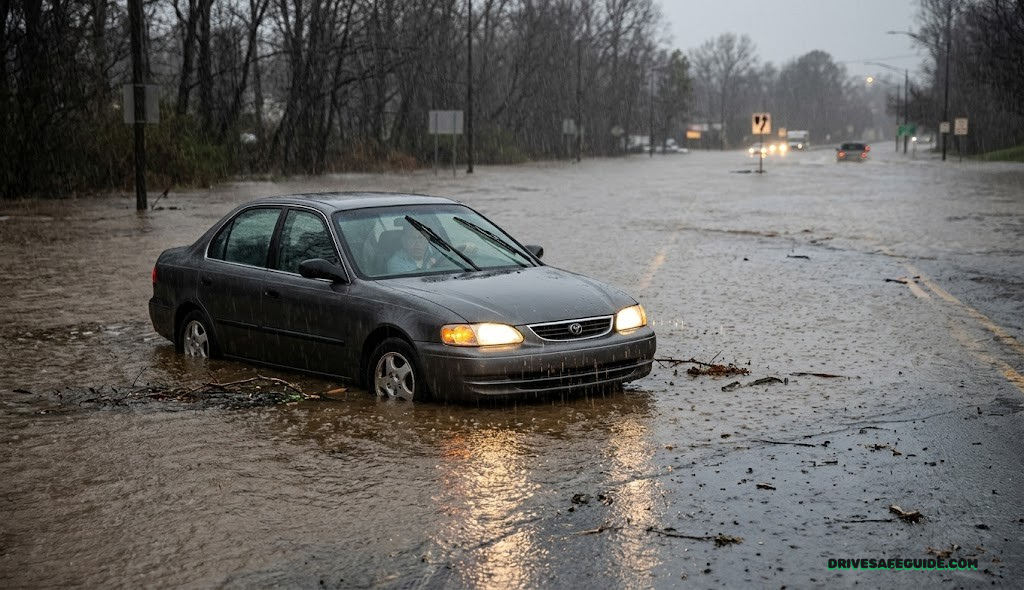
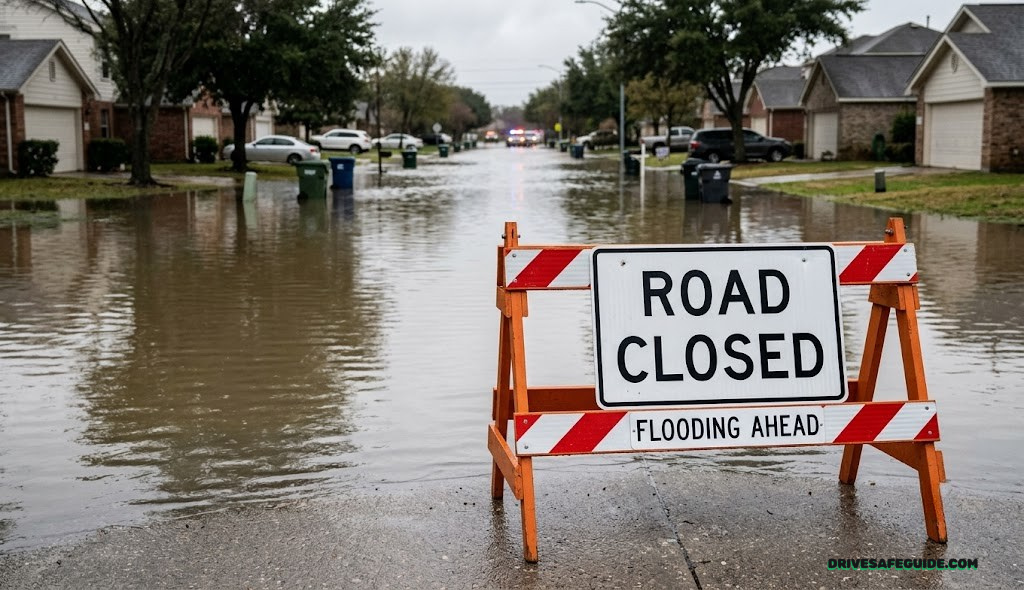
A barricaded, flooded roadway — one of the clearest signals to turn around rather than attempt a crossing.
Flash floods kill more people in their vehicles than almost any other severe weather event, and the reason is deceptively simple: most drivers dramatically underestimate what moving water can do to a car. A road that looks like it has “just a few inches” of water pooled across it can hide a washed-out shoulder, a missing section of pavement, or a current strong enough to push a two-ton SUV sideways. This guide walks through how flash floods actually threaten vehicles, how to read the warning signs before you’re committed to a flooded stretch of road, and exactly what to do if you ever find yourself trapped in rising water — plus how to prepare your car and your emergency kit so a sudden storm never catches you unprepared. If you’re building out a broader storm-driving playbook, this guide pairs well with our breakdowns of driving in high winds, rain driving safety, and black ice survival tactics.
What makes flash flood risk especially worth a dedicated guide, rather than a footnote in general storm-driving advice, is how differently it behaves compared to almost every other road hazard. Ice, fog, and heavy rain all degrade a driver’s margin gradually, giving time to slow down, pull over, or reroute well before conditions become unmanageable. Flash flooding compresses that entire timeline. A road can go from wet to impassable in the time it takes to finish a phone call, and the visual cues that would normally tip off a driver — standing water, a slowed pace of traffic ahead, a change in road sound — are often the only warning available, sometimes arriving mere seconds before a decision has to be made. That compressed timeline is exactly why pre-loaded knowledge matters so much more here than in most other driving scenarios: there usually isn’t time to look something up once the water is already ahead of you.
This guide is organized to match that reality. The first sections build the mental model — what the water is actually doing to a vehicle, and how to recognize danger before you’re anywhere near it. The middle sections cover the moment of decision, including the single rule that prevents the overwhelming majority of flash-flood vehicle incidents. The final sections shift to what happens if things go wrong anyway: how to get out of a vehicle safely, what to check afterward, and how to make sure your car and your emergency kit are already prepared long before a storm system ever appears on the radar.
1. Why Flash Floods Are More Dangerous to Drivers Than People Think
Most severe-weather driving hazards give you time to adjust — heavy rain slows traffic gradually, fog thickens over minutes, and even a snowstorm builds in stages you can watch develop. Flash floods don’t follow that pattern. Intense rainfall upstream, a blocked culvert, or a failed drainage system can turn a dry underpass into two feet of moving water in under fifteen minutes, often with no visible warning at your exact location even while the sky overhead looks unremarkable.
The physics work against the driver in three ways at once. Water is roughly 800 times denser than air, so even a modest current exerts enormous lateral force on a vehicle’s body panels. A vehicle also displaces water like a boat hull, which means once enough water surrounds it, buoyancy starts fighting against the tires’ grip on the road. And because floodwater is almost always opaque with silt, drivers can’t see whether the pavement underneath is even still there — a common cause of vehicles dropping into washed-out sections that looked like shallow puddles from the driver’s seat.
Understanding these mechanics is the foundation for every decision covered in this guide, from how you read a flooded intersection to what you do if your car is already floating. For a related look at how underestimating road conditions leads to loss of control, see our guide on hydroplaning recovery steps.
There’s also a timing problem unique to flash floods that other weather hazards don’t share quite the same way. Rain falling directly overhead is easy to notice and react to, but the water that produces a flash flood often falls miles upstream, well outside the area where you’re actually driving. By the time runoff reaches a low-lying road or a normally dry wash, the sky above you may already be clearing, which creates a false sense that the danger has passed. Local alerts and location-based weather notifications exist specifically to close that information gap, which is part of why having them active before storm season is one of the simplest upgrades a driver can make.

Keep an escape tool within reach
A spring-loaded window breaker and seatbelt cutter takes seconds to use and lives in a glovebox or console.
Check Price on Amazon2. Understanding Flash Flood Warnings vs. Watches
Weather alerts sound similar but mean very different things for a driver deciding whether to leave the house. A Flash Flood Watch means conditions are favorable for flash flooding to develop — the ground may already be saturated, or heavy rain is forecast, but flooding hasn’t started yet. This is the window to reroute a planned trip, top off your fuel, and avoid low-lying roads before conditions worsen.
A Flash Flood Warning means flooding is either happening or is imminent, based on radar-confirmed rainfall rates or reports from the ground. A warning is not a suggestion to be cautious; it’s a signal to stop driving toward the affected area immediately and, if you’re already in a vehicle nearby, to seek higher ground.
| Alert Type | What It Means | Driver Action |
|---|---|---|
| Flash Flood Watch | Conditions favorable for flooding; not yet occurring | Delay travel through low-lying areas; monitor updates |
| Flash Flood Warning | Flooding is occurring or imminent | Avoid the area entirely; do not attempt any crossing |
| Flash Flood Emergency | Rare, catastrophic flooding threatening life | Seek higher ground immediately; treat as a life-safety event |
Weather apps that push location-based alerts are worth having installed before storm season, not during it. We cover several worth trying in our roundup of apps every driver should use.
It also helps to understand why these categories exist as separate tiers rather than a single generic flood alert. A watch is fundamentally about probability and preparation — forecasters see the ingredients for flooding coming together, whether that’s a slow-moving storm cell, a saturated watershed, or an approaching tropical system, but the actual flooding hasn’t started. Treat a watch the way you’d treat a forecast of icy roads: not a reason to panic, but a clear signal to build in extra time, choose higher routes if you have the option, and stay alert to updates rather than assuming the situation is static. A warning, by contrast, is based on confirmed conditions — radar-estimated rainfall rates that exceed flooding thresholds, or direct reports of water over roads — which is why the appropriate response shifts from caution to avoidance.
Local emergency management agencies sometimes issue additional guidance layered on top of these national alert categories, such as targeted road closures or evacuation notices for specific low-lying neighborhoods. These localized alerts often carry more actionable detail than a broad regional warning, since they reflect real-time reports from crews on the ground rather than radar estimates alone. Following your local emergency management agency’s alert channels, in addition to a general weather app, closes a gap that automated forecasting alone sometimes misses.
3. The Six-Inch Rule: How Little Water It Takes to Move a Car
Federal flood-safety agencies commonly cite a rule that surprises most drivers the first time they hear it: as little as six inches of moving water can knock an adult off their feet, and that same six inches of fast-moving water reaching the underside of a car can be enough to cause a loss of traction and steering control. It doesn’t take a raging river — it takes current plus depth working together against a vehicle that was never designed to be a boat.
Those thresholds aren’t exact for every vehicle — a jacked-up pickup with a snorkel intake obviously tolerates more than a low-slung sedan — but they’re a useful mental model precisely because they’re conservative. A general guideline worth memorizing: if you cannot clearly see the pavement through the water, assume it exceeds six inches and do not proceed.
4. Reading the Road: Recognizing Flood-Prone Routes and Warning Signs
Long before water appears, the terrain around a route often telegraphs its flood risk. Low-lying underpasses, roads that run parallel to creeks or drainage channels, and areas near recent wildfire burn scars (where scorched ground can no longer absorb rain) are consistently the first places to flood. If you drive the same commute regularly, it’s worth mentally flagging which stretches sit in a dip versus on higher ground — that knowledge pays off the one time a storm catches you mid-trip.
Visual cues in the moment matter just as much. Debris lines on guardrails, water lapping at the base of road signs, floating branches or trash moving with visible current, and barricades or cones (even partially submerged or knocked over) are all signals to stop well before the waterline. Officials place barricades because they have information you don’t — about depth, about a washed-out shoulder, or about a downstream failure that’s about to send a surge through.
- Road dips below the surrounding grade, especially under bridges or overpasses
- Muddy water crossing the road rather than sitting still
- Visible movement of debris, leaves, or foam on the water’s surface
- Emergency vehicles or road crews stopped ahead with lights active
- A sudden change in road sound — water crossing pavement often has a distinct rushing note
Poor visibility compounds every one of these risks after dark or in heavy rain, which is why the habits covered in our night driving safety checklist are worth reviewing before storm season, alongside the general principles in our defensive driving habits guide.
Local knowledge is worth more than any single app or map layer, particularly in areas prone to recurring flash flooding. Long-time residents of a neighborhood often know exactly which intersection floods first, which culvert backs up in a heavy downpour, and which “shortcut” turns into a bottleneck the moment rain intensifies. If you’re new to an area or driving somewhere unfamiliar during a storm system, it’s worth asking locally or checking municipal flood-history data before assuming a route is safe simply because it’s the most direct one on a map.
5. Before You Drive: Pre-Storm Vehicle Prep Checklist
Most flash-flood incidents involve a driver who left home before the risk was on their radar. A few minutes of preparation before a storm system moves in meaningfully changes your options if conditions deteriorate while you’re already on the road.
Do this before you leave
- Check a live radar or weather-alert app, not just the morning forecast
- Confirm your route avoids known low-lying crossings if flooding is possible
- Top off your fuel tank — detours during flooding can add significant mileage
- Charge your phone fully and note where a portable charger is stored
- Tell someone your route and expected arrival time
Avoid these habits
- Relying on GPS routing alone — navigation apps don’t always reflect real-time flooding
- Assuming a “usually dry” road will behave the same in unusual rainfall
- Leaving without checking wiper condition, tire tread, and headlight function
- Driving on worn tires that already struggle in ordinary rain
Tire condition deserves special attention here — a vehicle riding on thin tread loses traction in standing water far sooner than one with healthy tires, compounding every risk described in this guide. If your car has been pulling or vibrating lately, get it checked before storm season using our notes on diagnosing highway-speed shaking. It’s also worth keeping a stocked kit in the vehicle year-round rather than assembling one the morning a storm is forecast — our guide to how to build a car safety kit covers the baseline items every vehicle should carry.
Route planning deserves more attention than most drivers give it during storm season. A default navigation route optimized for speed will happily send a driver through a low-lying underpass that’s flooded three times this year alone, simply because the app has no way of knowing that history. Before a trip during unsettled weather, it’s worth spending an extra minute scanning the route for obvious low points, bridges, and creek crossings, and having a rough mental backup in mind if the primary route turns out to be blocked. This is especially relevant for regular commutes, where a driver’s familiarity with the “normal” route can create a blind spot to how that same road behaves in unusual conditions.
It’s also worth considering timing, not just routing. If a flash flood warning is active or storm cells are tracking toward your area, delaying a non-essential trip by even thirty minutes can mean the difference between driving through clear conditions and arriving at a road that’s already closed. Where the trip can’t be delayed, favor routes on higher ground even if they add a few extra minutes, and avoid treating a flooded shortcut as worth the time saved.
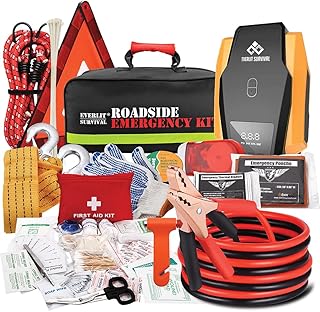
A stocked kit changes your options
Jump starter, flashlight, and first-aid basics in one compact case, ready before a storm rolls in.
Check Price on Amazon6. What To Do If You Encounter Standing or Moving Water
The moment you see water across the road ahead, the decision-making window is short and the correct default is conservative: stop well back from the water’s edge, assess, and be ready to reverse your route. Rolling forward “just to look” is how many drivers end up committed to a crossing they never intended to make, because reversing on a narrow flooded road with traffic behind you is far harder than stopping early.
If you have any doubt about depth, current, or what’s under the surface, treat that doubt as your answer. There is rarely a scenario where the time saved by crossing is worth the risk, and there is almost always an alternate route, even if it adds meaningfully to your drive time. This mirrors the same conservative logic recommended in our guide to dust storm driving protocol, where visibility and unpredictability likewise argue for stopping rather than pushing through.
One of the most persistent traps at a flooded crossing is watching another vehicle make it through and treating that as proof the crossing is safe. It isn’t. A larger or heavier vehicle ahead of you may have simply had more margin than yours does, road conditions can change between one vehicle’s pass and the next as water continues to rise or erode the surface underneath, and a successful crossing seconds ago tells you nothing about whether the current has shifted or intensified since. Base your decision on what you can verify yourself — depth, current, and road visibility — not on someone else’s outcome.
If you do stop short of a flooded section, use the time productively rather than idling in place weighing options. Check whether it’s safe to reverse and find an alternate route immediately; note whether other vehicles are backing up behind you and whether there’s room to turn around; and if you have any signal, pull up a live map or call ahead to confirm whether the road is officially closed. A few minutes spent rerouting almost always costs far less than the alternative, and it removes the temptation to reconsider crossing once traffic starts to build behind you.
7. Turn Around Don’t Drown: Why This Rule Saves Lives
“Turn Around Don’t Drown” is one of the most widely repeated pieces of flood-safety messaging for a reason — it’s simple, memorable, and correct in the overwhelming majority of cases. The rule exists because human intuition about water depth is consistently wrong: studies and post-incident reviews repeatedly find that drivers underestimate depth by a significant margin when judging by eye, especially at night or when water is muddy and opaque.
The rule also accounts for a psychological trap that catches experienced drivers as often as new ones: sunk-cost thinking. Once you’ve already driven partway into water, turning back can feel like giving up progress you’ve already made, but that instinct ignores that the safest point to reverse is always the earliest one. If you find yourself already partway across and the water is still shallow enough to see the road, back out the way you came rather than continuing forward on the assumption it will get better.
- Never drive around a barricade placed at a flooded crossing, even if the water looks shallow
- Assume every flooded road is unsafe until you have clear, verified information otherwise
- If in doubt, don’t go out — wait for water to recede and official confirmation the road is clear
This same conservative mindset extends to other sudden-onset hazards, including the guidance in our piece on never swerving for a deer — in both cases, the instinctive reaction is often the wrong one, and the trained response saves lives.
8. If Your Vehicle Starts to Float or Stall in Water
A stalled engine in floodwater is a serious event, but it is not automatically a life-threatening one — what happens next depends entirely on how you respond in the first sixty seconds. The priority shifts immediately from “get the car moving again” to “get yourself and your passengers to safety,” because a stalled vehicle in rising or moving water can begin to float, rotate, or be pushed off the road surface even while the engine sits dead.
If the vehicle is still on solid ground and water is not actively rising, it may be reasonable to stay put briefly and call for help. But if water is visibly rising around the vehicle, entering the cabin, or the vehicle has started to shift or drift, treat it as a get-out-now situation. Waiting to see what happens is the single most common mistake in flash-flood vehicle incidents.
| Situation | Recommended Response |
|---|---|
| Engine stalls, water is shallow and stable | Stay calm, call for help, monitor water level closely |
| Water is visibly rising around the vehicle | Unbuckle, get out immediately, move to higher ground on foot |
| Vehicle begins to float, rotate, or drift | Exit through a window without delay; do not wait for doors to open easily |
| Water is entering the cabin | Treat as a submersion emergency — see the escape protocol below |
It’s worth understanding why a stalled engine specifically raises the stakes rather than just being an inconvenience. Once the engine dies, power windows, power door locks, and in some vehicles even the ability to shift out of park can be affected, depending on how much of the electrical system has been compromised by water intrusion. This is exactly why acting in the first moments after a stall matters so much — the tools and systems you’d normally rely on to exit calmly may not stay available for long. If your vehicle stalls in water, treat the first attempt to open a door or window as time-sensitive rather than something to try at a leisurely pace.
Passengers add another layer of complexity that’s worth planning for in advance rather than improvising in the moment. If you regularly drive with children, older passengers, or anyone who might need extra help exiting quickly, it’s worth briefly talking through the plan before a storm season begins — where the escape tool is kept, how a window is broken safely, and who exits first to help pull others out. A calm, rehearsed plan executes far better under stress than one being invented on the spot.
9. Escaping a Submerging Vehicle: Step-by-Step Survival Protocol
Vehicle submersion is disorienting, and cold water combined with panic can quickly overwhelm normal decision-making. Rehearsing the sequence mentally — even just reading through it once — measurably improves the odds of a calm, effective response if it’s ever needed.
- Unbuckle first. This should be an automatic reflex the instant you recognize the vehicle is going into deep or moving water, before you do anything else.
- Unlock and try the door immediately. Doors open normally for a brief window before water pressure outside exceeds pressure inside the cabin — that window closes faster than most people expect.
- If the door won’t open, go for a window. Power windows often still function briefly on battery power even after the engine stalls; try them first, then use a dedicated window-breaking tool aimed at a corner of the glass, not the center.
- Get children and pets out first if possible, but prioritize creating an exit. A parent unable to escape helps no one; open the exit route, then assist others through it.
- Once out, swim or wade to the nearest stable, elevated ground — not necessarily the shortest path, but the path away from current and toward solid footing.
- Signal for help once safe. A whistle, a phone in a waterproof pouch, or simply shouting and waving from high ground all improve the odds of a fast rescue response.
Tools designed specifically for this scenario — spring-loaded glass punches and seatbelt cutters — are inexpensive, small enough to mount to a visor or center console, and remove the single biggest point of failure in an escape: fumbling for an improvised tool under stress. For a deeper comparison of options, see our review of emergency car escape tools. It’s also worth reviewing our dedicated guide on vehicle submersion escape for additional detail on buoyancy timing and cabin air pockets.
A vehicle typically doesn’t sink instantly, and understanding roughly how that process unfolds can reduce panic if it ever happens. Most cars float briefly as air trapped in the cabin and undercarriage provides buoyancy, which is often the best window to act calmly rather than the moment to freeze. As water finds its way in through door seals, vents, and gaps, that buoyancy decreases and the vehicle gradually settles and begins to tilt, frequently nose-first, since engine weight sits at the front of most vehicles. This staged process is exactly why the first sixty to ninety seconds matter so much: it’s typically the window where doors and windows are still operable and the interior hasn’t fully flooded, not a moment to be spent stunned or searching for a phone.
If every exit seems physically blocked and the cabin continues to fill, a small air pocket often persists near the roofline briefly. This is a last-resort fact worth knowing, not a strategy to plan around — the priority in every case remains getting an exit open in those first critical moments rather than waiting for or relying on an air pocket to buy additional time.
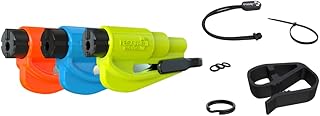
Mount it where you can reach it blind
A visor-clip escape tool means you’re not searching a glovebox while water is rising.
Check Price on Amazon10. After the Flood: Assessing Vehicle Damage and Electrical Risks
Even a vehicle that made it through shallow water without stalling isn’t automatically in the clear. Silt-laden water works its way into places a casual glance won’t catch — behind brake rotors, into connector housings, and along wiring harnesses low in the engine bay. A short post-flood inspection catches most of these issues before they become expensive failures weeks later.
- Avoid restarting the engine if you suspect water reached the air intake — hydrolock can cause serious internal engine damage
- Check the engine oil for a milky or cloudy appearance, which indicates water contamination
- Test brakes cautiously at low speed once safe, since wet brake components can perform inconsistently until dried
- Inspect and dry electrical connectors, fuse boxes, and interior carpeting to prevent corrosion and mold
- Have a qualified technician scan for stored fault codes even if the car seems to be running normally
Vehicles with more advanced driver-assistance sensors are worth extra scrutiny after any flood exposure, since sensor housings low on the bumper can trap moisture. If your dashboard shows any warning lights after driving through water, don’t dismiss them — cross-reference against our guide on solid vs. flashing check engine lights to judge whether it’s safe to continue driving or time to stop immediately.
Insurance is another area drivers overlook until it’s too late. Flood damage is typically covered under comprehensive coverage rather than standard liability or collision policies, so it’s worth confirming what your policy actually includes before storm season rather than during a claim. Photograph the vehicle’s interior and exterior as soon as it’s safe to do so, note the approximate water line if the cabin was affected, and keep any towing or inspection receipts — thorough documentation makes the claims process considerably smoother if a repair becomes necessary.
Odor is an underrated diagnostic tool after any flood exposure. A persistent musty smell days after the water has receded usually means moisture is trapped somewhere in the carpet padding, insulation, or HVAC system rather than having fully dried out, and that trapped moisture is a common precursor to mold growth and long-term corrosion in wiring harnesses that run beneath the cabin floor. Pulling floor mats, running the HVAC fan with windows cracked, and, where practical, having carpet padding professionally dried or replaced after significant water intrusion goes a long way toward preventing problems that are far more expensive to fix once they’ve set in than they would have been to address immediately.
11. Flash Flood Safety by Vehicle Type: Sedan vs. SUV vs. Truck vs. EV
No vehicle is flood-proof, but ground clearance, intake location, and weight distribution do change how much margin a driver has before water becomes dangerous. The table below is a general comparison — actual thresholds vary by specific model, trim, and modification.
| Vehicle Type | Typical Advantage | Key Risk |
|---|---|---|
| Sedan / low-clearance car | Lower center of gravity aids stability at very shallow depths | Stalls and floats at the lowest water depths of any vehicle class |
| Crossover / mid-size SUV | Moderate ground clearance buys extra margin | Still floats readily once water exceeds roughly a foot |
| Truck / body-on-frame SUV | Highest stock ground clearance and intake position | Higher center of gravity increases tip and drift risk in fast current |
| Electric vehicle | Sealed, low-mounted battery pack is engineered for water resistance | Substantial weight can still be overcome by strong current; charging systems need post-flood inspection |
A common misconception is that a taller vehicle is “safe” in floodwater — in practice, the extra clearance mainly buys time and a slightly higher depth threshold, not immunity. Drivers of any vehicle type benefit from reviewing our winter-specific comparison in front-wheel drive safety in winter, since many of the traction principles carry over to flood-prone conditions.
What higher clearance actually buys you
- A few extra inches before water reaches the air intake
- Slightly better visibility of the road surface ahead
- More time to react before the cabin floor is affected
What it doesn’t change
- Current force still acts on the full side profile of the vehicle
- Brakes, sensors, and electronics remain equally vulnerable
- A strong enough current can still float or displace any vehicle
Aftermarket modifications can shift these numbers somewhat, but they’re not a substitute for good judgment. A raised suspension or a relocated air intake buys a real vehicle a little more depth tolerance, and drivers who regularly encounter unpaved, flood-prone routes sometimes invest in exactly that kind of setup. Even so, no amount of ground clearance changes the fact that opaque water hides washed-out pavement equally well under any vehicle, and no factory or aftermarket modification is rated to withstand a genuine current strong enough to move a loaded vehicle sideways.
12. Building a Flash-Flood-Ready Emergency Kit
A well-stocked kit doesn’t prevent a flash flood, but it changes the range of outcomes if you’re ever caught by one — whether that means waiting out a stranded hour safely or having the right tool within arm’s reach during an escape. The core list below overlaps with general storm preparedness, so if you already keep a winter car emergency kit, you’re most of the way there.
- Window-breaker and seatbelt-cutter tool, mounted somewhere reachable without looking
- Waterproof flashlight with a spare battery or hand-crank backup
- Portable power bank, kept charged, for a phone that may need to call for rescue
- Small first-aid kit for cuts sustained during a window-breaking escape
- Whistle for signaling location if visibility is poor
- Road flares or LED beacons to warn other drivers away from a flooded stretch
- A physical, offline map or printed route in case cellular service drops during a storm
It’s worth thinking about kit placement as carefully as kit contents. A perfectly stocked bag buried under luggage in the trunk does little good if the cabin is filling with water — the items most relevant to an in-cabin emergency, like the window-breaker, seatbelt cutter, and flashlight, belong within arm’s reach of the driver’s seat, not packed away. Reserve the trunk for items you’d need after escaping the vehicle, such as a first-aid kit or a change of dry clothing, and periodically check that batteries in flashlights and power banks are still holding a charge, since a kit assembled once and never revisited tends to fail quietly over time.
For the flare or beacon component specifically, durability matters more than in dry-weather use — look for units rated for wet conditions rather than standard road flares. Our full breakdown of crushproof, waterproof LED road flares compares several options built for exactly this scenario. And if you’re assembling a kit from scratch rather than adding to an existing one, our general road trip essentials checklist is a solid starting frame to build from.

Warn other drivers, don’t just protect yourself
Waterproof LED beacons stay visible even where a flooded shoulder makes a standard flare useless.
Check Price on AmazonFrequently Asked Questions
How much water does it take to move a car?
As little as six inches of moving water can begin affecting traction and control, and around twelve inches can float many sedans and small SUVs off the road entirely.
Is it safe to drive through standing water on a road?
Only if you can clearly see the road surface, know the exact depth, and are certain there’s no current — in practice, that’s rarely something you can confirm from the driver’s seat, so the safest default is to avoid it.
What should I do if my car stalls in floodwater?
Unbuckle, unlock the doors, and get out to move toward higher ground on foot rather than waiting inside, especially if the water is rising or moving.
Why do doors get hard to open when a car is in water?
Once water outside the cabin is higher than water inside, pressure against the door makes it very difficult to push open — which is why exiting through a window early is often the more reliable option.
Should I stay in my car or get out during a flash flood?
If the vehicle is on stable, dry ground and out of the water’s path, staying inside is often fine; if water is rising around or inside the vehicle, getting out and moving to higher ground is generally safer.
What is the “Turn Around Don’t Drown” rule?
It’s a safety reminder to never attempt a crossing of a flooded road and instead turn around and find another route, since floodwater depth and the road beneath it are unpredictable.
Can floodwater damage a car even if the engine doesn’t stall?
Yes — even a brief pass through shallow water can push silt into brakes and moisture into electrical connectors, so a post-flood inspection is worthwhile regardless of whether the car kept running.
Is an SUV or truck safer than a sedan in a flash flood?
Higher clearance offers a modest edge in shallow water, but that advantage narrows quickly, and any vehicle can be swept away once water becomes a fast-moving current.
What tools should I keep in my car in case of a flash flood?
A window-breaking tool, a seatbelt cutter, a charged phone or power bank, and a waterproof flashlight are commonly recommended as within-reach essentials.
How fast can a flash flood happen?
Flash floods can develop within minutes of intense rainfall or an upstream failure, often without obvious warning at your exact location.
Does electric power in a car increase electrocution risk in floodwater?
Modern EVs and hybrids use sealed, isolated high-voltage systems with automatic shutoffs, so the primary danger in floodwater remains the water and current itself, not electrocution from the battery.
What should I do after driving through a flooded road by mistake?
Get to dry, stable ground, avoid restarting the engine if water may have entered the intake, and have the vehicle inspected for water intrusion before driving further.
The Bottom Line on Flash Flood Vehicle Safety
Flash floods reward caution and punish hesitation in equal measure — the drivers who come through safely are almost always the ones who turned around early, not the ones who tried to judge depth by eye and got it right. Build the habits in this guide into muscle memory: check alerts before you drive, treat every flooded road as a stop signal by default, and keep an escape tool and a stocked kit within reach so a worst-case moment never depends on searching for the right gear under pressure.
None of this preparation needs to feel like an extra burden layered onto ordinary driving. Most of it comes down to habits you build once and then carry forward automatically — glancing at a weather alert before a trip, keeping a small escape tool clipped where you’d actually reach it, and defaulting to “not today” the instant a road ahead looks even slightly uncertain. Those small, repeatable choices are what separate a close call from a tragedy, and they cost almost nothing compared to what they protect. Pair this guide with our broader pre-departure risk checklist and scenario-based road trip essentials so you’re prepared for flooding alongside every other severe-weather condition on the road.
Shop Flood Safety Essentials on Amazon🚗 Recommended for Drivers
Drive Safer Every Day
Explore our top picks for car safety gear — from dashcams to emergency kits — all hand-picked to help you stay safe on the road.
🚗 Shop Car Safety EssentialsAffiliate link — we earn a small commission that keeps DriveSafeGuide running. Thank you!