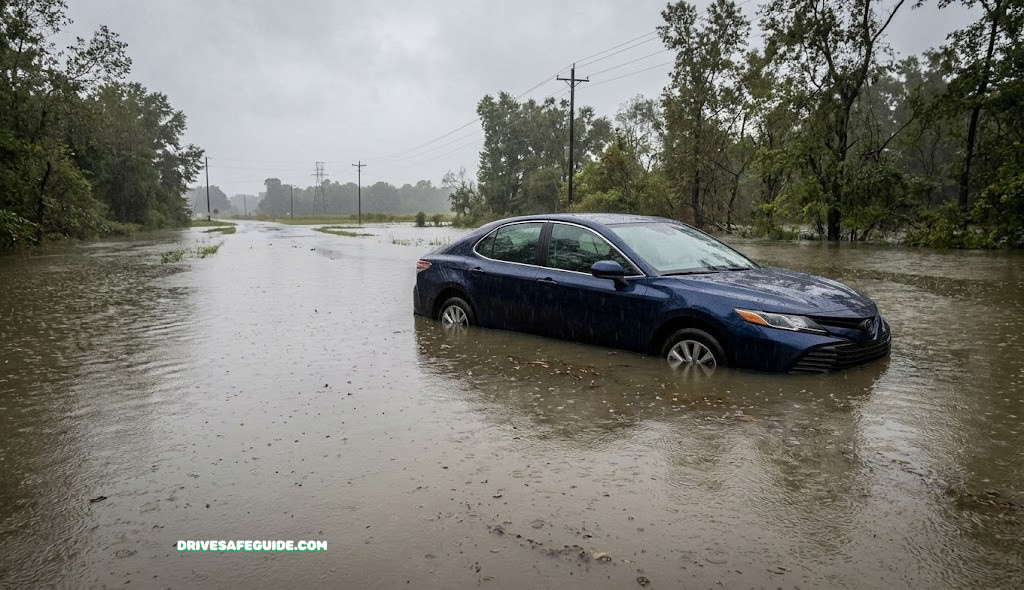
Surviving Vehicle Submersion: A Comprehensive Guide
What actually happens when a car goes into the water, how much time you really have, and the exact sequence trained responders teach for getting yourself and your passengers out alive.
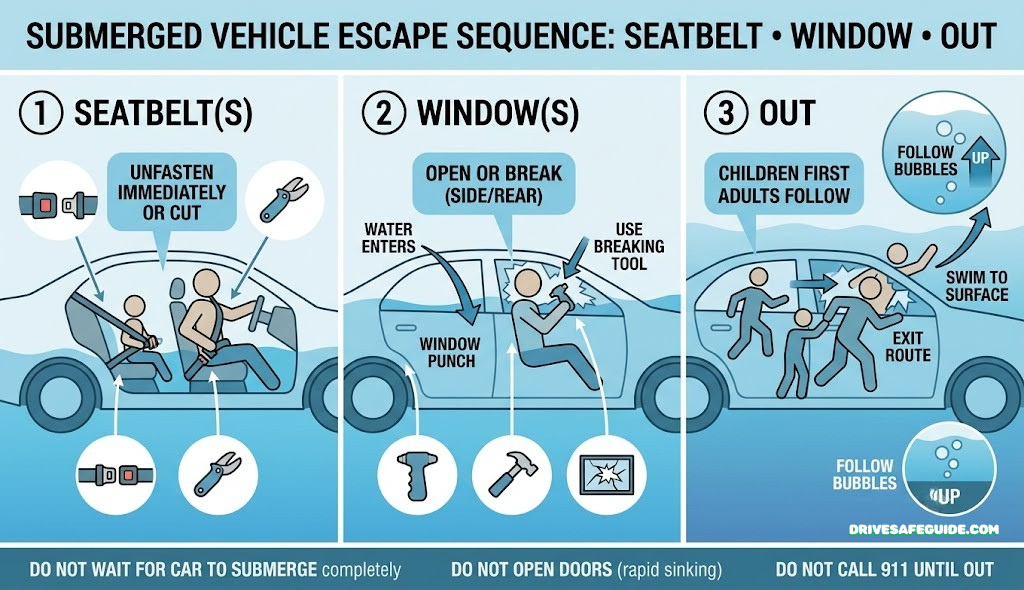
If your car enters deep water, the priority order that safety researchers and rescue trainers teach is simple to remember but easy to forget under stress. Say it now, before you ever need it.
- 1 · SEATBELTS OFF
- 2 · WINDOW OPEN
- 3 · OUT
- 4 · CHILDREN FIRST
Don’t wait for the car to fill with water before trying the door — that instinct is exactly backwards, and the rest of this guide explains why.
Why This Emergency Is Different From Any Other Crash
Most driving emergencies give you a fighting chance to react with your training on collision avoidance: braking, steering input, defensive positioning. A vehicle entering water is different, because the danger doesn’t peak at the moment of impact — it builds for the next one to two minutes, and it’s almost entirely up to you, not the car’s safety systems, to get everyone out. Airbags, crumple zones, and anti-lock brakes were engineered to protect you from the crash itself. None of them do anything to help you escape afterward.
It’s a rare event. Depending on the year and dataset, submersion crashes make up a very small fraction of all reported collisions nationally. But rarity is precisely the problem: because so few drivers ever rehearse this scenario, panic and hesitation cost far more lives than the physical difficulty of the escape itself. Researchers who study cold-water and submersion survival consistently find the same pattern in fatal cases — occupants who survived the initial impact with little or no injury, but who ran out of time or air while trying to figure out what to do.
The good news is that the physics of a sinking car are well understood, the sequence of events is predictable, and the correct response has been tested, refined, and taught by search-and-rescue professionals for years. This guide walks through that sequence in detail, alongside the tools and preparation that meaningfully improve your odds. If you haven’t already, it’s worth reading our companion page on escaping a submerged vehicle for a condensed field-reference version of everything covered here, and our breakdown of flash flood vehicle safety for what to do before you’re ever in the water at all.
The number that matters most
Vehicle submersion accounts for a meaningful share of drowning deaths nationally each year — several hundred fatalities annually by most estimates. The overwhelming majority of the people involved survived the crash itself. What killed them was the escape, not the impact.

Keep a spring-loaded escape tool within arm’s reach
A keychain-sized tool that breaks tempered glass and cuts a jammed seatbelt in one motion, designed to work even underwater.
Check Price on AmazonAnatomy of a Sinking Car: What Actually Happens Second by Second
A car that enters deep water doesn’t sink like a dropped stone. Modern vehicles are surprisingly buoyant at first, because the cabin is essentially a sealed air pocket sitting on top of a heavier engine block. That imbalance is the first thing worth understanding, because it explains almost everything that follows.
Stage 1 — The Float
Immediately after entering the water, most vehicles will float for a short period, commonly somewhere between thirty seconds and two minutes depending on the make, the integrity of the door seals, and whether any windows were already open. During this stage the cabin is still largely dry, the electrical system is often still functioning, and — critically — this is your best and safest window to act.
Stage 2 — The Nose-Down Tilt
Because the engine is heavy and sits at the front, the vehicle typically settles into a nose-down angle as water begins to find its way in through door seams, vents, and any gaps. Water usually enters from the bottom and front first. This is often when panic sets in, because the car visibly starts to feel unstable — but this stage still offers a real chance to escape if you’ve already started moving through the sequence in Stage 1.
Stage 3 — Cabin Filling and Pressure Equalization
As water rises inside the cabin, the pressure on the inside of the doors slowly rises to match the pressure pushing in from outside. Once the cabin is mostly full, the door pressure equalizes and — in theory — the door can be pushed open. The problem is timing: by the time equalization happens, most people have far less breath and far more disorientation than they started with. This stage should be treated as a fallback, not a plan.
Stage 4 — Full Submersion and Possible Inversion
Some vehicles roll or invert as they sink, especially if they entered the water at an angle or rolled during the initial crash. Disorientation is common here, particularly in murky or dark water where there’s no visual reference for which way is up. Anyone still inside at this stage is in a genuinely critical situation, which is exactly why every step in this guide is built around never reaching Stage 4 with anyone still in the car.
Understanding these four stages is what makes the escape sequence in the next section make sense — it isn’t an arbitrary checklist, it’s a direct response to how the car behaves physically over time. For a related look at how vehicles lose predictable handling in water at speed rather than fully submerging, see our guide to hydroplaning recovery.
| Stage | Approx. Timing | What’s Happening | Your Move |
|---|---|---|---|
| 1. Float | 0–30 sec | Cabin mostly dry, car floats | Seatbelt off, window down, exit now |
| 2. Nose-down tilt | 30–60 sec | Water entering, front sinks first | Still time — do not hesitate |
| 3. Equalization | 60–120 sec | Cabin filling, door pressure evens out | Last-resort door push if window failed |
| 4. Submersion | 120 sec+ | Fully underwater, may invert | Critical — orient toward air pocket |
The First 60 Seconds Decide Almost Everything
If there’s one idea to take from this entire guide, it’s this: your best chance to get out happens while the car is still floating, not after it sinks. Every safety organization and rescue researcher who studies this scenario converges on the same conclusion, even when the exact wording of their advice differs slightly.
The instinct many people have — to wait, assess, and try the door handle first — is understandable, but it works against you. Water pressure against a closed door climbs quickly, and within moments the door becomes physically impossible to push open from the inside no matter how strong you are. Meanwhile, the window is still very much usable. Recognizing this reflex in yourself before it happens is genuinely one of the most useful things you can take away from this guide, alongside the habits covered in our broader look at defensive driving habits that reduce collision risk in the first place.
Fight the freeze response
Cold water and sudden shock trigger an involuntary gasp reflex and a brief cognitive freeze in almost everyone, regardless of swimming ability. Naming this response in advance — “I might freeze for a second, and that’s normal” — measurably helps people move through it faster when it actually happens.
Practically, this means treating the first few seconds like a checklist you’ve already memorized, not a problem you’re solving for the first time. That’s the entire purpose of a mnemonic like the one in the next section — it turns a complex, high-stress decision tree into four words you can execute on autopilot.
The Escape Sequence: Seatbelt, Window, Out, Children First
Search-and-rescue trainers, child-safety organizations, and cold-water survival researchers have converged on a short sequence that’s designed to be remembered under extreme stress, when working memory and fine motor control are both compromised by adrenaline. It’s usually taught as an acronym so it can be recited rather than reasoned through in the moment.
Step 1 — Seatbelts Off
The instant the car contacts water, release your seatbelt and tell any passengers to do the same. A seatbelt that saved your life in the collision becomes an obstacle the moment you need to move quickly, and fumbling with a jammed buckle is one of the most commonly cited reasons rescuers give for why an otherwise survivable situation turned fatal. If a buckle is stuck, this is exactly the situation a seatbelt-cutting tool is built for.
Step 2 — Window Open (Not the Door)
Go for the window immediately, using the electric switch first since it may still work briefly, and moving to a manual break-in tool without hesitation if it doesn’t respond. Do not try the door at this stage. For a closer look at exactly why side glass behaves so differently from the windshield, the next section walks through it in detail. See our review of emergency car escape tools for how these devices perform in real testing.
Step 3 — Out
Once the window is open, exit through it rather than waiting for the door to become usable. Push yourself through feet-first or head-first depending on space, and don’t pause to gather belongings — a phone, a bag, or a wallet is never worth the seconds it costs you.
Step 4 — Children First
This is the step where guidance differs slightly depending on the source, and it’s worth understanding why rather than memorizing a single rigid rule. Some organizations teach that children should be pushed out through the window before any adult exits, on the theory that every second matters and children are lighter and easier to move through a window opening. Other researchers, having studied real rescue outcomes, now recommend that the nearest capable adult exit first and then pull children out from outside the vehicle, because a child struggling alone with an unfamiliar window opening in a panic can lose critical time. In either case, the underlying principle is identical: children should never be the ones figuring out the exit on their own. Whichever version you drill with your family, drill it — actually sitting in the car and practicing the motions, without water, makes an enormous difference to how fast everyone moves in a real event.
Practice this at home, right now
Sit in the driver’s seat with the engine off. Time yourself: unbuckle, reach for the window switch, then reach for the door handle. Do it again with your eyes closed. Most people are surprised by how much slower and more hesitant they are than they expected — which is exactly the point of practicing.
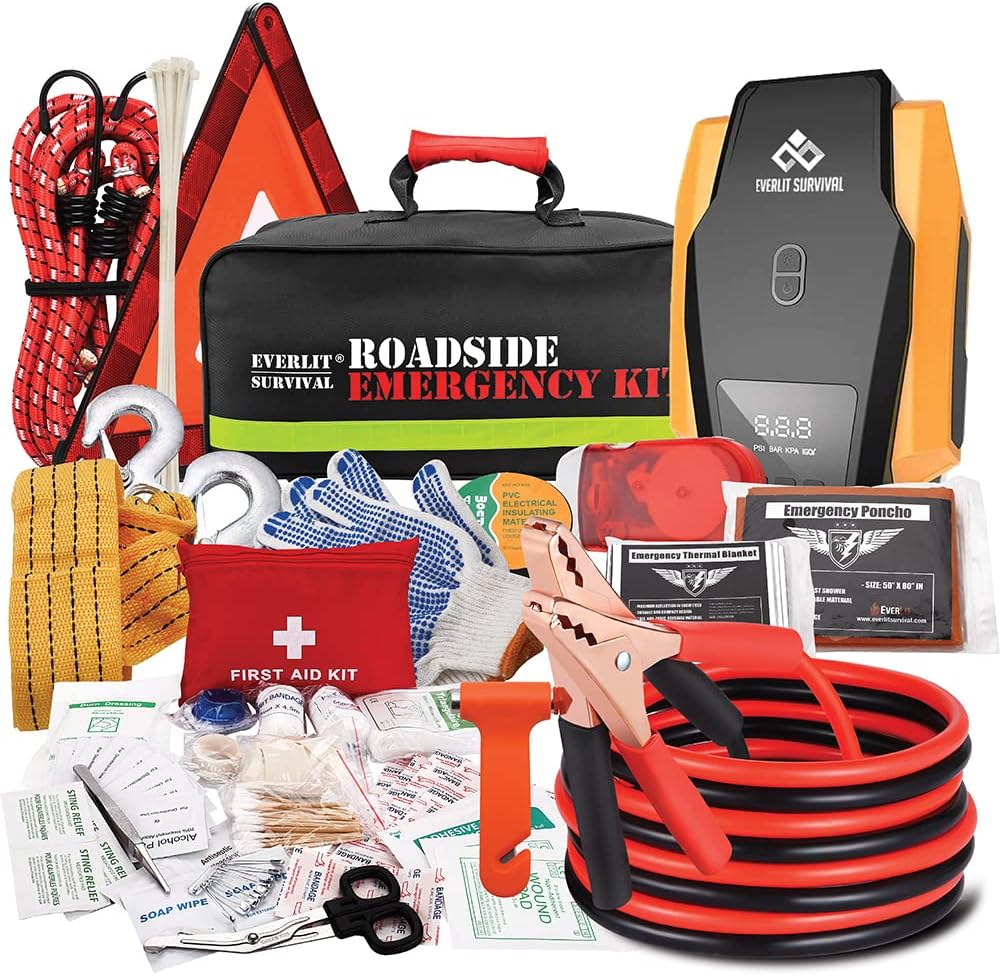
Pair your escape tool with a full car safety kit
A basic kit covering first aid, a flashlight, and roadside basics rounds out your preparation beyond just the escape tool.
Check Price on AmazonWindows vs. Windshield: Why Not All Glass Is Equal
One of the most repeated pieces of advice from rescue trainers is also one of the most counterintuitive at first glance: never target the windshield. It’s the largest piece of glass in the car, so it feels like the obvious escape route, but it’s built specifically to resist exactly the kind of impact you’d apply trying to break it.
Laminated Glass (Windshields)
Windshields use laminated glass — two layers of glass bonded to a flexible plastic interlayer. This design keeps the windshield intact even when cracked, so it doesn’t shatter into the cabin during a crash or eject outward. That flexibility is a safety feature in a collision, but it also means the glass absorbs impact rather than breaking cleanly, making it extremely difficult to punch through with hand tools, even purpose-built ones. Independent testing by automotive safety researchers has repeatedly found that none of the common civilian escape tools reliably break laminated glass.
Tempered Glass (Most Side and Rear Windows)
Side and rear windows are traditionally made of tempered glass, which is heat-treated so that when it does break, it shatters into small, relatively blunt pieces rather than long shards. This is the glass type that spring-loaded and hammer-style escape tools are designed to defeat, usually by focusing a sharp, concentrated point of impact into one corner of the pane rather than the center.
Check your own car before you need to know
Look for a small etched label in the bottom corner of each window — it will indicate “tempered” or “laminated.” An increasing number of newer vehicles use laminated glass on front door windows as well, for noise reduction and to prevent occupant ejection, which means the escape tool that works on your rear window may not work on your front one. Know which windows in your specific car are actually breakable before an emergency forces you to guess.
This distinction also matters if you’re dealing with a cracked windshield in everyday driving, not just in a submersion scenario — see our guide on driving with a cracked windshield for how these glass standards apply on the road generally.
Choosing and Using a Window-Breaking Tool
Not all escape tools are built the same way, and independent testing has found real, meaningful performance differences between the two dominant designs. Given how little time and space you may have underwater, this is not a category where “close enough” is good enough.
Spring-Loaded Punches
These small tools use a spring-loaded metal point that releases with a sharp mechanical snap when pressed firmly against glass — no swing required. That matters enormously in a submerged, confined space where you may not have the room, leverage, or strength left to swing a hammer-style tool effectively. In controlled testing by automotive safety researchers comparing multiple tool designs, spring-loaded punches consistently and reliably broke tempered glass, while performance among hammer-style tools was inconsistent.
Hammer-Style Tools
These rely on you generating force by swinging the tool’s pointed head into the glass. They can work well in open, dry conditions with a clear swing path, but underwater — where movement is slowed by resistance and space is often extremely limited — that swing becomes far harder to execute with enough force.
Spring-Loaded Punch — Pros
- Works with a simple press, no swing needed
- Effective even in a cramped, confined space
- Reusable and typically very compact
- Often combined with a seatbelt cutter in one tool
Hammer-Style Tool — Cons
- Requires room and force to swing effectively
- Underwater resistance blunts swing speed
- Performance varies significantly between models
- Harder to use one-handed while holding a child
| Feature | Spring-Loaded Punch | Hammer-Style Tool |
|---|---|---|
| Activation | Press against glass | Requires a swing |
| Space needed | Minimal | Significant |
| Works on tempered glass | Consistently, per independent tests | Inconsistent, per independent tests |
| Works on laminated glass | Not reliably | Not reliably |
| Seatbelt cutter included | Often, in combo tools | Sometimes |
| Best mounting spot | Keychain, visor clip | Center console, door pocket |
Whichever tool you choose, mount one within reach of every seating position if possible, not just the driver’s seat — our guide to building a full car safety kit covers exactly where to store gear like this so it’s actually reachable in an emergency rather than buried in a trunk.

Look for a spring-loaded punch, not a hammer-style tool
Independent testing consistently favors spring-loaded designs for reliability on tempered glass in confined, underwater conditions.
Check Price on AmazonIf the Window Won’t Open and the Door Won’t Budge
Occasionally a window escape genuinely isn’t possible — the glass is laminated, the tool has failed, or the window frame is damaged from the initial impact. In that specific situation, some rescue trainers teach a technique built around waiting for pressure to equalize, but it needs to be understood clearly as a fallback of last resort, not a primary plan, because of how physically and mentally demanding it is.
How the technique works, in principle
As the cabin fills with water, an air pocket typically remains near the ceiling, especially as the car tilts. The idea is to position yourself to breathe from that pocket for as long as possible while the cabin continues filling. Once the water level inside is close to matching the level outside, the pressure against the door equalizes and it becomes physically possible to push open, at which point you swim out.
Why this should be your backup plan, not your first move
This approach demands holding your breath for a period that most people significantly underestimate, often over a minute, in cold water, in the dark, while disoriented — conditions that are about as unfavorable for breath-holding as they come. It also depends entirely on locating and staying at an air pocket that may be shrinking or shifting as the car settles or rolls. This is precisely why every other section of this guide is built around getting through a window during Stage 1, while the situation is still manageable, rather than relying on this technique at all. Similar last-resort thinking applies to other rare but serious driving emergencies — see our guides on reacting to brake fade versus hydraulic failure and handling a sudden power steering failure for the same principle applied elsewhere.
The takeaway
Pressure equalization is a real, documented technique — but it is what you fall back on when everything else has failed, never the plan you start with. Everything earlier in this guide exists to help you avoid ever needing it.
Escaping With Children, Pets, and Multiple Passengers
Every additional person or animal in the car adds complexity to an already time-critical situation. Planning for this in advance, rather than improvising in the moment, is where families and pet owners can meaningfully change the outcome.
Children in Car Seats
Car seat harnesses are, by design, more secure and more complicated to release than a standard seatbelt — which is exactly right for crash protection and exactly wrong for a fast underwater exit. Practicing the release mechanism with your eyes closed, in a parked and stationary car, builds the muscle memory you’ll need if visibility is poor or the cabin is dark. Anyone who regularly drives your children, not just the primary caregiver, should be comfortable doing this too.
Multiple Adult Passengers
Assign zones of responsibility before it’s ever needed, if you regularly drive with the same people: whoever is nearest a given window is responsible for that window and for anyone seated near it. In a real event, a few seconds of clear division of labor beats everyone reaching for the same exit at once.
Pets
A frightened animal in a filling cabin can be genuinely difficult to control, and pets cannot operate a window or door release themselves. If your pet travels in a harness, use it to guide or lift them toward the open window rather than relying on a collar alone, which can slip. Prioritize your own exit and the exits of any children first — you’re far more useful to your pet once you’re outside able to help than if you’re still trapped trying to manage them from inside. Our guide on traveling safely with a dog covers restraint options that also make emergency handling easier.
A five-minute family drill is worth more than any single tool
Once a year, sit everyone in the car, engine off, and walk through the sequence together: seatbelts, windows, exit order, who’s responsible for whom. It costs nothing and consistently shows up in survivor accounts as the difference between hesitation and immediate action.

Mount a tool at every seating position, not just the driver’s
Compact enough to clip near each seat so every capable passenger can reach one without searching.
Check Price on AmazonStaying Alive Underwater: Breath, Orientation, and Panic Control
Even with the right sequence memorized, the physical and psychological experience of being in a sinking car is disorienting in ways that are hard to fully prepare for. A few specific pieces of knowledge make a measurable difference.
Controlling the panic response
Sudden cold-water immersion triggers an involuntary gasp reflex in nearly everyone, along with a spike in heart rate and a brief window of impaired decision-making. Recognizing this as a normal, temporary physiological response — rather than a sign that something has gone catastrophically wrong beyond the obvious — helps you move through it rather than freeze in it. Slow, deliberate breathing for even two or three seconds before acting can meaningfully steady your following decisions.
Finding “up” when you’re disoriented
In murky, dark, or fast-moving water, it’s genuinely difficult to tell which direction leads to the surface, especially if the car has rolled. If you’re fully submerged and disoriented, look for bubbles from your own exhaled air or from the car itself — they consistently travel upward, and following them can reorient you faster than trying to reason it out visually.
Managing your breath, honestly
Most people significantly overestimate how long they can comfortably hold their breath under stress, cold, and physical exertion combined. This is exactly why the entire emphasis of this guide is on exiting during Stage 1, while you still have air and the car hasn’t filled — not on how long you can hold out once submerged.
These same principles — staying calm, orienting deliberately, and not trusting your first instinct under stress — show up across other rare driving emergencies too, including our guide on reacting when you encounter a deer on the road and shouldn’t swerve, where the instinctive reaction is also frequently the wrong one.
After the Escape: What to Do Once You’re Out
Getting out of the vehicle is the hardest part, but it isn’t automatically the end of the danger, particularly in moving water, floodwater, or cold conditions.
Assess before you swim
If the car is still partially floating and shore is far away or the current is strong, holding onto the vehicle or any floating debris is often safer than attempting to swim, since cold water and adrenaline crash quickly sap swimming strength. If you do need to move through the water, swimming at an angle across a current rather than directly against it conserves far more energy.
Signal for help deliberately
Once you’re in a stable position, focus on being seen and heard rather than immediately trying to problem-solve everything else. Shouting, waving an arm, or using anything reflective can draw attention faster than you’d expect near roads or waterways. Our guide on using an emergency signal mirror covers a low-cost tool worth having for exactly this kind of situation.
Get everyone accounted for, then get warm
Confirm every passenger and pet is out and accounted for before doing anything else. Once safe, cold-water exposure and shock can set in even after the immediate danger has passed — get to warmth and dry clothing and seek medical evaluation, even if everyone feels physically fine, since shock and hypothermia symptoms can appear with a delay.
Be cautious around floodwater specifically
If the submersion happened in a flood rather than a lake or river, be aware the water itself may be contaminated with chemicals, sewage, or debris, and currents can be far stronger than they appear from a distance. Avoid wading through moving floodwater to reach “safety” if staying put and waiting for rescue is a realistic option instead.
Preventing the Scenario Before It Ever Happens
The single most effective piece of vehicle submersion advice has nothing to do with escape technique: never drive into water you can’t clearly assess. A remarkable number of submersion incidents happen not because a driver lost control, but because they deliberately drove onto a flooded road, misjudging the depth.
Floodwater is deceptive
Moving water as shallow as roughly a foot deep can float and sweep away a small car, and significantly deeper moving water can move even large trucks and SUVs. Water also hides the condition of the road beneath it — a washed-out section, a missing guardrail, or a collapsed shoulder can be completely invisible until you’re already on top of it. If you encounter a flooded roadway, the safest option is almost always to turn around and find another route, a principle covered in more depth in our guide to driving safely in heavy rain.
Know the higher-risk conditions
- Driving at night on unfamiliar roads near canals, rivers, or drainage areas, where a barrier or edge may be hard to see
- Flash flood warnings in your area, even if the sky above you looks clear
- Low-lying roads and underpasses that are known to pool water quickly during storms
- Icy conditions near water, where a vehicle can lose traction and slide toward a bank or shoreline — see our guide on reacting to black ice for related handling
Build the habit of route awareness
Before a road trip through unfamiliar or flood-prone terrain, a quick check of weather alerts and route conditions takes a couple of minutes and can eliminate the scenario entirely. Our road trip essentials checklist covers exactly this kind of pre-departure planning, alongside the physical gear worth carrying regardless of your route.
The habit that prevents this entire guide from ever being relevant
If you can’t see the road surface beneath moving water, don’t drive onto it — turn around instead. It’s the least dramatic piece of advice in this entire guide, and by far the most effective.
Rivers, Lakes, and Cold Water: Why the Setting Changes Your Odds
Not every submersion happens the same way, and the environment around the vehicle changes both the risks you face and the decisions worth making once you’re free of the car. Treating a flooded highway underpass the same as a still farm pond is a mistake worth avoiding in advance.
Moving Water: Rivers, Flooded Roads, and Drainage Channels
Current adds an entire second problem on top of the car itself. A vehicle swept off a flooded road can be pushed sideways or spun by moving water, which makes the nose-down tilt described earlier less predictable and can shift where the air pocket forms. Once out of the car, moving water also makes it far easier to be separated from anything you were holding onto. If you’re pulled from the vehicle by the current, orient your body feet-first and slightly downstream, the same defensive positioning used in swiftwater rescue, so your feet — not your head — absorb contact with any submerged debris.
Still Water: Lakes, Ponds, and Canals
Without current working against you, still water is meaningfully more forgiving once you’re outside the vehicle. The car itself may float for longer near the surface in calm water, which can occasionally give you a stable platform to hold onto while you assess distance to shore or wait for help, provided it hasn’t already started to invert.
Cold Water Considerations
Cold water shortens your usable time in ways that have nothing to do with the car at all. Cold shock triggers rapid, involuntary breathing and a spike in heart rate the moment you’re submerged, which is disorienting even for strong swimmers, and grip strength and fine motor control both decline within minutes of cold exposure — exactly the dexterity you need to operate a window switch, unbuckle a harness, or use an escape tool. If you know you regularly drive routes near cold water, treat the escape sequence with even more urgency, since the margin for hesitation is smaller than it would be in warmer conditions. Similar cold-weather judgment calls come up in our guide to winter driving safety by drivetrain type, where reduced traction near water crossings is a recurring theme.
Nighttime Submersion
Darkness compounds nearly every challenge already described — finding the window switch, judging which way is up, and locating a shoreline all become harder without visual reference. This is one of the strongest arguments for muscle-memory practice during the day: your hands should know where the window switch, door handle, and escape tool are without your eyes confirming it.

A waterproof flashlight belongs next to your escape tool
Useful for night incidents, murky water, and signaling for help once you’re safely out.
Check Price on AmazonBuilding Your In-Car Survival Kit
A well-thought-out kit turns a chaotic emergency into a rehearsed set of motions. For vehicle submersion specifically, a few items matter far more than others, but they’re worth pairing with a broader emergency setup for your car.
The non-negotiables
- A spring-loaded window punch with a built-in seatbelt cutter, mounted somewhere reachable without looking — a visor clip, keychain, or console mount.
- A second tool for rear passengers, since a driver’s tool may not be reachable by someone in the back seat during an emergency.
- A compact flashlight for low-visibility conditions, night incidents, or murky water, covered in more depth in our roundup of low-light and night-driving equipment.
Worth adding alongside it
A broader emergency kit — first aid basics, a whistle, gloves, and a warm blanket — rounds out your preparation for the aftermath of an escape, not just the escape itself. Our full car emergency kit checklist and winter-specific version both walk through exactly what to include and where to store it so it’s actually usable under pressure.
| Item | Purpose | Where to Mount It |
|---|---|---|
| Spring-loaded punch + seatbelt cutter | Break tempered glass, cut a jammed belt | Visor clip or keychain, driver’s seat |
| Second escape tool | Reachable option for rear passengers | Rear door pocket or headrest mount |
| Compact flashlight | Visibility in dark or murky conditions | Center console or glovebox |
| First aid kit | Treat injuries after escape | Trunk or under-seat storage |
| Whistle | Signal for help without shouting | Attached to escape tool or glovebox |
Common Myths About Vehicle Submersion
| Myth | Reality |
|---|---|
| Wait for the cabin to fill, then open the door | By the time the door opens easily, you may have far less air and much less time than you think. Windows are the faster, safer route in the first stage. |
| Break the windshield — it’s the biggest piece of glass | Windshields use laminated glass designed to resist exactly this kind of impact. Side and rear tempered glass is the realistic escape point. |
| The car will float for several minutes, so there’s no rush | Most vehicles begin sinking meaningfully within the first minute or two. Treat every second as valuable from the moment of impact. |
| You can swim out through the trunk | Trunks aren’t designed as an occupant exit and typically offer no viable air pocket or path back to the cabin. |
| A hammer-style tool is just as good as a spring-loaded one | Independent testing has found spring-loaded designs meaningfully more reliable on tempered glass, especially in confined, underwater conditions. |
Misconceptions like these persist mostly because vehicle submersion is rare enough that most people have never had to correct their thinking against a real scenario. Reviewing the actual sequence occasionally, the same way you’d review a fire escape plan, keeps the correct version fresh instead of the intuitive-but-wrong one.
FAQ: Vehicle Submersion Survival
How much time do I actually have before a car sinks completely?
Most passenger vehicles float for roughly 30 to 90 seconds before water rises high enough to make the side windows difficult to lower or break. That window shrinks quickly, which is why the escape sequence starts the instant the car contacts water rather than waiting to see what happens.
Should I try to open the door as soon as the car hits the water?
No. While the cabin is still mostly dry, outside water pressure on the door is far greater than the air pressure inside, which pins it shut. A window is almost always the faster, more reliable exit at this stage.
Will my power windows still work after the car goes into the water?
Often, at least briefly. Many electrical systems keep functioning for a short time after submersion begins, so trying the switch immediately is worth the second it takes — just don’t count on it working for long, and be ready to switch to a manual tool right away.
Can I break the windshield to escape?
It’s not recommended. Windshields use laminated glass built to stay intact even when cracked, which makes it extremely hard to break through with hand tools. Side and rear tempered glass is the escape point most tools and techniques are designed for.
Do window-breaking tools work on every car window?
Only on tempered glass. Some newer vehicles use laminated glass on front door windows too, which resists breaking the same way a windshield does. Check the small etched label in the corner of each window to know which type you’re dealing with.
What if I can’t get a window open or broken at all?
As a last resort, wait for an air pocket, stay as calm as possible, and let the cabin fill until pressure equalizes enough to push the door open. This demands holding your breath far longer than most people expect and should only be attempted once a window escape has genuinely failed.
Should children get out of the car first or last?
Guidance varies slightly, but the shared principle is that children should never be left to escape entirely alone. In practice this often means the nearest capable adult exits first through a window, then helps pull children out from outside.
Is it safe to swim to shore right after escaping?
Only if the water is calm and shore is genuinely close. In moving water or floodwater, holding onto the vehicle or floating debris while calling for help is often safer than swimming, since fatigue and cold water overwhelm even strong swimmers quickly.
How common is vehicle submersion compared to other crash types?
Far less common than collisions or rollovers, but disproportionately fatal, contributing meaningfully to national drowning statistics. Its rarity is exactly why most drivers have never rehearsed an escape plan.
What’s the single most useful item to keep in the car for this scenario?
A dedicated spring-loaded window-breaking and seatbelt-cutting tool, mounted somewhere reachable without looking. It activates with a simple press rather than a swing, which matters enormously underwater.
Does wearing a seatbelt make it harder to escape a sinking car?
No — the data consistently shows seatbelts save far more lives than they cost in rare scenarios like this one. The goal isn’t to skip the seatbelt; it’s to release it immediately once the car is in the water, which is Step 1 of the entire sequence for a reason.
The Sequence Is Simple. The Practice Is What Saves You.
Vehicle submersion is one of the rare driving emergencies where the correct response is fully known, well-tested, and genuinely learnable in a few minutes — yet it still catches people off guard because they’ve never rehearsed it. Seatbelts off. Window open. Out. Children first. Four steps, memorized in advance, executed without hesitation.
Pair that sequence with the right tool mounted somewhere you can actually reach it, a habit of never driving into water you can’t assess, and a few minutes spent walking your family through the motions — and you’ve done nearly everything within your control. For the condensed, field-reference version of this entire guide, bookmark our vehicle submersion escape page, and round out your preparation with our road trip essentials checklist before your next long drive.
🛡️ Be Prepared
Every Car Needs an Emergency Kit
Breakdowns happen without warning. A well-stocked car emergency kit can keep you safe until help arrives — don’t drive without one.
🏗 Shop Emergency Kits on AmazonAffiliate link — we earn a small commission that keeps DriveSafeGuide running. Thank you!