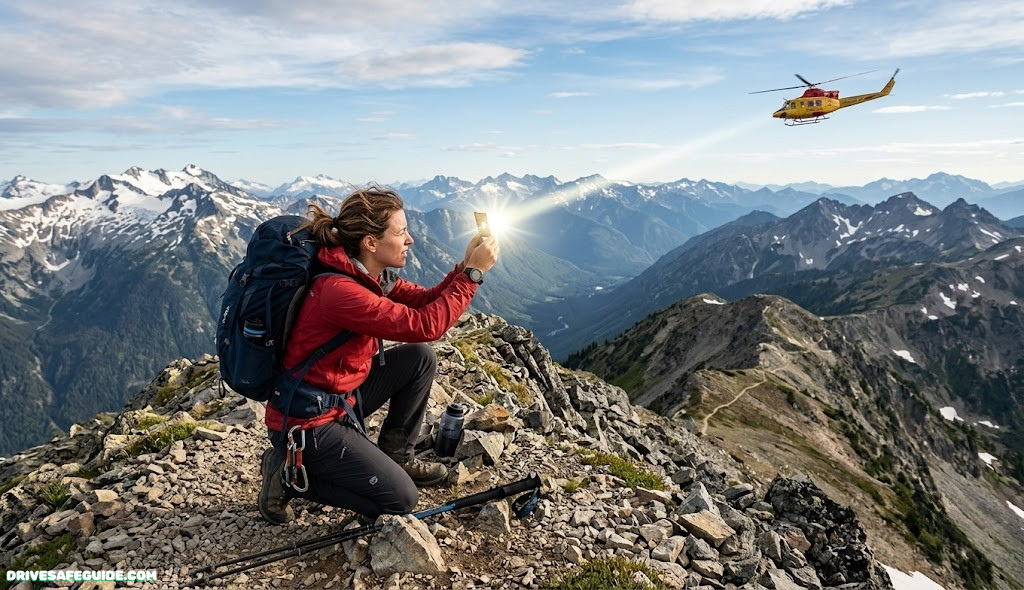
Mastering Emergency Signal Mirror Use for Survival
A small piece of glass or polycarbonate can throw a flash of light that carries for miles. Here’s how to aim it, when to use it, and how to make sure it actually gets seen.
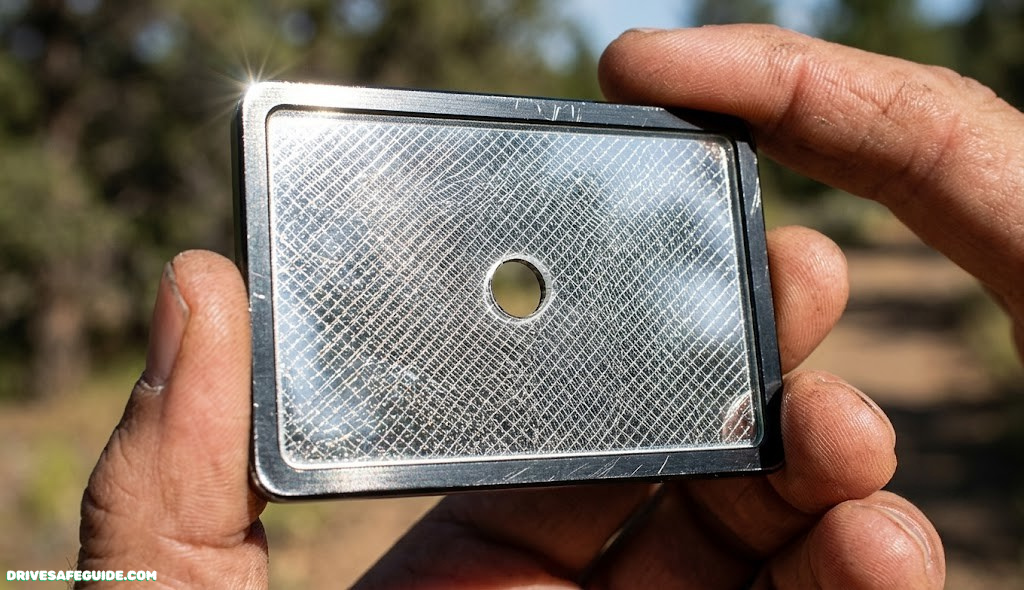
A glass signal mirror with a sighting hole and cross-hatched aiming grid — the same design issued in military and aviation survival kits.
Most people who own a signal mirror have never actually flashed one at a real target. It sits in a glovebox or a bug-out bag, unopened, alongside a whistle and a space blanket. That’s a shame, because of every piece of gear in a basic car emergency kit, a signal mirror is one of the few that can be seen from farther away than a person can shout, farther than a flashlight can reach, and farther than almost anything else you could realistically carry. Used correctly, a mirror flash has been spotted from over ten miles away by aircraft, and from several miles by ground search teams and passing boats. Used incorrectly — which is how most people use it — it does almost nothing. This guide walks through exactly how to aim one, when to use it, and how to avoid the small mistakes that turn a potentially life-saving flash into a wasted afternoon of squinting at the sun.
What a Signal Mirror Actually Is
A dedicated signal mirror looks unremarkable — a rectangle or oval of glass or polymer, usually 2 by 3 inches or 3 by 5 inches, with a small hole punched through the center. That hole is the entire trick. It lets you see through the mirror to your target while simultaneously watching the reflected sunlight land, so you can adjust your aim in real time instead of guessing. Most survival and marine kits include one because it needs no batteries, no charge, and no maintenance beyond keeping the reflective surface clean. It works exactly the same on day one as it does after ten years in a drawer, which is more than can be said for almost any other piece of emergency electronics.
The best signal mirrors are built specifically for this job rather than repurposed from a makeup case or a car visor. Genuine survival mirrors use a retroreflective aiming grid — a fine mesh printed on the glass — that helps you find the reflected “hot spot” even before you’ve mastered the aim-through-the-hole technique. This is different from a standard vanity mirror, which reflects light diffusely and gives you no feedback on where the beam is actually landing. If you’re building or restocking a car safety kit, a purpose-made signal mirror belongs next to the first aid supplies and tire tools, not as an afterthought bought at the last minute.
Signal mirrors are also strangely durable. Polycarbonate versions can be dropped, bent slightly, scratched, and submerged without losing their reflective ability, while glass versions offer a marginally brighter flash but need to be protected from cracking. Either way, this is a piece of gear that rewards a five-minute practice session far more than it rewards spending extra money on a premium model. Technique matters more than hardware here, which is unusual for survival equipment and worth remembering as you read the rest of this guide.
It’s worth being clear about what a signal mirror is not. It’s not a substitute for a charged phone, a GPS beacon, or a travel plan telling someone where you intended to be and when to expect you back. It’s a last-line, low-tech backup that keeps working when batteries die and when there’s no cell signal at all. That’s exactly the situation a lot of roadside emergencies turn into, especially the kind covered in guides on desert breakdowns and water rationing or being stranded in a blizzard, where a dead phone battery and no cell service can turn a routine trip into a waiting game measured in hours.
How Reflected Light Travels So Far
The physics behind a signal mirror is straightforward, but understanding it changes how you use one. Sunlight arrives at the Earth’s surface as roughly parallel rays. When those rays hit a flat, polished surface, they reflect at the same angle they arrived, essentially unchanged in intensity over enormous distances, because you’re not projecting a beam that spreads out and weakens — you’re redirecting a beam that was already traveling in a straight line from ninety-three million miles away. That’s why a mirror flash doesn’t dim the way a flashlight beam does over distance; the sun is doing the heavy lifting, and the mirror is just changing its direction.
This is also why timing and angle matter so much more than raw mirror size. A tiny 2-inch mirror aimed precisely at a target will outperform a large mirror aimed loosely, because the “spot” of reflected light at the target’s distance is determined by the angular size of the sun itself, not by the size of your mirror. In practical terms, this means a cracked mirror, or even a shard of one, can still be effective — a broken signal mirror is not a useless signal mirror, provided a flat reflective section remains and you understand the aiming principles covered later in this guide.
The other detail worth knowing is that a mirror flash is directional in a very narrow sense. Someone standing even a hundred yards to the side of your intended target generally won’t see the flash at all, while the intended target sees a blinding pulse of light. This precision is a strength once you can aim well, but it’s also the reason so many people wave a mirror around vaguely in the sky and wonder why the plane never turns.
There’s a useful mental model here: think of the mirror not as a light source but as a movable window that reveals the sun to a specific point in the distance. When that window lines up with a target’s location, the target effectively “sees the sun” reflected directly at them, which at close range can be uncomfortably bright and at long range still registers as a distinct, unnatural flash against the landscape. This is why pilots and search teams are trained to recognize mirror flashes as different from ordinary sunlight glinting off water, metal roofing, or car windshields — the rhythmic, deliberate quality of an aimed signal reads as intentional in a way accidental glare never does.
Types of Signal Mirrors Compared
Not every reflective object marketed for survival performs the same way. Below is a comparison of the main categories you’ll encounter when shopping, whether online or in an outdoor retailer.
| Type | Reflectivity | Durability | Sighting Aid | Typical Weight |
|---|---|---|---|---|
| Glass military-style mirror | Excellent | Fragile if dropped on hard ground | Grid + hole | 2–3 oz |
| Polycarbonate/acrylic mirror | Very good | Shatter-resistant, floats | Grid + hole | 1 oz |
| Stainless steel polished mirror | Good | Extremely durable, dents rather than shatters | Hole only, no grid | 3–4 oz |
| Improvised (CD, phone screen, foil) | Fair to poor | Varies widely | None | Negligible |
For most people building a kit that lives in the trunk alongside durable LED road flares and other roadside gear, the polycarbonate version is the sensible default: it’s nearly indestructible, weighs almost nothing, and floats if you ever need it near water. Glass mirrors throw a marginally crisper reflection but demand a hard case, which adds bulk most people won’t bother carrying consistently.
Stainless steel mirrors, sometimes sold as a rugged alternative, sit in an interesting middle ground. They’re essentially immune to shattering and can take a genuine beating, but polished metal reflects slightly less brightly than glass or acrylic and tends to develop fine surface scratches over years of use that gradually dull its reflectivity. They also rarely include a printed aiming grid, relying instead on the hole alone, which makes them a reasonable secondary or backup mirror rather than a first choice for someone learning the technique for the first time.
Improvised options round out the list mainly because they’re worth understanding rather than because they’re worth relying on by choice. A CD, a phone screen, or polished metal from a damaged part of a vehicle can all work in a genuine pinch, but none of them include a sighting mechanism, which means your accuracy depends entirely on the hand-sighting method described in the next section. If you have any choice in the matter, carrying a two-dollar dedicated mirror beats hoping an improvised substitute will be available and effective when you actually need it.

Add a Signal Mirror to Your Kit
A shatterproof, floating signal mirror with retroreflective grid and lanyard — pairs well with any roadside or backcountry emergency kit.
Check Price on AmazonAiming Without a Sighting Hole
If your only available reflective surface has no hole — a car mirror shard, a phone case, a piece of foil-backed cardboard — you can still aim it using what’s often called the hand-sighting method. Extend one arm toward the target and form a V with two fingers, or simply point straight at the target with your fingers spread. Hold the mirror close to your face with your other hand, angling it so the reflected sunlight lands on your extended hand or fingers. Once you see the bright spot of light on your hand, slowly tilt the mirror so that spot moves off your fingers and toward the target itself, keeping your fingers as a reference point the whole time.
This method takes more practice than the hole-and-grid method because you’re working from feedback on your own hand rather than direct visual confirmation that the flash is landing on the target. It helps enormously to practice this in daylight before an emergency, ideally with a friend standing at a distance of a few hundred yards who can confirm when they see the flash. Five minutes of practice in a parking lot is worth more than reading paragraphs about technique, so if you take nothing else from this guide, take that.
A second variant works well when you’re signaling something large and slow-moving, like a distant vehicle on a highway or a boat on open water. Instead of fine hand-sighting, sweep the mirror in a slow, deliberate arc across the horizon where the target is moving, pausing briefly every few seconds. This “sweep and pause” approach sacrifices precision for area coverage, which matters when you can’t be sure of the exact aim but know roughly where the target will pass.
Aiming With a Sighting Hole (The Aircraft Method)
This is the technique taught in military and aviation survival courses, and it’s dramatically more precise than hand-sighting. Hold the mirror a few inches from your eye and look through the small hole directly at your target — an aircraft, a boat, a ridge where you know a search party is working. With your other hand, tilt the mirror slightly so sunlight passes through the hole and creates a small bright dot of light visible through the hole itself, superimposed over your view of the target.
Once you can see that bright dot through the hole, adjust the mirror’s angle in tiny increments until the dot sits directly on top of the target as seen through the hole. When it does, the reflected beam is landing precisely on the target — not near it, not close to it, directly on it. This is the entire reason the sighting hole exists: it turns an exercise in guesswork into an exercise in direct visual confirmation, and it’s the reason military aircrew survival kits have used this exact design for decades without meaningful redesign.
Once aimed, don’t just hold the mirror steady. Rock it very slightly, a few degrees back and forth, several times per second. This creates a flickering or strobing effect at the target’s end, which is far more noticeable to a pilot or search team scanning a wide landscape than a single steady glint, which the human eye tends to filter out as background glare. A rhythmic flash pattern — three short flashes, a pause, three more — also reads unmistakably as an intentional signal rather than sunlight bouncing off a window or a lake.
It’s normal to struggle with this the first few tries. The most common early mistake is looking directly at the target through the hole while forgetting to actively hunt for the bright dot with the other hand — the mirror needs continuous small adjustments, not a single static tilt. If you can’t find the bright spot at all, widen your search by tilting the mirror in slow circles a few degrees in every direction while keeping your eye at the hole; the dot will eventually sweep across your field of view, and once you’ve seen it once, walking it back onto the target becomes far easier. Some people find it helps to first practice on a stationary, close target, like a mailbox or fence post fifty yards away, before attempting the technique on something distant or moving.
What Works
- Slow, deliberate scanning across the target’s likely path
- Rhythmic flash groups (three flashes, pause, repeat)
- Practicing the sighting-hole method before you need it
- Signaling early, even before you’re certain you’ve been spotted
What Doesn’t
- Random, frantic waving of the mirror in the general direction of the sky
- Waiting until the aircraft is directly overhead to start signaling
- Aiming without any sighting method on a fast-moving target
- Assuming one flash is enough for someone to register it
Best Times and Conditions to Signal
A signal mirror is a daytime tool, and its performance depends heavily on the sun’s position and the weather. It works best when the sun is between roughly 10 degrees and 60 degrees above the horizon — high enough to give you a strong beam, low enough that the angle between you, the sun, and your target is achievable without contorting yourself. Mid-morning and mid-to-late afternoon tend to be the most workable windows in most latitudes, though this shifts by season and location.
Overcast skies dramatically reduce effectiveness because the sunlight arriving at the surface is scattered rather than direct, but a mirror flash can still occasionally punch through thin or broken cloud, especially compared to no signal at all. Even under overcast conditions, it’s worth attempting a signal any time you hear or see a potential rescuer, since a partial flash is better than none and costs nothing to try.
It’s also worth signaling proactively rather than reactively. Search aircraft fly grid patterns and may pass within visual range only briefly. If you wait until a plane is directly overhead before attempting to aim, you’ll likely miss the window entirely, since the geometry required for a mirror flash to reach an aircraft changes constantly as it moves. Start signaling as soon as you hear engine noise or see a distant aircraft, even before you’re sure it’s searching for you specifically, because that early window is often the only one you get.

Build a Complete Signaling Kit
Pair a signal mirror with a whistle, flares, and a headlamp for day-and-night visibility from a single compact pouch.
Shop Signal Kits on AmazonSignaling Aircraft, Ground Teams, and Boats
Different rescuers require slightly different approaches. Aircraft, particularly fixed-wing search planes, are usually the fastest to spot a mirror flash because a pilot’s field of view sweeps across large areas of terrain and a bright flicker stands out sharply against natural background. For aircraft, prioritize the sighting-hole method and the three-flash rhythm described earlier, and keep signaling as long as the aircraft is within line of sight, even if it appears to be moving away, since search patterns often loop back.
Ground search teams are trickier because they’re closer to your elevation and may be partially obscured by terrain or trees. A mirror is still effective against ground teams crossing open areas, ridgelines, or roads, but you’ll often get better results combining it with audible signals like a whistle, since ground teams are scanning a much narrower field of view than a pilot and may be listening as much as looking. If you’re stranded near a road rather than deep backcountry, this is also where road flares and reflective triangles complement a mirror well, since drivers approach from a fixed direction rather than scanning broadly.
Boats and ships benefit enormously from mirror signals because water offers almost no obstructions and reflections carry exceptionally well across open water, sometimes for many miles farther than they would over land. If you’re stranded near a coastline or on a boat yourself, a signal mirror should be considered close to mandatory gear rather than optional, and it’s worth testing your aim against a distant landmark before you actually need it in an emergency.
It’s also worth thinking about the difference between signaling a single rescuer and signaling a coordinated search operation. Organized searches, whether led by a sheriff’s department, a coast guard unit, or a mountain rescue team, typically brief their spotters on what to look for, including the classic three-flash mirror pattern, which means your signal is more likely to be correctly interpreted the moment it’s seen. A lone hiker or driver who happens to notice your flash, on the other hand, may not immediately recognize it as a distress signal, so it can help to follow a mirror flash with any other attention-getting method available, from waving brightly colored clothing to sounding a vehicle horn, to reinforce that what they saw wasn’t accidental.
Mistakes That Waste a Signal
The single most common mistake is treating the mirror like a flashlight — waving it broadly in the sky and hoping the beam happens to cross a rescuer’s field of view. Because a mirror flash is so narrowly directional, this approach almost never works except by pure chance. The fix is always the same: use a sighting method, even the improvised hand method, rather than aiming by feel.
A second frequent mistake is giving up after a few seconds. Search aircraft and ground teams are scanning wide areas and may simply not be looking at your exact position during the one or two seconds your flash reaches them. Sustained signaling — minutes at a time, in rhythmic bursts — dramatically increases the odds of the flash landing during a moment someone happens to be looking in your direction.
Third, people often forget to protect their mirror from scratches and grime during storage, which reduces its reflectivity exactly when it matters most. Keep it in a soft pouch or case, separate from sharp tools, the same way you’d store a pair of polarized driving sunglasses rather than tossing them loose into a bag.
Finally, some people only think to use a mirror when they’re already visually confident a rescuer is looking their way, missing dozens of earlier opportunities. Every distant engine sound, contrail, or glint of a windshield on a faraway road is worth a signaling attempt, because the cost of trying is essentially zero and the cost of not trying, if that was the one pass that would have spotted you, is significant.
There’s also a subtler mistake worth naming: signaling from a poor vantage point. A flash aimed from inside a gully, under dense tree cover, or with a ridge blocking the line between you and the target will never reach that target no matter how well you aim. Before you start signaling, take thirty seconds to consider whether your position actually has a clear sightline to where you expect rescuers to appear, and if it doesn’t, move to higher or more open ground first if it’s safe to do so. This is the same situational awareness that matters when deciding how to position road warning devices after a roadside breakdown — visibility to the people who might help you is the entire point, and a great signal from a hidden spot helps no one.
Improvised Signal Mirrors When You Don’t Have One
Plenty of survival situations happen without a dedicated signal mirror on hand, which makes it worth knowing what else can work. A phone screen, powered off so it isn’t obscured by glare from its own display, can reflect sunlight reasonably well over shorter distances. A CD or DVD, held at an angle, reflects light with a slightly diffused rainbow quality but is still noticeable from a distance and is a common improvisation in vehicle emergency kits.
Polished metal — the back of a phone case, a belt buckle, the reflective backing of a car mirror if a vehicle has been damaged — can work in a pinch, though most polished metal reflects less efficiently than glass or polycarbonate designed for the purpose. Even the foil layer inside a snack wrapper, stretched taut over a flat piece of cardboard, can produce a usable flash across a few hundred yards, which is sometimes exactly the distance separating you from a road where a passing driver might notice.
Whatever improvised surface you use, the aiming principle stays identical: use the hand-sighting method described earlier, since none of these improvised options will have a sighting hole. The physics of reflection doesn’t care what the reflective surface originally was, only whether it’s flat, clean, and aimed correctly.
Combining Mirror Signals With Other SOS Tools
A signal mirror is powerful specifically because it’s a daytime, line-of-sight tool, which means it has clear gaps that other gear needs to fill. At night or in low light, a mirror does nothing at all, which is where a bright flashlight, a headlamp, or a magnetic-base flashlight mounted where it’s visible becomes essential. Three flashes, a pause, three flashes is the same universal SOS rhythm whether you’re using reflected sunlight or a beam of your own.
A whistle is the natural audio companion to a mirror because it works when visibility is poor and covers gaps in terrain a mirror flash can’t reach, such as dense trees or fog. Similarly, ground markers — three rocks in a triangle, a bright piece of clothing staked to a branch, or a tarp laid flat — help daytime aerial searchers even when the sun isn’t cooperating for a mirror flash. None of these tools replace each other; they cover different conditions, and a well-stocked kit modeled on a broader winter car emergency kit checklist or road trip essentials checklist should include several signaling methods rather than relying on any single one.
If you’re stranded in a vehicle specifically, don’t overlook the vehicle itself as a signaling asset. Hazard lights, headlights flashed in patterns, and even a car’s own mirrors angled toward the sun can supplement a dedicated signal mirror, particularly useful if you’re dealing with a desert breakdown where conserving your own energy for signaling matters as much as conserving water.
Layering signals also means thinking about what happens after you’re spotted, not just how you get spotted in the first place. A raised hood, a brightly colored item tied to an antenna, or a tarp spread across the ground all help a rescuer confirm your exact location once they’ve noticed a flash somewhere in the general area, since a single reflected glint doesn’t always pinpoint your position precisely. Treat the mirror as the tool that gets attention pointed your way, and treat these secondary, static markers as the tools that hold that attention once you have it.

Day and Night Signaling, Covered
A whistle-and-mirror combo tool covers the gaps a mirror alone can’t — sound for fog and night, reflected light for open daytime sightlines.
View Combo Tools on AmazonChoosing and Buying a Signal Mirror
When shopping for a dedicated signal mirror, prioritize three things: a genuine sighting hole with retroreflective grid, a durable non-glass construction unless you’re committed to protecting a glass one, and a compact size that you’ll actually carry rather than leave behind. Larger mirrors are not meaningfully more effective at long range, since the reflected “spot” size is governed by distance and the sun’s angular diameter rather than mirror size, so there’s little benefit to buying an oversized mirror at the cost of pocket space.
Look For
- Sighting hole plus printed aiming grid
- Floats in water (polycarbonate models)
- Attached lanyard or hole for a keyring
- Instructions printed on the reverse side
Skip
- Novelty “signal mirrors” with no sighting hole at all
- Oversized mirrors that won’t fit an actual kit or pocket
- Thin, flexible plastic that warps and distorts reflections
- Mirrors with no protective pouch or case included
It’s a small, inexpensive addition to any kit, and it complements gear you may already carry, like emergency car escape tools or a properly mounted fire extinguisher, in the sense that all of these items share the same logic: cheap, light, and easy to forget about until the one moment they matter enormously.
Price is rarely a good proxy for quality with this particular item. Because the underlying physics doesn’t change between a five-dollar mirror and a twenty-dollar one, most of what you’re paying extra for at the higher end is a sturdier case, a nicer lanyard, or a printed instruction card — genuinely useful, but not essential to the mirror’s core function. The one place it’s worth spending a little more is durability: a mirror that cracks the first time it’s dropped in a glovebox isn’t saving you money in the long run, even if it was cheaper upfront.
| Buying Priority | Why It Matters |
|---|---|
| Sighting hole + grid | Enables precise aim rather than guesswork |
| Shatter-resistant material | Survives being dropped, sat on, or stored loosely |
| Compact size | More likely to actually be carried day to day |
| Included pouch or case | Protects the reflective surface from scratches |
Building the Habit: Practicing Before You Need It
The gap between owning a signal mirror and being able to use one under stress is entirely closed by practice, and it takes very little time to close it. Find a friend or family member willing to stand a few hundred yards away — a parking lot, a field, a long driveway all work — and practice both the hole-and-grid method and the hand-sighting method until you can reliably land a flash on them within a few seconds. Most people find the hole-and-grid method clicks after five or ten attempts.
It’s worth practicing at different times of day, since the angle between you, the sun, and your target changes constantly, and a technique that felt intuitive at 2 p.m. may require a completely different arm position at 9 a.m. If you regularly review or refresh other parts of your preparedness routine, such as preparing your car before a road trip or restocking a car safety kit, add a two-minute mirror practice session to that same checklist. Muscle memory for the sighting-hole technique is the single biggest factor separating people who successfully signal rescuers from people who simply own a mirror that never gets used correctly.
Consider practicing the rhythmic flash pattern too — three flashes, pause, three flashes — since it’s a small thing to rehearse but makes an enormous difference in how quickly a distant observer recognizes your signal as deliberate rather than incidental glare. A rescuer scanning a landscape sees countless accidental glints off windshields, water, and metal roofing; a deliberate rhythm is what separates your signal from that background noise.
Knowing the Limitations
A signal mirror is a genuinely excellent piece of gear, but it’s worth being realistic about what it can’t do. It offers no help at night, none in dense fog, and very little under heavy overcast skies, all of which are exactly the conditions that tend to accompany the kind of severe weather that leads to people being stranded in the first place. This is one of the reasons a broader preparedness mindset matters more than any single item — the same logic behind carrying a full car safety kit rather than just one tool applies just as much to signaling as it does to tire repair or first aid.
It also requires a rescuer to actually be looking in roughly the right direction at roughly the right moment, which is a matter of probability rather than certainty. A mirror dramatically improves your odds of being seen, but it doesn’t guarantee it on any single flash, which is precisely why sustained, rhythmic signaling over minutes rather than seconds matters so much. Treat a signal mirror as one strong layer in a broader signaling strategy — alongside a whistle, bright clothing or ground markers, and a phone or radio if either is available — rather than as a single point of failure you’re relying on entirely.
Finally, remember that a signal mirror does nothing to address the underlying emergency itself. It doesn’t provide warmth, water, or first aid, and it shouldn’t come at the expense of decisions that keep you safe while you wait, such as staying with your vehicle in most breakdown scenarios, conserving energy, and following the same defensive thinking behind defensive driving habits that reduce risk before a problem ever starts. Signaling is what gets you found; the rest of your preparation is what keeps you safe until that happens.
Carry It, Practice It, Trust It
A signal mirror is one of the few pieces of survival gear that costs almost nothing, weighs almost nothing, and never needs batteries, yet can be seen from farther away than almost anything else in your kit. The only real investment it demands is a few minutes of practice with the sighting-hole method, ideally alongside a friend who can confirm when your flash lands. Add one to your car emergency kit today, practice the aim this weekend, and it will be ready the one time it truly matters. Pair it with the rest of a thoughtfully assembled kit, keep it somewhere you’ll actually reach for it, and it becomes one of the quietest, most reliable pieces of insurance you can carry.
Get a Signal Mirror on AmazonSignal Mirror Use Across Different Survival Scenarios
A signal mirror behaves a little differently depending on the environment you’re stranded in, and it helps to think through a few of the most common scenarios before you’re actually in one. In a desert breakdown, visibility is often at its best — flat terrain, wide sightlines, and strong direct sunlight for most of the day. The main challenge isn’t the mirror itself but managing your own energy and hydration while you wait and signal, which is why pairing signaling technique with the guidance in a desert breakdown and water rationing guide matters just as much as knowing how to aim.
Winter and mountain scenarios add a different wrinkle: snow reflects ambient light in every direction, which can make it harder for a rescuer to distinguish a deliberate mirror flash from the general glare of a snowfield. The fix is the same rhythmic three-flash pattern discussed earlier, held longer and repeated more often, since a sustained rhythm still stands out against random glare even in a bright, reflective landscape. If you’re building a kit for cold-weather trips, review it alongside a winter car emergency kit checklist so your signal mirror sits next to insulation and warmth items rather than being packed away separately.
Near water — whether you’re stranded on a boat, a coastline, or a lakeside campsite — a signal mirror performs exceptionally well because there’s little to obstruct the reflected beam and open water often extends your effective range well beyond what you’d get over broken land terrain. Vessels passing at a distance that would never hear a whistle or spot a small fire can often catch a well-aimed mirror flash, making it one of the highest-value items to keep within reach whenever you’re on or near open water.
Roadside breakdowns are a slightly different case, since you’re usually not trying to attract a search team but simply trying to get a passing driver’s attention, particularly at a distance or in conditions where road flares and hazard triangles aren’t yet visible. A mirror aimed at oncoming traffic on a long, straight stretch of road can catch a driver’s attention well before your vehicle itself becomes visible, especially in bright, low-angle sun where flares are harder to see against the daylight.
Frequently Asked Questions
How far away can a signal mirror be seen?
Under clear skies and with correct aim, a quality signal mirror flash has been spotted by aircraft from over ten miles away, and by ground observers or boats from several miles, depending on terrain, haze, and the angle of the sun.
Does a signal mirror work on a cloudy day?
Its effectiveness drops significantly under heavy overcast because there’s little direct sunlight to reflect, but thin or broken cloud can still allow a usable flash through, so it’s worth attempting regardless.
Can I use a signal mirror at night?
No, a signal mirror relies entirely on reflecting sunlight, so it’s a daytime-only tool. At night, a flashlight, headlamp, or fire is the appropriate substitute for visual signaling.
What’s the difference between the hole-and-grid method and hand-sighting?
The hole-and-grid method lets you look directly through the mirror at your target while confirming the reflected light lands on it, offering the most precise aim. Hand-sighting uses your extended fingers as a reference point and works without a sighting hole, but requires more practice to master.
Can a cracked or broken signal mirror still be used?
Yes. As long as a reasonably flat, reflective section remains, a broken mirror or even a shard can still produce a usable flash, since the reflected spot size depends on distance rather than mirror size.
What can I use if I don’t have a dedicated signal mirror?
A powered-off phone screen, a CD or DVD, polished metal, or even taut foil from a wrapper can all reflect sunlight well enough to signal over shorter distances using the hand-sighting method.
Is glass or polycarbonate better for a survival mirror?
Polycarbonate is generally the more practical choice for everyday carry since it’s shatter-resistant and often floats, while glass offers a marginally brighter reflection but requires more careful storage to avoid cracking.
How do I signal an aircraft specifically?
Use the sighting-hole method to aim precisely, then rock the mirror slightly to create a flickering effect, ideally in a rhythmic pattern of three flashes and a pause, which reads clearly as an intentional signal rather than incidental glare.
Should I keep signaling if the aircraft seems to be moving away?
Yes. Search aircraft often fly repeating grid patterns and may loop back, so continuing to signal even as a plane appears to move away keeps you visible for its next pass.
Do I need special training to use a signal mirror?
No formal training is required, but a few minutes of self-practice with a friend standing at a distance makes an enormous difference in how quickly and accurately you can aim under real conditions.
Where should I store a signal mirror in my vehicle?
Keep it in a soft pouch inside your glovebox or door pocket alongside other emergency signaling tools, protected from scratches and away from sharp objects that could damage its reflective surface.
Can a signal mirror replace flares or a whistle?
No single tool covers every condition. A mirror only works in daylight with a clear line of sight, so it should be carried alongside flares, a whistle, or a flashlight rather than as a sole signaling method.
🛡️ Be Prepared
Every Car Needs an Emergency Kit
Breakdowns happen without warning. A well-stocked car emergency kit can keep you safe until help arrives — don’t drive without one.
🏗 Shop Emergency Kits on AmazonAffiliate link — we earn a small commission that keeps DriveSafeGuide running. Thank you!