Surviving a Desert Breakdown: Water Rationing and Safety Tips
Your engine temp light comes on forty miles from the nearest town, the pavement is shimmering, and your phone shows one bar that keeps disappearing. Here is exactly what to do with the water you have, the shade you can build, and the signals that actually get noticed.
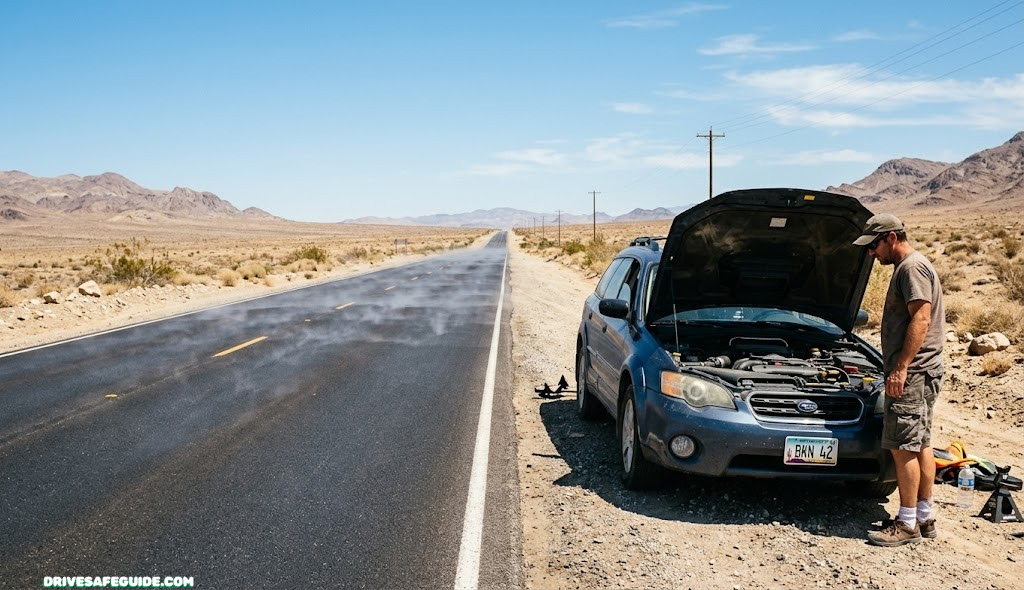
Desert highways look empty right up until the moment you actually need them not to be. A radiator hose splits, a belt shreds, or the temperature gauge just quietly climbs past the red line, and within a few minutes the biggest hazard on the road isn’t traffic — it’s the sun directly overhead and however much water happens to be in your car. Most of what people assume about surviving that situation is either outdated or, in the case of water, backward enough to be dangerous.
This guide walks through what actually keeps people alive when a vehicle fails in hot, remote terrain: how much water your body genuinely needs, why the instinct to ration it can work against you, how to build shade without wasting energy, and how to get found by the people looking for you. None of it requires special training. Most of it just requires knowing the numbers before the dashboard warning light forces you to guess.
It’s also worth saying plainly that this scenario is more common than people assume. Remote highway breakdowns take longer to resolve than urban ones almost by definition — tow trucks have farther to travel, cell coverage is patchier, and the environment itself keeps working against you the entire time you wait. None of that is a reason to avoid desert routes. It’s a reason to treat preparation as part of the drive itself, the same way you’d treat fuel or a working spare tire, rather than something to figure out after the hood is already up.
Why Desert Breakdowns Turn Deadly Fast
A breakdown in a city is an inconvenience. A breakdown on a two-lane desert highway is a countdown, and the clock starts the moment your engine stops making noise. Three things stack against you at once: there’s rarely any shade beyond what your own vehicle provides, there’s rarely any natural water within walking distance, and there’s rarely anyone driving past to notice you’re in trouble. Combine those with air temperatures that regularly clear 100°F and pavement temperatures that run 40 to 60 degrees hotter than the air above it, and a mechanical problem becomes a physiological one within an hour or two.
The body’s cooling system depends on sweat evaporating off the skin. In low humidity, which most deserts have plenty of, sweat evaporates so efficiently that people frequently underestimate how much fluid they’re losing — there’s no visible drenched shirt to serve as a warning. That hidden water loss, combined with radiant heat coming up off the asphalt and down from a cloudless sky, is what turns a two-hour wait for a tow truck into a genuine medical emergency. It’s also why the standard advice for a desert breakdown looks almost nothing like the standard advice for a breakdown anywhere else. Conserving fuel and battery still matters, but conserving your own hydration and body temperature matters more, and the two goals don’t always point in the same direction.
If you’re heading into remote desert terrain regularly, it’s worth pairing this guide with a broader look at what belongs in your road trip essentials checklist before you ever leave the driveway — most of what keeps you safe out here is decided before the trip starts, not after the hood goes up.
There’s also a timing element people underestimate. A breakdown at 7 a.m. in the desert is a very different problem than the same breakdown at 1 p.m. Morning heat builds gradually, giving you a window to assess the situation, set up shade, and signal for help before conditions peak. A midday breakdown skips straight to the hardest part of the day, with peak sun angle, peak pavement temperature, and often the least traffic, since long-distance drivers frequently plan their own trips around avoiding that exact window. If you have any control over departure time on a known-remote route, early morning or evening driving reduces your exposure risk before a breakdown ever happens — and it makes any breakdown that does occur meaningfully easier to manage.
The First 10 Minutes After You Stop
What you do in the first ten minutes sets the tone for everything after it, so resist the urge to immediately start walking, tinkering, or panicking. Get the vehicle as far onto the shoulder as it will go, set the parking brake, and turn on your hazard lights even in full daylight — a stalled car on a shoulder is still a collision risk for other drivers dealing with heat haze and sun glare. Raise the hood. It does two useful things simultaneously: it helps the engine bay vent heat, and it’s a universally recognized signal to anyone passing that you need assistance, long before they’re close enough to read your face.
Next, take stock before you do anything physical. Check your phone for signal, note your mileage and the last landmark or mile marker you passed, and look at what shade options actually exist — the car’s own shadow moves throughout the day, so don’t assume the shade you have now is the shade you’ll have in an hour. If you carry a folding sunshade or reflective panel for the windshield, this is the moment to deploy it; it does more to slow interior heat buildup than people expect.
Desert highways can also hand you compounding problems: a dust storm rolling in can drop visibility to near zero in minutes, and a summer monsoon cell miles away can send a flash flood down a dry wash you’re parked near without a drop of rain falling on you directly. If either is a realistic risk on your route, it’s worth knowing the dust storm driving protocol and flash flood vehicle safety basics before you’re the one standing next to a wash wondering why the ground is suddenly wet.
If you’re carrying reflective triangles or road flares, place them well back from the vehicle in the direction traffic is coming from — heat haze off the pavement can make a stopped car surprisingly hard for other drivers to register at speed until they’re much closer than they’d be in cooler conditions. LED beacons hold up better than combustion flares in extreme heat and don’t carry the same fire risk on dry roadside brush, which matters more in desert terrain than almost anywhere else.
The Water Rationing Myth
Here’s the part that surprises most people: the instinct to sip water slowly and stretch a limited supply across an unknown number of hours is, according to desert survival organizations and search-and-rescue guidance, usually the wrong move. Severe rationing doesn’t buy you meaningfully more time, and it can accelerate the exact outcome you’re trying to avoid. Search-and-rescue records include cases of people found deceased with water still in the bottle, having under-drunk out of caution right up until dehydration and heat impaired their judgment too badly to fix it.
The reasoning is straightforward once you see it laid out. Your body doesn’t store the water you drink for later use the way a fuel tank stores gasoline — you process fluids continuously, and once you’re already dehydrated, drinking a small amount doesn’t restore full function, it just slows the decline slightly. Meanwhile, the earliest symptoms of dehydration are the same ones that wreck your ability to make good decisions: headache, irritability, and difficulty concentrating. Ration too hard and you’re managing a crisis with a brain that’s already running on fumes.
None of this means “drink it all in the first hour and hope.” The actual guidance is closer to: drink when you’re thirsty, drink enough that thirst goes away, and don’t force extra water down if you’re not craving it. What you should ration instead is activity — movement, exertion, and time spent in direct sun — because those are what drive water loss up in the first place. Stay still, stay shaded, stay calm, and your genuine water requirement drops dramatically compared to someone pacing around in the sun out of nervous energy.
How Much Water You Actually Need
The baseline figure used across desert safety guidance is one gallon of water per person, per day, and that’s described as an absolute floor, not a comfortable target. In real desert heat — especially anything north of 100°F — with any physical activity at all, that number climbs fast. Planning for closer to one and a half gallons per person per day for anything beyond a short wait is the more realistic buffer, and it’s the reason emergency-prep guides consistently tell people to over-calculate water needs by wide margins rather than cutting it close.
The table below breaks it down by scenario, since “stuck in a car” covers a wide range of actual conditions.
| Scenario | Minimum per person / day | Notes |
|---|---|---|
| Resting in shade, mild heat (under 90°F) | ~0.5–1 gallon | Lower exertion, lower sweat loss |
| Resting in shade, extreme heat (100°F+) | 1–1.5 gallons | The realistic baseline for most desert breakdowns |
| Any walking or physical exertion in direct sun | 1.5–2+ gallons | Exertion in full sun multiplies water loss quickly |
| Child or smaller-bodied passenger | Roughly 60–70% of adult amount | Still needs regular fluids — don’t assume “less” means “little” |
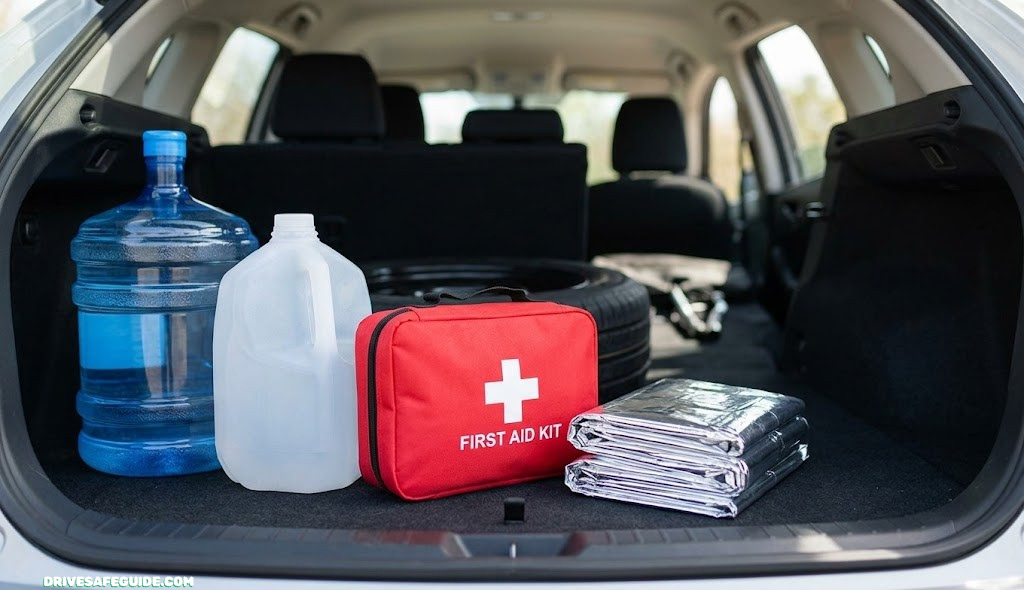
Two practical takeaways follow from this. First, if you’re loading up before a desert drive, a single case of bottled water is not the same thing as an emergency reserve — plan on at least one to two gallons per person sitting in the trunk at all times on remote routes, separate from whatever you’re drinking during the drive itself. Second, container choice matters more than people think: a sealed rigid jug holds up to trunk heat far better than a thin collapsible pouch, which can degrade or develop off-flavors after sitting in 130°F trunk temperatures for a season.

Stackable emergency water containers
Rigid, food-grade jugs that hold up to trunk heat and stack flat when empty — the baseline of any desert kit.
Check Price on AmazonBuilding Shade and Managing Vehicle Heat
Your car is your single best survival asset after your water supply, and it’s a better shelter than most people give it credit for — but only if you manage it correctly. A parked car with the windows shut can climb well past outside air temperature within twenty to thirty minutes, which is exactly why “stay in the car” advice always comes with conditions attached. Crack the windows on opposite sides about an inch to create airflow without fully opening the cabin to blowing dust or sun. If you have a reflective windshield shade, use it; it noticeably slows heat buildup by bouncing radiant heat back out before it ever gets absorbed by the dashboard and seats.
Running the engine for air conditioning is a real option, but treat it as a resource with a limit, not a comfort setting. Idling burns fuel and, depending on your cooling system’s condition, can push engine temperature back up if the original problem was heat-related in the first place. A reasonable middle ground many desert-safety guides land on is running the AC in short intervals — enough to cool the cabin and yourself down, then shutting it off and relying on shade and cracked windows to hold that temperature for a while before repeating. If your breakdown is directly caused by an overheating engine, running the AC at all can make things worse, so use it only if the vehicle itself is stable.
Beyond the car, use whatever else is available: a tarp or emergency blanket strung between the vehicle and a fence post or shrub extends your shaded footprint, and standing in the car’s own shadow as it shifts through the day works better than most people expect for short stretches. Avoid sitting or lying directly on the ground — desert sand and asphalt can run 30 degrees hotter than the air just a few feet above it, and that heat transfers into your body faster than you’d think through direct contact.
Getting your car heat-resilient before you ever leave pavement matters just as much as what you do once you’re stopped — a quick look at extreme heat engine care covers the maintenance habits that keep a cooling system from failing in the first place.
Not all sunshades perform the same way. A reflective foil-faced shade bounces radiant heat back out through the glass before it’s absorbed, while a plain fabric shade mostly just blocks visible light and does far less for actual temperature control — worth knowing before you assume any shade in the glovebox is doing the same job. Legally applied window tint offers a smaller, more passive version of the same benefit year-round, and if you’re curious how much is actually allowed where you drive, window tint darkness limits by state is worth a look before your next tint job.
Signaling for Help
Being visible matters as much as being alive to be seen. Your hazard lights and raised hood are your passive signals — they work around the clock without you doing anything. Everything else is active, and it’s worth setting up before you’re too fatigued to bother. Tie a brightly colored piece of clothing, a bandana, or a reflective triangle to the antenna or side mirror; bright orange, red, or safety-yellow stand out against sand and asphalt in a way that white or beige never will.
If you’re near enough to a road that aircraft or distant vehicles might pass, a signal mirror is disproportionately effective for how little it weighs — a well-aimed flash of sunlight is visible for miles and takes almost no energy to use, which matters when conserving your own strength is part of the plan. It’s worth learning how to actually aim a signal mirror before you need it, since the aiming technique isn’t obvious the first time you try it.
Don’t give up on your phone too early, either. Many phones can complete an emergency call through any available carrier’s tower, not just your own, even when your normal signal bars show nothing — this typically shows up as an “SOS” or “Emergency Calls Only” indicator instead of your carrier name. It’s worth trying an emergency call even when your phone looks like it has no service at all, since the threshold for an emergency-only connection is often lower than for a normal call or data connection.
The universal distress pattern in outdoor survival is three of anything — three flashes, three whistle blasts, three piles of rocks, three fires spaced apart. It’s recognized internationally as a deliberate signal rather than random noise or coincidence, which matters if a search plane or ranger is scanning the horizon and needs to distinguish “person in trouble” from “campfire.” If you have any kind of satellite messenger or personal locator beacon, this is the moment it earns its keep — cell towers are sparse in remote desert terrain, but satellite devices don’t need them. A broader GPS tracker guide and a look at which offline-capable apps every driver should have installed are both worth reviewing before a remote trip, since neither helps you if you’re setting it up for the first time after you’ve already lost signal.

Signal mirror & reflective distress kit
Lightweight, no batteries required, and visible for miles when aimed correctly — pairs well with a satellite messenger.
Check Price on AmazonHeat Exhaustion vs. Heat Stroke
Knowing where you or a passenger sit on this spectrum changes what you should do next, so it’s worth learning the distinction before you’re trying to diagnose it under pressure. Heat exhaustion is your body’s warning stage — uncomfortable and worth acting on immediately, but generally reversible with rest, shade, and fluids. Heat stroke is a medical emergency where the body’s cooling system has effectively failed, core temperature is climbing fast, and it can cause organ damage or death without emergency treatment.
| Sign | Heat Exhaustion | Heat Stroke |
|---|---|---|
| Skin | Cool, pale, clammy, heavy sweating | Hot, red, and dry — or damp; sweating may have stopped |
| Body temperature | Elevated but usually under 103°F | 103°F or higher, sometimes rising to 106°F within minutes |
| Mental state | Tired, headache, dizzy, irritable | Confused, slurred speech, agitation, possible loss of consciousness |
| Pulse | Fast, weak | Fast, strong and pounding |
| What to do | Move to shade, sip water, cool with damp cloths, loosen clothing | Call 911 immediately, cool the body aggressively, do not wait to see if it passes |
One counterintuitive point worth remembering: heat exhaustion responds well to drinking water, but once someone has progressed into full heat stroke with confusion or unconsciousness, forcing fluids by mouth becomes a choking hazard. At that point, cooling the body and getting emergency care becomes the priority over hydration.
Should You Stay or Should You Walk?
This is the single most consequential decision in a desert breakdown, and the near-universal guidance from search-and-rescue organizations is to stay with the vehicle unless you have a very specific, well-informed reason not to. A car is large, reflects light, casts shade, and is exactly what rescuers are trained to search for along a known route. A person on foot is small, blends into terrain from a distance, and — critically — becomes a moving target that search patterns have to guess the direction of. Search-and-rescue statistics consistently show that people who stay near their vehicle are found faster than those who leave it.
Reasons to Stay
- You told someone your route, or your car is visible from the road
- You have adequate shade and water to wait out a rescue
- You don’t know your exact distance to help
- Conditions are too hot for safe daytime walking
Reasons You Might Walk
- You know, with certainty, that help is a short and safe distance away
- Nobody knows your route and you have no way to signal for days
- You can travel only in the cool early morning or evening hours
- You have enough water for the walk plus a safety margin
If walking genuinely becomes necessary, timing is everything: move during the coolest parts of the day, generally the hour or two around sunrise, and avoid the hours surrounding midday entirely. Leave a note in the vehicle with your name, the time you left, and the direction you’re heading, in case rescuers reach the car before they reach you. This is also where trip-planning habits pay off after the fact — telling someone your route before departure is one of the simplest steps that turns “nobody knows where to look” into “help arrives on schedule.”
The Desert Breakdown Emergency Kit
Most of what makes a desert breakdown survivable was already sitting in the trunk before the engine ever failed. The list below isn’t exotic gear — it’s a short set of items that consistently show up across desert safety guidance because they each solve a specific, predictable problem: heat, dehydration, visibility, and communication.
Food is worth a brief note, even though it matters far less than water in the short term — the human body tolerates days without food far better than it tolerates hours without water in extreme heat, and digestion itself uses water your body may need elsewhere. Shelf-stable, low-effort snacks like nuts, crackers, or dried fruit are reasonable additions, but they’re a comfort item here, not a survival priority. Sun protection deserves more attention than it usually gets: sunburn accelerates dehydration by damaging the skin’s ability to regulate temperature, so a hat, sunglasses, and lightweight sun-protective clothing belong in the kit as seriously as the water does.
- At least one to two gallons of water per occupant, in rigid, sealed containers
- A reflective windshield sunshade to slow cabin heat buildup
- Bright-colored cloth or a reflective triangle for signaling
- A signal mirror and a whistle for the “three of anything” distress pattern
- A basic first aid kit with electrolyte packets
- A fully charged phone, a portable battery pack, and — for remote routes — a satellite messenger
- A paper map or offline map download as a backup to cell-dependent navigation
- Light-colored, breathable long sleeves and a wide-brim hat
- LED road flares or beacons for both daytime visibility and nighttime signaling
- A basic set of tools plus a jump starter sized correctly for your engine
Two of these are worth a longer look on their own, since “the right one” varies a lot by vehicle and situation: a proper look at durable, crushproof LED road flares and a guide to sizing a jump starter to your specific engine both go deeper than a checklist item can. If you’re building this out from nothing, start with the full breakdown in how to build a complete car safety kit, which covers the tire, battery, and first-aid basics this list assumes you already have.
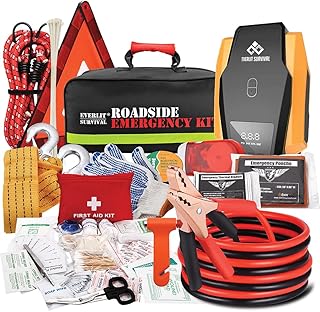
Complete roadside emergency kit
A pre-assembled kit covering signaling, first aid, and basic tools — a fast way to close the gaps in what’s already in your trunk.
Check Price on AmazonPreventing the Breakdown in the First Place
The best desert breakdown is the one that never happens, and most desert-specific failures trace back to a handful of predictable causes: overheating from a marginal cooling system pushed past its limit, dehydrated belts and hoses that crack in extreme heat, and tires that lose pressure or blow out on scorching asphalt. Before any remote desert drive, a cooling system check is non-negotiable — coolant level, hose condition, and radiator cleanliness all matter more in 105°F ambient heat than they do on a mild spring commute. A deeper look at spotting a coolant leak before it strands you and extreme heat engine care covers the specific checks worth doing the week before you leave.
Tire condition deserves equal attention. Hot pavement accelerates tire wear and raises internal tire pressure, and an already-worn tire is far more likely to fail under those conditions than in cooler weather. Check tread depth and pressure — including your spare — before departure, not after you’re already on a remote stretch of highway. If your vehicle supports it, a basic OBD2 scan tool can flag early warning codes (a marginal thermostat, a failing sensor) days before they’d otherwise show up as a dashboard light in the middle of nowhere; real-time sensor monitoring with an OBD2 scanner is worth the modest cost for anyone doing remote desert driving regularly.
Your tire pressure monitoring system is doing more work than it gets credit for on a desert route, flagging slow leaks or pressure swings from heat before they become a roadside blowout. If a sensor has failed or you’re chasing a phantom warning light that won’t clear, a look at when and how to replace a TPMS sensor is worth the ten minutes before a long remote drive rather than after a warning light has been ignored for weeks.
Beyond the mechanical checklist, the single highest-leverage habit is simply telling someone your route and expected arrival time before you leave cell coverage. A full pre-departure routine, covering everything from fluids to spare parts to trip notification, is laid out in preparing your car for road trip safety checks, and it’s worth treating as mandatory rather than optional for any drive through terrain this unforgiving.
Kids, Pets, Elders, and Medical Conditions
Everything above assumes a healthy adult, and the numbers shift meaningfully for anyone traveling with children, older passengers, pets, or a medical condition that affects heat tolerance or fluid balance. Children dehydrate faster relative to their body size and often can’t articulate early symptoms clearly — irritability and quietness can be the first signs, not just complaints of thirst. Watch for it proactively rather than waiting to be told. Older adults, meanwhile, often have a blunted thirst response, meaning they can be significantly dehydrated before they feel thirsty at all, so offer water on a schedule rather than waiting for a request.
Pets are at real risk in a hot, disabled vehicle and can’t regulate temperature the way humans do — they cool primarily through panting, which is far less efficient than sweating. Never leave a pet alone in the vehicle while stepping away, even briefly, and offer water frequently in small amounts. If pets are a regular part of your road trips, it’s worth reviewing pet restraint safety ratings so they’re secured — and easier to manage in an emergency — rather than loose in the cabin.
Certain medical conditions change the calculus further. Some medications, including several blood pressure drugs, antihistamines, and psychiatric medications, interfere with the body’s ability to regulate temperature or increase dehydration risk, so if you or a passenger takes any of these, build in an extra water margin as standard practice. Conditions with a seizure risk also warrant specific planning for heat and sun exposure — a look at epilepsy driving restrictions and considerations is a useful starting point if that applies to anyone in the vehicle.
Desert Breakdowns vs. Other Extreme Conditions
It’s worth noticing how differently desert protocol compares to breakdowns in other extreme environments, because the instincts that keep you safe in one can actively hurt you in another. A winter breakdown and a desert breakdown share the “stay with the vehicle” principle, but almost everything else about fluid, shelter, and clothing strategy runs in the opposite direction.
| Factor | Desert Breakdown | Winter / Blizzard Breakdown |
|---|---|---|
| Fluid strategy | Drink to thirst, avoid over-rationing | Fluids still matter, but cold suppresses thirst — drink on a schedule |
| Shelter goal | Block direct sun, maximize airflow | Seal drafts, trap body heat, limit airflow |
| Engine use | Short AC intervals, watch for overheating | Short heater intervals, watch for exhaust and carbon monoxide risk |
| Clothing | Light-colored, loose, long sleeves for sun — not heat trapping | Layered, insulating, moisture-wicking base layer |
| Biggest silent killer | Heat stroke and dehydration | Hypothermia and carbon monoxide from a blocked exhaust |
If your travel takes you through both climates in the same season — plenty of desert routes gain elevation into genuinely cold conditions after dark or in winter months — it’s worth reading blizzard stranded survival guidance and building a winter car emergency kit alongside your desert kit rather than assuming one setup covers both. The core mistake people make is packing for the climate they expect rather than the range of climates the actual route passes through.
Desert regions carry their own secondary hazards worth a quick mention, too — dry conditions and sparse vegetation make wildfire smoke a real visibility and air-quality concern on some routes even without a fire nearby, and it’s worth knowing how to handle driving through wildfire smoke if your route runs through fire-prone terrain during dry months.
Frequently Asked Questions
A few of the same questions come up again and again from people planning desert routes or looking things up mid-emergency. Here they are in one place, answered plainly and without hedging.
Generally, no. Desert survival guidance consistently recommends drinking water when you’re thirsty rather than strictly rationing it, since severe rationing can cause dehydration to set in faster and impair judgment before help arrives. What you should conserve is physical activity and time spent in direct sun, since those drive water loss far more than a few extra sips do.
Plan for at least one gallon per person per day as an absolute minimum, and closer to one and a half gallons per person per day if temperatures are above 100°F or there’s any chance of physical exertion. It’s safer to over-pack water than to calculate based on ideal, mild conditions.
It can help, used in short intervals rather than continuously, as long as the vehicle itself is mechanically stable and not overheating. If your breakdown involves an overheating engine or a cooling system problem, avoid running the AC, since idling adds heat load the engine may not be able to handle.
Stay with the vehicle in almost every case. A car is far easier for search-and-rescue teams to spot than a person on foot, and staying put avoids the added water and heat demands of walking in the sun. Walking is only advisable if you know with certainty that help is a short, safe distance away and you can travel during cool early morning or evening hours.
Early signs include heavy sweating, cool or clammy skin, headache, dizziness, fatigue, and irritability. Catching it at this stage and responding with shade, rest, and fluids typically prevents progression to the more dangerous heat stroke stage.
Heat stroke is a medical emergency where the body’s temperature regulation has failed. Look for hot, dry or damp skin, confusion or slurred speech, a body temperature at or above 103°F, and possible loss of consciousness. Unlike heat exhaustion, heat stroke requires immediate emergency medical attention and aggressive cooling — it will not resolve with rest alone.
Raise your hood, tie bright-colored cloth to your antenna or mirror, and use a signal mirror to flash sunlight toward roads or aircraft. The universal distress pattern is three of anything — three flashes, three whistle blasts, or three signals spaced apart — which is recognized as a deliberate call for help. A satellite messenger or personal locator beacon is the most reliable option in areas with no cell coverage at all.
No. Radiator fluid is mixed with coolant, which is toxic even in small amounts. This applies even if the coolant is diluted with water — it is never safe to drink under any circumstance.
Generally no. Most cactus species contain acids and alkaloids that can cause vomiting or diarrhea, which speeds up dehydration rather than solving it. This is a last-resort survival technique that requires specific plant knowledge, not a reliable emergency water source for most travelers.
It varies with temperature, activity level, and individual health, but in extreme desert heat with no water and continued sun exposure, dehydration can become life-threatening within roughly a day or two — sometimes faster with exertion. This is precisely why prevention, adequate water supply, and staying in shade matter more than any single response tactic once symptoms begin.
Crack windows on opposite sides about an inch to create airflow through the cabin without fully exposing the interior to dust, wind, or direct sun. Fully sealed windows let interior heat climb well past outside air temperature within minutes.
Yes. Pets cool themselves through panting rather than sweating, which is far less efficient in extreme heat, and they can’t communicate early symptoms. Offer water frequently in small amounts, never leave them alone in the vehicle even briefly, and watch for excessive panting, drooling, or lethargy as early warning signs.
The Mistakes That Turn a Breakdown Fatal
Almost every worst-case desert breakdown story shares a small set of avoidable mistakes rather than one single dramatic failure. Recognizing them ahead of time is often more useful than any single piece of gear, because gear can’t override a bad decision made under stress.
- Leaving the vehicle to “just walk a little way” without a firm plan, water margin, or timing strategy
- Rationing water so aggressively that dehydration and impaired judgment set in before help arrives
- Assuming cell service will be available and skipping any offline backup for navigation or communication
- Not telling anyone the planned route or expected arrival time before losing coverage
- Ignoring early symptoms of heat exhaustion until they progress toward heat stroke
- Packing water and gear for a short trip on a route that has no guaranteed short outcome
None of these require special training to avoid — they require deciding, in advance, that the calm and boring version of a breakdown is the version you’re aiming for. That’s the entire point of a guide like this one: by the time you’re actually reading the dashboard warning light instead of this page, the decisions should already be easy.
The Short Version
A desert breakdown is survivable, and most of what determines the outcome comes down to a few decisions made calmly in the first hour: stay with the vehicle, drink water when you’re thirsty instead of rationing it into a crisis, build whatever shade you can, and make yourself as visible as possible to anyone looking for you. The gear matters, but the judgment matters more — and now you have both.
Before your next remote drive, take twenty minutes to run through your own road trip essentials checklist and make sure your car safety kit actually has what this guide describes, not just what happened to be in the trunk from last season.
Shop Desert Emergency Kits on AmazonThis guide is provided for general safety education and does not replace professional emergency medical care, roadside assistance, or search-and-rescue guidance for your specific location and conditions. If you or someone with you shows signs of heat stroke, treat it as a medical emergency and seek help immediately.
🛡️ Be Prepared
Every Car Needs an Emergency Kit
Breakdowns happen without warning. A well-stocked car emergency kit can keep you safe until help arrives — don’t drive without one.
🏗 Shop Emergency Kits on AmazonAffiliate link — we earn a small commission that keeps DriveSafeGuide running. Thank you!