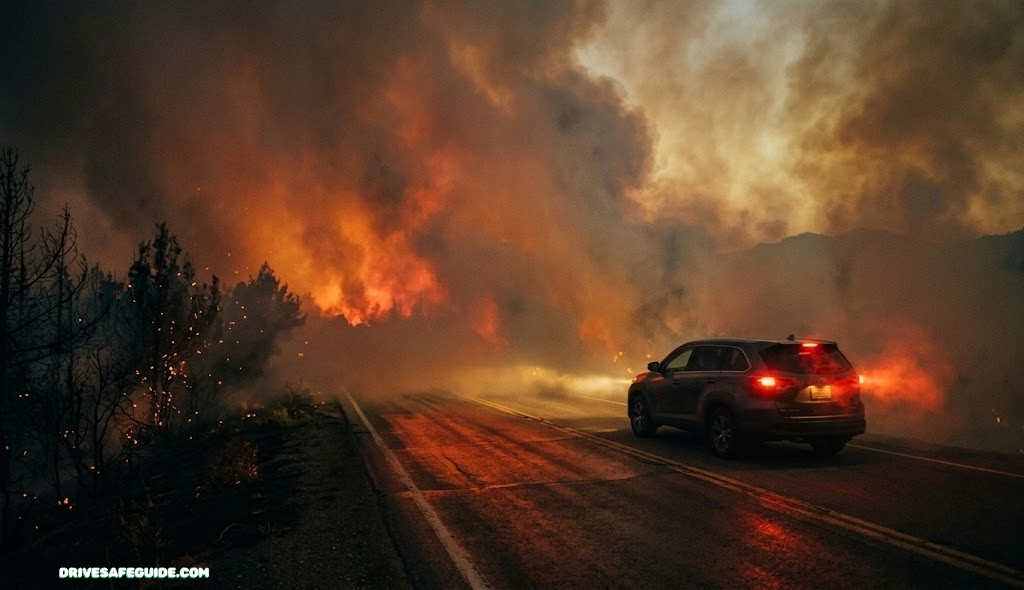
Driving Through Wildfire Smoke: Safety Tips and Precautions
Navigating through a wildfire zone is one of the most hazardous situations a driver can face. From blinding ash to toxic PM2.5 particles, understanding how to prepare your vehicle and react on the road can mean the difference between a safe escape and a deadly disaster.
1. Understanding the Unique Dangers of Wildfire Smoke
When you find yourself driving through wildfire smoke, you aren’t just dealing with a simple lack of visibility. Wildfire smoke is a complex, highly dangerous mixture of gases and fine particles released from burning vegetation, building materials, and synthetic compounds.
The primary threat is PM2.5 (Particulate Matter 2.5). These microscopic particles are small enough to bypass your respiratory system’s natural defenses and enter your bloodstream directly. Furthermore, active fires strip oxygen from the air and replace it with high concentrations of Carbon Monoxide (CO). Driving into these zones without preparation risks not only a physical collision due to zero visibility but also severe cognitive impairment from toxic gas inhalation.
Much like the sensory deprivation experienced during extreme weather events—which you can read about in our dust storm driving protocol—wildfire smoke severely disorients your spatial awareness. The combination of falling ash, glowing embers, and a brownish-orange sky can cause intense vertigo and panic in unprepared drivers.
| Hazard Type | Impact on Driver | Impact on Vehicle |
|---|---|---|
| PM2.5 Particulates | Respiratory distress, eye irritation, cognitive fog. | Clogs cabin air filters quickly. |
| Carbon Monoxide | Drowsiness, headache, eventual loss of consciousness. | No mechanical impact, but highly lethal to occupants. |
| Falling Ash/Embers | Complete loss of forward visibility. | Clogs engine air intake; risks igniting debris in the vehicle’s undercarriage. |
2. Pre-Trip Planning and AQI Thresholds
The safest way to handle wildfire smoke is to avoid driving through it entirely. Before embarking on any route during fire season, especially in prone areas like California, Oregon, or British Columbia, a rigorous pre-trip assessment is mandatory. This goes far beyond a standard cross-country driving checklist.
Monitor the Air Quality Index (AQI) using tools like AirNow.gov or specialized apps like PurpleAir. You need to know the threshold at which driving becomes hazardous not just for visibility, but for the structural integrity of your vehicle’s filtration system.
- AQI 0-100 (Good to Moderate): Safe for normal driving. Standard cabin filters are sufficient.
- AQI 101-150 (Unhealthy for Sensitive Groups): Keep windows rolled up. Ensure your HVAC is on recirculate.
- AQI 151-200 (Unhealthy): Visibility will noticeably drop. High-risk individuals should avoid driving. Upgraded filters recommended.
- AQI 201-300 (Very Unhealthy): Avoid driving if possible. Ash will begin accumulating on the windshield.
- AQI 301+ (Hazardous): Emergency evacuation only. Visibility can drop to mere feet. Severe risk of engine stalling and cabin air toxicity.
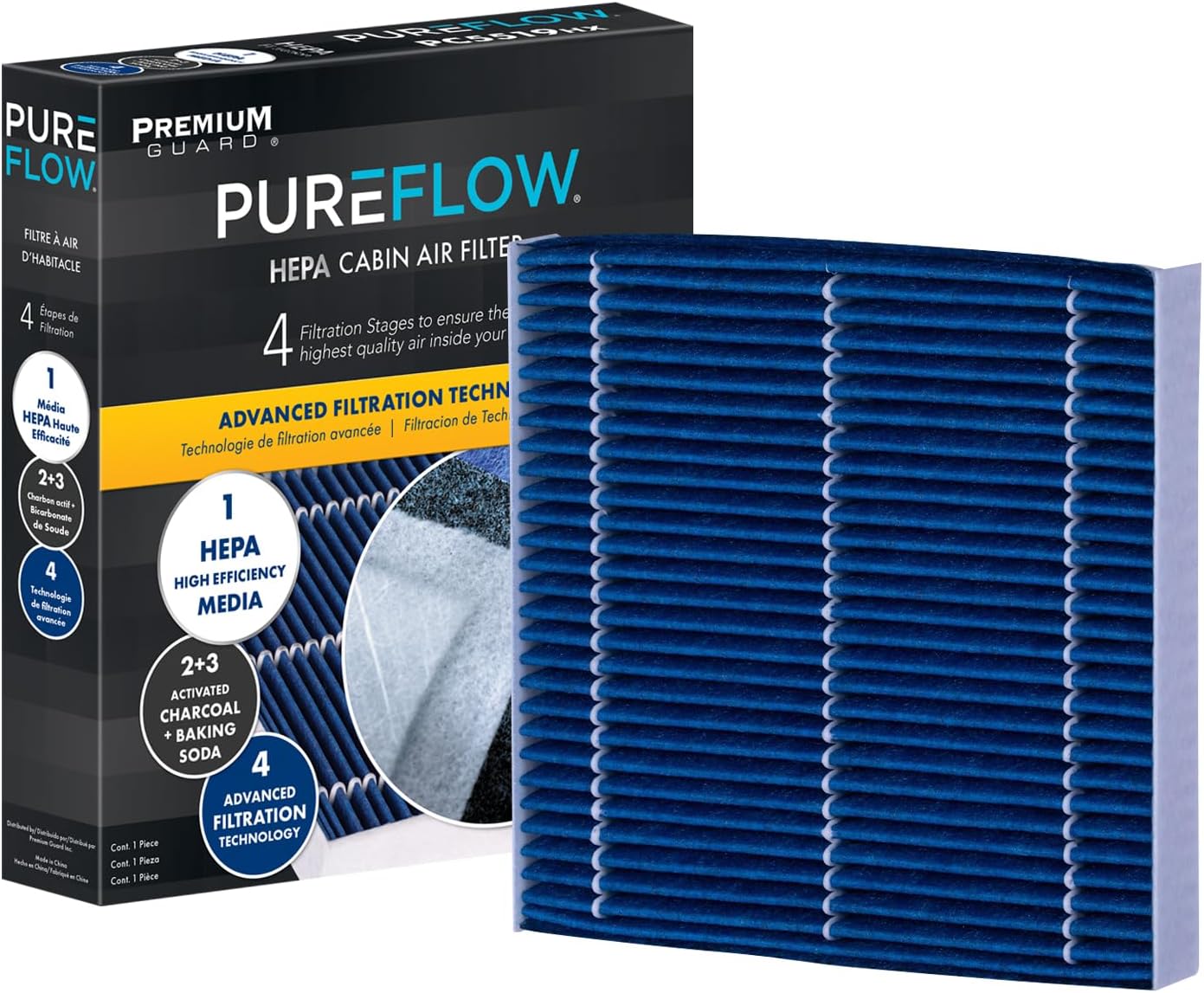
Stop Breathing Toxic Ash
Standard paper filters won’t stop wildfire PM2.5. Upgrade your vehicle to a True HEPA Cabin Air Filter with activated carbon to protect your lungs while evacuating.
Find HEPA Filters on Amazon3. Cabin Air Quality: Sealing Out Toxins
When the sky turns orange, your car’s climate control system is your first line of defense. The absolute most critical step you must take is to press the Air Recirculation Button (usually depicted as a car outline with a U-shaped arrow inside). If you leave your system pulling fresh air from the outside, you are actively pumping toxic smoke and carbon monoxide directly into the cabin.
However, running on recirculation for hours can lead to a buildup of CO2 from your own breath, making you drowsy. To combat this, you need a high-quality filtration setup. If you haven’t checked your filter recently, follow our DIY cabin air filter replacement guide to swap out your stock paper filter for an activated carbon or HEPA filter.
Pro-Tip for Smoke Driving: Turn the AC on (to dehumidify the cabin and keep temperatures comfortable) but keep the fan speed at a low-to-medium setting. Blasting the fan, even on recirculate, can create negative pressure in older vehicles, sucking smoke in through microscopic gaps in the door seals and firewall.
4. Visibility and Lighting Protocols
Heavy smoke scatters light identically to thick fog. Therefore, many of the same rules found in our fog driving strategies apply here—but with higher stakes, as smoke can instantly thicken based on wind gusts and fuel loads.
The Golden Rule: Never Use High Beams
When visibility drops, human instinct is to turn on the brightest lights available. In wildfire smoke, activating your high beams is incredibly dangerous. The intense light will reflect off the millions of suspended ash particles, creating a blinding, opaque “white wall” immediately in front of your windshield.
- Low Beams Always: Turn your headlights to the manual “ON” position. Do not rely on automatic headlights; daytime smoke can confuse optical sensors, leaving your taillights off and making you invisible from behind.
- Fog Lights: If your vehicle is equipped with fog lights, turn them on. Because they are mounted low to the ground, they cut under the densest layers of smoke and illuminate the lane markers.
- Hazard Lights: If you are forced to drive significantly below the speed limit (e.g., 20 mph on a 65 mph highway), activate your hazard lights to warn approaching drivers. Check your night driving safety checklist for more on maximizing visibility.
5. Speed, Following Distance, and Spatial Awareness
Smoke warps depth perception. The taillights of the car in front of you might look 100 feet away, but they could actually be 20 feet away. If that driver panic-brakes, you will rear-end them unless you have adjusted your following distance.
Under normal conditions, a 3-second following distance is standard. In heavy smoke, you must double or triple this. Revisit the safe following distance rule: you need at least 6 to 9 seconds of space between you and the vehicle ahead.
Do not use Cruise Control. You need full, manual control over your acceleration and braking at all times. Roll down your window just a crack for a few seconds if you safely can—not to breathe the air, but to listen. When visual senses are compromised, hearing sirens, honking horns, or the roar of an approaching fire can provide critical seconds of warning.

Be Seen in Zero Visibility
If you break down in a smoke cloud, standard reflectors won’t save you. Equip your trunk with magnetic, ultra-bright LED road flares to prevent rear-end collisions.
Get LED Road Flares on Amazon6. Protecting Your Engine in Heavy Ash
Your lungs aren’t the only things choking in a wildfire zone; your car’s engine requires massive amounts of oxygen to run. For every gallon of gas burned, an engine consumes roughly 10,000 gallons of air. When that air is saturated with ash, your engine air filter will clog at an alarming rate.
A clogged intake filter acts like a rag shoved into a runner’s mouth. The vehicle will experience sluggish acceleration, terrible fuel economy, and may eventually stall out completely. Furthermore, heavy ash can blanket the radiator, severely reducing its ability to dissipate heat. If you combine this with the naturally high ambient temperatures of a fire zone, engine overheating is a massive risk. We highly recommend reviewing our guide on extreme heat engine care if you live in fire-prone regions.
Warning Signs of Engine Suffocation:
- The engine temperature gauge creeping toward the red zone.
- Sputtering or shaking when pressing the accelerator.
- A sudden drop in RPMs while idling.
7. Physical Health, Fatigue, and Toxicity
Driving through an evacuation zone is highly stressful. Your heart rate is elevated, your grip on the steering wheel is tight, and your adrenaline is surging. This rapid onset of fatigue is compounded by the subtle ingress of toxic gases.
Even with the best filters and recirculation on, older vehicles are rarely airtight. Mild Carbon Monoxide exposure presents as a dull headache, slight nausea, and heavy eyelids. If you feel these symptoms, it is not just “tiredness”—it is chemical fatigue. This situation is far more acute than standard road trip exhaustion, though the advice in our drowsy driving checklist still applies: if you cannot keep your eyes open, you are a lethal hazard to yourself and others.
Keep a well-fitted N95 or P100 respirator mask in your glovebox. Do not rely on surgical masks or cloth bandanas; they offer exactly zero protection against PM2.5 smoke particles.
8. Emergency Protocols: When Visibility Drops to Zero
The scariest moment when navigating a wildfire is a “smoke out”—when shifting winds suddenly blow a dense wall of smoke across the highway, reducing visibility to the hood of your car.
If you literally cannot see the road ahead:
- Do Not Slam on the Brakes: Decelerate smoothly to avoid causing a chain-reaction pileup behind you.
- Turn on Hazard Lights: Immediately make yourself as visible as possible.
- Use Road Edges as Guides: Look slightly down and to the right to track the solid white shoulder line to guide you off the active lane.
- Pull Completely Off the Road: Get as far onto the shoulder as safely possible.
- Turn Off All Exterior Lights & Keep Foot Off Brake: Once parked on the shoulder, turn off your headlights and take your foot off the brake pedal (leave hazards on if safely off the road, but be careful). Why? In zero visibility, drivers behind you will instinctually follow any red taillights they see. If you are parked on the shoulder with your brakes illuminated, a confused driver may rear-end you at highway speeds thinking you are in the active lane.
If you are trapped and the fire is encroaching, you must be prepared to abandon the vehicle. Having reliable emergency car escape tools is non-negotiable in these extremes.

Fight Embers and Small Fires
Falling embers can ignite debris in your car’s cowl or undercarriage. Don’t let your escape vehicle burn down. Carry a highly-rated automotive fire extinguisher.
Shop Car Fire Extinguishers10. Fire Proximity and Evacuation Realities
If you find yourself inadvertently driving toward the glow of the fire rather than just through ambient smoke, you must execute a U-turn immediately. Do not attempt to “push through” a section of road where flames are visible on both sides.
The radiant heat from an active crown fire can easily exceed 1,500°F (815°C). At these temperatures, the heat radiating through the air—even without direct flame contact—is enough to melt plastic bumpers, warp window glass, and cause tires to spontaneously ignite or delaminate. Furthermore, high heat can vaporize the fuel in your lines, causing vapor lock and engine death right in the middle of the danger zone. Knowing engine fire extinguishing techniques is critical, but preventing proximity is far better.
11. Post-Exposure Decontamination and Maintenance
Once you are safely out of the smoke and back home, the danger to your vehicle isn’t over. Wildfire ash is not like normal dust. It contains potassium, calcium, and heavy metals. When it sits on your car’s clear coat and mixes with morning dew or rain, it forms a highly corrosive alkaline slurry that will permanently etch your paint and pit your windshield glass.
You must decontaminate the vehicle immediately:
- Do Not Wipe Dry Ash: Ash particles are abrasive like sandpaper. Wiping them with a dry towel will destroy your paint.
- Pre-Rinse Vigorously: Use a pressure washer or strong hose to blast away loose ash before making any contact with the paint.
- Use a pH-Neutral Soap: Wash the car thoroughly. You may want to invest in the best car cleaning kit to safely lift the heavy contaminants.
- Replace All Filters: The engine air filter and the cabin air filter must be replaced immediately. Even if they look okay, the microscopic PM2.5 particles have compromised their flow rate.
- Wash the Undercarriage: Embers and ash can get trapped in the chassis. If you want to keep your car looking new in hot climates, undercarriage care is paramount.
12. Building a Fire-Ready Vehicle Emergency Kit
If you live in a region prone to wildfires (the American West, Australia, parts of Southern Europe), standard emergency kits aren’t enough. You need to upgrade your setup specifically for fire season. A standard car safety kit must be augmented.
| Item | Purpose in a Wildfire Emergency |
|---|---|
| N95/P100 Masks (x4) | Vital for protecting your lungs if you have to change a flat tire in the smoke. |
| Heavy 100% Wool Blanket | Wool is naturally flame resistant. It can shield you from radiant heat in an extreme emergency. Avoid synthetic blankets (they melt). |
| Class B/C Fire Extinguisher | To put out embers that ignite dry brush under your car. Reference our guide to choose a car fire extinguisher. |
| 3+ Gallons of Water | For drinking, cooling down an overheated radiator, or dousing small flare-ups. |
| Leather Work Gloves | If you have to move burning branches or hot debris out of the roadway. |
Never wait until you smell smoke to pack this gear. Keep it stored in a dedicated bin in your trunk from May through November. For a broader overview of emergency preparation, see our comprehensive car emergency kit checklist and road trip essentials checklist.
Frequently Asked Questions (FAQs)
Conclusion
Navigating through a heavy blanket of wildfire smoke is a high-stress scenario that tests both your driving skills and your vehicle’s mechanical endurance. Mother Nature is entirely unforgiving when it comes to fire. The moment you see the sky turning an ominous hue, your priority must shift from reaching your destination to ensuring absolute survival. By sealing your cabin, managing your speed, utilizing proper lighting, and keeping a cool head when visibility vanishes, you vastly increase your odds of escaping the smoke cloud safely.
Don’t wait for the evacuation order to realize your car isn’t prepared. Equip your vehicle today with the filters, lighting, and emergency tools needed to survive the gauntlet.
🚗 Recommended for Drivers
Drive Safer Every Day
Explore our top picks for car safety gear — from dashcams to emergency kits — all hand-picked to help you stay safe on the road.
🚗 Shop Car Safety EssentialsAffiliate link — we earn a small commission that keeps DriveSafeGuide running. Thank you!