Lithium vs Lead-Acid Jump Starter: Which One Actually Deserves a Spot in Your Trunk?
Weight, cold-weather cranking power, charging speed, safety, and price — compared head-to-head so you can stop guessing and pick the right one.
Why the Battery Inside Your Jump Starter Matters
Every jump starter on the market does the same basic job: it delivers a burst of current to a dead battery so your engine can turn over. But the chemistry sitting inside that plastic housing changes almost everything about how the device behaves in the real world — how much it weighs, how it performs when the temperature drops, how long it holds a charge sitting in your trunk, and how much you’ll spend replacing it in a few years.
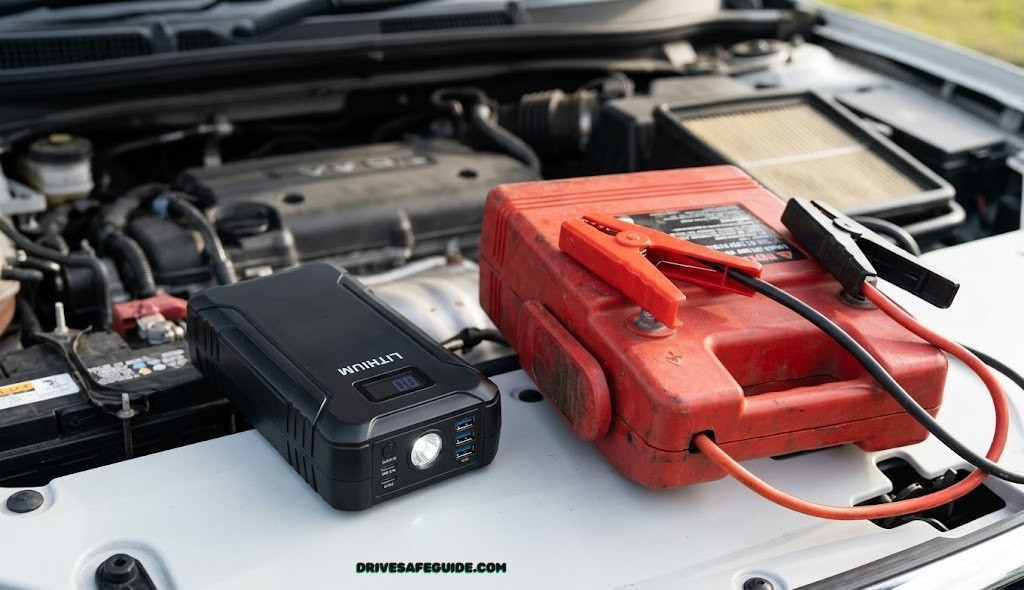
Most drivers never think about this until they’re standing in a parking lot deciding between two units that look nearly identical on the outside but couldn’t be more different on the inside. One is a modern lithium-ion pack the size of a paperback book. The other is a lead-acid unit that feels like it belongs under the hood of a tractor. Both will start your car. Only one of them is still going to work reliably three winters from now.
This guide breaks the two technologies down side by side — no marketing fluff, no assumptions that you already know what “cold cranking amps” means. By the end, you’ll know exactly which type fits your vehicle, your climate, and your budget. If you’re still unsure how much starting power you actually need before you even get to the lithium-vs-lead-acid question, it’s worth checking how many amps a jump starter needs for your specific engine first, since that number affects which units in either category are even worth considering.
It also helps to understand why this question has become more relevant in the last several years than it used to be. A decade or so ago, “jump starter” essentially meant one thing: a heavy AGM battery in a plastic case with a set of thick clamps hanging off the front. There wasn’t much of a decision to make because there wasn’t much of an alternative. Lithium-ion cells were still too expensive and too poorly understood in a starting-current context to compete. That’s no longer true. Advances in cell chemistry, protection circuitry, and manufacturing scale have pushed lithium jump starters down in price to the point where they now directly compete with — and in many cases outsell — traditional lead-acid units in the same amperage class.
That shift has created a genuinely useful decision for consumers, but it’s also created a lot of marketing noise. Product listings love to lead with peak amp numbers and jump-count claims without explaining what actually drives those numbers, or how they change once a unit has been sitting in a cold trunk for two months instead of fresh off the shelf in a climate-controlled warehouse. Understanding the underlying battery chemistry is the fastest way to cut through that noise, because it tells you not just how a unit performs on day one, but how it will behave a year or three years into ownership — which is really the only performance window that matters for a device you’re buying specifically for emergencies.
Throughout this guide, we’ll reference both real-world usage patterns and the underlying electrochemistry, but the goal is always practical: helping you walk away knowing which category of jump starter fits how you actually drive, where you actually park, and how cold it actually gets where you live.
What Is a Lead-Acid Jump Starter?
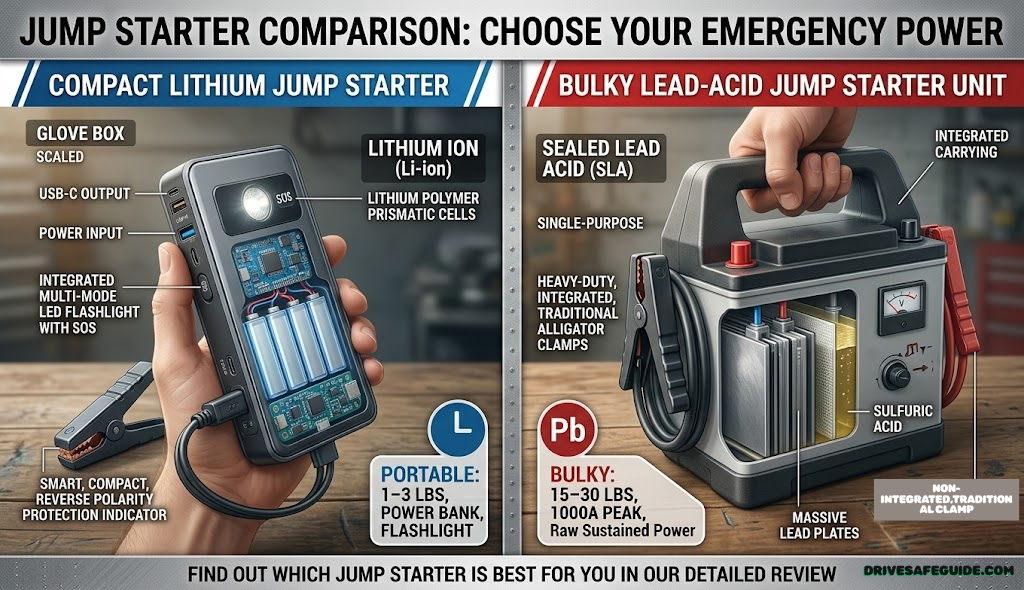
Lead-acid jump starters use the same core battery chemistry that’s been sitting under your hood for over a century — lead plates suspended in a sulfuric acid electrolyte. Inside a portable jump starter, that chemistry is usually packaged as either a sealed AGM (absorbent glass mat) battery or a smaller “gel cell,” both of which are safer and more spill-resistant than the flooded lead-acid batteries used in cars, but still fundamentally the same technology.
The appeal of lead-acid units has always been raw output and low upfront cost. AGM batteries can sustain very high discharge currents for short bursts, which is exactly what’s needed to crank a stubborn starter motor. They’ve also been manufactured at massive scale for decades, which keeps manufacturing costs — and therefore retail prices — relatively low.
The tradeoff is size and weight. Lead is a dense metal, and a battery large enough to reliably start a V8 engine multiple times without a recharge is going to weigh somewhere between four and twenty-five pounds depending on capacity. That weight, combined with a plastic housing, cables, and clamps, means most lead-acid jump starters end up being carried in the trunk and rarely, if ever, in a backpack, glovebox, or motorcycle saddlebag.
How Lead-Acid Units Typically Perform
A mid-range lead-acid jump starter usually delivers somewhere between 400 and 2,000 peak amps, which is more than enough for most passenger cars, though larger diesel trucks may need units at the higher end of that range or beyond. Self-discharge is the other defining trait of this chemistry — a lead-acid jump starter left untouched in a cold trunk for two or three months can lose a meaningful percentage of its charge, which is part of why so many people discover their old jump starter is dead exactly when they need it most.
Lead-Acid Pros
- Lower purchase price for comparable peak amperage
- High sustained current output, good for large engines
- Simple, well-understood technology with a long track record
- Less sensitive to a single deep discharge event
Lead-Acid Cons
- Significantly heavier and bulkier
- Faster self-discharge when stored
- Cold weather sharply reduces available power
- Shorter usable lifespan (typically 2–4 years)

Looking at a Lead-Acid Option?
Compare current AGM jump starter models and pricing before you buy.
Check Prices on AmazonWhat Is a Lithium Jump Starter?
Lithium jump starters use lithium-ion or lithium-polymer cells — the same broad family of battery technology found in laptops, power tools, and electric vehicles. Instead of lead plates and liquid electrolyte, energy is stored in tightly packed cells that offer far more capacity per pound than lead-acid can achieve.
This is why lithium jump starters can shrink down to the size of a smartphone or a small paperback while still delivering enough peak current to start a six-cylinder engine. The energy density of lithium chemistry is roughly three to five times that of lead-acid, which is the single biggest reason this category has taken over so much of the jump-starter market in recent years.
Most lithium jump starters also include a built-in battery management system (BMS) — a small circuit board that monitors voltage, temperature, and current flow to prevent overcharging, short circuits, and reverse-polarity mistakes. This is a meaningful safety upgrade over older lead-acid designs, which typically rely on simpler spark-proof clamps rather than active electronic protection.
How Lithium Units Typically Perform
A compact lithium jump starter in the 12,000–20,000mAh range can usually deliver 800 to 2,000 peak amps — comparable to a much larger lead-acid unit — while weighing under two pounds. Self-discharge rates are dramatically lower too; a quality lithium jump starter can often sit unused for six to twelve months and still retain enough charge for an emergency start, which matters enormously for something that’s supposed to work the one time you actually need it.
Lithium Pros
- Dramatically lighter and more compact
- Slow self-discharge, holds charge for months
- Built-in safety electronics (BMS, reverse-polarity protection)
- Faster recharge times via USB-C
- Longer overall lifespan (often 500+ charge cycles)
Lithium Cons
- Higher purchase price for equivalent peak amps
- Performance drops more sharply in extreme cold unless rated for it
- Cells can degrade faster if repeatedly fully drained
- Requires more careful storage temperature range
Lithium vs Lead-Acid: At a Glance
Here’s the side-by-side comparison most buyers actually want before reading another word of explanation.
| Category | Lithium Jump Starter | Lead-Acid Jump Starter |
|---|---|---|
| Typical Weight | 0.5 – 2.5 lbs | 4 – 25 lbs |
| Typical Size | Pocket to paperback-sized | Shoebox to tackle-box sized |
| Peak Amps (comparable unit) | 800 – 2,000A | 400 – 2,000A+ |
| Self-Discharge Rate | Very low (retains charge for months) | Higher (recharge every 1–3 months recommended) |
| Cold Weather Performance | Good if cold-rated; drops sharply if not | Moderate, degrades below freezing |
| Recharge Time | 1 – 3 hours (USB-C) | 4 – 10 hours |
| Typical Lifespan | 3 – 6 years / 500+ cycles | 2 – 4 years |
| Average Price Range | $40 – $150 | $25 – $100 |
| Built-In Safety Electronics | Standard on most models | Less common, varies by brand |
| Best For | Daily drivers, travel, small-to-mid engines | Trucks, fleets, budget buyers, cold storage tolerance |
If you’re cross-shopping specific brands rather than chemistries, our NOCO vs Halo comparison applies a lot of this same logic to two of the most popular lithium options on the market today.
Weight and Portability
This is the single biggest practical difference between the two categories, and it shows up the moment you pick either unit up for the first time. A lead-acid jump starter with enough capacity to reliably start a mid-size sedan multiple times typically weighs somewhere between six and twelve pounds. Units built for trucks or fleet vehicles can climb well past twenty pounds once you account for the internal battery, thick gauge cables, and reinforced housing.
A lithium jump starter delivering comparable peak amperage often weighs under two pounds, cables included. That difference isn’t just a convenience issue — it changes where and how the device actually gets used. A lead-acid unit tends to live permanently in the trunk, largely because nobody wants to carry it anywhere else. A lithium unit fits in a glovebox, a backpack, a motorcycle pannier, or a purse, which means it’s far more likely to actually be with you when you need it rather than sitting in a garage three states away.
For anyone building out a broader roadside kit rather than buying a single device, this weight difference compounds. If you’re also carrying flares, a first-aid kit, and tools, a lithium jump starter leaves meaningfully more cargo capacity than a lead-acid one. It’s worth reading through how to build a complete car safety kit to see how a jump starter fits into the bigger picture alongside tire, battery, and first-aid essentials.
Cold-Weather Starting Power
Cold weather is where battery chemistry differences become most obvious, and it’s also exactly when you’re most likely to need a jump starter in the first place — engine oil thickens, battery chemistry slows down, and a marginal battery that worked fine all summer suddenly can’t turn the engine over.
Lead-acid batteries lose a meaningful percentage of their effective output as temperature drops, generally somewhere in the range of 20-40% reduced capacity at freezing temperatures compared to room temperature, though sealed AGM units handle cold noticeably better than older flooded designs. Standard lithium-ion cells are actually more sensitive to extreme cold than lead-acid in some respects — below roughly 14°F (-10°C), an unprotected lithium cell’s internal resistance rises and output can drop sharply, sometimes even triggering a built-in low-temperature cutoff that prevents the unit from discharging at all until it warms up.
This is why the better lithium jump starters on the market specifically advertise a low-temperature discharge rating or an internal heating circuit that allows safe operation down into single-digit temperatures. If you live somewhere with genuinely harsh winters, that spec matters more than peak amperage on the box. It’s worth pairing this research with a look at the best cold-weather car batteries for reliable starts, since a jump starter is a backup plan, not a replacement for a battery that’s actually rated for your climate.
Quick Cold-Weather Takeaway
| Temperature Range | Lead-Acid Behavior | Lithium Behavior |
|---|---|---|
| Above 32°F (0°C) | Performs close to rated capacity | Performs close to rated capacity |
| 32°F to 14°F (0°C to -10°C) | Noticeable output reduction | Reduced output unless cold-rated |
| Below 14°F (-10°C) | Significant capacity loss, still usually functional | May cut off entirely without a heating circuit |

Shopping for Cold-Climate Reliability?
Look for a lithium jump starter with a specific low-temperature discharge rating.
Browse Cold-Rated Jump StartersCharging Speed and Battery Lifespan
Recharge time is another area where the two chemistries diverge noticeably. Most lead-acid jump starters recharge via a standard wall adapter and take anywhere from four to ten hours for a full charge, depending on capacity. Lithium units almost universally support USB-C fast charging today, and many can go from empty to full in one to three hours — a meaningful difference if you’ve just used the device and want it ready again before a return trip.
Lifespan tells a similar story. Lead-acid batteries, even sealed AGM versions, typically start losing meaningful capacity after two to four years regardless of how carefully they’re maintained, simply because the lead plates degrade with each charge cycle and with time itself. Lithium cells, when treated reasonably well — not left fully drained for long periods, not stored at extreme temperatures — commonly last three to six years and 500 or more charge cycles before capacity drops meaningfully.
That said, lithium cells are less forgiving of certain abuses. A lead-acid battery left fully discharged for a few weeks will usually still recover with a proper charge. A lithium cell left at zero percent for an extended period can suffer permanent capacity loss or, in some cases, fail to accept a charge at all. This is one of the few areas where lead-acid chemistry is genuinely more forgiving to a careless owner.
If your jump starter is one part of a larger diagnostic and maintenance routine, it’s worth understanding the difference between a load tester and a conductance tester, since either tool can tell you whether your main car battery is actually the problem before you reach for the jump starter at all.
Safety Features and Risks
Both technologies are generally safe when used as directed, but the failure modes differ. Lead-acid batteries contain sulfuric acid and can, in rare cases of severe overcharging or physical damage, vent hydrogen gas or leak electrolyte. Sealed AGM designs used in modern jump starters largely mitigate this, but it’s still a chemistry that can produce a spark near a battery terminal under the wrong conditions.
Lithium-ion cells carry a different risk profile. Thermal runaway — a rare but serious failure where a damaged or defective cell overheats and can catch fire — is the headline risk associated with lithium batteries generally, though the incidence rate in quality jump starters with proper battery management systems is low. This is exactly why the built-in BMS mentioned earlier matters so much: it actively prevents the overcharging, over-discharging, and short-circuit conditions that are the usual triggers for lithium cell failure.
Safety Features to Look For
- Reverse polarity protection — prevents damage or sparking if clamps are connected backward
- Spark-proof clamps — reduce ignition risk near battery terminals
- Short-circuit protection — cuts power instantly if clamps touch each other
- Overcharge/over-discharge protection — standard on quality lithium BMS units, less consistent on lead-acid
- Temperature cutoff — halts charging or discharging outside safe temperature ranges
Regardless of chemistry, a jump starter is only as safe as the way it’s used. Reviewing general defensive and preventive driving habits is a good reminder that most roadside emergencies — including dead batteries — are far easier to prevent than to fix on the shoulder of a highway.
Price and Long-Term Value
On a pure sticker-price basis, lead-acid jump starters usually win. You can find a capable AGM unit for $30–$60 that will comfortably start most passenger vehicles, while a lithium unit with similar peak output often starts closer to $50–$100. For a one-time purchase, lead-acid looks like the better deal.
The math shifts when you factor in lifespan and replacement frequency. If a lead-acid unit needs replacing every two to three years due to capacity loss or a battery that simply won’t hold a charge anymore, while a lithium unit lasts four to six years, the lithium option can end up costing less per year of actual service — even with a higher upfront price. Add in the lower self-discharge rate, and a lithium unit is also simply more likely to actually work the day you need it, which has a value that’s hard to put a dollar figure on.
| Ownership Factor | Lead-Acid | Lithium |
|---|---|---|
| Typical Upfront Cost | $25 – $100 | $40 – $150 |
| Expected Replacement Cycle | Every 2–4 years | Every 3–6 years |
| Approx. Cost Per Year of Use | Moderate | Often lower over time |
| Charge Maintenance Needed | Every 1–3 months | Every 6–12 months |
Extra Features Worth Comparing
Modern jump starters, particularly lithium models, rarely do just one job anymore. Many now double as portable power banks, flashlights, or even tire inflators, which changes how you should think about the comparison — you may not just be buying a jump starter, you may be buying a small piece of your entire roadside kit.
Common Bundled Features
- USB-A / USB-C output ports — for charging phones or small electronics, far more common and higher-powered on lithium units
- LED flashlight modes — often including SOS and strobe patterns for roadside visibility
- Built-in air compressor — increasingly common on premium lithium units, eliminating the need for a separate tire inflator
- Digital display — shows remaining charge percentage, far less common on lead-acid units
- Wireless charging pad — a growing feature on higher-end lithium models
If a built-in air compressor is a feature you’re weighing seriously, it’s worth reading a dedicated tire inflator buying guide covering duty cycle and CFM first, since a jump starter’s bundled compressor is usually far less powerful than a standalone unit and won’t be a good fit for larger tires.
Which One Should You Buy?
There’s no universal right answer here — the better chemistry depends on your vehicle, your climate, and how you’ll actually use and store the unit. Here’s a practical breakdown by situation.
Choose a Lithium Jump Starter If:
- You drive a sedan, hatchback, crossover, or smaller SUV
- You want something that fits in a glovebox, bag, or motorcycle case
- You travel frequently and want a device that also charges phones or laptops
- You won’t remember to recharge a spare jump starter every month
- Your winters are cold but not consistently below roughly 0°F
Choose a Lead-Acid Jump Starter If:
- You drive a full-size truck, van, or diesel vehicle needing very high peak amps
- You want the lowest possible upfront cost
- The unit will live in a garage or shop where recharging every month or two is easy
- You manage a small fleet and want interchangeable, budget-friendly units
If you’re only planning to use jumper cables and a second vehicle rather than buying a standalone unit at all, it’s worth reading through the tradeoffs in jump starter vs jumper cables before you commit to either battery chemistry, since a portable jump starter isn’t the only option on the table.

Ready to Pick One Up?
See today’s top-rated jump starters across both lithium and lead-acid options.
Shop Jump Starters on AmazonMaintenance and Storage Tips
Whichever chemistry you choose, how you store and maintain the unit has more impact on real-world reliability than almost any spec on the box.
For Lead-Acid Jump Starters
- Recharge fully every 30–90 days even if unused, to offset natural self-discharge
- Avoid storing in extreme heat, such as a trunk in summer, which accelerates degradation
- Never store fully discharged for extended periods — this is the fastest way to kill an AGM battery
- Keep terminals clean and free of corrosion
For Lithium Jump Starters
- Store at roughly 50–80% charge if not using it for months, rather than fully charged or fully drained
- Top off every 6–12 months even in storage
- Avoid leaving it in a hot car during summer for extended periods
- Avoid letting it sit completely drained — recharge promptly after heavy use
Pairing either unit with a broader emergency kit is still the smartest long-term strategy. Take a look at our winter car emergency kit checklist to make sure your jump starter isn’t the only thing standing between you and a stranded roadside wait.
Frequently Asked Questions
Is a lithium jump starter better than lead-acid overall?
For most everyday drivers, yes — lithium units are lighter, hold a charge longer, and recharge faster, which makes them more likely to actually work when needed. Lead-acid still holds an edge for very high-output needs and lower upfront cost.
Can a lithium jump starter start a truck or diesel engine?
Many higher-capacity lithium units can, but you need to check the peak amp rating carefully against your engine’s requirements, since some smaller lithium models are designed primarily for four- and six-cylinder engines.
How long does a lead-acid jump starter hold its charge?
Typically one to three months before a noticeable drop, which is why manufacturers recommend recharging it on a regular schedule even if it hasn’t been used.
Do lithium jump starters work in freezing temperatures?
Many do, but performance depends heavily on whether the unit has a specific low-temperature discharge rating or internal heating circuit. A standard lithium unit without cold-weather protection can underperform or shut down below roughly 14°F.
Which type is safer to keep in a car?
Both are safe when built with proper protection circuitry. Lithium units with a certified battery management system and lead-acid AGM units with sealed casings are both considered low-risk for everyday carry.
How many times can a jump starter be used before recharging?
This varies by capacity and engine size, but most lithium units can perform multiple jump starts — often five to twenty — on a single charge for a typical passenger car, while lead-acid units vary more widely by capacity.
Is it normal for a jump starter to get warm during use?
Mild warmth during a jump start is normal for both chemistries. Excessive heat, swelling, or an unusual smell is not normal and means the unit should be stopped and inspected.
Can I leave a lithium jump starter plugged in overnight?
Most modern units include overcharge protection that cuts power once full, but it’s still good practice to unplug once charging completes rather than relying on that circuit long-term.
Do lead-acid jump starters need any special maintenance?
Beyond regular recharging every one to three months, keeping terminals clean and avoiding extreme heat exposure are the main maintenance steps for AGM lead-acid units.
Which one is more compact for a small car or motorcycle?
Lithium jump starters are almost always the better choice here, since many models weigh under two pounds and are small enough to fit in a glovebox, under-seat compartment, or backpack.
Final Verdict: Lithium vs Lead-Acid Jump Starter
If you’re buying one jump starter to keep in a typical passenger vehicle, a lithium unit is the better all-around choice for most drivers today — it’s lighter, holds a charge far longer, recharges faster, and usually includes more built-in safety electronics. Lead-acid still earns its place for larger trucks, fleet use, or anyone prioritizing the lowest upfront cost and willing to keep up with regular recharging.
Whichever direction you go, the most important step is making sure the unit you choose actually matches your engine’s power requirements and your climate. Compare current models, prices, and capacities before you buy.
Compare Jump Starters on Amazon