NOCO Boost Plus vs Halo Bolt
Best Portable Jump Starter for Driver Safety?
Two of the most popular lithium jump starters on the market go head-to-head. We break down power, safety features, real-world usability, and which one belongs in your car.


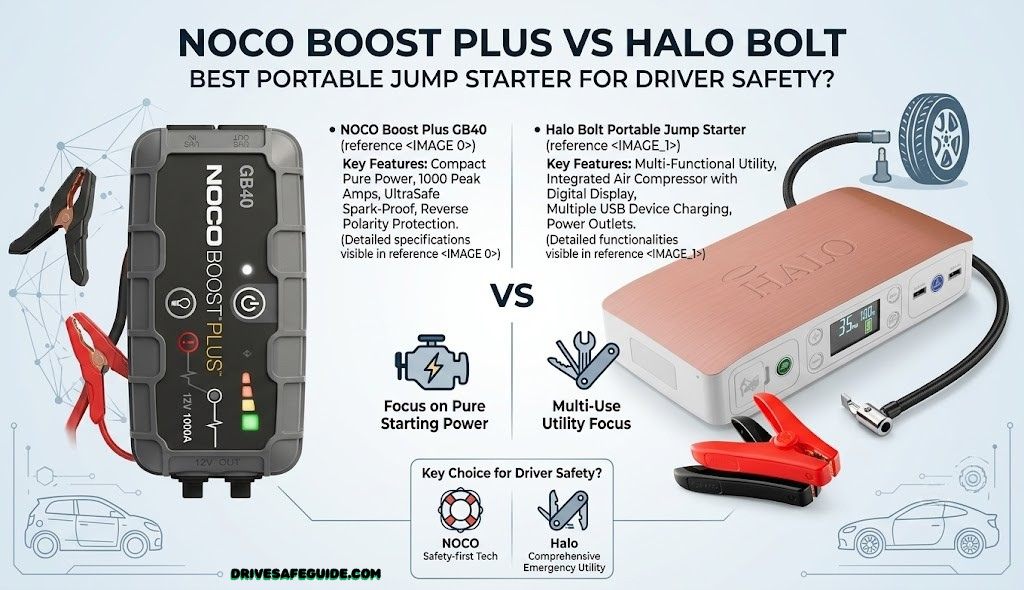
Quick Verdict: Which Jump Starter Wins?
A dead battery at the wrong moment — sitting alone in a parking garage, stranded on a dark highway at midnight, or stuck in a snowy lot with nowhere to go — is one of those automotive emergencies that can turn a minor inconvenience into a serious safety situation. That’s exactly why a portable jump starter has become one of the most valuable pieces of emergency equipment any driver can carry.
Two products consistently rise to the top of this category: the NOCO Boost Plus GB40 and the Halo Bolt Air. Both are lithium-powered, both fit in a glove box or trunk bag, and both can save you from a dead-battery nightmare — but they take very different approaches to the problem. This guide breaks down every meaningful difference so you can make the right call for your vehicle and driving habits.
Before diving into the detailed breakdown, it’s worth noting that both products occupy the same general price tier and are frequently purchased by drivers building out a proper car safety kit. Neither is a budget product, and neither disappoints — but the details matter when you need it to work at 2 a.m. on a cold highway.
Full Specifications: Side-by-Side
Numbers tell part of the story. Here’s how both units stack up on every measurable spec before we talk about what those numbers actually feel like in the real world.
| Specification | NOCO Boost Plus GB40 | Halo Bolt Air |
|---|---|---|
| Peak Current | 1,000 Amps ⭐ | 500 Amps |
| Battery Capacity | 12,000 mAh | 57,720 mWh (≈16,000 mAh) ⭐ |
| Supported Engine (Gas) | Up to 6.0L ⭐ | Up to 6.5L (rated) |
| Supported Engine (Diesel) | Up to 3.0L | Not specified |
| Built-in Air Compressor | No | Yes (150 PSI) ⭐ |
| AC Outlet (Wall Power) | No | Yes (120V, 65W) ⭐ |
| USB Outputs | 1× USB-A (2.1A) | 2× USB-A + 1× USB-C |
| Weight | 2.4 lbs ⭐ | 7.0 lbs |
| Dimensions | 7.2 × 3.2 × 1.5 in ⭐ | 8.9 × 4.1 × 2.5 in |
| Reverse Polarity Protection | Yes (Spark-proof) ⭐ | Yes |
| Charge Retention | Up to 12 months ⭐ | 3–6 months |
| Recharge Input | Micro-USB | AC or DC |
| IP Rating / Weatherproofing | IP65 (water & dust resistant) | Not IP rated |
| LED Flashlight | Yes (7 modes) | Yes (basic) |
| Operating Temp Range | -20°C to 60°C | 0°C to 45°C |
Jump-Starting Power: Amps, Cranking, and Engine Compatibility
If you’ve ever researched how many amps your engine actually needs to start, you already know that the relationship between peak amp ratings and real-world cranking performance isn’t always straightforward. Marketing numbers can be generous. What actually matters is the cold cranking amps (CCA) the unit can sustain through a genuine battery-drain scenario.
NOCO Boost Plus GB40 — Power Profile
The NOCO GB40 delivers a rated 1,000 peak amps from a compact lithium cell that’s roughly the size of a hardcover novel. For most passenger cars, SUVs, and light trucks with gas engines up to 6 liters, that’s more than enough current to crank a deeply discharged or completely flat battery. The NOCO GB40 is particularly well-regarded for its ability to jump-start batteries that appear completely dead — a scenario where many competitors struggle because their electronics refuse to engage unless they detect a minimum battery voltage.
NOCO’s answer to this is their “Boost Mode” — a manual override that bypasses the voltage detection requirement and allows the unit to attempt a jump even when the target battery reads 0 volts. This is a genuinely useful feature that distinguishes the GB40 from many competing units in its class.
Halo Bolt Air — Power Profile
The Halo Bolt Air is rated at 500 peak amps, which is half the NOCO’s rating on paper. In practice, the Halo Bolt performs adequately for the majority of everyday passenger vehicles — compact cars, mid-size sedans, small SUVs — but the lower current ceiling becomes a real limitation with larger V8 trucks, diesels, and vehicles with severely discharged batteries. Where the Halo Bolt genuinely pulls ahead is in raw energy storage: its 57,720 mWh capacity means it can charge your phone and laptop many times over and still have reserve power for a jump start.
Power Winner: NOCO Boost Plus GB40
For pure jump-starting capability — especially for larger engines, diesel applications, or deeply discharged batteries — the NOCO GB40’s 1,000A output and Boost Mode override give it a clear advantage. The shift from lead-acid to lithium jump starters has made compact units like the GB40 surprisingly capable, but their performance ceiling still varies considerably between models.
Safety Features: Which One Protects You Better?
A portable jump starter’s safety systems aren’t just a marketing checklist — they’re the difference between a successful roadside rescue and a dangerous electrical short that can damage your vehicle’s electronics, or worse. This is one of the most important dimensions to evaluate, and it’s where the two products diverge most sharply in philosophy. If you’re also comparing these alongside jump starters vs. traditional jumper cables, safety is the primary argument in the jump starter’s favor.
NOCO’s UltraSafe System
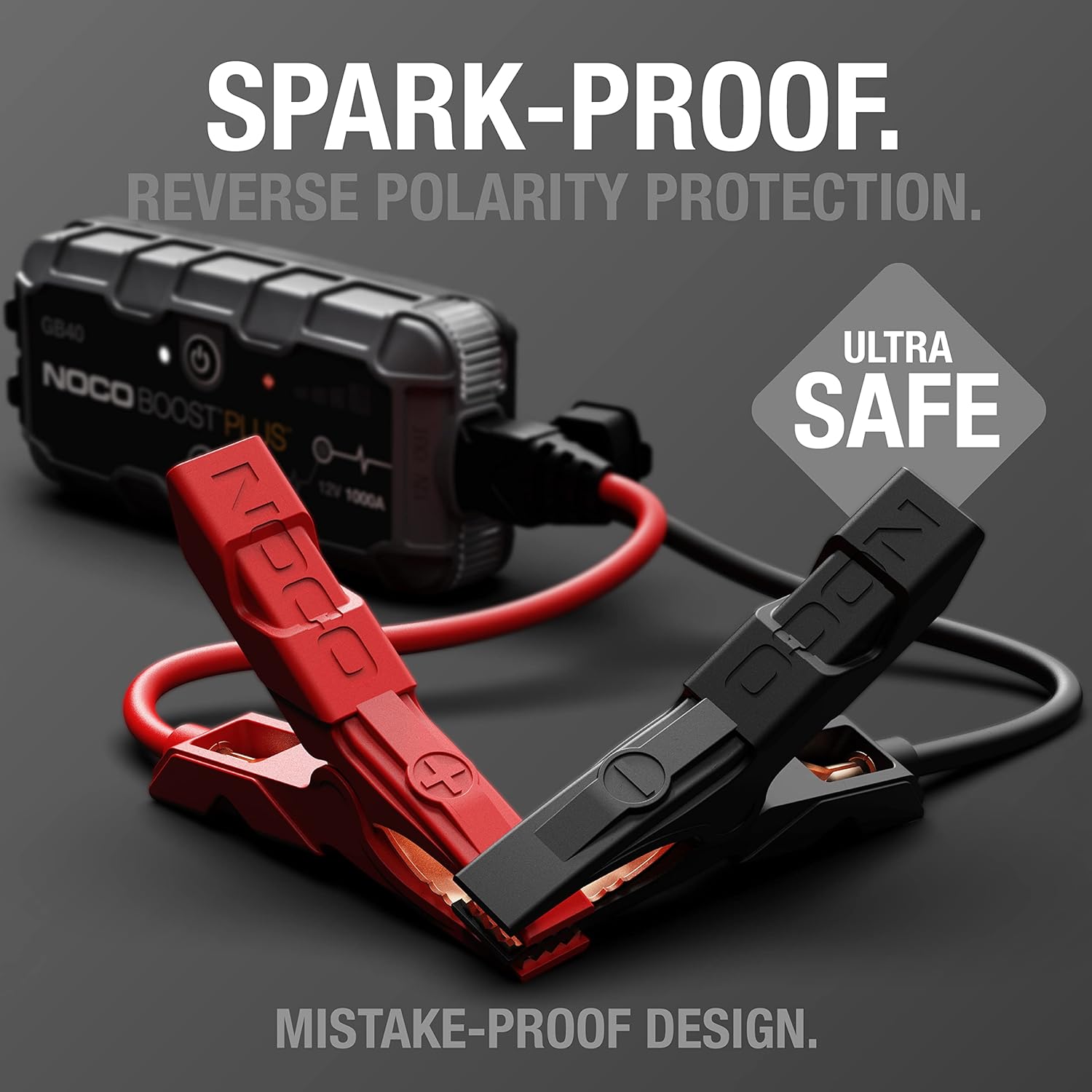
NOCO’s standout safety contribution is their patented UltraSafe clamp system. Unlike traditional jump starters that require the user to make connections in the correct order (positive first, then negative) to avoid sparks, the NOCO GB40’s clamps remain electrically inactive until the unit confirms a correct connection. That means even if you accidentally touch the clamps together or connect them in the wrong order, nothing happens — no spark, no short, no damaged electronics.
This is a genuinely significant difference from older jump starter designs. Modern vehicles carry extremely sensitive electronics — ECUs, battery management systems, infotainment modules — that can be damaged or corrupted by voltage spikes from improperly connected jump starters. The NOCO system reduces that risk dramatically, making it a more appropriate tool for newer vehicles.
Halo Bolt’s Safety Approach
The Halo Bolt includes standard overcurrent and reverse polarity protection, which are table-stakes features at this price point. What it lacks is the more sophisticated pre-connection safety logic that defines the NOCO’s UltraSafe system. The Halo Bolt’s clamps will spark if crossed, and the unit does not offer a 0-volt Boost Mode for completely flat batteries. For a casual user unfamiliar with proper jump-start procedure, the NOCO is simply the safer tool to hand to someone in a stressful roadside situation.
Safety Winner: NOCO Boost Plus GB40
The UltraSafe clamp technology and Boost Mode override make the NOCO GB40 the clear safety leader. This matters not just for the user’s peace of mind but for protecting the vehicle’s sensitive electronics. If you’re putting together a winter car emergency kit or a general car emergency kit, a jump starter with active safety logic is worth the investment.
Ease of Use: From Packaging to First Jump
How a jump starter performs in a calm garage test is one thing. How it performs when you’re stressed, it’s dark, your hands are cold, and you have no idea how long the battery has been dead is another matter entirely. Both of these products have learned from the clunky lead-acid units of previous generations, but they approach user experience from different angles.
NOCO GB40 — User Experience
The NOCO GB40 is remarkably well-thought-out for a tool that most people will use under stress. The unit powers on with a single button, the LED indicator clearly shows charge level, and the clamps are color-coded with bright labels. The UltraSafe system actually simplifies the connection process — instead of worrying about order and polarity, you connect both clamps and wait for the green LED to confirm everything is safe before starting. The integrated 7-mode LED flashlight (including SOS and emergency strobe modes) is genuinely useful for dark-parking-lot scenarios and makes the unit double as part of a broader road trip essentials kit.
The one gripe with the NOCO GB40’s usability is its Micro-USB charging port — an increasingly outdated standard that some users find frustrating in an era of USB-C cables. It’s a minor complaint but worth noting if you’re trying to standardize charging across your devices.
Halo Bolt Air — User Experience
The Halo Bolt Air is physically larger and heavier, which becomes more apparent in cramped engine bays. The interface is straightforward and the jump-start process is similar to most units on the market. Where the Halo Bolt shines on usability is its multi-function nature — the built-in air compressor eliminates the need to carry a separate tire inflator, and the AC outlet means you can plug in a laptop or a small appliance at a campsite or tailgate without hunting for an inverter. If you’re building a road trip safety kit by scenario, the Halo Bolt Air covers more bases with fewer items.
Usability Verdict: Tie
Both are genuinely easy to use. The NOCO’s active safety system makes the connection process more foolproof; the Halo Bolt’s multi-function design reduces how many separate tools you need to carry. The better choice depends on whether you prioritize simplicity or versatility.
Beyond the Jump: What Else Can Each Unit Do?
Modern portable jump starters have evolved well beyond their single-function origins. Both products here offer secondary capabilities — but the gap between them in this dimension is significant.
NOCO GB40 Extra Functions
- USB device charging: 1× USB-A port at 2.1A for charging phones and tablets
- 7-mode LED flashlight: Standard, high, strobe, SOS, and emergency flash modes
- Up to 20 jump starts per charge under ideal conditions
Halo Bolt Air Extra Functions
- 150 PSI air compressor: Built-in pump with pressure gauge and auto-shutoff for tire inflation — eliminates need for a separate portable tire inflator
- 120V AC outlet (65W): A genuine wall-type plug that can power laptops, CPAP machines, or small appliances
- Dual USB-A + USB-C: Charges multiple devices simultaneously
- Massive 57,720 mWh battery: Acts as a high-capacity power bank — charges a smartphone dozens of times
- LED flashlight: Basic but functional emergency light
Extras Winner: Halo Bolt Air
The Halo Bolt’s AC outlet and air compressor make it a clear winner on secondary functionality. For drivers who want a single emergency tool rather than a collection of separate gadgets, this matters. The NOCO is a focused specialist; the Halo Bolt is a versatile generalist.
Build Quality and Durability: Which One Lasts?
A jump starter that lives in your trunk needs to withstand some abuse — temperature swings, occasional drops, dusty environments, and the occasional splash of water when you’re working in the rain. Build quality is one area where the two products diverge noticeably.
NOCO GB40 Construction
The NOCO GB40 carries an IP65 rating, which means it’s fully protected against dust ingress and can withstand water jets from any direction. For a device that might sit in an open trunk in varying weather conditions or get used during a rainstorm on the highway, IP65 protection is a meaningful real-world advantage. The unit feels dense and well-engineered — the rubber-armored housing can take a fall from a reasonable height without issue, and the clamp housing and cable quality both feel like they belong on a premium product.
The NOCO GB40’s battery retention — holding a charge for up to 12 months — is particularly relevant for drivers who store their jump starter and forget about it. A unit that’s been sitting in your glove box all winter and still jumps your car in February is genuinely more useful than one that needs to be freshly charged before every use. This pairs well with strategies for reliable cold-weather starts more broadly.
Halo Bolt Air Construction
The Halo Bolt Air is built solidly enough for normal use, but it lacks any official IP or weatherproofing rating. The larger form factor also means it’s more prone to damage in a rough trunk environment — it’s not something you’d want to toss around casually. The added complexity of the air compressor mechanism introduces more potential failure points over time compared to the simpler NOCO design. The Halo Bolt’s charge retention is rated at around 3 to 6 months, which means drivers who don’t use it frequently will need to top it up periodically to ensure it’s ready when needed.
Durability Winner: NOCO Boost Plus GB40
The IP65 weatherproofing and 12-month charge retention give the NOCO a substantial durability advantage, particularly for drivers in variable climates. The NOCO is the kind of tool you can genuinely trust to be ready after months of sitting in your trunk untouched.
NOCO Boost Plus GB40 — Pros & Cons
- UltraSafe spark-proof clamp system for maximum electrical safety
- 1,000 peak amps handles most gas and small diesel engines
- IP65 weatherproofing — dust and water resistant
- Compact and lightweight at just 2.4 lbs
- Holds charge for up to 12 months in storage
- Boost Mode works on completely dead (0V) batteries
- 7-mode LED including SOS and emergency strobe
- Proven track record with hundreds of thousands of users
- Only 1 USB port — no multi-device charging
- Micro-USB charging input (outdated standard)
- No air compressor function
- No AC outlet for plugging in devices
- Smaller battery capacity than the Halo Bolt
Halo Bolt Air — Pros & Cons
- Built-in 150 PSI air compressor for tire inflation
- 120V AC outlet for charging laptops and appliances
- Massive battery capacity (57,720 mWh) for device charging
- Dual USB-A plus USB-C output ports
- Multi-function design reduces items needed in the trunk
- Good value for the number of features packed in
- Only 500 peak amps — weaker for large engines
- No IP rating or weatherproofing
- Heavier and bulkier at 7.0 lbs
- Shorter charge retention (3–6 months)
- No Boost Mode for completely dead batteries
- No spark-proof clamp safety system
Cold Weather Performance: Critical for Safety
Battery dead starts are disproportionately common in cold weather — when your car battery is already struggling with the added load of cold-cranking resistance, the last thing you want is a jump starter that’s also compromised by the temperature. Understanding cold-weather performance is especially important if you follow a thorough approach to winter driving safety.
Why the NOCO GB40 Handles Cold Better
The NOCO GB40 is rated for operation down to -20°C (-4°F) and uses a lithium-ion cell chemistry that is more tolerant of cold temperatures than the chemistry in some competing units. In practice, this means the GB40 will still deliver meaningful jump-starting current on a cold winter morning even if it’s been sitting in your car overnight. Its charge retention of up to 12 months also means the battery isn’t being cycled unnecessarily, which helps it maintain capacity in cold storage conditions.
The Halo Bolt Air’s operating temperature range starts at 0°C — right at freezing. Below that temperature, performance degrades quickly, which is precisely the scenario where you’re most likely to need a jump starter. Drivers in cold climates — those following a serious black ice survival strategy or navigating regular winter conditions — should factor this into their decision.
Cold Weather Winner: NOCO Boost Plus GB40
The NOCO GB40’s -20°C lower operating limit and superior charge retention under cold-storage conditions make it the substantially better choice for drivers in cold climates. This isn’t a minor difference — it could be the difference between a jump start that works and one that doesn’t when you need it most.
Value for Money: Price, Longevity, and Real Cost
Both products sit in similar price brackets — not budget products, but not premium-tier either. Value analysis has to look beyond the sticker price and consider longevity, versatility, and what comparable capabilities would cost if purchased separately.
| Value Factor | NOCO GB40 | Halo Bolt Air |
|---|---|---|
| Typical Street Price | $$ | $$–$$$ |
| Cost per Use (longevity) | Lower (IP65, 12mo charge) ⭐ | Moderate |
| Replaces Other Tools? | Jump starter + flashlight | Jump starter + tire inflator + power bank + AC inverter ⭐ |
| Resale Value / Reputation | Very high (NOCO brand premium) ⭐ | Moderate |
| Warranty | 1 year (NOCO) | 1 year (Halo) |
If you don’t own a tire inflator, a power bank, and a portable AC inverter, the Halo Bolt Air’s value proposition becomes compelling — it genuinely replaces all three in one purchase. If you already have those tools or don’t need them, the NOCO GB40’s combination of better jump-starting performance and superior weather resistance makes it the better value for its core function.
Value Winner: Depends on Context
For drivers who want only a jump starter, the NOCO GB40 is the better value. For drivers building their emergency kit from scratch who need a tire inflator and power bank too, the Halo Bolt Air is more cost-effective overall.
Overall Score Breakdown
Here’s how each unit rates across all the dimensions we evaluated, on a scale of 1–10:
Jump-Start Power
Safety Systems
Extra Functions
Durability & Build
Cold Weather Performance
Who Should Buy Each One?
- You drive a truck, SUV, or vehicle with a larger engine
- You live in a cold climate where winter starts are frequent
- You want the safest possible connection system — especially for newer vehicles with sensitive electronics
- You want a jump starter that can sit untouched for a year and still work
- You prefer a compact, lightweight unit you can keep in a glove box
- You already own a tire inflator and power bank
- You want one tool that handles jump starting, tire inflation, and device charging
- You frequently camp, tailgate, or travel and need portable AC power
- You drive a smaller vehicle where 500A is sufficient
- You’re building your emergency kit from scratch and want maximum bang for the dollar
- You want to charge a laptop or run a small appliance on the road
It’s also worth understanding where these products sit in the broader spectrum of roadside emergency options. If you’ve been weighing whether to bother with a portable jump starter at all, the jump starter vs. jumper cables comparison makes a strong case that modern portable units are safer and more practical for solo drivers. Unlike jumper cables, both the NOCO and Halo Bolt can be used without another vehicle present — a critical advantage in remote or isolated breakdown scenarios.
Other Jump Starters Worth Considering
The NOCO GB40 and Halo Bolt Air dominate their market segment, but they’re not the only options. If neither product perfectly fits your needs, a few alternatives deserve a look alongside your broader car safety kit planning.
| Model | Peak Amps | Best For | vs. NOCO / Halo |
|---|---|---|---|
| NOCO Boost Pro GB150 | 3,000A | Heavy-duty trucks, RVs, large diesels | More powerful but bigger and pricier than GB40 |
| Antigravity XP-10 | 400A | Motorcycles, ATVs, compact cars | Ultra-compact; smartphone-integrated charge alert |
| HULKMAN Alpha85 | 2,000A | SUVs, trucks, mid-range diesels | Higher amps than GB40 at a competitive price |
| Tacklife T8 | 800A | Budget-conscious everyday drivers | Lower cost; fewer safety features than NOCO |
For drivers who specifically want to understand whether their existing vehicle battery is failing — which might prevent even a good jump starter from getting you home reliably — our guides on battery load testers vs. conductance testers and choosing a cold-weather battery are worth reading alongside this comparison.
And if you’re evaluating your overall vehicle safety and emergency preparedness, the LED road flares guide, the car fire extinguisher guide, and the emergency car escape tools review round out the picture of a well-equipped driver. A jump starter solves one specific problem — a dead battery — but driver safety is a system, not a single product.

Frequently Asked Questions
The Bottom Line: NOCO Boost Plus vs Halo Bolt
After evaluating both products across power output, safety architecture, cold-weather performance, build quality, extra functions, and value, the picture is clear: these are two excellent products solving the same core problem in meaningfully different ways.
The NOCO Boost Plus GB40 is the most safety-focused, weather-resistant, and reliable jump starter in its class. Its UltraSafe clamp system is genuinely different from the competition — not just a marketing term — and the combination of IP65 weatherproofing, 12-month charge retention, and -20°C operating range makes it the jump starter you can trust to work when you’ve neglected it for months and it’s freezing outside. If you carry only one emergency tool in your vehicle, and that tool’s sole job is to get your engine started in any condition, the NOCO GB40 earns that trust.
The Halo Bolt Air is the jump starter for drivers who want to simplify their emergency kit by consolidating multiple functions into one unit. The built-in air compressor addresses what is statistically the most common roadside inconvenience — a low or flat tire — while the AC outlet and high-capacity power bank add genuine utility beyond the emergency context. If you’re starting your emergency kit from scratch or frequently camp and travel, the Halo Bolt Air’s versatility is compelling.
Whichever you choose, adding a quality jump starter to your vehicle is one of the most practical safety investments available to any driver. It pairs naturally with other defensive driving habits and emergency preparedness practices — from LED road flares to a complete car safety kit — that shift you from being a driver who hopes nothing goes wrong to a driver who’s ready when it does.
UltraSafe clamps · IP65 · 1,000A · 12-month charge retention · Boost Mode for dead batteries
150 PSI air pump · 120V AC outlet · 57,720 mWh · Dual USB + USB-C


Affiliate Disclosure: DriveGuide.com is a participant in the Amazon Services LLC Associates Program, an affiliate advertising program designed to provide a means for sites to earn advertising fees by advertising and linking to Amazon.com. Links on this page use the affiliate tag juhain-20. This does not affect our editorial independence or the products we recommend — we only feature products we believe offer genuine value to drivers.