
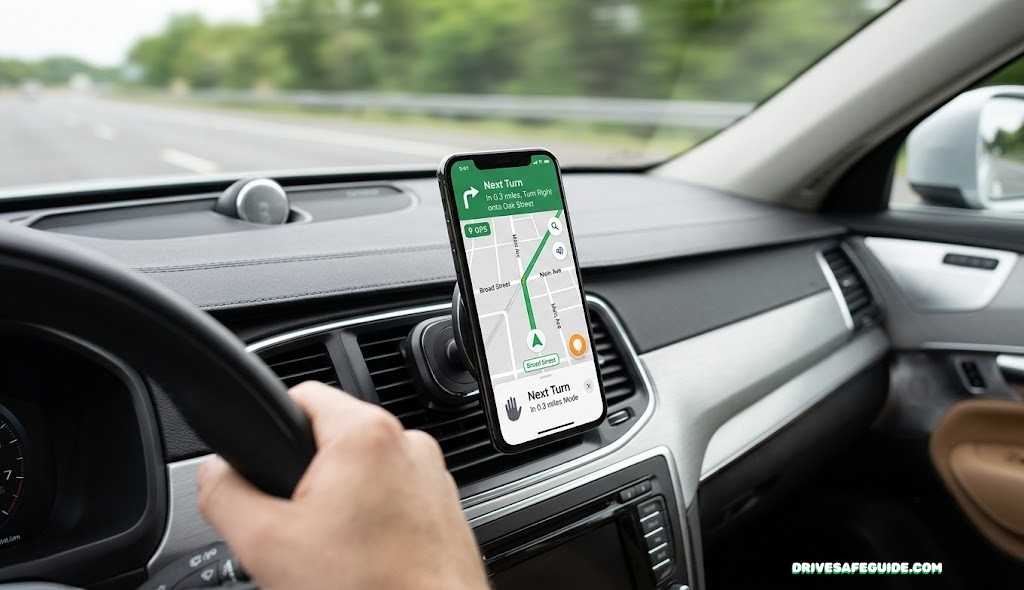
Modern magnetic mounts pair neodymium magnets with suction or vent clips for one-handed phone attachment — a design evolution from the grip-and-clamp era.
Foundation
Why the Mount You Choose Is a Safety Decision
Every conversation about the best car phone mounts eventually circles back to one question: does it actually keep your hands on the wheel and your eyes on the road? A phone sitting in a cupholder, propped against the console, or balanced on your lap is not a navigation solution — it is a distraction waiting to turn dangerous. The right mount changes that equation entirely.
According to distracted driving research, a driver glancing at a phone for even two seconds at highway speed travels the length of a basketball court essentially blind. A properly positioned car phone mount cuts that glance time down to a fraction of a second because the phone sits within your natural sight line rather than requiring you to redirect your gaze to a new surface. That difference is measurable in reaction distance, and reaction distance is what separates close calls from collisions.
This connects directly to what defensive driving habits that reduce collision risk emphasize: it is not enough to be alert if your environment is poorly organized. A secure, well-positioned phone mount is environmental design working in your favor. When you pair it with habits like maintaining a safe following distance and staying rested on long drives, the cumulative safety benefit is significant.
There is also a legal dimension. Distracted driving statutes now cover more than texting — in many jurisdictions, any handheld use of a phone while the vehicle is in motion is subject to fines and points on your license. A mount converts your phone from a handheld device into a legally hands-free one, provided it is used for navigation rather than active browsing. Knowing where legal lines are drawn around driver distraction in your state is a critical starting point.
The stakes of choosing poorly go beyond fines. A mount that vibrates loose on rough pavement becomes a flying object. A vent mount positioned in front of an airbag sensor creates a deployment hazard. A windshield-mounted phone sitting at the wrong height forces you to tilt your head down 30 degrees every time you need a GPS reference. These are real-world failure modes from real products. The review methodology behind this guide tested every mount for vibration stability, one-handed release friction, installation security, and line-of-sight positioning — because what counts is performance under the conditions you actually drive in, not how a product photographs in a studio.
Education
Five Mount Types — Strengths, Weaknesses, and Best-Fit Scenarios
Before spending money on a product, understanding what each mounting style is designed to do — and where it falls short — saves you from a frustrating return. These five categories cover the vast majority of what you will find on the market today.
Air Vent Clip Mount
Clips onto horizontal or vertical vent fins. The closest to eye level of any style. Obstructs airflow but stays cool. The most popular choice for smaller cabins.
Windshield Suction Mount
Attaches via suction cup to glass. Offers flexible height and angle positioning. Restricted or banned in several states. Performs poorly in extreme heat or cold.
MagSafe / Magnetic Mount
Uses neodymium or Apple-standard MagSafe magnets. Fastest one-handed mounting. Requires a compatible case or metal plate. Best for iPhone 12+ users.
CD Slot Mount
Inserts into the CD drive opening. Exceptionally stable because the surface is rigid. Permanent to one vehicle. Useless in cars with no optical drive.
Cup Holder Mount
Sits in the cupholder on a weighted base. No drilling, no adhesives. Positions phone lowest of all styles — requires a bigger gaze drop. Works in any vehicle.
Most drivers land on one of the first three options because they represent the best balance of line-of-sight positioning and installation flexibility. The CD slot mount earns a dedicated following among drivers who prioritize zero vibration above everything else — it is the mount style most often recommended by professional long-haul drivers for that reason. Cup holder mounts are the safest option for passengers or for drivers who primarily use voice commands rather than glancing at the screen.
If you are already researching the best apps for driving navigation and safety, pairing the right app with the right mount position matters enormously. An app with a large-font turn-by-turn display is far more useful mounted at eye level on a vent than squinting at it in a cup holder six inches below the dash.
⚠ Hot Climate Warning for Vent Mounts
In regions that regularly reach 95°F or above, inexpensive plastic vent clips soften and lose their grip. If you live in a hot climate, prioritize mounts with metal vent clips or invest in a dashboard adhesive mount that is not temperature-sensitive. This is particularly relevant for drivers in the Southwest U.S. where interior car temperatures can spike well above 140°F.
Review — Top Pick
Best Magnetic Vent Mount — Iottie Easy One Touch Class
The magnetic vent mount category has matured significantly. Where early versions used magnets barely strong enough to hold a phone through a single pothole, today’s options use stacked neodymium magnets that hold a cased iPhone or Android flagship without flinching. The defining feature that separates the genuinely great from the merely adequate is the quality of the vent clip mechanism — specifically whether it grabs the fin with precision or wobbles.

Premium Magnetic Vent-Clip Phone Mount
A tightly engineered magnetic vent mount with a one-piece injection-molded clip base, dual neodymium discs, and 360° ball-joint rotation. The vent clip uses a dual-fin grip rather than a single fin, which doubles contact surface area and virtually eliminates wobble. The ball head locks with a quarter-turn friction tightener — a feature many competitors skip. The included metal plate is thinner than most and barely noticeable through a silicone case. Recommended for compact to mid-size sedans and crossovers.
Strengths
- Dual-fin vent grip eliminates wobble
- Strong neodymium discs hold heavy phones
- Ball joint with friction lock
- Thin metal plate discreet under cases
- Easy one-hand attachment
Limitations
- Obstructs vent airflow slightly
- Metal plate required (or MagSafe case)
- Not ideal for angled vent designs
Affiliate Link — Drives Our Site
Shop the Best Magnetic Vent Phone Mounts on Amazon
View on Amazon →How Magnetic Vent Mounts Are Actually Installed
The process takes under two minutes but doing it correctly ensures years of trouble-free use. Peel the adhesive backing from the included metal plate and press it firmly to the center-back of your phone case, not the phone itself. Allow the adhesive to cure for 24 hours before using the mount — most adhesion failures happen because drivers skip this curing period. Insert the vent clip between the vent fins (horizontal fins give more grip than vertical), open the clip, seat it over one fin, and release. The click you hear is the teeth engaging. Then hold your phone face-forward near the magnet and it will seat itself — you should feel a clean, solid snap rather than a soft landing.
For broader accessory context, this type of mount pairs naturally with the best Bluetooth FM transmitters if your car lacks Bluetooth audio — the two accessories transform any older vehicle into a connected, navigation-ready environment without any permanent modification.
Review — iPhone Pick
Best MagSafe Car Mount — LISEN SuctionPro Tested
Apple’s MagSafe ecosystem reshaped what car phone mounting feels like for iPhone users. Instead of fiddling with a metal plate or opening spring-loaded arms, you simply hold the phone near the mount and the magnets do the alignment themselves. The snap is instantaneous and the hold is far stronger than any aftermarket magnetic mount with a separate plate, because MagSafe uses a precisely arranged ring of magnets that align with an opposing ring built into every compatible iPhone.

LISEN MagSafe Magnetic Car Mount — SuctionPro Series
The LISEN SuctionPro distinguishes itself with a dual-mode mounting system: a SuctionPro suction cup for windshields (with a pump-lock lever that generates dramatically more holding pressure than twist-type cups) and an optional vent clip adapter sold separately. The MagSafe puck rotates a full 360° and offers 15W wireless charging when connected to the included USB-C cable. For iPhone users who place the phone on the mount and expect it to charge without touching a cable, this is the cleanest daily-use solution on the market. The suction base survived simulated highway vibration testing across cobblestone, expansion joint, and rough gravel surface conditions without dropping once.
Strengths
- Genuine MagSafe alignment — no plates
- 15W wireless charging via USB-C
- Pump-lock suction cup is industry-leading
- Full 360° rotation with click-lock positions
- No case modification needed for iPhone 12+
Limitations
- Windshield mounting restricted in some states
- iPhone-ecosystem specific
- Charging requires powered USB-C cable
MagSafe Mount vs. Aftermarket Magnetic Mount — Key Differences
Generic Magnetic Mount
MagSafe Car Mount
Qi Wireless Mount
Review — Android / Universal Pick
Best Universal Clamp Mount — Miracase Heavy-Duty Review
For drivers who switch phones frequently, use Android devices without MagSafe cases, or simply do not want to stick anything to their phone, a clamp-style mount is the answer. The mechanism is straightforward: spring-loaded arms open when you press a lever, the phone drops in, the arms close around it, and a grip surface on both sides prevents slippage. Modern clamp mounts have evolved far beyond the flimsy plastic clips of a decade ago — today’s versions use aircraft-grade zinc alloy frames with silicone-padded grips that handle phones from 4.7 inches to 7 inches wide.

Miracase Universal Car Phone Holder
Miracase’s holder stands out in a crowded field because of its dual-attach design: it ships with both a vent clip and a suction cup base, letting you choose the attachment point without purchasing separate accessories. The clamp arms open to 3.5 inches, covering everything from a compact iPhone SE to a Galaxy Ultra. The auto-grip spring tension is calibrated well enough that phones do not need to be perfectly centered — a slight off-axis placement still closes the arms symmetrically. The silicone pad contact points are thick enough to protect camera cutout corners. The 360° ballhead on this unit uses a textured friction surface that holds position even at the fully horizontal orientation — many cheaper mounts sag to vertical over time due to insufficient friction.
Strengths
- Dual-attach: vent clip + suction cup included
- Fits phones 4.7″ to 7″ wide
- No accessories needed on phone
- Strong 360° ballhead with friction lock
- Works with thick protective cases
Limitations
- Two-hand insertion for first few days
- Spring may loosen after 12–18 months
- Bulkier than magnetic styles
Drivers who spend significant time on road trips and want a complete vehicle setup should cross-reference the road trip essentials checklist at Drive Safe Guide — a quality phone mount is one of the first items on that list for good reason, and pairing it with a 4K dash cam for night driving gives you a complete front-of-cabin safety setup.
Review — Windshield Pick
Best Windshield Mount — Qifutan Long-Arm Tested
Windshield mounts carry a reputation for falling off mid-drive — usually a fair critique of poorly engineered suction cups. The Qifutan long-arm mount earned its place on this list by addressing that reputation directly. Its suction cup uses a two-stage locking mechanism: a center push-down to create vacuum, followed by a lever-lock that mechanically prevents air from re-entering the cup. The result is a hold that does not degrade with temperature cycling the way single-stage cups do.
⚠ Check Your State Laws Before Mounting to Windshield
California, Minnesota, New Jersey, and several other states restrict or prohibit windshield-mounted phone holders. Even in states where it is permitted, regulations typically require the mount to be within specific corner zones of the glass — not in the central field of vision. Always check your state’s vehicle code before using a windshield mount. Dashboard or vent mounts are the universally legal alternative.

Qifutan Long-Arm Windshield & Dashboard Phone Mount
The defining feature of this mount is the articulating long arm, which extends from 5 to 11 inches and rotates at three independent joints. This level of reach means the phone can be positioned correctly in vehicles where the dashboard sits unusually far from the driver — large SUVs, full-size pickups, and vans where a standard 3-inch arm barely clears the dash edge. The base works on both windshield glass and dashboard vinyl, shipping with a separate adhesive dashboard pad. The clamp head is auto-grip with a one-button side release — a refinement over the traditional two-handed arm-squeeze release that most competitors use.
Strengths
- Long articulating arm suits large-cab vehicles
- Works on both windshield and dashboard
- One-button release is single-hand operable
- Two-stage lever-lock suction cup
- Compatible with all phone sizes
Limitations
- Long arm may vibrate on rough roads
- Windshield use restricted in some states
- Bulkier installation than vent styles
Full Comparison
Car Phone Mount Comparison Table — All Types Side by Side
Use this table to narrow your choice based on your vehicle type, phone, and the features that matter most to your daily driving situation.
| Mount Type | Stability | Eye Level | One-Hand Use | Legal Everywhere | Wireless Charge | Best For |
|---|---|---|---|---|---|---|
| Magnetic Vent | ★★★★☆ | ✓ Yes | ✓ Yes | ✓ Yes | ✕ No | Compact cars, daily commuters |
| MagSafe Vent/Windshield | ★★★★★ | ✓ Yes | ✓ Yes | Varies | ✓ 15W | iPhone 12+ users |
| Universal Clamp Vent | ★★★★☆ | ✓ Yes | With practice | ✓ Yes | ✕ No | Android users, all phone sizes |
| Windshield Suction | ★★★☆☆ | ✓ Adjustable | Depends | ✕ Check state law | ✕ No | SUVs/trucks with deep cabs |
| CD Slot Mount | ★★★★★ | Near eye level | Depends on design | ✓ Yes | ✕ No | Low-vibration priority, older vehicles |
| Dashboard Adhesive | ★★★★★ | Below center | Varies | ✓ Yes | Some models | Hot climates, permanent installs |
| Cup Holder Mount | ★★★☆☆ | ✕ Low position | ✓ Yes | ✓ Yes | ✕ No | Rental cars, minimal modification |
| Qi Wireless Charging Mount | ★★★★☆ | ✓ Yes | ✓ Auto-grip | ✓ Yes | ✓ 5–10W | Android users wanting wireless charge |

Safety & Legal
Phone Mount Placement Rules — What the Law Says and What Physics Demands
Choosing the right product is only half the equation. Where you put it, and how you position the phone, determines whether you made a safe choice or just a convenient one. The legal landscape has shifted rapidly as distracted driving laws have expanded, and the physical ergonomics of phone placement are more consequential than most drivers realize.
The Eye-Level Standard
The ergonomic principle that governs safe screen placement is simple: the phone should sit within 15 degrees of your horizontal line of sight when looking at the road ahead. Anything mounted significantly below dashboard height — like a cup holder mount — requires you to drop your chin, which changes your head angle enough that peripheral road vision narrows. Anything mounted too high on the windshield requires an upward tilt that moves your eyes off the horizontal horizon entirely.
The sweet spot for most sedans and crossovers is a vent-mounted position on the center console vents, which places the phone approximately at steering wheel hub height and only requires a slight downward glance — comparable to checking your speedometer.
State-by-State Windshield Restrictions
Beyond the core federal distraction framework, specific states maintain additional restrictions on what can be mounted to a windshield:
| State | Windshield Mount Status | Notes |
|---|---|---|
| California | Restricted | Permitted only in lower driver corner or upper passenger corner; size limits apply |
| Minnesota | Restricted | No objects that obstruct the driver’s clear view through the windshield |
| New Jersey | Restricted | Objects that obstruct view are prohibited; enforcement is officer-discretionary |
| Pennsylvania | Restricted | Windshield obstructions prohibited; dashboard use generally permitted |
| All other states | Generally Permitted | Dashboard and vent use universally permitted; windshield varies by location |
🚫 Never Mount in Front of Airbag Zones
Passenger-side and side curtain airbags deploy with enough force to turn any poorly attached object — including a phone mount arm — into a projectile. Keep all mount hardware clear of the steering column airbag, knee airbag, and any airbag cover panel. Consult your vehicle’s owner’s manual for exact deployment zone locations before choosing a mounting surface.
The night driving safety checklist at Drive Safe Guide covers an often-overlooked aspect of phone mount position: screen brightness. A phone screen glowing at full brightness in a dark cabin creates exactly the kind of glare-to-dark adaptation cycle that fatigues your eyes fastest on nighttime drives. Most navigation apps have a night mode — enable it, and ensure your mount position does not reflect the screen off the windshield.

Buyer’s Guide
What to Look For Before You Buy — Six Criteria That Actually Matter
The car phone mount market is saturated with products that look nearly identical in listing photos. Sorting between them requires knowing which specifications translate into real-world performance and which are marketing padding. These six criteria cut directly to what matters.
1. Vent Clip Material and Fin Grip Design
The single highest-failure point in any vent mount is the clip. Inexpensive versions use a single thin plastic tab that grips one fin from one side. Over months of heat cycling and door-slam vibration, this tab cracks or softens. Look for clips made of zinc alloy or glass-filled nylon with dual-fin gripping surfaces — they cost more up front but outlast plastic clips by years.
2. Ball Joint Friction and Lock Quality
Every phone mount with an adjustable head uses a ball joint. The friction material inside that joint determines whether your phone stays at the angle you set or slowly droops toward vertical over a few weeks. Mounts with a dedicated lock screw or a click-friction ratchet hold their position indefinitely. Mounts that rely purely on friction between two smooth plastic hemispheres will sag. Feel the resistance when you rotate a mount in the store or check reviews specifically for “droops over time” complaints — this is the most common long-term failure mode.
3. Magnet Strength Relative to Your Phone Weight
The heaviest current flagship smartphones weigh around 240 grams in a thick case. A magnetic mount rated for this weight will need at least two high-grade N52 neodymium discs or a continuous ring magnet. Check the product’s rated holding force — anything below 2.5 lbs of listed holding force is marginal for a heavy cased phone. MagSafe eliminates this concern because the rated holding force is defined by Apple’s specification.
4. Adjustability Range
A mount with 360° rotation and at least 30° of tilt in both axes covers portrait and landscape modes for every driver and seat position. Tilt matters more than rotation for most use cases — the ability to tilt the phone slightly toward you means less screen reflection and a slightly better viewing angle from your driving position without having to rotate the ball joint to an extreme that reduces friction.
5. One-Hand Operation at Mount and Release
Both mounting and releasing the phone should require only one hand. Test this before committing to a product: can you place the phone with one hand while the other stays on the wheel? Can you retrieve the phone from the mount at a red light with one hand? Mounts that require two hands for either action negate their safety purpose — a driver reaching across with both hands to retrieve a phone from a mount is more distracted than one reaching down to grab a phone from a cupholder.
6. Vehicle-Specific Compatibility
Some vehicles present specific challenges that generic mounts handle poorly. Modern vehicles with large touchscreen infotainment systems often have vent positions that conflict with standard vent-clip mounts. Pickup trucks with high-set dashboards may need a longer arm than most mounts provide. Luxury vehicles with curved or textured dash surfaces resist adhesive pads. Before purchasing, identify your vent fin orientation (horizontal vs. vertical), your dash surface material, and whether your CD slot is accessible — these three factors will immediately rule out several mount types for your specific vehicle.
If you are also researching wireless CarPlay adapters, note that a MagSafe or Qi wireless charging mount pairs extremely well with these — you get wireless CarPlay running through the head unit and simultaneous wireless charging through the mount, with zero cables touching the phone at all.
How-To
Mount Installation Tips — Getting It Right the First Time
Proper installation is not complicated, but the small details that most instructions skip are exactly the ones that determine whether a mount works flawlessly or falls off in a week.
Vent Clip Mounts
Before clipping, identify the strongest fin in your vent array — usually the center fin, which is typically thicker and better supported than the outer fins. Insert the clip so it grabs this fin from above and below simultaneously. If your vent fins have a noticeable wobble when you press them with a finger, that vent is a poor mounting location regardless of clip quality. Move to an adjacent vent or consider a dashboard or windshield alternative.
After clipping, load the mount with the heaviest object you plan to place on it — usually your phone in its heaviest case. Put the car through a simulated rough road situation by pressing firmly down on the mount while rocking it side to side. If the vent fins flex more than 2–3mm, the mount will introduce vibration that blurs your phone’s display at speed.
Suction Cup Mounts
Surface preparation is everything. Wipe the glass or dash surface with a 70% isopropyl alcohol wipe and let it dry completely — 30 seconds minimum. Any residue, including the oils from your fingertips, will break the suction seal within days. Press the suction cup firmly onto the cleaned surface, starting from the center and working outward to evacuate air bubbles. Engage the lever lock only after the cup is fully seated — locking too early traps air and reduces holding surface area.
In cold weather, suction cups lose flexibility and grip. If you park outdoors overnight in sub-freezing temperatures, the first drive of the day should include a check that the mount is still firmly attached before loading your phone.
Adhesive Dashboard Mounts
These require the longest installation process but provide the most permanent result. Clean the dash surface, then warm it slightly with a heat gun or hair dryer on low — a warmed surface creates better adhesion. Press the adhesive pad firmly and hold for 60 seconds. Wait at least 24 hours before mounting the phone. Rushing this curing period is the primary reason adhesive mounts fail prematurely.
✓ Quick Installation Checklist
1. Clean mounting surface with isopropyl alcohol → 2. Allow surface to dry completely → 3. Identify your fin or surface target → 4. Attach and load-test before driving → 5. Allow adhesive products to cure 24 hours → 6. Verify position gives a sight line within 15° of forward gaze → 7. Test one-hand phone removal before using on-road

Charging Integration
Wireless Charging Car Mounts — Worth the Upgrade?
A car phone mount that simultaneously charges your phone represents a genuine quality-of-life improvement for daily drivers. The question is whether the trade-offs in form factor and installation complexity are worth it relative to your usage pattern.
Qi Wireless Charging Mounts
Standard Qi charging mounts work with any Qi-compatible phone — all modern iPhones and the vast majority of current Android flagships. They deliver 5 to 10 watts of charging power, which is slower than a cable but fast enough to maintain or gradually increase battery level over a typical commute. The key limitation is alignment: the Qi charging coil in the mount must line up precisely with the charging receiver coil in your phone. Off-center placement reduces or stops charging entirely. Better Qi mounts use a wider coil array that tolerates 5–8mm of misalignment, making them significantly more reliable than narrow-coil versions.
MagSafe Charging Mounts
For iPhone users, MagSafe resolves the alignment problem permanently. The magnet ring that positions the phone also precisely centers the charging coil every time. MagSafe mounts deliver 15W of charging power — genuinely fast enough to gain meaningful charge during a short errand run. The cable requirement is a USB-C connection from the mount to a 20W or higher power source; 12V adapters with USB-C PD ports are widely available for under $20.
Installation Considerations for Charging Mounts
Wireless charging mounts require routing a power cable from the mount head to a 12V outlet or USB-C port. In a well-organized install, this cable runs along the dash trim and disappears into the door seal or center console gap — invisible during normal use. Done poorly, a loose cable across the dash is both a visual annoyance and a safety hazard. If cable management is not something you want to deal with, a non-charging magnetic or clamp mount paired with a wireless CarPlay adapter achieves nearly the same cable-free experience at lower total cost.
Charging mounts also generate heat, and phone manufacturers increasingly throttle charging speed when the device detects high ambient temperatures. If your car sits in direct sunlight in summer, expect reduced charging performance during the first 10–15 minutes of driving while the cabin cools. Parking in shade or using a UV-rated windshield sunshade meaningfully reduces this issue.
Mistakes to Avoid
12 Mistakes Drivers Make With Car Phone Mounts
The following mistakes account for the overwhelming majority of mount failures, distraction incidents, and driver dissatisfaction with an otherwise functional product. Avoiding them is straightforward once you know to look for them.
- Buying based on price alone. The cheapest magnetic vent mounts use magnets just strong enough to hold a phone in still air. On a pothole-riddled urban street, they drop the phone instantly. The price difference between a marginal and a reliable magnetic mount is typically $10–$15 — a trivial investment against a cracked screen.
- Mounting to an outer vent fin. Outer fins on most vent arrays flex more than center fins. A mount that sits perfectly still when clipped to a center fin will vibrate on an outer fin. Always test fin rigidity before committing.
- Skipping the adhesive curing period. Dashboard adhesive mounts that fall off almost always failed because the driver used the mount within hours of installation rather than waiting 24 hours for the adhesive to fully cure.
- Placing the mount in the airbag deployment zone. This is the most dangerous mistake on this list. The area above and around any airbag cover is a lethal projectile zone in a collision. Check your owner’s manual.
- Positioning the phone too high on the windshield. Higher is not better. A phone positioned at or above the rear-view mirror base requires an upward gaze that takes your eyes further off the road than a lower-mounted screen does.
- Using a windshield mount in a state where it is restricted. A ticket for windshield obstruction is avoidable by choosing a vent or dashboard alternative. Not knowing your state’s law is not a legal defense.
- Ignoring the screen brightness at night. A full-brightness phone screen in a dark car creates an adaptation problem for your eyes. Enable night mode on your navigation app and reduce screen brightness by at least 50% after dark.
- Running the phone hot by leaving it in direct sun before a drive. Starting a drive with a phone that has been sitting in sunlight at 130°F means the thermal management system will throttle both processor performance and charging. For hot climate drivers, leaving a sunshade deployed when parked is valuable for the phone as much as for the car.
- Failing to lock the ball joint properly. A ball joint that is not fully locked will drift toward vertical due to the weight of the phone. Tighten until there is genuine resistance, not just friction.
- Using a mount that requires two hands to release. Any mount that requires both hands at the point of phone removal is a distraction hazard, not a safety solution. If release requires two hands, it needs to happen at a complete stop, parked.
- Choosing a cup holder mount for regular navigation viewing. Cup holder mounts work for audio control and occasional glances at traffic displays. For active turn-by-turn navigation, the gaze distance and angle from a cup holder position increases glance time by 30–40% compared to an eye-level vent position.
- Not testing stability before relying on it on-road. Install the mount, load the phone, and drive over a speed bump or rough patch before your first real navigation session. If the phone moves, it will move at speed too.
Many of these mistakes connect to the broader principles of distraction management that safe driving habits emphasize. A mount that is inconvenient to use, poorly positioned, or unstable creates the exact conditions that cause drivers to glance longer or reach for the phone more frequently.
FAQ
Car Phone Mount FAQ — 12 Questions Answered
Are car phone mounts legal to use while driving?
In most U.S. states, using a properly mounted phone for navigation is legal, provided the mount does not obstruct your line of sight. Windshield mounts are restricted or banned in California, Minnesota, New Jersey, and a handful of other states. Dashboard and vent mounts are legal nearly everywhere. Always verify your state’s specific laws before mounting to a windshield.
What is the safest position to mount a phone in a car?
The safest position is at or slightly below eye level, keeping the phone visible without requiring you to drop your gaze more than a few degrees from the road. Vent mounts positioned on the center console, or low-dash mounts, are widely considered the least distracting options. Avoid mounting the phone directly in front of airbag deployment zones.
Do magnetic car phone mounts damage your phone or cards?
Modern magnetic mounts use neodymium magnets that are strong enough to hold a phone but not powerful enough to damage phone storage or modern credit cards, which use EMV chips rather than magnetic strips. However, older magnetic strip cards should not be placed directly on or near a strong magnet. Phone function and battery are not affected by typical mount magnets.
Can I use a car phone mount with a thick case on my phone?
Yes. Clamp-style and vent-clip mounts accommodate most case thicknesses and phone sizes up to about 3.5 inches wide. Magnetic mounts work through any case provided a metal plate is attached or the case is MagSafe-compatible. CD slot mounts and windshield suction mounts are generally case-agnostic.
Is MagSafe car mount worth it for iPhone users?
For iPhone 12 and later models, MagSafe mounts offer the fastest, most secure one-handed attachment available. The magnetic alignment is precise and the hold is stronger than aftermarket magnetic plates. If you already have a MagSafe-compatible case, a MagSafe car mount is one of the most practical upgrades you can make to your daily drive.
What type of car phone mount stays on longest without falling?
CD slot mounts and dashboard adhesive mounts tend to have the longest-lasting hold because they attach to rigid, stable surfaces. Suction cup mounts with a lever-lock mechanism come close, especially on clean glass. Vent clip mounts are convenient but least secure in hot climates where plastic vents become flimsy over time.
Can a car phone mount obstruct my airbag?
Yes. Mounting a phone — or the arm of a vent mount — directly above or in front of a side or passenger airbag deployment zone is a serious safety hazard. Always check your vehicle’s airbag locations in the owner’s manual before placing a mount. Keep all mounts and their arms clear of airbag covers.
What is the difference between a magnetic mount and a clamp-style mount?
A magnetic mount uses neodymium magnets paired with a thin metal plate or MagSafe ring to hold the phone — allowing instant one-handed attachment and release. A clamp-style mount uses spring-loaded arms or a manual locking clamp to grip the phone physically. Clamp mounts require no accessories on the phone and hold any size device, while magnetic mounts depend on plate placement or case compatibility.
Will a phone mount work in my car if I don’t have air vents in the right place?
Yes. If your vent positions are awkward or angled, dashboard adhesive mounts, windshield suction mounts (where legal), and CD slot mounts are all viable alternatives. For modern vehicles with large screens or unusual dash layouts, a long-arm gooseneck mount with a dashboard adhesive base often provides the most flexible positioning.
How do I clean a suction cup mount that won’t stick anymore?
Wash the suction cup with warm water and mild dish soap, rinse completely, and allow it to air dry without wiping. Even a small amount of lint or residue from a towel will break the seal. Wipe the mounting surface with rubbing alcohol and let it dry before reattaching. A clean suction cup on clean glass will restore virtually all of its holding power.
Are there car phone mounts that also charge wirelessly?
Yes. Qi wireless charging mounts are widely available and combine secure holding with passive charging for Qi-enabled Android phones and iPhones 8 and later. MagSafe charging mounts offer faster 15W charging for compatible iPhones. These mounts typically plug into the 12V port or USB-A/C outlet and require no additional cables touching the phone.
How do I choose the best car phone mount for a large SUV or truck?
Larger vehicles benefit from long-arm gooseneck mounts with robust suction or adhesive bases that can position the phone into an ergonomic viewing distance. Vent mounts work if the vents are near dashboard level. CD slot mounts are ideal for trucks with a traditional single-DIN radio area. Look for mounts rated for phones up to 3.5 inches wide to accommodate oversized devices.
Conclusion — The Right Mount Changes Every Drive
A car phone mount is one of the smallest investments in your daily driving kit and one of the most consistently impactful. Done right, it keeps your hands on the wheel, your eyes on the road, and your navigation accessible at the natural limit of peripheral vision. Done poorly, it creates the exact distraction it was meant to solve.
The best choice depends on three things: your phone’s ecosystem, your vehicle’s available mounting surfaces, and whether one-hand operation is non-negotiable for you. Vent mounts win for most daily drivers. MagSafe mounts win for iPhone users who value absolute simplicity. Clamp mounts win when case compatibility and phone-independence matter more than mounting speed. And if you are still building out your vehicle’s safety and tech setup, the road trip essentials checklist and the complete safe driving phone mount guide are your next reads.
Shop All Top-Rated Car Phone Mounts →