Recognizing the Signs for Serpentine Belt Replacement
The belt that quietly runs your alternator, power steering, water pump, and AC compressor gives you warning before it fails. Here’s exactly what to look, listen, and feel for.
What the Serpentine Belt Actually Does
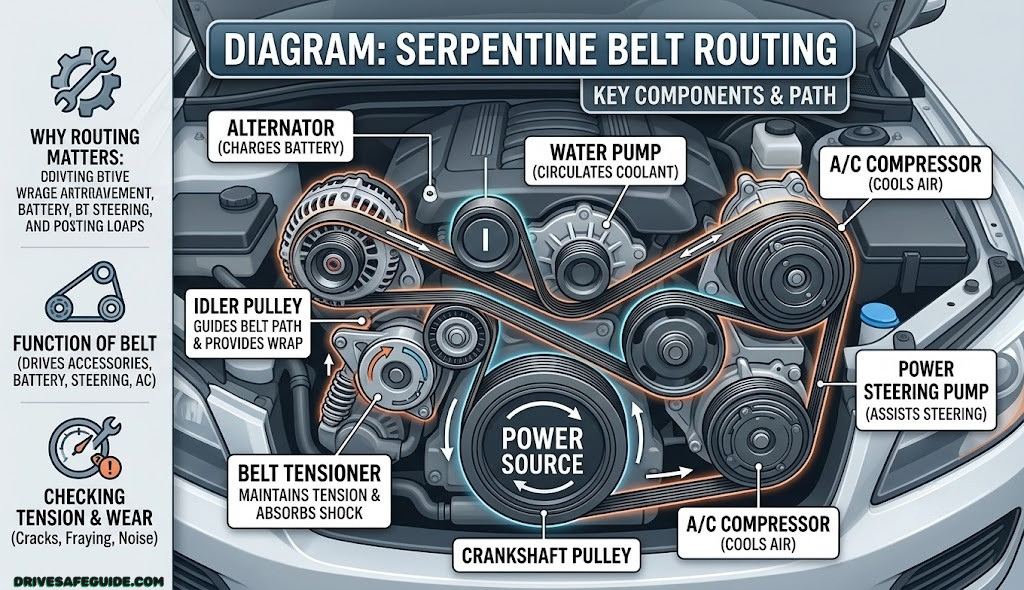
Pop the hood on almost any modern car and you’ll find one long, ribbed rubber belt snaking its way around a series of pulleys at the front of the engine. That single belt, commonly called the serpentine belt, is doing the job that three or four separate belts used to handle in older vehicles. It spins the alternator so your battery stays charged, drives the power steering pump so the wheel doesn’t fight you in a parking lot, turns the water pump that keeps coolant circulating, and, on most vehicles, powers the air conditioning compressor. In a handful of designs it also drives the power brake booster pump.
Because one belt is responsible for so many systems at once, its condition matters more than almost any other rubber component on the car aside from the tires. A belt that snaps on the highway doesn’t just kill your air conditioning — it can leave you with no power steering assist, a rapidly overheating engine, and a battery that drains within minutes because the alternator has stopped charging. That combination is exactly why a properly stocked roadside safety kit is worth having before a belt-related breakdown happens, not after.
The good news is that serpentine belts almost never fail without warning. They’re made of reinforced rubber compounds designed to degrade gradually, which means the belt is telling you it’s wearing out weeks or months before it actually lets go. The rest of this guide walks through exactly what those warnings sound like, look like, and feel like, so you can catch the problem on your own schedule instead of on the shoulder of a highway.
It helps to understand why the design shifted to a single belt in the first place. Older engines used a separate V-belt for each accessory, which meant more failure points, more adjustment procedures, and more parts to track. Consolidating everything onto one continuous ribbed belt, tensioned automatically by a spring-loaded arm, simplified maintenance and reduced the number of things that could go wrong at once. The tradeoff is exactly what makes this belt worth paying attention to: instead of losing one accessory at a time if a belt fails, you risk losing several at once.
Not every vehicle routes the same accessories off the belt. Some newer designs have moved the power steering pump to an electric motor entirely, removing it from the belt’s job list, while others still rely on the belt for the AC compressor, water pump, alternator, and power steering pump all at once. Checking your owner’s manual or the routing diagram sticker under the hood will tell you exactly which systems are riding on your belt, which is useful context when you’re trying to figure out whether a symptom you’re noticing, like weak air conditioning or heavier steering, could plausibly be belt-related on your specific vehicle.
Audible Warning Signs
Sound is usually the first clue a serpentine belt is aging, and for most drivers it’s the reason they end up searching for what’s wrong in the first place. The trick is learning to tell a worn belt apart from the dozen other things under the hood that can also make noise, like a failing alternator bearing or a struggling fuel pump.
The high-pitched squeal on startup
This is the classic symptom. A sharp, high-pitched squeal that hits the moment you turn the key, then fades after a few seconds, almost always points to a belt that has hardened and lost its grip on the pulleys. Cold rubber is stiffer and slips more easily, which is why the noise is loudest on the first start of the day and often quiets down once everything warms up. It doesn’t mean the problem went away — it means the rubber flexed just enough to regain traction once it warmed up.
Squealing under load
If the squeal shows up specifically when you turn the steering wheel sharply, when the AC compressor kicks on, or when you accelerate hard, that’s a sign the belt is slipping under the exact moments it’s being asked to transfer the most torque. This pattern often shows up alongside unusual vibration at highway speed, since a belt that’s stretched or glazed doesn’t ride smoothly across the pulleys anymore.
Rhythmic chirping or ticking
A steady chirp that rises and falls with engine RPM, rather than a continuous squeal, usually points to a specific damaged section of the belt or a single pulley that’s slightly misaligned. Because the noise repeats with every rotation of the belt, it’s actually one of the easier symptoms to diagnose — count the interval and you can often correlate it to belt length and engine RPM.
A deep rumbling or grinding sound
This one is more serious and usually means a pulley bearing or the tensioner itself is failing, not just the belt. A grinding or rumbling noise from the front of the engine warrants inspection sooner rather than later, since a seized pulley can shred a belt in a matter of minutes.
Why cold climates make belt noise more common
Rubber compounds stiffen predictably as temperature drops, which is why belt squeal is reported far more often in the first cold snap of the season than during a mild stretch of weather. A belt that was borderline through a warmer month can suddenly announce itself the first freezing morning of the year, not because it failed overnight, but because the cold simply exposed wear that was already present. Drivers in colder regions often notice this pattern lines up with other cold-weather issues, like slower cranking tied to a marginal cold-weather battery, since both symptoms tend to surface at the same time of year.
Visual Inspection Signs
Sound tells you something is wrong; a visual inspection tells you exactly how far along the problem is. Modern EPDM rubber belts don’t crack the way older neoprene belts did, so the signs to look for have shifted slightly over the years, but they’re still easy to spot once you know what you’re looking at.
Surface cracking
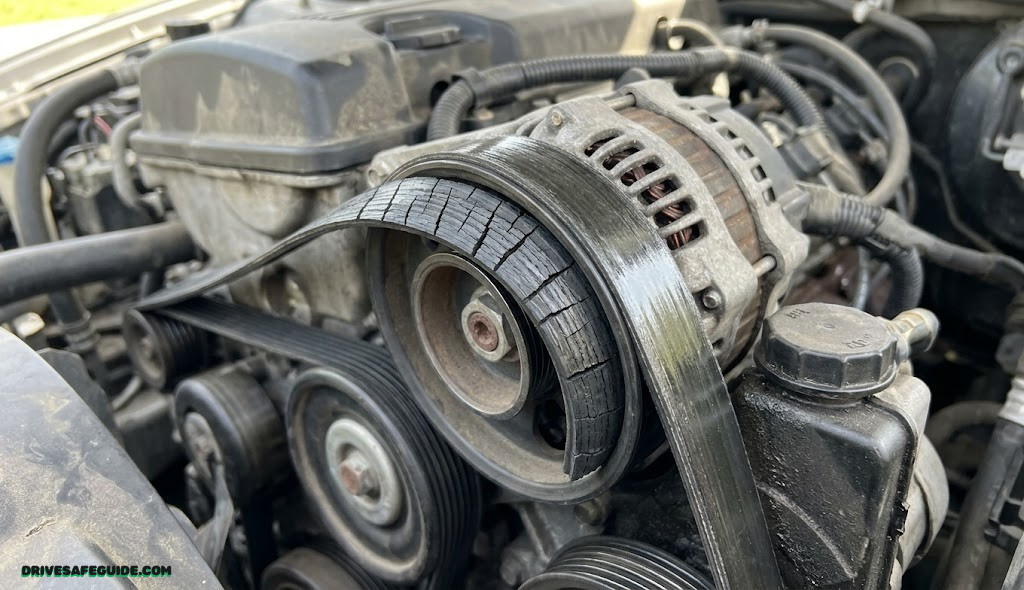
Turn the belt over (or use a flashlight and mirror to see the underside without removing anything) and look at the ribbed side. Fine, shallow cracks running perpendicular to the ribs are normal wear over time and not automatically a reason to replace the belt. What matters is density: if you can count more than three or four cracks within a one-inch section, or if the cracks are deep enough to see daylight through, the belt has lost enough flexibility that replacement should be scheduled soon.
Glazing and shine
A belt that looks shiny, almost glass-like, rather than matte black has been slipping against the pulleys and generating friction heat. Glazing reduces the belt’s grip, which creates a feedback loop — the more it slips, the more it glazes, the more it slips. A glazed belt often makes noise even when the tension is technically correct.
Fraying edges
Look along both edges of the belt for frayed threads or a rough, string-like texture. This typically means the belt is misaligned on one or more pulleys, which is worth checking before installing a replacement, since a new belt will fray the same way if the underlying alignment issue isn’t fixed.
Missing chunks or rib separation
If you can see sections where a rib has separated from the belt body, or actual pieces of rubber missing, replace the belt immediately. This is the stage right before a full snap, and it usually means the belt has been in this condition for a while without anyone noticing.
Contamination from oil or coolant
A belt that looks swollen, oily, or has a chemical sheen has likely been exposed to a leaking gasket or hose. Oil and coolant both break down rubber compounds quickly, so a contaminated belt should be replaced even if the wear pattern otherwise looks acceptable — and the source of the leak should be tracked down, since coolant leaks are progressive and will keep degrading the new belt if left unaddressed.
Checking without removing anything
Most vehicles let you see a meaningful portion of the belt just by looking down through the top of the engine bay, but the section riding over the bottom-most pulleys is usually hidden from that angle. A small inspection mirror on an extendable handle solves this without needing to remove a splash shield or jack the car up, and it’s worth doing before assuming a belt looks fine based only on the visible top section, since wear isn’t always evenly distributed around the full loop.

Keep a Matched Replacement Belt On Hand
Once cracking or glazing is visible, having the correct belt ready means the repair is a same-day job instead of a multi-day wait.
Check Price on AmazonPerformance & Warning-Light Signs
Not every symptom of a failing belt shows up as a sound or a visible mark. Sometimes the first clue is a change in how the car behaves, and these signs are easy to misattribute to a completely different system.
Battery warning light or dimming electronics
Because the belt spins the alternator, a slipping belt can starve the charging system just enough to trigger a battery or charging-system warning light, especially at idle when belt speed is lowest. If you’ve also noticed slow cranking or headlights that dim at stoplights, it’s worth ruling out the belt before assuming the alternator itself has failed, since a slipping belt can produce nearly identical symptoms to a dying alternator.
Heavier steering effort
On vehicles with belt-driven hydraulic power steering, a slipping or badly worn belt reduces pump output, which shows up as noticeably heavier steering, particularly at low speeds like parking maneuvers. This symptom tends to get worse gradually, which is exactly why it’s easy to adapt to without noticing until the belt fails outright.
Engine temperature creeping up
Since the water pump on many engines is belt-driven, a slipping belt reduces coolant flow and can cause the temperature gauge to run slightly higher than normal, especially in stop-and-go traffic or during hot-weather driving when the cooling system is already working harder. This is worth taking seriously, since sustained overheating risks much more expensive damage than the belt itself.
Air conditioning that cuts in and out
A belt slipping under the extra load of the AC compressor clutch engaging can cause the compressor to momentarily lose drive speed, which shows up as air conditioning that seems to surge or weaken in short bursts rather than blowing consistently cold.
Dashboard warning lights unrelated to the belt itself
Modern vehicles increasingly rely on sensors that can flag secondary symptoms of a slipping belt — a fluctuating voltage reading, an erratic coolant temperature signal, or a power steering pressure warning. Running a basic OBD2 scan tool can help correlate a stored code with the timing of belt-related symptoms, rather than guessing at which system triggered the light.
Performance-based symptoms are easy to dismiss individually since none of them scream “belt problem” on their own. Taken together, though — heavier steering paired with a dimming dome light, or a temperature gauge running a touch high alongside a weakening AC — they build a pattern that points squarely at the accessory drive system rather than any one component acting up in isolation.

Rule Out Sensor Codes in Minutes
A compact OBD2 scanner reads live voltage and temperature data so you can confirm whether a warning light traces back to the belt or somewhere else.
Check Price on AmazonTensioner and Pulley Clues
The belt itself gets most of the attention, but the automatic tensioner and idler pulleys that keep it snug are just as prone to wear, and a failing tensioner will destroy even a brand-new belt in short order. It’s worth checking both at the same time, since replacing one without inspecting the other is one of the most common reasons a “fixed” belt problem comes right back.
Visible belt flutter while the engine runs
With the hood open and the engine idling, watch the belt’s path between pulleys. A healthy belt runs in a smooth, stable line. If you see the belt visibly flutter or wobble, especially near the tensioner pulley, the spring inside the tensioner has likely weakened and is no longer holding consistent pressure.
A tensioner arm that doesn’t spring back
With the engine off, most tensioners can be manually pushed using a breaker bar and released to see how they respond. A properly functioning tensioner will spring back smoothly and hold firm resistance throughout the range of motion. One that feels loose, sticky, or slow to return is close to failing.
Wobble in the idler or tensioner pulley itself
Grip the pulley (engine off) and try to rock it side to side and front to back. Any noticeable play indicates a worn bearing inside the pulley, which will eventually seize or let the belt wander off its track — often producing that grinding sound covered earlier.
When to replace the tensioner on its own
If the belt itself still looks and sounds fine but you notice flutter, arm play, or a persistent chirp that changes when you lightly spray a small amount of water on the belt (a rough field test some mechanics use to momentarily change friction and confirm the noise source), the tensioner is the more likely culprit and can be replaced by itself without necessarily needing a new belt at the same time. That said, most shops will still recommend inspecting the belt closely during that same visit, since a tensioner that’s been struggling for a while has often already accelerated wear on the belt riding against it.
Common Causes of Premature Wear
Two vehicles of the same age and mileage can have wildly different belt conditions depending on what’s happening around the belt, not just how many miles it has spun. Understanding the common causes of early failure makes it easier to figure out why a belt on your car might be wearing faster than the general mileage guidelines suggest.
Misaligned pulleys
If an accessory like the alternator or AC compressor was replaced or reinstalled slightly off-center, the belt will ride unevenly across that pulley every single rotation. This shows up as one-sided fraying and can shorten belt life dramatically even if everything else about the belt is in good shape.
A weak or seized tensioner
As covered earlier, the tensioner is what maintains constant pressure on the belt as it stretches slightly over time. A tensioner that’s lost spring tension allows the belt to flex more than it should with every rotation, accelerating cracking and glazing well before the belt would otherwise need replacing.
Underhood heat concentration
Turbocharged engines, tightly packaged engine bays, and vehicles that spend a lot of time idling in traffic all run hotter under the hood, and sustained heat is one of the fastest ways to dry out and stiffen rubber compounds. This is part of why the same belt part number can have very different real-world lifespans between two different vehicle models.
Fluid leaks nearby
A leaking valve cover gasket, oil seal, or coolant hose positioned near the belt path can slowly coat the belt in fluid without an obvious puddle ever showing up underneath the car. Because oil and coolant both break down the rubber compound, even a small, slow leak can cut belt life significantly if it goes unnoticed for months.
Short-trip, stop-and-go driving patterns
Every cold start puts more strain on the belt than steady highway cruising does, since the rubber is stiffest and least able to grip the pulleys in the first few seconds after startup. Vehicles used mostly for short errands accumulate far more of these high-stress startup cycles per mile than vehicles used mostly for highway trips, which is one reason mileage-based intervals are only a starting point rather than a guarantee.
It’s also worth noting that aftermarket accessory installs — a non-stock alternator, an aftermarket AC compressor, or a supercharger pulley kit — can quietly change belt geometry in ways the original design never accounted for. If a belt keeps wearing unevenly on a vehicle with recent aftermarket work, that’s usually a stronger lead than assuming the belt itself is simply a bad unit.
Belt Lifespan by Mileage
There’s no single universal number for serpentine belt life, since it depends heavily on the belt material, engine bay heat, and driving conditions. That said, most manufacturers publish a general range, and knowing where your vehicle falls helps you decide whether a symptom you’re noticing lines up with expected wear or points to something accelerating the failure.
| Belt Type / Condition | Typical Interval | Notes |
|---|---|---|
| Standard EPDM rubber belt | 60,000–100,000 miles | Most common on vehicles built in the last two decades |
| Older neoprene belt | 36,000–50,000 miles | More prone to visible cracking; largely phased out |
| Belt exposed to high underhood heat | Lower end of range | Turbocharged and tightly packaged engine bays run hotter |
| Frequent short-trip / stop-and-go driving | Lower end of range | More start-up cycles mean more slip events |
| Highway-dominant driving | Higher end of range | Fewer cold starts, more consistent load |
| Belt with fluid contamination | Replace immediately regardless of mileage | Oil and coolant degrade rubber rapidly |
Because these ranges are wide, mileage alone shouldn’t be the only trigger for replacement. Pairing a mileage check with the visual and audible signs covered earlier gives a far more reliable picture than either one on its own — the same logic used when judging timing belt versus timing chain service intervals, where interval charts are a starting point rather than a guarantee.
If you’ve inherited a used vehicle without service records, it’s reasonable to assume the belt is closer to the middle of its expected life unless a full visual and audible check says otherwise. Manufacturer stickers under the hood sometimes list a specific replacement mileage, but many don’t, which puts the burden back on a physical inspection rather than a lookup table.
What Happens If You Ignore It
It’s tempting to put off a belt replacement, especially if the noise is intermittent and the car otherwise drives fine. The problem is that serpentine belt failure rarely stays contained to just the belt. Because so many systems share that one strip of rubber, a snapped belt tends to cause a cascade of secondary problems.
Sudden loss of power steering assist
On vehicles without electric power steering, the wheel becomes dramatically harder to turn the instant the belt lets go, which is especially dangerous at low speed maneuvers like parking lots or tight turns.
Battery drain and eventual stall
With the alternator no longer spinning, the car runs entirely on stored battery charge. Depending on how many electrical accessories are running, this can mean anywhere from a few minutes to closer to an hour before the engine stalls or the electronics start behaving erratically.
Overheating
If the water pump is belt-driven, coolant stops circulating the moment the belt breaks, and engine temperature can climb quickly — sometimes fast enough to cause head gasket damage if the engine isn’t shut off promptly. This is one of the few situations that can turn a cheap belt into an expensive question about whether it’s safe to keep driving with a blown head gasket.
Stranding in an inconvenient or unsafe location
A snapped belt on the highway means losing power steering and battery charge simultaneously, often the two worst systems to lose at speed. This is exactly the scenario that a pre-trip inspection checklist is designed to catch before it happens, particularly ahead of long-distance driving.
Secondary damage from belt debris
When a belt shreds rather than cleanly snapping, loose fragments can get thrown into nearby components, sometimes striking a radiator fin, wrapping around a pulley, or jamming against a hose. This is one of the less obvious risks of waiting until a belt is visibly falling apart before replacing it, since the failure mode isn’t always a clean break.
Timing implications on interference engines
On most vehicles the serpentine belt is entirely separate from the timing belt or timing chain that keeps the engine’s internal components synchronized, so a snapped serpentine belt by itself typically won’t cause the kind of internal engine damage associated with a timing failure. Still, it’s worth understanding the distinction, since drivers sometimes confuse the two systems when researching symptoms, and mixing up a serpentine belt issue with a timing belt issue can lead to the wrong repair being scheduled entirely.
DIY Inspection in Five Minutes
You don’t need a lift or specialized tools to get a reliable read on belt condition. With the engine off and fully cooled, here’s a quick sequence that covers the highest-value checks. The whole process takes less time than filling up at a gas station, and doing it consistently is far more valuable than doing it once perfectly.
Aim to run through this sequence roughly every few months, or any time you notice one of the audible or performance signs covered earlier. Keeping a simple note on your phone with the date and what you observed turns a one-off check into a useful trend line, since a belt that’s changed noticeably between two checks is telling you something even if it hasn’t crossed the line into obvious failure yet.
- Locate the belt. Check the underhood sticker or owner’s manual for the routing diagram so you know which pulleys it wraps around.
- Shine a flashlight along the full length. Look for cracking density, glazing, fraying, and any missing rib sections.
- Flex a section between two fingers. A supple belt should bend easily; a stiff, brittle feel is a sign of age even if cracks aren’t obvious yet.
- Check for contamination. Look for shiny or swollen sections that suggest oil or coolant exposure.
- Rock the tensioner and idler pulleys. Check for play or resistance as described earlier.
- Start the engine briefly and watch belt tracking. Confirm it runs true across every pulley without wobbling off-center.

Get a Clear Look at Hard-to-Reach Pulleys
A telescoping inspection mirror paired with a bright flashlight makes it far easier to see the underside of the belt without pulling anything apart.
Check Price on AmazonDIY vs Professional Replacement
Once a belt has confirmed wear, the next decision is whether to replace it yourself or have a shop handle it. The right answer depends on how accessible the belt is on your specific engine and what tools you already have.
DIY Replacement — Pros
- Belt itself is inexpensive; labor is the main cost you save
- Straightforward on many transverse-engine layouts with clear pulley access
- Good opportunity to inspect the tensioner and pulleys firsthand
DIY Replacement — Cons
- Some engine bays require removing splash shields or engine mounts for access
- Incorrect routing can damage the belt or accessories within minutes of startup
- Releasing a strong tensioner spring without the right tool risks pinched fingers
Professional Replacement — Pros
- Technician has correct routing diagrams and specialty tensioner tools on hand
- Tensioner and idler pulleys typically inspected in the same visit
- Often bundled with a broader check, similar to a brake pad wear inspection, catching adjacent issues early
Professional Replacement — Cons
- Labor cost added on top of the part itself
- Requires scheduling and a window without the car
A reasonable way to decide is to look up the specific belt-replacement time estimate for your make and model before committing either way. If it’s listed as a straightforward under-an-hour job with clear top-down access, a confident DIYer with basic hand tools and a breaker bar can usually handle it. If the estimate involves removing a wheel well liner, an engine mount, or a serpentine belt tensioner tool that isn’t part of a typical home toolbox, the labor savings from doing it yourself shrink quickly once you account for the extra time and any specialty tools you’d need to buy for a one-time job.
What Affects Replacement Cost
Cost estimates for this job vary widely because two factors do most of the work: how accessible the belt is on your particular engine, and whether the tensioner or pulleys need replacing alongside it. Shoppers are often surprised that the part itself is one of the cheaper components in an average engine bay, which is exactly why waiting until a belt visibly fails rarely saves any real money — the labor charge to install it stays roughly the same whether the belt was replaced proactively or reactively after a breakdown.
| Cost Factor | Impact |
|---|---|
| Belt only, easy access | Lowest total cost; mostly the price of the part |
| Belt plus tensioner replacement | Moderate increase; recommended at higher mileage |
| Restricted engine bay access | Higher labor time, even with an inexpensive part |
| Multiple accessory-drive parts worn together | Highest cost, but often prevents a repeat visit |
| Fluid contamination requiring a separate repair | Adds the cost of fixing the leak source, such as a gasket |
It’s worth asking a shop for a written estimate that separates the belt, tensioner, and labor line items, since bundling the tensioner in one visit is almost always cheaper than paying for two separate labor charges months apart.
Regional labor rates and vehicle make also factor in more than most people expect. A belt tucked behind an engine mount on a transversely mounted V6 can take considerably longer to access than the same job on a simple four-cylinder layout with the belt facing straight out toward the front bumper. If a quote seems unusually high, it’s reasonable to ask specifically what’s driving the labor estimate, since access difficulty is often the real reason, not the part itself.
Building a Prevention Habit
The most reliable way to avoid a surprise belt failure isn’t a single inspection — it’s folding a quick check into maintenance you’re already doing. A few practical habits make this easy to sustain.
Tie it to your oil change schedule
Since most people already pop the hood at oil change time, use that same visit to run through the five-minute inspection sequence above. It takes less time than waiting for the technician to finish paperwork.
Log what you see
Jot down a quick note on cracking density or glazing each time you check. A belt that looked fine three months ago but now shows moderate cracking is degrading faster than expected, which is useful information even before it becomes an urgent problem.
Watch for compounding heat exposure
Vehicles that regularly deal with sustained high underhood temperatures should lean toward the shorter end of the typical mileage range rather than assuming the full interval applies.
Keep a spare on hand for older vehicles
Once a vehicle passes the higher end of its typical belt lifespan, keeping a correctly matched spare belt in the trunk — alongside the rest of a basic breakdown kit — turns a roadside failure into a fifteen-minute fix instead of a tow call.
Pay attention after other underhood work
Any time an accessory like an alternator, AC compressor, or power steering pump is replaced or serviced, it’s worth double-checking belt alignment and tension shortly afterward. A pulley that’s slightly misaligned during reinstallation won’t always be obvious immediately, but it will show up as new fraying or noise within the first few hundred miles, and catching it early prevents a brand-new belt from wearing out well before its expected lifespan.
Treat long trips as a trigger for a pre-check
Long-distance driving puts sustained load on the belt for hours at a time rather than the shorter bursts of typical commuting, which makes it a reasonable moment to confirm belt condition rather than assuming everything is fine simply because the car has been running normally around town.
Frequently Asked Questions
How do I know if it’s the serpentine belt or something else making noise?
Belt noise is typically a squeal or chirp that changes with engine RPM and often intensifies on cold starts or when the steering wheel is turned. A deep grinding or knocking sound is more likely to point to a bearing or internal engine issue rather than the belt itself.
Can I drive with a squealing belt for a while?
A brief squeal that fades once the engine warms up usually means you have some time, but the sound will typically return more often and last longer as the belt continues to wear. It’s best treated as a signal to schedule an inspection soon rather than something to ignore indefinitely.
What does a failing serpentine belt sound like at idle versus at speed?
At idle, a worn belt tends to produce a steady squeal or chirp tied to engine RPM. At higher speeds or under load, such as accelerating or turning the wheel sharply, the same belt may produce a louder, more strained squeal as more torque passes through it.
Does a cracked belt always need immediate replacement?
Not necessarily. A small number of shallow cracks spread across the belt is common wear and not automatically urgent. Dense cracking, deep cracks you can see through, or cracks paired with glazing or fraying are the combination that signals replacement should happen soon.
How long does a serpentine belt typically last?
Most modern EPDM rubber belts last somewhere in the range of 60,000 to 100,000 miles, though heat exposure, short-trip driving, and fluid contamination can shorten that considerably.
What’s the difference between a slipping belt and a failing tensioner?
A slipping belt often shows visible glazing or cracking and produces a squeal tied to load. A failing tensioner tends to show up as visible belt flutter while the engine runs, or a tensioner arm that feels loose or slow to spring back when manually tested.
Should the tensioner be replaced at the same time as the belt?
Many manufacturers recommend it, especially past higher mileage, since the labor required to access the tensioner is largely the same as replacing the belt alone, and a weak tensioner will shorten the life of a brand-new belt.
Can a broken serpentine belt damage other parts of the engine?
Yes. Depending on the vehicle, a snapped belt can cause sudden loss of power steering assist, stop the alternator from charging the battery, and halt coolant circulation if the water pump is belt-driven, which can lead to overheating if not addressed quickly.
Is it safe to inspect the belt myself without professional tools?
Yes, a visual and tactile inspection with the engine off and cooled — checking for cracking, glazing, fraying, and pulley play — can be done safely with basic tools like a flashlight and an inspection mirror. Actually replacing the belt may require a specialty tensioner tool depending on the vehicle.
Why does my belt only squeal when it’s raining or humid?
Moisture can temporarily reduce friction between a glazed or worn belt and the pulleys, making an existing slip condition more noticeable. It’s usually a sign the belt was already marginal, and the humidity is simply exposing wear that was already present.
Does the serpentine belt affect fuel economy?
A belt that’s slipping enough to reduce alternator or power steering pump efficiency can cause the engine to work slightly harder to maintain output, though the effect on fuel economy is typically minor compared to the safety and reliability risks of ignoring the wear.
What tools do I need for a basic at-home belt inspection?
A flashlight, an inspection mirror for hard-to-see angles, and your hands to check for flex and pulley play are enough for a reliable inspection. An OBD2 scanner can help if you’re also trying to correlate a dashboard warning light with a possible belt issue.
Is a serpentine belt the same thing as a timing belt?
No. The serpentine belt runs on the outside of the engine and drives accessories like the alternator, power steering pump, and AC compressor. The timing belt, when present, is typically hidden behind a cover and keeps the engine’s internal valve timing synchronized. They wear differently, have different replacement intervals, and a failure of one doesn’t necessarily indicate a problem with the other.
Why does my belt squeal right after it rains?
Water temporarily reduces friction between a belt and its pulleys, which can expose slipping that a marginally worn belt was otherwise just barely getting away with in dry conditions. If the squeal disappears once everything dries out but returns with the next rain, it’s a sign the belt condition is already borderline rather than a rain-specific issue on its own.
Don’t Wait for the Belt to Make the Decision for You
A serpentine belt rarely fails without warning — it squeals, cracks, glazes, and flutters its way toward failure over weeks or months. Catching any one of those signs early turns a fifteen-minute fix into the outcome, instead of a tow truck and a cascade of secondary repairs. Run through the five-minute inspection next time the hood is open, and keep a matched replacement on hand once your vehicle passes the higher end of its typical belt lifespan.
Shop Replacement Belts on Amazon