
Timing Belt vs. Timing Chain Service Intervals: What You Need to Know
A clear, mechanic-level breakdown of how often each system needs attention, what failure actually looks like, and how to budget for the job before it becomes an emergency.
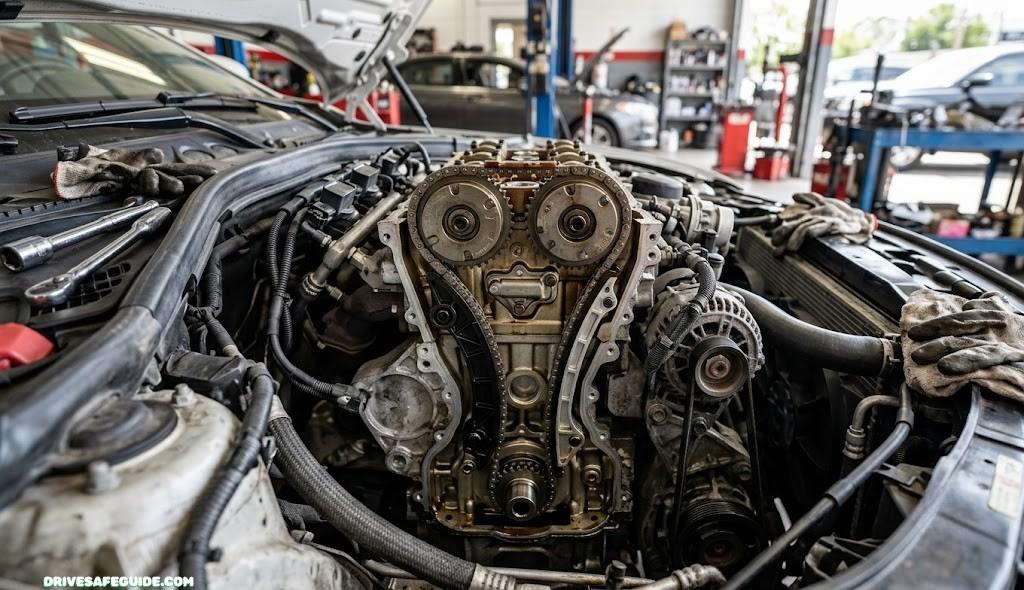
If you’ve ever asked a mechanic “does my car have a timing belt or a timing chain?” and gotten a shrug in response, you’re not alone. It’s one of the most misunderstood parts of routine car care, mostly because the two systems look similar from a distance but behave very differently over the life of an engine. One wears out on a predictable schedule. The other is built to outlast the rest of the car — until, occasionally, it isn’t.
Getting this wrong isn’t a minor inconvenience. A timing system failure at highway speed can bend valves, crack pistons, or leave you stranded on the shoulder, and in some engines it can turn a $600 repair into a $4,000 one in the time it takes to hear a single bad noise. This guide walks through exactly how each system works, when it needs attention, what failure looks like before it becomes catastrophic, and how the costs compare — so you can plan the job on your terms instead of the engine’s.
Before we get into intervals, it helps to understand a broader picture of your car’s condition. If you’ve been noticing a check engine light behaving oddly, that context matters just as much as mileage when deciding how urgently to act.
It also helps to reframe the question you’re really asking. “Belt or chain, which is better?” is the wrong starting point, because neither system is universally superior — they’re simply optimized for different tradeoffs. Rubber belts are cheaper to produce, quieter, and lighter, which is exactly why manufacturers used them heavily in compact and economy platforms for decades. Metal chains are heavier and slightly noisier, but they resist the specific failure mode — material fatigue from heat and ozone exposure — that dooms rubber over time. The real question isn’t which system wins in the abstract, it’s whether you know which one is under your hood and whether you’re treating it according to its actual maintenance profile.
That distinction becomes especially important if you drive in extreme climates, tow regularly, or put unusually high annual mileage on a vehicle. A belt rated for 100,000 miles in mild conditions may need earlier attention in a hot, dusty climate where under-hood temperatures run consistently high. A chain that would normally go untouched for the life of the engine can wear prematurely in a vehicle with a history of extended oil-change intervals or frequent short trips that never let the oil fully warm up and circulate properly. In both cases, the manufacturer’s baseline number is a starting point, not a guarantee.
What a Timing Belt Does
A timing belt is a reinforced rubber belt, usually lined with fiberglass or Kevlar cording, that connects the crankshaft to the camshaft (or camshafts). Its entire job is synchronization: as the crankshaft spins and pistons move up and down, the timing belt makes sure the camshaft opens and closes the intake and exhaust valves at exactly the right moment. Get that timing off by even a few degrees and the engine runs rough, loses power, or in worse cases, damages itself internally.
Because it’s made of rubber compounds rather than metal, a timing belt is quieter than a chain and lighter, which is part of why manufacturers favored it for decades in smaller, fuel-focused engines. The tradeoff is that rubber degrades. Heat, oil contamination, and simple age cause the material to harden, crack, and eventually strip teeth or snap outright. Unlike a chain, a timing belt runs dry — no oil bath — which is exactly why it has a hard mileage limit rather than a “lifetime” rating.
Most timing belt setups also drive one or more accessories, such as the water pump, which is why replacement jobs often bundle in cooling system work. If your engine has ever shown a coolant leak, it’s worth having the water pump inspected at the same time the belt is off, since labor overlaps significantly between the two repairs.
A timing belt typically runs over a series of pulleys: a crankshaft sprocket, one or two camshaft sprockets, a tensioner pulley that keeps the correct amount of slack out of the system, and often an idler pulley or two that simply redirect the belt’s path around other components in the engine bay. Every one of those pulleys is a potential point of failure independent of the belt itself. A seized idler bearing, for instance, can shred a brand-new belt within a few thousand miles, which is exactly why reputable shops replace the entire kit — belt, tensioner, and idlers together — rather than swapping the belt alone and hoping the older hardware holds up for another full interval.
The rubber compound itself is engineered to resist heat, oil, and ozone for a defined service life, but it’s still an organic material subject to the same principles as a garden hose or a windshield wiper blade left in the sun. Micro-cracking begins on the inside curves of the belt, where it flexes tightly around the smaller pulleys, long before it becomes visible on the outer ribbed surface. This is one of the reasons visual inspection alone is an unreliable way to judge remaining life — by the time cracking is obvious to the naked eye, the belt has often already lost a meaningful percentage of its designed strength.

Bundled kits with belt, tensioner, and water pump save a second labor charge down the road.
Shop Timing Belt Kits →What a Timing Chain Does
A timing chain performs the identical function — linking crankshaft rotation to camshaft movement — but it’s built from metal links, similar in concept to a bicycle chain, and it runs submerged in engine oil rather than exposed and dry. That single design difference is why chains have a reputation for lasting the life of the engine while belts have a fixed replacement date.
Metal doesn’t degrade from heat and ozone exposure the way rubber does, so a timing chain’s main enemies are oil quality and stretch. Over very high mileage, or with neglected oil changes, the chain’s links and pins wear slightly at each joint. That wear accumulates as “stretch,” which isn’t the chain literally getting longer so much as the pins loosening in their bushings, letting the chain ride slightly differently over the sprockets. Eventually, worn guides, a stretched chain, or a failed tensioner can cause a rattle, timing inaccuracy, or in rare cases, a jump that throws valve timing off entirely.
Because chains rely on clean, adequately pressurized oil, engines with a history of sludge, extended oil-change intervals, or a marginal oil pump are the ones that see premature chain wear. This is one more reason that using the correct oil viscosity isn’t just a fuel-economy footnote — it’s directly tied to timing chain longevity.
Most timing chains run in a single or double-row configuration, with single-row chains being lighter and quieter but marginally less durable than the double-row designs found in some larger or higher-output engines. Guides and tensioners, usually made from a nylon-faced composite rather than solid metal, cushion the chain’s path and take up slack automatically as tiny amounts of wear accumulate over hundreds of thousands of cycles. It’s often these guides — not the chain itself — that fail first, since the composite material can become brittle with age and heat exposure in a way the metal chain does not.
Modern engines increasingly use variable valve timing systems that rely on the timing chain to also carry oil-pressure-actuated phasers, adding another layer of complexity. A worn chain in one of these engines doesn’t just risk a jumped tooth — it can also throw off phaser timing, producing a rattle that’s frequently mistaken for a simple chain-stretch issue when the real culprit is a phaser or actuator solenoid. This is part of why a proper diagnosis, rather than a guess based on noise alone, matters before any parts are ordered.
Key Differences at a Glance
Both systems accomplish the same goal, but the way they age, the noises they make, and the way you budget for them are almost opposite. Here’s a side-by-side comparison to anchor the rest of this guide.
| Category | Timing Belt | Timing Chain |
|---|---|---|
| Material | Reinforced rubber | Metal links |
| Lubrication | Runs dry | Bathed in engine oil |
| Typical service interval | 60,000–100,000 miles | Not scheduled; often 150,000+ miles or “life of engine” |
| Failure mode | Cracks, strips teeth, or snaps | Stretches, rattles, or jumps time |
| Warning before failure | Often minimal or none | Usually audible rattling first |
| Noise level | Quiet | Slightly louder, especially cold start |
| Replacement cost | Moderate, but scheduled | Higher labor, but rarely scheduled |
| Common companion parts | Water pump, tensioner, idler pulleys | Guides, tensioner, sometimes oil pump |
Notice that the belt’s biggest risk is silence — it can fail without warning at the exact mileage the manufacturer predicted. The chain’s biggest risk is neglect — it can go far longer than a belt, but only if oil maintenance keeps pace.
There’s also a psychological difference worth naming. Because timing belt replacement shows up as a line item in the maintenance schedule, most owners treat it the way they treat a brake job or a set of tires — a known, budgetable expense that arrives on a predictable timeline. Timing chains, precisely because they’re marketed as “lifetime” components, tend to fall off an owner’s mental checklist entirely. That’s fine for the majority of chain-driven engines that genuinely never need attention, but it becomes a blind spot for the smaller percentage that do develop problems, since nobody was watching for it in the first place.
If you’re shopping for a used vehicle and want to know which system it has before you commit, the manufacturer’s official maintenance schedule — not a general internet search — is the most reliable source. A quick call to a dealership parts department with your VIN, or a look at your OBD2 scanner’s vehicle information screen, can usually settle the question in a few minutes.
Timing Belt Service Intervals
Manufacturers publish a specific interval for timing belt replacement, typically somewhere between 60,000 and 100,000 miles, though the exact number depends heavily on the engine family. Some older four-cylinder engines called for replacement as early as 60,000 miles, while many modern belt-driven engines stretch that to 90,000 or 100,000. The number in your owner’s manual is not a suggestion — it’s calculated from accelerated aging tests on the actual rubber compound used, factoring in heat cycles and typical driving conditions.
Time matters as much as mileage. A belt that sits under heat cycles for seven or eight years, even on a low-mileage car, is still hardening and losing flexibility. That’s why most manufacturers list a dual interval — for example, “100,000 miles or 8 years, whichever comes first.” If your vehicle is older but has low mileage, don’t let the odometer talk you out of the calendar-based limit.
| Engine Type (General Pattern) | Typical Belt Interval |
|---|---|
| Older 4-cylinder economy engines | 60,000–70,000 miles |
| Mid-size V6 engines | 90,000–100,000 miles |
| Diesel and turbocharged engines | Often shorter due to higher heat loads |
| Time-based limit (any engine) | 6–10 years, whichever comes first |
If you bought the car used and don’t have service records, it’s worth having a shop check for the original manufacture date stamped on the belt itself rather than assuming the interval starts from your purchase date.
It’s also worth understanding why the interval varies so much between engine families in the first place. Engine designers choose belt materials and routing based on the specific heat and load profile of that engine — a compact belt running a single overhead camshaft experiences a very different stress pattern than a longer belt driving dual overhead camshafts plus a water pump and balance shaft on a larger engine. Shorter, simpler belt paths generally tolerate longer intervals because there’s less flex cycling per rotation and fewer pulleys generating localized heat. This is one reason you can’t reliably borrow an interval number from a similar-looking engine in a different make; even small routing differences change the math meaningfully.
Driving style factors in as well, though less dramatically than with a chain. Frequent short trips that never let the engine reach full operating temperature can actually be gentler on a belt than sustained high-RPM highway driving in hot weather, since heat cycling under load is what accelerates rubber fatigue. If your typical driving involves long highway commutes in a hot climate, it’s not unreasonable to plan for the shorter end of the manufacturer’s stated range rather than assuming you’ll get the maximum mileage figure.
Timing Chain Service Intervals
Timing chains don’t come with a mileage number in the maintenance schedule for a simple reason: under normal conditions, they’re designed to outlast most other components in the engine. Many manufacturers don’t list a replacement interval at all, treating the chain as a “lifetime” part alongside the engine block itself.
That doesn’t mean chains are maintenance-free. Their lifespan is directly tied to oil condition, oil pressure, and how well the tensioner and guides — which are usually made of a harder plastic or nylon material — hold up. A chain riding on worn guides will develop slack even if the chain itself has plenty of life left, which is why “timing chain problems” are frequently guide or tensioner problems in disguise.
Because there’s no calendar reminder for chains, this is one of those maintenance items that rewards proactive listening rather than proactive scheduling. A quick OBD2 scan for cam and crank sensor correlation codes during a routine oil change can catch early chain stretch before it becomes an audible problem.
Some manufacturers have quietly moved away from the “lifetime chain” assumption in recent engine designs, particularly smaller displacement turbocharged engines that run higher oil temperatures and tighter tolerances than older naturally aspirated designs. A handful of these engine families have developed reputations for earlier-than-expected chain stretch, often tied to a specific combination of a marginal factory tensioner design and owners who followed extended oil-change marketing claims rather than more conservative real-world intervals. If you own one of these newer, smaller turbocharged engines, it’s worth researching whether your specific engine family has any known chain-related service bulletins, since a proactive tensioner or guide replacement is far cheaper than waiting for a failure.
This is also where oil filter quality quietly matters more than most owners realize. A filter that bypasses too easily under cold start pressure, or one that isn’t rated for your engine’s specific oil flow requirements, can send unfiltered oil through the chain and tensioner briefly on every cold start. Over tens of thousands of cold starts, that adds up to measurably more wear than a properly rated filter would allow. It’s a small detail, but it’s part of the same broader principle: chain longevity is really an oil-system health question wearing a timing-component costume.

Catch cam/crank correlation codes early, before a stretched chain turns into a rattle.
Shop OBD2 Scanners →Signs a Timing Belt Is Failing
The uncomfortable truth about timing belts is that they frequently fail with little to no warning, which is exactly why the mileage-based interval matters more than symptom-watching. Still, there are a few signs worth taking seriously if your belt is approaching or past its recommended interval.
- Visible cracking or fraying along the ribbed underside, visible if the belt cover is removed.
- A high-pitched squeal or chirp from the front of the engine, often pointing to a failing tensioner or idler pulley rather than the belt itself.
- Engine misfire or rough idle that develops gradually, which can indicate a belt that has skipped a tooth without fully failing.
- Oil or coolant contamination near the belt, which accelerates rubber degradation significantly.
If the belt snaps completely while driving, the engine will shut off immediately — no sputtering, no warning lights, just sudden silence and loss of power steering and power brakes assist. If that happens, coast safely to the shoulder and avoid restarting the engine, since a restart attempt on an interference engine can cause additional internal damage.
It’s worth repeating that these symptoms are unreliable as a primary safety strategy. Many timing belt failures happen on belts that showed no visible cracking and no unusual noise right up until the moment of failure, simply because the internal cording — the fiberglass or Kevlar strands that give the belt its tensile strength — failed before the outer rubber showed obvious wear. This is precisely why manufacturers set a mileage and time interval based on internal material fatigue testing rather than relying on visual inspection criteria the way you might with, say, brake pad wear indicators. Treat the interval as the primary signal and any symptoms as a secondary, not a substitute, warning system.
If your vehicle is well past its recommended interval and you’re weighing whether to keep driving it in the short term, consider both the interference status of your specific engine and how the vehicle is used. A short, low-speed commute carries meaningfully less risk exposure than regular highway driving, though neither eliminates the risk entirely. If you’re unsure which category applies to your car, treating it as interference until you confirm otherwise is the safer assumption.
Signs a Timing Chain Is Failing
Unlike belts, chains are much more likely to announce their decline audibly before anything catastrophic happens, which is one of their genuine safety advantages.
Early Warning Signs
- A metallic rattle on cold start that fades after a few seconds
- A persistent rattling or knocking noise that worsens with engine load
- Rough idle paired with a check engine light for timing correlation
- Reduced fuel economy or a subtle loss of power
Advanced Failure Symptoms
- Loud, continuous rattle at all RPMs
- Engine stalling or refusing to start
- Visible metal shavings in the oil
- Sudden loss of power from a jumped tooth on the sprocket
A cold-start rattle that disappears within a few seconds is often oil simply taking a moment to reach the tensioner, and it’s worth monitoring rather than panicking over. A rattle that persists, especially under load, deserves a same-week inspection rather than a “we’ll keep an eye on it” approach.
One diagnostic nuance worth knowing: a rattle isn’t always the chain itself. It’s frequently the plastic guides that have started to wear or crack, allowing the chain slightly more lateral movement than the tensioner was designed to absorb. A shop can often distinguish between these causes using a combination of live timing data, a borescope inspection through an oil galley or cover opening, and in some cases a direct visual check once the front cover is removed. Replacing guides and a tensioner proactively, before they fail completely, is meaningfully cheaper than waiting for a chain to jump time or shed debris into the oil pan.
It’s also worth noting that not every top-end rattle on a chain-driven engine is timing-related at all. Lifter tick, a loose heat shield, or a failing accessory pulley bearing can all produce noises that sound similar to an untrained ear. This is exactly the kind of situation where a proper diagnostic process — rather than assuming the worst or dismissing the noise entirely — saves both money and stress.
Cost of Replacement and Repair
Cost is where the two systems diverge in a way that surprises a lot of car owners. Timing belt jobs are more frequent but generally cheaper per instance. Timing chain jobs are rarer but tend to cost more when they do happen, largely because of labor complexity.
| Job | Typical Parts Cost | Typical Labor Hours |
|---|---|---|
| Timing belt only | $40–$150 | 3–6 hours |
| Timing belt + water pump kit | $150–$400 | 4–7 hours |
| Timing chain + guides + tensioner | $200–$600 | 6–12 hours |
| Timing chain on an interference engine after failure | $1,500–$4,000+ | Varies, often includes head work |
The labor gap exists because timing chains typically sit deeper in the engine, behind the front cover, and often require removing the engine mount or even breaking the crank pulley bolt torque, which on some vehicles calls for over 100 lb-ft of force. Timing belts, by contrast, are designed for accessibility since manufacturers know they’ll be serviced on a schedule.
This cost gap is exactly why chain-driven engines lull owners into a false sense of security — the job is rare, but expensive and disruptive when it does happen, especially if it happens unexpectedly rather than during planned maintenance.
When comparing quotes between shops, pay close attention to what’s actually included rather than just the bottom-line number. A quote that only covers the belt or chain itself, without the tensioner, guides, or seals that are typically replaced at the same time, may look cheaper on paper but often results in a return trip — and a second labor charge — within a year or two when one of the un-replaced companion parts fails. Ask specifically whether the quote includes new gaskets or seals for the front cover, since reusing old ones is a common source of oil leaks after timing service.
It’s also reasonable to get a second opinion for any timing chain quote that comes in dramatically higher or lower than the ranges above, since labor time estimates vary more for chain jobs than for belt jobs due to the wider range of access difficulty across different engine layouts. A transverse-mounted four-cylinder chain job and a longitudinally-mounted V8 chain job can differ by several hours of labor even though the underlying repair concept is identical.

Timing jobs demand precise torque specs — a quality wrench protects the whole repair.
Shop Torque Wrenches →Pros and Cons of Timing Belts
Pros
- Quieter operation than a chain
- Lighter, which slightly benefits fuel economy
- Cheaper to manufacture, keeping vehicle cost down
- Predictable, schedule-based maintenance
Cons
- Hard mileage and time limit, no exceptions
- Can fail with little to no warning
- Rubber degrades faster in extreme heat
- Often paired with interference engine design, raising failure stakes
Pros and Cons of Timing Chains
Pros
- Often lasts the life of the engine
- Provides audible warning before failure
- No fixed replacement interval to track
- More resistant to heat degradation than rubber
Cons
- Louder, especially on cold start
- Heavier, with a very slight fuel economy penalty
- More expensive labor when replacement is needed
- Highly sensitive to oil-change neglect
Interference vs. Non-Interference Engines: Why It Matters
This distinction matters more than belt-versus-chain in determining how bad a failure actually is. In an interference engine, the pistons and valves share physical space at certain points in the rotation, relying entirely on correct timing to avoid contact. If the timing system fails, valves and pistons can collide, bending valves, cracking pistons, or damaging the cylinder head — often turning a routine repair into an engine rebuild.
In a non-interference engine, there’s enough clearance built in that a timing failure simply stops the engine from running correctly, without physical contact between components. The car won’t start or will stall, but internal damage is much less likely.
Both belt-driven and chain-driven engines can be interference or non-interference designs — the timing mechanism itself doesn’t determine which category an engine falls into. This is exactly why knowing your specific engine’s design matters more than knowing whether it uses a belt or chain. If you’re unsure, a quick search of your engine code or a call to a trusted shop will clarify which category your vehicle falls into, and that answer should shape how conservatively you treat any timing-related symptom.
If you’re already dealing with unrelated warning signs, such as a blown head gasket or a failing fuel pump, it’s worth having the whole front of the engine inspected together, since labor for multiple front-engine repairs often overlaps.
The practical takeaway is that interference status should shape your tolerance for risk, not your maintenance schedule itself. Both interference and non-interference engines still benefit from following the manufacturer’s belt interval and staying attentive to chain symptoms — the difference only shows up in the aftermath of an actual failure. Owners of interference engines sometimes choose to replace a timing belt slightly ahead of the stated interval as a margin of safety, reasoning that the cost difference between “a bit early” and “right on time” is small compared to the cost difference between a routine belt job and a full valve and piston repair. There’s no universal right answer here, but it’s a reasonable way to think about how much risk tolerance you want to build into your own maintenance decisions.
Maintenance Tips That Extend Timing System Life
For Timing Belts
- Follow the manufacturer’s mileage and time interval — whichever comes first, not whichever is more convenient.
- Replace the water pump, tensioner, and idler pulleys at the same time, since labor to access them is already paid for.
- Address coolant leaks quickly, since oil or coolant contact accelerates rubber breakdown.
- Keep records of the replacement date, not just mileage, especially for vehicles driven infrequently.
For Timing Chains
- Never stretch oil-change intervals beyond the manufacturer’s recommendation, even with “extended life” oil claims.
- Use the correct oil viscosity grade for your climate and mileage.
- Investigate any cold-start rattle that lasts more than a couple of seconds rather than assuming it will resolve itself.
- Have the oil pump and pickup screen inspected if the engine has a history of sludge or delayed oil changes.
Regardless of which system your engine uses, general engine health plays a supporting role. A worn serpentine belt or an aging alternator won’t damage your timing components directly, but neglecting the small stuff is often a sign that bigger maintenance items, like the timing system, are being overlooked too.
Keeping a simple written or digital log of major services — not just timing work, but oil changes, coolant flushes, and accessory belt replacements — makes it far easier to spot patterns over time. If you notice oil changes have consistently slipped past the recommended interval over several years, that’s useful information when deciding how conservatively to treat your chain’s remaining life, even in the absence of any audible symptoms yet. Conversely, a clean service history is one of the strongest arguments for trusting the manufacturer’s “lifetime” chain claim at face value.
Finally, don’t overlook the value of a pre-purchase inspection when buying a used vehicle, particularly one approaching the upper end of its belt interval or with an unclear maintenance history. A qualified shop can often estimate remaining belt life from visual and tactile inspection even without a manufacture date stamp, and can check for early chain-related codes using a scan tool in a matter of minutes — a small upfront cost that can save you from inheriting someone else’s deferred maintenance.

Clean, properly rated oil is the single biggest factor in timing chain longevity.
Shop Synthetic Oil →DIY vs. Professional Replacement
Whether a timing job belongs in your garage or on a lift at a shop depends heavily on which system you’re dealing with and how comfortable you are with precision work under time pressure. Timing belt replacement is one of the more approachable “advanced” DIY jobs on a modern car, provided you have the right tools and, critically, the manufacturer’s timing marks and torque specifications for your specific engine. Getting the crank and cam sprockets even one tooth out of alignment before buttoning everything back up can turn a routine maintenance job into a damaged engine, so this isn’t a project to eyeball.
Timing chain work is a different category of difficulty entirely. Because the chain and its guides typically live behind the front timing cover, deep in the engine, the job often requires removing the harmonic balancer, front engine mount, and sometimes the alternator or power steering pump just to gain access. Some platforms require supporting the engine from above with a hoist while the mount is disconnected, which introduces real risk if the vehicle isn’t properly secured. For most owners, this is the point where a professional shop with a lift, the correct alignment tools, and experience with your specific engine family becomes the safer and often cheaper option once you account for tool costs and the risk of a mistake.
| Factor | Timing Belt DIY | Timing Chain DIY |
|---|---|---|
| Typical difficulty | Moderate | High to very high |
| Special tools needed | Belt tension gauge, crank holding tool | Chain tool, engine support fixture, alignment tools |
| Risk if done incorrectly | Rough running to severe engine damage | Severe engine damage, often more costly to correct |
| Recommended for | Experienced home mechanics with manual and tools | Most owners should use a professional shop |
If you do decide to tackle a belt replacement yourself, invest in a factory service manual or a reputable repair database rather than relying on a generic video, since timing mark locations and torque sequences vary significantly even between engines from the same manufacturer. A quality set of hand tools matters here too — a torque wrench that’s out of calibration can under- or over-tighten a tensioner bolt in a way that causes premature failure just a few thousand miles later.
Spotting Timing Issues With Diagnostics
Modern engine control units track camshaft and crankshaft position constantly, comparing the two signals against each other many times per second. When those signals drift out of their expected relationship — even slightly — the computer logs a correlation fault, often before a human would notice any change in how the car drives or sounds. This makes a simple diagnostic scan one of the most underused early-warning tools for timing chain stretch in particular.
Common codes worth knowing include camshaft position correlation faults and crankshaft-to-camshaft timing over-advanced or over-retarded codes. None of these automatically mean the timing chain is failing — a lazy variable valve timing solenoid or low oil pressure can trigger the same codes — but they’re exactly the kind of early signal that justifies a proper inspection rather than a wait-and-see approach. Pairing a scan with a physical inspection of chain slack, where accessible, gives a far more complete picture than either check alone.
For timing belts, diagnostics play a smaller role since failure tends to be mechanical rather than gradual — a belt either holds its timing or it doesn’t. That said, a misfire code paired with a belt approaching its service interval is a strong signal to move the replacement up rather than waiting for the exact mileage number, since a skipped tooth can produce a misfire long before a complete failure occurs.
Frequently Asked Questions
How do I know if my car has a timing belt or timing chain?
Check your owner’s manual maintenance schedule for a “timing belt replacement” line item — if it’s listed with a mileage number, you have a belt. If no interval is listed at all, your engine almost certainly uses a chain. You can also search your engine code online or ask a shop to confirm during an oil change.
Can a timing chain last the life of the car?
In many cases, yes. With consistent oil changes and a healthy oil pump, timing chains frequently outlast 150,000 to 200,000 miles, and many never need replacement over a typical ownership period. Neglected oil maintenance is the main factor that shortens that lifespan.
What happens if a timing belt breaks while driving?
The engine will stop running immediately, along with power steering and power brake assist. On an interference engine, a broken belt can also bend valves or damage pistons. Coast safely to the shoulder and avoid restarting the engine until it’s inspected.
Is a rattling timing chain always a serious problem?
Not necessarily. A brief rattle on cold start that fades within a few seconds is often just oil taking a moment to fill the tensioner. A rattle that persists, especially under load or at idle, should be inspected promptly since it typically points to chain stretch or a worn tensioner.
Why do timing belts need replacement but chains often don’t?
Timing belts are made of rubber compounds that harden and crack with heat and age, regardless of how well they’re maintained. Timing chains are metal and run in an oil bath, which resists degradation far better — their main wear factor is oil condition rather than time.
How much does a timing belt replacement typically cost?
A timing belt alone often runs $40 to $150 in parts, with labor bringing the total higher depending on the shop. Bundling in the water pump and tensioner, which many manufacturers recommend, raises the total but avoids paying for the same labor twice later.
Does a timing chain ever need to be replaced?
Yes, though it’s far less common. Chains can be replaced due to stretch, worn guides, or tensioner failure, usually surfacing as a persistent rattle or a timing-correlation trouble code. High-mileage vehicles or those with a history of delayed oil changes are the most likely candidates.
Is it worth replacing a timing belt early, before the recommended interval?
If the vehicle is approaching the time-based limit (often 6–10 years) even with low mileage, yes — rubber hardens with age regardless of miles driven. Early replacement is also reasonable if you notice cracking, squealing, or if you’re buying a used car with no service records.
Can I inspect a timing belt myself without removing the cover?
Only partially. You may be able to see a section of the belt through gaps in the cover with a flashlight, but a full inspection requires removing the timing cover, which is typically done as part of the scheduled replacement itself rather than as a separate check.
Are timing chains louder than timing belts in normal operation?
Slightly, yes. A timing chain produces a bit more mechanical noise than a rubber belt, especially noticeable on cold start before oil pressure builds. This is normal operating noise and different from the sharper rattle associated with a worn chain or tensioner.
Does timing system type affect fuel economy?
Marginally. Timing belts are lighter than chains, which offers a very small efficiency advantage, but the difference is minor compared to other factors like driving habits, tire pressure, and overall engine condition.
Conclusion: Plan Around the System You Actually Have
The belt-versus-chain debate isn’t really about which system is “better” — it’s about knowing which one your engine uses and respecting how it fails. A timing belt rewards discipline: replace it on schedule, and it will almost never let you down. A timing chain rewards vigilance: keep the oil clean and take rattles seriously, and it can outlast the rest of the car.
Whichever system sits under your timing cover, the smartest move is the same one that protects every other part of the engine — stay ahead of the maintenance schedule instead of reacting to a warning light or a strange noise on the highway. Pair this with a broader roadside safety kit so that if something does go wrong away from home, you’re prepared rather than stranded.

A simple OBD2 scanner lets you catch early timing-correlation codes before they turn into a roadside breakdown.
Shop OBD2 Scanners →🛡️ Be Prepared
Every Car Needs an Emergency Kit
Breakdowns happen without warning. A well-stocked car emergency kit can keep you safe until help arrives — don’t drive without one.
🏗 Shop Emergency Kits on AmazonAffiliate link — we earn a small commission that keeps DriveSafeGuide running. Thank you!