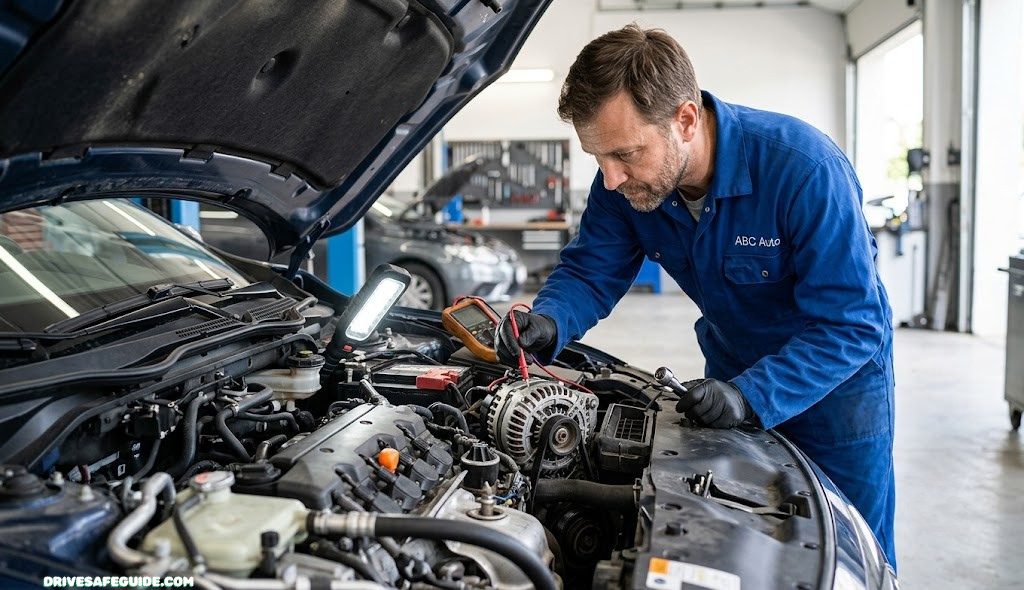
Recognizing Alternator Failure Symptoms to Ensure Your Safety on the Road
Catching a failing alternator early can mean the difference between a quick repair and being stranded on the shoulder at night. Here’s everything you need to know.
Most drivers never think about their alternator until it’s too late. Unlike a flat tire or a check-engine light for a minor sensor, a failing alternator has a habit of giving off subtle, easy-to-dismiss clues for days or even weeks before it finally quits — usually at the worst possible moment, like on the highway at night or in the middle of a road trip. The good news is that alternator failure almost never happens instantly. There’s a pattern of warning signs, and once you know what to look for, you can catch the problem while it’s still a scheduled repair instead of a roadside emergency.
In this guide, we’ll walk through every major symptom of alternator failure, explain what’s happening mechanically and electrically behind each one, show you how to tell an alternator problem apart from a battery or starter issue, and give you a clear action plan for what to do if you suspect your alternator is on its way out. If you’re also seeing a warning light and aren’t sure if it’s a bigger issue, our guide on solid vs. flashing check engine lights is a useful companion read.
1. What an Alternator Actually Does (And Why It Fails)
Before you can recognize the symptoms of alternator failure, it helps to understand what the part is actually responsible for. The alternator is a small generator bolted to your engine, spun by the serpentine belt, that converts mechanical energy from the engine into electrical energy. That electricity does two jobs at once: it recharges your battery while the engine runs, and it directly powers every electrical system in the car — headlights, infotainment, power steering assist on many newer vehicles, fuel injection, climate control blowers, and the countless small computers that keep a modern car running.
Your battery’s main job is simply to provide the initial jolt to start the engine. Once the engine is running, the alternator takes over almost all electrical demand. This is a critical distinction, because it explains why alternator failure symptoms often look exactly like battery problems — dim lights, slow cranking, a car that won’t start — even though the battery itself may be perfectly healthy.
Alternators fail for a handful of predictable reasons: worn-out brushes that lose contact over time, a failing voltage regulator that can’t control output correctly, worn or seized bearings that cause noise and drag, a slipping or cracked serpentine belt that no longer spins the pulley fast enough, or corroded/loose wiring connections at the alternator itself. Heat, age, and high mileage are the biggest predictors — most alternators are rated to last somewhere between 80,000 and 150,000 miles, though heavy electrical loads (aftermarket stereos, winches, additional lighting) can shorten that lifespan considerably.
Because the alternator’s decline is usually gradual, your car essentially gives you an early-warning system. The sections below walk through each of those warnings in the order most drivers actually notice them.
2. Dashboard Warning Light Signs
The most direct signal your car can give you is the battery-shaped warning light on the instrument cluster — often labeled “ALT,” “GEN,” or simply a battery icon. Despite the battery icon, this light is primarily monitoring your car’s charging system, which is almost entirely the alternator’s responsibility. When the alternator’s voltage output drops outside the normal range (typically it should sit between roughly 13.5 and 14.8 volts while running), the car’s onboard computer flags it and lights up this icon.
What the light can mean
- Steady illumination: Usually indicates the charging system voltage is out of range — a strong early sign of alternator trouble.
- Flickering battery light: Often points to a loose or corroded connection, or a belt that’s intermittently slipping on the alternator pulley.
- Light appears with other warnings: If it comes on alongside power steering, ABS, or traction control lights, that’s a strong sign the whole electrical system is losing adequate voltage — those systems are voltage-sensitive and often “trip” first.
It’s worth noting this light is not the same as the check engine light, though the two are sometimes confused. If you’re unsure which light you’re actually seeing, or whether it’s flashing versus solid, our detailed breakdown on solid vs. flashing check engine lights explains the difference and what each pattern typically means for whether it’s safe to keep driving.
Never ignore a battery/charging warning light, even if everything else feels normal. Unlike some sensor-related check engine codes that can wait a week or two, a charging system warning is a countdown clock — the battery is likely draining in real time with nothing recharging it.

Confirm What the Warning Light Means
A budget OBD2 scanner lets you pull the exact charging system code in seconds, instead of guessing.
Check Price on Amazon3. Dimming or Flickering Headlights and Interior Lights
Of all the alternator failure symptoms, this is the one drivers notice first and most often — usually at night. Headlights that visibly dim when you turn on the air conditioning, brake, or idle at a stoplight are a classic sign that the alternator can no longer keep up with electrical demand. You may also notice interior dome lights, dashboard illumination, or infotainment screen brightness pulsing or dimming in sync with engine RPM.
Here’s why this happens: a healthy alternator produces enough current at idle to power everything and still trickle-charge the battery. As the alternator weakens — from worn brushes, a failing diode, or a struggling voltage regulator — its output becomes inconsistent, especially at low RPM. The car’s electrical system then starts pulling reserve power from the battery to compensate, which is why lights flicker rather than staying uniformly dim.
Signs to watch for specifically
- Headlights noticeably brighter when you rev the engine, dimmer at idle.
- Interior lights pulsing or flickering, especially when multiple accessories (defroster, radio, wipers) run at once.
- Dashboard gauges or warning lights flickering briefly, particularly over bumps (a sign of a loose connection compounding the issue).
If you notice this pattern at night on the highway, treat it seriously — losing your headlights unexpectedly at speed is one of the more dangerous ways an electrical failure can play out. Our guide to night driving safety and headlight checks covers additional lighting-related risks worth knowing about.
4. Battery Symptoms That Actually Point to the Alternator
This is one of the most common points of confusion for drivers. A battery that seems to die repeatedly, needs frequent jump-starts, or shows a “weak battery” reading at the auto parts store is very often not actually a battery problem — it’s an alternator that has stopped adequately recharging it. If your battery is less than three years old and keeps testing weak or dying overnight, the alternator deserves just as much suspicion as the battery itself.
Key clues that the alternator, not the battery, is the real issue:
- You replace the battery, and the same “weak start” symptoms return within a few weeks.
- The battery tests fine when checked in isolation (engine off) but the car still struggles to start after a drive.
- Jump-starting the car gets it running, but it dies again shortly after you turn it off, suggesting nothing is topping the battery back up while driving.
- A rotten-egg smell (from an overcharging alternator cooking the battery) or visible corrosion buildup around battery terminals.
It’s genuinely difficult to separate a bad battery from a bad alternator by symptoms alone, which is why a proper charging system test (covered in section 11) is worth doing before you spend money replacing the wrong part. If you’d rather rule out the battery first, keeping a reliable jump starter in your trunk is a smart interim safety net — see our comparison of jump starters vs. traditional jumper cables for options.
| Symptom | More Likely Battery | More Likely Alternator |
|---|---|---|
| Car won’t start after sitting overnight, but starts fine after driving | ✔ | |
| Car starts fine but dies again shortly after turning it off | ✔ | |
| Weak start only in cold weather | ✔ | |
| Headlights dim at idle, brighten when revving | ✔ | |
| Battery is 4+ years old | ✔ | |
| Whining or grinding noise from engine bay | ✔ |
5. Strange Noises From Under the Hood
Alternators are mechanical as well as electrical, and a failing one often makes itself known audibly before the electrical symptoms become obvious. Because the alternator spins continuously whenever the engine runs — usually at a higher speed than the crankshaft itself, thanks to pulley ratios — worn internal bearings tend to produce very specific, recognizable sounds.
Common alternator noises and what they mean
- High-pitched whining or squealing that changes pitch with engine RPM — usually a slipping serpentine belt or a bearing beginning to wear.
- Grinding or growling — often a sign the internal bearings have worn down significantly and metal-on-metal contact has started.
- Rattling — can indicate a loose mounting bracket, a failing pulley, or debris caught in the cooling fan blades inside the alternator housing.
- Clicking — sometimes a sign of a broken internal diode causing irregular electrical arcing, though this is less common than mechanical causes.
It’s easy to confuse alternator noise with a failing serpentine belt itself, since both live in the same corner of the engine bay and often deteriorate around the same mileage. If you’re hearing a squeal specifically on cold starts that fades after a minute, it’s worth reading our guide on serpentine belt replacement signs to help narrow down the source before assuming it’s the alternator itself.
6. Electrical Accessory Malfunctions
Because nearly every powered feature in a modern vehicle depends on stable alternator output, a weakening charging system tends to cause a cluster of seemingly unrelated electrical glitches rather than one obvious failure. Drivers often describe this stage as their car “acting haunted” — small, intermittent issues that don’t point to any single cause.
- Power windows moving noticeably slower than usual, or stalling partway.
- Infotainment system rebooting, freezing, or losing Bluetooth pairing randomly.
- Power door locks working inconsistently.
- Digital dashboard clock resetting itself repeatedly.
- Wipers slowing down or speeding up unexpectedly, independent of the setting selected.
- Radio static or a whining noise through the speakers that changes pitch with RPM — a classic sign of alternator “ripple” (electrical noise) bleeding into the audio system.
Any one of these on its own could be a minor unrelated fault. But when several appear together, especially alongside dimming lights or a dashboard warning, it’s a strong indicator that voltage regulation across the whole vehicle is becoming unstable. Vehicles with heavier electronic loads — those with aftermarket dash cams, upgraded stereos, or auxiliary lighting — tend to show these symptoms earlier, since the alternator has less margin to spare.

Keep a Multimeter in the Glovebox
A simple digital multimeter lets you check charging voltage yourself in under a minute — no shop visit required.
Check Price on Amazon7. Burning Smells or Overheating Signs
A burning rubber or “hot electrical” smell coming from the engine bay is one of the more urgent alternator failure symptoms, and it shouldn’t be ignored even for a short drive. There are a few distinct causes worth knowing:
- Burning rubber smell: Usually caused by a slipping serpentine belt overheating against the alternator pulley — friction generates enough heat to start degrading the rubber compound.
- Hot electrical or “burning wire” smell: Can indicate the alternator’s internal windings are overheating due to a failing voltage regulator forcing it to overwork, or a wiring harness connector that has corroded and is generating resistance heat.
- Sulfur or rotten-egg smell: Points to an overcharging alternator cooking the battery’s electrolyte, which is a serious safety issue that can lead to battery swelling or, in rare cases, rupture.
If you notice a burning smell along with any dashboard warning light, dimming lights, or noise, this is generally a “pull over safely and get it checked” situation rather than a “schedule an appointment for next week” one. An overheating alternator can, in rare but serious cases, become an electrical fire risk. Keeping a properly rated extinguisher on hand is smart insurance regardless — see our guide on how to choose the right class of car fire extinguisher.
8. Difficulty Starting or Random Stalling While Driving
As alternator output continues to degrade, two related but distinct symptoms tend to show up: trouble starting the car, and — in more advanced cases — the engine stalling unexpectedly while you’re actually driving.
Difficulty starting
Because the battery hasn’t been properly recharged on recent drives, cranking becomes slower and weaker each time you try to start the car, even though the starter motor itself is fine. This is one of the most misdiagnosed symptoms, since it looks identical to a simple dead battery.
Stalling while driving
This is a more advanced and more dangerous stage. Once the battery’s reserve charge is depleted and the alternator can no longer supply the fuel system, ignition system, and engine computer with adequate voltage, the engine can lose power and stall — sometimes at highway speed, sometimes at a stoplight. Losing engine power also typically means losing power steering assist and, on some vehicles, power brake assist, both of which make the vehicle noticeably harder to control in the moment.
If your car has stalled unexpectedly even once with no clear explanation, treat it as a serious warning sign rather than a fluke, especially if it’s accompanied by any of the earlier symptoms in this guide. Practicing safe reactions for sudden loss of power is worth reviewing regardless of cause — our guide to handling sudden vehicle control issues covers safe pull-over technique under pressure.
9. Visual Inspection Clues Under the Hood
Beyond what you hear, smell, and see on the dashboard, a quick visual check under the hood can reveal alternator trouble before it becomes an emergency. You don’t need mechanical expertise for this — just a flashlight and a few minutes with the engine off and cool.
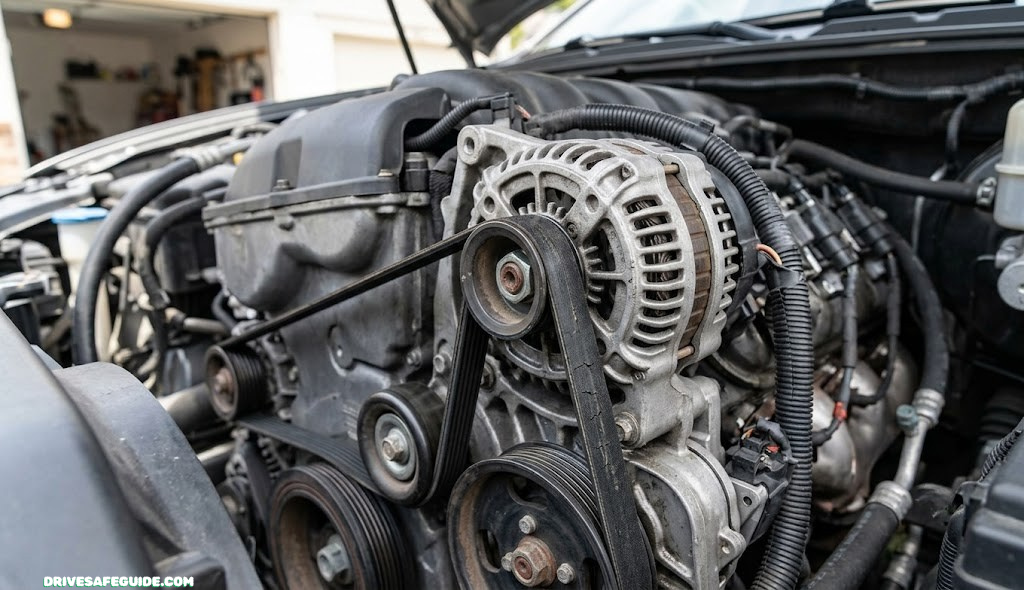
- Serpentine belt condition: Look for cracking, glazing (a shiny, slick surface), fraying edges, or visible slack. A worn belt can’t spin the alternator pulley efficiently even if the alternator itself is healthy.
- Alternator wiring and connector: Check for corrosion (a white or greenish crust) at the electrical connector, and make sure the wiring insulation isn’t cracked or melted-looking near the unit.
- Battery terminals: Heavy corrosion here can mimic charging problems by restricting current flow, so it’s worth ruling out before blaming the alternator.
- Physical damage or looseness: Give the alternator pulley a gentle wiggle (engine off) — excessive play indicates worn bearings.
- Discoloration or a burnt smell directly at the unit: A telltale sign of internal overheating.
If you already keep a basic toolkit in the trunk, this kind of inspection takes only a couple of minutes. If you don’t yet, our guide to building a complete car safety kit outlines exactly what’s worth having on hand for checks like this and for roadside emergencies in general.
10. Alternator vs. Battery vs. Starter: How to Tell the Difference
Because these three components work together so closely, it’s genuinely common for drivers — and even some quick-service shops — to replace the wrong part first. Understanding the distinct role each one plays is the fastest way to narrow things down before spending money.
| Component | Main Job | Classic Failure Symptom | Quick Way to Suspect It |
|---|---|---|---|
| Battery | Provides initial power to start the engine | Slow or no crank, especially in cold weather, after sitting | Car struggles to start cold but runs fine once started |
| Alternator | Recharges battery and powers electronics while running | Dimming lights, dies shortly after starting, flickering electronics | Car starts but dies again minutes later, or won’t stay running |
| Starter | Physically turns the engine over to begin ignition | Clicking sound with no crank at all, or complete silence on turn of key | Lights and dashboard work fine, but engine won’t turn over |
Signs It’s the Alternator
- Dashboard battery/charging light on
- Dimming lights that brighten with RPM
- Car dies shortly after a jump start
- Whining noise tied to engine speed
- Multiple electronics glitching at once
Signs It’s NOT the Alternator
- Clicking with no crank (points to starter)
- Only fails in extreme cold (points to battery)
- Battery tests weak but car runs fine for days after charging
- Corrosion isolated to battery terminals only
If your symptoms don’t clearly match one category, a proper charging system test (below) removes the guesswork entirely. It’s also worth ruling out unrelated causes with similar symptoms, like a failing fuel pump — see the overlap in our failing fuel pump symptoms guide — since stalling and hard starting can stem from either system.
11. Testing Your Alternator: DIY Check vs. Professional Diagnosis
Once you suspect the alternator, confirming it doesn’t have to mean an immediate trip to the shop. A basic voltage check with a multimeter takes about a minute and tells you most of what you need to know.
The simple DIY multimeter test
- With the engine off, set a multimeter to DC volts and check the battery — a healthy resting battery should read roughly 12.4–12.7 volts.
- Start the engine and let it idle, then measure across the battery terminals again.
- A healthy charging system should read approximately 13.5–14.8 volts while running.
- Turn on headlights, blower fan, and rear defroster together, and check the reading again — it shouldn’t drop below roughly 13 volts.
A reading that stays close to battery-resting voltage while the engine runs (barely above 12.7V) suggests the alternator isn’t charging adequately. A reading well above 15V can indicate overcharging from a failing voltage regulator, which is just as damaging to the battery and electronics over time.
| Method | Best For | Limitation |
|---|---|---|
| Basic multimeter voltage test | Quick pass/fail check anyone can do at home | Doesn’t measure load capacity under real demand |
| Battery/alternator load tester | More accurate real-world output measurement | Requires a dedicated tool or shop visit |
| OBD2 scanner with live data | Reading manufacturer-specific charging system codes | Only works on OBD2-equipped vehicles (most since the late 1990s) |
| Professional diagnosis | Confirming exact failure point (diode, regulator, brushes, bearings) | Costs more than DIY methods |
For a deeper look at the difference between simple load testers and more advanced conductance testers, our comparison of load testers vs. conductance testers breaks down which is worth buying for regular at-home checks. If you’d rather monitor things continuously rather than test occasionally, a real-time OBD2 monitoring tool can flag charging system trouble the moment it starts.

Get an Accurate Charging System Reading
A dedicated load tester goes a step beyond a multimeter, showing how your alternator performs under real electrical demand.
Check Price on Amazon12. What to Do If You Suspect Alternator Failure
If you’ve spotted one or more of the symptoms above, a calm and methodical response goes a long way toward keeping you safe and avoiding a full breakdown.
If you’re at home or somewhere safe
- Run the multimeter test described above to confirm charging voltage.
- Visually inspect the belt and wiring connections for obvious damage or looseness.
- Avoid unnecessary drives, especially at night, until you’ve either confirmed the alternator is fine or had it repaired — headlight failure at speed is a genuine risk.
- Book a diagnostic appointment sooner rather than later; alternator replacement is a routine, predictable repair when caught early.
If symptoms appear while you’re already driving
- Turn off non-essential electrical accessories immediately — radio, heated seats, rear defroster, phone charger — to reduce load on the failing system.
- Head toward the nearest safe place to stop rather than continuing your full route, especially if you notice dimming headlights after dark.
- If the engine stalls, steer smoothly toward the shoulder; without power assist, steering and braking will feel noticeably heavier, so apply firmer, steadier pressure.
- Once stopped safely, use hazard lights sparingly if the battery is nearly depleted, and consider road flares instead to conserve remaining charge — our review of durable LED road flares covers battery-independent options.
Keeping a well-stocked emergency kit dramatically reduces the stress of any electrical breakdown. At minimum, a charged jump starter, a basic tool kit, and a flashlight belong in every glovebox — our complete car emergency kit checklist walks through everything worth carrying.

Be Ready for a Sudden Dead Battery
A compact lithium jump starter can get you running again in seconds if the alternator drains your battery unexpectedly.
Check Price on AmazonFrequently Asked Questions
How long can I drive with a failing alternator?
It depends entirely on how far the alternator has degraded and how much your battery still has in reserve. Some drivers get a few days of intermittent warning signs; others lose power within an hour of the first symptom. Because the timeline is unpredictable, it’s safest to treat any charging system warning as something to address within a day or two, not weeks.
Can a car run at all with a completely dead alternator?
Briefly, yes — the engine can keep running on battery reserve alone for a short time, often somewhere between 20 minutes and an hour depending on electrical load and battery health. Once that reserve is used up, the engine will stall and typically won’t restart until the battery is recharged or jump-started.
Will a new battery fix alternator problems?
No. A new battery may temporarily mask the symptoms by providing a fresh reserve of charge, but if the alternator isn’t recharging it properly, the same weak-start and dying-battery symptoms will return within days or weeks, and the new battery may itself be damaged by chronic undercharging or overcharging.
What does a failing alternator sound like?
The most common sounds are a high-pitched whine or squeal that changes with engine speed, a grinding or growling noise from worn bearings, or a rattling sound from a loose mount or damaged pulley. A squeal on cold start that fades after a minute is often a belt issue rather than the alternator itself.
Is it safe to drive at night with a failing alternator?
This is one of the riskier scenarios, since headlights are one of the higher electrical draws in the vehicle and are the first thing to visibly dim. If you notice any dimming or flickering after dark, it’s best to limit driving to essential trips and get the charging system tested as soon as possible.
How much does alternator replacement typically cost?
Costs vary widely by vehicle make, model, and labor rates in your area, and by whether you choose a new, remanufactured, or aftermarket unit. Getting a quote from a trusted local shop is the most reliable way to know your specific cost, since parts accessibility (some alternators are buried deep in the engine bay) significantly affects labor time.
Can extreme heat or cold cause alternator failure?
Yes, both extremes add stress. Heat accelerates the breakdown of internal components like brushes, bearings, and diodes, while cold weather increases the initial electrical demand on the whole charging system as the battery struggles to hold a charge. Regions with hot summers tend to see somewhat shorter average alternator lifespans.
Does a bad alternator throw a check engine light?
Sometimes, though the dedicated battery/charging light is the more direct and reliable indicator. On some vehicles, a severe charging system fault can also trigger the check engine light if it affects sensors or modules that rely on stable voltage. If both lights appear together, treat it as a priority to get checked.
Can I test my alternator without any tools?
You can get a rough sense using the “revving test” — watch whether headlights or interior lights visibly brighten when you rev the engine and dim at idle, which suggests inconsistent output. However, this isn’t a substitute for an actual voltage reading with a multimeter, which takes only a minute and gives a far more reliable answer.
Why do my electronics glitch before the car actually dies?
Modern vehicles run dozens of small computers and modules that are sensitive to voltage stability. As alternator output becomes inconsistent, these systems are often the first to show symptoms — resetting, freezing, or behaving erratically — well before the more obvious symptoms like dimming headlights or a no-start condition appear.
Is a whining noise from the alternator always serious?
Not always immediately dangerous, but it should never be ignored. A whine can indicate anything from a simple belt tension issue to worn bearings that will eventually seize. Since diagnosing the exact cause visually can be difficult, it’s worth having it checked before it progresses to a full charging system failure.
Should I replace the alternator myself or have a professional do it?
This depends heavily on the vehicle and your comfort level with automotive electrical work. On some cars the alternator is easily accessible; on others it’s buried behind other components, making the job significantly more time-consuming. Given the safety implications of getting the installation and wiring connections wrong, many drivers choose to have this specific repair done professionally even if they handle other maintenance themselves.
Stay Ahead of Alternator Failure
A failing alternator rarely fails without warning — dimming lights, strange noises, a lingering burning smell, or a battery that just won’t hold a charge are all signs your car is asking for attention. Catching these symptoms early turns a potential roadside emergency into a routine, scheduled repair.
Pair this knowledge with a well-stocked emergency kit and a reliable jump starter, and you’ll be ready no matter what your charging system throws at you.
Shop Roadside Emergency Kits on Amazon