

Every driver on this road made a hundred small decisions to get there safely. This guide is about making more of yours count.
Most driving advice gets filed away and forgotten because it’s either too vague (“be careful out there”) or too technical to remember when it matters. This guide is built the other way around. It starts with a six-step routine you can actually run through before you pull out of the driveway, then goes deep on the specific situations that cause the most serious outcomes on real roads: tailgating, bad weather, night glare, sudden mechanical failure, distraction, and the legal gray areas that trip drivers up. Whether you’re a new driver building habits from scratch or someone who’s been driving for decades and wants a genuine refresher, treat this as a reference you come back to — not something you read once and forget.
Your 6-Step Pre-Drive & On-Road Safety Routine
Almost every serious safety habit traces back to one of six checkpoints. Run through these before a drive and reinforce them while you’re moving, and you’ll have already addressed the majority of what causes preventable collisions. Each step below includes a quick visual so you can see exactly what “doing it right” looks like, not just read about it.
Adjust Your Mirrors and Seat Before You Move
Most drivers set their mirrors once, when the car is new, and never again — even after a different person drove it last. Properly angled mirrors should show a sliver of your own car at the inside edge and extend just past where your peripheral vision picks up, which minimizes the blind spot rather than duplicating what your rearview mirror already shows. Seat height should let you see the road over the dashboard without leaning forward, and the headrest should sit level with the top of your ears, not your neck, so it actually protects you in a rear-end impact.
Check Your Tire Tread Depth
Insert a coin into the tread groove, ridge-side down. If you can see the top of the ridge, tread is running shallow and stopping distance on wet roads climbs fast. Rotating this check into a monthly habit — not just an annual one — catches gradual wear before it becomes a hydroplaning risk. If you’d rather not eyeball it, a digital tread gauge removes the guesswork entirely.
Keep a Three-Second Following Gap
Pick a fixed point — a sign, an overpass shadow, a mile marker — and start counting the moment the car ahead passes it. If you reach that same point before you hit “three,” you’re following too closely. This single habit, repeated automatically on every drive, is the backbone of safe following distance and gives you the reaction window that separates a hard brake from a collision.
Perform a Real Shoulder Check Before Changing Lanes
Mirrors alone can’t cover the blind spot just behind your rear door — the exact spot where a motorcycle or a car in your peripheral vision disappears entirely. A quick glance over your shoulder, timed to under a second, confirms what your mirrors can’t. Skipping this step is one of the most common causes of avoidable sideswipe collisions during lane changes.
Correct a Hydroplane Skid the Right Way
If the steering suddenly feels light and the car drifts despite your input, you’re hydroplaning — your tires have lost contact with the pavement on a film of water. Ease off the gas smoothly, hold the wheel straight, and resist the urge to brake or overcorrect. The moment your tread finds grip again, the car will straighten out on its own. See the full breakdown in our hydroplaning recovery guide.
Stage a Roadside Emergency Kit You Can Reach
A kit buried under luggage in the trunk doesn’t help you at 2 a.m. on a dark shoulder. Keep the essentials in one grab-and-go container, positioned somewhere you can reach without unloading the whole trunk. We cover the full packing list later in this guide — for now, know what the core items look like.
Bigger picture: this six-step routine is the practical version of the framework covered in our broader safe driving habits guide — worth bookmarking alongside this one.

Digital Tire Tread & Pressure Gauge
Skip the coin test guesswork — get an exact reading in seconds and catch uneven wear before it becomes a blowout.
Check Price on AmazonMaster Your Stopping Distance
Total stopping distance is perception time, plus reaction time, plus braking distance — and every one of those numbers grows the moment conditions turn against you. Understanding roughly how much room your car actually needs changes how you plan a following gap, and it explains why a driver who “slammed the brakes” still couldn’t stop in time. If you’ve ever felt your car shake or pull at highway speed, that’s a separate issue worth checking too, since it can quietly extend your braking distance even before you touch the pedal.
| Speed | Dry Pavement | Wet Pavement | Snow / Ice |
|---|---|---|---|
| 30 mph | ~75 ft | ~105 ft | ~225 ft |
| 45 mph | ~150 ft | ~210 ft | ~450 ft |
| 60 mph | ~260 ft | ~365 ft | ~780 ft |
| 75 mph | ~385 ft | ~540 ft | ~1,150 ft |
These are planning estimates, not lab measurements — actual distance depends on your specific tires, brake condition, and vehicle weight. The pattern that matters is the multiplier: wet pavement roughly adds 40% to your stopping distance, and snow or ice can triple it. That’s the entire justification for slowing down before conditions look dangerous, not after.
Warning signs your brakes need attention
- A soft or spongy pedal that sinks further than usual before engaging
- Grinding or high-pitched squealing, which often means worn brake pad indicators are doing their job
- The car pulling to one side under braking
- A pedal that feels firm one moment and drops to the floor the next — a sign worth reading up on in our brake fade vs. hydraulic failure breakdown
Build Defensive Driving Habits That Actually Reduce Risk
Defensive driving isn’t a mindset you switch on during a close call — it’s a set of small, repeated decisions that reduce how often you end up in one. Our full defensive driving habits guide goes deep on this, but the core ideas are worth internalizing here.
Scan further ahead than feels necessary
Most drivers fix their attention on the car directly in front of them. Experienced defensive drivers scan 10–15 seconds ahead — the next intersection, the brake lights two cars up, the pedestrian stepping off a curb — which buys reaction time most drivers never realize they’re missing.
Give yourself an out
Whenever possible, position your car so you have an escape path: open lane, shoulder, or gap in traffic. Boxing yourself in between two trucks with no way to maneuver removes options exactly when you might need them.
Treat every intersection as if someone might run it
A green light doesn’t guarantee the cross-traffic will stop. A half-second glance left-right before entering an intersection, even on a green, catches the driver who’s distracted or running late.
Don’t let frustration drive your decisions
Tailgating a slow driver or accelerating through a yellow to “beat” someone accomplishes almost nothing and meaningfully raises your risk. If road rage is starting to creep into how you drive, our guide on preventing road rage incidents has concrete de-escalation tactics.
Merge like the lane is a courtesy, not a right
Where lanes end, the zipper merge — using both lanes until the merge point, then alternating — moves traffic faster and more safely than everyone squeezing over early. It feels counterintuitive, but it’s backed by traffic-flow research for a reason.
Front & Rear Dash Cam
Objective footage settles disputes fast and protects you against staged-accident claims — cheap insurance for what it costs.
Check Price on AmazonHandle Rain, Fog, Wind & Black Ice Without Losing Control
Weather doesn’t just reduce traction — it reduces your visibility, your reaction time, and your margin for error all at once. Each condition below calls for a slightly different response, and mixing them up is a common mistake.
Heavy rain
Turn off cruise control — it can’t respond to a hydroplane the way you can — and increase following distance to at least six seconds. Our rain driving safety guide covers why cruise control specifically becomes a liability at highway speeds in wet conditions.
Fog
Use low beams, not high beams — high beams reflect off fog and worsen your own visibility. Slow down enough that you can stop within the distance you can actually see, and use the right edge line as a steering reference if visibility drops further. Full tactics are in our fog driving strategies guide.
High winds
Crosswinds hit high-profile vehicles — trucks, vans, anything with a roof box — hardest, and gusts near overpasses or in open plains can shove a car sideways with little warning. Loosen your grip slightly so a gust doesn’t overcorrect through your hands, and slow down before bridges and open stretches, not after you feel the push. See driving in high winds for a full breakdown.
Black ice
Black ice is nearly invisible and most common on bridges, overpasses, and shaded roads that freeze before the rest of the pavement. If you feel the back end shift with no visible cause, you’ve likely found it. Ease off the gas, avoid braking or steering inputs, and let the car coast through — our black ice survival guide walks through the full recovery sequence.
Packed snow
Even without chains, slower speeds, gentler inputs, and extended following distance handle most snow conditions safely. See driving in snow without chains and our broader winter driving safety guide for traction-specific advice.

Winter Car Emergency Kit
Blankets, traction aid, and an ice scraper turn a cold-weather breakdown from dangerous into just inconvenient.
Check Price on AmazonOwn the Night: Headlight Glare, Fatigue, and Visibility
Nighttime driving concentrates several risks that barely register during the day: reduced depth perception, oncoming headlight glare, and a much higher chance you’re fighting fatigue without realizing it. Our full night driving safety checklist is worth a dedicated read, but here’s the core of it.
Manage glare instead of fighting it
Looking directly at oncoming headlights temporarily blinds your night vision. Instead, aim your gaze toward the right edge of your lane and use it as a steering reference. A clean windshield — inside and out — cuts glare scatter significantly, and a pair of polarized driving glasses designed for low light (not standard tinted sunglasses) can help without darkening your overall vision.
Recognize drowsy driving before it becomes dangerous
Missing your exit, drifting within your lane, or not remembering the last few minutes of driving are all signs it’s time to stop, not push through. Our drowsy driving checklist lays out exactly when to pull over versus when a quick break is enough.
Check your own headlight aim
Misaligned headlights blind oncoming drivers without improving your own visibility. If other drivers frequently flash you, or your low beams seem to light up more sky than road, it’s worth having your aim checked at your next service visit.
Anti-Glare Polarized Driving Glasses
Purpose-built for headlight glare and dusk driving, without the over-darkening of regular sunglasses.
Check Price on AmazonHighway, Merging, and Roundabout Confidence
High-speed roads and unfamiliar intersection types cause a specific kind of anxiety that leads to hesitation — and hesitation at a merge point or roundabout entry is often more dangerous than moving decisively.
Merging without hesitation
Match your speed to the flow of traffic while you’re still on the ramp, not after you’re in the lane. Drivers who merge too slowly force the vehicles behind them to brake unexpectedly, which is a common trigger for rear-end collisions. Our highway merging anxiety guide has a step-by-step approach if ramps make you tense.
Roundabouts
Yield to traffic already in the circle, enter when there’s a safe gap, and signal your exit — not your entry. Confusion usually comes from treating a roundabout like a four-way stop. See our roundabout navigation rules guide for the full picture.
Know where the runaway ramps are
On long mountain descents, escape ramps exist specifically for vehicles with failing brakes. Knowing what they look like and where they typically appear — before you need one — matters more than most drivers realize. Our escape ramp safety guide explains how to use one correctly if it ever comes to that.
What to Do When Something Goes Wrong
Most drivers never rehearse how to respond to a sudden mechanical failure, and that’s exactly why panic takes over when one happens. Knowing the sequence in advance — even just reading it once — measurably improves how calmly you react.
Brake failure
Pump the pedal firmly to try to rebuild hydraulic pressure, downshift to use engine braking, and apply the parking brake gradually rather than yanking it, which can lock the rear wheels. Steer toward an open shoulder if one is available. Full sequence in our brake failure emergency procedures guide.
Stuck accelerator
Shift into neutral immediately — this disconnects engine power from the wheels regardless of what the pedal is doing — then brake to a controlled stop. Don’t reach for the ignition first; a stuck-accelerator response should always start with neutral. See stuck accelerator response for the complete steps.
Power steering failure
The wheel becomes heavy, not unresponsive. Slow down, grip firmly with both hands, and steer with more deliberate input than usual. Sudden loss of power steering assist is manageable if you don’t panic-fight the wheel. Details in power steering failure handling.
Hood flies open
Slow down immediately, look through the gap at the base of the windshield rather than around the raised hood, and use your side windows and mirrors to guide yourself to a stop. Our hood flying open protocol covers the full response.
An animal crosses your path
Brake firmly in a straight line. Swerving to avoid a deer or other animal is what most often turns a survivable collision into a rollover or head-on crash. See deer collision safety for the reasoning and the aftermath steps.
Your car starts to skid
Steer in the direction you want the front of the car to go, keep your foot off the brake until the skid resolves, and avoid overcorrecting, which is what turns one skid into a fishtail in the opposite direction. Full technique breakdown in skid control techniques.
LED Reflective Warning Triangles
Give approaching traffic advance warning if you’re pulled over on a shoulder, especially at night or in poor visibility.
Check Price on AmazonEliminate Distracted and Impaired Driving Risks
Distraction and impairment don’t always look like a phone in hand or a drink before driving — they include a long list of smaller habits most drivers don’t think twice about.
Headphones and hearing
Rules on driving with headphones vary by state and by whether both ears are covered. Beyond the legal question, covering both ears removes your ability to hear sirens, horns, and the sound cues that often warn you of danger before you see it. See driving with headphones for the state-by-state breakdown.
Eating behind the wheel
It’s legal almost everywhere, but the risk comes from what it does to your hands and attention, not the food itself. Foods that need two hands or frequent glances down are the real hazard. Full context in eating while driving.
Passengers and open containers
Open container laws for passengers vary significantly by state, and the rules for drivers are stricter almost everywhere. Check the specifics in our passenger alcohol consumption guide and our broader open container laws by state reference.
DUI checkpoints
Knowing your rights at a checkpoint — what you’re required to provide and what you’re not — reduces confusion in a high-stress moment. See DUI checkpoint refusal rights for a plain-language explanation.
Safety Considerations for Every Kind of Driver
Generic safety advice sometimes misses drivers whose circumstances genuinely change what “safe” looks like. None of these situations disqualify someone from driving — they just call for specific strategies.
Neurodivergent drivers
Dyslexia, ADHD, and dyspraxia can affect processing speed for road signs or spatial coordination, but plenty of strategies exist to adapt around them, along with legal protections most drivers don’t know about. See driving with dyslexia, ADHD, and dyspraxia.
Deaf and hard-of-hearing drivers
Every U.S. state permits deaf drivers, and accident rates for deaf drivers are not meaningfully higher than hearing drivers — visual scanning habits often compensate. Details in deaf drivers and U.S. laws.
Drivers with epilepsy
Rules on seizure-free intervals before licensing vary by state and depend heavily on medical guidance. See epilepsy driving restrictions for a state-level overview.
Senior drivers
Reaction time, night vision, and neck mobility change gradually, often without a driver noticing day to day. A senior driver refresher course is a low-pressure way to get an honest assessment — and often qualifies for an insurance discount.
Anxious drivers
Driving anxiety is more common than most people admit, and it responds well to structured, gradual exposure rather than avoidance. See driving anxiety treatment for practical approaches.
Build a Roadside Emergency Kit You’ll Actually Use
The best kit is the one that’s actually in your car, not the exhaustive list you meant to assemble someday. Start with the essentials, then layer in extras based on your climate and how often you drive long distances. Our full car safety kit guide and emergency kit checklist go deeper than the summary below.
| Item | Priority | Why it matters |
|---|---|---|
| Jumper cables or jump starter | Essential | The most common roadside failure by far is a dead battery |
| Reflective warning triangle | Essential | Gives approaching drivers time to react to your stopped car |
| Flashlight + extra batteries | Essential | Needed for repairs and visibility after dark |
| Basic first aid kit | Essential | Covers minor injuries before help arrives |
| Tire pressure gauge | Essential | Confirms whether a soft tire is a slow leak or a blowout risk |
| Drinking water | Essential | Matters most if you’re stranded for hours in heat or cold |
| Ice scraper & blanket | Recommended (cold climates) | A breakdown in freezing weather is a different risk category |
| Fire extinguisher | Recommended | Small vehicle fires are containable if caught early — see our fire extinguisher buying guide |
| Seatbelt cutter / window breaker | Recommended | Covered in our emergency escape tools review |
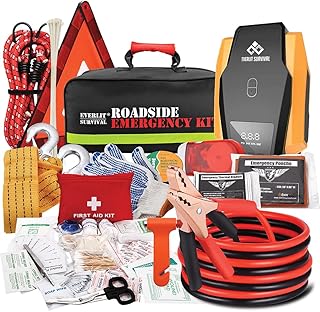
All-in-One Roadside Emergency Kit
Covers cables, triangle, flashlight, and first aid in one grab-and-go case — the fastest way to check every essential box at once.
Check Price on AmazonTech Tools That Make You a Safer Driver
Built-in driver-assist systems get most of the attention, but a handful of aftermarket tools close gaps that factory tech doesn’t cover — especially in older vehicles. See our roundup of apps every driver should use for the software side of this list.
Built-In ADAS (factory-installed)
- Integrated with the vehicle’s braking and steering systems
- No installation required
- Often includes automatic emergency braking
Built-In ADAS — trade-offs
- Not available or limited on older vehicles
- Expensive to repair after a windshield or bumper replacement
- Can create false confidence if drivers over-rely on it
Aftermarket Add-Ons (dash cam, OBD2)
- Retrofits any vehicle, regardless of age
- Dash cam footage helps directly with insurance claims
- Relatively inexpensive compared to factory options
Aftermarket Add-Ons — trade-offs
- Requires separate installation and setup
- Doesn’t intervene in the vehicle’s braking or steering
- Quality varies significantly between budget and premium units
A quality dash cam built for low-light footage and an OBD2 scanner that reads live sensor data are two of the highest-value additions for the cost, especially paired with a solid phone mount that keeps navigation visible without taking your eyes far from the road.
Bluetooth OBD2 Scanner
Read live engine data and catch warning signs before a dashboard light forces the issue on the side of the highway.
Check Price on AmazonKnow the Laws That Keep Everyone Safer
Traffic laws exist because someone, somewhere, learned the hard way why the rule mattered. A few of the ones drivers misunderstand most often:
- Move over laws — slowing and changing lanes for stopped emergency or roadside vehicles is required nearly everywhere. See move over law requirements.
- School bus stopping laws — rules differ for divided highways versus undivided roads, which trips up more drivers than any other stopping rule. Details in school bus stopping laws.
- Right on red — permitted in most states but not all, and local signage always overrides the general rule. See right on red state variations.
- Uninsured motorist coverage — often overlooked until it’s needed. Worth reviewing in uninsured motorist coverage.
- Graduated licensing restrictions — passenger limits and curfews for new teen drivers vary by state and are frequently misunderstood by parents too. See graduated licensing restrictions.
Frequently Asked Questions
Keeping consistent space around your vehicle — a minimum three-second following gap behind, awareness of what’s beside and behind you, and an exit path ahead — does more to prevent a collision than any single piece of gear. Space is what turns a sudden hazard into a manageable one instead of an unavoidable one.
Use the three-second rule in good conditions: pick a fixed point the car ahead passes, and count until you reach the same point. Three seconds or more means adequate space. Double that gap to six seconds or more in rain, at night, or when towing, and increase it further on ice or packed snow.
Ease off the accelerator smoothly, keep the steering wheel pointed straight ahead, and avoid braking or making sudden steering corrections until the tires regain contact with the road. Braking or jerking the wheel during a hydroplane skid is what typically turns a scary moment into a spin.
Rules vary by state and by whether both ears are covered, so the honest answer is it depends on where you’re driving. Because it can also mask sirens, horns, and tire noise that warn you of danger, it’s worth treating as a safety question first and a legal one second.
At minimum: jumper cables or a jump starter, a reflective warning triangle, a flashlight, a basic first aid kit, a tire pressure gauge, and drinking water. Cold-climate drivers should add an ice scraper, blankets, and traction aid, since a breakdown in freezing weather carries different risks than one in mild weather.
Check tread depth roughly once a month and before any long trip. A quick coin test tells you whether you’re approaching the legal wear limit, and catching shallow tread early gives you time to shop for replacements instead of discovering the problem in the rain.
Pump the brake pedal firmly to try to rebuild pressure, shift into a lower gear to use engine braking, and apply the parking brake gradually rather than yanking it. Steer toward an open shoulder or runaway lane if one is available, and avoid turning off the engine at speed, which can lock the steering wheel.
For most drivers, yes. A dash cam provides objective footage in a dispute, which can shorten insurance claims and protect you against staged-accident fraud. The value comes less from preventing incidents and more from having clear evidence when something happens despite your best efforts.
Look toward the right edge of your lane rather than directly at oncoming headlights, keep your windshield clean inside and out, and have your own headlights aimed correctly. Anti-reflective or polarized driving glasses can also cut glare without darkening your overall night vision the way sunglasses would.
Match your speed to highway traffic while still on the ramp, use the acceleration lane to find a gap rather than stopping and waiting, and glance over your shoulder to confirm the lane is clear before committing. Merging too slowly is one of the more common causes of rear-end collisions at on-ramps.
Not automatically, but a refresher course is worth considering if reaction time, night vision, or neck mobility have changed, or if it’s simply been many years since a formal review of current rules. Many courses also qualify drivers for an insurance discount, which offsets the cost.
Brake firmly in a straight line rather than swerving. Swerving to avoid an animal is a leading cause of drivers losing control and hitting a tree, guardrail, or oncoming vehicle, which is typically far more dangerous than the collision with the animal itself.
The Real Takeaway
None of this works as a one-time read. The six-step routine at the top of this guide takes under two minutes and catches most of what causes preventable incidents. The situational sections — weather, night driving, emergencies, the law — are there for when you need a specific answer fast, so bookmark this page rather than trying to memorize it in one sitting.
Before your next long drive, run through our road trip essentials checklist and make sure your safety kit is actually in the car, not just on your to-do list.
Shop Portable Jump Starters on AmazonAs an Amazon Associate, DriveGuide earns from qualifying purchases made through links on this page. This comes at no extra cost to you and helps support the guides we publish.
🛡️ Be Prepared
Every Car Needs an Emergency Kit
Breakdowns happen without warning. A well-stocked car emergency kit can keep you safe until help arrives — don’t drive without one.
🏗 Shop Emergency Kits on AmazonAffiliate link — we earn a small commission that keeps DriveSafeGuide running. Thank you!