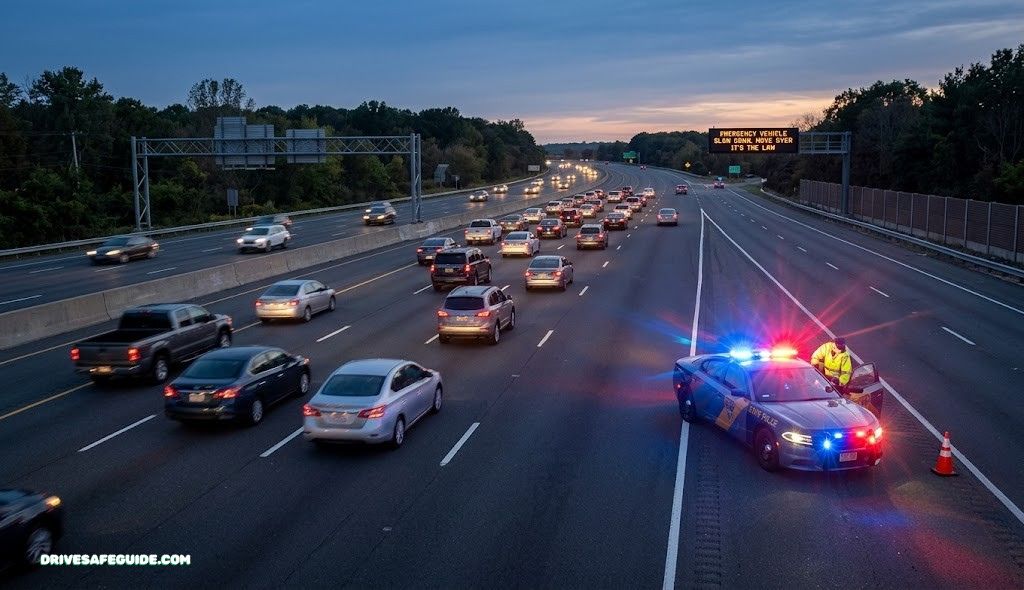
Understanding Move Over Law Requirements for Safe Driving
Every state has one, most drivers can’t fully explain it, and getting it wrong can cost you points, a fine, or someone’s life. Here’s exactly what the Move Over Law asks of you, lane by lane, state by state.
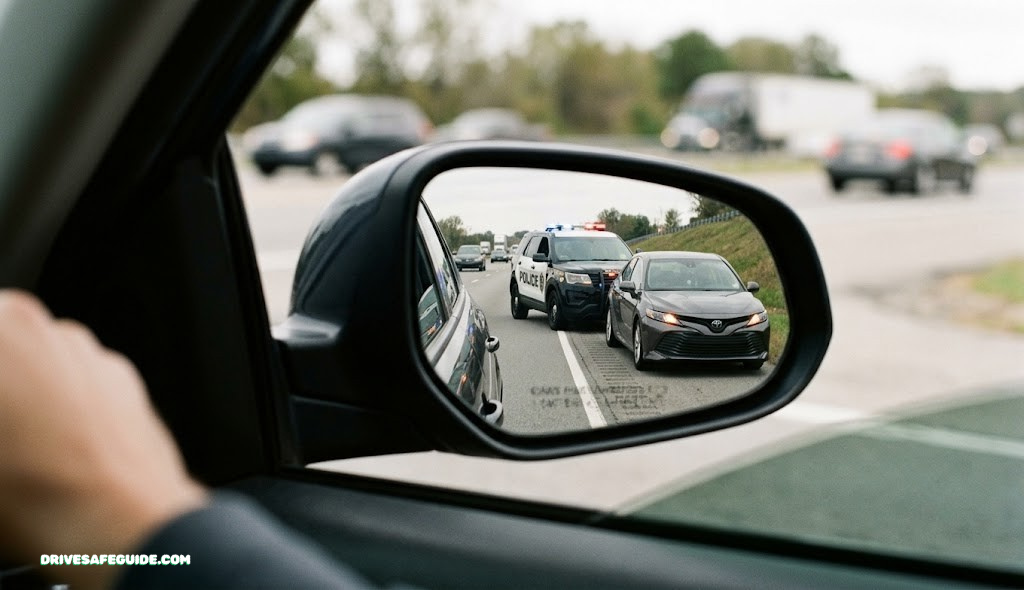
A routine traffic stop on the shoulder — exactly the scenario the Move Over Law is written for.
Informational Guide
You’re doing sixty on the interstate, three lanes of traffic humming along beside you, when a set of red and blue lights appears ahead on the shoulder. In that half-second, most drivers make a decision on instinct rather than knowledge — and that instinct is often wrong. The Move Over Law exists precisely for that half-second, and understanding it properly is one of the simplest ways to protect both yourself and the people working on the side of the road.
This guide breaks the law down in plain language: what it requires, who it protects, how the rules shift from state to state, and what actually happens if you get caught ignoring it. Whether you’re studying for a license test, brushing up before a road trip, or simply want to stop guessing every time you see flashing lights ahead, you’ll find the full picture here.
If you want a broader foundation before diving into this specific rule, our defensive driving habits guide covers the everyday behaviors that keep you and everyone around you safer on the road.
Part of what makes this particular rule tricky is that it rarely gets the same classroom attention as speed limits, right-of-way rules, or parking regulations. Many drivers learned the basic concept years ago in a driver’s education course and never revisited it, even as the statute itself was quietly rewritten to cover more vehicles and stricter penalties. Others picked up the general idea informally, through habit or a passing mention from a family member, without ever reading the actual language of the law. That gap between assumption and statute is exactly where citations happen — not from reckless intent, but from an outdated mental model of what the law actually says today.
Treat this guide as a refresher you can return to before a long drive, a cross-state trip, or simply the next time you find yourself unsure whether you handled a roadside pass correctly. By the end, you’ll have a clear, current picture of what the law expects, how enforcement typically works, and how to build the kind of habits that make compliance automatic rather than a last-second scramble.
What Is the Move Over Law?
At its core, the Move Over Law is a traffic statute that requires drivers to change lanes, slow down, or both when approaching a vehicle stopped on the shoulder with its emergency lights activated. It sounds simple, but the details — which lights count, which vehicles qualify, how much you need to slow down — are where most drivers get tripped up.
Every U.S. state has adopted some version of this law, though the exact wording, covered vehicles, and penalties differ. The unifying idea is straightforward: a stopped vehicle on the roadside is a hazard, and the person standing beside it is in far more danger than the driver passing by at speed. The law shifts responsibility onto passing traffic to create a buffer of space and a reduction in speed, rather than leaving safety entirely up to the reflexes of the person on foot.
It’s worth noting that this isn’t a suggestion or a courtesy — it’s an enforceable traffic law with real citations attached, and officers actively watch for violations, particularly around highway incidents and construction zones.
One reason the law is worded around “safely possible” rather than an absolute command is that traffic conditions change block by block. A merge that’s easy on an open stretch of interstate at ten at night can be genuinely dangerous during rush hour with bumper-to-bumper traffic in the adjacent lane. Lawmakers built that flexibility into the statute on purpose, so that officers and courts can evaluate whether a driver made a reasonable choice given the conditions in front of them, rather than applying a rigid, one-size-fits-all standard that ignores real road conditions.
That flexibility, though, is not a loophole. “I didn’t think I could move over safely” is a defense that only holds up if the traffic conditions genuinely prevented it — not if a driver simply didn’t notice the lights in time, was distracted, or chose not to bother. Officers who witness a violation are generally looking at the same traffic conditions you were, which makes an after-the-fact excuse about heavy traffic difficult to use convincingly if the road was, in fact, clear.
Why “Reduce Speed” Isn’t a Weaker Requirement
Some drivers treat the speed-reduction fallback as the lighter version of the law, something you can satisfy by easing off the accelerator for a second or two. In practice, courts and officers tend to look for a genuine, sustained reduction that lasts through the entire pass, not a brief tap of the brakes right as you draw level with the stopped vehicle. The intention behind the law is to give the person on the shoulder a meaningfully safer few seconds, and a token slowdown doesn’t accomplish that.

Carry Visible Warning Signals in Your Trunk
A set of crushproof LED road flares makes your stopped vehicle far easier for other drivers to spot — and easier for them to give you the space the Move Over Law requires.
Shop LED Road Flares on AmazonWhere the Law Came From
Move Over laws emerged out of a hard pattern that repeated in state after state: officers, tow operators, and roadside responders were being struck and killed by passing vehicles during routine stops. A traffic stop that should have taken ten minutes was turning fatal, not because of the incident being handled, but because of the traffic flowing past at full speed just a few feet away.
South Carolina is widely credited as the first state to pass a formal Move Over statute, and within roughly a decade the concept had spread nationwide as other states saw similar near-misses and fatalities on their own highways. What began as protection specifically for law enforcement gradually expanded to include firefighters, paramedics, tow truck operators, utility crews, and — in a growing number of states — any driver who has simply pulled over with hazard lights on.
That expansion matters. It reflects a shift in thinking: the danger isn’t really about who is standing on the shoulder, it’s about the physics of a vehicle traveling at highway speed passing within a few feet of anyone standing outside a car.
Industry and government safety campaigns played a significant role in accelerating that shift. Tow and recovery associations lobbied heavily for their members to be included in state statutes after data consistently showed operators being struck while hooking up a vehicle just feet from live traffic. Utility companies made similar arguments on behalf of line crews working after storms, often at night and in poor visibility. Each addition to the law followed a similar pattern: a documented rise in a specific category of roadside injuries, followed by an advocacy push, followed by a legislative amendment broadening the statute’s coverage.
The result today is a patchwork that still shares a common ancestor. If you compare an early Move Over statute from its first year on the books to the current version of the same state’s law, you’ll typically find far more protected categories, tighter language around what counts as a “safe” lane change, and steeper penalties than the original draft contained. The law, in other words, has not stood still — it has consistently moved in the direction of covering more people and demanding more from passing drivers, which is exactly why relying on an old memory of “how the law works” can leave you out of date.
How the Law Actually Works
The mechanics of the Move Over Law generally follow a two-step decision tree that plays out in a matter of seconds as you approach the stopped vehicle.
Step One: Can You Change Lanes Safely?
If the road has multiple lanes traveling in your direction and it is safe to do so — meaning no vehicle is currently occupying the lane you would merge into and you have enough room to complete the maneuver smoothly — the law requires you to move over into a lane that is not adjacent to the stopped vehicle.
Step Two: If You Can’t Change Lanes, Slow Down
If merging isn’t possible because of traffic in the adjacent lane, a narrow road, or a single-lane configuration, the law falls back to its second requirement: reduce your speed substantially below the posted limit and proceed with heightened caution as you pass.
The law is written this way intentionally, because forcing an unsafe lane change would create a new hazard rather than removing one. Slowing down is always the fallback, never an excuse to skip the first option when it’s actually available.
For drivers who find themselves regularly overwhelmed by fast-developing highway situations like this, our guide on highway merging anxiety offers practical techniques for staying calm and decisive in exactly this kind of moment.
Which Vehicles Are Protected
The list of vehicles covered by Move Over laws has grown steadily over the years. Understanding the current scope helps you recognize when the law applies, rather than assuming it’s limited to police cruisers alone.
Almost Always Covered
- Police cars and sheriff’s vehicles
- Fire trucks and fire department vehicles
- Ambulances and other EMS vehicles
- Tow trucks and roadside recovery vehicles
Varies by State
- Utility and highway maintenance vehicles
- Sanitation and waste collection trucks
- Survey and construction crew vehicles
- Ordinary vehicles displaying hazard lights
The trend line across nearly every legislative session is expansion rather than contraction — more categories of vehicles are being added to the protected list, not fewer. If you’re unsure whether a specific type of vehicle counts in your state, the safest default is to treat any stopped vehicle with active flashing lights as covered, since the maneuver costs you almost nothing and the downside of ignoring it can be severe.
Why the List Keeps Growing
Each category added to a Move Over statute usually followed a documented pattern of injuries or fatalities in that specific line of work. Tow operators were among the earliest additions after data showed how often they were struck while hooked to a vehicle on the shoulder, sometimes with their upper body angled away from oncoming traffic and limited ability to react. Utility crews followed a similar trajectory, particularly after storm-response call-outs that put line workers on foot along dark, high-speed roads for extended periods.
More recently, several states have moved to close what lawmakers described as an obvious gap: an ordinary driver stranded with a flat tire or dead battery faces the exact same danger as a tow operator standing beside them, yet earlier versions of the law offered that stranded driver no legal protection at all. Extending the statute to cover any vehicle with hazard lights activated closes that gap, and it also simplifies the rule for everyday drivers — rather than trying to identify a vehicle type at highway speed, you simply respond to the presence of flashing lights.
What to Do When You’re Genuinely Unsure
If you can’t immediately tell what kind of vehicle is stopped ahead — perhaps it’s dusk, or the vehicle is partially obscured by an overpass shadow — the safest response is identical regardless of the answer. Begin slowing and start scanning for a safe merge opportunity as soon as you notice the lights, and finalize your decision as you get a clearer view. Waiting until you’ve positively identified the vehicle type before reacting defeats the purpose of the early-warning value that flashing lights are designed to provide.
State-by-State Comparison
While the underlying concept is consistent, the fine print differs enough between states that it’s worth understanding the general categories of variation before you assume your home-state rule applies everywhere you drive.
| Category | Typical Approach | Variation You’ll See |
|---|---|---|
| Covered vehicles | Police, fire, EMS, tow trucks | Some states add utility, sanitation, and hazard-light vehicles |
| Lane-change requirement | Move over when safely possible | A few states specify exact distance or lane conditions |
| Speed reduction | “Reasonable and safe” speed | Some states name a specific mph reduction below the limit |
| First-offense fine | Ranges widely by jurisdiction | Higher fines common in states with frequent worker fatalities |
| Repeat-offense penalty | Escalating fines and license points | Some states add license suspension after multiple violations |
Because the details genuinely change from state to state, it’s worth checking your specific state DMV or department of motor vehicles page if you’re planning a long interstate trip, especially one that crosses several state lines in a single day. Our cross-country driving checklist is a useful companion for exactly that kind of trip planning.
Regional Patterns Worth Knowing
While every state ultimately writes its own version of the statute, a few regional patterns tend to hold up. States with large rural highway networks and heavy commercial trucking traffic have generally been among the earliest to expand coverage to tow operators and utility crews, likely because those roads see a disproportionate share of roadside breakdowns relative to more urban states with denser public transit alternatives. States that have experienced a high-profile roadside fatality involving a specific profession — a utility lineman, a state trooper, a tow operator — have also tended to move quickly to close the relevant gap in their statute afterward.
None of this means you should try to guess your way through an unfamiliar state’s law based on regional assumptions. It simply explains why the patchwork looks the way it does, and why a quick check of the specific state you’re driving through is worthwhile rather than relying on a generalized regional impression.
Speed Reduction Requirements
When a lane change isn’t possible, the law shifts its focus to speed. Most statutes describe this using language like “reasonable and prudent” rather than a hard number, which can feel vague, but a useful working rule is to treat it the same way you would treat passing a school zone: a deliberate, noticeable reduction, not a light tap of the brakes.
| Posted Speed Limit | General Guidance When Passing |
|---|---|
| 65–75 mph | Reduce to roughly 45–55 mph if safe traffic flow allows |
| 55–60 mph | Reduce to roughly 35–45 mph |
| 35–45 mph | Reduce to roughly 25–30 mph |
| Below 35 mph | Slow further and be prepared to stop if needed |
These figures are general guidance rather than a legal citation for any specific state, since a handful of jurisdictions do write an exact number into their statute. The safer mental model is simple: your speed should feel dramatically different than your normal cruising speed, not marginally different.
Why Gradual Braking Matters
How you reduce speed matters almost as much as the final number. Slamming the brakes the instant you notice flashing lights can startle the driver behind you and increase the odds of a rear-end collision — which would create a second incident directly on top of the first. The safer approach is to begin easing off the accelerator as soon as you spot the lights, well before you’re anywhere near the stopped vehicle, so your speed has already dropped naturally by the time you’re passing rather than requiring a sudden, late correction.
This is also where consistent following distance pays off. A driver who maintains a healthy gap to the vehicle ahead has far more room to slow down gradually without forcing the car behind them to react suddenly. Tailgating, on the other hand, removes that cushion entirely and turns a routine Move Over pass into a much higher-risk maneuver for everyone nearby.

Stay Visible If You Ever Have to Step Out
A high-visibility reflective vest kept in your glovebox means that if you’re ever the one stopped on the shoulder, passing traffic sees you long before they reach you.
Shop Reflective Safety Vests on AmazonPenalties and Fines for Violations
Move Over violations are treated as moving violations in every state that has adopted the law, which means they typically carry more weight than a simple parking ticket. The exact penalty structure depends heavily on where you’re cited, but a few patterns show up consistently.
| Outcome | Common Consequence |
|---|---|
| First offense | Fine, often paired with license points |
| Repeat offense | Escalated fine, possible license suspension |
| Violation causing property damage | Higher fine, mandatory court appearance in many states |
| Violation causing injury | Criminal charges possible, license suspension likely |
| Violation causing death | Felony charges in a majority of states |
Beyond the direct legal consequence, a citation of this kind can also affect your insurance premium at renewal, since insurers generally treat moving violations as a signal of elevated risk. It’s one more reason the small effort of moving over is disproportionately cheap compared to the cost of ignoring it.
Some states have also introduced enhanced penalties specifically tied to commercial drivers, on the reasoning that a citation on a commercial license carries broader professional consequences than one on a standard personal license. A rideshare driver, delivery driver, or commercial trucker who accumulates a Move Over violation may face employer-side consequences on top of the state’s standard penalty, including points against a commercial driving record that can affect employability. If driving is part of your livelihood, it’s worth treating this law with the same seriousness as any other moving violation that could put your license, and your income, at risk.
How Officers Typically Enforce the Law
Move Over enforcement looks different from a standard speeding stop, largely because the violation often happens right in front of the officer who is already stopped on the shoulder. Rather than needing to chase down a vehicle after the fact, an officer working an existing traffic stop can observe a passing vehicle fail to slow down or move over in real time, which makes these citations comparatively straightforward to issue and difficult to contest after the fact.
Many states have also run dedicated enforcement waves specifically targeting this violation, often coordinated around dates tied to fallen officer or worker memorials, or in direct response to a local incident that drew public attention. During these campaigns, an unmarked patrol car may sit farther down the shoulder specifically to observe how passing traffic responds to a marked vehicle stopped ahead of it, radioing violations to a second unit positioned to make the stop.
What Officers Are Actually Watching For
In practice, officers are usually judging two things: whether a safe lane change was genuinely available and whether the driver made any real attempt to slow down. A driver who maintains a constant speed and stays in the adjacent lane despite open space in the next lane over is the clearest, most commonly cited pattern. A driver who begins slowing noticeably as they approach, even if a lane change wasn’t possible, is generally viewed far more favorably, even in borderline cases.
Dash cam footage has increasingly become a factor in how these citations are resolved, both for and against drivers. If you believe you were cited unfairly because a lane change genuinely wasn’t safe, footage showing the traffic conditions at the time can be relevant evidence — another reason a dash cam is worth considering even outside of this specific law.
Real-World Driving Scenarios
The law reads cleanly on paper, but real highway conditions are messier. Here’s how the rule plays out in situations drivers actually encounter.
Scenario One: Heavy Traffic, No Room to Merge
You spot the flashing lights early, but the lane beside you is bumper to bumper. In this case, forcing a merge would be more dangerous than staying put. Slow down significantly, increase your following distance, and pass with full attention rather than attempting an unsafe lane change.
Scenario Two: Lights Appear Suddenly Around a Curve
Limited visibility on a curve or hill crest means less reaction time. This is where consistent scanning habits pay off — a wide field of attention lets you begin slowing the moment lights become visible, rather than reacting at the last second.
Scenario Three: A Broken-Down Personal Vehicle, Not an Emergency Vehicle
Many drivers assume the law only applies to marked vehicles, but in a growing list of states, a private car with hazard lights on the shoulder is treated the same way. Since the visual cue — flashing lights on the roadside — is identical either way, treating every stopped vehicle the same is the simplest habit to build.
Scenario Four: Multiple Stopped Vehicles in a Row
Larger incidents, like a multi-car collision or a stalled vehicle that a tow truck has already responded to, can mean two or three sets of flashing lights clustered together rather than one. In these situations, hold your reduced speed and lane position for the entire cluster rather than accelerating back to normal speed the moment you clear the first vehicle. Treat the whole scene as a single hazard zone until you’ve fully passed it.
Scenario Five: Driving an Unfamiliar Rental Car Out of State
Drivers on vacation or business travel often assume their home-state understanding of the law travels with them, which isn’t always accurate. If you’re renting a vehicle in a state you don’t normally drive in, it’s worth a quick check of that state’s specific Move Over requirements, particularly if your trip involves long highway stretches where roadside stops are common.
These situations become far less stressful with practice. Our guide to defensive driving habits that reduce collision risk walks through the scanning and spacing techniques that make split-second decisions like these feel automatic rather than panicked.
Move Over Rules Near Work Zones
Construction and maintenance work zones deserve their own mention because they combine several hazards the Move Over Law is designed to address: reduced lane width, workers on foot close to live traffic, and heavy equipment that can obstruct sightlines. Many states layer additional work-zone-specific penalties on top of the standard Move Over statute, meaning a violation inside a marked construction zone can carry a steeper fine than the same maneuver on an open stretch of highway.
Work zones also tend to have posted temporary speed limits that are lower than the standard limit for that stretch of road, and those temporary limits are almost always enforceable even when no workers are visibly present at that exact moment. The safest approach is to treat the reduced work-zone limit as the real speed limit for the entire length of the zone, rather than reverting to the normal limit the moment you don’t see anyone in a safety vest.
Because work zones frequently narrow the number of available lanes, the option to simply merge away from the hazard is often removed entirely, leaving speed reduction as the only tool available. Building the habit of slowing down early — well before the first cones appear — gives you a much smoother, safer transition than braking hard once you’re already inside the zone.
Multi-Lane and Highway Nuances
On a two-lane rural road, the choice is usually binary: slow down, since there’s often nowhere else to go. On a wide interstate with three or four lanes running in the same direction, the law gets more nuanced, and so does the etiquette around it.
If you’re already in the far lane from the shoulder, you generally aren’t required to change lanes again — the point of the law is distance from the stopped vehicle, not a specific lane number. If you’re in the lane immediately next to the shoulder, moving one lane over is usually sufficient; you don’t need to cross all the way to the far side of a five-lane highway if a nearer lane already puts safe distance between you and the stopped vehicle.
Timing matters just as much as the maneuver itself. Signal early, check mirrors and blind spots the same way you would for any lane change, and complete the move well before you’re alongside the stopped vehicle — not at the last possible moment. A rushed, last-second lane change near a roadside incident is exactly the kind of maneuver that causes secondary collisions, which is the outcome the law is trying to prevent in the first place.
If you regularly navigate blind spots on wider vehicles or unfamiliar highways, a set of blind spot mirrors for trucks and SUVs can make these lane changes noticeably safer.
Technology That Helps You Comply
A surprising amount of modern in-car technology quietly supports Move Over compliance, even when that isn’t its primary marketed purpose.
Dash Cams as a Record and a Reminder
A forward-facing dash cam won’t move your car for you, but it does create an objective record if you’re ever wrongly cited, and reviewing footage after a near-miss is one of the fastest ways to sharpen your reaction habits. Our best dash cam guide breaks down which models perform well in the low-light, high-speed conditions typical of highway shoulders at night.
Driver Alert Apps
Several navigation apps now flag reported incidents, stalled vehicles, and police activity ahead in real time, giving you a few extra seconds of warning before the shoulder scene comes into view. That advance notice is often the difference between a smooth, early lane change and a rushed one. Take a look at our roundup of apps every driver should use for a deeper list.
OBD2 and Vehicle Monitoring Tools
Staying broken-down-free in the first place is the best compliance strategy of all — you can’t violate the law from the other side of it if your own car never ends up stalled on the shoulder. Tools like an OBD2 scan tool with real-time sensor monitoring can catch developing engine problems before they leave you stranded.

Keep a Record of Every Roadside Encounter
A reliable dash cam captures the moments that matter most — including footage that can protect you if a Move Over situation ever gets disputed.
Shop Dash Cams on AmazonDefensive Driving Habits That Support Compliance
Following the Move Over Law well isn’t really about memorizing a statute — it’s about building the same scanning, spacing, and anticipation habits that make you a safer driver in every other situation too.
- Scan far ahead, not just the car in front of you. Flashing lights are usually visible well before you’re close enough to need a rushed reaction.
- Check mirrors continuously, not just before a maneuver. You want to already know where the gaps in traffic are before you need one.
- Signal early and commit smoothly. A gradual, well-signaled lane change is safer than a late, abrupt one.
- Treat every set of flashing lights the same way. Don’t waste time deciding whether a vehicle “counts” — default to caution.
- Keep extra following distance in poor visibility. Rain, fog, and darkness all shrink your reaction window.
Scanning far ahead is arguably the single highest-leverage habit on this list, because nearly every rushed, unsafe Move Over maneuver traces back to a driver noticing the lights too late. Rather than fixing your eyes on the vehicle directly in front of you, train yourself to periodically lift your gaze toward the horizon and the far edges of your lane, the same way you’d naturally do while driving on an unfamiliar road at night. That habit alone often buys you three or four extra seconds of decision time, which is frequently the difference between a smooth, early lane change and a last-second swerve.
Continuous mirror checks work the same way for the lane beside you. A driver who only glances at their mirrors right as they decide to merge is working with stale information — the gap they saw two seconds ago may already be gone. Building a steady rhythm of mirror checks throughout normal driving means you already know where the traffic gaps are the moment you spot flashing lights ahead, rather than needing to gather that information under time pressure.
These habits overlap heavily with general highway safety practice. Our highway safety tips guide and our piece on the safe following distance rule both reinforce the same underlying skill set.
A Note for Teen and New Drivers
New drivers face a particular challenge with this law: it requires a fairly advanced blend of hazard perception, mirror awareness, and lane-change timing, all skills that are still developing in the first year or two behind the wheel. If you’re a newer driver, or teaching one, it’s worth practicing the maneuver deliberately in low-traffic conditions — for example, discussing out loud what you’d do if you saw flashing lights ahead on an open road — so the decision process feels familiar before it needs to happen at highway speed with no time to think it through.
Graduated licensing programs in many states already restrict certain conditions for newer drivers, such as nighttime driving or highway passenger limits, precisely because hazard recognition takes time to develop. Treating Move Over compliance as a specific skill to practice, rather than assuming it will simply click into place, tends to produce far more consistent results.
Myths vs. Facts
Most Move Over violations don’t come from drivers who intend to break the law — they come from drivers operating on an outdated or simply incorrect understanding of what the law actually requires. Clearing up a handful of persistent myths goes a long way toward avoiding an unnecessary citation.
Common Myths
- “It only applies to police cars.”
- “If I just slow down a little, that’s enough.”
- “It doesn’t apply on a highway with a median.”
- “Officers rarely enforce it.”
The Reality
- Most states now cover tow trucks, utility crews, and often any hazard-light vehicle.
- The law expects a meaningful, noticeable speed reduction, not a token one.
- The obligation is tied to your side of the roadway, median or not.
- Many states run dedicated enforcement campaigns specifically targeting this violation.
Misunderstanding the scope of the law is one of the most common reasons drivers get cited — not because they intended to break it, but because they assumed it didn’t apply to the specific situation in front of them.
Building an Emergency-Ready Habit
Understanding the Move Over Law is really one piece of a bigger habit: being prepared for roadside emergencies, both the ones you encounter and the ones you might cause yourself. A well-stocked vehicle turns a stressful shoulder stop into a manageable inconvenience.
Start with the basics — a way to be seen, a way to signal distress, and a way to handle a minor mechanical issue without waiting hours for help. Our guide to how to build a car safety kit covering tires, battery, and first aid is a solid starting checklist, and if you’re prepping for a longer trip, the road trip essentials checklist goes a layer deeper.
Being the well-prepared driver on the shoulder doesn’t just help you — it also makes it easier and faster for passing traffic to identify you as a hazard early, move over cleanly, and keep the whole flow of traffic safe.

Be Ready Before You’re Ever Stranded
A complete roadside emergency kit covers the basics — jumper cables, tools, and first aid — so a breakdown stays a minor delay instead of a real emergency.
Shop Roadside Emergency Kits on AmazonFrequently Asked Questions
What exactly does the Move Over Law require drivers to do?
In nearly every state, the law requires you to move into a non-adjacent lane if it’s safe to do so, or slow down noticeably if a lane change isn’t possible, whenever you approach a stopped emergency, utility, or roadside vehicle with flashing lights.
Does the Move Over Law apply on single-lane roads?
Yes. When there’s no lane to move into, the law shifts entirely to the speed-reduction requirement, expecting a clear, deliberate slowdown rather than your normal cruising speed.
Which vehicles are protected under Move Over laws?
Police, fire, and EMS vehicles are covered everywhere. Tow trucks are covered in most states, and a growing number also include utility crews, sanitation vehicles, and ordinary cars with hazard lights on.
What happens if I fail to move over for a stopped emergency vehicle?
Expect a fine and possible license points at minimum. If the violation causes injury or death, many states escalate the charge to a criminal offense, including felony charges in serious cases.
Is the Move Over Law the same in every state?
No. The core idea is consistent nationwide, but covered vehicles, required speed reduction, and penalties vary from state to state.
Do I need to move over for a car with hazard lights on the shoulder?
In many states, yes — the definition of a protected vehicle has expanded well beyond marked emergency vehicles in recent years.
What should I do if moving over would be unsafe due to traffic?
Don’t force it. Slow down significantly instead and pass with extra caution; a forced, unsafe lane change creates more risk than it removes.
Can a Move Over Law violation raise my insurance rates?
It’s a moving violation in most states, and insurers commonly factor moving violations into premium calculations at your next renewal.
Does the Move Over Law apply on highways with a center median?
Generally the obligation is tied to your side of the roadway, so a median doesn’t remove the requirement to move over or slow down.
Are tow truck operators protected the same way as police officers?
In most states, yes, though a small number of states still limit full protection to law enforcement, fire, and EMS specifically.
How fast should I slow down when I can’t change lanes?
Most laws describe a “reasonable and safe” reduction; treat it like passing through a school zone — a clear, noticeable drop below your normal speed.
Why do Move Over laws exist in the first place?
They were created in response to a pattern of roadside worker and first-responder injuries and deaths caused by passing traffic, aiming to create both distance and reduced speed around anyone stopped on the shoulder.
Drive Like the Shoulder Could Be Yours One Day
The Move Over Law asks very little of you in the moment — a signal, a lane change, or a few seconds of slower driving — in exchange for a meaningfully safer outcome for the person standing on the shoulder. The easiest way to stay compliant everywhere you drive is to stop asking “does this specific vehicle count?” and simply treat every set of flashing lights the same way: move over if you can, slow down if you can’t.
Pair that habit with a well-stocked emergency kit, a working dash cam, and the broader defensive driving habits covered throughout this site, and you’ll be ready for both sides of this law — the driver passing safely, and the driver who might one day be the one stopped on the shoulder.
Laws like this one only work when enough drivers treat them as second nature rather than an occasional reminder. The next time you see flashing lights ahead — whether it’s a police cruiser, a tow truck, a utility crew, or simply a stranger with their hazards on — you’ll already know exactly what to do, and you’ll be able to do it early, smoothly, and without hesitation.
Build Your Roadside Safety Kit Now🚗 Recommended for Drivers
Drive Safer Every Day
Explore our top picks for car safety gear — from dashcams to emergency kits — all hand-picked to help you stay safe on the road.
🚗 Shop Car Safety EssentialsAffiliate link — we earn a small commission that keeps DriveSafeGuide running. Thank you!