Overcoming Highway Merging Anxiety: Tips for a Safer Drive
Turn one of driving’s most nerve-wracking moments into a smooth, confident maneuver — every single time you take the on-ramp.
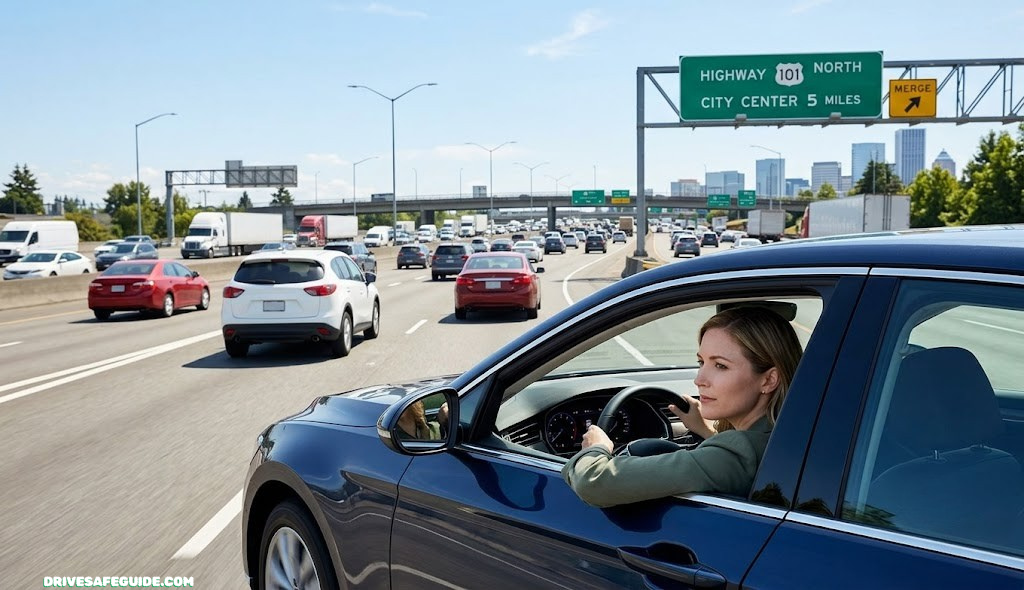
There’s a particular kind of dread that creeps in as the on-ramp narrows and the highway traffic roars past at seventy miles an hour. Your hands tighten on the wheel. Your eyes dart between the mirror, the blind spot, and the merging lane that seems to be disappearing faster than you’d like. If this sounds familiar, you’re not alone — highway merging anxiety is one of the most commonly reported driving fears, cutting across age groups, experience levels, and even decades behind the wheel.
The good news is that merging anxiety isn’t a personality flaw or a sign that you shouldn’t be driving. It’s a predictable response to a genuinely demanding task: judging speed, distance, and timing simultaneously while other drivers make their own unpredictable choices. And like most driving skills, it responds well to the right combination of knowledge, technique, and practice. This guide walks through exactly how to build that confidence, one merge at a time.
Whether you’re a brand-new driver facing highway traffic for the first time, someone returning to regular commuting after years away from it, or simply a driver who’s never quite shaken that flicker of tension on a fast-moving on-ramp, the approach is the same: understand what’s actually happening mechanically and psychologically, practice the specific pieces that give you trouble, and let repeated, low-stress success rebuild your confidence from the ground up.
1. Understanding Highway Merging Anxiety
Merging anxiety typically shows up as a tight chest, sweaty palms, racing thoughts, or a strong urge to slow down right when speeding up is what the situation calls for. It’s the mismatch between what your body wants to do (hesitate, brake, wait for a “perfect” gap) and what the road actually requires (match the flow of traffic and commit to a gap that’s merely good enough) that makes merging uniquely stressful compared to other driving tasks.
Unlike parallel parking or navigating a four-way stop, merging happens at speed, with limited time to reconsider, and with other drivers who are not obligated to make room for you. That combination — high stakes, high speed, low control — is a textbook recipe for anxiety in almost any context, not just driving. Recognizing that your nervous system is reacting rationally to a genuinely demanding task, rather than malfunctioning, is often the first step toward managing it.
It also helps to know how common this is. Driving instructors report that merging and lane changes on high-speed roads are among the top three fears named by both new drivers and drivers returning to the road after a long break. Anxiety here isn’t rare or embarrassing — it’s a predictable response that improves dramatically with the right approach, which is exactly what the rest of this guide focuses on.
If you find that your discomfort extends beyond merging into general unease about driving on highways altogether, it may be worth reading through our deeper look at driving anxiety treatment options, which covers approaches ranging from gradual exposure to professional support.
How Anxiety Shows Up Physically
Before the logical, thinking part of your brain even registers “I need to merge now,” your body has often already started reacting. A faster heartbeat, shallow breathing, and a subtle tightening across the shoulders and forearms are all part of the same stress response that once helped early humans react quickly to physical danger. On the highway, that same response gets triggered by a converging vehicle instead of a predator, and the result is the same: heightened alertness, narrowed focus, and a strong urge to either freeze or overreact.
Recognizing these physical cues for what they are, an old survival mechanism firing in a modern context, can take some of the mystery and self-criticism out of the experience. You’re not uniquely bad at driving. You’re a person whose nervous system is doing exactly what nervous systems are built to do when faced with a fast-moving, high-consequence decision.
The Anticipation Problem
Interestingly, a lot of merging anxiety doesn’t happen during the merge itself; it happens in the minutes leading up to it. Drivers who know a stressful interchange is coming up often report the anxiety building well before they even reach the on-ramp, sometimes reshaping an entire trip to avoid it. This anticipatory anxiety can, over time, become more disruptive than the merge itself, since it colors an entire drive rather than a few brief seconds of it.
Addressing this anticipation directly, through the practice techniques covered later in this guide, tends to produce faster relief than focusing only on the moment of the merge.
2. Why Merging Feels So Overwhelming
Merging asks your brain to do several things at once: track your own speed, estimate the speed of oncoming traffic, judge a closing gap, plan a path into that gap, and execute a steering and throttle adjustment — all within a window that might last three or four seconds. Psychologists call this kind of task “high cognitive load,” and it’s well established that cognitive load is one of the biggest drivers of situational anxiety.
There’s also a visibility problem baked into merging. Your side mirrors show a version of the world with a built-in blind spot, and that blind spot happens to sit exactly where a merging car needs to look. Even confident, experienced drivers occasionally get caught out by a vehicle they simply couldn’t see, and near-misses like that tend to stick in memory far longer than the hundreds of uneventful merges that came before them.
The Role of Past Near-Misses
If you’ve had a scary moment on an on-ramp before — a horn blast, a sudden brake check, or a car appearing seemingly out of nowhere — your brain is likely to flag every future merge as a potential repeat of that event. This is a completely normal learning mechanism, but it can overcorrect, making ordinary merges feel far riskier than they statistically are.
Traffic Unpredictability
Merging lanes are also where driver behavior varies the most. Some drivers move over generously to make room; others hold their lane out of habit, distraction, or simple lack of awareness. That inconsistency removes the sense of a predictable “script,” which is unsettling for anyone who prefers order and clear rules — a preference most drivers share, whether they realize it or not.
Sensory Overload From Speed and Noise
Highway speeds also introduce a sheer sensory intensity that surface streets rarely match. Wind noise, tire noise, the visual blur of the shoulder rushing past, and the sound of engines passing at a closing speed of well over 100 mph combined all compete for your attention at once. For a driver who’s already nervous, this sensory load can feel like static drowning out the calm, methodical thinking that a good merge actually requires.
Reducing unnecessary sensory input, such as turning the radio down or asking passengers to keep conversation to a minimum during the approach to a merge, is a small but genuinely effective way to free up mental bandwidth for the decision itself.
The Comparison Trap
It’s easy to look at drivers merging smoothly and effortlessly around you and assume they don’t feel any of the tension you do. In reality, many experienced drivers still feel a flicker of heightened alertness during difficult merges; they’ve simply built enough repetition that the physical sensation no longer derails their decision-making. The goal isn’t to eliminate all nervous energy, which would be unrealistic and even slightly risky, since a bit of alertness sharpens focus. The goal is to keep that energy from tipping into hesitation or panic.

Close the Blind Spot Gap
A quality set of blind spot mirrors gives you a wider field of view exactly where merging visibility matters most.
Check Price on Amazon3. The Physics of a Safe Merge
Merging is fundamentally a math problem disguised as a driving skill. Two vehicles are converging on the same point in space, and the only variables you actually control are your own speed and your own timing. Once you understand the physics, the anxiety often shrinks, because the situation stops feeling like chaos and starts feeling like a solvable equation.
The single most important number is the speed differential between you and the traffic you’re merging into. If the highway is moving at 65 mph and you enter the merge lane at 45 mph, you’re asking every driver behind you to either brake or swerve to accommodate a 20 mph gap. Matching speed — ideally before you reach the point where the lanes converge — removes almost all of the danger and most of the stress in one move.
| Merge Speed vs. Highway Speed | Relative Risk | Driver Experience |
|---|---|---|
| 10+ mph slower than traffic | High — forces sudden braking behind you | Frequent horn use, tailgating, aborted merges |
| 5 mph slower than traffic | Moderate — small adjustment needed from others | Some hesitation, minor gap-closing needed |
| Matched to traffic speed | Low — smooth integration into flow | Minimal disruption, natural gap acceptance |
| 5+ mph faster than traffic | Low-moderate — requires early lane commitment | Confident merge, but less margin if gap closes |
The second variable is the size of the gap you’re aiming for. A generous rule of thumb is the same three-second following distance you’d use anywhere else on the highway — if you can count “one-one-thousand, two-one-thousand, three-one-thousand” between the car ahead of your intended gap and the car behind it passing the same fixed point, that gap is workable at highway speed. For a deeper breakdown of how following distance protects you in every driving scenario, our guide on the safe following distance rule is worth bookmarking.
Acceleration is the third piece. Most merging anxiety incidents happen because a driver waits too long to accelerate, then tries to make up for lost distance all at once — a jerky, unpredictable motion that other drivers find hard to read. A smoother, earlier acceleration curve communicates your intentions clearly and gives you more usable options if the gap changes size.
Why Ramp Length Matters More Than You Think
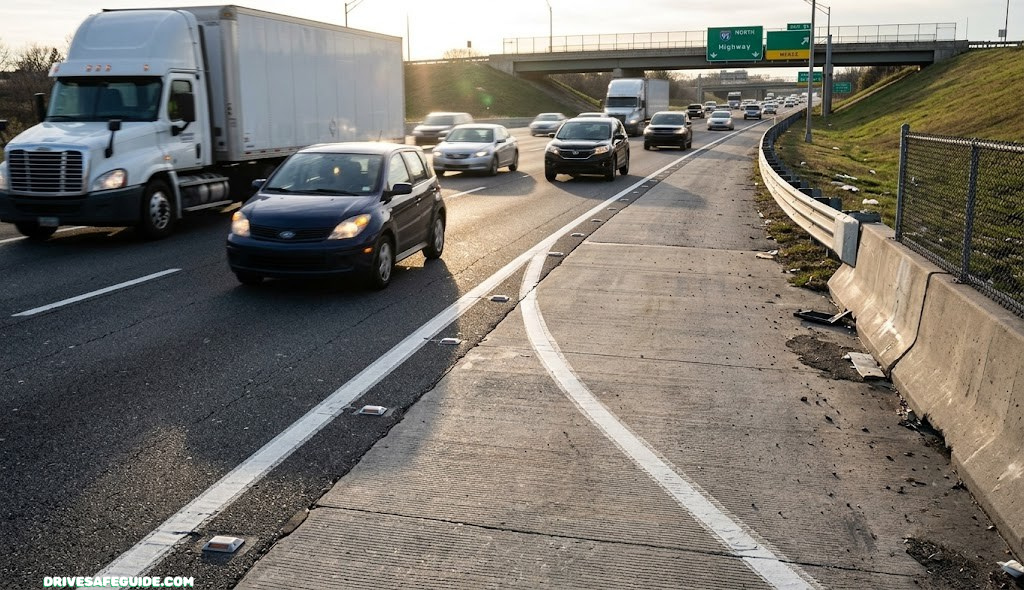
Not all acceleration lanes are created equal. A long, gently curved on-ramp on a newer highway gives you far more room to build speed gradually, while a short, sharply angled ramp on an older interchange might leave you only a few seconds to go from a near-stop to highway speed. If you know a particular interchange has a notoriously short ramp, treating it with extra caution and, when safe, approaching it with slightly more speed already built up before the ramp even begins, can make a meaningful difference.
Some interchanges also feature a “merge lane” that runs parallel to the highway for a short distance rather than angling directly into it. These lanes are more forgiving because they give you a stretch of shared space to fully match speed before an actual lane change is required, rather than needing to accelerate and merge as a single combined motion.
Reading the Traffic Density Ahead of Time
Experienced drivers often glance at traffic conditions before they even reach the highway, using visible congestion, brake lights, or even a quick check of a traffic app to anticipate whether they’ll be merging into free-flowing traffic or a slow-moving queue. This single habit changes your entire strategy: free-flowing traffic calls for the speed-matching approach described above, while a queue calls for patience and a more deliberate, cooperative gap search.
4. Zipper Merge vs. Early Merge: Which Etiquette Actually Works
One surprisingly common source of merging stress isn’t the merge itself — it’s uncertainty about which merging convention is “correct.” Should you merge as early as possible, or use the full length of the lane and merge at the very end? Traffic engineers have studied this extensively, and the answer depends heavily on context.
The “zipper merge,” where drivers use both lanes fully and alternate one-at-a-time at the merge point, is the technique recommended by most state transportation departments for congested or construction-zone merging. It reduces overall backup length and, counterintuitively, tends to feel less stressful once drivers trust that other cars will actually let them in. Our full explainer on zipper merge etiquette covers the do’s and don’ts in more depth.
The “early merge,” where drivers move over as soon as they see a lane-closure sign, works better in free-flowing traffic where there’s no queue to manage, since it avoids the awkward negotiation of finding a gap at the very last moment.
Zipper Merge — Pros
- Shortens overall traffic backup
- Uses full road capacity
- Reduces frustration once normalized
Zipper Merge — Cons
- Feels confrontational to unfamiliar drivers
- Inconsistent adoption causes conflict
- Requires trust that others will let you in
Early Merge — Pros
- Feels more predictable and low-stress
- Works well in light traffic
- No last-second decision-making
Early Merge — Cons
- Wastes lane capacity in heavy traffic
- Lengthens overall backup at bottlenecks
- Can create a long single-file line
The practical takeaway: read the traffic density, not just the signage. In heavy, slow-moving traffic, plan on a zipper merge and expect to take your turn near the lane closure. In light, fast-moving traffic, merge earlier and settle into your lane well before the roads converge.
What to Do When Other Drivers Won’t Cooperate
Not every driver follows either convention consistently, and that inconsistency is often what triggers the most frustration and anxiety. If a driver refuses to let you merge during a zipper sequence, avoid forcing the issue. Slow slightly, signal your intention clearly, and wait for the next vehicle, which is very often more accommodating. A single uncooperative driver is not worth an aggressive maneuver, and our guide on preventing road rage incidents offers additional de-escalation strategies for exactly this kind of moment.
5. Executing a Confident Merge, Step by Step
Confidence on the on-ramp comes from breaking the maneuver into a repeatable sequence rather than treating each merge as a fresh, high-stakes decision. Here’s the sequence experienced drivers use almost automatically.
Step 1: Scan Early
As soon as you’re on the ramp, start watching the highway traffic pattern rather than fixating on the lane markings in front of you. Identify clusters of vehicles and the gaps between them well before you need to commit to one.
Step 2: Match Speed Before the Merge Point
Use the length of the ramp to accelerate to highway speed. Arriving at the merge point already matched to traffic flow eliminates the single biggest cause of merge-related conflict.
Step 3: Signal Early and Consistently
Turn your signal on well before you move, giving surrounding drivers time to process your intention and adjust if they’re willing to.
Step 4: Check Mirrors, Then Check the Blind Spot Directly
Mirrors alone won’t show you everything. A quick glance over your shoulder toward the lane you’re entering confirms what your mirrors can’t.
Step 5: Commit Smoothly
Once you’ve chosen a gap, move into it with a steady, continuous steering input rather than a last-second swerve. A gradual lane change is easier for other drivers to anticipate and react to.
Step 6: Settle Into the Flow
After merging, resist the urge to immediately change lanes again. Give yourself a few seconds to stabilize your speed and re-establish your following distance before making any further moves.
Practicing this sequence out loud — narrating each step to yourself as you drive — is a technique borrowed from pilot training, where checklists reduce the cognitive burden of complex tasks under time pressure. Many nervous drivers find that verbalizing the steps, even quietly, keeps their mind on the process instead of the fear.

Document Every Merge With Confidence
A reliable dash cam provides peace of mind and evidence if another driver makes an unsafe move during a merge.
Check Price on Amazon6. Common Merging Mistakes That Increase Anxiety and Risk
Certain habits show up again and again in anxious mergers, and most of them actually make the maneuver harder, not easier. Recognizing these patterns in your own driving is often enough to start correcting them.
Stopping on the Ramp
Coming to a full stop on an acceleration lane, unless traffic is completely gridlocked, removes your ability to use the lane’s length for building speed and forces an even more difficult merge from a standstill.
Waiting for a “Perfect” Gap
Holding out for a huge, effortless gap often means missing several perfectly safe ones. The three-second rule described earlier is the target — not an enormous, empty stretch of highway.
Merging Without Matching Speed
As covered in the physics section, entering the highway well below the prevailing speed is one of the most common triggers for horn honks and near-misses, which then reinforce the anxiety for next time.
Over-Focusing on the Mirror Instead of the Road Ahead
Checking mirrors is essential, but fixating on them for too long means losing track of what’s happening directly ahead, including brake lights or debris.
Sudden, Sharp Steering Inputs
A jerky lane change reads to other drivers as unpredictable and often triggers defensive braking, which can itself cause a chain reaction. For more on how small habits compound into bigger safety outcomes, see our guide on defensive driving habits that reduce collision risk.
Riding the Brakes Through the Ramp
Some nervous drivers unconsciously ride the brake pedal all the way down the acceleration lane, tapping it lightly even when there’s no obstacle ahead. This habit undercuts the very acceleration the ramp is designed to provide and often results in arriving at the merge point well below highway speed, recreating the exact problem the ramp was meant to solve.
Ignoring the Car Behind You
It’s easy to focus so intently on the highway traffic that you forget another vehicle may be right behind you on the ramp, also trying to merge. Sudden braking in this situation can catch a following driver off guard. A quick mirror check for the vehicle behind you, alongside your highway-focused scanning, rounds out a complete picture of the situation.
These mistakes tend to cluster together — a driver who’s anxious about merging is more likely to hesitate, which leads to a mismatched speed, which leads to a harder gap search, which increases anxiety further. Breaking the cycle at any one point, especially the speed-matching step, tends to unravel the whole chain.
7. Vehicle Tech That Makes Merging Easier
Modern vehicle technology has made meaningful progress on exactly the parts of merging that cause the most anxiety: blind spots and unpredictable closing speeds. None of these tools replace good technique, but they add a genuine safety margin.
Blind Spot Monitoring Systems
These use radar sensors in the rear bumper to detect vehicles in your blind spot and typically illuminate a small warning light in or near the side mirror. Our comparison of blind spot monitoring systems breaks down which setups perform best in real-world merging scenarios.
Convex and Wide-Angle Mirrors
For vehicles without built-in blind spot monitoring, aftermarket convex mirrors mounted to the existing side mirror dramatically widen the field of view. This is especially valuable for larger vehicles; see our guide to blind spot mirrors for trucks and SUVs.
Adaptive Cruise Control
While primarily a highway-cruising feature, adaptive cruise control can help smooth out the speed-matching process right after a merge by automatically maintaining a set following distance once you’re in the flow of traffic.
| Feature | What It Solves | Best For |
|---|---|---|
| Blind spot monitoring | Vehicles hidden from mirror view | Daily commuters, all vehicle sizes |
| Convex mirrors | Narrow factory mirror field of view | Older vehicles, trucks, SUVs |
| Adaptive cruise control | Speed matching after merging | Long highway stretches |
| Rear cross-traffic alerts | Vehicles approaching from an angle | Complex merge/exit combinations |
OBD2 Scanners and Vehicle Health
It’s easy to overlook, but a vehicle that hesitates or lags on acceleration due to an unresolved mechanical issue makes every merge more difficult and more anxiety-inducing than it needs to be. A quick check with an OBD2 scan tool can catch small issues, like a sluggish throttle response or a misfire, before they turn a routine merge into a stressful one.
Don’t Over-Rely on Assistive Technology
It’s worth a note of caution here: blind spot monitoring and similar systems are excellent supplements, but they are not infallible. Sensor coverage can have gaps, and adverse weather can reduce their accuracy. Treat every alert as a helpful second opinion rather than a replacement for your own visual check.

Widen Your Field of View
Stick-on convex mirrors are an affordable upgrade that noticeably reduces blind spot surprises during merges.
Check Price on Amazon8. Building Confidence Off the Highway
You don’t have to face your most stressful merge to start improving. Confidence is built in layers, and the early layers can be practiced somewhere far lower-stakes than rush hour traffic.
Practice on Quiet On-Ramps
Choose a highway on-ramp during a low-traffic time of day, such as mid-morning on a weekend, to practice the full merge sequence without the pressure of dense traffic.
Rehearse the Sequence Mentally
Visualization is a well-documented technique in sports psychology, and it applies just as well to driving. Before you even start the car, mentally walk through scanning, signaling, matching speed, and committing to the gap.
Use Breathing Techniques Before High-Stress Merges
A few slow, deliberate breaths before approaching a known difficult interchange can lower your heart rate enough to keep your decision-making sharp rather than reactive.
Debrief After Each Drive
Rather than replaying a stressful merge with self-criticism, take a moment afterward to note what worked and what you’d adjust next time. This turns each drive into a small, low-pressure learning opportunity instead of a pass/fail test.
If merging anxiety is part of a broader pattern of nervousness behind the wheel, our guide on treating driving anxiety outlines gradual exposure techniques that pair well with the practice approach above.
Build a Gradual Exposure Ladder
Rather than jumping straight into the busiest interchange in your area, build a short list of merges ranked from least to most intimidating. Start with the easiest one and only move to the next rung once the current one feels routine. This step-by-step approach, borrowed directly from exposure-based anxiety treatment, prevents the discouragement that comes from tackling the hardest scenario first.
Ride Along as a Passenger First
If a particular stretch of highway feels especially daunting, riding along as a passenger while someone else drives it can help desensitize you to the visual experience before you take the wheel yourself. Pay attention to how the driver handles the merge, and notice that the traffic pattern is rarely as chaotic as it feels from the driver’s seat.
Track Small Wins
Keeping a simple mental or written log of successful merges, even the small, unremarkable ones, builds a body of evidence that counters the anxious brain’s tendency to remember only the difficult moments. Over weeks, this record becomes a genuinely persuasive argument against the fear.
9. Merging in Difficult Conditions
Everything gets harder when visibility drops, roads are slick, or traffic is unusually heavy. Preparing specifically for these scenarios prevents them from catching you off guard.
Merging at Night
Headlight glare makes it harder to judge the distance and closing speed of oncoming traffic. Slow down slightly earlier than usual and rely more heavily on the shoulder check than on judging headlight distance alone. Our night driving safety checklist covers glare-reduction habits that help here too.
Merging in Rain
Wet roads reduce your available traction for both acceleration and steering, meaning your merge window effectively shrinks. Give yourself a slightly larger gap than you would in dry conditions, and review our guide on rain driving safety at highway speeds before wet-weather trips.
Merging in Construction Zones
Narrow lanes, shifting barriers, and inconsistent driver behavior make construction-zone merges some of the most demanding on the road. Slow down earlier than the posted signage suggests and expect the zipper merge convention to apply.
Merging After Hydroplaning Conditions
If standing water is present, reduced tire contact can make even a routine speed-matching maneuver feel unpredictable. Reviewing hydroplaning recovery steps ahead of time means you won’t be learning them for the first time mid-merge.
Merging With High Winds
Strong crosswinds can push a vehicle, particularly a taller SUV, van, or vehicle towing a trailer, off its intended line right as you’re trying to hold a steady path into a gap. If wind is a factor, grip the wheel a little more firmly, anticipate a slight correction, and give yourself a wider gap than usual. Our guide on driving in high winds without losing control covers the broader technique in more detail.
Merging in Heavy Traffic Congestion
Stop-and-go congestion turns merging into a slower, more negotiated process, often involving eye contact, a wave, or a deliberate gap left by a cooperative driver. In this environment, patience matters more than speed-matching, since the traffic itself is moving well below highway speed limits. Signal early, watch for a driver who slows slightly or leaves visible space, and move over decisively once that space appears.
10. When Anxiety Becomes Something More
For most drivers, merging anxiety fades with practice and eventually becomes background noise rather than a dominant experience. For a smaller group, the fear persists or even grows, sometimes generalizing into a broader avoidance of highways altogether.
Signs that it may be worth seeking additional support include avoiding highway routes entirely even when they’re clearly faster and safer, physical symptoms like a racing heart or shortness of breath that don’t fade after the merge is complete, or a growing reliance on someone else to drive whenever a highway is involved.
None of this is a reflection of your ability as a driver — anxiety disorders related to specific tasks are well recognized and respond well to structured treatment, including cognitive behavioral techniques and gradual, supervised exposure. If any of these signs sound familiar, our resource on driving anxiety treatment is a good starting point, and a conversation with a doctor or therapist experienced in anxiety-related concerns can help determine the right next step.
11. Tools That Support Calmer Merging
Beyond blind spot technology, a handful of practical accessories can reduce the small frictions that add up to a stressful drive.
Polarized Sunglasses
Glare from wet pavement or a low sun can make it genuinely harder to judge the position of nearby vehicles. A good pair of polarized driving sunglasses removes one more variable from an already busy moment.
Wide-Coverage Dash Cams
Beyond documentation, many drivers report that simply knowing a dash cam is recording reduces their own stress, since it removes the “he said, she said” anxiety around any close call.
Comfortable Seating and Posture Support
Physical tension compounds mental tension. A supportive cushion or improved seating posture can reduce the fatigue that often makes anxious moments feel worse later in a long drive.
| Accessory | Primary Benefit | Impact on Merging |
|---|---|---|
| Polarized sunglasses | Reduced glare | Clearer view of gap and closing speed |
| Blind spot mirrors | Wider field of view | Fewer visibility-related surprises |
| Dash cam | Documentation and peace of mind | Lower stress about disputed incidents |
| Lumbar/seat cushion | Reduced physical fatigue | Sharper focus during demanding merges |
Steering Wheel Covers for Grip Confidence
A worn, slick steering wheel can quietly undermine confidence during a firm, decisive merge, especially in sweaty palms brought on by nervous energy. An easy-install, non-slip steering wheel cover is a small upgrade that keeps your grip steady exactly when you need it most.
Keeping the Cabin Free of Distraction
A cluttered interior, loose items rolling around, or a phone mount blocking part of your view all add small amounts of friction to an already demanding moment. A quick pass with a car vacuum and a properly positioned phone mount go a surprisingly long way toward a calmer cabin environment.

Cut the Glare Before It Cuts Your Reaction Time
Polarized lenses make it easier to judge gaps and closing traffic in bright or wet conditions.
Check Price on Amazon12. Teaching Teens and Nervous Passengers to Merge Safely
If you’re coaching a new driver — whether a teenager or an adult returning to the road — merging deserves more dedicated practice time than almost any other skill. It’s also one of the easiest skills to teach badly, since a nervous instructor can unintentionally transfer their own tension to the new driver.
Start With Narration, Not Correction
Rather than pointing out mistakes in the moment, have the new driver narrate their own scanning and decision process out loud. This builds the habit of conscious observation before it becomes automatic.
Choose Low-Traffic Practice Windows
Just as with adult confidence-building, early practice sessions should happen when traffic is light, giving the new driver room to make small mistakes without serious consequences.
Reinforce Speed-Matching Above All Else
If a new driver internalizes only one lesson from this entire guide, matching highway speed before merging is the one most likely to prevent a serious incident.
For a broader curriculum beyond merging, our guide for parents teaching teen drivers covers a full progression of skills, and our comparison of online drivers ed programs can help if formal instruction is part of the plan. Practice questions from our permit test practice questions resource also reinforce the rules governing right-of-way during merges.
13. Recognizing Different Interchange Designs
Not every merge follows the same layout, and part of building lasting confidence is learning to recognize a handful of common interchange designs before you’re already committed to navigating one.
The Standard On-Ramp Merge
The most common design, a single acceleration lane joining a straight highway segment, is also the most forgiving, since it usually offers a reasonably long, straight stretch to build speed and observe traffic before committing.
The Cloverleaf Interchange
Cloverleaf interchanges route entering and exiting traffic through tight, looping ramps that place merging and exiting vehicles in close proximity, sometimes within the same short “weave” section. These require extra vigilance, since a car merging onto the highway and another car exiting a few hundred feet later are both maneuvering through the same stretch of road simultaneously.
The Left-Hand Merge
Less common but disproportionately stressful, a small number of highways merge traffic in from the left rather than the right, meaning traffic already on the highway needs to check its opposite mirror and blind spot. If you know a route includes a left-hand merge, a quick mental reminder to check the correct side beforehand goes a long way.
Double and Triple Lane Merges
Some larger interchanges merge two or even three lanes of traffic into a single continuing highway section nearly simultaneously. These require reading not just the gap directly beside you but the broader pattern of multiple merging streams, and they typically call for a more patient, zipper-style approach regardless of overall traffic volume.
Familiarizing yourself with the specific interchange types you drive through regularly, even by looking at a satellite map view ahead of time, removes a layer of uncertainty and lets you plan your scanning strategy before you’re already accelerating down the ramp.
Merging With Confidence Starts With One Good Habit
Highway merging anxiety loses most of its power once you understand the mechanics behind it: match your speed, find a workable gap, commit smoothly, and let the rest follow. Every confident merge you complete becomes evidence for your own brain that the next one will go just as well.
Progress here is rarely a straight line. Some days the merge will feel effortless; other days, especially in unfamiliar traffic or tough weather, the old tension might resurface. That’s a normal part of building any driving skill, not a sign you’ve lost ground. Stay patient with yourself, lean on the techniques in this guide, and give each drive a chance to reinforce the habits that make merging feel routine rather than daunting.
Explore more of our driver confidence and safety resources to keep building on what you’ve learned here.
Browse Defensive Driving TipsFrequently Asked Questions
Is highway merging anxiety common?
Yes. Merging and highway lane changes are consistently among the top driving fears reported by both new and experienced drivers, largely because they combine high speed, limited time, and unpredictable traffic behavior.
What is the safest speed to merge onto a highway?
The safest approach is to match the prevailing speed of highway traffic before you reach the point where the lanes converge, rather than merging at a slower speed and forcing other drivers to adjust.
Should I stop if I can’t find a gap to merge?
Stopping on an acceleration lane should be a last resort, since it removes your ability to build speed and makes the eventual merge more difficult. It’s almost always safer to continue at a manageable speed while scanning for the next available gap.
What’s the difference between a zipper merge and an early merge?
A zipper merge uses both lanes fully until the very end, with drivers alternating one at a time, while an early merge involves moving into the continuing lane well before the merge point. Zipper merging works better in heavy, slow traffic, while early merging tends to feel calmer in lighter traffic.
How do I check my blind spot safely while merging?
A brief glance over your shoulder toward the lane you intend to enter, in addition to your mirrors, is the most reliable way to confirm the space is clear before committing to the lane change.
Can technology like blind spot monitoring eliminate merging risk?
Blind spot monitoring meaningfully reduces risk by flagging vehicles you might otherwise miss, but it works best as a supplement to good scanning habits rather than a replacement for them.
Why does merging feel harder at night or in rain?
Reduced visibility and traction narrow your margin for error, making it harder to judge distances and closing speeds accurately, which is why slightly larger gaps and earlier speed adjustments are recommended in those conditions.
Is it normal to feel anxious about merging even after years of driving?
Yes. Merging anxiety can persist or resurface at any experience level, particularly after a stressful near-miss, a long break from highway driving, or a move to an unfamiliar road layout.
How can I help a nervous new driver practice merging?
Choose low-traffic practice windows, encourage the driver to narrate their scanning and decision process out loud, and emphasize speed-matching as the single most important habit to build first.
When should I consider professional help for driving anxiety?
If you find yourself avoiding highways entirely, experiencing physical symptoms that persist well after the drive ends, or relying heavily on others to avoid highway driving, it may be worth speaking with a doctor or therapist about structured anxiety treatment approaches.
What should I do if another driver won’t let me merge?
Stay calm, avoid sudden or aggressive maneuvers, and look for the next available gap rather than forcing your way in. Reacting with frustration can escalate the situation; our guide on preventing road rage incidents covers de-escalation strategies for exactly this scenario.
Does merging anxiety affect roundabouts and other intersections too?
Many of the same skills apply. If merges feel challenging, roundabouts often trigger similar hesitation; our roundabout navigation rules guide walks through a comparable gap-judgment process at lower speeds.