
Mastering Roundabout Navigation Rules for Safer Driving
Right-of-way, lane choice, signaling, and the small habits that separate confident roundabout drivers from the ones stuck in the outside lane, gripping the wheel.
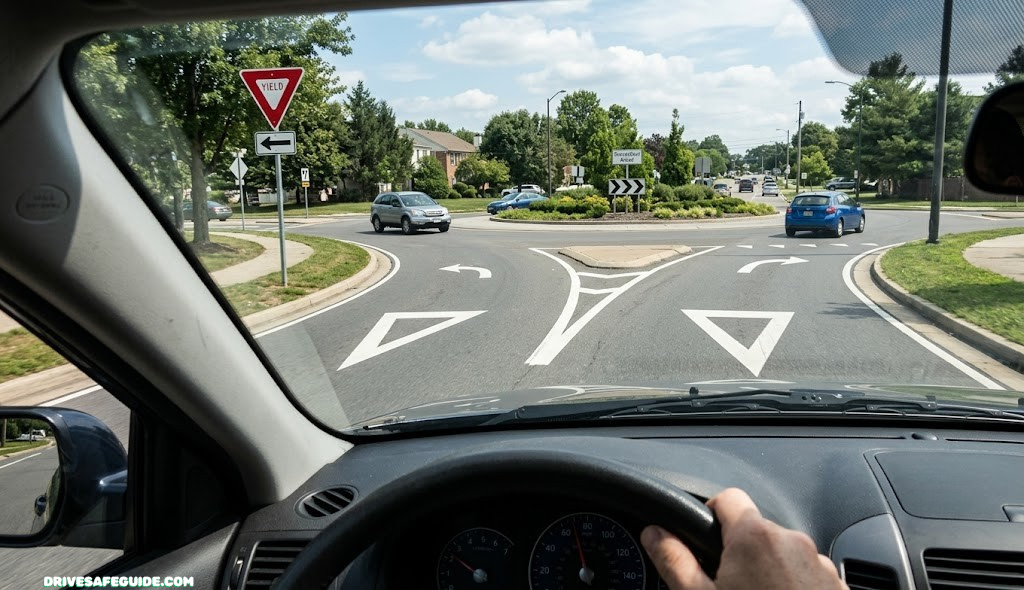
Roundabouts move more traffic with fewer serious crashes than traditional intersections — but only when drivers actually know the rules.
Roundabouts have a reputation problem. Engineers love them because they cut serious injury crashes at intersections by a wide margin, yet plenty of drivers still tense up the moment they see the circular yield sign ahead. The truth is that roundabout navigation isn’t complicated once you understand a handful of rules — who yields, which lane to pick, and when to signal. This guide breaks down every one of those rules in plain language, covers single-lane and multi-lane roundabouts separately, and walks through what to do when a truck, cyclist, or emergency vehicle enters the mix. Pair this with our defensive driving habits guide and you’ll have a well-rounded foundation for handling almost any intersection you meet.
Why Roundabouts Exist — And Why They’re Safer
Before diving into the rules, it helps to understand the logic behind the design. A traditional four-way intersection has roughly thirty-two potential points where vehicle paths can cross, merge, or diverge. Many of those crossing points involve two cars moving directly at each other from perpendicular directions, which is exactly the setup that produces T-bone and head-on collisions — the crash types most likely to cause serious injury or death. A roundabout eliminates almost all of those direct crossing conflicts by forcing every vehicle to travel in the same counterclockwise direction (in right-hand-drive countries like the US) around a central island.
What’s left are merging conflicts, not crossing conflicts. Cars entering and exiting a roundabout do so at shallow angles, which naturally slows traffic and turns any collision that does occur into a low-speed sideswipe rather than a high-speed broadside impact. Transportation researchers have consistently found that converting a stop-controlled or signalized intersection into a roundabout reduces injury crashes substantially and virtually eliminates fatal crashes at that location. That’s the entire point of this design, and it’s also why more cities keep adding them every year.
There’s a secondary benefit too: roundabouts keep traffic moving. Because there’s no red light to wait through, a roundabout with light-to-moderate traffic often clears vehicles faster than a signalized intersection, which cuts down on idling, fuel use, and the kind of impatience that leads to road rage incidents at busy corners.
A Brief History of the Modern Roundabout
Circular intersections aren’t new — traffic circles date back over a century, with some of the earliest examples built around monuments and plazas long before anyone thought about crash statistics. What changed everything was a redesign pioneered in the United Kingdom during the 1960s: instead of letting entering traffic merge in on equal footing with circulating traffic, engineers flipped the priority so that vehicles already inside the circle always had the right-of-way. That single change is what turned a chaotic, often gridlocked traffic circle into the smooth, self-regulating modern roundabout used around the world today.
The United States was slower to adopt the design, largely because early American traffic circles from the mid-20th century had earned a poor reputation — they were often oversized, high-speed, and built without the yield-on-entry rule, which made them genuinely more dangerous than a standard intersection. It wasn’t until the 1990s that U.S. transportation departments began building true modern roundabouts based on the improved UK model, and the safety data from those early installations was compelling enough that adoption accelerated quickly. Today thousands of modern roundabouts operate across the country, from small residential neighborhoods to major interstate interchanges.
Understanding this history matters practically, not just academically: if you’re driving through an older traffic circle built decades ago, especially in parts of New England or the mid-Atlantic, don’t assume it follows the same yield-on-entry logic as a newer roundabout. Some genuinely operate under different, older rules — a distinction covered in more detail later in this guide.
The Numbers Behind the Safety Claims
It’s easy to say roundabouts are safer without backing it up, so it’s worth being specific about what “safer” actually means in this context. Studies conducted by transportation safety researchers on intersections converted from traffic signals or stop signs to roundabouts have found consistent, substantial reductions in the crash types that cause serious injury — right-angle and left-turn collisions in particular, which are the crash types most associated with the crossing conflicts a roundabout eliminates. Total crash counts sometimes shift only modestly, because roundabouts do introduce their own minor sideswipe and rear-end fender-benders during the merge, but the severity of those incidents is dramatically lower. A low-speed sideswipe at 15 mph produces very different outcomes than a T-bone collision at 40 mph through a red light.
This severity reduction is the entire reason city planners keep choosing roundabouts for intersections with a history of serious crashes, even in places where residents initially resist the change. Once a roundabout has been in place for a year or two, community opposition typically fades as drivers get comfortable with the new pattern and notice the reduced wait times.

See What’s Beside You Before You Commit to a Lane
A wide-angle blind spot mirror makes multi-lane roundabout merges far less stressful — glance, confirm, go.
Check Price on AmazonThe Core Right-of-Way Rule Everyone Needs to Know
If you remember only one rule from this entire guide, make it this one: traffic already inside the roundabout always has the right-of-way over traffic trying to enter it. Every vehicle approaching a roundabout must yield to circulating traffic coming from the left (in right-hand-drive countries) before entering the circle. There is no “first come, first served” the way there sometimes is at an all-way stop — the circle always wins.
This single rule is what makes roundabouts function without traffic lights. You’re not negotiating with the driver across from you or trying to make eye contact to figure out whose turn it is. You’re simply checking one direction — to your left — and waiting for a safe gap. Once you’re circulating, everyone approaching the entrances you pass owes you the right-of-way, not the other way around.
Compare this to a standard safe following distance rule scenario at a normal intersection, where you’re managing space in front of and behind you. In a roundabout, your main spatial awareness shifts to your left shoulder and mirror — that’s where the traffic that can conflict with you is coming from.
Approaching a Roundabout: Speed, Signage, and Lane Selection
Good roundabout driving starts well before you reach the yield line. Most roundabouts are preceded by an advance warning sign showing the circular arrow layout, sometimes with a recommended speed placard beneath it. That recommended speed — often somewhere between 15 and 25 mph depending on the roundabout’s diameter — isn’t a suggestion to ignore. It reflects the geometry engineers built in specifically to slow traffic down safely.
Step 1: Slow Down Gradually
Begin braking as soon as you see the advance warning sign, not at the yield line. Slamming the brakes at the last second is one of the most common causes of rear-end collisions at roundabout approaches, since the driver behind you may not expect a sudden stop.
Step 2: Identify Your Exit Before You Choose a Lane
If it’s a multi-lane roundabout, figure out which exit you need before you commit to the left or right lane. Overhead or ground-level pavement arrows will usually tell you which lane serves which exits — treat these the same way you’d treat lane markings on a highway approaching a complex highway merge.
Step 3: Check Left, Find Your Gap, Enter Smoothly
At the yield line, look left for circulating traffic. You don’t need a completely empty circle — you need a gap large enough to merge into at roundabout speed without forcing anyone already in the circle to brake. Enter with a smooth, confident acceleration rather than creeping in.
Single-Lane Roundabouts: The Simplest Case
Single-lane roundabouts are the most common type in residential neighborhoods and smaller towns, and they’re genuinely simple once you’ve done one. There’s only one lane circulating and one lane approaching from each direction, so the only decision you’re making is when to enter and when to exit — there’s no lane choice to worry about.
| Situation | What To Do |
|---|---|
| Approaching with no traffic in the circle | Slow to the posted speed, check left, proceed without stopping |
| Traffic already circulating | Yield at the line until you see a safe gap |
| Taking the first exit (right turn equivalent) | No left turn signal needed on entry; signal right just before your exit |
| Taking the exit straight across (through movement) | No signal needed on entry; signal right just before your exit |
| Taking the far exit (left turn equivalent) | No signal needed on entry; signal right just before your exit, same as any other exit |
Notice the pattern: in a single-lane roundabout, you never use your left turn signal, regardless of which exit you’re taking. You’re always turning right relative to the circle when you exit, so your right signal is the only one that matters, and it only needs to go on once you’re approaching your exit — not while you’re still circulating toward it.
Multi-Lane Roundabouts: Choosing the Correct Lane
This is where most driver confusion happens, and it’s worth slowing down to get right. Multi-lane roundabouts typically have two circulating lanes — sometimes three at very large interchanges — and picking the wrong one late can force a risky last-second lane change inside the circle, which is exactly the kind of maneuver that causes sideswipe crashes.
The General Rule of Thumb
- Right lane: Use for the first exit (a right turn) or continuing straight through if signage indicates the right lane also serves that exit.
- Left lane: Use for a left turn or for going all the way around back the direction you came from (a U-turn movement).
- Middle lane (three-lane roundabouts): Typically serves the through movement, but always confirm with pavement markings — this varies by intersection.
Because these assignments can shift based on local geometry, the single most reliable method is reading the pavement arrows and any overhead signage as you approach, the same way you’d read lane-use signs before a complicated freeway split. Don’t guess based on habit from a different roundabout you’ve driven before — every one is engineered slightly differently.
Once inside, stay in your lane for the entire circulation unless pavement markings explicitly show a lane transitioning toward your exit. Changing lanes mid-circle is legal in some jurisdictions if done with a clear signal and gap, but it’s generally discouraged — the safer approach is choosing the correct lane before you ever enter.
Three-Lane and Turbo Roundabouts
Larger interchanges sometimes use three circulating lanes, occasionally arranged as a “turbo roundabout,” where raised lane dividers physically prevent lane changes once you’re inside the circle. These are more common at former highway interchanges being converted away from traditional cloverleaf designs, and they demand even more careful lane selection before entry, since there’s no opportunity to correct a mistake once you’ve committed to a lane. Turbo roundabouts use spiral-shaped lane markings that guide you naturally toward your exit as you circulate, which actually makes them easier to navigate correctly than a standard multi-lane roundabout once you understand the visual pattern — the raised dividers simply won’t let you drift into the wrong lane by accident.
If you encounter a three-lane roundabout without turbo-style dividers, treat lane selection with the same seriousness: the middle lane can sometimes serve either the through movement or an additional turning movement depending on the specific intersection, so pavement arrows are non-negotiable reading material before you commit. Never assume the middle lane behaves the same way from one three-lane roundabout to the next.
What to Do If You End Up in the Wrong Lane
If you realize too late that you’re in the wrong lane for your intended exit, the safest response is almost always to continue circulating in your current lane and simply pass your exit, planning to either take the next one if that works for your route or complete another full loop to reach the correct exit. Forcing a lane change at the last second inside the circle — cutting across another driver’s path to reach an exit — is a leading cause of the sideswipe collisions that do occur in roundabouts. One extra loop costs a few seconds; a forced last-second cut can cost far more.

Record Every Lane Change, Every Time
A reliable dash cam settles disputes instantly if another driver cuts across lanes inside a roundabout.
Check Price on AmazonSignaling Rules Inside the Circle
Signaling in a roundabout follows a consistent logic once you learn it, but it trips up a lot of drivers who are used to signaling on entry to any turn. The rule is: you signal your exit, not your entry.
| Movement | Signal on Entry? | Signal Before Exit? |
|---|---|---|
| First exit (right turn) | No | Right signal, or none needed if already in the right lane the whole way |
| Through / straight movement | No | Right signal just before your exit |
| Left exit / far side | Left signal recommended in some states to show continued circulation | Right signal just before exiting |
| Full loop / U-turn | Left signal to indicate continued travel | Right signal before your final exit |
The reason you always signal right before exiting, regardless of which exit you’re taking, is that the right signal tells drivers waiting to enter behind and beside your position that you’re about to leave the circle and open up space. It’s the same communicative purpose as signaling a lane change — you’re informing nearby drivers of your next move, not describing the turn you made to get where you are.
Roundabouts vs Traditional Four-Way Intersections
It’s worth seeing the two designs side by side, because the differences explain almost every rule covered so far.
| Factor | Roundabout | Four-Way Signal or Stop |
|---|---|---|
| Right-of-way logic | Yield to circulating traffic on entry | Signal phase or stop-order based |
| Typical crash severity | Low — mostly low-speed sideswipes | Higher — includes T-bone and head-on risk |
| Traffic flow during off-peak hours | Continuous, no full stop required | Full stop or wait for green even with no cross traffic |
| Power outage resilience | Fully functional without electricity | Signalized intersections fail without power |
| Learning curve for new drivers | Moderate — requires understanding lane choice | Low — rules are more familiar from driver’s ed |
The resilience point matters more than people realize. During storms or power outages, a signalized intersection becomes an unregulated all-way stop that drivers often handle inconsistently, while a roundabout keeps operating exactly as designed. This is one reason cities in fog-prone or storm-heavy regions increasingly favor roundabouts at key intersections.
Mini-Roundabouts vs Traffic Circles vs Modern Roundabouts
Not every circular intersection follows the same rulebook, and lumping them together is where a lot of driver confusion originates.
Modern Roundabout
Raised central island, deflected entry angles that force slow speeds, yield-on-entry control, and one-way circulation. This is the design covered throughout this guide and the current U.S. engineering standard for new installations.
Old-Style Traffic Circle
Common in older Northeastern U.S. cities, these are often large, fast, and sometimes signal-controlled or merge-based rather than strict yield-on-entry. Rules can vary significantly by state and even by specific circle — always check local signage.
Mini-Roundabout
A smaller version found on lower-speed residential streets, sometimes with a mountable (drivable) central island for trucks and buses. Same yield rules apply, but larger vehicles are permitted to track over the center if needed.
Signalized Rotary
A hybrid where traffic lights control entry into a circular junction. These behave more like a standard signalized intersection layered onto a circular shape, so normal signal rules take priority over roundabout yield rules.
If you’re ever unsure which category you’re dealing with, default to the most cautious behavior: yield to circulating traffic, keep speed low, and watch for supplemental signage that might override the standard yield-on-entry rule.
Special Situations: Trucks, Bicycles, Pedestrians, and Emergency Vehicles
Large Trucks and Buses
Big rigs and buses often need the full width of the roundabout, including the mountable apron around the central island, to complete a turn without their rear wheels cutting the curb. If you’re behind a large vehicle in a roundabout, give it extra space and don’t attempt to pass alongside it inside the circle.
Bicycles
Cyclists have two legal options in most jurisdictions: they can either take the full lane and circulate like a vehicle, following the same yield rules drivers do, or use a designated bike lane or shared-use path around the outer edge if one exists. As a driver, treat a cyclist taking the lane exactly as you would another vehicle — don’t attempt to squeeze past.
Pedestrians
Crosswalks at roundabout entries and exits are typically set back slightly from the yield line. Pedestrians in these crosswalks have the right-of-way, and you must yield to them even while you’re focused on watching for a gap in circulating traffic. This is a common blind spot for drivers who are looking left for cars and forget to check the crosswalk directly in front of them.
Emergency Vehicles
If you hear sirens while approaching or inside a roundabout, do not stop inside the circle. Continue to your nearest exit, then pull over to let the emergency vehicle pass, the same way you would on any other road. Stopping inside the circulating lane creates a hazard for everyone still moving around you.
Motorcycles
Motorcyclists are more vulnerable to the uneven pavement, painted lane lines, and manhole covers that sometimes appear inside a roundabout, all of which can reduce traction for a two-wheeled vehicle far more than for a car. If you’re driving a car and notice a motorcyclist ahead of or beside you in a roundabout, give extra following distance and avoid any sudden lane positioning changes that might surprise them, since they have far less room to absorb an unexpected maneuver.
Vehicles Towing a Trailer
Towing changes a vehicle’s turning radius and stopping distance, both of which matter directly inside a roundabout’s curved path. If you’re towing, take your line through the circle wider and slower than you normally would, and choose your lane in a multi-lane roundabout with extra care, since correcting a trailer’s position mid-turn is far harder than correcting a car alone. Drivers following a vehicle with a trailer should also expect a wider turning arc and give it room accordingly.
Common Roundabout Mistakes — And How to Avoid Them
| Mistake | Why It’s Dangerous | Fix |
|---|---|---|
| Stopping when the circle is clear | Causes unnecessary rear-end collisions | Slow, check left, proceed if the gap is safe |
| Choosing the wrong lane late | Forces a risky last-second lane change inside the circle | Read pavement arrows before reaching the yield line |
| Signaling a left turn on entry for a far exit | Confuses drivers waiting to enter, who may think you’re exiting immediately | Save your signal for just before your actual exit |
| Braking hard at the last second | Increases rear-end crash risk from following traffic | Begin slowing at the advance warning sign |
| Failing to check the crosswalk | Missed pedestrians who legally have right-of-way | Scan both the circulating lane and the crosswalk directly ahead |
| Tailgating the car ahead through the circle | Leaves no room to react if that driver brakes unexpectedly | Maintain a normal following gap even at low roundabout speeds |
Most of these mistakes come down to timing — checking too late, signaling too early, or braking later than you should. Building the habit of scanning well ahead solves nearly all of them, and it’s the same underlying skill covered in our guide to night driving safety and hazard scanning.
Why “Roundabout Freeze” Happens — and How to Break the Habit
Almost every driver who struggles with roundabouts describes the same sensation: a moment of total hesitation right at the yield line, even when the circle is genuinely clear. This freeze usually comes from trying to process too many things at once — checking traffic, remembering the exit, watching for pedestrians, and reading signage all in the same two or three seconds. The fix isn’t confidence alone; it’s breaking the task into the same sequential steps outlined earlier in this guide, so each piece becomes automatic rather than something you’re consciously juggling. Drivers who deliberately practice the “identify exit, choose lane, check left, commit” sequence out loud a few times report the freeze disappearing within just a handful of roundabouts.
It also helps to recognize that a brief pause at the yield line, even when a gap is technically available, isn’t a serious error — it’s simply inefficient. The mistake worth avoiding isn’t hesitation itself, it’s the combination of hesitation and starting to enter anyway, which is what produces the unpredictable half-committed movements that confuse surrounding drivers. If you’re not sure, wait for the next clear gap rather than splitting the difference.

Be Ready for the Unexpected Near Any Intersection
A compact roadside kit keeps reflective triangles, a flashlight, and basic first aid within reach if a low-speed roundabout fender-bender ever happens.
Check Price on AmazonRoundabout Tips for New and Nervous Drivers
If roundabouts still make you anxious, you’re far from alone — plenty of experienced drivers grew up without them and had to learn the rules as adults. A few habits make the learning curve much shorter.
- Practice during low-traffic hours first. Early mornings or quiet weekend afternoons let you get comfortable with the entry and lane-choice decisions without pressure from a line of cars behind you.
- Say the exit out loud before you enter. A simple verbal cue — “first exit, right lane” — helps commit the lane choice to memory before you’re inside the circle making split-second decisions.
- Don’t fixate on the car directly ahead. Watch the traffic flow as a whole, the same broader-awareness habit taught in defensive driving courses.
- If you miss your exit, it’s fine. Simply continue around the circle again rather than making an unsafe last-second cut across lanes.
- Review the layout on a map beforehand if you’re headed to an unfamiliar multi-lane roundabout for an important trip — this is especially useful advice if you’re navigating an unfamiliar route like the ones covered in our Oahu driving itinerary guide.
New drivers preparing for a licensing exam should also expect roundabout questions to show up in both the written and road test portions in many states — our permit test practice questions guide covers the kind of scenario-based questions examiners tend to ask.
State-by-State and International Variations
While the core yield-on-entry principle is nearly universal across the United States, a few details can vary by state or municipality:
- Some states legally require a signal before every exit; others only recommend it as best practice.
- Older traffic circles in states like Massachusetts, New Jersey, and New York may use merge-based rules rather than strict yield-on-entry — always defer to posted signage over general roundabout habits at these specific locations.
- Mountable center islands for larger vehicles are more common in mini-roundabouts found in newer suburban developments.
Internationally, countries that drive on the left — the UK, Australia, Japan, and others — use the mirrored version of every rule in this guide: circulation runs clockwise, and you yield to traffic approaching from your right instead of your left. If you’re renting a car abroad, spend a few minutes mentally rehearsing this mirror-image logic before your first roundabout, the same way you’d prepare for any unfamiliar driving law covered in our international driving permit requirements guide.
Regional Density and Design Differences Within the U.S.
Beyond the legal quirks already mentioned, the sheer number and design style of roundabouts varies enormously by region. States like Michigan, Colorado, Washington, and Florida have invested heavily in modern roundabout construction over the past two decades and have correspondingly high driver familiarity — locals in these areas often navigate multi-lane roundabouts with barely a second thought. In regions where roundabouts remain relatively rare, drivers may encounter one only occasionally, which is exactly the situation where reviewing rules like the ones in this guide pays off most, since the skill hasn’t had the chance to become automatic through repetition.
Rural roundabouts also tend to differ meaningfully from urban ones. A rural roundabout built at a former stop-controlled highway intersection is often larger, faster, and designed to handle higher-speed approach traffic, while an urban or neighborhood roundabout is deliberately tight and slow by design. Both follow the same yield-on-entry principle, but the margin for error shrinks as approach speeds increase, which is exactly why advance warning signage and speed reduction matter even more on rural roundabouts than on the small residential ones you might practice on first.

Know Your Exit Before You Arrive
A dedicated GPS unit with lane-guidance graphics can show you exactly which lane a multi-lane roundabout requires, well before you reach it.
Check Price on AmazonRoundabout Driving in Rain, Snow, Fog, and Low Light
Every rule covered so far assumes clear, dry conditions. Weather changes the equation in ways worth planning for specifically, since roundabouts remove the predictability of a traffic light and replace it with judgment calls that get harder when visibility or traction drops.
Rain and Wet Pavement
Wet roads increase stopping distances significantly, which matters most at the yield line, where you may need to brake suddenly if a gap you thought was safe closes faster than expected. Slow down earlier than you would in dry conditions, and increase your following distance once you’re circulating — the same core guidance covered in our rain driving safety guide, which also explains why cruise control should be avoided in these conditions, a rule that applies equally on the approach to any roundabout.
Snow and Ice
A snow-covered or icy roundabout is one of the more demanding situations a driver can face, because the curved path through the circle requires steady, moderate steering input rather than the straight-line braking most winter driving guidance focuses on. Losing traction mid-turn inside a roundabout can send a vehicle toward the central island or into the path of another car. Reduce speed well below the posted limit, avoid sudden steering corrections, and if you feel the vehicle start to slide, ease off the accelerator rather than braking hard. Our winter driving safety guide and black ice survival guide go deeper on recovering from a slide, and the same recovery principles apply if it happens inside a curved roundabout lane rather than a straight road.
Fog and Reduced Visibility
Fog is particularly tricky at roundabouts because you’re relying on being able to see circulating traffic approaching from your left at a glance, and dense fog can hide a car until it’s much closer than it would normally appear. Slow down more than usual, use low-beam headlights and fog lights if equipped, and be prepared to treat the yield line like a full stop if you can’t clearly judge the gap. For more on this, our dedicated fog driving strategies guide covers visibility techniques that apply directly to roundabout approaches.
Night Driving Through Roundabouts
At night, the central island, curbing, and lane markings that guide you through a roundabout during the day can be much harder to pick out, especially at unfamiliar or poorly lit intersections. Reflective signage helps, but don’t rely on it exclusively — slow your approach speed slightly compared to daytime driving and give yourself extra time to identify your lane and exit. Review our full night driving safety checklist for broader guidance on headlight use and glare management that pairs well with this advice.
Roundabout Etiquette: The Unwritten Rules That Keep Traffic Smooth
Beyond the legal right-of-way rules, there’s a layer of informal etiquette that experienced roundabout drivers follow almost without thinking. None of these are enforceable traffic laws, but ignoring them is exactly what causes the hesitation, confusion, and occasional honking that gives roundabouts their bad reputation among new drivers.
- Commit once you’ve found your gap. Hesitating halfway into the circle after you’ve already started to enter is more dangerous than either committing fully or waiting for the next gap. Indecision inside the entry point is one of the most common triggers for minor collisions.
- Don’t camp in the wrong lane “just to be safe.” Sitting in the left lane because you’re unsure of your exit, when you actually need the right lane, forces other drivers to react to your uncertainty. If you’re not sure, take an extra moment before you reach the yield line to read the signage rather than guessing at the last second.
- Leave a reasonable gap for the driver behind you to also merge in. Roundabouts work best as a continuous flow. If you leave a huge gap ahead of you out of over-caution, you can actually stall the flow of traffic trying to enter behind you.
- Resist the urge to wave others through. It feels polite, but hand-waving someone into a roundabout out of turn undermines the yield-on-entry system that makes roundabouts predictable, and it can confuse the driver you’re waving at, since they still owe yield to circulating traffic behind you that you can’t see.
- Keep your speed consistent once circulating. Sudden acceleration or braking inside the circle — outside of a genuine hazard — disrupts the smooth merging pattern that following drivers are relying on.
These habits overlap heavily with general defensive driving habits, and they’re worth practicing deliberately if you drive through the same roundabout regularly on a commute — repetition is what turns these into automatic reflexes rather than conscious decisions.
Frequently Asked Questions About Roundabout Rules
Do I always have to stop at a roundabout?
No. Roundabouts are yield-controlled, not stop-controlled. If the circle is clear, you can proceed at the posted speed without coming to a full stop. You only slow to a stop if circulating traffic doesn’t leave a safe gap.
Which direction do I yield to when entering a roundabout?
In right-hand-drive countries like the United States, you yield to traffic approaching from your left, since that’s the direction circulating traffic comes from before reaching your entry point.
Do I need to signal when entering a roundabout?
Generally no signal is required on entry. The signal that matters is your right turn signal just before you exit, letting other drivers know you’re about to leave the circle.
How do I know which lane to use in a multi-lane roundabout?
Look for pavement arrows and overhead signs before you reach the yield line. As a general rule, the right lane serves the first exit or a through movement, while the left lane serves a left turn or a full loop back the way you came — but always confirm with the specific signage at that intersection.
What happens if I miss my exit in a roundabout?
Simply continue circulating and take the same exit on your next pass around. Don’t attempt a sudden lane change or cut across the circle to correct course — that maneuver is far more dangerous than one extra loop.
Can I change lanes inside a roundabout?
It’s best to avoid it. Choose your lane before entering based on your intended exit. If a lane change becomes unavoidable, only do so where pavement markings clearly permit it, with a clear signal and gap.
Who has the right-of-way — the car entering or the car already circulating?
The car already circulating inside the roundabout always has the right-of-way. Entering traffic must yield until there is a safe gap.
Are roundabouts actually safer than traditional intersections?
Yes. Roundabouts convert most high-speed, right-angle crossing conflicts into low-speed merging conflicts, which substantially reduces the likelihood of severe or fatal crashes compared to signalized or stop-controlled intersections.
What should I do if I hear an emergency vehicle while inside a roundabout?
Do not stop inside the circulating lane. Continue to your nearest exit first, then pull over safely to let the emergency vehicle pass.
Do pedestrians have the right-of-way at a roundabout crosswalk?
Yes. Pedestrians in a marked crosswalk at a roundabout entry or exit have the right-of-way, and drivers must yield to them even while also watching for a gap in circulating traffic.
Why do large trucks sometimes drive over the center of a mini-roundabout?
Many mini-roundabouts include a raised but mountable apron around the central island specifically so longer vehicles like trucks and buses can complete the turn without their rear wheels leaving the roadway.
Is roundabout etiquette tested on driving exams?
In many states, yes. Roundabout right-of-way and lane-choice scenarios commonly appear on both written permit tests and behind-the-wheel road tests, so it’s worth practicing before your exam.
Building Roundabout Confidence Over Time
Like most driving skills, roundabout competence is built through repetition rather than memorization. Reading a guide like this one gives you the rulebook, but the muscle memory that makes roundabouts feel effortless only comes from actually driving through them repeatedly, ideally starting with simpler single-lane examples before working up to busy multi-lane interchanges.
If you’re a parent teaching a teen driver, or a driving instructor building a lesson plan, consider structuring roundabout practice the same way you’d structure any other complex skill: start slow, isolate the decision points, and gradually add complexity. Have the new driver verbalize their exit and lane choice before entering, the same technique suggested earlier for nervous adult drivers. Our guide to parents teaching teen drivers and comparison of online drivers ed programs both cover structured approaches to building confidence behind the wheel that apply directly to roundabout practice sessions.
Older drivers returning to more active driving, or anyone who simply hasn’t driven much since roundabouts became common in their area, may also benefit from a structured refresher rather than relearning informally through trial and error. A short session with a qualified instructor focused specifically on roundabout entries and multi-lane exits can resolve years of low-grade anxiety in a single afternoon — see our senior driver refresher course guide for what these sessions typically cover.
Final Takeaway: Confidence Comes From Repetition
Roundabout navigation isn’t difficult once the core logic clicks: yield to the circle, pick your lane early, and signal your exit rather than your entry. Every rule in this guide flows from those three ideas. The nervousness most drivers feel the first few times fades quickly once you’ve driven through the same roundabout a handful of times and watched the pattern repeat itself predictably.
If you want to keep building a stronger overall safety foundation, our defensive driving habits guide and safe following distance guide are natural next reads, and both apply directly inside a roundabout as well as on the open road.