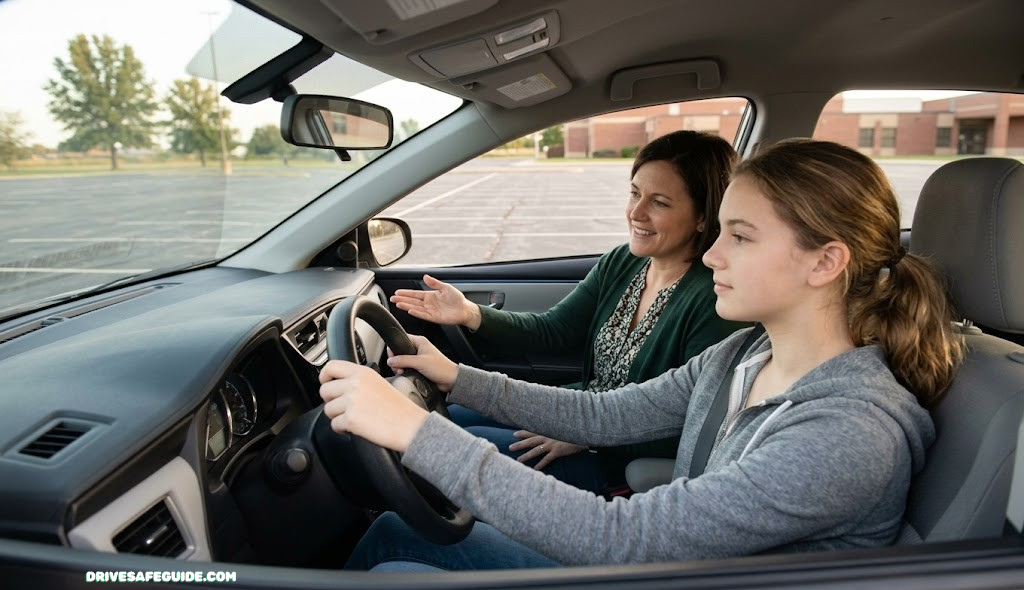
A Parent’s Guide to Teaching Teen Drivers
A mile-by-mile plan for turning permit-holders into confident, low-risk drivers — built around the practice hours, road conditions, and ground rules that actually move the needle.
Handing a teenager the keys is one part milestone, one part negotiation, and one part risk management. The good news: research on Graduated Driver Licensing shows that a structured, patient practice plan changes outcomes. This guide lays out exactly how to run that plan, stage by stage.
Why Parent-Led Teaching Works
Every state now runs some version of a Graduated Driver Licensing program, and the reason is simple: a brand-new driver’s risk is not evenly spread across their first years behind the wheel. It’s concentrated hard into the first few months of solo driving, before judgment has caught up with basic vehicle control. Federal crash data consistently shows drivers aged 16 to 19 involved in fatal crashes at a rate close to three times that of drivers over 20, per mile driven — and the risk is highest specifically in the 16-to-17 window, right when most teens are earning their first license.
That gap doesn’t close with a single driver’s-ed course. It closes with hours. Lots of supervised, varied, deliberately structured hours, with a calm adult in the passenger seat who can narrate hazards the teen hasn’t learned to see yet. States that combine an extended learner’s permit period with nighttime and passenger restrictions — the core pillars of GDL — have documented fatal-crash reductions among 16-year-old drivers as steep as 40 percent. The parent isn’t a backup to that system; the parent supervising practice hours is the system.
It’s worth sitting with that passenger statistic for a moment, because it surprises most parents. A single teenage passenger roughly doubles the risk of a fatal crash for a 16-or-17-year-old driver compared to driving solo — but when an adult aged 35 to 64 is in the vehicle instead, that risk is cut by about half. The car itself hasn’t changed. The behavior around the driver has. That’s the entire logic behind this guide: your presence, structure, and calm coaching in the passenger seat are doing measurable safety work, not just satisfying a permit requirement.
None of this is about frightening a teenager out of driving — independence behind the wheel is a genuinely important developmental milestone, and most new drivers who go through a structured practice plan become perfectly safe, capable drivers. It’s about respecting that the first months carry outsized risk, and building a plan that spends those months in the lowest-risk conditions possible before layering on real-world complexity.
If you decide to share any of these numbers with your teen directly, frame them as context rather than a warning. Most teenagers already sense that new drivers are considered higher-risk; what they usually haven’t heard is the specific, actionable part — that the risk drops sharply with hours logged, and that the practice you’re doing together each week is the exact mechanism closing that gap. Teens tend to respond better to “here’s what actually lowers the odds” than to a lecture about danger in the abstract.
Know Your State’s GDL Rules Before You Start
Before the first parking-lot lesson, spend twenty minutes on your state DMV’s website. Graduated Driver Licensing rules vary meaningfully from state to state — permit age, required supervised hours, nighttime cutoffs, and passenger limits are all locally set — and teaching against the wrong checklist wastes practice time. Nearly every program, though, is built from the same three-stage skeleton.
The variation between states is bigger than most parents expect. Learner’s permit ages range roughly from 14 to 16 depending on where you live, required supervised hours can run anywhere from around 30 to 70, and nighttime restrictions might kick in as early as 9 p.m. or as late as midnight. None of these numbers transfer from a friend’s state or a forum post — write down your own state’s exact figures on the same sheet you’re using to log hours, so there’s no ambiguity later about whether your teen has actually met the requirement.
| Stage | Typical Focus | Common Restrictions |
|---|---|---|
| Learner’s Permit | 100% supervised driving with a licensed adult; building fundamental control and hazard awareness | Adult must occupy the front passenger seat at all times; often a minimum holding period before the road test |
| Intermediate / Provisional License | Solo driving allowed, but in a narrower risk window while judgment is still developing | Nighttime driving cutoff (often mid-evening); limits on non-family teen passengers |
| Full License | Unrestricted driving privileges | Granted after a clean record through the intermediate stage, usually at a set age |
Three provisions inside that structure matter more than the rest: how long the learner’s permit stage has to last, how many supervised hours are logged (many states expect somewhere in the neighborhood of 50, with a meaningful chunk after dark), and how tightly the intermediate stage restricts passengers and night driving. If your teen’s home state allows it, request the printable logging sheet from the DMV rather than relying on memory — a paper or app-based hour log also becomes a built-in progress tracker for this whole plan. For the specifics on what’s restricted and for how long where you live, see our full breakdown of graduated licensing restrictions by state.
One more thing worth deciding early: whether to pair parent-led practice with a formal driver’s education course. They’re not competing approaches — they cover different ground. A classroom or online course is efficient at transferring rules-of-the-road knowledge and hazard-perception training; it is not a substitute for the sheer volume of supervised seat time a parent provides. If you’re weighing options, our comparison of online driver’s ed programs breaks down what each format actually covers.
Setting Up Before Lesson One
A few decisions made before your teen ever turns the key will save you both a lot of friction later. First: pick the vehicle deliberately. A smaller, simpler car with good visibility and modern (but not overwhelming) safety features is easier to learn in than a large SUV or a high-horsepower vehicle. If you have a choice between two family cars, hand the keys to whichever one has the smallest blind spots and the most forgiving turning radius.
Second: call your insurance agent before the permit even arrives. Ask specifically how a learner’s permit affects your policy, what changes at licensing, and whether a driver-monitoring or good-student discount applies. Handling this early avoids an awkward surprise later and gives you a natural, low-pressure moment to explain to your teen that driving carries real financial stakes, not just personal ones.
Parent-Taught vs. Professional Driving School
Parent-Led Practice — Strengths
- Unlimited, flexible scheduling around real family routes and errands
- Builds trust and communication that carries past the permit stage
- Free, and lets you tailor practice to your teen’s specific weak spots
Parent-Led Practice — Watch-Outs
- No dual brake pedal — you’re coaching, not controlling the car
- Emotions between parent and teen can spike under stress
- Easy to unintentionally pass down your own bad habits
Most families get the best result by blending the two: a short professional course to build foundational skills and correct a parent’s own bad habits before they transfer, followed by months of parent-supervised hours to build the volume that actually reduces crash risk. Neither one alone typically delivers both pieces.
It also helps to sketch out a rough family driving agreement before the permit stage even ends, rather than negotiating every rule reactively once your teen is licensed. Cover the basics early: which vehicle they’ll typically drive, how gas and maintenance costs will be split if at all, what happens after a ticket or a fender-bender, and how privileges expand as a track record builds. Having this conversation calmly in advance, separate from any single incident, tends to produce a fairer and more durable set of rules than one drafted in the heat of a disagreement later.

A dual-facing dash cam lets you review tricky moments together after the drive — a calmer way to coach than correcting in the moment.
Shop Dash Cams on AmazonA Week-by-Week Practice Plan
Structure beats improvisation. Teens who practice the same easy loop every week plateau fast; teens whose parents throw them into complex traffic too early get overwhelmed and defensive. The plan below spreads roughly 50 supervised hours — a common state benchmark — across four phases, each one layering in more difficulty once the previous skills are automatic rather than effortful.
Two scheduling habits make this plan work in practice. First, short and frequent beats long and rare — three twenty-five-minute sessions a week build skill faster than one exhausting ninety-minute marathon, because fatigue erodes focus for a new driver much faster than it does for an experienced one. Second, treat the phase boundaries as flexible, not fixed by the calendar. A teen who’s still tense on tight turns at the end of week two simply needs another week of parking-lot practice before moving on — the timeline below is a default pace, not a deadline to hit regardless of readiness.
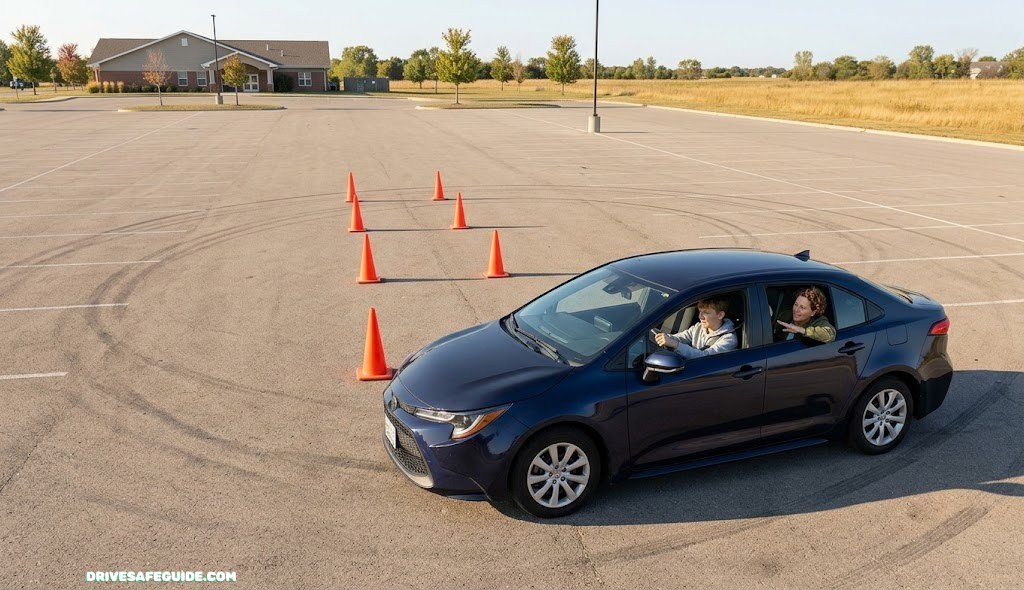
Weeks 1–2 — Parking lot control. No traffic, no pressure. This phase is entirely about the physical relationship between your teen and the car: steering input, smooth braking, mirror checks, and starting to build a hill start without rollback if your area has any grade at all. Ten to twelve short sessions here, twenty to thirty minutes each, build muscle memory faster than a few long ones.
Weeks 3–6 — Neighborhood and local roads. Quiet residential streets, four-way stops, and low-speed turns. This is where scanning habits get built — teaching your teen to look through an intersection before entering it, not just at the car in front of them.
Weeks 7–11 — Highway, weather, and night driving. Once local-road driving looks automatic rather than effortful, layer in merging, higher speeds, one supervised session in light rain, and short night drives on familiar roads.
Weeks 12 and on — Road-test polish. Parallel parking, three-point turns, and mock-test runs on routes similar to what the DMV actually uses in your area.
Parking-Lot Fundamentals, Done Properly
It’s tempting to treat the empty-lot phase as a formality on the way to “real” driving. Resist that. Almost every bad habit that shows up later — riding the brake, cutting corners too tight, forgetting mirror checks — traces back to a rushed foundational phase. Slow down here and you’ll move faster later.
Start with the seat and mirrors, every single session, no exceptions. Making mirror and seat adjustment an automatic pre-drive ritual now means your teen will still be doing it as a twenty-five-year-old, long after you’re out of the passenger seat. From there, work through a simple sequence: straight-line acceleration and smooth braking, then wide gentle turns, then tighter turns, then reversing in a straight line, then backing around a corner.
Reversing deserves more time than most parents give it. New drivers tend to either over-rely on the backup camera or ignore it entirely, and both habits cause problems later. Teach your teen to use the camera as one input alongside a physical head turn and mirror check — not a replacement for either — and practice backing in a straight line before ever attempting to back around a corner or into a space.
The skills that deserve extra repetition
- Smooth braking. Have your teen practice bringing the car to a stop so gradually that a cup of water on the dash wouldn’t spill. This single habit does more for following-distance safety than any lecture about tailgating.
- Mirror-signal-shoulder-check sequencing. Build the order as a physical habit, not a memorized rule, by having them narrate it out loud every time for the first two weeks.
- Space awareness. Use cones or empty parking spaces to teach your teen exactly how wide their car is — most new drivers badly misjudge this early on.
If your teen’s first car is a manual transmission, this is also the phase to build clutch control without stress. Stalling repeatedly in an empty lot costs nothing; stalling at a busy intersection costs confidence. Our guide to diagnosing and fixing manual stalling habits is worth reading together before that first drive.
Building Confidence on Neighborhood and Local Roads
Once parking-lot control feels boring rather than challenging, it’s time to move to quiet residential streets. The goal of this phase isn’t speed or distance — it’s decision density. Every four-way stop, every unprotected left turn, every pedestrian crossing mid-block is a small decision, and new drivers need hundreds of low-stakes reps making those decisions before they’re ready for higher-speed roads.
Pick a rotating set of three or four local routes rather than the same one every time. Repetition on a single route teaches route memorization, not driving skill — your teen can start “predicting” the road instead of actually reading it. Mix in a school zone, a route with a roundabout, and a stretch with on-street parking so they learn to judge the extra space a parked car requires.
This is also the right stage to introduce right-of-way edge cases most new drivers haven’t internalized — four-way stop order, right-on-red rules, and how roundabouts actually work. A few dedicated sessions on these specifically pay off far more than generic “just drive around” practice. See our breakdowns of roundabout navigation rules and right-on-red variations by state for the details worth quizzing them on.
Watch, too, for the moment your teen starts anticipating instead of reacting — noticing a ball roll into the street before a child follows it, easing off the gas near a driveway with a reversing car. That shift from reactive to anticipatory driving is the single clearest sign they’re ready to move up to the next phase.
Neighborhood streets are also the best place to build pedestrian and cyclist awareness, since that’s where most of it actually happens. Coach your teen to scan sidewalks and driveways proactively rather than only responding to movement directly in their path, to cover the brake near school zones and parks even when nothing is currently crossing, and to give parked bikes and pedestrians real clearance rather than the minimum legal distance. These habits are cheap to build now and expensive to retrofit later.
Leveling Up: Highway and Higher-Speed Driving
Highway driving is where a lot of parents get nervous, understandably — merging into fast traffic is genuinely one of the harder skills to teach. The fix isn’t to avoid it until the last minute; it’s to introduce it in small, controlled doses well before the road test, ideally starting with a short, quiet stretch during low-traffic hours.
Before the first merge, talk through the mechanics on paper: matching speed to traffic flow before entering, using the full length of the on-ramp rather than merging early and slow, and checking the mirror-then-blind-spot sequence rather than relying on mirrors alone. Teens who merge too slowly are actually a more common hazard than teens who merge too fast, because a slow merge forces highway traffic to brake unexpectedly.
| Highway Skill | Why New Drivers Struggle | How to Practice It |
|---|---|---|
| Merging up to speed | Underestimating how much room closing traffic actually needs | Time the merge against a fixed landmark on quiet stretches first |
| Following distance at speed | The 3-second gap feels “too far” until it’s practiced | Count seconds out loud between your car and a fixed point |
| Lane changes | Blind-spot checks get skipped under time pressure | Physical head-turn drilled as a non-negotiable habit |
| Exiting | Braking too late after misjudging exit distance | Practice reading exit signs and mile markers early |
Lane positioning is worth a dedicated conversation too. New drivers often drift toward the edge of their lane nearest a large adjacent vehicle out of instinct, when centering the lane actually maximizes visibility and reaction space on both sides. Once merging and lane changes feel comfortable, introduce cruise control on a long, low-traffic stretch — it’s a genuinely useful tool, but only after your teen has already built a strong instinct for following distance without it, since cruise control can otherwise mask a gap that’s closing too fast.
Following distance deserves its own emphasis — it’s one of the most protective habits a new driver can build, and one of the easiest to under-practice because it doesn’t feel dramatic in the moment. Our guide to the safe following-distance rule gives a simple counting method that works well taught from the passenger seat. For the merge itself specifically, the etiquette details in our zipper-merge etiquette guide and tips for merging anxiety are worth reviewing together before that first on-ramp.

Convex blind-spot mirrors give a new driver an extra visual check while the mirror-and-shoulder-check habit is still forming.
Shop Blind Spot Mirrors on AmazonWeather and Low-Visibility Practice
A teen who has only ever driven in clear daylight on dry roads is, functionally, only half-trained. Weather and darkness change the physics of driving — longer stopping distances, reduced traction, harder-to-read hazards — and those changes need supervised practice just as much as parallel parking does. The catch is that this practice has to happen deliberately, in low-risk doses, not for the first time when your teen is suddenly caught in a storm alone.
Night driving deserves particular attention. Fatal crash rates for teen drivers after dark run roughly three times higher than for adults in their thirties, per mile driven, and a large share of teen crash deaths cluster into the evening and overnight hours on weekends specifically. Start with short, well-lit, familiar routes after dusk, then gradually extend distance and reduce lighting as your teen builds comfort judging distances by headlight alone. Our night driving safety checklist covers headlight use, glare management, and fatigue signs worth reviewing before those first evening sessions.
Rain is the next priority, since it’s the weather condition new drivers encounter most often. Practice a light-rain session on familiar roads, focusing on increased following distance and gentler braking. If it’s available near you, a wet skid-pad or empty lot session teaches controlled skid recovery far more safely than a real road ever could. Our guides on driving safely in heavy rain and recovering from hydroplaning walk through exactly what to coach in the moment.
Depending on your climate, winter conditions and fog each deserve at least one supervised session before your teen faces them solo. Cover the basics of gentle inputs on snow and ice, what black ice looks like and how to react if the rear end starts to slide, and how to adjust speed and following distance when visibility drops in fog. These are covered in more depth in our winter driving safety guide, our black ice survival guide, and our fog driving visibility strategies.
Pair this phase with a quick vehicle-maintenance lesson: how to check wiper condition, top off washer fluid, and use the defrost setting correctly, since a fogged windshield or streaking wipers turn an ordinary rainy drive into a genuinely harder one. A car with fresh wipers and clear glass gives a new driver one less variable to manage while everything else about the weather is already demanding more attention than usual.

Polarized sunglasses cut glare on wet roads and low-sun evening drives — small comfort improvements that keep a new driver relaxed and focused.
Shop Polarized Sunglasses on AmazonThe Distraction Problem: Phones, Passengers, and Fatigue
Vehicle control is only half of what you’re teaching. The other half is attention management, and it’s arguably the harder half, because it’s invisible until it fails. Three factors dominate teen crash risk once basic driving skill is in place: phone use, passenger load, and sleep debt.
Phones
The habit to build isn’t “don’t text and drive” — that’s too abstract to hold up under real pressure. The habit is a pre-drive ritual: phone goes into a bag, glovebox, or dedicated holder, on silent, before the car starts moving, every single time. Make this non-negotiable for yourself too; a teen who watches a parent glance at texts at red lights learns that rule is optional. Our guide on the legal status of distracted driving and headphone use is a useful one to read together, since the rules are less obvious than most families assume.
Passengers
This is the restriction most teens push back on hardest, and the data backs up why it exists: a single teenage passenger measurably raises crash risk for a 16-or-17-year-old driver compared to driving alone, and that risk climbs further with each additional young passenger. Most GDL programs cap non-family passengers during the intermediate license stage for exactly this reason. Hold the line on this one even after the state-mandated restriction technically lifts — extend it informally for another few months if your teen’s driving confidence still feels new.
Fatigue
Drowsy driving gets far less attention than drunk or distracted driving, but it impairs reaction time and judgment in a similar way, and teenagers are chronically under-slept as a group. Set a simple rule: no solo driving on less than a full night’s sleep, no exceptions for “just a quick trip.” If your teen is ever driving back from an event and starts to feel drowsy, the safest move is always to pull over at a rest stop rather than push through — our drowsy driving checklist covers the warning signs worth teaching them to recognize in themselves.
Part of what makes the passenger issue hard to enforce is social, not logical — your teen isn’t unaware of the risk, they’re navigating peer pressure in the moment, and research on teen driving consistently finds that risky driving behavior becomes more likely specifically when other teenagers are in the car. Giving your teen a built-in excuse helps here: “my parents check the mileage log” or “I’m not allowed to yet” is an easier social out than having to personally refuse a friend’s request for a ride.
Preparing for the Road Test
By the final weeks before the test, your teen should be practicing on routes that resemble what the local DMV actually uses — many testing centers run a small rotation of routes, and other parents or local driving schools often know the general pattern. Drive it together several times, but don’t drill it to the point of pure memorization; examiners deliberately vary small details to make sure a candidate is actually reading the road.
Run a mock test with a stopwatch and a clipboard. Score the maneuvers examiners actually grade: full stops (not rolling stops), complete mirror-signal-shoulder-check sequences, smooth parallel parking, a controlled three-point turn, and consistent speed control. Being strict here — more strict than the actual examiner will likely be — builds a safety margin into test day nerves.
What Usually Goes Right
- Vehicle control and basic maneuvers, if practiced consistently
- Following instructions and route navigation
- Mirror checks, once drilled as automatic habit
Common Instant-Fail Mistakes
- Rolling through a stop sign instead of a full stop
- Failing to check blind spots before merging or changing lanes
- Unsafe speed for conditions, in either direction
Our full breakdown of instant-fail road test mistakes is worth reviewing together the week before the test — most of the items on it are habit fixes, not knowledge gaps, and habits are exactly what your practice sessions have been building. If your teen wants extra written-test repetition, our permit test practice questions are a low-stress way to review before the DMV visit.
Nerves on the actual test day are normal, and a small amount of adrenaline usually sharpens focus rather than hurting performance. What does hurt performance is a teen who’s never driven with an unfamiliar adult grading their every move — so if you can arrange it, have your teen do at least one practice session with another trusted adult in the passenger seat instead of you. That single change removes a lot of the test day’s novelty.
Building Your Teen’s First Car Safety Kit
Handing over independence should come with a basic emergency toolkit, both physical and informational. A newly licensed driver is far more likely to encounter a flat tire, a dead battery, or a minor fender-bender in their first year than a serious weather emergency — so the kit should be built around the realistic, everyday version of “something went wrong,” not a worst-case bunker list.
At minimum: a portable jump starter, a properly inflated spare or a tire inflator, a flashlight, a basic first-aid kit, and printed copies of insurance and registration information as a backup to phone storage. Walk through how to actually use each item together before it’s ever needed — a jump starter sitting untouched in a trunk is far less useful than one your teen has practiced connecting once under low-stress conditions.
Beyond the physical kit, run a short “what if” conversation covering the scenarios your teen is actually likely to face: what to do immediately after a fender-bender (move to safety, exchange information, call you before anyone else), what to do if pulled over, and what to do if the car breaks down on a busy road. Rehearsing these calmly in advance means your teen has a script to follow instead of panic to manage in the moment.
Tuck a small information card into the glovebox alongside the physical kit: roadside assistance or towing number, the make and model of the car (surprisingly easy to blank on when stressed), and your own contact information along with one backup adult. It sounds redundant when everything is stored on a phone, but a dead battery has a way of taking the phone’s charge down with it after a long wait for help.

A compact lithium jump starter is one of the highest-value items for a new driver’s trunk — small, safe to use solo, and covers the most common roadside surprise.
Shop Jump Starters on AmazonAfter Licensing: Staying Involved Without Hovering
The license doesn’t mark the finish line — it marks the start of the highest-risk driving period your teen will ever go through. This is exactly the window where independent driving replaces supervised practice, and it’s why extending a few informal rules past the state’s minimum requirements is worth the friction it causes.
Keep a written or verbally agreed “driving contract” for the first several months: passenger limits that may be a bit stricter than the state minimum, a nighttime curfew, and a clear expectation about phone placement before the car starts. Frame it as a graduated trust system rather than a punishment — privileges expand as a track record builds, the same logic the GDL system itself is built on.
Stay engaged without becoming a backseat driver on every trip. Ask about specific situations rather than generic “how was driving today” questions — “did you hit any tricky merges” or “how was the rain on the way home” invites real conversation instead of a one-word answer. And keep modeling good habits yourself; teens notice when a parent’s own following distance, phone habits, or seatbelt use don’t match what was taught.
A few more resources worth bookmarking for this stage: our guide to defensive driving habits that reduce collision risk is a good six-month check-in read, and if driving nerves crop up even after licensing, our piece on managing driving anxiety covers practical, non-alarming approaches. And when the milestone is worth celebrating, our practical graduation gifts for teen drivers list leans useful over novelty — safety gear and car care tools that quietly reinforce the habits you just spent months building.
It’s worth naming the emotional side of this stage too. Loosening a driving contract month by month, watching your teen head out solo for the first time, and eventually stepping back from ride-along check-ins entirely is its own small transition for a parent, separate from the safety planning. That’s a normal part of the process, not a sign anything is going wrong — the goal of every mile in this guide was always to arrive at a driver who no longer needs the passenger seat coach at all.
Frequently Asked Questions
Follow your state’s minimum learner’s permit age rather than a personal preference — most states set it between 14 and 16. Once the permit is issued, the earlier structured practice begins within that legal window, the more supervised hours your teen can bank before the intermediate license stage.
State requirements vary, but many land near 50 total supervised hours, with a meaningful portion after dark. Treat that number as a floor, not a target — more varied practice, spread across conditions and road types, produces a safer new driver than the minimum alone.
They cover different ground. A formal course is efficient for teaching rules-of-the-road knowledge and correcting bad habits before they transfer from a parent. Parent-led practice provides the sheer volume of supervised hours that most reduces crash risk. Most families get the strongest result combining both.
Narrate hazards before they become urgent rather than reacting after the fact, and save any real debrief for after the car is parked. A startled “watch out” teaches a teen to fear your voice more than the road; a calm heads-up teaches anticipation.
A smaller, simpler vehicle with good outward visibility, modern (but not overly complex) driver-assist features, and a forgiving turning radius. Avoid handing a brand-new driver a high-horsepower or oversized vehicle, even if it happens to be the more “convenient” car in the driveway.
Only after local-road driving looks automatic rather than effortful — typically several weeks into supervised practice. Start with a short, quiet stretch during low-traffic hours before attempting a busy merge, and treat the first few sessions as merging practice specifically, not general highway driving.
It’s worth considering. Crash risk for 16-and-17-year-old drivers rises measurably with each additional teen passenger, while an adult passenger tends to lower it. Extending an informal passenger limit for a few months past the legal minimum is a low-cost way to keep that early risk window smaller.
Some nervousness is normal and often fades with calm, repeated exposure to low-stakes practice. If anxiety seems to be interfering with progress rather than easing over several sessions, it’s worth reading more on the topic or discussing it with your teen directly before pushing further practice.
Occasionally, yes — especially for new route types like an unfamiliar highway or a first long drive. The goal isn’t to hover, but to spot-check that supervised habits are holding up once you’re not in the car for every trip.
Run a strict mock test using the same maneuvers examiners actually grade: full stops, complete mirror-signal-shoulder-check sequences, parking, and consistent speed control. If your teen passes your mock test cleanly on more than one attempt, they’re generally ready for the real one.
Rushing the parking-lot and neighborhood phases to get to “real” driving faster. Foundational habits built under low pressure carry forward; habits rushed under real traffic pressure tend to need correcting later, which is harder on both the teen’s confidence and the parent’s nerves.
Often both, though the details vary by insurer. Call your agent when the permit is issued to understand the immediate impact, and ask about good-student or driver-monitoring discounts that can offset the increase once your teen is fully licensed.
The Plan Works — If the Hours Do
There’s no shortcut that replaces structured, supervised seat time. A teen who moves through parking-lot basics, local roads, highway merging, and weather practice in that order — with a calm coach narrating hazards along the way — walks into their road test with real skill, not memorized maneuvers. That skill is what keeps the highest-risk months after licensing as safe as they can realistically be.
Start with Mile 01, log the hours as you go, and revisit this guide at each phase. The version of your teen who passes the road test should be noticeably more capable than the one who sat down for lesson one — that gap is the entire point of the plan.
Build Their First Car Safety Kit →🏆 Recommended Course
Take a Defensive Driving Course Online
Reduce your insurance premium, dismiss a traffic ticket, or simply become a safer driver — all from home, at your own pace.
💻 Start Your Course — From $24.95Affiliate link — we earn a small commission that keeps DriveSafeGuide running. Thank you!