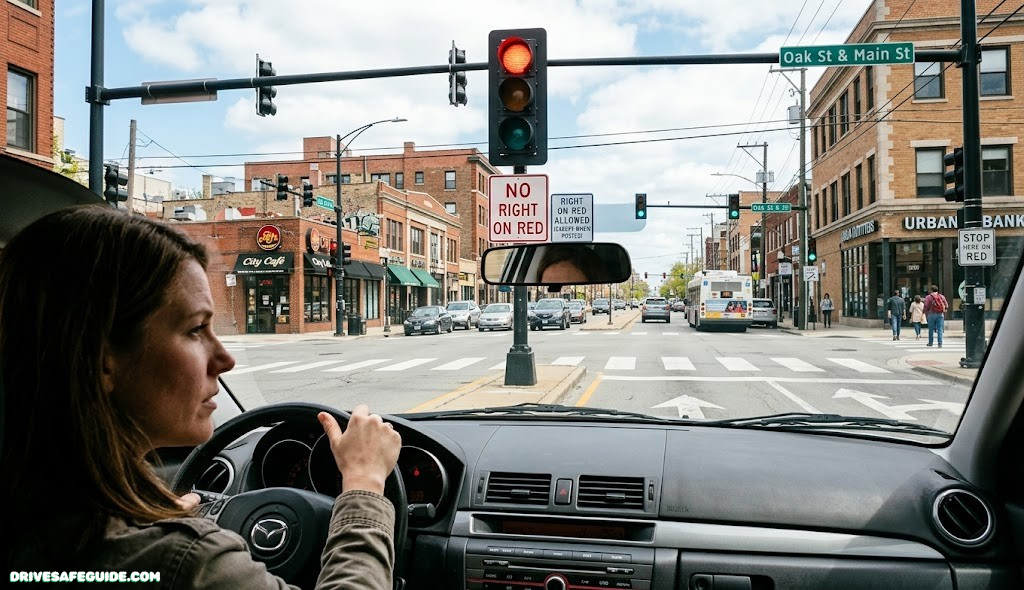
Understanding Right on Red State Variations: A Comprehensive Guide
Right on red feels like second nature almost everywhere in the United States — until you land in a city, a school zone, or an intersection where the rule quietly flips. Here is exactly what changes, where, and how to spot it before you turn.
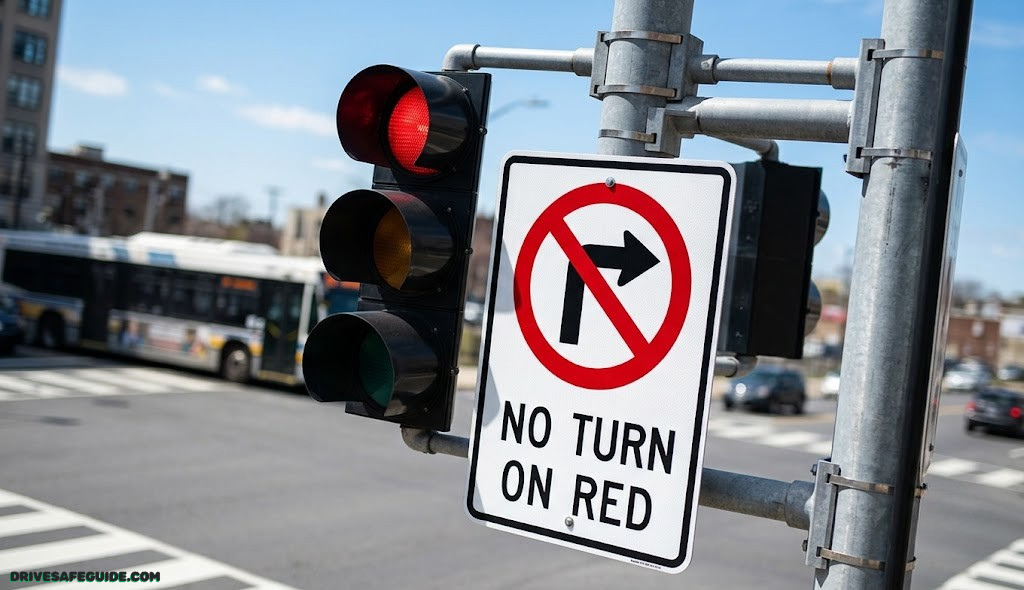
A posted “No Turn on Red” sign always overrides the general state default — no matter what state you’re driving in.
Right on red is one of those driving habits that becomes so automatic it barely registers as a decision anymore. Roll to the line, glance left, ease into the turn if the coast is clear — most American drivers have done this thousands of times without a second thought. But the rule that makes this legal is not actually a single, uniform federal law. It is a patchwork of state statutes, municipal codes, and intersection-specific signage that can flip the default from “generally allowed” to “specifically prohibited” in the space of a single block. This guide walks through exactly how that patchwork works, where it tends to tighten up, and how to read the cues at any intersection so you never guess wrong.
What Right on Red Actually Means
The modern right-on-red rule traces back to the 1970s energy crisis, when federal fuel-conservation policy pushed states to stop requiring vehicles to idle needlessly at red lights when a safe right turn was available. Within a few years, nearly every state had adopted some version of the rule, and it has remained the default baseline of American traffic law ever since. In practical terms, the rule says that after coming to a complete stop at a red signal, a driver may turn right if the way is clear of pedestrians, cyclists, and cross traffic, unless a sign specifically says otherwise.
That last clause — “unless a sign says otherwise” — is where all of the real complexity lives. The default is permissive, but it is a rebuttable default. Any city, county, or state transportation authority can post a “No Turn on Red” sign at a specific corner and instantly override the general rule at that one location, without changing anything about the law anywhere else. This is why two intersections a mile apart, in the same city, can have completely different rules.
It also helps to separate the legal question from the safety question. Just because a turn is legally permitted does not mean it is automatically safe at that moment. A clear legal allowance still requires an actual gap in pedestrian and vehicle traffic, full visibility, and a genuine full stop — not a rolling slowdown that many drivers mistake for compliance. Understanding this distinction matters just as much as knowing where the rule applies, and it connects directly to broader defensive driving habits that reduce collision risk at every kind of intersection, not just signalized ones.
Is Right on Red Legal in Every State?
Broadly, yes — the underlying statute permitting right turns on red after a full stop exists in every state and the District of Columbia in some form. What varies is how aggressively local jurisdictions carve out exceptions, and how often those exceptions show up in dense urban areas versus rural highway corridors. A driver moving through a mix of small towns and major cities on a single road trip can expect to encounter the full range of variation described in this guide, sometimes within the same afternoon.
The table below is a general reference for how the rule tends to be applied across different environments. It is intentionally categorical rather than an exhaustive legal listing, because individual cities and even individual intersections can and do deviate from their state’s typical posture. Always defer to posted signage over any general expectation.
| Environment Type | Typical Default | What to Watch For |
|---|---|---|
| Suburban and rural intersections | Right on red generally allowed | Occasional signs near hospitals, fire stations, or blind curves |
| Mid-size city arterials | Allowed unless posted | Higher density of “No Turn on Red” signs near schools and transit stops |
| Dense urban cores (e.g., core Manhattan) | Prohibited unless posted otherwise | Reverse-default zones where a sign must affirmatively allow the turn |
| School zones during active hours | Often restricted on a schedule | Time-limited signage plates beneath the main sign |
| Construction and detour zones | Temporarily restricted | Orange temporary signage that supersedes the permanent sign |
For travelers planning a multi-state route, it is worth pairing this kind of legal-variation awareness with broader trip preparation. A good starting point is a general road trip essentials checklist, which covers the kind of documentation and vehicle prep that matters regardless of which state’s turning rules you happen to be navigating that day.

Recommended Gear
Keep local traffic-law alerts and lane guidance visible while you drive Check Price on AmazonStates and Regions With Broad Right-on-Red Allowance
Most of the country falls into what can be described as a broad-allowance posture: the state default is permissive, exceptions are handled intersection-by-intersection through signage, and drivers can generally expect the turn to be available at the majority of red lights they encounter. Wisconsin is frequently cited as an example of a state with an especially permissive posture, including allowances for left turns on red from one one-way street onto another one-way street, in addition to the standard right-turn allowance.
This broad-allowance model tends to correlate with lower traffic density, wider intersection geometry, and fewer competing modes of transportation sharing the same corner. In these environments, transportation planners generally view the turn as a low-risk efficiency gain, since sightlines are longer and pedestrian volume is lower than in a dense downtown core.
What “broad allowance” does not mean
It is a mistake to read “broad allowance” as “no restrictions at all.” Even in the most permissive states, individual counties, cities, and even private developments with signalized entrances can and do post restrictive signage. A broad state default simply means restrictive signage will be the exception you specifically watch for, rather than the rule you specifically watch for.
Advantages of Broad Allowance
- Reduced idling time and fuel consumption at low-traffic intersections
- Smoother traffic flow during off-peak hours
- Predictable behavior for drivers unfamiliar with a given town
Trade-Offs to Keep in Mind
- Drivers can develop an autopilot habit that skips the required full stop
- Sightline assumptions can fail at oddly angled corners
- Out-of-state visitors may not scan for the rare restrictive sign
If your driving mostly happens on this kind of open, suburban road network, it is also worth reviewing habits that reduce risk on higher-speed approaches to intersections, such as maintaining a safe following distance so you have time to react if the vehicle ahead brakes unexpectedly at a light you assumed was a free-flowing right turn.
Cities and Zones With Tighter Restrictions
At the opposite end of the spectrum are dense urban cores where the general expectation flips. New York City is the most commonly cited example in the entire country: right on red is prohibited throughout the five boroughs unless a specific sign says it is allowed, which is the reverse of the national default. Washington, D.C. has moved in a similar direction, expanding “No Turn on Red” coverage across a large share of signalized intersections in recent years as part of a broader push to reduce pedestrian conflict points.
Beyond these two frequently cited examples, many other cities apply restrictive signage far more densely in their downtown cores than in outlying neighborhoods, even when the city as a whole technically follows the standard state default. This creates a kind of gradient: permissive on the edges of town, progressively more restricted as you move toward the pedestrian-heavy center.
Why dense cities restrict the turn more heavily
The rationale is almost always pedestrian-safety driven. In a corridor with high foot traffic, a driver’s attention during a right-on-red maneuver is often split between watching for a gap in cross traffic on the left and watching for pedestrians stepping off the curb on the right — precisely the kind of divided attention that safety researchers flag as a crash risk. Removing the option entirely simplifies the decision for the driver and reduces the number of conflict points at the corner.
| City Type | Common Approach | Driver Takeaway |
|---|---|---|
| Historic dense grid (e.g., core Manhattan) | Default prohibited citywide | Look for a sign that affirmatively allows the turn |
| Capital / federal district cores | Expanding restriction zones | Assume restriction near government buildings and transit hubs |
| Mid-size downtown cores | Restriction concentrated near schools, hospitals, transit | Watch for signage clusters near these specific land uses |
Drivers who regularly move between suburban and urban environments in the same week benefit from treating every unfamiliar downtown core as “restricted until proven otherwise,” rather than carrying suburban habits into a dense grid. This mindset pairs well with general urban navigation planning, similar to how you might plan timing and traffic patterns before a dense island or city driving itinerary where local rules differ from what you are used to at home.
How to Read the Signage Correctly
Because the rule is sign-dependent in so many places, the single most valuable skill for navigating right-on-red variation is fast, accurate sign reading. There are a handful of distinct sign types you will encounter, and each carries a slightly different instruction.
The standard prohibition sign
A rectangular white sign with red lettering reading “No Turn on Red,” typically mounted directly on or just beside the signal head, is the most common and most unambiguous version. Where this sign is present, the turn is not allowed at any time unless a supplemental plate says otherwise.
Time-restricted plates
Many jurisdictions attach a smaller plate beneath the main sign specifying hours, such as school-day morning and afternoon windows, or weekday rush-hour periods. Outside those specific windows, the turn typically reverts to the general state default. Reading the small print on these plates carefully is essential, since misreading a time window is one of the more common ways drivers unintentionally commit a violation.
The red arrow versus the red circle
A dedicated red arrow pointing in the direction of your turn is generally a much stricter instruction than a standard red circle. Where a red arrow controls your turn, the safe assumption in almost every state is that no turn is permitted while the arrow is illuminated red, regardless of how clear the intersection appears.
Reading signage quickly and correctly under time pressure is a skill that also matters far beyond right-on-red situations — the same scanning habits help with everything from spotting a windshield obstruction that could trigger a ticket to catching a lane-restriction sign before a merge.

Recommended Gear
Record every intersection in case a right-on-red dispute ever needs proof Check Price on AmazonT-Intersections and One-Way Street Variations
T-intersections introduce their own wrinkle. Because the through street effectively continues in the direction of a right turn at many T-shaped junctions, some states treat this configuration as functionally exempt from the standard stop-and-assess red light rule, on the theory that there is no true “crossing” movement involved. This is not a universal rule, however, and unmarked or oddly angled T-intersections should still be approached with a full stop and full situational scan unless local signage or long-standing local practice clearly indicates otherwise.
Left turns on red from one one-way street to another
A related but distinct allowance exists in many states: turning left on red is permitted specifically when moving from one one-way street onto another one-way street, because the maneuver does not require crossing opposing traffic in the way a standard left turn would. This exception is easy to confuse with the general right-on-red rule but is legally separate, has its own conditions, and is not available in every state.
| Maneuver | General Availability | Primary Condition |
|---|---|---|
| Right on red, standard intersection | Widely available | Full stop, clear intersection, no prohibiting sign |
| Right on red at T-intersection | Often available, state-dependent | Same core conditions, some states treat it as unrestricted |
| Left on red, one-way to one-way | Available in many but not all states | Both streets must be one-way; full stop required |
| Left on red, two-way street involved | Not permitted | Standard red light rules apply fully |
Drivers navigating unfamiliar downtown one-way grids should combine this knowledge with general merging and lane-change confidence strategies, since one-way corridors often require quicker lane decisions immediately after completing a legal turn.
Right on Red With Pedestrians and Cyclists Present
No matter how permissive the underlying state or city rule is, pedestrian and cyclist right-of-way sits above it in every jurisdiction. A technically legal right on red is not legal in the moment if a pedestrian is in the crosswalk, approaching the crosswalk with clear intent to cross, or a cyclist is moving through a marked bike lane that intersects your turning path.
The “look-look-look” habit
Safety instructors commonly teach a three-point visual check before completing the turn: look left for the gap in cross traffic, look right and directly down toward the crosswalk for pedestrians about to step off the curb, and look right again just before committing to the turn to catch anyone who entered the crosswalk in the interim. Skipping the second or third look is one of the most common contributing factors in right-on-red pedestrian incidents.
Cyclists deserve equal weight in this scan, particularly where a protected or painted bike lane runs directly through the path a turning vehicle would take. A driver looking only for pedestrians in the crosswalk can easily miss a cyclist approaching at higher speed from the same general direction, which is why blind-spot awareness tools designed for larger vehicles can be a genuinely useful addition for SUV and truck drivers who have a harder time seeing directly down and to the right.
School Zones and Bus-Related Restrictions
School zones frequently carry their own supplemental right-on-red restrictions, often tied to a specific time window rather than applying around the clock. A sign reading “No Turn on Red 7:00–9:00 AM, 2:00–4:00 PM School Days” is a common format, and outside that window the intersection typically reverts to whatever the general local default is.
Separate from any posted sign, the presence of an active school crossing guard, a flashing school-zone beacon, or a child physically in or approaching the crosswalk requires every driver to yield fully, regardless of whether a right-on-red sign is present at all. A green light, or a legally available right on red, never overrides a crossing guard’s stop signal.
School buses and right on red
Right on red rules and school bus stop-arm rules are legally separate, but they frequently intersect in practice near schools during dismissal. A stopped school bus with its stop arm extended and lights flashing requires traffic in both directions on most roads to stop completely, which functionally removes any right-on-red opportunity at that moment regardless of the signal state at a nearby intersection.
Parents who regularly drive carpool routes benefit from treating the entire school-zone corridor, not just the signalized intersections within it, as a zone requiring reduced speed and heightened scanning. This complements broader family safety planning, including practical guidance for new and teen drivers who are still building the habit of checking for restrictive signage before defaulting to a turn.
Recommended Gear
Build a complete roadside and school-run safety kit for your vehicle Check Price on AmazonCommon Mistakes That Cause Tickets and Crashes
Most right-on-red violations are not the result of drivers intentionally breaking the rule. They are the result of a handful of specific, repeatable mistakes that show up in enforcement data and crash reports across the country.
The rolling stop
By far the most cited mistake is treating the stop requirement as a slowdown rather than a full stop. Officers and enforcement cameras alike are trained to flag any vehicle that does not fully cease forward motion before the wheels begin turning again, even if the driver’s speed at the stop line was already quite low.
Turning on a red arrow
Because red arrows look visually similar to a “you have extra permission” signal to inattentive drivers, misreading a red arrow as an ordinary red circle is a common and often costly mistake, since many jurisdictions treat this specific violation more seriously than a standard right-on-red infraction.
Missing a time-restricted sign
Glancing at a “No Turn on Red” sign without reading the smaller time-restriction plate beneath it is another frequent error, particularly for drivers unfamiliar with a specific school or business corridor.
Stopping past the marked line
Stopping with the front of the vehicle extended into the crosswalk or beyond the stop line can itself be a separate violation, and it also degrades the driver’s own sightlines for spotting pedestrians and cross traffic, compounding the risk of the maneuver that follows.
| Mistake | Why It Happens | How to Avoid It |
|---|---|---|
| Rolling stop | Habit, low perceived risk at empty intersections | Count “one-one-thousand” at every stop before checking for a gap |
| Red arrow misread | Visual similarity to a standard red circle | Train your eye to specifically identify arrow-shaped signal heads |
| Missed time plate | Small text, quick glance | Slow down enough to read the full sign, not just the top line |
| Stopping past the line | Misjudging distance, following too closely | Practice consistent stop-line spotting well before the intersection |
Many of these same attention lapses show up in other contexts too, including instant-fail mistakes on a driving test, which is a useful reminder that the habits examiners look for are the same habits that keep experienced drivers out of trouble years later.
Right on Red and Electric or Quiet Vehicles
The legal mechanics of right on red do not change based on what powers your vehicle. An electric vehicle, a hybrid running in electric mode, or any unusually quiet gasoline vehicle must follow exactly the same full-stop, clear-intersection standard as any other car. What has changed is the broader safety conversation around these vehicles at low speed.
Pedestrians and cyclists have historically relied, at least in part, on engine and exhaust noise as an ambient cue that a vehicle is present and approaching, especially at corners where sightlines are partially blocked. Quieter drivetrains reduce that ambient cue, which is one reason some regulators have pushed for low-speed alert sounds on electric vehicles, and why many safety advocates specifically call out extra visual scanning as a compensating habit for EV and hybrid drivers making a right on red.
This is also a good moment to think holistically about vehicle-specific safety habits. EV and hybrid owners benefit from reviewing broader range-anxiety and battery management guidance alongside these intersection habits, since both are part of the same overall shift in driving behavior that comes with a quieter, differently powered vehicle.
What Happens If You Get a Right-on-Red Ticket
An illegal right on red is generally treated as a moving violation, and the consequences typically scale with the specifics of the jurisdiction and whether the violation involved a near-miss with a pedestrian or cyclist. In most places you can expect some combination of a fine, potential points added to your driving record, and a possible ripple effect on insurance premiums at your next renewal, particularly if the violation is not your first.
Camera enforcement
A growing number of cities use red-light cameras that are specifically configured to catch illegal turns on red in addition to straight-through red-light running. These systems can issue a citation by mail days after the violation, without any officer present at the time, which means a driver may not realize a mistake was made until the notice arrives.
| Consequence Type | Typical Range | Notes |
|---|---|---|
| Base fine | Varies significantly by jurisdiction | Camera-issued tickets sometimes carry different fine structures than officer-issued ones |
| License points | Commonly a small number of points | Accumulation toward suspension varies by state’s point system |
| Insurance impact | Possible premium increase | Typically assessed at renewal, not immediately |
| Pedestrian-involved incident | Substantially more serious | May involve additional charges beyond the traffic infraction itself |
If you believe a citation was issued in error — for example, at a T-intersection where the exemption applies, or during a time window outside a posted restriction — many jurisdictions allow a formal contest process. Documentation matters heavily in these disputes, which is another reason continuous dash cam footage, including in low-light conditions, has become a common tool for drivers who want an objective record of exactly what happened at the intersection.

Recommended Gear
Stay ahead of dashboard warnings so you’re never distracted at an intersection Check Price on AmazonYour Pre-Turn Safety Checklist
Bringing all of the previous sections together, here is a compact sequence worth building into muscle memory at every red light where a right turn is even potentially available.
Before You Reach the Line
- Scan for any “No Turn on Red” sign and read the full time-restriction plate
- Identify whether the signal is a red circle or a red arrow
- Note any school zone, crosswalk, or bike lane markings at the corner
At the Line
- Come to a complete, full stop behind the line or crosswalk
- Look left for a genuine gap in cross traffic
- Look right and down for pedestrians or cyclists about to enter your path
- Look right one more time immediately before committing to the turn
This same layered-scanning approach pairs well with year-round vehicle safety kit preparation, since a driver who is confident about their vehicle’s reliability tends to make calmer, less rushed decisions at exactly the kind of judgment-call intersections this guide has covered.

Recommended Gear
Cut glare at low-sun intersections so your pedestrian scan is never compromised Check Price on AmazonFrequently Asked Questions
Is right on red legal in all 50 states?
Right on red after a full stop is the default rule in nearly every state, but it is not absolute. Cities, specific intersections, and certain corridors can override the default with posted signage, so local signs always take priority over any general expectation.
Which cities are known for restricting right on red?
New York City is the most commonly cited example, where the turn is prohibited citywide unless a sign specifically allows it. Washington, D.C. has expanded similar restrictions in recent years, and many other dense downtown cores have added heavier signage near schools and transit corridors.
Do I have to come to a complete stop before turning right on red?
Yes. A rolling stop does not meet the legal standard anywhere. You must stop fully, confirm the intersection is clear, and only then proceed if it is safe and not otherwise prohibited.
What does a red arrow mean for right turns?
A red arrow is generally a stricter instruction than a red circle. In most places it prohibits any turn in that direction until the arrow changes, even where the general local rule allows right on red from a red circle.
Can I turn right on red at a T-intersection?
Often yes, since the through street effectively continues in the turning direction at many T-junctions, but this is not universal. Treat unmarked or unusual T-intersections with the same caution as any other signalized corner.
Is right on red allowed from a one-way street onto another one-way street?
A related but separate allowance in many states permits a left turn on red specifically between two one-way streets. It still requires a full stop and a clear intersection, and it is not available everywhere.
What happens if I get a ticket for an illegal right on red?
Consequences vary but commonly include a fine, possible points on your record, and a potential insurance impact at renewal. Some cities issue citations by mail through camera enforcement even without an officer present.
Do pedestrians always have the right of way during a right on red?
Yes. Any pedestrian in or approaching the crosswalk has priority over a turning vehicle, and the same applies to cyclists in a marked bike lane crossing your turning path.
Are electric and hybrid vehicles held to different right-on-red standards?
The legal rules do not change, but quieter drivetrains give pedestrians less audible warning, which is why extra visual scanning is commonly recommended for EV and hybrid drivers specifically.
Do school zones override right-on-red rules?
Many school zones post time-limited “No Turn on Red” signage during active hours, and a crossing guard or child in the crosswalk always requires drivers to yield regardless of any sign or signal state.
Related Reading From Our Driving Safety Library
Right on red is just one piece of the broader intersection-safety picture. These related guides dig deeper into adjacent situations you’re likely to encounter on the same drive.
The Bottom Line on Right on Red
Right on red is one of the most universally recognized driving allowances in the country, and for most drivers, most of the time, it is exactly as simple as it feels: stop fully, check carefully, and go if it’s clear. The variation described throughout this guide does not mean the rule is unpredictable — it means the rule has a small set of specific override conditions, and knowing what those conditions look like is enough to navigate almost any intersection in any state with confidence. Read the sign, respect the arrow, watch for pedestrians and cyclists, and treat any doubt as a reason to wait one more cycle.
Build that habit once, and it travels with you from a quiet suburban corner to the middle of a dense downtown grid without ever needing to relearn the rule from scratch.
Shop Driving Safety Essentials on Amazon🚗 Recommended for Drivers
Drive Safer Every Day
Explore our top picks for car safety gear — from dashcams to emergency kits — all hand-picked to help you stay safe on the road.
🚗 Shop Car Safety EssentialsAffiliate link — we earn a small commission that keeps DriveSafeGuide running. Thank you!