Understanding School Bus Stopping Laws to Ensure Safety
Amber lights, red lights, an extended stop arm — the sequence looks simple until you’re the one behind the wheel deciding whether to stop, slow down, or keep going. Here’s exactly what the law requires, in every kind of traffic situation.
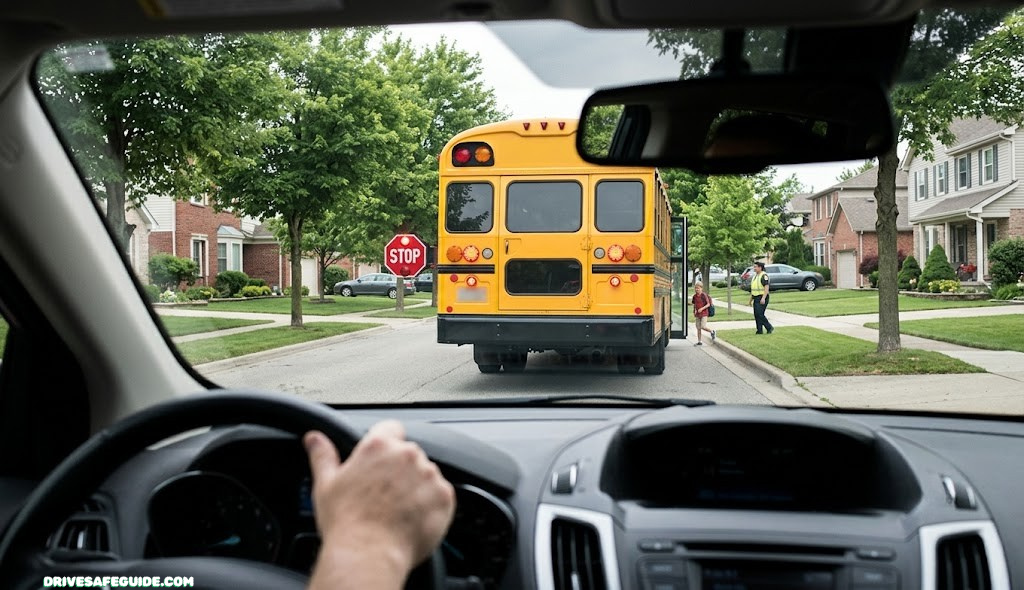
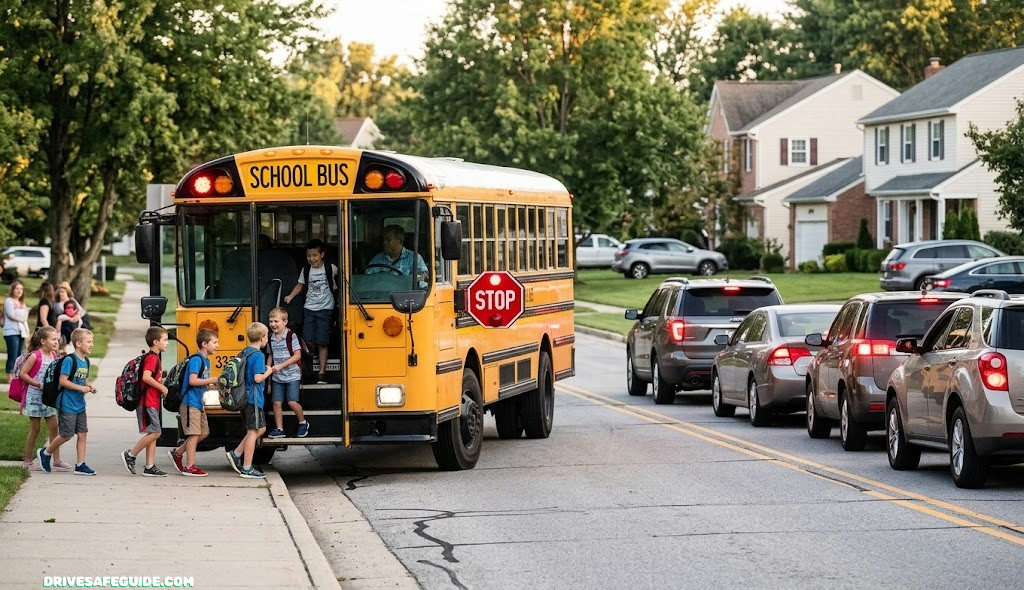
Every U.S. state requires drivers to stop for a school bus that has its red lights flashing and stop arm extended, and to remain stopped until the arm retracts and the lights go off. Most states require a stop of 10 to 50 feet from the bus, in both directions of travel, on nearly every type of road. The main exception is a highway physically divided by a raised median, concrete barrier, or grass strip — not just a painted line — where opposite-direction traffic is often (but not always) exempt.
Violations typically carry fines from about $100 to $500 for a first offense, climbing into the thousands with license points, suspension, or criminal charges for repeat violations, passing on the right side of the bus, or any incident involving a child in the road.
Of all the traffic laws drivers deal with regularly, few carry as much genuine urgency as the rule requiring you to stop for a school bus. It’s not a revenue-generating equipment technicality or a rule that mostly matters for insurance purposes. It exists because children under about ten years old — the age group most often struck at bus stops — are unpredictable, low to the ground, and easy to miss in a driver’s blind spot the moment they step off a curb.
And yet the most recent nationwide one-day count of illegal school bus passings found tens of thousands of vehicles blowing past extended stop arms in a single day, a number researchers extrapolate to tens of millions of violations across a typical school year. Most of those drivers weren’t reckless by nature. They misjudged the distance, misread a multi-lane road, or genuinely didn’t understand what a state’s law required once they crossed into it.
This guide breaks the law down piece by piece: what each light actually signals, exactly how far back you need to stop, where the real exceptions are (and where the exceptions people assume exist don’t), what a citation costs beyond the printed fine, and how the growing use of stop-arm cameras has changed the odds of getting caught.
It’s also worth knowing that this isn’t purely a state-level concern. Federal transportation safety officials track illegal passing data nationally, publish public education campaigns aimed at closing the awareness gap, and have repeatedly flagged the issue as one of the more solvable causes of preventable child pedestrian injury on the road. Congress has also seen recurring bipartisan legislative efforts specifically aimed at improving how illegal passing data is collected and reported, which reflects just how consistently this issue shows up as a policy priority regardless of which state you’re in.
What the Law Actually Requires
Every state has some version of the same core rule: when a school bus stops on a public road to load or unload children and activates its red flashing lights with the stop arm extended, approaching and following traffic must come to a complete stop and stay stopped until the bus signals it’s safe to move again. That’s true whether you’re behind the bus, meeting it from the opposite direction, or approaching an intersection where it’s stopped just ahead.
The legal definition of “stopped” is stricter than most drivers assume. It doesn’t just mean braking and slowing to a crawl while inching forward. You need to bring the vehicle to a full, complete stop, and you’re required to remain stationary — not just slow — until three specific things happen, in this order:
- The stop arm retracts back against the side of the bus.
- The red flashing lights turn off.
- The bus itself resumes moving, or the driver visibly signals that it’s safe to proceed.
Skipping any one of those three conditions — for example, creeping forward the moment the lights go dark but before the bus actually starts moving — is still a violation in most states, even if it feels like the danger has passed. Bus drivers are trained to watch for exactly this kind of early creep, and it’s one of the more common ways drivers who think they’re being careful still end up cited.
Why This Law Exists
School buses are, statistically, one of the safest ways for a child to get to school — far safer than being driven in a private car. The danger isn’t inside the bus. It’s in the small window of time when a child steps off it, especially the “danger zone” directly in front of the bus, where a driver’s own sightline and a young child’s height work against each other at exactly the moment the child needs to be seen most.
National one-day surveys conducted by pupil transportation officials consistently find well over 60,000 illegal passing incidents in a single day when only a fraction of the country’s school bus drivers even participate in the count — meaning the real national number is substantially higher. Extrapolated across a full school year, that points to tens of millions of illegal passes annually. The overwhelming majority of those incidents don’t result in a collision, but a small number every year end in a child being injured or killed, almost always during the loading or unloading process rather than while the bus is moving.
That’s the entire logic behind the stop-arm system: it converts a moment that would otherwise depend on every driver noticing a child near a bus into a hard, unambiguous signal — flashing lights, a physical arm swinging into the road — that’s designed to be impossible to miss. Lawmakers in a number of states have tightened these laws recently specifically because painted-line loopholes and inconsistent enforcement were undermining that signal. If you want a sense of how differently states handle rules that are conceptually simple but full of edge cases, our guide to right-on-red rules by state covers a similarly patchworked area of traffic law.
It helps to understand the danger zone the way bus drivers themselves are trained to see it. School bus operators are taught to check a roughly ten-foot radius around every side of the bus before opening the door, precisely because that radius represents the area where a driver’s forward view is most obstructed by the hood and mirrors, and where a small child is genuinely hardest to see from a normal seated position. A car approaching or passing through that same radius while children are present isn’t a technical rule violation in the abstract — it’s a vehicle entering the exact space where a bus driver’s own visibility is weakest.
The Three-Phase Light Sequence, Explained
Almost every point of confusion about school bus laws comes down to one thing: drivers not recognizing which phase of the light sequence they’re looking at. There are three distinct phases, and each one calls for a different response.
The amber phase is a warning, not a command — you’re not legally required to stop yet, but you should be actively slowing and scanning for children near the road. The moment the lights switch to red and the arm swings out, the command becomes absolute: stop, and don’t move again until all three conditions from the previous section are satisfied. A common and dangerous misread is treating the transition from amber to red as gradual; in reality it can happen in well under two seconds, which is exactly why “I thought I had time to get through” is one of the most frequent explanations bus drivers hear from cited motorists.
How Far Back You Must Stop
Unlike the light sequence, which is essentially identical everywhere, the required stopping distance varies meaningfully by state — and it’s rarely printed anywhere a driver would casually see it, like a road sign. Reported minimum distances across different states range from as little as 10 feet to as much as 50 feet from the bus, measured from the front of your vehicle to the rear of the bus (or the front, if you’re approaching from the opposite direction).
Illustrative range compiled from state statutes referenced throughout this guide. Always confirm your specific state’s exact requirement, since minimums are amended periodically.
In practice, this number matters less than most drivers assume, for one simple reason: if you’re close enough to a stopped bus to be debating exact footage, you’re already too close and should already be stopping. Treat the specific distance requirement as a legal minimum, not a target — the safer habit is to stop as soon as you recognize the red lights and arm, well before you’d need to measure anything.
Following distance matters here in a broader sense too. Drivers who maintain a safe gap in normal traffic are naturally positioned to react to a bus’s warning lights with room to spare, rather than needing to brake hard at the last second. If that’s a habit you’re still building, our guide to the safe following distance rule covers the fundamentals that make stopping for anything — a bus, a sudden brake check, road debris — noticeably less stressful.

Polarized Anti-Glare Driving Sunglasses
Low morning and afternoon sun is exactly when school buses run their routes. Reducing glare means spotting flashing lights and children near the road a second or two sooner.
Check Price on AmazonAs an Amazon Associate, DriveSafeGuide earns from qualifying purchases. See our full polarized driving sunglasses guide for more picks.
Divided Highways, Multi-Lane Roads, and the Median Exception
This is the single most misunderstood part of school bus law, and it’s responsible for a large share of “accidental” violations. The question drivers get wrong most often: if I’m traveling in the opposite direction on a multi-lane road, do I still have to stop?
The honest answer is: it depends entirely on how the road is physically constructed, and the bar most states set is stricter than people expect. The traditional exception applies only to a highway that’s genuinely divided — meaning a raised median, a grass strip, a concrete barrier, or some other physical structure that separates the two directions of travel. On a road like that, a bus stopped on one side generally does not require traffic on the far side of that physical divider to stop.
What doesn’t count, in a growing number of states, is a center turn lane, a double yellow line, or any other painted-only division. Several states have moved specifically to close this loophole in recent updates to their vehicle codes, clarifying that only a genuine physical barrier — not paint — creates the exception. Colorado’s recently strengthened law is a clear example: lawmakers there explicitly rewrote the statute so that only a raised median or concrete divider qualifies, specifically because painted-line ambiguity had been leaving children crossing multi-lane roads exposed to oncoming traffic that assumed it was exempt.
| Road Configuration | Typical Rule | Common Driver Mistake |
|---|---|---|
| Two-lane undivided road | All traffic in both directions must stop | Assuming oncoming traffic is exempt |
| Multi-lane road, painted center line or turn lane only | All traffic in both directions must stop in most states | Treating a painted median as a physical barrier |
| Highway with raised median or concrete barrier | Opposite-direction traffic often exempt | Assuming the exception applies to any wide road |
| Four-lane road, no median, bus stopped in far lane | Still requires a full stop from all lanes in most states | Believing distance across lanes creates an exemption |
The safest working assumption, regardless of what state you’re driving in: if you can’t immediately identify a raised, physical barrier — not a stripe, not a turn lane — between you and the bus, stop. Guessing wrong in the direction of “I didn’t think I had to” is exactly the mistake this rule exists to prevent. Roads that combine this kind of layout ambiguity with heavy commuter traffic are also where merging and multi-lane driving anxiety tends to spike, so it’s worth building general confidence in multi-lane situations beyond just the bus-stop scenario.
Advance warning signage can help, but it’s not universal, and you shouldn’t rely on it as your only cue. Some school zones and known bus-route corridors post yellow “School Bus Stop Ahead” or “Watch for School Buses” signage well before the actual stop location, particularly on rural highways where sightlines are longer and stopping distances matter more. Where that signage exists, treat it as a prompt to actively cover your brake and scan ahead rather than something that changes the underlying legal requirement — the obligation to stop is triggered by the bus’s own lights and arm, not by whether a sign warned you in advance.
Passing on the Right Side: Why It’s the Most Dangerous Violation
Not all illegal passes carry equal risk, and the data reflects that clearly. National one-day surveys consistently find that the vast majority of illegal passes happen on the left side of the bus — a driver overtaking or approaching from the front — while only a small single-digit percentage happen on the right, passenger-door side. That imbalance sounds reassuring until you consider what it means in practice: the right side is precisely where children are boarding and exiting, standing closest to moving traffic, often looking toward the bus door rather than over their shoulder at the road.
Because of that concentrated risk, a number of states specifically elevate a right-side pass to a more serious charge than an equivalent left-side violation, regardless of whether anyone was actually struck. It’s also the scenario automated stop-arm camera systems are increasingly designed to catch, since a right-side pass is both the hardest for a bus driver to witness directly — it happens behind and beside them, outside their primary sightline — and the one enforcement officials consider the highest priority to deter.
Lower-risk mistake (still a violation)
- Misjudging distance and stopping late on the left side
- Failing to notice amber lights from a distance
- Creeping forward slightly before the bus fully moves
Highest-risk violation
- Passing on the right, passenger-door side of the bus
- Passing while a child is visibly outside the bus or in the road
- Continuing through an intersection the bus is stopped at
Drivers of larger vehicles — trucks, vans, and SUVs with wider blind spots — have an added layer of risk here, since a small child near the right side of a bus can disappear from view entirely in a standard side mirror. If you regularly drive a taller vehicle, it’s worth pairing basic bus-stop awareness with a broader look at blind spot mirrors for trucks and SUVs, since the same visibility gap that hides a merging car can just as easily hide a child.

Wide-Angle Blind Spot Mirrors (2-Pack)
Convex, distortion-corrected mirrors that shrink the right-side blind spot where children near a stopped bus are hardest to see.
Check Price on AmazonAs an Amazon Associate, DriveSafeGuide earns from qualifying purchases.
What a Violation Actually Costs
Fines for illegally passing a stopped school bus are consistently higher than routine moving violations, and for good reason — lawmakers have deliberately priced these citations to stand out. A representative first-offense range across the states referenced in this guide runs from roughly $100 up to $500, though several states set their minimum at $500 outright, and a handful allow penalties reaching several thousand dollars for aggravating circumstances or repeat violations.
| Violation Type | Representative Range | Additional Consequences |
|---|---|---|
| First offense, standard violation | ~$100–$500 | License points in many states |
| First offense, statutory misdemeanor | $500 minimum or more | Criminal record possible even without injury |
| Second or subsequent offense | $300–$2,000+ | License suspension (30 days to 1 year in various states) |
| Camera-issued civil citation | ~$100–$500 | Often a civil fine rather than a criminal charge |
Camera-based enforcement, now authorized in a large majority of states, works differently from an officer-issued ticket. A stop-arm camera mounted on the bus captures video the moment the arm extends and a vehicle fails to stop; a reviewer confirms the violation before a citation is mailed to the vehicle’s registered owner. In several states this creates an important legal distinction — a camera-issued ticket is often treated as a civil infraction against the vehicle owner rather than a criminal charge against a specific driver, which changes both the process and the consequences compared to being pulled over directly.
Reinstatement fees after a suspension add another layer of cost that rarely shows up in headline fine amounts, typically running somewhere in the range of $55 to $125 depending on the state — on top of whatever base fine and court costs were already owed. If you’re weighing the broader financial exposure of a conviction like this, it’s worth reading up on uninsured motorist coverage as well, since a license suspension can complicate your own insurance standing well beyond the ticket itself.
Insurers also tend to treat this specific violation differently from an ordinary speeding ticket. Because a stop-arm conviction is frequently classified as a misdemeanor rather than a simple infraction, it can trigger a larger premium increase and stay on record longer than a comparable non-criminal moving violation, depending on the carrier’s underwriting rules and your state’s insurance regulations. Some insurers specifically flag any violation involving a school zone or a child pedestrian as a distinct risk category, separate from their general moving-violation scoring, which is part of why this particular ticket tends to cost more in the long run than its face-value fine suggests.

Dual-Channel Dash Cam with Parking Mode
Timestamped footage protects you if you’re wrongly cited, and it’s exactly the kind of evidence investigators ask for if you witness someone else illegally passing a stopped bus.
Check Price on AmazonAs an Amazon Associate, DriveSafeGuide earns from qualifying purchases. See our full dash cam buying guide for a deeper comparison.
When It Becomes a Criminal Charge
Most first-time stop-arm violations, even the ones that feel alarming in the moment, are resolved as traffic infractions or misdemeanors rather than serious criminal matters — provided no one was hurt and the driver wasn’t passing on the right side or endangering a child directly in the road. That said, several specific circumstances reliably push a case into more serious territory.
- A child is injured. In most states, causing injury during an illegal pass elevates the charge from a traffic infraction to a criminal offense, and in the most serious cases, a felony.
- A child is killed. This is treated as a serious felony virtually everywhere, carrying the possibility of significant prison time regardless of the driver’s intent.
- Passing on the right side while children are outside the bus. A number of states specifically define this combination as an aggravating factor that upgrades a standard misdemeanor to a gross misdemeanor.
- Repeat offenses within a defined window (commonly three to five years). Second and third violations frequently carry mandatory minimum fines, automatic license suspension, and in some states a real possibility of jail time even without any injury.
It’s worth being clear that even an entirely accidental first offense — misjudging a light sequence, misunderstanding a divided-highway exception — is not automatically excused just because there was no intent to break the law. Courts in states like Minnesota have been explicit that the statute doesn’t distinguish between an honest mistake and a deliberate pass; both are chargeable the same way, though sentencing and prosecutorial discretion still tend to treat a documented, unintentional first offense more leniently than a willful or repeated one. If a citation like this does escalate into a court appearance, it’s worth understanding your broader rights during any law enforcement stop — our guide to checkpoint and stop refusal rights covers related ground on what officers can and cannot require of you at the roadside.
How Violations Are Caught: Officers, Witnesses, and Stop-Arm Cameras
Enforcement of school bus stopping laws happens through three overlapping channels, and it’s become measurably harder to get away with an illegal pass than it was even a few years ago.
Direct officer observation
Police officers who witness a stop-arm violation directly can issue a citation on the spot, the same as any other moving violation. This is the least common enforcement path simply because officers aren’t usually positioned at every bus stop every morning and afternoon.
Bus driver reports
Bus drivers are trained to note license plates, vehicle descriptions, and the time and location of illegal passes, and many states allow that report — sometimes combined with the child’s account, if relevant — to support a citation even without an officer present. This channel depends heavily on the driver being able to safely observe the violation while also managing the students on board, which is part of why it’s an imperfect substitute for automated systems.
Automated stop-arm cameras
A large majority of states now authorize camera systems mounted directly on the bus. These cameras activate automatically the instant the stop arm extends, capturing video and still images of any vehicle that passes illegally. A reviewer — sometimes at the school district, sometimes at a contracted vendor, sometimes at law enforcement — checks the footage before a citation is mailed to the registered owner of the vehicle, which is why these tickets often name the owner rather than a specific identified driver.
The financial mechanics behind these programs vary, but several states direct camera-generated fine revenue specifically back into school transportation safety budgets, which is part of the policy argument for expanding them. From a driver’s perspective, the practical takeaway is simple: assume every school bus you encounter may be recording, and drive accordingly, the same way you’d treat any road with visible photo enforcement. If you’re generally interested in where camera-based traffic enforcement is expanding, our guide to radar detector legality by state covers a closely related corner of the same enforcement landscape.

High-Visibility Reflective Backpack Cover
Makes kids dramatically easier to spot at dawn, dusk, and in low-visibility weather while they’re waiting for or stepping off the bus.
Check Price on AmazonAs an Amazon Associate, DriveSafeGuide earns from qualifying purchases.
State-by-State Snapshot: How Widely the Rules Really Vary
As with most vehicle codes, the core principle is nationally consistent while the specifics differ enough to catch drivers off guard when they cross a state line. Below is a representative sample — not an exhaustive fifty-state table, since these statutes are amended on an ongoing basis — illustrating just how differently comparable violations are handled.
| State (example) | Stopping Distance | Notable Penalty Detail |
|---|---|---|
| Minnesota | 20 feet | Mandatory minimum $500 fine; misdemeanor by default, gross misdemeanor for right-side or child-endangerment cases |
| Michigan | 20 feet | Camera-based violations treated as a civil infraction with a $100–$500 fine paid to the school district |
| Colorado | 20 feet | Recently closed the painted-median loophole; only a physical barrier now qualifies for the opposite-direction exception |
| States with shorter minimums | ~10 feet | Often paired with penalties reaching $500 and jail exposure up to 90 days |
| States with longer minimums | ~50 feet | Frequently paired with steep escalation for second offenses within a set window |
This kind of variation shows up across nearly every category of state-level traffic law, not just school bus rules. If you’re curious how far the differences go, it’s worth comparing how states diverge on move-over law requirements for emergency vehicles, open container laws, or graduated licensing restrictions for new drivers. The practical lesson is identical every time: don’t assume a rule works the same way just because you’re still driving the same car.
Common Misunderstandings That Lead to Honest Mistakes
Most drivers cited for a stop-arm violation genuinely didn’t intend to break the law. A handful of recurring misunderstandings account for a disproportionate share of these cases.
“I was in a parking lot, so it doesn’t count.”
Many states’ stop-arm laws apply broadly to any street or highway, and a number extend that coverage to parking lots and private roads specifically because school pickup lines and lot loading are common flashpoints. Don’t assume a bus stopped off the main road is exempt from the same rules.
“The arm wasn’t all the way out yet, so I still had time.”
Some state courts have actually drawn a technical line here — a violation may not legally occur if the arm is still mid-swing rather than fully extended. But this is a narrow legal distinction that depends on precise timing evidence, not a safe habit to rely on in the moment. Treat the first sign of amber or red lights as your cue to slow down regardless of the arm’s exact position.
“There was a turn lane between us, so I was exempt.”
As covered earlier, this is one of the most consistently wrong assumptions on the road. A center turn lane or painted median is not a physical barrier in most states, and this exact misunderstanding is what several recent law updates were written to eliminate.
“The bus was on the other side of the intersection, so I wasn’t approaching it.”
Most statutes cover any vehicle “approaching or meeting” a stopped bus, which typically includes traffic stopped at or moving through an adjacent intersection, not just vehicles directly behind or facing the bus on the same road segment.
“I didn’t see the bus in time because of a hill or curve.”
Limited sightlines are a real hazard, but they generally don’t function as a legal defense on their own — the law expects drivers to adjust their speed to conditions, including blind curves and hill crests on routes they know carry regular bus traffic. If you drive the same route daily, treat known low-visibility spots as an automatic cue to ease off the accelerator well before you’d actually need to react.
“The bus was stopped in someone’s driveway, not on the road.”
A bus loading or unloading a child at the end of a long driveway is usually still governed by the same rule, since the relevant question is typically where your vehicle is on the public roadway, not where the bus itself is parked. Don’t assume a driveway pickup changes your obligation to stop.
Confusing signage and unfamiliar layouts are a recurring theme across driving law generally, not just around buses — the same instinct that helps here is useful at roundabouts and other layouts where drivers often assume a rule that doesn’t actually exist.
How to Drive Safely Around School Buses
Beyond the legal minimums, a short list of habits meaningfully reduces the risk of ever being in this situation at all — whether that means avoiding a citation or, more importantly, avoiding a genuine tragedy.
- Slow down early on residential and school-adjacent routes, especially during the specific morning and afternoon windows when buses run. A few extra seconds of travel time costs nothing.
- Treat amber lights as your stopping cue, not the red lights. Waiting for red means you’re reacting to the final warning instead of the first one.
- Never assume the road you’re on qualifies for the divided-highway exception unless you can clearly see a raised median, grass strip, or physical barrier — not paint.
- Give buses extra following distance during pickup and drop-off windows, since they stop far more frequently and with less predictable timing than ordinary traffic.
- Scan actively for children near the bus, not just the bus itself — the vehicle is the easy part to see; a small child stepping out from in front of it is not.
- Stay stopped until the bus actually moves, not just when the lights go off, since a brief gap between the two is common and children may still be crossing.
Weather adds another layer of risk worth planning for separately. Fog, heavy rain, and low winter sun all reduce how early you’ll spot a bus’s warning lights, which means the safe habit is to build in extra following distance and reduce speed proactively on bus routes during those conditions rather than relying on your reaction time to compensate. Our guide to fog driving strategies covers the broader visibility fundamentals that apply just as directly to spotting a stopped bus as they do to spotting any other hazard.
If your household includes a new driver who hasn’t fully internalized these habits yet, it’s worth working through them explicitly rather than assuming the rules will simply come up naturally in normal driving practice. Our guides on parents teaching teen drivers and permit test practice questions are useful starting points, since school bus rules are consistently one of the more heavily tested — and misunderstood — sections of most state driving exams.
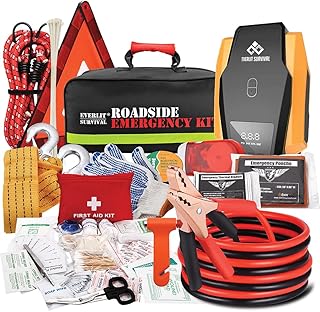
Complete Car Safety & Emergency Kit
A well-stocked kit is a good companion habit to good bus-stop awareness — both come down to the same instinct: expect the unexpected before it happens.
Check Price on AmazonAs an Amazon Associate, DriveSafeGuide earns from qualifying purchases.
Frequently Asked Questions
Do I have to stop if I’m driving in the opposite direction from the bus?
In most cases, yes. The main exception applies only on roads with a genuine physical divider — a raised median, grass strip, or concrete barrier — between the two directions of travel. A painted line or center turn lane usually does not qualify.
What do the amber lights on a school bus mean?
Amber or yellow flashing lights are a warning that the bus is about to stop. You’re not required to stop yet, but you should slow down immediately and prepare to come to a complete stop.
How far back do I need to stop from a school bus?
It varies by state, with reported minimums ranging from about 10 to 50 feet. Rather than trying to judge exact distance, the safer approach is to stop as soon as you see the red lights and extended arm.
When can I start driving again after a bus stops?
Only after the stop arm fully retracts, the red lights turn off, and the bus itself resumes moving (or the driver visibly signals it’s safe). Moving before all of these happen is a violation in most states, even if it feels like the danger has passed.
Is passing a school bus on the right side worse than passing on the left?
Yes. The right side is where children board and exit, making it the most dangerous type of violation. Several states specifically charge right-side passes more severely than left-side ones.
Can I get a ticket from a school bus camera without an officer present?
Yes. A large majority of states now authorize stop-arm camera systems that record violations automatically. A reviewer confirms the footage before a citation is mailed to the vehicle’s registered owner, often as a civil rather than criminal matter.
What happens if I accidentally pass a stopped school bus?
Most states don’t legally distinguish between an accidental and intentional violation, though courts and prosecutors often treat a documented first-time, unintentional case more leniently than a repeat or willful one. You can still be cited or charged either way.
Will a school bus violation add points to my license?
In many states, yes. Point totals vary by state, and enough points can lead to a license suspension, higher insurance premiums, or mandatory driver education, depending on your state’s specific rules.
Is passing a stopped school bus ever a felony?
It can be, if the violation results in a child’s injury or death. Most states elevate the charge from a traffic infraction to a criminal offense, and in the most serious cases, a felony, when a collision with a child occurs.
Do school bus stop-arm laws apply in parking lots or on private roads?
In many states, yes. A number of statutes are written broadly enough to cover parking lots, school pickup lines, and private roads specifically because loading and unloading also happens off the main street.
What should I do if I witness someone illegally passing a school bus?
If it’s safe to do so, note the vehicle’s description, license plate, location, and time. Many local police departments and school transportation offices accept these reports, and dash cam footage can significantly strengthen a report if you have it.
Related Driver Law & Safety Guides
School bus stopping rules are one piece of a much larger set of state-by-state traffic laws. These related guides cover the rest of that landscape:
The Bottom Line
School bus stopping laws are one of the rare corners of traffic law where the underlying purpose is impossible to argue with, even when the details get complicated. Amber means slow down. Red and an extended arm mean stop, fully, and stay stopped until the bus tells you otherwise. The exceptions are narrower than most drivers assume, and the cost of guessing wrong — in fines, in points, in the worst cases in a child’s safety — is never worth the handful of seconds you’d save.
If there’s one habit worth taking from this guide, it’s this: the moment you see those lights, stop being a driver evaluating your options and just be a driver who stops. Everything else about this law is designed to be simple in exactly that moment.
Build Stronger Defensive Driving Habits →This article is for general informational purposes and reflects publicly reported state laws and enforcement trends at the time of writing. It is not legal advice. Vehicle codes change frequently and enforcement varies by jurisdiction — confirm current requirements with your state DMV or a licensed attorney before making decisions based on this guide.
🚗 Recommended for Drivers
Drive Safer Every Day
Explore our top picks for car safety gear — from dashcams to emergency kits — all hand-picked to help you stay safe on the road.
🚗 Shop Car Safety EssentialsAffiliate link — we earn a small commission that keeps DriveSafeGuide running. Thank you!