Understanding Your DUI Checkpoint Refusal Rights
What you can legally decline, what “implied consent” really means, and what actually happens to your license the moment you say no.
Every year, roughly 10,000 sobriety checkpoints go up across the states that allow them, and most drivers who roll through one never think twice about what they’re actually being asked to do. Then the lights come on, an officer leans toward the window, and suddenly nobody remembers what’s required versus what’s just habit. This guide breaks that down section by section — checkpoint by checkpoint, test by test — so you know exactly where “cooperate” ends and “consent” begins.
What a DUI Checkpoint Actually Is
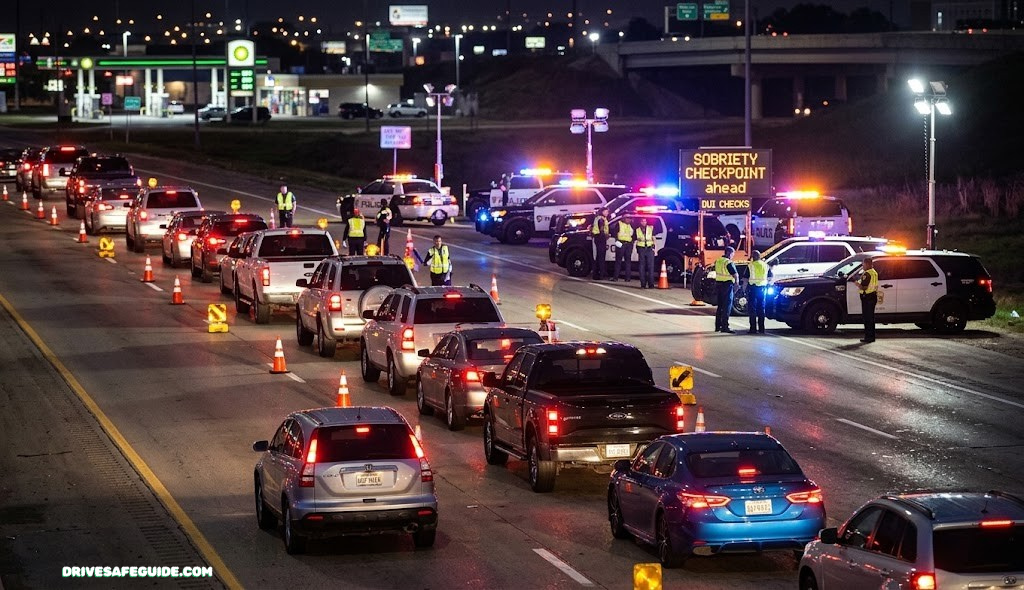
A sobriety checkpoint — sometimes called a DUI roadblock — is a fixed location where officers stop vehicles using a set, neutral pattern instead of the usual requirement of individual suspicion. Instead of watching for a specific driving mistake, police stop every car, every third car, or every fifth car, screening each one briefly for signs of impairment before waving most drivers through.
That neutral-formula requirement is the whole reason checkpoints are allowed to exist at all. A normal traffic stop needs an officer to have a specific, articulable reason — a rolling stop, a broken taillight, drifting out of a lane. A checkpoint sidesteps that requirement entirely, but only because it applies the same brief interruption to everyone who passes through, rather than singling drivers out. Change that formula mid-shift, and the checkpoint’s legal footing gets a lot shakier.
In practice, a lawful checkpoint usually looks like this: it’s set up in a location chosen in advance by a supervising official (not just whichever officer feels like it), it’s publicized ahead of time through local news or department channels, it’s marked with visible signage and lighting well before drivers reach it, and the stop itself is short — typically well under a minute unless something specific raises an officer’s suspicion. If any of those pieces are missing, a defense attorney has real grounds to challenge the stop later.
What checkpoints are not is a general excuse to search vehicles or run every occupant’s record. Officers can usually check a license, registration, and proof of insurance, and they can look for open containers — a separate issue covered in our breakdown of open container laws by state — but a full vehicle search still requires probable cause, a warrant, or your consent, the same as it would anywhere else.
Are DUI Checkpoints Even Legal?
Yes, under federal law — but the answer gets more complicated once you factor in where you’re standing. The U.S. Supreme Court settled the federal question in Michigan Department of State Police v. Sitz (1990), ruling that briefly stopping every vehicle at a well-run checkpoint doesn’t violate the Fourth Amendment’s protection against unreasonable searches and seizures. The Court weighed the state’s interest in reducing drunk driving against the minor inconvenience to sober drivers passing through, and found the balance tipped in favor of the checkpoint.
That ruling didn’t give police an unlimited pass, though. Later cases narrowed things further. In Indianapolis v. Edmond (2000), the Court drew a hard line against using checkpoints for general crime control — a roadblock built to search for narcotics rather than screen for impairment doesn’t get the same constitutional shortcut. Illinois v. Lidster (2004) went the other way, allowing a checkpoint set up to gather witness information about a specific recent crime. The throughline across all of it: checkpoints survive scrutiny when they’re narrow, brief, and tied to a specific public-safety purpose — not when they’re a general fishing expedition.
Here’s the part most drivers don’t expect: even though the Supreme Court gave checkpoints a green light nationally, individual states are free to be stricter. A number of state courts and legislatures have decided that their own state constitutions offer broader protection against warrantless stops than the federal Fourth Amendment does — and in those states, DUI checkpoints simply aren’t used, regardless of what federal law allows. We cover exactly which states fall into that category in Exhibit K below.
Implied Consent: The Fine Print You Already Agreed To
Every state has some version of an implied consent law, and almost nobody reads it before they need it. The basic idea: by accepting a driver’s license, you’ve already agreed that if an officer has probable cause to believe you’re impaired, you’ll submit to a chemical test — breath, blood, or urine — to measure your blood alcohol concentration. You didn’t sign anything specific to this at the DMV counter; the agreement is baked into the act of holding a license in the first place.
This is the single most misunderstood piece of checkpoint law, so it’s worth separating clearly: implied consent covers the evidentiary chemical test that happens after an arrest, not the preliminary roadside screening that happens before one. Those are two different tests, with two very different sets of consequences attached to refusing them, and the next two sections walk through each one separately.
Refusing the post-arrest evidentiary test doesn’t stop the state from suspending your license — implied consent laws build that penalty in automatically, often before you’ve even seen a courtroom. It’s an administrative action tied to your driving privilege, separate from and in addition to whatever happens with the underlying DUI charge. Some states also allow the refusal itself to be mentioned to a jury later, as circumstantial evidence that you had something to hide.
Can You Refuse the Breathalyzer at a Checkpoint?
Technically, yes — but which breathalyzer matters enormously here, and this is where a lot of the confusion around checkpoint refusal actually starts.
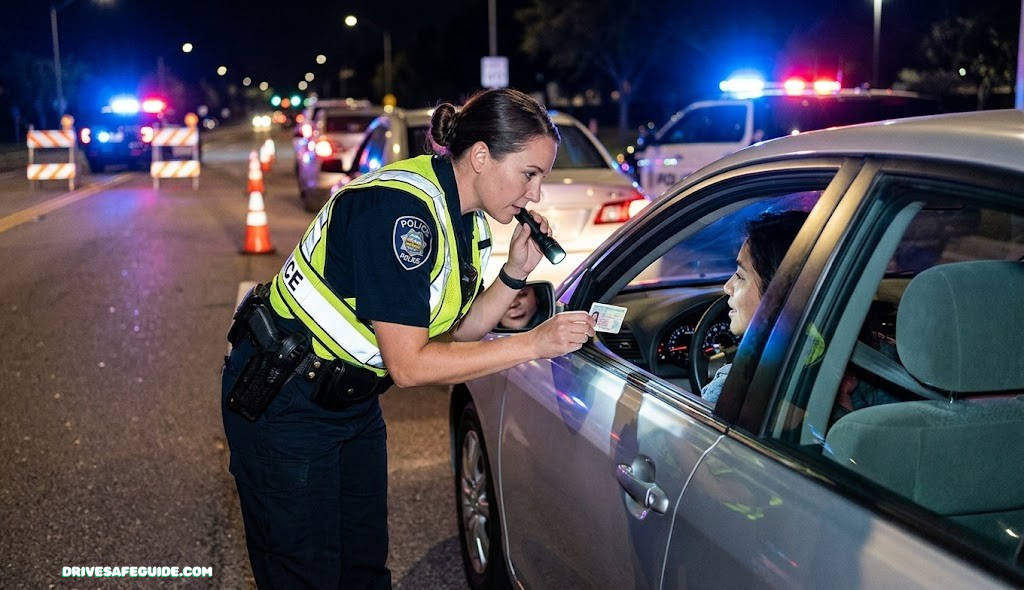
At the checkpoint itself, before any arrest, an officer may ask you to blow into a small handheld device called a preliminary breath test (PBT). In most states, this roadside PBT is voluntary. You can decline it, and in states where it’s genuinely optional, that refusal alone typically doesn’t trigger an automatic license suspension — though it may give the officer a reason to investigate further, since declining a voluntary test can read as one more data point alongside anything else they’ve observed.
Once you’ve been arrested — meaning an officer has decided there’s probable cause to believe you’re impaired — a different test comes into play: the evidentiary breath test, usually a larger, calibrated machine back at the station or in a mobile unit. This is the test implied consent laws are actually built around. Refusing it is the refusal that triggers the automatic administrative suspension described in Exhibit C, and in a growing number of states, a documented refusal can also be used to obtain a warrant for a blood draw instead.
The practical distinction, boiled down: the little handheld device at the checkpoint window is usually optional; the machine after an arrest usually isn’t, in the sense that saying no still has serious, near-automatic consequences attached to it.
| Test | When It Happens | Typically Voluntary? | Cost of Refusal |
|---|---|---|---|
| Preliminary breath test (PBT) | Roadside, pre-arrest | Usually yes | Varies by state; often none automatically, but can support probable cause |
| Evidentiary breath/blood test | Post-arrest, at station or via warrant | Usually no | Automatic license suspension under implied consent; may be used as evidence |
Because this line shifts from state to state — and because an officer isn’t obligated to explain the distinction to you in the moment — the safest approach is asking directly: “Am I under arrest, and is this test the implied consent test?” A clear answer to that question tells you exactly which set of consequences you’re looking at.
Check Your BAC Before You’re Ever Near a Checkpoint
A personal breathalyzer won’t change the law, but it takes the guesswork out of “am I actually okay to drive” long before an officer is asking the same question.
Shop Personal BreathalyzersCan You Refuse Field Sobriety Tests?
Yes, in nearly every state. The walk-and-turn, the one-leg stand, and the horizontal gaze nystagmus test — the officer tracking your eyes as they follow a pen — are collectively called the standardized field sobriety tests (SFSTs), and they are voluntary roadside exercises, not chemical tests, and not something implied consent laws typically reach.
That distinction matters because these tests were never designed to be easy. They’re built to isolate divided attention — balancing, counting, and following instructions at the same time — which means fatigue, anxiety, poor lighting, uneven pavement, or an old knee injury can all produce the same visual cues as intoxication. Officers are trained to look for specific indicators, but the test is subjective by nature, scored by the same person who’s also deciding whether to make an arrest.
Declining a field sobriety test doesn’t make you invisible to suspicion, though. If an officer already smells alcohol, notices slurred speech, or watched you struggle to find your license, those observations stand on their own as potential evidence of probable cause — a refused FST just means there’s one fewer data point in the officer’s notes, not zero data points. Some drivers find that trade worthwhile; others would rather have the test on record in case it goes well. There’s no universally “correct” answer, only an informed one.
Reasons Some Drivers Refuse FSTs
- The tests are subjective and can be affected by nerves, footwear, or terrain
- A poor performance can become part of the arrest report even if you weren’t impaired
- Refusing an FST typically carries no automatic license penalty, unlike the evidentiary chemical test
Reasons Some Drivers Comply
- A clean performance can support your side of the story if the stop is later disputed
- Refusal can be noted as a factor an officer weighs alongside other observations
- Cooperative, calm interactions sometimes end faster than a standoff over a voluntary test
What Refusal Actually Costs You
Refusing the post-arrest evidentiary test is where the real consequences live, and they land fast — often before any DUI charge has even been formally filed. Because implied consent penalties are administrative, tied to the DMV rather than the criminal court, they typically don’t require a conviction, a trial, or even a finding of guilt. The refusal itself is usually enough.
- Automatic license suspension. First refusals commonly trigger suspensions ranging from several months to a full year, depending on the state; second or subsequent refusals within a set window are often longer, sometimes two years or more.
- The refusal can follow you into the criminal case. Many states allow prosecutors to introduce your refusal as evidence at trial — the argument being that an innocent driver would have taken the test.
- Reinstatement isn’t automatic or free. Getting your license back after an implied consent suspension usually means fees, sometimes an ignition interlock requirement, and in some states, mandatory alcohol education before driving privileges are restored.
- It stacks with, not instead of, DUI penalties. If you’re separately convicted of DUI based on other evidence — officer observations, video, a blood draw obtained by warrant — the implied consent suspension runs on top of whatever penalties come with that conviction, not in place of them.
| Consequence | 1st Refusal (Typical Range) | 2nd+ Refusal (Typical Range) |
|---|---|---|
| License suspension | 6 months – 1 year | 1 – 3 years |
| Reinstatement fee | State-dependent, often required | State-dependent, often higher |
| Ignition interlock | Sometimes required | More commonly required |
| Usable against you at trial | In many states | In many states |
Ranges above are general and illustrative — exact suspension lengths, fees, and interlock rules are set individually by each state’s DMV or equivalent agency and change over time. Confirm current figures for your state before making a decision.
A Dash Cam Records What Your Memory Won’t
If a stop ever gets disputed later, timestamped video of the actual interaction is worth more than anyone’s recollection — including the officer’s. See our picks for night-driving dash cams.
Shop Dash CamsRefusal vs. Failing: Which Carries More Risk?
There’s no clean, universal answer, because the two paths create different kinds of exposure rather than a simple “worse” and “better.” Failing a chemical test hands the prosecution a specific number — a BAC reading a jury can see in black and white. Refusing removes that number but replaces it with an automatic administrative suspension and, in many states, a refusal the prosecution gets to describe to that same jury as consciousness of guilt.
Some defense attorneys view refusal as removing the state’s strongest single piece of evidence, since a jury reacting to “he refused” is working with an inference, not a measurement. Others point out that the guaranteed, near-immediate license suspension attached to refusal is a real, certain cost — while a chemical test result can sometimes be challenged later on grounds like improper calibration, chain-of-custody issues, or medical conditions that mimic impairment.
What actually tips the balance is specific to the person and the state: prior refusal or DUI history, how the initial stop was conducted, whether other strong evidence of impairment already exists independent of any test, and what that state’s implied consent penalty structure looks like. This is exactly the kind of decision where general information runs out and a conversation with a DUI attorney licensed in your state becomes genuinely necessary — not as a formality, but because the right call depends on facts a website can’t know about your specific stop.
Your Rights During the Stop
Checkpoints don’t suspend the Constitution — they just change which parts of it apply first. Here’s the practical shape of your rights while you’re sitting at the window:
- You must stop. Once you’re in the checkpoint line, you’re required to come to a stop and provide license, registration, and proof of insurance on request. This part isn’t optional.
- You have the right to remain silent. Beyond identifying yourself through your documents, you’re not required to answer questions like “have you been drinking tonight?” or “where are you coming from?” You can politely decline to answer without that silence itself being a crime.
- You have the right to refuse a vehicle search. Absent probable cause, a warrant, or your consent, officers can’t search your car simply because you’re stopped at a checkpoint. If asked, a calm “I don’t consent to a search” preserves the issue for later without escalating the interaction.
- You have the right to an attorney once you’re in custody. A checkpoint stop itself generally isn’t a custodial interrogation, so Miranda warnings typically aren’t required at that stage — but once you’re arrested, that right activates, along with the requirement that officers inform you of it before further questioning.
- You have the right to be free of excessive delay. A checkpoint stop is supposed to be brief. If it stretches on without a clear, articulated reason, that extended detention is itself something a later legal challenge can examine.
None of this means being combative helps you. Officers are trained to notice tone and behavior as much as words, and a hostile interaction rarely improves the outcome. The goal isn’t confrontation — it’s calm, clear boundaries. “Officer, I’m going to remain silent and I’d like to speak with an attorney” does the job without raising the temperature. It’s also worth keeping your hands visible and movements slow and telegraphed throughout, the same baseline advice covered in our defensive driving habits guide for any interaction with law enforcement.
Can You Record the Interaction?
In every state, you have the right to record your own interaction with police in a public place, including from inside your own vehicle, as long as you’re not physically interfering with the officer’s duties. This is settled well enough that it rarely comes up as a point of dispute at an actual checkpoint — most officers are used to being recorded and won’t ask you to stop.
A dashboard camera that’s already running when you reach the checkpoint is often the cleanest way to do this, since it captures the interaction automatically without you needing to hold a phone up or fumble with an app in the moment — which matters, because reaching for a device abruptly at a checkpoint can itself draw unwanted attention. If you’d rather record manually, a simple “I’m going to record this for my own records” stated calmly, once, is usually enough; you’re not required to ask permission first, but announcing it tends to keep the interaction lower-friction.
One practical note: some states have wiretapping or eavesdropping statutes that add wrinkles to recording audio of private conversations without consent. Recording your own conversation with an officer performing public duties is different from secretly recording a private call between other people, and courts have generally protected the former — but if you’re ever unsure, a dash cam that records continuously as a matter of routine, rather than something you switch on selectively at a stop, sidesteps most of that ambiguity entirely.
What About Passengers?
Passengers have a narrower but still meaningful set of protections at a checkpoint. Like the driver, a passenger generally isn’t required to answer an officer’s questions and can decline to do so without that silence being treated as an offense. Unlike the driver, a passenger typically doesn’t have an independent obligation to produce ID unless local law specifically requires it or the officer develops individualized suspicion about that passenger specifically — being present in a car being screened isn’t, by itself, grounds to compel identification from everyone inside it.
That said, an officer who develops reasonable suspicion about a passenger — visible open containers within reach, odor, behavior — can extend the encounter to that passenger specifically, the same way it would with a driver. And practically speaking, a checkpoint is not the setting to relitigate who has to answer what; a passenger who wants to assert these rights is generally best served doing it the same way a driver would — calmly, briefly, and without turning a thirty-second stop into a standoff.
A Glovebox Notepad for Badge Numbers, Times, and Locations
If you ever need to reconstruct a stop later, a simple written record — time, location, badge number, what was said — is something a phone alone won’t always capture.
Shop Glovebox OrganizersCan You Legally Turn Around Before a Checkpoint?
Generally, yes. If you spot checkpoint signage or the line of brake lights ahead and there’s a legal way to turn around — a side street, a driveway, a legal U-turn — doing so is not, by itself, grounds for a stop. Courts have consistently held that avoiding a checkpoint isn’t suspicious behavior on its own; drivers are allowed to route around inconvenience the same way they’d route around traffic.
The catch is entirely in the word “legal.” The turn itself has to follow ordinary traffic law. An illegal U-turn, crossing a solid double line, cutting through a private lot to bypass the road, or a sudden, unsignaled swerve can each independently give an officer reasonable suspicion for a stop — not because you avoided the checkpoint, but because you broke a traffic law while doing it. At that point, the checkpoint you were avoiding is irrelevant; you’ve created a new, separate reason to be pulled over.
There’s a second layer some drivers don’t anticipate: erratic or unusually abrupt turning, even if technically legal, can itself read as suspicious to a trained officer watching the approach. A calm, signaled, otherwise-normal turn a reasonable distance before the checkpoint is a very different picture than a last-second swerve into a gas station the moment the lights come into view.
What to Say (and Not Say) at the Checkpoint
Most checkpoint stops are over in under a minute, and how that minute goes usually comes down to a handful of small, deliberate choices. Here’s a practical sequence:
- Slow down early and turn on your interior light at night. Officers are watching the approach as much as the stop itself; a calm, visible, unhurried approach reads as exactly what it is.
- Have your documents ready before you’re asked. License, registration, and insurance handed over promptly and without fumbling removes one common trigger for further questioning.
- Answer identifying questions, decline investigative ones. “Here’s my license” is fine. “Have you had anything to drink tonight?” can be met with a polite “I’d rather not answer that” — you’re not required to narrate your evening.
- If asked to step out or take further tests, ask a clarifying question first. “Am I being detained, or am I free to go?” and “Is this test required?” are both fair, calm questions that clarify exactly what’s happening before you decide how to respond.
- Don’t argue the law in the moment. Even if you believe a request goes beyond what’s required, a checkpoint stop is not the venue to win that argument. Comply with lawful orders, state your position clearly and once, and save the legal argument for an attorney and, if necessary, a courtroom.
- If arrested, invoke your right to counsel clearly. “I am going to remain silent and I want to speak with an attorney” is a complete sentence. Repeating it if questioned further is fine; elaborating on it usually isn’t necessary.
None of this requires memorizing a script word-for-word — the underlying idea is simpler than it looks: be cooperative with what’s legally required, be clear and calm about what isn’t, and don’t try to negotiate constitutional law with an officer at 11 p.m. on the side of the road. If you’re new to driving generally, our defensive driving habits guide and night driving safety checklist both cover the broader version of staying calm and predictable behind the wheel, checkpoint or not.
State-by-State Snapshot: Where Checkpoints Aren’t Used
Roughly 38 states plus Washington, D.C. permit sobriety checkpoints in some form, while 12 states have decided — through legislation, statute interpretation, or state supreme court rulings — that checkpoints aren’t used at all, regardless of what federal law allows. In those states, every DUI stop has to be built on individual reasonable suspicion, the same standard that applies to any other traffic stop.
| State | Checkpoint Status | Basis |
|---|---|---|
| Alaska | Not used | State constitutional interpretation |
| Idaho | Not used | State constitutional interpretation |
| Iowa | Not used | Statute doesn’t authorize checkpoints |
| Michigan | Not used | State constitution |
| Minnesota | Not used | State constitution |
| Montana | Not used | State law limits to individual “spot-checks” |
| Oregon | Not used | State constitution |
| Rhode Island | Not used | State supreme court decision |
| Texas | Not used | State interpretation of search & seizure protections |
| Washington | Not used | State supreme court decision |
| Wisconsin | Not used | State statute |
| Wyoming | Not used | Statutory interpretation |
| All other states + D.C. | Permitted, with conditions | Federal + state authorization; procedures vary by state |
“Permitted, with conditions” is doing real work in that last row. Even among the 38 states that allow checkpoints, the fine print varies: some require advance judicial sign-off before a checkpoint can run, most require public notice, and all of them require the neutral-selection and minimal-delay standards covered back in Exhibit B. Rules also shift over time as legislatures and courts revisit them, so if you’re relying on this for something more than general awareness, confirm current status with your state’s DMV or attorney general’s office rather than any single article — including this one.
Keep Your Phone Mounted, Not in Your Hand
A steady, hands-free mount keeps navigation or recording visible without ever pulling your phone off the wheel — see our guide to safe driving phone mounts.
Shop Phone MountsAfter You Refuse: Court, Lawyers, and Getting Your License Back
A refusal sets two separate processes in motion, and it helps to think of them as running on parallel tracks rather than one after the other.
Track one is administrative. Your state’s licensing agency handles the implied consent suspension directly, outside the criminal court system. Most states allow you to request a hearing to challenge that suspension within a short window — often just days after the stop — so this is usually the first real deadline you’re facing, and it’s easy to miss if you don’t know it exists. Missing it typically means the suspension takes effect automatically.
Track two is criminal, if you’re formally charged with DUI based on other evidence gathered during the stop. This moves through the regular court process: arraignment, pretrial motions, and either a plea agreement or trial. Your refusal itself may come up here too, depending on your state’s rules about admitting it as evidence.
Because these two tracks have different deadlines, different decision-makers, and sometimes conflicting strategic considerations, this is the point where general information runs out and case-specific legal advice becomes genuinely necessary rather than optional. A DUI attorney can evaluate whether the checkpoint itself met the standards from Exhibit B, whether the arrest had adequate probable cause, and whether the administrative hearing is worth requesting given your specific facts.
Reinstatement, once the suspension period runs its course, usually involves a combination of a reinstatement fee, proof of insurance (sometimes at a higher-risk filing level), and in many states, either an alcohol education course or an ignition interlock requirement before full driving privileges return. None of these steps happen automatically — they typically require you to initiate them with your state’s licensing agency once you’re eligible.
Build a Roadside Kit Before You Ever Need One
Whether it’s a stop, a breakdown, or something else entirely, a stocked emergency kit means one less thing to think about under pressure. See our full car emergency kit checklist.
Shop Emergency KitsCheckpoint Myths That Refuse to Die
A lot of checkpoint advice circulating online is outdated, state-specific advice presented as universal, or just wrong. A few of the most persistent ones:
Myth
- “Refusing every test guarantees they can’t charge you with anything.”
- “Checkpoints are illegal everywhere — it’s a federal thing.”
- “If I don’t roll my window all the way down, they can’t do anything.”
- “Officers can search my trunk just because I’m at a checkpoint.”
Reality
- Refusal removes one piece of evidence but adds an automatic license consequence, and other observations can still support a charge.
- Checkpoints are federally legal nationwide; whether your specific state uses them is a separate, state-level question covered in Exhibit K.
- Refusing to roll down a window enough for basic identification and communication is likely to extend the stop rather than end it.
- A trunk search still requires probable cause, a warrant, or consent — the checkpoint alone doesn’t create that authority.
The pattern across all of these: checkpoint law is full of half-remembered rules that were true somewhere, once, or under specific circumstances, then got repeated as universal fact. Treat anything you read online — including this guide — as a starting point for understanding the shape of your rights, not a substitute for confirming the specifics that apply in your state.
Frequently Asked Questions
Can I refuse to stop at a DUI checkpoint?+
No. Once you’re approaching a lawfully operating checkpoint, you’re required to stop, just as you would at any other lawful traffic control point. Driving through or around a checkpoint without stopping can lead to a stop on its own, separate from any DUI concern, and potentially additional charges.
Is it legal to turn around before reaching a checkpoint?+
Generally yes, as long as the turn itself is legal — a proper U-turn, a side street, or a driveway used correctly. Avoiding a checkpoint isn’t suspicious on its own, but committing a traffic violation while doing it (an illegal U-turn, crossing a solid line, erratic movement) can give an officer a separate, valid reason to stop you.
Do I have to answer an officer’s questions at a checkpoint?+
Beyond identifying yourself and providing license, registration, and insurance, no. You have the right to remain silent on questions like where you’ve been or whether you’ve been drinking. Declining to answer isn’t itself an offense.
Can I refuse the roadside breathalyzer?+
In most states, the small handheld device offered before an arrest — the preliminary breath test — is voluntary, and refusing it typically doesn’t trigger an automatic license suspension on its own, though it may factor into an officer’s broader assessment. This is different from the evidentiary test given after an arrest, which implied consent laws treat much more strictly.
What happens if I refuse the breathalyzer after I’m arrested?+
This is the refusal implied consent laws are built around. It typically triggers an automatic administrative license suspension, separate from any criminal DUI case, and in many states the refusal itself can later be introduced as evidence at trial.
Can I refuse field sobriety tests like the walk-and-turn?+
Yes, in nearly every state, standardized field sobriety tests are voluntary. Refusing them generally doesn’t carry the automatic license penalty tied to refusing a chemical test, though other evidence an officer has already observed can still support an arrest.
Can refusing a test be used against me in court?+
In many states, yes — prosecutors can sometimes point to a refusal as circumstantial evidence, arguing it suggests consciousness of guilt. Rules on this vary significantly by state, which is part of why case-specific legal advice matters so much here.
How long does a license stay suspended after a refusal?+
It varies widely by state and by whether it’s a first or repeat refusal, but first-time refusal suspensions commonly run from around six months to a year, with longer suspensions for repeat refusals. Always confirm the current figure with your state’s DMV, since these numbers do change.
Can police search my car at a checkpoint without asking?+
No. A checkpoint stop alone doesn’t give officers authority to search your vehicle. They generally still need probable cause, a warrant, or your voluntary consent, the same standard that applies to any other roadside stop.
Do all states use DUI checkpoints?+
No. Roughly 38 states plus Washington, D.C. permit them in some form, while 12 states — including Texas, Michigan, Oregon, and Washington — don’t use them at all, relying instead on individual reasonable suspicion for every DUI-related stop.
You Have Real Rights Here — Use Them Calmly
A DUI checkpoint isn’t a legal void where your rights pause until you’re back on the open road. You have to stop, and you have to hand over identification — that part isn’t negotiable. Past that, though, a surprising amount of the interaction is genuinely up to you: what you say, what tests you agree to, and how clearly you assert the boundaries you’re entitled to. The drivers who navigate checkpoints best aren’t the ones who know a clever trick — they’re the ones who stay calm, know the difference between “required” and “requested,” and ask a clarifying question instead of guessing.
None of this replaces preparation on the front end. The single most effective checkpoint strategy is never needing to think about any of it — planning a ride home before you start drinking, keeping a rideshare app ready, or simply knowing your limit ahead of time. For everything else on the road, DriveGuide’s defensive driving habits and road trip safety guides cover the broader picture of staying safe and staying prepared, checkpoint or not.
Round Out Your Roadside Safety Setup
From dash cams to emergency kits, DriveGuide’s driver safety accessories roundup covers the essentials worth having before you’re ever pulled over.
Shop Driver Safety Essentials⚠️ Safety First
Know Before You Drive — Personal Breathalyzer
A personal breathalyzer gives you accurate BAC readings in seconds. Don’t guess — know for certain before you get behind the wheel.
📶 Shop Breathalyzers on AmazonAffiliate link — we earn a small commission that keeps DriveSafeGuide running. Thank you!