Understanding Radar Detector Legality: A Comprehensive Guide
Which states allow them, which ones don’t, how laser jammers are treated differently, and what commercial drivers are required to know.
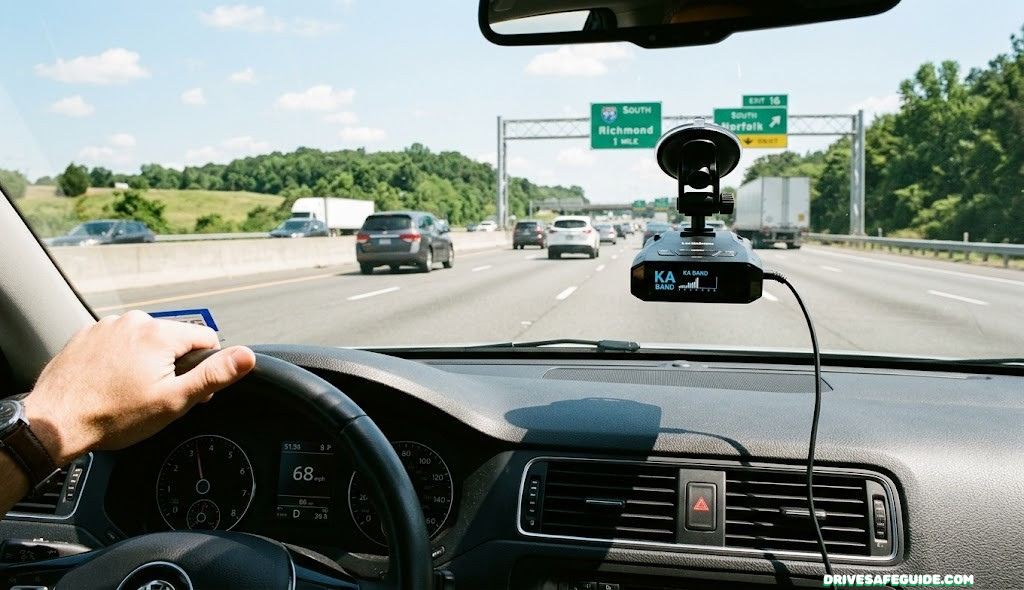
A radar detector is one of the few pieces of car gear where the legality question is genuinely more complicated than the technology itself. The hardware hasn’t changed dramatically in years, but the patchwork of state, federal, and international rules governing where you’re allowed to use one absolutely has. A device that’s a completely ordinary accessory in one state can be a confiscated piece of contraband forty miles down the same highway. This guide breaks down exactly where radar detectors are legal, where they’re not, how laser jammers are treated as an entirely different legal category, and what commercial and international drivers specifically need to know before they mount one to the windshield.
None of this is abstract legal trivia. Getting it wrong doesn’t just mean a device gets confiscated; in commercial contexts it can mean a fine layered on top of a violation that follows a driver’s record. Treat this the same way you’d treat any other piece of equipment law, like window tint darkness limits or modified exhaust legality: worth ten minutes of research before you spend money on the equipment, not after.
This guide is organized to move from the general to the specific: first the technology and the overall legal framework, then the state-level detail, then the special cases that trip up otherwise well-prepared drivers, like commercial vehicle status, military installations, and international travel. If you already know roughly where your route falls and just need the fast answer, the state reference table and comparison table further down are built to be skimmed on their own. If you’re planning a longer trip through several jurisdictions, reading the full guide once is worth the extra few minutes, since the exceptions tend to matter more than the general rule once a route gets complicated.
Why Radar Detector Laws Are So Confusing
Most vehicle equipment law in the United States is set primarily at the state level, and radar detectors are no exception, but they have an unusual added wrinkle: a separate federal layer applies specifically to commercial vehicles, regardless of what the state otherwise allows. That means the same stretch of interstate can have one legal standard for a passenger car and a completely different one for the truck driving next to it.
Layer onto that a second axis of confusion: radar detectors and laser jammers are regulated as fundamentally different categories of device in many jurisdictions, even though most drivers lump them together mentally as “the same kind of thing.” A state that permits passive detection can still ban active jamming outright, with meaningfully different penalties attached to each. Add international travel, where an entirely separate set of provincial or national rules applies the moment you cross a border, and it’s easy to see why so many drivers simply guess rather than verify.
The rest of this guide works through each of those layers individually, starting with a short technical primer on what these devices actually do, since the legal distinctions only make sense once the underlying technology is clear.
There’s also a simple structural reason the confusion persists: radar detector statutes are old relative to the technology they govern. Many of the laws on the books today were written decades ago, then amended piecemeal as radar and laser enforcement technology evolved, rather than rewritten from scratch. That history is why terminology sometimes lags behind what a device actually does, and why a strict reading of an older statute occasionally produces a legal answer that feels out of step with how modern detectors and jammers actually function. When state guidance and plain statutory text seem to disagree, the safest assumption is always the more restrictive one.
How Radar Detectors Work: A Quick Primer
A radar detector is a passive receiver. It doesn’t transmit anything; it simply listens for the radio frequency bands that police radar guns use to measure vehicle speed, and it alerts the driver when it picks up a signal strong enough to suggest a nearby unit. Because it’s receive-only, it has no way to interfere with an officer’s equipment, which is the central legal distinction that separates it from a jammer.
Modern detectors typically monitor several radar frequency bands used across different regions and eras of law enforcement equipment, plus a separate laser detection sensor for LIDAR guns. Detection range varies enormously depending on terrain, weather, the angle of the signal, and whether the enforcement unit is running continuously or only activated briefly, a mode commonly called instant-on specifically to reduce the warning window a detector can provide.
Understanding this passive, receive-only mechanism matters because it’s exactly the distinction most state laws draw when deciding what to regulate. A device that only listens is treated very differently from a device that talks back, and that single technical difference is the hinge the entire legal landscape swings on.
It’s also worth understanding what a detector cannot do, since marketing sometimes implies more than the physics actually delivers. A detector cannot see around a hill or through a curve; it relies on a direct or reflected line of sight to the transmitting radar unit, which is why detection ranges shrink dramatically in hilly or heavily wooded terrain compared to flat, open highway. It also cannot detect an officer who is using a fully manual, unaimed visual speed estimate, or a camera-based system that doesn’t rely on radar or laser at all, which is an entirely different enforcement method covered in more detail later in this guide.
Federal vs. State Law: Who Actually Regulates Radar Detectors
For private passenger vehicles, radar detector legality is almost entirely a state matter. There is no general federal law banning ordinary drivers from owning or using one, and the Federal Communications Commission’s involvement is limited to certifying that a device doesn’t emit interfering radio signals of its own, which is a manufacturing standard rather than a use restriction.
Commercial vehicles are the major exception. The Federal Motor Carrier Safety Administration prohibits radar detectors in commercial motor vehicles operating in interstate commerce above a certain weight threshold, and this rule applies uniformly across all fifty states regardless of what each state individually allows for private cars. A truck driver crossing from a state where detectors are otherwise legal into one where they’re banned doesn’t experience a change in their own legal status, because the federal commercial rule already applied the entire time.
| Vehicle Type | Governing Authority | General Rule |
|---|---|---|
| Private passenger vehicle | Individual state law | Legal in most states, banned in a small number |
| Commercial motor vehicle (interstate) | Federal (FMCSA) | Banned nationwide regardless of state |
| Rental vehicle | State law + rental agreement | Follows the state you’re driving in |
| Military installation | Federal/installation policy | Often banned on base regardless of state |
The practical takeaway is that private drivers need to check state law for wherever they’re currently driving, while commercial drivers can treat the federal rule as a constant they never need to re-check state by state. We’ll cover the commercial rule in more depth further down.
It’s worth noting that federal law can also preempt or interact with state law in more subtle ways beyond the commercial vehicle rule, particularly around radio frequency emissions and device certification. The FCC’s role is limited to ensuring a detector doesn’t broadcast interference on frequencies it shouldn’t, which is a manufacturing and import standard rather than a use restriction, so a device sold legally in US retail channels has already cleared that bar regardless of which state you’re driving in. State law then layers a separate, use-based restriction on top of that baseline federal certification, which is why the two systems can coexist without directly conflicting: one governs whether the device can be manufactured and sold at all, the other governs whether you’re allowed to use it on a given stretch of road.
States Where Radar Detectors Are Fully Legal
The majority of US states place no restriction at all on owning or using a radar detector in a private passenger vehicle. This includes the large majority of the country by both population and land area, which is part of why many drivers assume the devices are universally legal until they research a specific trip and discover otherwise.
- No state permit, registration, or declaration is required to own or use a legal detector.
- Windshield mounting is generally permitted as long as it doesn’t obstruct the driver’s direct line of sight, a separate rule that applies to any mounted device.
- Legal status applies equally whether the detector is a standalone unit or integrated into a dash cam or navigation device.
- Most legal states also permit laser jammers, though this should always be verified separately since the two categories aren’t always bundled together in statute.
Even in fully legal states, it’s worth remembering that a radar detector doesn’t create any right to speed, nor does it provide a defense if cited. It’s a legal accessory, not a legal shield, and courts treat it exactly that way if the question ever comes up.
It’s also worth understanding why the majority of states landed on permissive rules in the first place, since it’s not simply an oversight. Several state legislatures have explicitly considered and rejected detector bans over the years, generally on the reasoning that a passive receiving device doesn’t itself create a safety hazard the way an active jammer or a genuinely unsafe piece of equipment might. That policy reasoning is part of why the legal landscape has remained fairly stable over time in permissive states, even as enforcement technology on the police side has continued to evolve. A driver relocating from a legal state to a banned one, or vice versa, is often surprised that the underlying policy debate is decades old rather than a recent development.
States and Areas Where Radar Detectors Are Banned or Restricted
Two jurisdictions stand out as the clearest and most consistently enforced bans in the country: Virginia and Washington, D.C. Both prohibit radar detector use in private passenger vehicles outright, not just in commercial trucks, and Virginia in particular has a long-standing reputation among road trip drivers precisely because of how consistently the law is enforced.
Enforcement Reality Check
In a state where radar detectors are banned, having the device confiscated is a realistic outcome of a routine stop, not a rare edge case. If your road trip route passes through a banned jurisdiction, the safest approach is to remove or fully power down and store the unit before you enter that state, not simply switch it off while it remains mounted.
Beyond the two clear statewide bans, restrictions layer in around specific contexts even in states that otherwise permit detectors broadly: commercial vehicles nationwide under the federal rule already discussed, certain military installations regardless of surrounding state law, and in a handful of states, restrictions specifically on laser jammers even where detectors themselves remain legal. This is exactly the kind of nuance covered further in our breakdown of how traffic rules vary meaningfully state by state, which is worth a look if you’re road-tripping across multiple jurisdictions on the same trip.
Because enforcement and interpretation shift more often than most drivers expect, treat any specific state-by-state list, including the general guidance here, as a starting point rather than a final answer, and verify current law for your specific route before departure.
Virginia’s ban predates most modern radar detector technology by decades, and it has survived numerous legal challenges over the years precisely because it targets the mere presence of a functioning receiver rather than any specific use of it. That legal design choice is part of why the ban has proven so durable and so consistently enforceable compared to some other states’ more narrowly written statutes: there’s very little ambiguity for a court to interpret when the rule is simply “the device may not be present and operable in the vehicle,” full stop, regardless of intent or actual use at the time of the stop.
A Quick State-by-State Reference
The following table is meant as a fast orientation rather than a substitute for checking current law on your exact route. Categories, exceptions, and enforcement emphasis can all shift, so treat anything here as a starting point to verify, not a final citation.
| State / Area | Passenger Vehicle Status | Notes |
|---|---|---|
| Virginia | Illegal | Consistently and strictly enforced statewide |
| Washington, D.C. | Illegal | Applies within district boundaries |
| California | Legal (radar); jammers restricted | Laser jammers treated more strictly |
| Texas | Legal | No general statewide restriction |
| New York | Legal (cars); illegal in commercial trucks/buses | Separate rule for larger vehicles even intrastate |
| Illinois | Legal | No general restriction for private vehicles |
| Florida | Legal | No general restriction for private vehicles |
| Minnesota | Legal | No general restriction for private vehicles |
| All other states not listed | Generally legal | Always confirm current local statute before travel |
Notice the pattern in a few of the entries above: some states that fully permit radar detectors still draw a hard line around laser jammers, or apply a different standard to commercial and larger passenger vehicles like buses. This is exactly the kind of nuance that a simple “legal or illegal” headline can flatten, so when a specific state matters to your trip, it’s worth reading the actual statute summary rather than relying on a single-word classification from any source, including this one.
If your trip touches several states in a single day, which is common on long interstate routes, it’s worth mapping the jurisdictions in advance the same way you’d map fuel stops. Our route planning guide and driver app roundup both cover tools that make this kind of multi-state planning easier to manage on the fly.
Radar Detectors vs. Speed and Red-Light Cameras
A common point of confusion is assuming a radar detector provides any warning against fixed photo enforcement, like speed cameras or red-light cameras. It doesn’t, at least not directly. Most photo enforcement systems don’t rely on the same radar or laser frequencies a detector monitors; many use inductive loop sensors embedded in the road, separate laser systems that operate differently from handheld guns, or simple time-and-distance calculations between two fixed points.
- Radar-based fixed cameras can sometimes be picked up by a detector, but coverage isn’t guaranteed across all system types.
- Purely camera and sensor-based systems with no radar or laser component won’t trigger a radar detector at all.
- GPS-based detector databases often include known fixed camera locations as a separate alert category, which is a mapping feature rather than a radar detection feature.
- Legality of the camera systems themselves, and how citations are processed, is a completely separate legal question from radar detector legality.
This distinction matters practically because a driver relying solely on a radar detector for photo enforcement zones is working with a partial picture at best. A detector with a strong GPS-based camera database closes some of that gap, but it’s worth understanding it as a mapping feature layered on top of the radar hardware rather than something the radar sensor itself is detecting.
Radar Detectors vs. Laser Jammers: Different Legal Categories
It’s easy to assume a radar detector and a laser jammer are simply two versions of the same product, but legally they occupy very different territory. A detector listens; a jammer actively transmits a signal designed to interfere with or scramble a laser gun’s ability to get an accurate reading. That active transmission is exactly what draws stricter regulation.
Radar Detector
- Passive, receive-only operation
- Legal in the large majority of US states
- No interference with enforcement equipment
- Generally treated as an ordinary accessory
Laser Jammer
- Active transmission designed to interfere
- Illegal in several states where detectors are legal
- Can carry harsher penalties than detector bans
- Regulated separately in most state statutes
Some states that fully permit radar detectors specifically prohibit laser jammers, treating active interference with law enforcement equipment as a more serious matter than passive detection. Before purchasing a jammer specifically, verify its legal status independently rather than assuming it’s covered by the same rules as a standard detector, since conflating the two is one of the more common and consequential mistakes drivers make in this space.
There’s a useful mental model that keeps the two categories straight without needing to memorize statute language: a detector is closer to a smoke alarm, it notices something and alerts you, while a jammer is closer to actively disabling that smoke alarm so it can’t function at all. Regulators and courts tend to view the second category as meaningfully more aggressive, which is why penalties for jammer possession or use often carry heavier fines, and in some jurisdictions criminal rather than purely civil consequences, compared to a straightforward detector violation in the same state.
Commercial Vehicles and Radar Detector Restrictions
Commercial drivers operate under a materially different rulebook than private drivers, and it’s worth understanding in some detail given how many road trip vehicles, from larger vans to trailers, can brush up against commercial classification thresholds without the driver realizing it.
- Federal rules prohibit radar detectors in commercial motor vehicles over 10,000 pounds gross vehicle weight operating in interstate commerce.
- The ban applies to the device being present and operational in the cab, not just actively displaying an alert.
- Violations can result in a driver being placed out of service and can affect a carrier’s federal safety rating, a consequence with real financial weight for commercial operators.
- The rule applies uniformly nationwide, regardless of whether the specific state being driven through otherwise permits detectors for private vehicles.
If you’re renting or borrowing a larger vehicle for a road trip, particularly anything approaching a commercial weight classification with a trailer attached, it’s worth double-checking whether the combined weight crosses the federal threshold before assuming private-vehicle rules apply. Our guide to trailer hitch classes covers weight ratings in more detail if towing is part of your trip.
It’s worth being precise about who the federal rule actually covers, since the “commercial vehicle” label causes confusion of its own. The restriction applies to vehicles engaged in interstate commerce above the weight threshold, which captures the large majority of long-haul trucking but doesn’t automatically apply to every large vehicle on the road. A privately owned RV, for instance, isn’t operating in interstate commerce in the regulatory sense even though it may weigh more than a commercial threshold, so it typically falls back under whichever state’s private-vehicle rule applies rather than the federal commercial ban. Drivers who genuinely aren’t sure which category their vehicle and use case fall into should check directly with FMCSA guidance or a qualified transportation attorney rather than guessing, since the financial and licensing consequences of a commercial violation are meaningfully higher than a simple state equipment fine.
Military Bases and Federal Property Restrictions
Even in states where radar detectors are broadly legal, driving onto a military installation or certain other federal properties can subject you to a completely separate set of rules set by the installation itself rather than the surrounding state. Many bases prohibit radar detectors on the premises regardless of state law, and this is enforced as a condition of entry rather than a traffic law in the traditional sense.
This distinction matters most for drivers who live near or regularly access a base for work or family reasons, but it’s also relevant for road trip routes that happen to pass through or near installations with public-access roads. When in doubt, the simplest solution is the same one that applies to any banned jurisdiction: power the unit down and store it out of sight before entering federal property where the rule might apply, rather than assuming your home state’s law travels with you.
The same logic extends, with less consistency but a similar spirit, to some national park roads and tribal lands, where a separate governing authority can set its own vehicle equipment rules independent of the surrounding state. These situations are far less standardized than the military base example, so if your route includes an extended stay inside a park or on tribal land, it’s worth a quick check with that specific authority rather than assuming state law is the only relevant layer. Our guide to national park vehicle passes covers a related category of park-specific vehicle requirements that’s worth reviewing at the same time.
Canada and International Radar Detector Laws
Drivers planning a cross-border road trip into Canada need to treat radar detector legality as a completely separate question from US state law, because Canadian provinces set their own rules independently. Ontario and Quebec both prohibit radar detectors outright, including simply possessing one in the vehicle even if it’s powered off, and enforcement at the provincial level is generally strict and consistent.
| Province / Region | Radar Detector Status | Notable Detail |
|---|---|---|
| Ontario | Illegal | Possession alone can result in confiscation |
| Quebec | Illegal | Enforced similarly strictly to Ontario |
| Most other provinces | Legal | Verify current status before departure regardless |
| Most European countries | Illegal or heavily restricted | Rules vary significantly by country |
If your route into Canada crosses through a legal province before or after a banned one, the safest approach mirrors the domestic advice above: remove or fully store the device before entering restricted territory rather than relying on it being switched off while still mounted. If a border crossing is part of your route, it’s worth reviewing our broader border crossing vehicle inspection guide alongside this one, since equipment legality and document readiness are both part of the same pre-departure homework.
Outside North America, the general pattern shifts noticeably toward restriction. The United Kingdom permits radar detectors but prohibits laser jammers outright, drawing the same active-versus-passive distinction discussed earlier in this guide but applying it at a national rather than state level. Australia’s rules vary meaningfully by state and territory in a pattern that echoes the American system, with some jurisdictions banning detectors entirely and others permitting them with restrictions on where they can be used. Most of continental Europe leans toward broad restriction or outright bans on both detectors and jammers, reflecting a generally stricter regulatory posture toward speed enforcement countermeasures than is typical in North America. Any driver planning an international trip involving a rental vehicle should assume the device is not permitted until they’ve confirmed otherwise for that specific country, rather than assuming a North American default applies.
What Happens If You’re Caught With an Illegal Radar Detector
Consequences scale with jurisdiction and vehicle type, but a few outcomes are consistent enough to plan around. In a state or province with an outright ban, an officer who spots a mounted detector during a stop can issue a citation and confiscate the device as part of the same interaction, without needing any additional evidence beyond its presence in the vehicle.
- Citation and fine, with the exact amount set by the specific jurisdiction’s statute.
- Confiscation of the physical device, which is rarely returned even after a fine is paid.
- For commercial drivers, a potential out-of-service order and an entry on the carrier’s federal safety record.
- In rare aggravated cases involving jammers specifically, penalties can escalate well beyond a simple equipment fine.
None of these outcomes require the detector to have actually been in active use or to have provided any warning at the time of the stop. Presence and operability are typically enough to establish the violation in a banned jurisdiction, which is exactly why the “just don’t have it turned on” workaround doesn’t hold up in practice.
There’s also a secondary consequence worth flagging that has nothing to do with the detector itself: a stop that begins as an equipment check can sometimes broaden into a more thorough review of the vehicle and its occupants, simply because the driver is already out of the flow of traffic and the officer is already engaged. This isn’t universal and shouldn’t be treated as an inevitability, but it’s one more reason the simplest risk management strategy, removing or storing the device before entering a restricted jurisdiction, is worth the minor inconvenience compared to the range of possible downstream outcomes from a stop that didn’t need to happen in the first place.
Radar Detector vs. Laser Jammer: Full Comparison
Bringing the distinctions from earlier sections together into a single reference makes the practical differences easier to keep straight when you’re actually shopping for a device.
| Feature | Radar Detector | Laser Jammer |
|---|---|---|
| How it works | Passive reception | Active signal interference |
| Typical legality | Legal in most US states | Illegal in several states that allow detectors |
| Commercial vehicle status | Banned federally (interstate CMVs) | Banned federally (interstate CMVs) |
| Detection vs. defeat | Alerts driver only | Attempts to defeat a laser reading |
| Typical penalty severity | Standard equipment fine where banned | Often more severe, treated as interference |

Long-Range Radar & Laser Detector
Broad frequency coverage with a dedicated laser sensor, built for states where detectors are legal.
Check Price on AmazonChoosing a Legal, Effective Radar Detector for Your State
Once you’ve confirmed a detector is legal for the states or provinces your route actually covers, the shopping decision comes down to a handful of practical factors rather than marketing claims. Range, false-alert filtering, and how the unit handles instant-on radar tend to matter far more day-to-day than headline specifications.
- Multi-band radar coverage plus a dedicated laser sensor, since laser enforcement is increasingly common in many areas.
- GPS-based false alert filtering, so the unit learns to ignore fixed sources like automatic doors and speed signs.
- A low-profile mount that doesn’t obstruct the windshield, satisfying the separate driver-visibility rules that apply regardless of detector legality.
- Firmware or app updates, since enforcement frequency data improves meaningfully over a device’s lifespan.

Compact GPS-Filtered Detector
A smaller footprint unit with automatic false-alert filtering, well suited to daily driving as well as long trips.
Check Price on AmazonPairing a detector with a dash cam is a natural combination for many drivers, both for general road documentation and because some newer units integrate the two functions into a single windshield-mounted device. If you’re shopping for either separately, our 4K dash cam comparison and general dash cam buying guide both cover the mounting and low-light considerations that overlap with detector placement.

4K Dash Cam With Wide Dynamic Range
Documents the drive itself while leaving windshield space free for a separate detector mount.
Check Price on AmazonMounting position also matters more than most drivers initially expect, both for reception quality and for compliance with the separate windshield-obstruction laws mentioned earlier. Centered, low placement near the rearview mirror mount tends to balance a clean line of sight ahead against consistent forward-facing detection, and it keeps the unit out of the driver’s direct line of sight far more reliably than a suction mount placed lower and further into the driver’s field of view. A dedicated low-profile mount or hardwired kit reduces cord clutter across the windshield, which both looks cleaner and avoids any secondary equipment complaint during a routine stop.
Hardwire Mount & Cable Management Kit
Keeps windshield-mounted electronics clean, low-profile, and out of the driver’s direct sightline.
Check Price on AmazonStaying Updated: How Laws Change and How to Verify Current Rules
Radar detector law doesn’t change often at the state level, but it does change, and enforcement emphasis shifts even more frequently than the statutes themselves. Relying on a single list, whether it’s this guide or any other source, without a final check before a long trip is the most common way well-informed drivers still end up caught off guard.
- Check the specific state department of motor vehicles or state police site for any jurisdiction on your route a few weeks before departure.
- For international travel, check the relevant provincial or national transportation authority directly rather than a general aggregator site.
- Join or check community sources for real-time driver reports, which often surface enforcement pattern changes before official guidance updates.
- When a route crosses multiple states or provinces, verify each one individually rather than assuming consistency across the trip.
If you’re already building a broader pre-trip verification habit, it pairs naturally with the kind of route and law research covered in our cross-country driving checklist, which treats regional legal variation as a standard planning step rather than an afterthought.
It’s also worth building a habit of checking a device’s own compliance documentation when purchasing, since reputable manufacturers typically publish a state-by-state legality summary specific to their product line and update it as laws shift. This isn’t a substitute for your own verification, since it’s ultimately the driver’s responsibility to know the law for wherever they’re driving, but it’s a useful secondary source that’s often more current than generic third-party lists that don’t get revisited after publication. Cross-referencing a manufacturer’s compliance page against a state’s own official statute summary before a long trip takes only a few minutes and closes most of the realistic gap between “probably fine” and “confirmed fine.”
The Bottom Line
Radar detector legality isn’t complicated once it’s broken into its actual parts: check your state, treat laser jammers as a separate and stricter category, remember the federal commercial vehicle ban applies everywhere, and re-verify the moment you cross a state, provincial, or national line. A device that’s a completely ordinary accessory ninety percent of the time only causes a problem when a driver assumes the rule from the last state still applies in the next one. Build the verification step into your regular pre-trip routine the same way you’d check tire pressure or fuel range, and the device stops being a legal question mark and goes back to being exactly what it was designed to be: a quiet, useful piece of driving equipment that mostly stays out of the way.
Explore More Defensive Driving GuidesFrequently Asked Questions
Are radar detectors legal in all US states?
No. Radar detectors are legal for private passenger vehicles in most states, but Virginia and Washington, D.C. prohibit their use entirely, and additional restrictions apply near certain military installations regardless of state law.
Is it legal to use a radar detector in a commercial truck?
No. Federal Motor Carrier Safety Administration rules prohibit radar detectors in commercial motor vehicles over 10,000 pounds operating in interstate commerce, regardless of whether the state the truck is driving through otherwise allows them.
What’s the difference between a radar detector and a laser jammer?
A radar detector passively listens for radar and laser signals and alerts the driver, while a laser jammer actively transmits a signal to interfere with a laser gun’s reading. Jammers are regulated far more strictly and are outright illegal in several states where detectors are permitted.
Can a radar detector be confiscated by police?
In states where radar detectors are illegal, such as Virginia, police can stop a vehicle, issue a citation, and confiscate the device on the spot as part of the enforcement process.
Do radar detectors work against LIDAR laser guns?
Only if the detector includes dedicated laser detection sensors, and even then detection range against LIDAR is inherently much shorter than against radar because laser beams are narrow and don’t scatter forward the way radio waves do.
Is a radar detector legal in Canada?
It depends on the province. Radar detectors are illegal in Ontario and Quebec, legal in most other provinces, and simply carrying one in your vehicle while transiting a banned province can result in confiscation even if it’s turned off.
Will using a radar detector void my auto insurance?
Using one legally has no effect on insurance. However, a citation received for using a banned radar detector or jammer in a restricted state can contribute to a driving record that affects future premiums.
Are radar detector apps on a phone treated the same as hardware units?
Legally, most states treat crowdsourced alert apps differently from radar-receiving hardware, since the apps don’t detect an actual signal. However, a small number of jurisdictions still restrict any device used for the purpose of evading speed enforcement.
Do rental cars ever come with radar detectors installed?
Almost never as factory equipment, though some radar-sensing driver alert features are increasingly built into newer vehicles as part of driver assistance systems, which is a separate and generally legal category from an aftermarket radar detector.
Can a windshield-mounted radar detector itself be illegal, separate from its function?
Yes, in some states windshield-mounted devices of any kind are restricted if they obstruct the driver’s view, which is a separate law from radar detector legality specifically and applies regardless of what the mounted device does.
How often do radar detector laws change?
Not frequently at the state level, but enforcement emphasis and interpretation can shift, and crossing between states or countries means the applicable law changes the moment you cross the line, so it’s worth reverifying before any long road trip.
Does a radar detector help against handheld or moving radar?
Yes, most modern detectors pick up the same radar frequency bands used by handheld, dash-mounted, and moving-mode radar guns, though instant-on radar still limits the effective warning window regardless of detector quality.
🔑 Drive Smart
Stay Alert With a Top-Rated Radar Detector
Know what’s ahead on the road. Top-rated radar detectors keep you aware of speed cameras and police radar so you can adjust in time.
🔍 Shop Radar DetectorsAffiliate link — we earn a small commission that keeps DriveSafeGuide running. Thank you!