5 Best Car Battery Testers : Don’t Get Stranded
The sound of a car failing to start—that sluggish, groaning “rur-rur-rur” followed by silence—is a universal driver’s nightmare. It usually happens when you are already late for work, or worse, in the middle of a road trip safety checklist scenario miles from home.
While having a portable jump starter is an excellent reactive measure, it doesn’t solve the core problem: knowing why your battery failed. Is it just old? Is your alternator not charging it? Or did you leave a light on?
This is where a dedicated car battery tester becomes essential. Unlike a basic multimeter that only tells you voltage, a proper battery tester analyzes the State of Health (SOH) and Cold Cranking Amps (CCA). It’s the difference between guessing and knowing.
At DriveSafeGuide, we’ve analyzed the market to bring you the 5 best car battery testers available in 2025. Whether you are a DIY novice or a seasoned mechanic, one of these tools belongs in your garage alongside your emergency flashlight and OBD2 scanner.
Quick Comparison: Top Rated Battery Testers
| Model | Type | Best For | Voltage | System Test |
|---|---|---|---|---|
| TOPDON BT100 | Digital Conductance | Overall Best | 12V | Cranking & Charging |
| ANCEL BA101 | Digital Professional | Data Lovers | 12V | Yes + PC Print |
| FOXWELL BT705 | Heavy Duty | Trucks/Commercial | 12V & 24V | Full System |
| Schumacher BT-100 | Analog Load | Budget/Old School | 6V & 12V | Load Only |
| QUICKLYNKS BM2 | Bluetooth Monitor | Tech Savvy | 12V | App Monitoring |
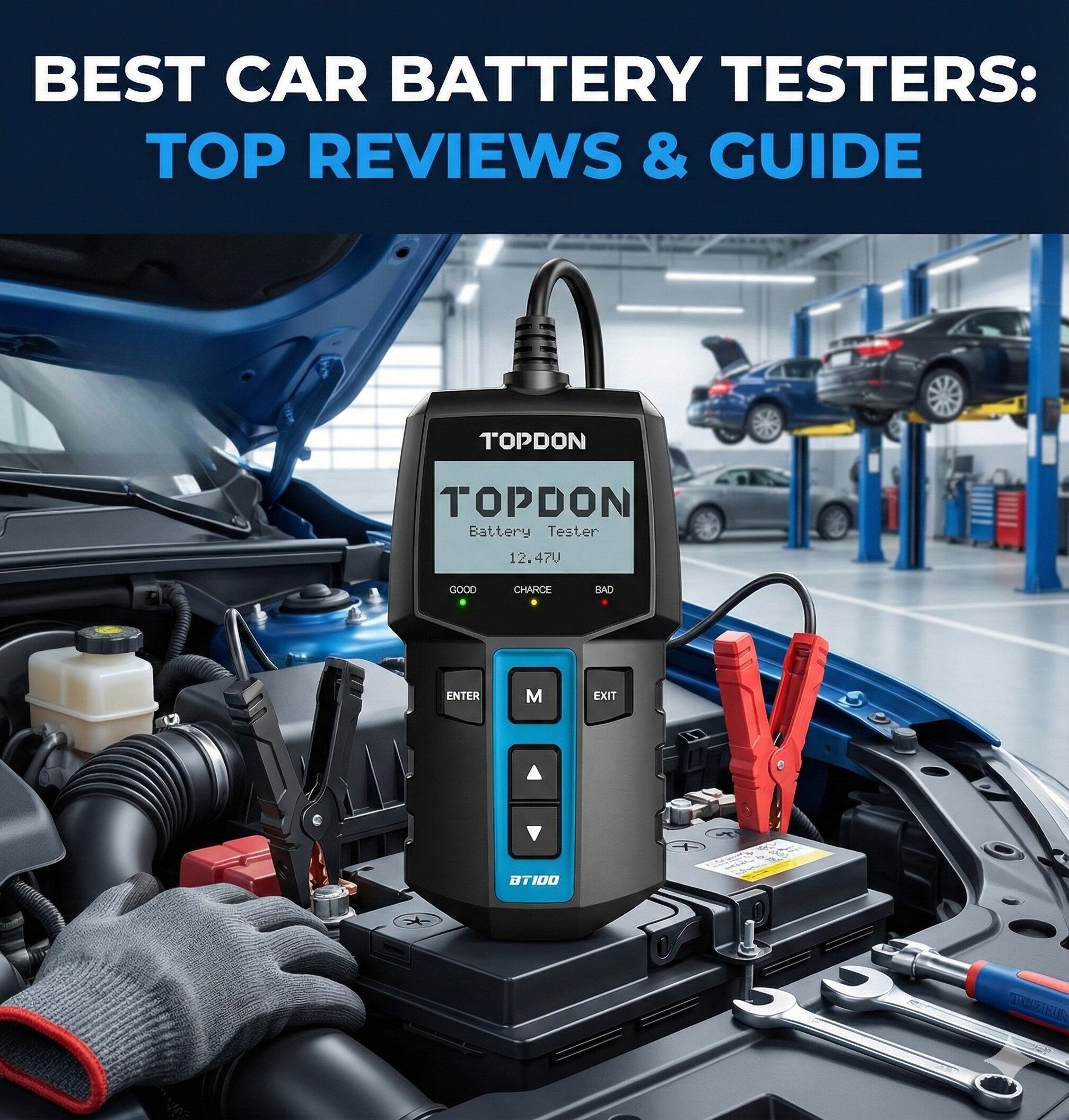
1. TOPDON BT100: The Best Overall Value

If you want a device that is plug-and-play, accurate, and affordable, the TOPDON BT100 is the undisputed champion for most passenger vehicles. It strikes the perfect balance between professional features and user-friendly interface.
Why It Stands Out
The BT100 doesn’t just give you a “Good/Bad” light. It provides specific metrics including voltage, internal resistance, and CCA rating. It utilizes advanced conductance testing technology, meaning it won’t drain your battery while testing it, nor will it get dangerously hot like older analog testers.
It also features a Cranking Test (to check the starter) and a Charging Test (to check the alternator). If your car is struggling to start, this tool helps you verify if the issue is the battery or if you need to look into engine warning lights related to the charging system.
- Extremely easy to use, even for beginners.
- Compact size fits in any glovebox.
- Tests batteries both in and out of the vehicle.
- Clear LCD screen with intuitive navigation.
- Cable length is adequate but could be longer for large trucks.
- No data printing capability.
2. ANCEL BA101: The Professional’s Choice for Data

For those who want a deeper dive into their vehicle’s electrical health, the ANCEL BA101 offers capabilities usually found in much more expensive shop tools. It is a favorite among DIY mechanics who already own specialized gear like the best car safety tools.
Precision and Printing
The standout feature of the BA101 is its extended cable range and the ability to print data via a PC. If you are diagnosing a car for a friend or a customer, being able to hand them a printed report of their battery health is a professional touch.
It covers a wide range of battery types including Regular Flooded, AGM Flat Plate, AGM Spiral, and Gel batteries. Whether you are prepping for winter (check our winter emergency checklist) or just doing routine maintenance, the BA101 provides peace of mind.
- Long 3-foot cable makes reaching terminals easy.
- USB port for printing test results via computer.
- Very fast analysis speed.
- Rugged housing design.
- The PC software interface looks a bit dated.
- Slightly bulkier than the TOPDON unit.
3. FOXWELL BT705: The Heavy-Duty Powerhouse
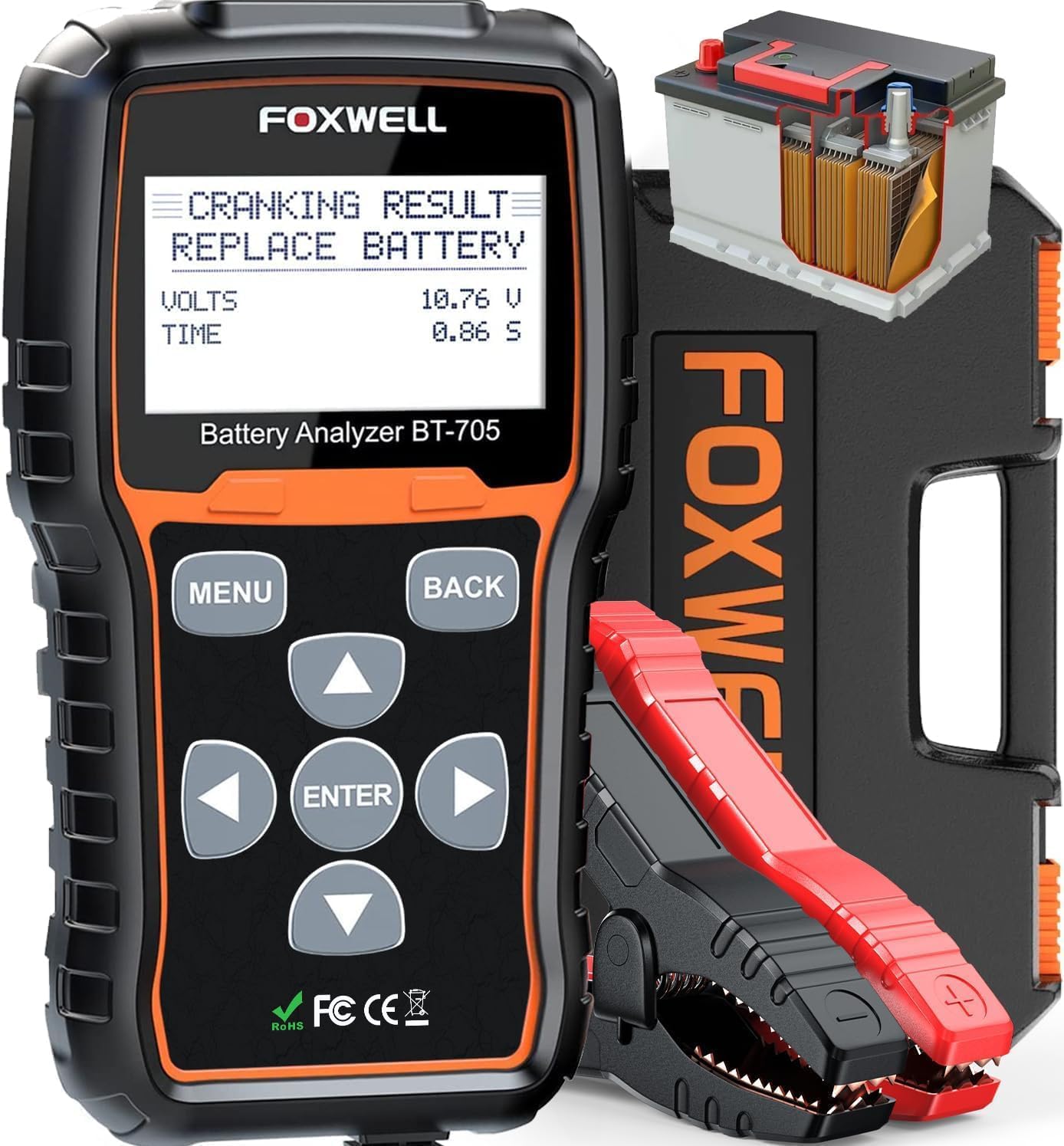
Do you own a diesel truck, an RV, or a car with a 24V system? Standard testers won’t cut it. The FOXWELL BT705 is designed to handle the heavy lifting. This unit is built for the garage that has everything from air compressors to hydraulic jacks.
Versatility Across Vehicles
The BT705 is unique because it can test both 12V and 24V charging systems, making it indispensable for commercial vehicles or heavy-duty pickups. It uses advanced Kelvin clamp technology to ensure a solid connection even on corroded terminals.
If you are wondering why your car shakes when you drive, it’s usually mechanical, but if your electronics flicker simultaneously, a deep system test with the BT705 can rule out alternator spikes or voltage drops.
- Compatible with 12V and 24V systems.
- Premium copper clamps for accurate readings.
- Detects “surface charge” for more accurate results.
- Rubberized sleeve for impact protection.
- Significantly more expensive than basic 12V testers.
- Overkill for a standard compact sedan.
4. Schumacher BT-100: The Budget “Old School” Load Tester

Sometimes, technology isn’t the answer. Sometimes, you just need physics. The Schumacher BT-100 is a traditional load tester. It works by applying a physical 100-amp load to the battery—simulating the act of starting the car—and seeing if the voltage holds.
Simple and Effective
This is one of the top budget-friendly car gadgets available. It has no digital screen to break and no batteries to replace. You hook it up, flip the switch, watch the needle, and feel the heat. It is incredibly definitive; either the battery holds the load, or it doesn’t.
However, be careful. The unit gets very hot during use (because it converts that electrical energy into heat). It’s great for checking batteries on cars, lawn tractors, or even motorcycles (6V systems).
- Extremely affordable.
- No internal batteries required to operate.
- Works on 6V and 12V batteries.
- Simple “Pass/Fail” analog gauge.
- Generates significant heat (safety caution required).
- Requires a “cool down” period between tests.
- Not as precise as digital analyzers.
5. QUICKLYNKS BM2: The Bluetooth Battery Monitor

What if you didn’t have to pop the hood to check your battery? The QUICKLYNKS BM2 stays permanently attached to your battery terminals and sends data to your phone via Bluetooth. This is the future of maintenance.
Continuous Monitoring
This device is perfect for vehicles that sit for long periods, such as convertibles stored for winter or classic cars. It alerts your phone if the voltage drops too low. It pairs perfectly with other safe driving apps for smartphones to create a complete digital dashboard for your car.
While it doesn’t perform a heavy load test like the Schumacher, it excels at tracking trends. You can see a graph of your voltage over 30 days, helping you identify if your battery drains overnight (parasitic draw).
- Wireless monitoring via smartphone app.
- Great for detecting parasitic drains.
- Sends notifications when charge is low.
- Installation is “set and forget.”
- Bluetooth range is limited (must be near the car).
- App interface can be finicky on some phones.
Buying Guide: How to Choose the Right Battery Tester
Not all testers are created equal. Before you buy, consider these factors to ensure you’re getting the right tool for your vehicle.
1. Compatibility (CCA and Voltage)
Most cars run on 12V systems. However, if you have a vintage car (6V) or a heavy truck (24V), you need a specific tester. Also, check the CCA range. A small tester might handle a Honda Civic (400 CCA) but struggle with a diesel Ford F-350 (900+ CCA).
2. Test Types
A basic tester checks voltage. A good tester checks Health. The best testers checks the System (Cranking and Charging).
- Battery Test: Tells you if the battery is dead or needs charging.
- Cranking Test: Checks if the starter motor is pulling too much voltage.
- Charging Test: Verifies the alternator is replenishing the battery.
3. Climate Considerations
Batteries behave differently in the cold. If you are learning how to drive on black ice or live in freezing regions, ensure your tester has temperature compensation features. Cold batteries show lower CCA, and a good tester accounts for this.
4. Ease of Use
If you aren’t a mechanic, avoid the analog load testers (like the Schumacher) which get hot and spark. Stick to digital conductance testers (like TOPDON or ANCEL). They are safer, cooler, and give clear “Replace” or “Good” instructions. These make excellent gifts for new car owners.
How to Use a Digital Battery Tester: Step-by-Step
Most drivers assume battery testing requires a mechanic, but a digital conductance tester turns this into a five-minute driveway job. Here is the process in detail so you get a reading you can actually trust.
Step 1: Prepare the Vehicle
Turn off the engine, headlights, radio, and any accessories. Open the hood and let the battery rest for a few minutes if the car has just been driven. A battery that was recently charged by the alternator carries a “surface charge” that can produce an artificially high voltage reading, which throws off the test.
Step 2: Locate and Clean the Terminals
Find the positive (red, marked +) and negative (black, marked -) terminals. If you see white or greenish crust around the posts, that’s corrosion, and it can cause a false low reading. A quick wipe with a wire brush or a baking-soda-and-water paste resolves this before you connect any clamps.
Step 3: Enter the Battery Specifications
Most digital testers ask you to select the battery type (Flooded, AGM, Gel, or EFB) and enter the rated CCA or CA number printed on the battery label. Skipping this step, or guessing the number, is the single most common reason people get a confusing result. If you can’t find the label, the manufacturer’s website or the door-jamb sticker on many vehicles will list the OEM rating.
Step 4: Connect the Clamps
Attach the red clamp to the positive terminal first, then the black clamp to the negative terminal or an unpainted metal ground point. A loose or corroded connection is the most common cause of an “Error” or “Check Connection” message on the display.
Step 5: Read the Results
The tester will display voltage, a State of Health percentage, and often a plain-language verdict such as “Good Battery,” “Recharge and Retest,” or “Replace Battery.” If the unit has a system test mode, start the engine (carefully, with clamps still attached per the manual) to run the cranking and charging tests.
Step 6: Log or Act on the Result
If the battery passes but is more than four years old, it’s worth re-testing every few months, since conductance can decline quickly once a battery starts to age. If it fails, that’s your cue to shop for a replacement before you’re stuck, rather than after.
Understanding Battery Chemistry: Flooded, AGM, Gel, and EFB Explained
One keyword that trips up a lot of buyers is “AGM battery tester,” because not every tester handles every chemistry the same way. Here’s a plain-English breakdown of what’s under your hood.
Flooded (Wet Cell) Batteries
This is the traditional, most common, and least expensive battery type. Lead plates sit in a liquid electrolyte bath. They’re reliable and cheap to manufacture, but they are more sensitive to vibration and deep discharging than newer chemistries.
AGM (Absorbent Glass Mat) Batteries
Increasingly standard on vehicles with start-stop technology, AGM batteries hold the electrolyte in a fiberglass mat instead of loose liquid. This makes them spill-proof, vibration-resistant, and capable of handling the frequent cycling that start-stop systems demand. AGM batteries also tend to have a slightly different voltage curve than flooded batteries, which is exactly why selecting the correct battery type on your tester matters so much for an accurate State of Health reading.
Gel Batteries
Similar to AGM in that the electrolyte is immobilized, but using a silica-thickened gel instead of a mat. These are less common in daily-driver cars and more frequent in deep-cycle applications like RVs, boats, and mobility scooters.
EFB (Enhanced Flooded Battery)
A middle ground between traditional flooded and AGM, EFBs are built with reinforced plates to better tolerate the partial-discharge cycling of entry-level start-stop vehicles, at a lower cost than full AGM units.
Why this matters for testing: Feeding the wrong chemistry setting into a conductance tester can skew the internal resistance calculation, leading to a false “replace” verdict on a perfectly healthy AGM battery, or a false “pass” on a failing flooded one. Always double-check the battery label before you start the test.
Battery Tester vs. Multimeter vs. Trickle Charger: What’s the Difference?
These three tools get confused constantly because they all clip onto the same two terminals, but they do very different jobs.
Multimeter
A multimeter only reports voltage (and sometimes resistance or current if you know how to set it up manually). A reading of 12.6V tells you the battery is charged, but it says nothing about whether the battery can actually deliver enough current to crank a cold engine. This is the classic trap: the battery reads “full” on a multimeter yet still fails to start the car.
Battery Tester (Conductance or Load)
A dedicated tester goes further, measuring internal resistance or applying an actual load to calculate cranking capacity and overall health. This is the only category of tool that can tell you a battery is dying before it leaves you stranded.
Trickle Charger / Maintainer
A trickle charger doesn’t diagnose anything, it adds a small, steady current to keep a battery topped off, which is especially useful for vehicles that sit unused for weeks. A “smart” maintainer switches itself on and off automatically to prevent overcharging, while a basic trickle charger needs to be watched and disconnected manually. Neither one will tell you if your battery is actually healthy; that’s still a job for a tester.
The ideal home setup pairs a battery tester (to diagnose) with a maintainer (to prevent the problem from recurring), especially if you also keep a portable jump starter in the trunk as a backup for emergencies.
Reading Your Results: What CCA, SOH, and Internal Resistance Actually Mean
Digital testers throw a lot of numbers on the screen. Here’s what each one is telling you.
Cold Cranking Amps (CCA)
This is the amount of current a battery can deliver for 30 seconds at 0°F (-17.8°C) while staying above a minimum voltage. It’s printed on the battery label as its rated value; your tester compares the battery’s tested output against that rating.
State of Health (SOH)
Expressed as a percentage, SOH compares the battery’s current performance to its rated performance when new. A reading above roughly 80% is generally considered healthy, the 60-80% range is a gray zone worth monitoring, and anything below 60% usually means replacement is coming soon.
State of Charge (SOC)
This is simply how “full” the battery is right now, based on voltage. A fully charged 12V flooded battery reads about 12.6V; anything under 12.4V suggests it needs a charge before you can get an accurate health test.
Internal Resistance
As batteries age, chemical build-up inside the cells increases resistance to current flow. Conductance testers infer health largely from this resistance value, since rising resistance is one of the earliest and most reliable signs of a battery nearing the end of its life.
Signs Your Car Battery Is Failing (Before It Leaves You Stranded)
A battery tester is the confirmation tool, but your car often gives early warning signs long before the “click-click-click” moment.
- Slow engine crank: The engine turns over noticeably slower than usual, especially on cold mornings.
- Dashboard warning light: A battery-shaped icon illuminating is a direct signal to test the charging system.
- Dim headlights at idle: If headlights brighten when you rev the engine, the battery or alternator may be struggling to keep up with demand.
- Swollen or misshapen battery case: Heat and overcharging can cause the plastic casing to bulge, a sign the battery should be replaced immediately.
- Corroded terminals: A build-up of white or blue-green powder around the posts can indicate leaking or off-gassing.
- Old age: Most flooded batteries last 3-5 years; if yours is approaching or past that mark, testing it becomes a priority, similar to reviewing your road trip safety checklist before a long drive.
- Electrical gremlins: Flickering dashboard lights, a radio that resets itself, or power windows that move slower than normal can all point to a weakening battery.
How Climate Affects Battery Life and Testing
Temperature is the single biggest external factor in battery performance, which is why manufacturers rate cranking power specifically at freezing temperatures.
Cold Weather Effects
Cold thickens engine oil, making the starter motor work harder, at the exact moment a cold battery’s chemical reactions slow down and produce less current. This is why batteries seem to “die” more often in winter, even though the underlying degradation likely happened over the previous summer.
Hot Weather Effects
Heat is actually the bigger long-term enemy. High under-hood temperatures accelerate the chemical reactions that cause internal corrosion and fluid evaporation in flooded batteries, quietly shortening lifespan even when the battery seems fine on a warm afternoon. This is part of why we recommend testing twice a year: once before summer heat sets in, and again before winter cold arrives.
Temperature Compensation in Testers
Higher-end testers, including several on our comparison table, factor ambient or battery temperature into their calculations. Without this compensation, a cold battery can appear weaker than it actually is, while a battery tested right after highway driving in summer heat can appear artificially strong.
Battery Tester Accuracy and Calibration
A common question buyers search for is why two different testers, or a tester and a shop machine, sometimes disagree. A few factors explain most discrepancies.
- Surface charge: Testing immediately after driving or charging without letting the battery “rest” skews results high.
- Incorrect CCA input: Entering the wrong rated CCA changes the SOH percentage the tester calculates, even though the raw conductance measurement is the same.
- Algorithm differences: Budget and professional-grade testers use different proprietary formulas to convert conductance into a health percentage, so a small variance between brands is normal and doesn’t necessarily mean either unit is wrong.
- Clamp contact quality: Corrosion, a loose grip, or thin cable gauge on cheaper units can all introduce small measurement errors.
- Temperature at time of test: As covered above, testing a stone-cold battery versus a warm one can shift results by a meaningful margin without compensation.
In practice, digital conductance testers from reputable brands are accurate enough for consumer decision-making (replace vs. keep), even if they won’t match a $2,000 shop analyzer down to the decimal point.
DIY Testing vs. Taking It to a Shop or Auto Parts Store
Many auto parts retailers offer free battery testing, so it’s fair to ask whether buying your own tester is worth it.
The Case for Free In-Store Testing
It costs nothing, uses professional-grade equipment, and the staff can immediately sell you a replacement if needed. The downside is convenience: you have to remove the battery or drive there, and you’re at the mercy of their hours and, sometimes, a sales pitch.
The Case for Owning Your Own Tester
A personal tester pays for itself if you own more than one vehicle, live somewhere rural, or simply want to catch a problem before it strands you. Testing every six months takes five minutes in your own driveway instead of a special trip, and units like the TOPDON BT100 or ANCEL BA101 cost less than a single tow truck call-out.
When to See a Professional Anyway
If your tester repeatedly flags an issue with the charging system rather than the battery itself, that’s a sign to have the alternator, drive belt, and wiring inspected by a mechanic, since a home tester identifies symptoms but isn’t a substitute for full electrical diagnostics.
Battery Tester Cost Breakdown: What You’re Paying For
Prices for battery testers span a wide range, and understanding what drives that range helps you avoid overpaying or underbuying.
- Entry-level analog load testers (like the Schumacher BT-100) are the cheapest option, trading precision and safety convenience for a rock-bottom price.
- Mid-range digital conductance testers (like the TOPDON BT100) add accuracy, safety, and multiple test modes without a huge price jump, which is why they dominate “best overall” recommendations.
- Professional-grade testers with data printing (like the ANCEL BA101) cost more but pay off for anyone doing testing regularly for others, such as a side mechanic business.
- Heavy-duty and dual-voltage testers (like the FOXWELL BT705) command a premium because of their broader compatibility with 24V commercial and diesel systems.
- Bluetooth monitors (like the QUICKLYNKS BM2) are priced for convenience and continuous monitoring rather than one-time diagnostic depth.
As a rule of thumb, most drivers get the best return by matching the tester’s capability to their actual vehicle fleet rather than buying the most expensive unit available.
Battery Recycling and Safe Disposal
Once your tester confirms a battery needs replacing, disposing of the old one properly matters both legally and environmentally, since lead-acid batteries are classified as hazardous waste in most regions.
- Never throw a car battery in household trash. The lead and sulfuric acid inside can contaminate soil and water if it ends up in a landfill.
- Most retailers accept old batteries for free. Auto parts stores and many big-box retailers are required or incentivized to take your old battery, often with a “core charge” refund when you buy a new one.
- Keep it upright during transport. Tipping a battery can cause acid to leak from the vent caps.
- Recycling rates for lead-acid batteries are among the highest of any consumer product, since the lead and plastic casing are both highly reusable in new battery manufacturing.
Battery Testers by Vehicle Type
Not every driver has the same needs. Here’s how to think about tester selection based on what you actually drive.
Standard Passenger Cars and Sedans
A basic 12V digital conductance tester like the TOPDON BT100 covers the vast majority of use cases with no extra features needed.
Trucks, SUVs, and Diesel Engines
Diesel engines demand significantly higher CCA to crank a compression-ignition engine, especially in cold weather, so a tester with a wide CCA range or dual-battery support is worth the extra cost, similar in spirit to the FOXWELL BT705.
Motorcycles and Powersports
Many motorcycles and ATVs use smaller 12V or 6V batteries. Make sure any tester you buy explicitly supports low-CCA “powersport” testing, since some automotive-focused units have a minimum CCA threshold that’s too high for small batteries.
RVs, Boats, and Deep-Cycle Applications
Deep-cycle and dual-purpose batteries discharge and recharge differently than standard starting batteries, so look specifically for a tester or monitor, such as a Bluetooth-based option like the QUICKLYNKS BM2, that supports deep-cycle or marine battery profiles.
Commercial and Fleet Vehicles
Fleet operators benefit most from testers with data logging or printing, like the ANCEL BA101, since maintenance records for multiple vehicles need to be tracked and shared with drivers or shop staff.
Seasonal Battery Care Checklist
Pairing your tester with a seasonal routine catches problems while they’re still cheap and easy to fix.
Before Summer
- Test overall battery health, since heat accelerates internal degradation that may have started the previous winter.
- Check electrolyte level on flooded (non-sealed) batteries and top off with distilled water if low.
- Inspect and clean terminals, since heat speeds up corrosion buildup.
Before Winter
- Test CCA specifically, since cold weather is when marginal batteries finally fail.
- Consider a trickle charger or maintainer for vehicles that will sit unused during cold months.
- Review your winter emergency checklist to make sure jump-start gear and warm clothing are on hand just in case.
Long-Term Storage
If a vehicle will sit for more than a few weeks, either disconnect the battery or attach a smart maintainer. A battery left completely idle can self-discharge to a damagingly low voltage over just a few months, especially in cold storage conditions.
Common Battery Testing Mistakes to Avoid
- Testing right after driving or charging without letting surface charge dissipate, which skews results artificially high.
- Entering the wrong CCA rating, or skipping that step entirely, which throws off the calculated State of Health.
- Testing over dirty or corroded terminals, which can produce a falsely low reading due to poor contact.
- Ignoring a borderline result. A battery reading in the 60-80% health range should be retested in a month or two, not forgotten about until it fails outright.
- Assuming a passed battery test rules out all electrical problems. A healthy battery can still mask a failing alternator, loose ground strap, or parasitic drain elsewhere in the system.
- Using a load tester without ventilation or care around the heat it generates, which is a real safety consideration with analog units like the Schumacher BT-100.
Maintenance Tips: Extending Your Battery Life
A tester diagnoses the problem, but maintenance prevents it. Here are quick tips to keep your battery healthy:
- Clean Terminals: Corrosion adds resistance. Clean the posts with a wire brush and baking soda solution.
- Drive Regularly: Short trips don’t allow the alternator to fully recharge the battery. Take a longer drive once a week, especially if you are wondering how long it takes to drive around Oahu or just cruising the highway.
- Secure the Hold-Down: Vibration kills batteries. Ensure the battery is clamped down tight so internal plates aren’t damaged.
- Turn Off Accessories: Don’t leave headlights or AC on when the engine is off. This is a common mistake seen in common driving test mistakes.
- Use a Maintainer During Downtime: A smart trickle charger keeps a parked vehicle’s battery topped off automatically, switching on and off as needed without the risk of overcharging.
- Avoid Deep Discharges: Repeatedly running a standard starting battery down to near-empty shortens its life dramatically compared to keeping it consistently near full charge.
- Match Replacement Battery Specs Exactly: When it’s time to replace, match the group size, CCA, and chemistry (Flooded, AGM, EFB) to the original equipment rather than downgrading to save a few dollars.
Glossary of Battery Testing Terms
CCA (Cold Cranking Amps): The current a battery can deliver for 30 seconds at 0°F while maintaining a minimum voltage.
CA (Cranking Amps): Similar to CCA but measured at a milder 32°F, resulting in a higher number for the same battery.
MCA (Marine Cranking Amps): A rating commonly used for marine batteries, also measured at 32°F.
SOH (State of Health): A percentage comparing current battery performance to its original, as-new rated performance.
SOC (State of Charge): How full the battery currently is, typically derived from voltage.
Conductance Testing: A method of estimating battery health by measuring how easily an electrical signal passes through the plates, without draining the battery.
Load Testing: A method of testing battery health by applying an actual electrical load and observing whether voltage holds steady.
Parasitic Draw: A small, continuous electrical drain from something left on (or malfunctioning) that slowly depletes the battery even when the car is off.
Surface Charge: A temporary, artificially high voltage reading present right after driving or charging, before the battery has had time to rest and settle.
Desulfation: A process, offered by some smart chargers, intended to break down sulfate crystal buildup on battery plates that accumulates over time.
Buying Guide: How to Choose the Right Battery Tester
Not all testers are created equal. Before you buy, consider these factors to ensure you’re getting the right tool for your vehicle.
1. Compatibility (CCA and Voltage)
Most cars run on 12V systems. However, if you have a vintage car (6V) or a heavy truck (24V), you need a specific tester. Also, check the CCA range. A small tester might handle a Honda Civic (400 CCA) but struggle with a diesel Ford F-350 (900+ CCA).
2. Test Types
A basic tester checks voltage. A good tester checks Health. The best testers checks the System (Cranking and Charging).
- Battery Test: Tells you if the battery is dead or needs charging.
- Cranking Test: Checks if the starter motor is pulling too much voltage.
- Charging Test: Verifies the alternator is replenishing the battery.
3. Climate Considerations
Batteries behave differently in the cold. If you are learning how to drive on black ice or live in freezing regions, ensure your tester has temperature compensation features. Cold batteries show lower CCA, and a good tester accounts for this.
4. Ease of Use
If you aren’t a mechanic, avoid the analog load testers (like the Schumacher) which get hot and spark. Stick to digital conductance testers (like TOPDON or ANCEL). They are safer, cooler, and give clear “Replace” or “Good” instructions. These make excellent gifts for new car owners.
Frequently Asked Questions (FAQ)
What is the difference between a load tester and a conductance tester?
A load tester (traditional) applies a physical electrical load to the battery to see if it holds voltage, generating heat. A conductance tester (digital/modern) sends a low-frequency signal through the battery to calculate health without draining it or creating heat.
Can I test a battery while it is still in the car?
Yes, most modern digital battery testers allow you to test the battery while it is connected to the vehicle (in-vehicle test). However, ensure the engine and all accessories are turned off before starting the test.
How do I know what CCA my battery should have?
The Cold Cranking Amps (CCA) rating is printed on the label of your car battery. You will need to input this number into digital testers to get an accurate State of Health (SOH) reading.
Can a multimeter replace a battery tester?
Not entirely. A multimeter can only measure voltage (State of Charge). It cannot measure the Cranking Amps or internal resistance (State of Health). A battery can show 12.6V but still fail to start the car under load.
How often should I test my car battery?
It is recommended to test your battery twice a year, specifically before winter and summer, as extreme temperatures are the hardest on battery chemistry.
Will a tester work on a dead battery?
Most digital testers require a minimum voltage (usually around 7-8V) to power on. If the battery is completely flat, you may need to charge it slightly before the tester can analyze it.
Does the tester check the alternator too?
Yes, most of the top-rated testers on our list (like the TOPDON and FOXWELL) include a system test mode that analyzes the starter motor (cranking test) and the alternator (charging test).
Is it safe to use these testers?
Yes, modern conductance testers are spark-free and do not generate heat, making them very safe for users. Traditional load testers generate heat and require more caution.
What is the difference between a battery tester and a trickle charger?
A battery tester diagnoses the current health and charge of a battery, but it doesn’t add any energy to it. A trickle charger, or maintainer, slowly feeds current into the battery to keep it topped off over time. Many owners use both together: a tester to diagnose, and a maintainer to prevent the problem from recurring.
Do I need a different tester for an AGM battery?
Most modern digital conductance testers, including the models on our list, include a battery-type selector for Flooded, AGM Flat Plate, AGM Spiral, and Gel batteries. This means one tester can generally handle every common consumer battery chemistry as long as you select the correct type before testing.
Why does my battery tester give a different reading than the shop?
Small discrepancies usually come down to surface charge not being cleared before testing, an incorrect CCA value being entered, a temperature difference between test locations, or a lower-cost tester using a slightly different proprietary algorithm than a professional shop analyzer.
Can testing a battery damage it?
Digital conductance testing is completely non-invasive and cannot harm the battery, since it only sends a tiny diagnostic signal. Analog load testing draws real current and generates heat, so repeated tests in quick succession without a cooling-off period can add unnecessary stress, though a single test performed correctly is safe.
How long does a car battery typically last?
Most standard flooded batteries last around three to five years, while AGM batteries often last a bit longer under normal conditions. Climate, driving habits (short trips versus highway driving), and how well terminals are maintained all significantly affect actual lifespan.
What does it mean if my battery passes the test but my car still won’t start?
A passing battery test rules out the battery itself, which means the problem likely lies elsewhere: the starter motor, ignition switch, fuel system, or a corroded ground connection. At that point, a broader diagnostic tool such as an OBD2 scanner can help narrow down the cause.
Conclusion
A dead battery is more than an inconvenience; it’s a vulnerability. Whether you are prepping for a family vacation or just want to ensure you can get to work on time, a reliable battery tester is a small investment that pays massive dividends in peace of mind.
For most drivers, the TOPDON BT100 offers the perfect mix of price and performance. For the data-obsessed or semi-pro mechanic, the ANCEL BA101 is a fantastic upgrade. Whichever you choose, don’t wait until you hear that dreaded “click-click-click” to buy one.