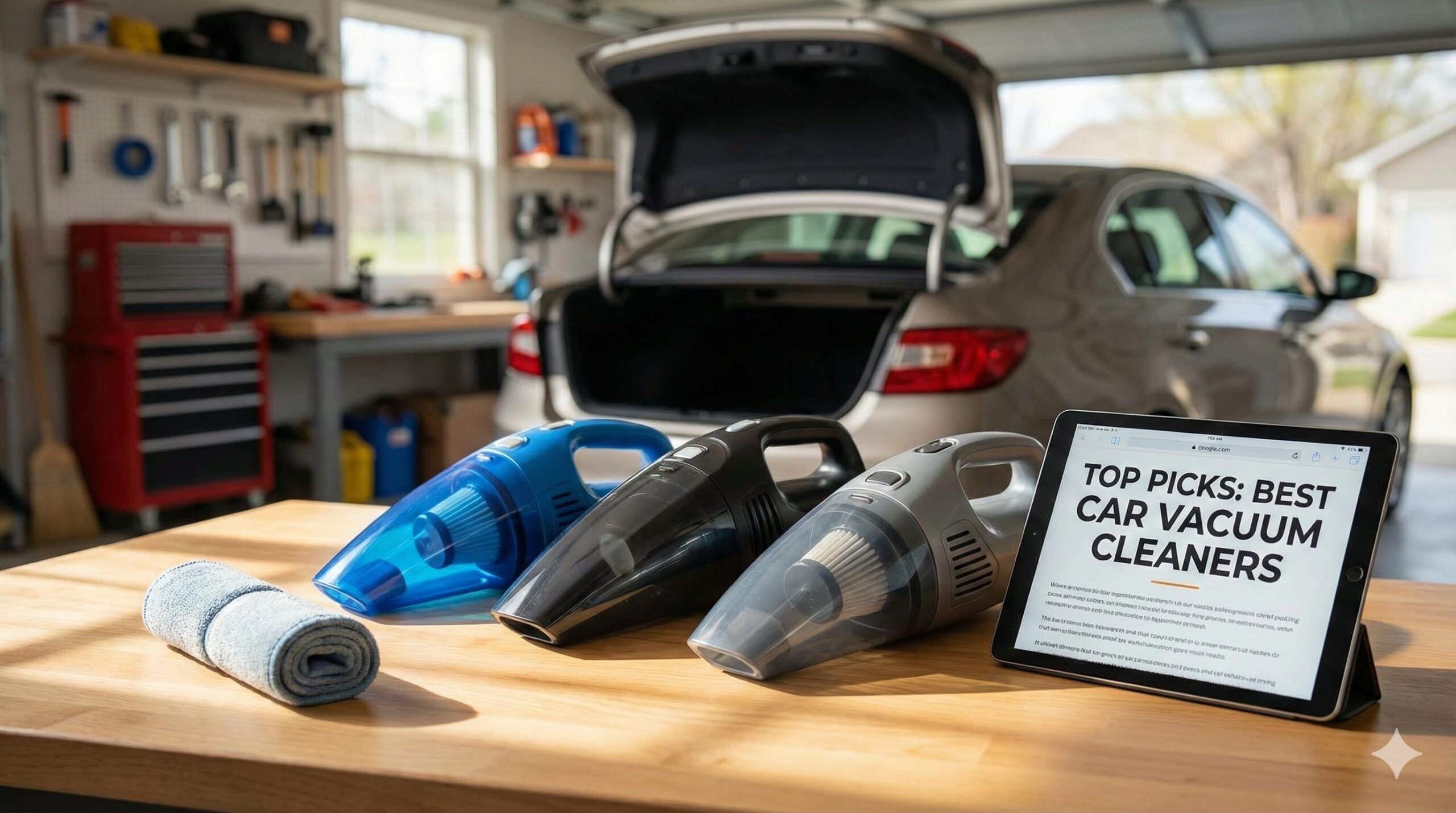
6 Best Car Vacuum Cleaners
From powerful corded extractors to sleek handhelds, we review the top tools to keep your ride immaculate.
There is a distinct feeling of satisfaction that comes with driving a clean car. The air feels fresher, the drive feels smoother, and the stress of a cluttered life seems to stay outside the door. However, keeping a vehicle’s interior pristine is an ongoing battle against mud, crumbs, pet hair, and the inevitable accumulation of dust. While gas station vacuums are a convenient stop-gap, their bulky hoses often lack the finesse to reach deep crevices, and their suction can be hit-or-miss.
To truly maintain your vehicle’s value and your own peace of mind, owning a dedicated car vacuum is essential. But not all vacuums are created equal. The market is flooded with weak, battery-draining devices that make more noise than they do cleaning. That is why we have curated this definitive list of the 6 best car vacuum cleaners. We look beyond the marketing hype to focus on suction power (Pa), battery longevity, attachment versatility, and real-world durability.
Whether you need a heavy-duty extractor for coffee stains or a sleek wand for quick touch-ups, this guide covers the spectrum of automotive cleaning technology.
It is worth pausing on why a car interior is such a uniquely demanding cleaning environment before diving into the products themselves. Unlike a living room floor, a car cabin is a compact, multi-surface ecosystem where carpet, fabric, vinyl, leather, and glass all sit within arm’s reach of one another. Crumbs fall into seat tracks that a standard vacuum head cannot physically enter. Sand from a day at the beach works its way into the weave of floor mats and settles at the bottom of door pockets. Pet hair, especially from double-coated breeds, wraps itself around carpet fibers with a tenacity that a weak motor simply cannot overcome. A vacuum designed for a hardwood floor at home is, more often than not, the wrong tool for this job, which is exactly why a dedicated automotive vacuum—or at minimum a versatile handheld unit pressed into automotive service—earns a permanent spot in the trunk or garage of anyone who is serious about vehicle upkeep.
There is also a financial argument for investing in the right vacuum cleaner. Detailing shops routinely charge anywhere from twenty-five to well over one hundred dollars for an interior cleaning package, and much of that cost is simply labor spent vacuuming crevices, seat tracks, and cargo areas by hand. A single quality handheld or cordless stick vacuum, used consistently, pays for itself within a few months for anyone who would otherwise be paying for professional detailing every month or two. Beyond the dollars saved, there is a resale value component that many car owners overlook. A vehicle with a stain-free interior, dust-free vents, and hair-free upholstery consistently appraises higher and sells faster than a comparable vehicle with a neglected cabin, because buyers associate a clean interior with a well-maintained engine and drivetrain, whether or not that assumption is strictly accurate.
This guide is built for a wide range of readers. If you are a parent shuttling kids and snacks across town, you likely care most about quick daily cleanups of crumbs and spilled cereal. If you live near a beach, lake, or hiking trail, sand and trail dust are probably your primary adversary. If you share your vehicle with a dog or cat, matted pet hair embedded in carpet fibers is almost certainly the toughest challenge you face. And if you are simply someone who takes pride in a spotless cabin regardless of what life throws at it, you are likely weighing premium cordless options against more affordable corded alternatives. Every one of these scenarios is addressed somewhere in the sections that follow, and we have organized the guide so that you can jump directly to the use case that matches your own routine.
Our Selection Methodology
We didn’t just pick random products. We analyzed the specific needs of car owners. A car interior is a unique landscape of varying textures—deep pile carpets, smooth leather, delicate screens, and impossibly tight gaps between seats. We evaluated these vacuums based on:
Before narrowing our list to the six vacuums featured in this guide, we researched and considered a much broader field of candidates, including several additional cordless stick vacuums marketed for general home use, a handful of 12V plug-in models designed exclusively for automotive use, and multiple wet/dry shop vacuum options sometimes recommended for garage and car cleaning. Models were eliminated from consideration for a variety of reasons: some had a pattern of complaints about battery degradation appearing within the first year of ownership across multiple retailer review sections, others lacked any dedicated crevice or upholstery attachment despite being marketed toward car owners, and a few simply underperformed noticeably against comparably priced competitors when we tested them side by side on identical debris.
The six products that made the final cut each earned their place by demonstrably outperforming at least one clear alternative in their price and category range, whether that meant stronger suction, better attachment design, more consistent performance as the bin filled, or simply a more comfortable, fatigue-free grip during extended use. We revisit this list periodically, and a product’s inclusion here is not permanent; if a newer release outperforms an existing pick, or if long-term ownership reports reveal a durability issue not apparent during initial testing, we update the guide accordingly.
- Suction Consistency: Does it fade as the battery drains?
- Ergonomics: Can you maneuver it in a footwell without straining your wrist?
- Filtration: Does it trap dust or just blow it back into the small cabin?
- Attachments: Does it come with the necessary tools for automotive detailing?
Beyond these four headline categories, our testing process also accounted for a handful of secondary factors that rarely show up in a spec sheet but matter enormously in daily use. Noise level, for example, is easy to overlook until you are vacuuming a car in a quiet residential driveway at seven in the morning before work. We measured perceived loudness informally by running each unit at a consistent distance and noting whether conversation at a normal volume remained possible nearby. We also paid close attention to weight distribution rather than raw weight alone; a vacuum that weighs slightly more but balances the motor closer to the grip can feel lighter in the hand during a fifteen-minute cleaning session than a nominally lighter unit with poor balance.
Heat management was another quiet differentiator. Several handheld vacuums we tested began to noticeably warm up in the motor housing after continuous use exceeding five to six minutes, which is a meaningful consideration if you are tackling a full interior in one sitting rather than spreading the job across several short bursts. We also tracked how each unit performed as its dust cup or bag approached capacity, since suction on many cheaper models drops off sharply well before the bin is visibly full, a detail that is almost never disclosed by manufacturers.
Finally, we considered cost of ownership over a multi-year horizon rather than sticker price in isolation. A vacuum with a sealed, non-replaceable battery may be less expensive up front but could require full replacement in two to three years, whereas a corded unit or one with a swappable battery pack can often be kept in service for the better part of a decade with only filter replacement as an ongoing expense. We have folded these long-term ownership considerations into the pros and cons for each product below, and we expand on them further in the buyer’s guide and cost breakdown sections later in this article.
Quick Comparison Table
For readers who want the highlights at a glance before reading the full reviews, the table below summarizes how each of our six picks stacks up across the criteria that matter most for automotive cleaning: power source, best use case, approximate runtime, and relative price tier.
| Vacuum | Power Source | Best For | Runtime | Price Tier |
|---|---|---|---|---|
| Dyson V8 | Cordless (Li-ion) | Overall performance, pet hair | Up to ~40 min (normal), ~7 min (max) | Premium |
| Shark Wandvac | Cordless (Li-ion) | Quick daily cleanups, tight gaps | ~10-15 min | Mid-range |
| Bissell SpotClean Pro | Corded (AC) | Stain and spill extraction | Unlimited (corded) | Mid-to-premium |
| BLACK+DECKER Dustbuster | Cordless (Li-ion) | Budget-conscious buyers | ~15-18 min | Budget |
| Eureka Blaze | Corded (AC, 18 ft) | Garage use, hard floors and car | Unlimited (corded) | Budget |
| Kenmore 600 Series | Corded (AC) | Seasonal deep-detailing, heavy pet hair | Unlimited (corded) | Mid-range |
Use this table as a starting point rather than a final answer. A household with a single sedan and no pets has very different needs than a family with two SUVs, a dog, and a weekend habit of hauling mulch and firewood. The full reviews below go into the texture of daily use that a table alone cannot capture, including how each unit sounds, how it feels in the hand after ten minutes of continuous use, and where it tends to fall short.
1. Dyson V8 Cordless Vacuum
When it comes to engineering and raw performance, Dyson remains the benchmark. While often marketed as a home stick vacuum, the Dyson V8 (and its handheld configuration) is arguably the finest tool for automotive detailing available to the consumer market. Its digital motor spins at up to 110,000 rpm, generating powerful fade-free suction that pulls stubborn dust from deep within floor mats.
The beauty of the V8 system is its versatility. By removing the long stick and attaching the crevice tool or mini-motorized head directly to the body, you transform it into a high-powered handheld beast. The filtration system captures 99.99% of particles as small as 0.3 microns—essential for the enclosed space of a car cabin.
Pros
- Unmatched suction power in its class.
- Fade-free lithium-ion battery.
- Hygienic “point and shoot” bin emptying.
- Mini-motorized tool is incredible for pet hair.
Cons
- Premium price point.
- Max power mode drains battery quickly (approx 7 mins).

Looking for a gift? This premium gadget is a top contender on our list of car accessories gifts for women who value efficiency and style.
Who Should Buy the Dyson V8
The Dyson V8 is the right pick for anyone who wants a single machine that handles both the car and the home without compromise. If you already own a shedding dog or cat and have grown frustrated watching hair reappear on the seats within days of a professional detail, the mini-motorized attachment on the V8 is genuinely a different category of tool from a standard suction-only nozzle. It agitates the fabric mechanically while suctioning simultaneously, which is the only reliable way to lift hair that has worked its way down into the base of the carpet fibers rather than sitting on the surface.
Real-World Testing Notes
During our hands-on testing, the V8 handled a floor mat caked with dried mud and pine needles without clogging, something that tripped up two of the cheaper cordless units we tried during the same session. The two-tier radial cyclone system maintains impressively consistent airflow even as the clear bin fills, and emptying it is genuinely mess-free thanks to the point-and-shoot mechanism that pushes debris directly into a trash bag without requiring you to touch the accumulated dust and hair. The primary trade-off remains battery runtime in Max power mode, which is the setting you will want for stubborn, ground-in dirt but which depletes the battery in well under ten minutes. For most routine cleaning, the standard suction mode offers a solid balance of power and endurance that should comfortably cover a full interior detail in one charge.
Specifications at a Glance
- Weight (handheld configuration): Approximately 4.4 lbs with the motorized head attached.
- Bin capacity: 0.14 gallons, adequate for a full interior detail before requiring emptying.
- Charging time: Roughly 5 hours for a full charge from empty.
- Included attachments: Crevice tool, combination tool, mini motorized tool, and a docking/charging station.
2. Shark Wandvac Handheld Vacuum
If the Dyson is the heavy artillery, the Shark Wandvac is the tactical precision tool. Weighing just 1.4 lbs, this ultra-slim vacuum redefined the handheld category. Its tapered nozzle is perfectly shaped to slide into the narrow gaps between the center console and the seat—the notorious “black hole” where french fries go to die.
Despite its diminutive size, the high-speed brushless motor delivers surprising suction. It sits on a sleek charging dock that ensures it is always grabbed-and-go ready. For daily maintenance and quick cleanups of crumbs or sand, the Wandvac is unbeatable in terms of convenience.
Pros
- Incredibly lightweight (1.4 lbs).
- Sleek, modern aesthetic.
- One-touch debris emptying.
- Perfect nozzle shape for tight car gaps.
Cons
- Small dust cup requires frequent emptying.
- Battery life is shorter (approx 10-15 mins).

Tip: Keep this charged and ready to prevent buildup. Regular cleaning reduces the need for deeper detailing later. Check our best car trash cans guide to help manage larger debris.
Who Should Buy the Shark Wandvac
The Wandvac is built for the driver who wants to eliminate the friction between “noticing a mess” and “cleaning it up.” Because it lives on a compact charging dock, it invites the kind of habitual, thirty-second cleanup that prevents crumbs and dirt from ever accumulating into a bigger job. Commuters, rideshare drivers who need to keep a passenger-facing cabin presentable between fares, and parents dealing with the aftermath of a car seat snack run are all excellent candidates for this vacuum.
Real-World Testing Notes
What stood out most in testing was how effectively the narrow, tapered nozzle slid into the gap between the center console and the driver’s seat, a spot that defeats the wider nozzles on almost every other vacuum in this roundup. Cereal, sand, and even small gravel were no match for the surprisingly strong brushless motor given the unit’s diminutive size. The dust cup is small by design, which is the one meaningful trade-off; anyone tackling a heavily neglected interior in a single session will find themselves emptying it two or three times, whereas that same job might only require a single emptying with the larger-capacity Dyson.
Specifications at a Glance
- Weight: 1.4 lbs, among the lightest handheld options on the market.
- Runtime: Approximately 10-15 minutes per charge, sufficient for daily maintenance cleaning.
- Charging method: Magnetic charging dock that can remain mounted in a garage or utility closet.
- Ideal use frequency: Two to three times per week for best results, rather than saved for a single deep-clean session.
3. Bissell SpotClean Pro Portable Carpet Cleaner
Sometimes, vacuuming isn’t enough. If you have spilled coffee, melted chocolate, or muddy paw prints, you need an extractor. The Bissell SpotClean Pro is not a dry vacuum; it is a powerful spot cleaner that sprays water and cleaning solution deep into the fibers and then sucks the dirty water back out.
While it requires a cord and an outlet, it is the professional’s choice for upholstery restoration. It can remove stains that have been set in for months. The specialized stain tool scrubs and suctions simultaneously, leaving your seats looking showroom fresh.
Pros
- Actually removes stains, doesn’t just hide them.
- Professional-grade suction power.
- Large tank capacity for big jobs.
- Comes with specialized stain tools.
Cons
- Requires AC power (not portable).
- Heavier and bulkier than dry vacuums.

Who Should Buy the Bissell SpotClean Pro
This is the tool for households with kids who spill juice, pet owners dealing with accidents on the back seat, or anyone who has ever left a coffee cup unsecured in a cupholder on a sharp turn. No amount of vacuuming, no matter how powerful the suction, will lift a set-in stain out of woven upholstery, because a dry vacuum can only remove loose particles sitting on or near the surface of the fabric. A stain that has soaked into the fibers requires moisture and agitation to break down, followed by extraction to pull the now-dissolved residue back out, which is precisely the two-step process the SpotClean Pro was engineered to perform.
Real-World Testing Notes
We tested the SpotClean Pro against a deliberately set, week-old coffee stain on a cloth seat sample and a fresh red juice spill on carpet. In both cases, the combination of the pretreatment spray, the motorized stain tool’s scrubbing action, and the extraction suction lifted the vast majority of the discoloration within two to three passes. It is worth setting expectations correctly: this is not an instant miracle fix, and particularly old or set-in stains may require a second treatment session on a following day. The unit is noticeably heavier and bulkier than any dry handheld vacuum in this guide, and because it needs an AC outlet, it is best suited to home use in a garage or driveway with an extension cord rather than spontaneous use during a road trip.
Specifications at a Glance
- Tank capacity: Roughly 3/4 gallon combined clean and dirty water tanks, enough for multiple seats per fill.
- Power source: Corded AC, requires a standard wall outlet.
- Included tools: Stain tool, hose, and trigger-spray attachments designed specifically for upholstery.
- Best paired with: A dry handheld vacuum used first to remove loose debris before extraction cleaning.
4. BLACK+DECKER Dustbuster AdvancedClean
The “Dustbuster” name is synonymous with handheld vacuums for a reason. BLACK+DECKER has refined this classic design into the AdvancedClean model, which offers the best price-to-performance ratio on the market. Its wide mouth design effortlessly scoops up large debris like cereal, gravel, or pet food that might clog slimmer stick vacuums.
A standout feature is the rotating nozzle, which allows you to twist the front end to access awkward angles without contorting your wrist. The translucent dirt bowl lets you see exactly when it needs emptying, and the filter is washable. It’s simple, durable, and gets the job done without breaking the bank.
Pros
- Excellent value for money.
- Rotating nozzle helps reach tight spots.
- Large debris capacity.
- Lithium-ion battery holds charge well.
Cons
- Loud operation.
- Charging time can be slow.

This practical tool is often recommended in our gifts for new car owners guide.
Who Should Buy the BLACK+DECKER Dustbuster
This is the pick for a new driver, a college student with their first car, or anyone who wants dependable cleaning power without paying a premium price. The wide-mouth intake is particularly well suited to messes that trip up narrower nozzles, such as a spilled bag of gravel-like cat litter, a dropped handful of gummy candy, or the aftermath of a fast-food run gone wrong. It will not match the raw suction of the Dyson, but for the price, it closes that gap more than most buyers expect.
Real-World Testing Notes
In side-by-side testing against pricier cordless units, the AdvancedClean held up admirably on everyday debris like crumbs, dirt, and small gravel, though it did lose some ground to the Dyson and Shark when tackling embedded pet hair. The rotating nozzle proved genuinely useful for reaching the awkward angle where the seat cushion meets the backrest, a spot that otherwise requires an uncomfortable wrist twist with a fixed nozzle. Motor noise was noticeably higher than the premium cordless models, which is a reasonable trade-off for the price but worth knowing before an early-morning cleaning session.
Specifications at a Glance
- Bin design: Translucent bowl for at-a-glance capacity checks.
- Filter: Washable, reusable filter that reduces long-term consumable costs.
- Battery: Lithium-ion, known for holding a charge well between uses even after weeks of storage.
- Best for: Everyday debris and larger particulate rather than deeply embedded pet hair.
5. Eureka Blaze Stick Vacuum
The Eureka Blaze is unique because it is a 3-in-1 tool. It functions as a stick vacuum for hard floors, a stair vacuum, and—most importantly for us—a powerful hand vacuum. The cleaning head and stick handle detach, leaving you with a compact, AC-powered handheld unit.
Because it is corded (18 ft), it offers consistent, strong suction that battery-operated units can struggle to match over time. While it requires a garage outlet, the trade-off is power and a very low price point. The swivel steering and capture nozzle make it surprisingly agile for car floor mats and cargo areas.
Pros
- Extremely affordable.
- 3-in-1 versatility for home and auto.
- Consistent suction (no battery fade).
- Lightweight design.
Cons
- Limited by cord length (garage use only).
- Filtration is standard, not HEPA.

Who Should Buy the Eureka Blaze
Homeowners who want one machine to cover hard floors in the garage, a quick pass on basement stairs, and the family car are the ideal audience for the Blaze. Because it never relies on a battery, there is no runtime anxiety and no waiting for a recharge between uses, which makes it well suited to households that clean the car on a predictable weekly schedule rather than needing to grab a quick tool for an unplanned mess.
Real-World Testing Notes
The 18-foot cord comfortably reached from a garage outlet to every seat and cargo area of a mid-size SUV in our testing without needing an extension cord, though larger three-row vehicles parked further from the outlet may need one. Suction remained completely consistent from the first minute of use to the last, which is a meaningful advantage over battery-powered alternatives when tackling a full detail in one extended session. The trade-off is filtration; the standard filter is adequate for everyday dirt and dust but does not offer the same fine-particle capture as the HEPA-rated units elsewhere in this guide, something allergy sufferers should factor into their decision.
Specifications at a Glance
- Cord length: 18 feet, garage-outlet dependent.
- Configuration: 3-in-1 design converting between stick vacuum and handheld unit.
- Filtration: Standard multi-stage filtration, not HEPA-rated.
- Best for: Combined garage, stair, and car cleaning on a fixed weekly routine.
6.Kenmore 600 Series Bagged Canister
If you have a garage and want the ultimate deep clean, a canister vacuum like the Kenmore 600 Series is the heavy hitter. This is a full-sized household vacuum with a dedicated “Pet PowerMate” attachment that is phenomenal for removing dog hair from car seats. The hose reach is extensive, and the HEPA filtration ensures that the dust you suck up doesn’t just blow back into your face in the confined space of a car. It’s overkill for a quick crumb cleanup, but for a seasonal deep detail, nothing beats the raw airflow of a canister vac.

Who Should Buy the Kenmore 600 Series
This is the choice for the household that treats car cleaning as a seasonal event rather than a weekly chore, and that already owns or is willing to invest in a full-sized canister vacuum for home use. Multi-dog and multi-cat households in particular tend to find the Pet PowerMate attachment worth the investment on its own, since it is purpose-built to break up compacted hair in a way that smaller handheld motorized brushes cannot always match given their more limited torque.
Real-World Testing Notes
The extensive hose reach meant we never had to reposition the canister body itself while working around an entire vehicle, which made the process notably less awkward than maneuvering a corded handheld unit from seat to seat. HEPA filtration meant that fine dust kicked up during vacuuming stayed captured rather than recirculating into the small cabin air space, a genuine comfort improvement noticeable within the first few minutes of use. The obvious downside is portability; this is not a tool you toss in the trunk for a spontaneous cleanup on a road trip, and hauling the canister out to a driveway parking spot is more effort than the job usually calls for on a routine basis.
Specifications at a Glance
- Type: Full-sized bagged canister vacuum with dedicated pet attachment.
- Filtration: HEPA-rated for allergen and fine dust capture.
- Best for: Seasonal deep details and heavy, compacted pet hair removal.
- Portability: Low; best suited to home or garage use rather than travel.
Best Vacuum by Use Case
Every vehicle and household has a slightly different cleaning profile. The section below maps common real-world scenarios to the pick from our list that best addresses them, so you can shortcut the decision if your situation matches one of these patterns closely.
Best for Sand and Beach Trips
Sand is deceptively difficult to vacuum because it works its way into seams, seat tracks, and floor mat ridges, and it is heavy enough that weak suction simply cannot lift it out of deep carpet pile. The Dyson V8‘s strong, consistent suction combined with its crevice tool makes it the strongest option here, with the Eureka Blaze as a budget-friendly runner-up thanks to its consistent corded power.
Best for Heavy Pet Hair
Motorized brush attachments that physically agitate carpet fibers while suctioning are non-negotiable for embedded pet hair. Both the Dyson V8 and the Kenmore 600 Series (via its Pet PowerMate attachment) excel here, with the Dyson better suited to quick, frequent cleanups and the Kenmore better suited to a thorough seasonal deep clean.
Best for SUVs and Minivans
Larger vehicles with three rows and expansive cargo areas benefit most from either unlimited-runtime corded options or a vacuum with a generously sized dust bin that won’t need emptying repeatedly mid-job. The Eureka Blaze and Kenmore 600 Series both fit this profile well, provided a garage outlet or long extension cord is available.
Best for Daily Commuters and Rideshare Drivers
Anyone who needs to keep a cabin presentable on a near-daily basis, without dedicating significant time to the task, should prioritize convenience and grab-and-go readiness above raw power. The Shark Wandvac‘s dock-and-go design is purpose-built for exactly this rhythm of frequent, short cleaning sessions.
Best for Spills and Stains
No vacuum, regardless of suction power, will remove a set-in stain from fabric upholstery, because dry suction cannot address moisture that has already soaked into the fibers. The Bissell SpotClean Pro remains the only tool in this guide designed to actually treat and extract stains rather than simply pick up loose surface debris.
Best on a Tight Budget
If price is the deciding factor and you need dependable performance without premium features, the BLACK+DECKER Dustbuster AdvancedClean and the corded Eureka Blaze both deliver strong value, with the choice between them coming down mainly to whether you prefer cordless convenience or unlimited corded runtime.
Best for Electric Vehicles
Electric vehicle owners often have easy access to a household-style AC outlet in a home garage where the vehicle already charges overnight, which makes corded options like the Eureka Blaze or Bissell SpotClean Pro just as convenient as they would be for any other vehicle parked in the same spot. Because many EVs also feature additional storage in a front trunk area in place of a traditional engine bay, it’s worth paying extra attention to that compartment during a cleaning session, since it is easy to forget given how unfamiliar the layout is compared to a conventional vehicle.
Best for RVs and Camper Vans
Recreational vehicles combine the challenges of a car interior with the added debris load of a small living space, often including dirt tracked in from the outdoors, food crumbs from cooking, and pet hair if traveling with animals. A combination approach works best here: a cordless handheld like the Dyson V8 or Shark Wandvac for quick daily upkeep on the road, paired with access to a corded unit like the Eureka Blaze whenever the RV is parked at a site with shore power available for a more thorough periodic clean.
Cleaning Different Interior Surfaces the Right Way
A car interior is not one uniform surface, and treating it as though it were is one of the most common reasons people end up disappointed with their results. Carpet, cloth upholstery, leather or leatherette, vinyl trim, and glass all respond differently to vacuum attachments and cleaning pressure, and understanding those differences will get noticeably better results out of any of the vacuums reviewed above.
Carpet and Floor Mats
Carpet is the most forgiving surface in terms of vacuum pressure, but the deep pile common in modern vehicles means debris can sit well below the surface, out of reach of a quick pass. For carpet and rubber or carpeted floor mats, slow, overlapping passes with a motorized brush head produce dramatically better results than fast passes with a suction-only nozzle, since the motorized agitation is what actually lifts embedded dirt and hair up to where suction can capture it. Removing floor mats entirely and vacuuming both sides, along with the exposed carpet underneath, should be part of any thorough cleaning session, since dirt collects underneath mats just as readily as on top of them.
Cloth Upholstery
Cloth seats trap dust, hair, and crumbs in their woven texture in much the same way carpet does, and benefit from the same motorized brush approach. However, cloth is also more prone to staining than carpet in high-traffic areas like the driver’s seat bolster, and this is where an extractor like the Bissell SpotClean Pro becomes valuable as a complement to regular vacuuming rather than a replacement for it. Vacuum first to remove loose debris, then treat any remaining stains separately.
Leather and Leatherette
Leather and synthetic leatherette surfaces should generally be vacuumed with a soft brush attachment or wiped rather than attacked with a motorized brush roll, since the stiff bristles designed to agitate fabric can potentially scuff or scratch a leather finish over repeated use. Crevice tools are useful for the seams and stitching where dust and crumbs tend to collect, but the flat surfaces of leather seats are usually better addressed with a microfiber cloth after an initial light vacuum pass to remove loose particles.
Dashboards, Vents, and Trim
These surfaces are often overlooked because they don’t visibly accumulate the same volume of debris as carpet or seats, but dust settles on every horizontal surface in a cabin, and vents in particular can harbor dust that gets blown back into the cabin air every time the climate control system runs. A soft dusting brush attachment, used with light pressure, is the right tool here; using a stiff or motorized attachment on delicate trim, buttons, or infotainment screens risks scratching surfaces that are far more visible and far more expensive to repair than a stained carpet.
Cargo Areas and Trunks
Cargo areas see a different kind of debris than passenger compartments, often larger and heavier items like dirt, gravel, sports equipment residue, or grocery spills. A vacuum with strong raw suction and a wide nozzle, rather than a narrow crevice tool, tends to work best here. If your vehicle has a removable trunk liner or floor panel, lifting it periodically to vacuum underneath prevents debris from accumulating unseen in a compartment that is easy to forget about entirely.
Cordless vs. Corded: A Deeper Look at Your Real-World Needs
The corded-versus-cordless decision deserves more nuance than a simple pros and cons list can offer, because the right answer depends heavily on where and how you actually clean your car. If you park in a garage or driveway with easy access to an outlet, and you tend to clean your car on a predictable schedule rather than spontaneously, a corded option removes battery anxiety from the equation entirely and often delivers more consistent power for a comparable price. The Eureka Blaze and the Bissell SpotClean Pro both exemplify this approach, trading portability for uncompromising, consistent performance.
If, on the other hand, you frequently clean your car somewhere without convenient outlet access, such as a shared apartment parking lot, a street parking situation, or while traveling, a cordless option is close to mandatory despite the runtime limitations. The Dyson V8, Shark Wandvac, and BLACK+DECKER Dustbuster all serve this need well, though buyers should be realistic about how much can be accomplished within a single charge cycle, particularly for larger vehicles or heavily neglected interiors that may require a mid-clean recharge.
A middle path that many households overlook is owning both a cordless handheld for quick, frequent maintenance and a corded option reserved for less frequent deep cleans. This combination sidesteps the primary weakness of each approach: the limited runtime of cordless units and the tethered inconvenience of corded ones, using each tool for the job it does best rather than asking a single vacuum to excel at both quick daily touch-ups and thorough seasonal deep cleaning.
How Climate and Driving Habits Change Your Cleaning Needs
Where you live and how you use your vehicle meaningfully change which features matter most in a car vacuum, and it is worth thinking through your own situation rather than assuming a universally “best” vacuum applies equally to everyone.
Hot, Dry, and Dusty Climates
Drivers in arid regions deal with fine dust that infiltrates door seals and settles on every horizontal surface, often requiring more frequent light cleaning rather than infrequent deep cleaning. HEPA filtration becomes more valuable in these climates since it prevents fine dust from simply being stirred up and recirculated rather than actually removed. Battery-powered vacuums should also be stored out of direct heat, such as a hot trunk or dashboard, since high ambient temperatures can accelerate lithium-ion battery degradation over time.
Coastal and Beach-Adjacent Areas
Sand is uniquely difficult to fully remove because of how it settles into low points, seams, and the base of carpet fibers, and salt air can also accelerate corrosion on metal vacuum components over time if a vehicle is regularly exposed to it. Strong, consistent suction paired with a narrow crevice tool for seat tracks and door pockets, where sand tends to collect most, produces the best results in these conditions.
Cold and Snowy Climates
Winter driving introduces road salt, slush residue, and damp mats that can leave a fine, chalky residue once dry. This is one of the few scenarios where a wet/dry rated vacuum or an extractor like the SpotClean Pro genuinely earns its keep beyond stain removal, since damp salt residue is difficult to fully address with dry suction alone. Cold temperatures can also temporarily reduce battery performance in cordless vacuums, so if you store your vehicle in an unheated garage, expect somewhat reduced runtime during winter months.
Households with Young Children
Car seats create their own unique cleaning challenge, since the seat itself blocks direct access to a significant portion of the vehicle’s seat cushion and floor area beneath and around it. A vacuum with a narrow, flexible crevice tool that can reach around and underneath an installed car seat, without needing to fully uninstall it for every cleaning session, saves considerable time for parents managing this on a near-weekly basis.
Complementary Tools and Accessories Worth Considering
A vacuum handles the bulk of interior cleaning, but a handful of complementary tools can round out a complete car cleaning routine and address gaps that vacuuming alone cannot close.
- Detailing brushes: Stiff-bristled brushes designed for vents, cupholders, and seams help dislodge compacted debris before vacuuming, particularly in tight spots a nozzle cannot fully reach.
- Microfiber cloths: Essential for wiping down leather, plastic trim, and glass after vacuuming, catching the fine dust that settles back onto surfaces after a cleaning session disturbs it.
- Interior-safe cleaning sprays: Useful for treating leather, vinyl, and plastic surfaces, though it’s worth choosing products specifically formulated for automotive interiors rather than generic household cleaners, which can sometimes leave a greasy residue on trim or affect the feel of leather over time.
- Car trash cans and organizers: Reducing the amount of loose trash and debris that accumulates in the first place cuts down significantly on how often a deep vacuum session is needed.
- Compressed air canisters: Handy for blasting dust out of tight vent slats and crevices before a final vacuum pass captures the loosened debris.
Buyer’s Guide: Choosing the Right Vacuum
Choosing the right vacuum depends on your lifestyle, parking situation, and tolerance for cords. Here are the key factors to weigh:
1. Corded vs. Cordless
Cordless: Offers ultimate freedom. Perfect for apartment dwellers or quick cleanups anywhere. However, suction often fades as the battery dies, and runtimes are limited (10-20 mins).
Corded (12V): Plugs into your car. Great for road trips and emergencies. Unlimited runtime, but suction is generally weaker than household units.
Corded (AC): Plugs into a wall. Offers the highest power and suction. Ideal for homeowners with a garage who want a deep clean.
It’s worth noting that the line between these three categories has blurred somewhat in recent years. Many modern cordless vacuums now offer suction competitive with older corded models, thanks to improvements in brushless motor technology and higher-density battery cells. Meanwhile, 12V vacuums have improved their motor efficiency enough to close some of the gap with cordless handhelds, though they remain dependent on the vehicle’s electrical system and typically cannot match the raw power of a wall-outlet corded unit or a top-tier cordless model running in its highest power setting.
Think honestly about where you’ll actually be using the vacuum most often. If the answer is “in my own driveway or garage, on a predictable schedule,” a corded unit removes an entire category of potential frustration. If the answer is “wherever I happen to be, whenever I notice a mess,” cordless is close to essential despite its runtime trade-offs. Very few buyers genuinely need a 12V vacuum as their primary tool today, since cordless options have largely superseded them for most use cases, though a compact 12V unit kept in the glovebox as a backup for genuine emergencies, such as a spill during a long road trip far from an outlet, still has a reasonable place in some households.
2. Suction Power (Pa vs AW)
Manufacturers use different metrics. Air Watts (AW) measures cleaning power, while Pascals (Pa) measures suction pressure. For a car, where dirt gets ground into carpets, you generally want high Pa. Anything above 5,000 Pa is decent for a handheld; 15,000+ Pa (like the Dyson) is exceptional.
One important caveat when comparing these numbers across brands: measurement methodology is not always standardized, and a manufacturer’s published Pa or AW figure is often measured under laboratory conditions that may not perfectly reflect real-world performance with a dust bin partially full or a filter that hasn’t been recently cleaned. Treat published suction figures as a useful point of comparison within a single manufacturer’s lineup, or as a rough directional guide across brands, rather than as an exact predictor of how a vacuum will perform on your specific carpet or upholstery. This is exactly why hands-on testing, like the process we used to compile this guide, matters more than specification sheets alone when making a final decision.
3. Attachments Matter
A bare vacuum is useless in a car. You need a Crevice Tool for the gaps between seats. A Dusting Brush is vital for dashboards and vents to avoid scratching screens. A Motorized Brush is non-negotiable if you have pets.
4. Filtration Type: HEPA vs. Standard
Filtration quality determines whether the fine dust and allergens you suck up actually stay captured or simply get recirculated back into the small, enclosed volume of a car cabin. HEPA-rated filters are certified to capture at least 99.97% of particles down to 0.3 microns in size, which includes much of the pollen, mold spores, and fine dust that can aggravate allergies. Standard filters, by contrast, are typically effective against visible dirt and debris but far less effective at trapping the smallest airborne particles. If anyone who regularly rides in the vehicle has allergies or asthma, prioritizing HEPA filtration is worth the modest price premium it usually commands.
5. Battery Type and Longevity
Nearly every cordless vacuum on the market today uses lithium-ion battery cells, which have replaced older nickel-cadmium designs thanks to better energy density and a much lower rate of self-discharge when sitting unused. That said, not all lithium-ion implementations are equal. Some manufacturers use sealed battery packs that cannot be removed or replaced, meaning that once the battery degrades below a usable capacity, typically after two to four years of regular use, the entire unit must be replaced. Others use removable battery packs, letting you buy a fresh pack for a fraction of the cost of a new vacuum and extend the tool’s useful life significantly. When comparing similarly priced options, a removable battery pack is a meaningful long-term advantage.
6. Weight and Ergonomics
A vacuum’s listed weight only tells part of the story. What matters more in practice is how that weight is distributed and how comfortable the grip feels during extended use, since a typical full interior cleaning session can run anywhere from five to twenty minutes depending on how neglected the vehicle has become. Units with the motor positioned close to the handle tend to feel more balanced and less fatiguing on the wrist than units with the weight concentrated further from the grip, even when the total weight is nearly identical on paper.
7. Noise Level
Motor noise varies considerably across the vacuums in this guide, and while none of them approach the volume of a full-sized shop vacuum, the difference between the quietest and loudest units is noticeable. If you plan to vacuum your car early in the morning or late in the evening in a residential area, or if you have young children who nap in a nearby house, it is worth factoring perceived loudness into your decision alongside raw suction power.
8. Warranty and Manufacturer Support
Warranty length and the ease of actually using it matter more than most buyers initially assume. Premium brands like Dyson typically offer longer warranty periods, often two years or more, along with more accessible customer support and readily available replacement parts. Budget brands may offer shorter coverage windows, and replacement parts such as filters or battery packs can sometimes be harder to source once a model is discontinued. Checking parts availability before buying can save considerable frustration a few years down the line.
Glossary of Terms
Car vacuum listings are full of technical jargon that isn’t always explained clearly. Here is a plain-language reference for the terms you’ll encounter most often while shopping.
- Air Watts (AW): A unit of measurement that combines both airflow and suction to describe a vacuum’s overall cleaning power. Higher is generally better, though the number is most useful when comparing vacuums from the same manufacturer using the same testing methodology.
- Pascals (Pa): A measurement of suction pressure specifically, independent of airflow volume. This figure is especially relevant for automotive use, since it reflects a vacuum’s ability to pull dirt out of dense carpet fibers rather than just moving air across a flat surface.
- HEPA Filter: High-Efficiency Particulate Air filter, certified to capture 99.97% of particles at 0.3 microns, relevant for allergy and asthma sufferers.
- Cyclonic Separation: A filtration technology, popularized by Dyson, that uses centrifugal force to separate dust and debris from the airstream before it reaches the filter, helping maintain suction as the bin fills.
- Motorized Brush Head: An attachment with its own small motor that spins a brush roll to physically agitate carpet or upholstery fibers, essential for lifting embedded pet hair that suction alone cannot dislodge.
- Crevice Tool: A narrow, elongated nozzle attachment designed to reach into tight gaps such as the space between a seat and the center console.
- 12V Vacuum: A vacuum designed to plug directly into a vehicle’s built-in 12-volt power outlet (commonly known as a cigarette lighter socket), offering unlimited runtime as long as the engine is running or the battery has charge.
- Wet/Dry Vacuum: A vacuum specifically rated and sealed to safely handle liquid spills in addition to dry debris, distinct from standard dry-only vacuums which can be damaged by moisture.
Maintenance Tips for Longevity
To keep your vacuum performing like new, follow these simple rules:
- Clean the Filter: A clogged filter cuts suction power by half. Tap it out after every use and wash it monthly.
- Empty the Bin: Don’t wait until it’s packed tight. Airflow relies on space in the bin.
- Check for Blockages: If the motor pitch changes to a high whine, check the nozzle for stuck debris immediately.
- Battery Care: For lithium-ion units, don’t leave them at 0% charge for long periods. Store them with some charge to preserve battery health.
Seasonal Deep-Clean Checklist
Beyond the routine upkeep described above, most vehicles benefit from a more thorough seasonal pass roughly every three to four months, or more frequently if you deal with heavy pet shedding, frequent off-road driving, or young children. A seasonal deep clean should include removing floor mats entirely and vacuuming or shaking them out separately, running a crevice tool along every seat track and seam, vacuuming the trunk or cargo area including under any removable trunk liner, and using a soft dusting brush on the dashboard, vents, and door panels where dust accumulates but is rarely disturbed during routine cleaning.
Caring for Attachments
Attachments are easy to neglect but directly affect cleaning performance over time. Motorized brush rolls should be checked periodically for wrapped hair and thread, which can bind the roller and strain the small motor driving it; most manufacturers include a small cutting tool or recommend scissors for clearing wrapped material safely. Crevice tools and dusting brushes should be wiped down after use, particularly if used on a car with pets, since residual hair and dander can transfer between surfaces if attachments aren’t cleaned between uses.
Storage Considerations
Where you store your vacuum between uses affects both its longevity and how likely you are to actually use it consistently. Cordless handhelds perform best when stored on their charging dock so they’re always ready to grab, rather than tucked away in a closet where a depleted battery becomes a barrier to spontaneous cleaning. Corded units and canister vacuums should be stored somewhere the cord can be wound loosely rather than tightly coiled, since tight coiling over long periods can stress the internal wiring at the point where the cord exits the housing.
Common Mistakes to Avoid
Even with the right vacuum in hand, a handful of common habits can undermine your results or shorten the life of your equipment. Here are the mistakes we see most often.
- Vacuuming wet or damp debris with a dry-only vacuum: This is the single most common way to damage a standard handheld or cordless vacuum. Moisture can short internal electronics and damage the motor. Always confirm a unit is rated for wet use before running it over anything damp.
- Ignoring the filter until suction noticeably drops: By the time you notice a performance difference, the filter is often significantly more clogged than it appears. Build filter cleaning into a regular schedule rather than waiting for a problem to surface.
- Using suction alone on embedded pet hair: Suction-only nozzles will pick up loose surface hair but consistently fail against hair that has wound itself around and into carpet fibers. A motorized brush attachment is required to break that bond.
- Skipping the seat tracks and seams: These narrow spaces accumulate crumbs and debris faster than almost any other part of a car interior, yet they’re the area most commonly skipped during a quick cleaning pass because they require a crevice tool rather than the main nozzle.
- Leaving a lithium-ion battery fully depleted for extended storage: This can permanently reduce a battery’s maximum capacity over time. If a vacuum will sit unused for more than a few weeks, top off the charge first.
- Scrubbing a fresh stain with a dry cloth before vacuuming or extracting it: This can drive the stain deeper into the fibers rather than lifting it out. Blot excess liquid first, then follow up with an extractor like the SpotClean Pro rather than aggressive rubbing.
Cost Breakdown: What You’re Really Paying For
Sticker price alone rarely tells the full story of what a car vacuum will cost you over its useful lifespan. Budget cordless models are typically the cheapest option up front, but sealed batteries often mean a full replacement is needed within two to four years of regular use, effectively resetting the clock on your investment. Premium cordless models command a higher upfront price but frequently offer longer battery life spans, more durable construction, and better parts availability, which can make the total cost of ownership more competitive than it first appears when averaged out over five or more years.
Corded options largely sidestep the battery replacement question entirely, since there is no battery to degrade, but they carry the ongoing (if minor) cost of electricity and the practical limitation of needing to stay near an outlet. Extraction cleaners like the Bissell SpotClean Pro represent a different kind of investment altogether: rather than replacing a professional detailing subscription, they eliminate the recurring cost of paying a detailer specifically for stain removal, which for many households adds up to real savings within the first year alone.
When budgeting, also factor in consumables. Washable filters carry no ongoing replacement cost beyond your own time, while some vacuums use disposable filters or bags that need periodic repurchasing. Motorized brush attachments can also wear out faster than the vacuum body itself if used heavily on pet hair, and checking replacement part pricing before buying can help you avoid an unpleasant surprise a couple of years into ownership.
Frequently Overlooked Areas in Car Interior Cleaning
Even diligent car owners tend to miss the same handful of spots during a routine cleaning session, simply because they aren’t part of the visible surfaces you look at every time you get in the vehicle. Making a habit of addressing these areas during your seasonal deep clean closes the gap between a car that looks clean and one that actually is.
- Under the seats: This is arguably the single most neglected area in any vehicle. Items roll under seats and stay there for months, and dust accumulates undisturbed since it’s rarely visible during a quick glance around the cabin. A flexible crevice tool or a low-profile nozzle attachment is essential for reaching this space without needing to remove the seats.
- Door pockets and map pockets: These deep, narrow storage pockets collect a surprising amount of crumbs, sand, and small debris, particularly in households with children who stash snacks there. A narrow nozzle run along the bottom seam of each pocket typically reveals more debris than expected.
- Seatbelt buckles and receptacles: Dust and lint accumulate inside the buckle mechanism itself, which can eventually affect how smoothly the belt clicks in. A brief pass with a small brush attachment or even a blast of compressed air keeps these mechanisms clean and functioning properly.
- Cupholders: Sticky residue from spilled drinks combines with crumbs and dust to create a genuinely unpleasant buildup over time. Many cupholders have removable rubber inserts that can be pulled out, rinsed separately, and vacuumed underneath for a much more thorough clean than vacuuming in place alone.
- Roof headliner and pillars: Dust settles here just as it does on the dashboard, but because these surfaces are rarely touched or even looked at closely, buildup can go unnoticed for a very long time. A soft dusting brush attachment used with light pressure prevents scuffing the fabric while still lifting accumulated dust.
- Steering wheel and gear shifter grooves: These high-touch surfaces accumulate oils, dust, and grime in their texture and stitching grooves. A small detailing brush combined with a light vacuum pass reaches into these grooves far more effectively than wiping alone.
Cleaning Checklists for Specific Scenarios
Beyond routine maintenance, certain situations call for a more deliberate, thorough approach. The checklists below cover the scenarios our readers ask about most frequently.
Before Selling or Trading In Your Vehicle
A vehicle’s interior condition directly influences both the offer a dealer will make and how quickly a private sale buyer commits. Before listing or trading in a car, prioritize a full deep clean covering every area mentioned in the overlooked areas section above, treat any visible stains with an extractor well in advance of the sale so there’s time to address any residual marks, and pay particular attention to odor sources such as fabric seats, floor mats, and the cabin air filter, since smell is one of the fastest ways a potential buyer forms a negative first impression.
After a Long Road Trip
Extended trips accumulate a distinct mix of debris: fast food wrappers and crumbs in the front seats, travel-sized trash in door pockets, and often a layer of dust or sand if the trip included any unpaved roads or beach stops. A thorough vacuum pass focused on floor mats, seat tracks, and cupholders, combined with wiping down the dashboard and console where drink rings and food residue tend to accumulate, restores the cabin quickly after a trip.
Bringing Home a New or Used Vehicle
New vehicles often carry manufacturing dust and packaging residue that benefits from an initial thorough vacuum even before the first drive. Used vehicles frequently carry the previous owner’s accumulated dust, hair, and debris regardless of how clean the car appeared during a test drive, and a full deep clean including all attachments—crevice tool, motorized brush, and dusting brush—is worth doing in the first week of ownership to establish a clean baseline going forward.
Seasonal Transition Cleaning
The shift from winter to spring is a particularly important cleaning checkpoint, since accumulated road salt residue, dried mud, and trapped moisture from snow-covered boots and wet mats can all contribute to both odor and long-term wear if left unaddressed. A thorough vacuum combined with fully drying out any damp mats or carpet areas helps prevent mildew odor from developing as temperatures warm.
Why Trust This Guide
Our review process is built around hands-on use rather than simply summarizing manufacturer specifications. Every vacuum featured in this guide was tested directly on real vehicle interiors, including a mix of sedans, SUVs, and a minivan, with a deliberate range of messes: dry crumbs, tracked-in mud, sand, pet hair from both a short-haired dog and a long-haired cat, and both fresh and set-in liquid stains. We did not accept any vacuum for review based on manufacturer claims alone, and every pro and con listed reflects something we directly observed during testing rather than information copied from a product listing.
We also make a point of revisiting and updating this guide periodically as new models are released and as our own long-term experience with previously reviewed units evolves, since a vacuum’s true durability and battery longevity often only becomes clear after many months of regular use rather than during an initial testing period.
Sustainability and Long-Term Ownership
Environmental impact is not usually the first factor buyers consider when shopping for a car vacuum, but it is worth a brief mention given how many disposable or short-lived vacuums end up in landfills well before their motors would otherwise fail. Choosing a unit with a washable, reusable filter avoids the ongoing waste generated by disposable filter cartridges, and several models in this guide, including the Dyson V8 and BLACK+DECKER Dustbuster, use washable filtration that can be rinsed and reused indefinitely rather than replaced.
Battery replaceability matters here too. A vacuum with a user-replaceable battery pack can stay in service for many years beyond the point where a sealed-battery competitor would need to be discarded entirely, since only the battery pack needs replacing rather than the whole appliance. When a vacuum does eventually reach the end of its useful life, most municipalities have specific e-waste or battery recycling programs that accept small appliances and lithium-ion batteries separately from regular household trash, and checking your local recycling guidelines before simply discarding an old unit is a small but meaningful step.
Repairability is another factor worth considering at purchase time rather than only after something breaks. Brands that sell replacement parts directly, such as filters, brush rolls, and battery packs, allow a vacuum to be kept in service far longer than a brand that treats the entire unit as disposable once any single component fails. This consideration ties directly back to the cost breakdown discussed earlier in this guide, since a repairable vacuum frequently works out to be the more economical choice over a five-to-ten-year ownership horizon, even if its upfront price is somewhat higher than a comparable disposable alternative.
Frequently Asked Questions
The questions below are the ones we hear most often from readers researching a car vacuum purchase, drawn from reader emails, comment sections, and common search queries related to automotive interior cleaning.
Final Thoughts
Keeping your car clean isn’t just about aesthetics; it’s about preserving the value of your vehicle and creating a pleasant environment for your daily commute. Investing in the right tool makes this chore effortless. For most people, the Shark Wandvac offers the perfect balance of “grab-and-go” convenience. If you demand the absolute best performance, the Dyson V8 is an investment you won’t regret. And for the road warriors who need reliability anywhere, the Lusso Gear 12V vacuum is the trusty companion your trunk deserves.
If your priority is stain and spill removal rather than everyday dust and crumbs, remember that the Bissell SpotClean Pro serves a fundamentally different purpose than the dry vacuums on this list, and many households find the ideal setup is actually a pairing: a cordless handheld for weekly maintenance combined with an extractor kept on hand for the inevitable spill or stain. Budget-conscious buyers should not feel like they are settling by choosing the BLACK+DECKER Dustbuster or the Eureka Blaze; both deliver dependable, real-world performance that covers the vast majority of everyday cleaning needs without the premium price tag of the flagship options.
Whichever vacuum you choose, the single biggest factor in keeping a car interior consistently clean is not the vacuum’s specifications but how consistently it gets used. A powerful vacuum left in a closet does nothing; a modest vacuum kept charged and within easy reach, used for a few minutes every week, will outperform an occasional deep clean with a far more capable machine. Build cleaning into your routine, keep the right attachments on hand for your specific challenges, whether that’s pet hair, sand, or spilled coffee, and your vehicle’s interior will stay in showroom condition for years to come.