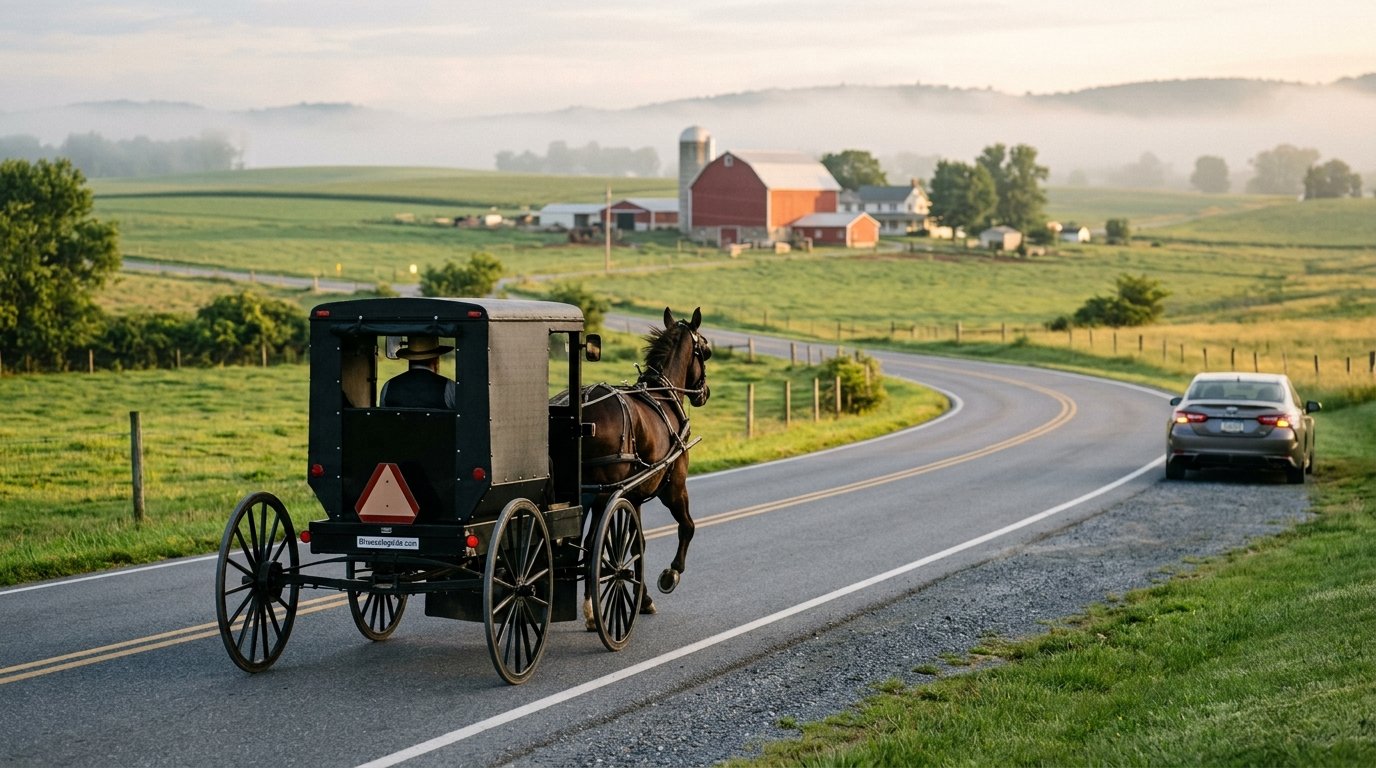
Can Amish Drive Cars? The Real Answer, Explained
Short answer: most Old Order Amish do not drive or own cars, but they can ride in them. The longer answer involves faith, community, history, and a surprising amount of flexibility.
You are following a slow, steady clip-clop down a country road, a gray-topped buggy ahead of you, and a question pops into your head: why don’t they just buy a car? Or maybe you have seen an Amish man climb out of a white passenger van at a hardware store and wondered whether the rules are really as strict as people say.
The truth sits somewhere between the stereotype and the exception. Amish life is not a simple list of banned objects. It is a carefully negotiated way of living, and transportation is one of the clearest windows into how that negotiation works. In this guide, we will walk through exactly what the Amish can and cannot do with cars, why those lines exist, how they differ from one community to the next, and what everyone else on the road should know when sharing pavement with a horse-drawn buggy.
1. The Quick Answer: Can Amish Drive Cars?
In most communities, no. Baptized members of Old Order Amish churches do not own or drive cars. They are generally allowed to ride in cars driven by someone else, such as a hired driver, a neighbor, or a friend outside the faith. A few Amish-related groups, such as Beachy Amish and some New Order congregations, do permit car ownership.
That one-sentence answer hides plenty of nuance, which is why searches for this topic never seem to slow down. The word “Amish” covers many separate church districts, each guided by its own bishop and its own written or unwritten rules, called the Ordnung. What is forbidden in one settlement might be tolerated a few counties over.
Here is a fast snapshot of how common situations are typically handled in Old Order communities:
| Situation | Usually Allowed? | Notes |
|---|---|---|
| Owning a car | No | Core restriction in Old Order groups |
| Driving a car | No (after baptism) | Some youth drive before joining the church |
| Riding in a hired car or van | Yes | Very common for long trips, work, and medical visits |
| Riding a bus or train | Yes | Public transit is widely accepted |
| Flying | Rarely | Often limited to emergencies or special cases |
| Horse and buggy | Yes | The main form of local transportation |
If you only remember one thing, remember this: the restriction is about ownership and control, not about the physical act of sitting inside a vehicle.
Browse well-reviewed books that explain Amish culture, history, and beliefs.
2. Owning vs. Riding vs. Driving: The Distinction That Explains Everything
Most confusion about this subject comes from lumping three very different actions together. Owning a car, driving a car, and riding in a car are separate matters in Amish thinking, and each carries its own level of concern.
Owning a car
Ownership is what the church objects to most strongly. A privately owned car sits in the driveway, ready at a moment’s notice, and that is exactly the problem. It makes it easy to leave the neighborhood, skip church functions, visit far-off places, and live a more individual life. A car on the property changes the rhythm of a household in ways that a buggy never could.
Driving a car
Baptized members are generally not permitted to drive. The reasoning ties back to ownership: if you cannot own a car, you also should not be operating one as your own. Some communities have narrow exceptions, such as a church member driving a tractor or a work truck under specific conditions, but the car itself stays off limits.
Riding in a car
Riding is treated as a practical necessity. The Amish are not asking anyone to walk 200 miles to a wedding or to take a buggy to a hospital in another county. Hiring a driver, often called an “Amish taxi,” is a long-established arrangement. These drivers are usually neighbors or professionals who are not Amish, and many have built entire small businesses around serving Amish clients.
This is why you may see Amish passengers at gas stations, pharmacies, farmers’ markets, and even regional airports without any conflict with their beliefs. They are not breaking the rules. They are living inside a framework designed to keep the community close while still allowing access to a modern world they do not reject outright.
Travel guides and road atlases make country-road navigation much easier.
3. Why Most Amish Avoid Cars: The Beliefs Behind the Rule
The Amish do not avoid cars because they think engines are evil. Their decision rests on a handful of values that guide almost every choice they make about technology.
Gelassenheit: yielding to the community
The German word Gelassenheit is often translated as humility, submission, or yielding. It means putting the group ahead of the self. A car is a powerful symbol of independence. It lets one person decide where to go, when to go, and with whom, all without checking with anyone else. Amish leaders have long argued that this kind of freedom slowly pulls families away from one another and from the church.
Keeping life local
A horse and buggy have a natural range. You can reasonably reach your neighbors, your church, your school, and the local market. You cannot easily commute 40 miles to a job or spend a Saturday at a distant city. That limit is not a flaw in Amish thinking. It is the point. Close distances keep families, friends, and church districts tightly connected and encourage people to rely on each other.
Avoiding pride and display
Cars come with status. Make, model, color, and condition all send signals about wealth and taste. Plain living, a central Amish principle, tries to remove those signals. A black buggy looks like every other black buggy, and that sameness is intentional.
Resisting a slippery slope
Many communities treat technology as a series of doors. Once one opens, the next is hard to keep shut. A car leads to longer commutes, which lead to different jobs, which lead to less time on the farm, which leads to a thinner church life. Leaders prefer to hold the line early rather than manage the consequences later.
Notice how none of these reasons say “the car is sinful.” The church asks a different question about each new tool: does it strengthen our community or weaken it? For the automobile, most Old Order bishops have answered the same way for over a century.
Check out titles on Amish values, family life, and plain living.
4. How the Car Debate Began
The Amish story with automobiles starts in the early twentieth century, when cars were new, loud, and increasingly common on rural roads. Church leaders across several states had to decide quickly how their members should respond. There was no single national meeting that settled the matter. Instead, individual districts reached their own conclusions, and most landed in the same place.
Early resistance
At first, cars were expensive and unreliable, so the question was largely theoretical for farm families. As prices fell and roads improved, some members began to see real advantages: faster trips to market, quicker help in emergencies, and easier travel to see distant relatives. Leaders watched what was happening in neighboring communities and noticed something troubling. Families who adopted cars tended to drift away from the church over time.
The split that created new groups
In some regions, the disagreement over cars and other modern conveniences became so sharp that congregations divided. Those who wanted to allow automobiles often formed or joined separate fellowships. That is part of how groups like the Beachy Amish and various Amish Mennonite churches came to exist alongside the Old Order. The line was not always bitter, and many of these groups remain on friendly terms, but the practical difference is clear: one side keeps the buggy and the other embraces the car.
Holding steady through the decades
Through the mid-century and beyond, Old Order districts reaffirmed their position, often writing the car restriction into their Ordnung. The reaffirmation was not just a repeat of the old rule. Each generation of leaders had to weigh the same questions again as roads became busier and rural life changed around them.
Today, the Amish population has grown rapidly and spread into many states. New settlements often choose rural land with lighter traffic, partly to make buggy travel safer. The car question has not gone away, but the answer in Old Order communities has been remarkably stable.
Explore books on Anabaptist history and the origins of the Amish.
5. Which Amish Groups Allow Cars? A Group-by-Group Look
Saying “the Amish” is a bit like saying “the Christians.” It is accurate but too broad to be useful. Several distinct groups exist, and their rules about cars vary a great deal.
| Group | Car Ownership | Typical Approach |
|---|---|---|
| Old Order Amish | Not allowed | Buggies for local travel, hired drivers for distance |
| Swartzentruber Amish | Not allowed | Among the most conservative; very limited exceptions |
| New Order Amish | Usually not allowed | Slightly more open to some technology, but cars generally still restricted |
| Beachy Amish | Allowed | Cars and electricity accepted, plain dress often maintained |
| Amish Mennonite | Allowed | Closer to mainstream Mennonite practice |
Old Order Amish
This is the group most people picture. They ride buggies, speak a Pennsylvania German dialect at home, and prohibit private car ownership. Hired drivers are accepted and often essential.
Swartzentruber Amish
One of the strictest branches. They tend to avoid even small conveniences that other Old Order communities accept, and they are known for plain, unadorned buggies. They often resist adding reflective markings, a decision that has sometimes brought them into conflict with state traffic laws.
New Order Amish
These communities generally emphasize personal Bible study and evangelism more than the Old Order does. Some are a little more flexible about technology, but most still keep the traditional restriction on car ownership.
Beachy Amish and related churches
These groups accept cars, electricity in the home, and other modern tools, yet often keep modest dress and many cultural traditions. If you spot someone in plain clothing driving a pickup, there is a good chance they belong to one of these fellowships rather than an Old Order church.
Because even within one category practices vary by settlement, the only reliable way to know a particular community’s rule is to ask someone in that community, or to read local guidance from the church itself.
Compact safety tools can help whenever you pull over in unfamiliar territory.
6. How the Amish Actually Get Around
With cars off the table, Amish families rely on a layered transportation system. Each layer handles a different distance and purpose.
Horse and buggy: the daily workhorse
For trips to church, school, the neighbor’s farm, or the local store, the buggy is the standard choice. A horse at a steady trot covers roughly eight to ten miles per hour, and a rural trip of a few miles is entirely practical. Buggies are surprisingly well engineered, with brakes, lighting powered by batteries, and carefully built frames that vary by community.
Hired drivers
When the destination is farther than a horse can comfortably go, families call a driver. This arrangement covers weddings in other states, hospital appointments, shopping trips, and business travel. Many drivers become trusted fixtures in the community, and some offer vans designed to carry a whole group at once.
Buses and trains
Public transit is widely accepted. It is shared, scheduled, and not owned by the individual, which fits Amish values. You will often see groups traveling by Amtrak or long-distance bus to visit relatives in other settlements.
Bicycles, scooters, and wheeled alternatives
Practices differ. Some communities allow bicycles, while others do not. Adult kick scooters are common in many places because they are quiet, cheap, and good for short errands. Roller skates and in-line skates also appear in certain districts, mostly for quick trips on smooth pavement.
Walking
Never underestimate walking. For short distances and in many settings, it remains a normal and expected part of daily life.
This mix shows that the Amish are not anti-mobility. They are particular about how mobility is organized. They accept transportation that stays tied to the community and the occasional need, and they resist transportation that gives each household its own private engine on demand.
A reliable dash cam helps document your drive and protect you on narrow rural roads.
7. Rumspringa and Cars: What Happens Before Baptism
Rumspringa, usually translated as “running around,” is the period when Amish teenagers gain more freedom before deciding whether to be baptized into the church. Popular media has painted it as a wild free-for-all, and while some young people certainly do test boundaries, the reality is much more varied and, in most places, much quieter.
Do Amish teens drive?
Sometimes. In certain communities, youth who have not been baptized are not bound by the same rules as full members. A few may learn to drive, and some even buy a used car. Because they do not yet hold a church membership, leaders are often less strict about what they do. That said, practices vary widely, and many Amish teenagers never touch a steering wheel at all.
What about licenses and insurance?
A young person who wants to drive legally in the United States faces the same requirements as anyone else: a license, registration, and insurance. Those can be real obstacles for someone living in a community that does not use the same documentation as the wider world. Anyone curious about what restrictions typically apply to new drivers can read our guide to graduated licensing restrictions.
The choice at baptism
When a young adult chooses to be baptized, they agree to follow the Ordnung of their church district. In an Old Order community, that includes giving up the car. Those who already own one are generally expected to sell it or hand it over. Most young people who grew up in the culture do choose baptism, and retention rates in many Amish communities are high.
Those who leave
Some individuals decide they do not want to join the church. Because they were never baptized, they are usually not subject to the formal shunning that follows when a baptized member leaves. They can pursue a driver’s license, own a car, and build a life outside the community, though the emotional cost of leaving family and tradition can be significant.
Practical gifts and learning tools help beginners build confidence on any road.
8. Tractors, Planes and Other Machines: Where the Lines Fall
People are often surprised to learn that the Amish do use some machinery. The rule is not “no engines.” It is “no engines that change how the community lives.” The distinctions can look odd from outside, but they usually follow a logic.
Tractors
Many Old Order communities allow tractors for specific farm tasks but restrict them from public roads. A common solution is steel wheels instead of rubber tires. Steel wheels work fine in a field but are awkward and slow on pavement, which discourages casual travel while still permitting work. Other settlements do not allow tractors at all for field use.
Stationary engines and alternative power
Gas, diesel, hydraulic, and compressed-air power are commonly used in workshops and barns. A shop may run tools by compressed air, and a farm may use a diesel engine to run a milking system. Power is allowed when it supports work, not when it connects the household to the outside world through a public electric grid.
Telephones
Many communities permit a phone in a shared “phone shanty” or in a place of business, but not in the home. The idea is similar to the car: a tool that serves the work or an emergency is accepted, while one that constantly interrupts family life is not.
Airplanes
Flying is generally discouraged, though some communities make exceptions for emergencies or specific trips. Because an airplane covers long distances quickly and is not owned by the passenger, it falls into a gray area that each district handles on its own.
Boats and ferries
Ferries and similar public conveyances are broadly accepted. Private motorboats may be restricted in the same way as cars.
Seen together, these rules are less about the machine itself and more about who controls it, who benefits from it, and what it does to relationships over time.
Portable jump starters and tire inflators are lifesavers far from town.
9. Buggy Laws, Safety Markings, and the Reflective Tape Debate
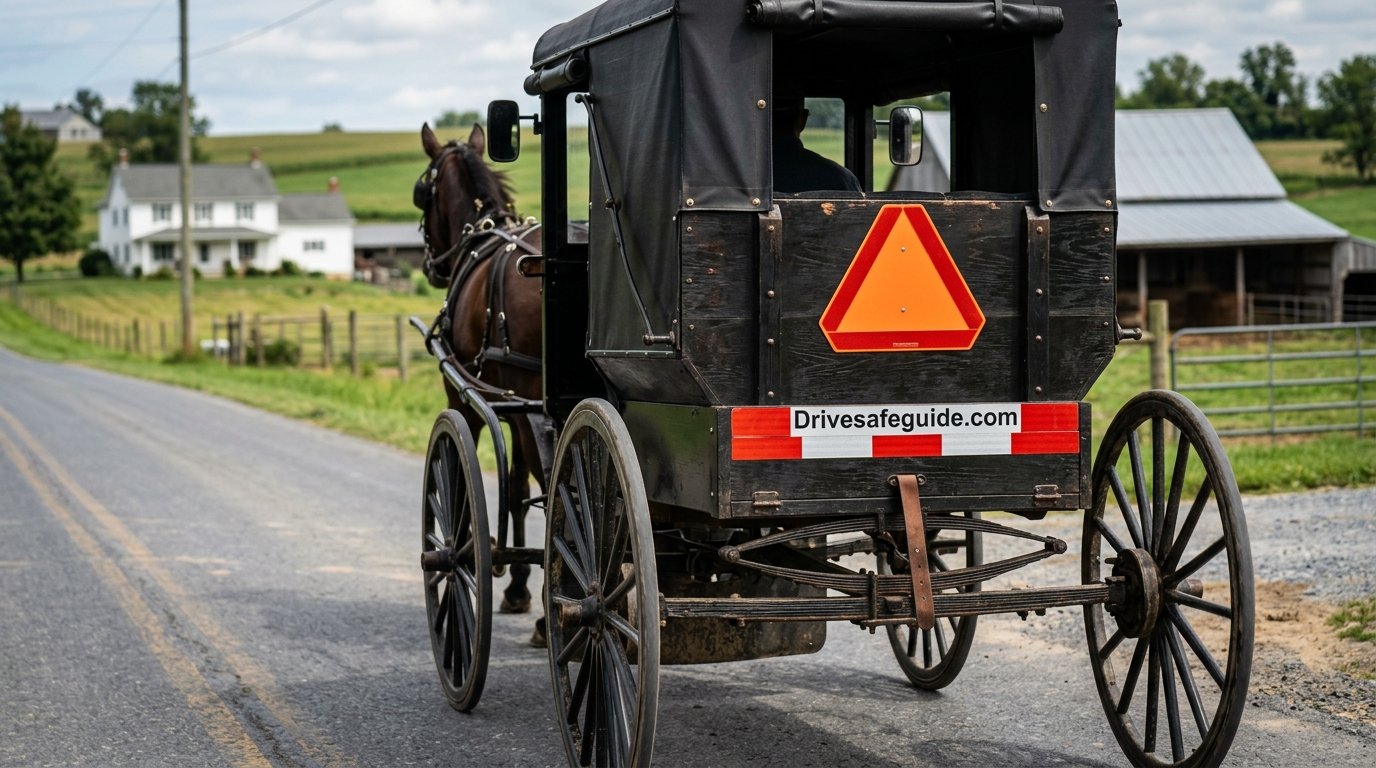
Horse-drawn buggies are legal vehicles on public roads in many states, and they are subject to specific safety rules. These typically include lighting, reflectors, and a bright triangular emblem warning approaching drivers that the vehicle is slow.
The slow-moving vehicle triangle
The orange-and-red triangle, officially called the slow-moving vehicle emblem, is a familiar sight on the back of buggies. In many states it is required for vehicles that travel below a certain speed on public roads. Its fluorescent center and reflective border are designed to be visible from far away, in daylight and at night.
Why some communities object
A number of Old Order and Swartzentruber communities have objected to the bright triangle. Their concerns are tied to the principle of plain living and, in some cases, to the belief that bold, flashy colors draw attention to the self. They have also expressed the view that trusting in divine protection is a matter of faith, and that a bright warning symbol can seem like a sign of reliance on human safeguards instead.
Compromises that emerged
Over the years, courts and legislatures in multiple states have wrestled with this tension between religious practice and public safety. Many places now allow alternatives, such as reflective tape in white or silver outlining the buggy, along with lanterns or battery lights. Some communities use the triangle without issue, while others rely on the alternatives. The details depend on state law and local enforcement.
Lighting and visibility
Modern buggies often use battery-powered LED lights, which are bright, efficient, and allowed by many Amish groups because they are not connected to the public power grid. These lights greatly improve nighttime visibility compared with older kerosene lanterns.
The overall picture is one of ongoing cooperation. Safety officials want drivers to see buggies, and Amish leaders want to practice their faith while protecting their families. The fact that so many compromises exist shows how seriously both sides take the question.
LED road flares and reflective triangles keep you seen when you must stop at the roadside.
11. Common Myths About the Amish and Cars
Few topics are as wrapped in folklore as the Amish and their relationship to the automobile. Here are the most frequent misunderstandings, and what is actually true.
Myth: The Amish think cars are evil
Not at all. The objection is about what ownership does to community life, not about metal and engines. Many Amish people ride in cars regularly and appreciate their usefulness.
Myth: All Amish follow identical rules
The rules vary enormously. Some groups allow cars, some allow certain tractors, and some allow phone shanties. A rule that applies in one county may not apply in the next.
Myth: The Amish are forbidden from ever touching a car
Wrong. They may ride, they may hire drivers, and in some situations they may even work on or with vehicles as part of a business. What they avoid is personal ownership and daily driving.
Myth: Amish teens are secretly wild drivers
Some experiment, but most do not. Television and film have exaggerated Rumspringa into a stereotype that does not match everyday life in many settlements.
Myth: The Amish do not follow traffic laws
Buggy drivers are expected to follow the rules of the road, just like anyone else. There are disagreements about specific requirements like the bright triangle, but the broader approach is cooperation.
Myth: They refuse all modern technology
The Amish adopt technology selectively. They use LED lights, solar chargers, power tools run by compressed air, and sometimes business phones. The test is always the same: does it support or weaken the community?
Understanding these distinctions helps everyone treat Amish neighbors with the respect and accuracy they deserve.
A well-stocked emergency kit belongs in every trunk, especially on long country drives.
12. Pros, Cons, and the Road Ahead for Amish Transportation
Like any system, the Amish approach to cars has real strengths and real challenges. Looking at both gives a fair picture of how this tradition works in the modern world.
Pros
- Strong family and neighborhood ties
- Lower costs: no car loans, fuel, or insurance premiums
- Slower pace of life and less commuting stress
- Smaller environmental footprint for local travel
- Shared hired-driver rides still allow long-distance access
Cons
- Buggy and car collisions can be serious
- Long trips depend on hired drivers and schedules
- Emergency response can be slower in remote areas
- Growing rural traffic increases risk
- Fewer job options far from home
Growing pressure on rural roads
As Amish settlements expand and more commuters and tourists use rural highways, buggies and cars meet more often. Many communities have responded with improved lighting, safer buggy designs, and local education campaigns. Some have worked with county officials to add wider shoulders or designated buggy lanes.
Technology and flexibility
Amish leaders continue to evaluate new tools one at a time. Battery-powered devices, solar panels, and cleaner lighting systems have found a place in many homes and shops. It is possible that future decisions will shift in small ways, but the core idea behind the car restriction, protecting community over convenience, is likely to remain.
What outsiders can do
Drive thoughtfully, respect the space buggies need, and treat Amish travelers as the neighbors and fellow road users they are. If you travel across states, brush up on local requirements such as international driving permit requirements if you plan to travel abroad, and keep tools like the ones in our guide to the best car safety tools within easy reach.
Pick up a few smart safety upgrades before you head into the countryside.
Frequently Asked Questions
Can Amish drive cars?
Most Old Order Amish members do not drive or own cars, but they may ride in them. Some groups, including Beachy Amish and certain Amish Mennonite churches, do allow car ownership and driving.
Why can’t the Amish own cars?
Church leaders believe private car ownership weakens community life by making it easy to travel far, live independently, and display status. The rule protects close family and church relationships.
Can the Amish ride in cars?
Yes. Riding in a car driven by someone else is generally accepted. Many families hire drivers for long trips, medical visits, shopping, and business travel.
What is an Amish taxi?
An Amish taxi is a driver, often a neighbor or a small business owner outside the Amish church, who provides rides to Amish customers. Services range from short errands to cross-country trips.
Do Amish teenagers drive during Rumspringa?
Some do, especially in more lenient communities, because they have not yet been baptized. Many teens never drive at all. After baptism into an Old Order church, members are expected to give up car ownership.
Can the Amish fly on airplanes?
Flying is usually discouraged, though some communities allow it for emergencies or special circumstances. Practices differ widely from one district to another.
Can the Amish ride buses and trains?
Yes. Public transit is widely accepted because it is shared and not owned by the individual. Many Amish travelers use trains and buses to visit relatives in other settlements.
Do the Amish use tractors?
Some do, but often with restrictions such as steel wheels that limit road use. Other communities do not allow tractors at all. The rules depend on the local church district.
Which Amish groups can own cars?
Beachy Amish, Amish Mennonites, and some other Anabaptist-related fellowships permit car ownership. Old Order, Swartzentruber, and most New Order groups do not.
Why do some Amish avoid the orange triangle on buggies?
Some communities view the bright emblem as flashy and inconsistent with plain living. Many have accepted alternatives like reflective tape and lights, and several states allow these as substitutes.
How should I drive around an Amish buggy?
Slow down early, leave extra room, avoid honking loudly, and pass only when you have a clear and safe view. Be especially careful at dawn, dusk, and in bad weather.
Do Amish people follow traffic laws?
Yes. Buggy drivers are generally expected to follow the same rules of the road as other vehicles, apart from the occasional disagreement over specific requirements such as the slow-moving vehicle triangle.
Conclusion: A Different Kind of Road
So, can Amish drive cars? For most Old Order Amish, the honest answer is no, not as owners and not as regular drivers. But they can ride, they can hire drivers, they can take trains and buses, and in some related groups they can own and operate cars just like anyone else. The rule is not about fear of engines. It is a deliberate choice to keep life centered on family, faith, and neighbors.
For the rest of us, the lesson is practical as well as cultural. If you drive through Amish country, expect buggies, slow down early, and give them room. A little patience protects everyone on the road, and it shows respect for a community that has made its transportation choices very thoughtfully.
Whether you are planning a scenic road trip, upgrading your safety gear, or just satisfying your curiosity, a few smart tools can make every journey calmer and safer.
Explore top-rated driving safety essentials and travel gear.