Driving Shirtless: Is It Illegal, Or Just Uncomfortable?
1. Executive Summary & Core Legal Truth
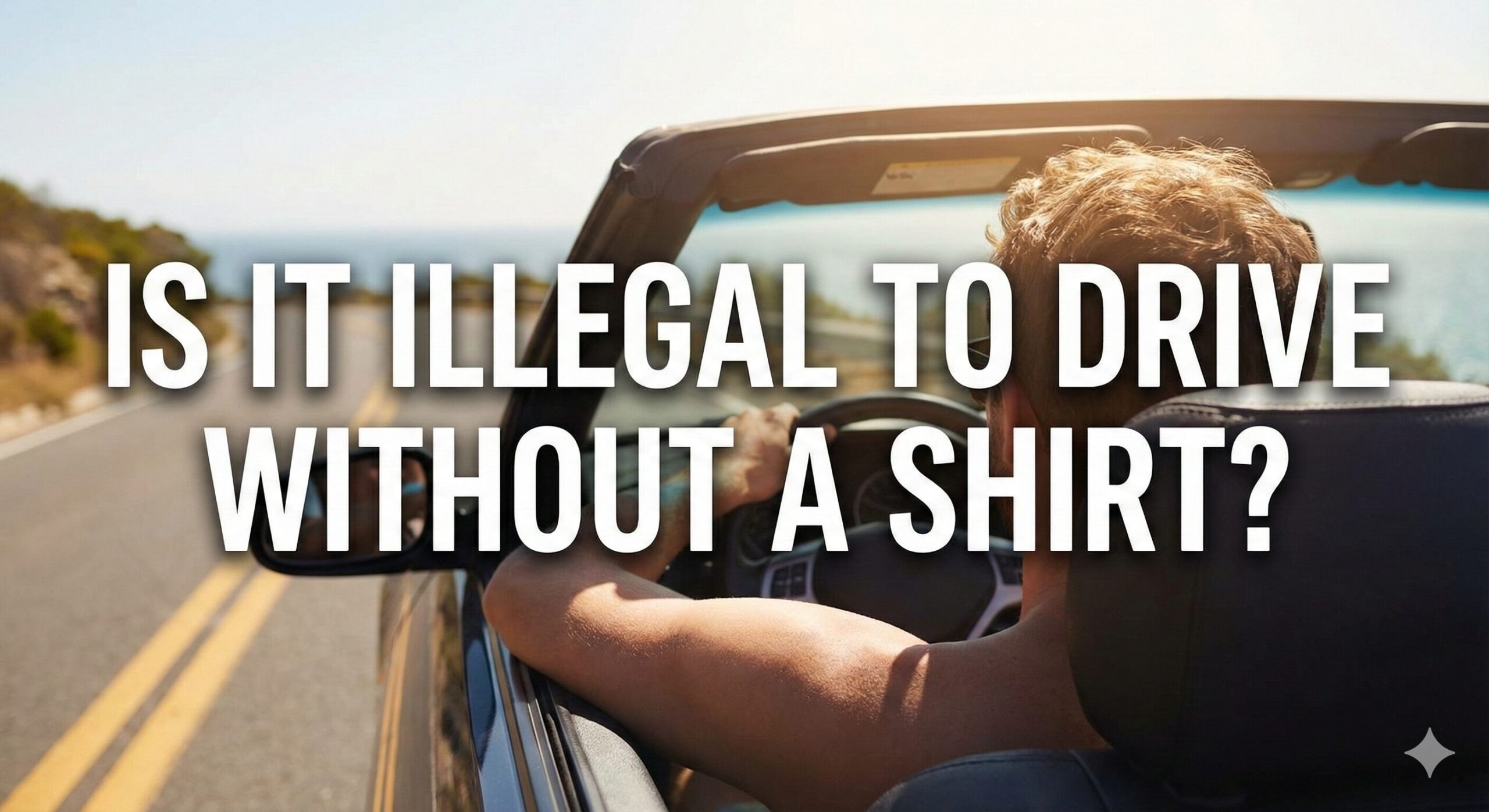
Picture this scenario: It is mid-July, ambient temperatures hover above 95°F, and your vehicle’s air conditioning compressor has just given out in bumper-to-bumper highway traffic. As perspiration drenches your clothing, the instinctive reaction is to strip off your upper layer to stay cool. Alternatively, you may be returning from a day at the beach, still damp from ocean water, with a swimsuit resting in your backseat. As you put the vehicle in drive, a lingering question arises: Is driving shirtless illegal?
The short answer across all 50 U.S. states, as well as Canada, the United Kingdom, and Australia, is NO—it is not directly illegal for male drivers to operate a private motor vehicle without a shirt. State vehicle codes and motor vehicle administration rules govern vehicle operation, road control, mechanical safety, and driver responsiveness. No U.S. state traffic code mandates that a vehicle operator wear a shirt while behind the wheel.
However, the full legal reality is far more complex. While traffic laws do not outlaw driving shirtless, statutory compliance requires navigating a web of penal statutes, local public decency ordinances, commercial fleet policies, constitutional gender equity standards, and civil negligence implications. What is perfectly legal inside an enclosed passenger cabin can instantly become a misdemeanor offense under public lewdness laws the moment you step out of the car, drive a convertible with the top down, or encounter a law enforcement officer during a routine traffic stop.

2. Traffic Laws vs. Penal Codes: The Legal Framework
To fully understand why driving shirtless occupies a legal grey area, one must dissect the jurisdictional boundaries separating State Departments of Motor Vehicles (DMVs) from criminal judicial codes.
Department of Motor Vehicles & Traffic Codes
Motor vehicle codes (such as the California Vehicle Code, Texas Transportation Code, or Florida Statutes Chapter 316) exist solely to preserve public safety on roadways. They dictate vehicle mechanical standards, speed boundaries, right-of-way rules, signaling requirements, and driver physical capacities. DMV regulations require drivers to maintain control of the vehicle at all times, wear seatbelts, and avoid driving under the influence or while impaired.
Crucially, no U.S. state traffic statute specifies a mandatory dress code for private passenger vehicle operators. Just as driving barefoot is widely misunderstood yet completely legal under state traffic codes, driving shirtless does not constitute a traffic infraction in itself. The traffic enforcement authority cannot cite you simply for driving without a shirt.
Penal Codes, Public Decency, and Indecent Exposure
While motor vehicle codes remain silent on driver attire, state penal codes strictly govern public conduct, lewdness, and exposure. The legal challenge arises because a motor vehicle operating on a public road, highway, or parking lot exists within the “public view.”
Under statutory criminal law, three primary legal thresholds dictate whether being shirtless in public is punishable:
- Indecent Exposure: Generally defined as the intentional, willful exposure of one’s private parts (genitals, buttocks, or female breasts) in a public place, or in a private place where others may be offended, often requiring proof of a sexual or lascivious intent (mens rea).
- Public Lewdness / Disorderly Conduct: Broader statutes that penalize acts that shock public decency, breach the peace, or create a public hazard or nuisance.
- Distraction Hazards / Impairment of Public Safety: Broad omnibus laws permitting officers to cite individuals if their actions or appearance directly create a hazardous traffic condition by severely distracting other motorists.
For male drivers, being shirtless in public is standard practice across North America and Europe at beaches, parks, and athletic grounds. Thus, a shirtless male driver does not meet the criminal statutory criteria for indecent exposure or lewd conduct under state penal codes.
3. Comprehensive State-by-State Legal Breakdown
Although no state directly outlaws driving shirtless in its vehicle code, enforcement practices and municipal public decency laws vary significantly across regions. Below is an overview of how state legal frameworks treat shirtless driving and public exposure inside vehicles:
| State / Region | Traffic Code Status | Penal Code Considerations | Key Exceptions & Notes |
|---|---|---|---|
Municipal Preemption and Local Ordinances
It is vital to distinguish state laws from municipal ordinances. In some states, local city councils possess “home rule” authority to enact stricter public decency standards than state legislatures. For instance, while state highway codes permit driving shirtless, a specific resort town or conservative municipality might maintain local ordinances prohibiting bare torsos on public streets, boardwalks, or municipal parking structures.
When operating a vehicle within these local jurisdictions, an officer who observes a shirtless driver exiting their vehicle on a public roadway can issue a municipal ordinance citation, even if state traffic laws remain uninvolved.
4. Gender Differences, Topless Driving, and Civil Rights Case Law
One of the most complex aspects of shirtless driving legal doctrine centers on gender equity. The enforcement of public exposure laws historically treats male and female torsos differently under criminal law.
Legal Framework for Female Drivers
In many conservative jurisdictions, female breasts are statutorily classified under indecent exposure or lewd conduct laws. Consequently, while a male driver can operate a vehicle without a shirt with virtually zero legal risk, a female driver operating a vehicle without a top could face criminal charges, including:
- Indecent Exposure (Misdemeanor): Exposing female breasts in a public space where observers could be offended.
- Disorderly Conduct: Acts deemed to intentionally disrupt public order or create a hazard.
- Distracting Motorists / Traffic Hazard Creation: An officer citing a driver on the grounds that their bare torso causes rubbernecking or traffic collisions among surrounding drivers.
Constitutional Jurisprudence & The 10th Circuit Landmark Ruling
Over the past decade, legal advocacy groups and the “Free the Nipple” movement have systematically challenged gender-specific exposure statutes under the Equal Protection Clause of the Fourteenth Amendment of the U.S. Constitution.
A major legal precedent occurred in 2019 with the landmark 10th Circuit Court of Appeals case, Free the Nipple v. City of Fort Collins (916 F.3d 592). The federal appellate court held that municipal ordinances penalizing female toplessness while permitting male toplessness unconstitutionally discriminate based on gender, relying on outdated gender stereotypes rather than compelling government interests.
This ruling legally struck down gender-specific bare torso bans across the states of the 10th Circuit Court jurisdiction, which includes:
- Colorado
- Utah
- Wyoming
- New Mexico
- Kansas
- Oklahoma
Similarly, in states like New York, state supreme court rulings have long established that women have the identical legal right to be bare-chested in public as men. However, outside these specific federal circuits and progressive state jurisdictions, driving topless as a female driver remains a high legal risk for criminal citations under local indecent exposure statutes.

5. Commercial Drivers, Gig Workers, and Corporate Dress Codes
While state traffic codes grant private motor vehicle operators the liberty to drive shirtless, this legal freedom evaporates when operating vehicles in a commercial, occupational, or fleet capacity.
Federal Motor Carrier Safety Administration (FMCSA) & CDL Drivers
Commercial Motor Vehicle (CMV) operators holding a Commercial Driver’s License (CDL) are bound by the regulatory framework established by the U.S. Department of Transportation (DOT) and the FMCSA. While FMCSA safety regulations do not specifically dictate individual articles of clothing in their federal manual, federal occupational standards mandate that drivers maintain safe operational readiness.
Furthermore, motor carriers (trucking companies) enforce strict internal safety policies governed by OSHA (Occupational Safety and Health Administration) regulations. Under OSHA safety standards, commercial drivers are required to wear Personal Protective Equipment (PPE) appropriate for their work environment, which mandates protective upper body clothing to shield against thermal injuries, chemical spills, mechanical abrasion, and cargo handling hazards. A commercial driver caught driving shirtless by a fleet safety officer face immediate termination, safety compliance suspensions, and blacklisting from corporate carriers.
Rideshare Drivers: Uber, Lyft, and Taxi Fleet Mandates
For independent contractors driving for rideshare networks such as Uber or Lyft, state vehicle laws do not require a shirt, but platform contracts strictly do. Both Uber and Lyft enforce comprehensive Community Guidelines that require drivers to maintain professional standards of hygiene and attire.
A rideshare driver operating without a shirt will face instant passenger complaints, low rating scores, and permanent platform deactivation. Rideshare insurance policies can also leverage violations of company safety standards during claims investigations following a crash.
Delivery Services: Amazon Flex, DoorDash, UPS, FedEx, and USPS
Last-mile delivery drivers operating for Amazon Flex, DoorDash, FedEx, UPS, or the United States Postal Service represent their respective entities while behind the wheel. These entities mandate corporate uniforms or strict dress codes (prohibiting bare torsos, swimwear, or offensive attire). Operating a delivery vehicle shirtless constitutes a material breach of vendor agreements and grounds for instant termination.
6. Auto Insurance Implications, Tort Law, and Crash Claims
Perhaps the most overlooked consequence of driving shirtless is its impact on civil litigation, insurance claims processing, and fault determination following a motor vehicle collision.
Comparative Negligence and Contributory Fault
In civil tort law, when two or more vehicles collide, insurance adjusters and civil courts evaluate liability under principles of Comparative Negligence (or Contributory Negligence in states like Virginia, Maryland, and North Carolina). Under comparative negligence, an injured driver’s financial compensation is reduced by their percentage of fault in contributing to the accident or worsening their own injuries.
If an insurer or opposing defense attorney can prove that driving shirtless directly contributed to the crash or exacerbated injuries, they can shift partial financial fault onto the shirtless driver. Consider the following scenarios:
- Sudden Thermal Distraction: The driver’s bare back came into contact with a 140°F sun-baked leather seat, causing a involuntary muscle flinch that resulted in swerving into an adjacent lane.
- Seatbelt Discomfort & Slippage: The lack of a shirt caused the driver to unhook, adjust, or position the shoulder strap behind their back due to severe chafing against bare skin, violating seatbelt usage laws.
- Reduced Steering Control: Excessive bodily perspiration caused the driver’s bare torso and arms to slip across the seat bolster or steering wheel during an emergency evasive maneuver.
In these situations, insurance claims adjusters can argue that driving shirtless constituted a failure to exercise reasonable care under civil law, leading to reduced insurance payouts or denied claims.
7. Medical, Ergonomic, and Biomechanical Hazards
Setting aside legal statutes and insurance liabilities, the physical, medical, and ergonomic risks of driving shirtless present compelling arguments for keeping your upper body covered behind the wheel.
1. Seatbelt Friction Burn & Epidermal Shear Stress (“Seatbelt Rash”)
Automotive seatbelts are manufactured using heavy-duty, cross-woven polyester webbing designed to hold thousands of pounds of kinetic energy during a crash. To prevent human ejection, the seatbelt retractor locks instantaneously upon rapid deceleration, tightening the strap across the chest and clavicle.
When a driver wears a shirt, the fabric serves as a low-friction sacrificial barrier that absorbs shear force. When driving shirtless, the coarse polyester webbing grips directly against human skin. In a crash at 35 mph, a locked seatbelt dragging across bare human skin generates extreme friction, resulting in second-degree friction burns, deep epidermal abrasion, and severe lacerations across the chest and shoulder.
2. Thermal Conduction from Upholstery (Leather & Vinyl Burns)
When a vehicle sits parked in direct summer sunlight with exterior temperatures at 90°F, interior cabin temperatures rapidly exceed 130°F to 150°F within 30 minutes due to the greenhouse effect through automotive glass. Upholstery surfaces—particularly dark leather or synthetic vinyl—absorb solar radiation, reaching surface temperatures in excess of 160°F.
Direct skin contact with surfaces at 160°F causes instantaneous first-degree or second-degree thermal burns within seconds. A shirtless driver leaning back against sun-heated leather will experience immediate pain, triggering involuntary spinal reflexes that cause them to jump forward, release steering wheel pressure, or accidentally hit the accelerator pedal.
3. Solar UV Radiation Exposure & Asymmetrical Skin Damage
Automotive manufacturers treat front windshields with laminated glass that filters out both UV-A and UV-B rays. However, side and rear windows are typically constructed from tempered glass, which blocks UV-B rays but allows harmful, deep-penetrating **UV-A radiation** to pass into the cabin unobstructed.
Dermatologists frequently document asymmetrical photo-aging and skin malignancies (melanoma and basal cell carcinoma) on the left arm, shoulder, and torso of drivers due to chronic UV-A exposure through side windows. Driving shirtless exposes large expanses of unprotected torso tissue to concentrated UV-A radiation, accelerating skin cancer risks during long summer drives. Protect your skin and consider taking steps to protect your car’s paint from sun damage as well.

8. Law Enforcement Encounters and Constitutional Rights
Understanding your constitutional rights and police protocol during a traffic stop while shirtless is essential for de-escalating encounters and avoiding unnecessary legal citations.
The Officer Safety Perspective
When a police officer executes a traffic stop, their primary operational priority is assessing potential safety threats. When approaching a vehicle containing a shirtless driver, officers may subconsciously heightened their vigilance. In law enforcement training, an unshirted individual in public is sometimes associated with states of intoxication, controlled substance impairment, mental health crises, or aggressive behavior.
While being shirtless is completely legal under state traffic codes, it can alter the tone of the interaction from a routine traffic stop to a detailed investigation.
Constitutional Precedent: *Pennsylvania v. Mimms*
Under the United States Supreme Court ruling in Pennsylvania v. Mimms (434 U.S. 106), a law enforcement officer conducting a lawful traffic stop has absolute authority to order the driver to step out of the vehicle for officer safety reasons, without violating Fourth Amendment protections against unreasonable search and seizure.
If you are driving shirtless and an officer orders you to exit the vehicle, you are legally required to comply. However, the moment you step out of your vehicle onto a public highway, shoulder, or sidewalk, you step fully into the public domain. If you are a female driver in a jurisdiction with strict public decency laws, stepping out of the vehicle while bare-chested could lead to immediate public exposure charges.
- Maintain composure, turn on your interior cabin light if at night, and keep both hands visibly on the steering wheel at 10 and 2 o’clock.
- If a shirt, jacket, or towel is resting within easy reach, politely inform the officer before reaching for it: “Officer, I have a shirt on the passenger seat. May I put it on?”
- Putting on a shirt demonstrates professionalism, respects the officer, and immediately removes any ambiguity regarding public exposure.
9. Vehicle Specifics: Convertibles, Jeeps, Motorcycles & RVs
The type of vehicle you operate significantly changes both the legal exposure and physical risks of driving shirtless.
1. Convertibles and Doorless Jeeps
Operating a convertible with the top folded down, or driving a Jeep Wrangler with the doors removed, completely eliminates the protective enclosure of a traditional vehicle cabin. Inside a fully enclosed sedan with tinted windows, a shirtless driver maintains a degree of privacy. In a doorless Jeep or open-top convertible, your torso is directly visible to pedestrians, commercial truck drivers, and law enforcement.
In jurisdictions that enforce strict municipal lewdness or public distraction ordinances, operating an open-air vehicle without a shirt dramatically increases your probability of being stopped by police officers.
2. Motorcycles (“Squid Riding”)
In motorcycle culture, riding without protective gear—and specifically riding shirtless—is referred to as “Squid” riding (an acronym for Stupidly Quick, Underdressed, and Imminent Death). While state motorcycle statutes mandate helmets and eye protection in many jurisdictions, few states mandate upper-body clothing for adult riders.
However, riding a motorcycle shirtless represents extreme physical danger. At 60 mph, airborne gravel, road debris, and insects strike bare skin with kinetic impact comparable to paintballs. More critically, in a motorcycle crash, sliding across asphalt without a protective leather or Kevlar jacket results in immediate catastrophic **third-degree road rash**, tearing away skin, muscle tissue, and exposing bone within fractions of a second.
3. Recreational Vehicles (RVs) and Motorhomes
RVs and motorhomes occupy a unique legal space as hybrid entities that function as both motor vehicles and temporary residential dwellings. While driving an RV down a public highway, the driver seat is governed strictly by motor vehicle traffic and penal codes (making shirtless driving legal for men, but subject to standard visibility rules). Once the RV is parked at a campsite or RV park with utilities connected, the vehicle transitions legally into a private residence, where internal dress codes do not apply.
10. International Law Breakdown: Driving Shirtless Abroad
If you plan to drive internationally, assume that local traffic laws and cultural public modesty standards differ significantly from those in North America.
United Kingdom (UK Highway Code)
In the United Kingdom, there is no specific statutory offense under the Road Traffic Act 1988 for driving shirtless. However, Rule 148 of the **UK Highway Code** specifies that drivers must avoid distractions and maintain full control of the vehicle at all times.
Furthermore, under section 3 of the Road Traffic Act, if an unshirted driver is involved in a collision and the lack of clothing or seatbelt irritation contributed to a loss of vehicle control, police can charge the driver with “Driving Without Due Care and Attention” (Careless Driving), which carries heavy fines and driving license penalty points.
Canada
Canadian provincial highway traffic acts (such as the Ontario Highway Traffic Act or British Columbia Motor Vehicle Act) contain no statutes prohibiting shirtless driving. Public nudity laws under the Criminal Code of Canada (Section 174) require proof that the exposure offends public decency or order. Canadian courts consistently rule that male bare torsos do not violate the Criminal Code.
Germany and Continental Europe
In Germany, the Straßenverkehrs-Ordnung (StVO) permits drivers to operate vehicles shirtless. Germany is famous for its relaxed attitudes toward nudism (FKK culture). However, German legal doctrine enforces strict standards regarding vehicle control. If a driver gets into an accident while driving shirtless and barefoot, insurance companies can invoke Grobe Fahrlässigkeit (Gross Negligence), reducing or denying insurance payouts.
Middle Eastern Jurisdictions (UAE, Saudi Arabia, Qatar)
In Middle Eastern nations governed by strict public decency statutes and Islamic law principles, driving shirtless is **strictly illegal**. In cities like Dubai or Abu Dhabi, operating a vehicle without a shirt on public roads constitutes a direct violation of public morality laws, resulting in immediate vehicle impoundment, heavy court fines, and potential deportation for foreign nationals.

11. Safer Alternatives for Staying Cool in Hot Cars
If extreme cabin heat is tempting you to drive shirtless, relying on targeted cooling accessories and smart ventilation strategies is a far safer approach. Pair these habits with a good pair of polarized driving sunglasses for glare protection to reduce strain during sun-drenched summer commutes.
1. Moisture-Wicking Technical Apparel
Instead of stripping down to bare skin, wear lightweight, moisture-wicking technical fabrics (polyester-spandex blends, merino wool, or athletic compression gear). These fabrics pull sweat away from your skin, promoting evaporative cooling while providing a vital protective barrier against seatbelt friction and leather seat burns.
2. Ventilated and Gel-Infused Seat Covers
Installing an aftermarket ventilated seat cushion featuring built-in micro-fans or cooling gel channels provides constant airflow across your back and thighs. This prevents the buildup of sweat and eliminates the uncomfortable feeling of skin sticking to hot upholstery.
3. Ceramic Window Tinting and Solar Reflector Shades
High-performance nano-ceramic window tint reflects up to 99% of infrared radiation and solar heat without obstructing visibility or violating local tint darkness limits. When parked, always deploy a metallic accordian windshield sunshade to keep interior dashboard and seat temperatures from reaching dangerous levels.
4. Pre-Cooling Cabin Ventilation Method
Before entering a sun-baked car, open the passenger side window, walk to the driver’s side, and open and close the driver door rapidly 5 to 6 times. This simple pumping action instantly expels superheated air from the cabin, dropping interior temperatures by 20°F to 30°F before you turn on the engine.
12. Frequently Asked Questions
While the law is firmly on your side when operating a private vehicle without a shirt, common sense, safety considerations, and personal comfort favor keeping a light shirt or towel nearby. Prioritizing your safety behind the wheel ensures a smoother, stress-free drive every time.