What Is All-Wheel Drive? How AWD Works, What It Means, and How It Differs From 4WD
A plain-English guide to all-wheel drive, four-wheel drive, front-wheel drive, rear-wheel drive and 4×2, plus what to know before you buy an AWD SUV.
You are shopping for a car, a crossover or an SUV, and the listing says “AWD.” A friend swears you need it. Another says it is just marketing. A third mixes it up with 4×4 and 4WD and now nobody agrees on what anything means. If that sounds familiar, you are in good company, because drivetrain terms are some of the most misunderstood words in the car world.
This guide untangles all of it. We will start with the simplest question, what all-wheel drive actually is, then work through how it works under the hood, how it differs from four-wheel drive, what front-wheel drive, rear-wheel drive and 4×2 mean, how fast you can go in 4 High, and what to look for in a good all-wheel-drive SUV. Along the way you will see real-world driving advice, honest pros and cons, and links to other guides if you want to go deeper on winter driving, tires and safety.
1. What Is All-Wheel Drive?
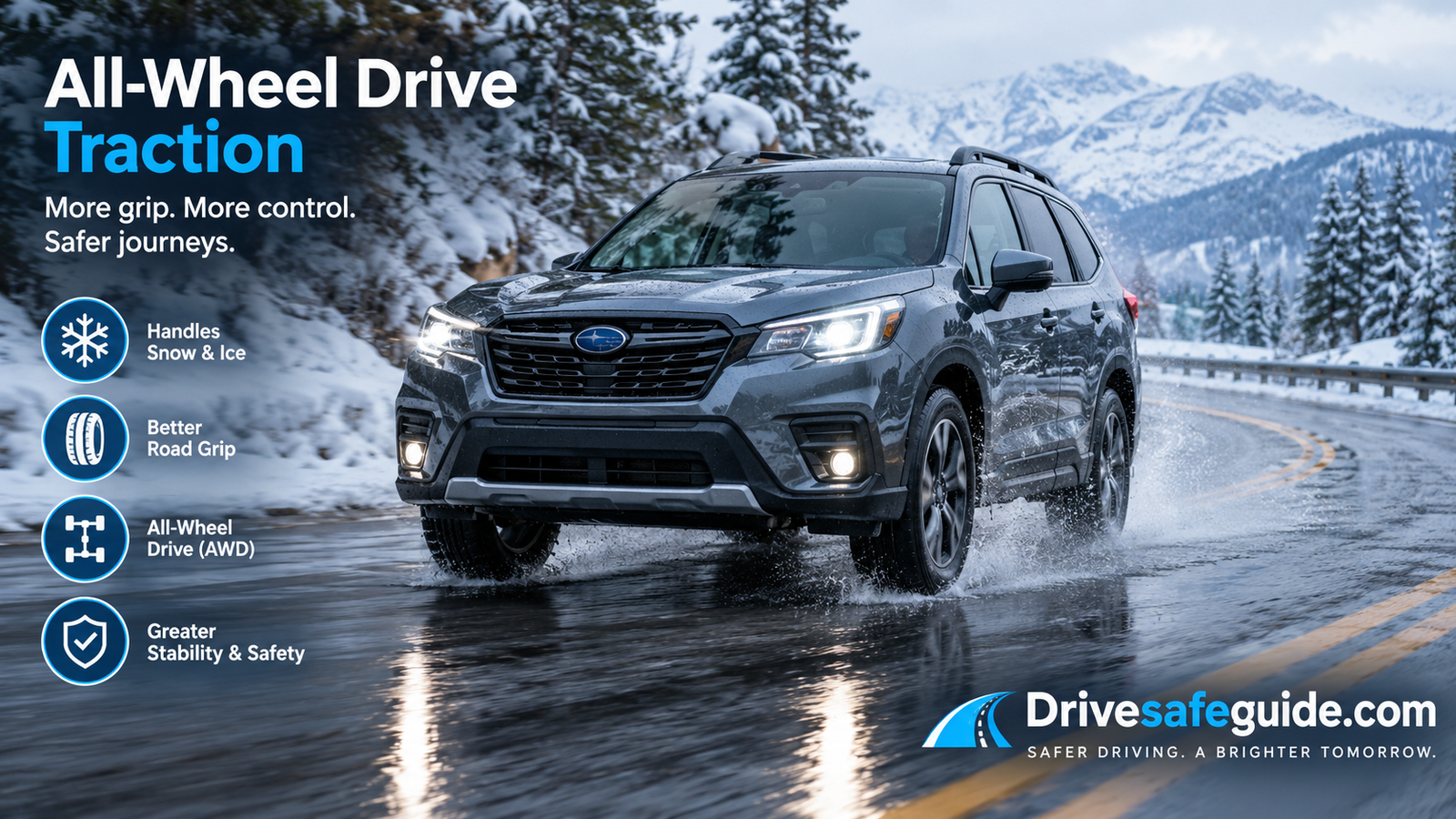
All-wheel drive is a vehicle layout in which the engine’s power can be delivered to all four wheels instead of just two. When one pair of tires starts to lose grip, the system moves some of the power to the other pair so the car keeps moving. In everyday driving you never have to think about it. There is no lever to pull and no dial to turn. The car decides for you, many times per second.
To appreciate why that matters, picture a normal two-wheel-drive car. Only two tires are responsible for pushing the car forward and, in some cases, for steering as well. If those two tires hit a patch of wet leaves, packed snow or loose gravel, they can spin while the other two tires, which are not being driven, just roll along. Power is wasted, and you go nowhere fast. An AWD vehicle simply has more tires to share the work. Four tires gripping is almost always better than two.
The core idea in one sentence
AWD spreads the job of accelerating across all four contact patches, which improves traction when you pull away from a stop, accelerate out of a corner, or climb a slippery hill.
Where you will find it
A generation ago, AWD was rare outside a few rally-bred sedans and wagons. Today it is everywhere. Compact crossovers, three-row family SUVs, luxury sedans, sports cars, minivans, and even some electric vehicles offer it. In electric cars, AWD usually means one motor per axle, which makes the system very quick to react.
- Automatic operation
- Power to four wheels
- Best for on-road traction
- No driver controls needed
Keep one limit in mind from the start: AWD helps you go, not stop. Your brakes and tires still do the stopping on every vehicle. We will return to that point later, because it is the biggest misunderstanding about all-wheel drive. If you drive in cold climates, our tips for driving in winter pair nicely with everything here.
2. What Does All-Wheel Drive Mean?
The literal meaning is simple: all four wheels can be driven by the engine. In a car with a “drive” label of AWD, four wheels receive torque, at least some of the time. The words matter because manufacturers use them loosely, and the badge on the back of a vehicle does not always tell you how sophisticated the system underneath is.
Reading the badge on the trunk
Different brands use different names for the same general idea. You may see “AWD,” “Quattro,” “xDrive,” “4MATIC,” “SH-AWD,” “Symmetrical AWD,” “4Motion,” or simply “4×4” on a crossover that is actually all-wheel drive. Do not assume that the name tells you everything. Two vehicles with identical “AWD” badges can behave very differently, because one might send power to the rear wheels only when slip is detected, while the other keeps power flowing to all four wheels at all times.
“2 wheel drive” vs “all wheel drive” in a listing
When you see “2WD” or “FWD” in a used-car ad, the vehicle drives only two wheels. When you see “AWD,” it drives four, automatically. When you see “4WD” or “4×4,” it drives four, usually with a driver-selectable system. The numbers describe how many wheels can be driven versus how many wheels exist: a “4×2” has four wheels, and two of them receive power. A “4×4” has four wheels, and all four receive power.
| Label | Wheels driven | Typical meaning |
|---|---|---|
| FWD | Front two | Most compact cars and crossovers |
| RWD | Rear two | Sports cars, many trucks and luxury sedans |
| AWD | All four, automatically | Crossovers, SUVs, performance sedans |
| 4WD / 4×4 | All four, driver-selected | Trucks and rugged SUVs |
| 4×2 | Two of four wheels | Two-wheel-drive trucks and SUVs |
Understanding these labels protects you in a showroom. If a salesperson says “it has 4×4” about a front-biased crossover, ask whether it is a true four-wheel-drive system with a low range or an AWD system with a different name. The answer affects what the vehicle can do, what it costs to maintain, and whether it is right for your driving.
3. How Does All-Wheel Drive Work?
Understanding how all-wheel drive works is easier if you start with how power normally travels. The engine makes torque. The transmission manages gears. From there, torque has to be delivered to the wheels. In a front-wheel-drive car, a short path leads to the front axle. In an AWD car, extra hardware carries some of that torque to the rear axle as well.
The key parts
- Transfer case or power transfer unit: splits power between the front and rear axles.
- Driveshaft: a rotating shaft that carries torque to the rear axle.
- Differentials: let the left and right wheels spin at different speeds in a turn. AWD has one at each axle, and often a third in the center.
- Center coupling or clutch pack: controls how much torque goes to the second axle and how quickly.
- Sensors and computers: wheel-speed, throttle, steering-angle and yaw sensors tell the computer what the car is doing.
Why the center differential matters
When you turn a corner, your front wheels travel a slightly longer path than your rear wheels. That means the front and rear axles need to spin at slightly different speeds. If the two axles were locked rigidly together on dry pavement, the drivetrain would bind, tires would chirp, and parts would wear. A center differential, or a clutch that can slip, solves this by allowing the axles to turn at different speeds while still sharing torque.
What happens when a tire slips
Imagine pulling away from a stoplight on an icy hill. Sensors notice that one wheel is spinning faster than the others. The computer tells the clutch to engage more firmly or tells the differential to send torque toward the axle with traction. Some systems also apply a light touch of brake force to the slipping wheel, which pushes torque toward the wheel on the same axle that can still grip. This happens within a fraction of a second, long before most drivers would notice it.
Electric AWD is different
In many electric vehicles, there is no driveshaft at all. A motor on each axle can be controlled independently, so the “split” between front and rear is simply software. That is why electric AWD is so fast and smooth. If you are curious about how EVs behave in other ways, see our guide on EV battery range anxiety tips.
4. Types of All-Wheel-Drive Systems
Not every AWD system is built the same way. Engineers choose a layout based on what the vehicle is supposed to do, how much it should cost, and how much fuel economy matters. Broadly, there are three families.
Full-time AWD
In a full-time system, all four wheels are always connected to the engine through a center differential or similar device. Power is typically split in a fixed ratio, such as 50/50 or 40/60 front-to-rear, and adjusts when slip is detected. This is the traditional approach seen on many wagons and performance sedans. It offers consistent grip, but it can cost a bit more in fuel.
On-demand (automatic or part-time) AWD
Most crossovers use this style. The vehicle runs as a front-wheel-drive vehicle under normal conditions to save fuel. When sensors detect slip, or sometimes when you accelerate hard, a clutch engages and sends power to the rear wheels. The benefit is efficiency. The drawback is that the rear axle can be a split second late to help.
Torque-vectoring AWD
Higher-end systems can send different amounts of power to individual wheels. When you take a corner, the car can push extra torque to the outside rear wheel, which helps rotate the car and reduces understeer. It is more engaging on a twisty road and more stable in slippery turns.
| System type | How it behaves | Best for | Trade-off |
|---|---|---|---|
| Full-time AWD | Always powers all four wheels | Mixed weather, spirited driving | Slightly lower fuel economy |
| On-demand AWD | Mostly front-drive, adds rear when needed | Commuting, light snow | Small delay before rear engages |
| Torque-vectoring AWD | Shifts power wheel by wheel | Performance, wet roads | Higher cost and complexity |
| Electric dual-motor AWD | Software splits torque between axles | Quick response, efficiency | Needs charging infrastructure |
When you test-drive an AWD vehicle, ask which type it uses. Reviewers often describe the layout, and the owner’s manual will explain whether the system is full-time or on-demand. Matching the system to your needs is a smarter move than simply buying the badge.
5. What Is Front-Wheel Drive?
Front-wheel drive, often shortened to FWD, means the engine powers only the front wheels. Those two wheels pull the car along and steer it at the same time. It is the most common layout in the world for passenger cars, compact crossovers and minivans, mainly because it is cheap, compact and efficient.
What does front-wheel drive mean for the way a car feels?
Since the engine, transmission and drive wheels sit together at the front, the layout is mechanically simple. There is no long driveshaft to the rear, which frees up cabin and trunk space. The weight over the front wheels also helps them find traction, which is why FWD cars generally do well on slippery roads compared to rear-wheel-drive cars with the same tires.
Strengths and weaknesses
Pros
- Lower purchase price
- Better fuel economy
- More interior room
- Predictable in slippery conditions
- Fewer parts to maintain
Cons
- Understeer when pushed hard
- Front tires wear faster
- Less thrilling handling
- Limited towing capability
- Less grip than AWD on steep, slick hills
Front-wheel drive with good tires is perfectly adequate for most people, most of the time. If you live somewhere with occasional snow, a good set of winter tires on a front-wheel-drive car can outperform an AWD vehicle on mediocre all-season rubber. If you want a practical checklist, read our guide to keeping a front-wheel drive car safe in winter.
6. What Is Rear-Wheel Drive?
Rear-wheel drive, or RWD, sends power only to the rear wheels. The front wheels steer, and the rear wheels push. This is the classic layout for sports cars, many luxury sedans, and the majority of pickup trucks and cargo vans. Enthusiasts love it because splitting the jobs between the axles gives balanced handling and a more natural feel when accelerating out of a corner.
How rear-wheel drive behaves
When you accelerate hard in a rear-wheel-drive vehicle, weight shifts to the back, which presses the rear tires into the road and helps them grip. That is great on dry pavement. On slippery roads, though, the rear end can step out, which is called oversteer. Modern traction control and stability control reduce this a lot, but physics still applies. Smooth throttle inputs matter. If you ever feel the back end slide, our skid control techniques guide explains how to recover calmly.
Why trucks use it
An empty pickup has very little weight over the rear axle, which makes its rear tires prone to spinning in rain or snow. Truck owners often add weight in the bed or choose a four-wheel-drive version. When a truck is loaded or towing, the extra weight on the rear axle improves traction, and RWD is wonderfully capable. If you tow, see our primer on trailer hitch classes.
Pros
- Balanced weight distribution
- Fun, engaging handling
- Strong towing and hauling
- Front tires only handle steering
- Better acceleration grip on dry roads
Cons
- Tail can slide in snow and rain
- Takes up cabin space with a driveshaft tunnel
- Less traction when unloaded
- Needs good tires in winter
- Usually costs more than FWD
Rear-wheel drive is not “bad” in bad weather. It simply asks more of the driver and the tires. Treat the throttle gently, leave extra following distance, and keep your tires in good shape. The same advice holds for any drivetrain, which is why the safe following distance rule belongs in every driver’s habits.
7. What Is Four-Wheel Drive (4WD) and What Is 4×2?
Four-wheel drive, written as 4WD or 4×4, is a system that locks the front and rear axles together so that all four wheels turn at the same average speed. It is built for tough, low-traction situations, such as mud, deep snow, steep rocky trails, and boat ramps. What does four wheel drive mean in practice? It means you can choose when to engage it, and when you do, the vehicle sends power to both axles in a more direct, mechanical way than most AWD systems.
The gear that makes 4WD different
Most 4WD vehicles have a transfer case with at least two driving modes: 2H (two-wheel drive, high range), 4H (four-wheel drive, high range) and 4L (four-wheel drive, low range). Some also have Auto 4WD, which behaves more like AWD. Low range multiplies torque and slows the vehicle, which is useful for crawling over rocks, pulling a heavy trailer up a steep ramp, or climbing a slick hill in control.
Part-time versus full-time 4WD
Part-time 4WD has no center differential. When you engage it, the front and rear driveshafts are locked together, which is fine on loose surfaces where tires can slip slightly, but harmful on dry pavement, where tires cannot slip and the drivetrain binds in turns. Full-time 4WD includes a center differential, so it can be driven on any surface, although it still usually offers a low range for extreme conditions.
What is 4×2 drive?
The first number in “4×2” counts the wheels on the vehicle, and the second counts how many are driven. A 4×2 therefore has four wheels, with two receiving power. In pickups and body-on-frame SUVs, 4×2 almost always means rear-wheel drive, and it is simply another way of saying two-wheel drive (2WD). A 4×4, by contrast, drives all four. You may also see “6×4” on heavy trucks, meaning six wheels with four driven.
| Term | Meaning |
|---|---|
| 4×2 | Four wheels, two driven (usually rear-wheel drive on trucks) |
| 4×4 | Four wheels, all four driven |
| 2H | Two-wheel drive, high range, for normal road driving |
| 4H | Four-wheel drive, high range, for slippery roads and light off-road |
| 4L | Four-wheel drive, low range, for slow, high-torque situations |
If you ever plan a long trip with a 4WD rig, our cross-country driving checklist and guide to preparing your car for a road trip are good places to start.
8. AWD vs 4WD: What Is the Difference Between All-Wheel Drive and Four-Wheel Drive?
This is the question people search most, and it is phrased in many ways: Is all wheel drive the same as 4 wheel drive? Is 4 wheel drive the same as all wheel drive? What is the difference between four-wheel drive and all-wheel drive? The honest answer is that they are related but not the same. Both can power all four wheels. The difference lies in how, when, and for what purpose.
| Feature | All-wheel drive (AWD) | Four-wheel drive (4WD) |
|---|---|---|
| Operation | Automatic, always ready | Driver selects the mode |
| Low-range gearing | Rare | Common (4L) |
| Best surface | Pavement, rain, snow, gravel | Mud, deep snow, rocks, steep trails |
| Typical vehicles | Crossovers, SUVs, sedans | Trucks, rugged SUVs |
| Fuel economy | Slight penalty | Usually a larger penalty |
| Use on dry pavement | Yes, always safe | Only in full-time or Auto modes |
| Complexity and cost | Moderate | Higher, heavier |
| Towing and hauling | Good for light to medium loads | Excellent for heavy loads |
A helpful analogy
Think of AWD as a smart assistant that helps without being asked. It keeps you steady when conditions turn bad and rarely requires any decisions. Think of 4WD as a toolbox. You reach for it on purpose, it contains heavy equipment, and it can do jobs that the assistant cannot. If you mostly drive to work, school, and the grocery store, the assistant is perfect. If you launch boats, haul trailers up muddy ramps, or explore backcountry roads, the toolbox is worth it.
Where the lines blur
Marketing complicates things. Some “4×4” crossovers are really AWD with a lock button. Some trucks offer “4Auto,” which is full-time 4WD that behaves like AWD. Some AWD SUVs include a low-range mode or locking center differential. The best approach is to read the owner’s manual or the manufacturer’s specification sheet and look for terms like “low range,” “transfer case,” and “locking differential.” Those words signal a true 4WD system. When in doubt, ask the dealer to show you the drive modes in the vehicle.
For more on picking the right gear, see our roundup of the best car safety tools.
9. How Fast Can You Drive in 4 High?
If you own a truck or SUV with selectable 4WD, you have probably wondered about this one. “How fast can I drive in 4 High?” is a fair question, because 4H is meant for higher speeds than 4L, yet it is not meant for the interstate on a dry day.
Why there is a limit
At high speeds, a locked 4WD system can strain driveline parts, especially in part-time systems with no center differential. It also reduces steering stability and can make the vehicle harder to control in an emergency maneuver, because all four tires are being pushed to rotate together. The practical point is that 4H is a tool for conditions where you are already driving slowly and carefully: snow, slush, mud, loose gravel, and sand.
Using 4H correctly
- Use it on slippery or loose surfaces only if you have part-time 4WD. Dry pavement makes the system bind.
- Shift while rolling or stopped as your manual describes. Many modern systems allow shifting between 2H and 4H at low to moderate speeds.
- Slow down for corners. 4H helps you accelerate, not turn or stop better.
- Return to 2H as soon as the road is clear and dry.
- Never use 4L at highway speed. Low range is for walking pace, often under 10 or 15 mph.
If your vehicle has an Auto 4WD mode, it will usually engage on its own, and you can leave it on for mixed conditions. When in doubt, shift to 4H only when you need it and return to 2H when you do not. Doing so saves fuel and extends the life of the drivetrain.
Our winter car emergency kit checklist shows what to pack.
10. AWD in Snow, Rain and Off-Road: What It Can and Cannot Do
All-wheel drive is often sold as a safety feature. The truth is more nuanced. AWD improves acceleration traction on slippery surfaces. It does not improve braking, and it does little to help you steer when your front tires are already past their limit. Knowing the difference can save you from overconfidence.
Snow and ice
AWD is a clear advantage when pulling away from a stop in snow, climbing a hill, or slogging through slush. It reduces the odds of getting stuck. What it cannot do is shorten your stopping distance on ice. A heavy AWD SUV can actually take longer to stop than a light sedan with winter tires. For this reason, many safety experts argue that tires matter more than drive layout. If you are weighing options, see our guide to summer tires vs all-season tires, and learn the difference between freezing rain and sleet before driving in either.
Rain and hydroplaning
On wet pavement, AWD helps with acceleration grip and stability. It does not prevent hydroplaning, which happens when a layer of water lifts the tires off the road. Reduce your speed in heavy rain and keep your tires properly inflated and tread healthy. Our guides on driving safely in heavy rain and hydroplaning recovery steps cover what to do.
Gravel, dirt and light trails
This is where AWD shines. Loose surfaces are a bit like snow: tires slip, and a second axle helps. Many AWD SUVs offer decent ground clearance and drive modes for sand, mud, or snow. They are not rock crawlers, but they are far more capable than a front-wheel-drive sedan on a forest road or a rutted driveway.
Fog, wind and night driving
AWD does nothing for visibility or crosswinds. In those conditions, speed and attention are your best tools. See tips for driving in fog, how to drive in high winds, and tips for driving at night.
| Condition | Does AWD help? | What matters more |
|---|---|---|
| Pulling away on snow | Yes, a lot | Tires |
| Braking on ice | No | Winter tires, speed, distance |
| Cornering on slush | A little | Tires, smooth steering |
| Heavy rain | A little | Tread depth, speed |
| Gravel roads | Yes | Ground clearance |
| Fog or night | No | Lights, speed, attention |
11. Pros, Cons and Ownership Costs of All-Wheel Drive
AWD is a great feature for many drivers, but it is not free. Before you pay extra for it, weigh the benefits against the costs.
Pros
- Better acceleration grip on wet, snowy and loose surfaces
- Confidence pulling out of driveways and onto hills
- Automatic, no driver input needed
- Improved stability in slippery corners
- Often boosts resale value in snowy regions
- Useful for light towing and mountain roads
Cons
- Higher purchase price
- Lower fuel economy
- More parts to maintain
- Added weight
- Does not shorten stopping distance
- Can create false confidence
Costs you may not expect
Purchase price: AWD typically adds a noticeable premium over the front-drive version of the same model, and it is often bundled with higher trims. Fuel: The extra weight and friction usually cost a mile or two per gallon. Tires: Many AWD systems need all four tires to have nearly the same circumference, so when one tire is damaged you may need to replace more than one. Ask a tire shop before you buy a single replacement.
Maintenance that keeps AWD healthy
- Rotate tires on schedule to keep wear even.
- Keep tire pressures matched. A reliable air compressor for car tires makes this simple, and replacing sensors is covered in our TPMS sensor replacement guide.
- Change differential and transfer case fluid at the interval in your manual. Many owners forget this one.
- Use the right oil. Our explainer on engine oil viscosity grades helps you decode the numbers.
- Watch for drivetrain warning signs such as shuddering in tight turns, humming from the rear, or slipping. If gears seem to slip, our guide on transmission slipping causes will help you narrow it down.
- Check your brakes. Heavier vehicles wear pads faster. See brake pad wear indicators.
- Store off-season tires properly using our tips on how to store summer tires.
Hybrid and electric buyers should also read about hybrid vehicle maintenance, because many hybrid SUVs use a small electric motor on the rear axle to deliver AWD.
12. Choosing the Best All-Wheel-Drive SUV
“What is the best all-wheel-drive SUV?” is a bit like asking for the best shoe. It depends on what you do. A parent in a snowy suburb needs something different from a hunter who drives forest roads, or a commuter who wants efficiency. Instead of naming a single winner, here is a framework that works in any year and any market.
Step one: decide what you really need
- Mostly pavement with rain and light snow: a compact or midsize crossover with on-demand AWD is plenty.
- Frequent snow and hills: choose full-time or well-reviewed AWD, and budget for winter tires.
- Gravel roads and camping: prioritize ground clearance, skid plates and a drive-mode selector.
- Towing or serious off-road: look at true 4WD SUVs with low range, or capable AWD models with a tow rating that fits your trailer.
- Efficiency matters: hybrid or electric AWD can deliver traction without a big fuel penalty.
Step two: compare the features that matter
| What to check | Why it matters |
|---|---|
| AWD system type | Full-time, on-demand, or torque-vectoring changes how it feels |
| Ground clearance | More clearance helps in deep snow and on rough roads |
| Drive modes | Snow, mud and sand modes tune traction and throttle |
| Tow rating | Must exceed your trailer’s loaded weight |
| Safety systems | Stability control, blind-spot monitoring and emergency braking |
| Fuel economy | AWD costs fuel; compare real numbers |
| Reliability and cost to own | Look at long-term reliability data and service intervals |
Step three: shortlist by category
Reviewers regularly highlight compact crossovers from brands like Subaru, Toyota, Honda, Mazda and Hyundai for strong AWD value, and larger three-row models from Kia, Hyundai, Toyota and Honda for family hauling. Luxury buyers often look at Audi, BMW, Mercedes-Benz and Volvo for refined AWD, while rugged choices tend to come from Jeep, Toyota, Ford and Land Rover. Because lineups, prices and ratings change, check current independent reviews and crash-test results before you buy rather than relying on a list that may be out of date.
Step four: test it properly
Drive the vehicle on a route that includes a hill, a few tight turns and a rough patch if possible. Ask the dealer about the AWD type, the recommended fluid-change interval and the tire replacement policy. Check that the spare tire, or a repair kit, suits the drivetrain. Then plan your add-ons: winter tires, a safety kit, and a dash cam. Our best dash cams for car guide and best driving tips are good next steps, and if you are planning a long trip, the road trip essentials checklist helps you pack smart.
If you carry cargo on the roof, read our guide to rooftop cargo carrier safety, because added height and weight change how any SUV handles. Finally, keep a charged portable jump starter in the vehicle, since cold weather is hard on batteries, and check our picks for cold-weather car batteries.
Frequently Asked Questions About All-Wheel Drive
What is all wheel drive in simple terms?
All-wheel drive is a drivetrain that can send engine power to all four wheels automatically. When one pair of tires slips, the system moves torque to the pair with grip, which helps you accelerate on wet, snowy or loose roads.
What does all wheel drive mean on a car?
It means all four wheels can receive power from the engine, usually without any action from the driver. The exact behavior depends on whether the car uses a full-time, on-demand or torque-vectoring system.
How does all wheel drive work?
A transfer case or coupling splits torque between the front and rear axles, and differentials let each wheel spin at its own speed in turns. Sensors detect slip and the computer adjusts how much power each axle or wheel receives, often in a fraction of a second.
Is all wheel drive the same as 4 wheel drive?
No. Both power four wheels, but AWD is automatic and designed mainly for on-road traction, while 4WD is usually driver-selected and built for heavy-duty off-road use, often with a low-range gear.
Is 4 wheel drive the same as all wheel drive?
Not exactly. Some modern vehicles blur the line, such as full-time 4WD systems that work like AWD, but a traditional 4WD has a transfer case with selectable modes and usually a 4L setting that AWD systems rarely include.
What is four wheel drive and what does 4 wheel drive mean?
Four-wheel drive means the vehicle can lock its front and rear axles together so all four wheels turn together. It is used for mud, deep snow, steep trails and towing, and typically offers 2H, 4H and 4L modes.
What is 4×2 drive?
A 4×2 has four wheels, with two of them driven. On trucks and body-on-frame SUVs, it nearly always means rear-wheel drive, which is another way of saying two-wheel drive.
How fast can you drive in 4 High?
Many manufacturers recommend keeping 4H under about 55 mph, and some allow higher speeds on slippery surfaces. Because limits differ, check your owner’s manual, and avoid 4H on dry pavement unless your system is full-time or has an Auto mode.
What is rear wheel drive?
Rear-wheel drive sends power only to the rear wheels while the front wheels steer. It gives balanced handling and strong towing ability, but the back end can slide on slippery roads if you are heavy on the throttle.
What is front wheel drive and what does front wheel drive mean?
Front-wheel drive means the engine powers only the front wheels, which both pull and steer the car. It is efficient, affordable and predictable in slippery conditions, which is why it is the most common layout in passenger cars.
Does all wheel drive help you stop faster?
No. AWD improves acceleration traction, but your brakes and tires determine stopping distance. A heavy AWD vehicle on worn tires can take longer to stop than a light car on good winter tires.
What is the best all-wheel-drive SUV?
The best choice depends on your needs. Match the AWD type, ground clearance, tow rating and safety features to your driving, then compare current reviews, reliability data and crash-test results before buying.
Conclusion: Pick the Drivetrain That Fits Your Life
All-wheel drive is a smart, automatic way to put power to all four wheels, and for many drivers it is a real upgrade in rain, snow and on loose roads. Four-wheel drive is the heavier-duty cousin, built for rough terrain and hard work, and front-wheel and rear-wheel drive remain excellent, affordable choices for everyday driving when paired with good tires.
The most important lesson is also the simplest: the drivetrain helps you go, but your tires, your speed and your habits help you stop and steer. Choose the system that matches your conditions, maintain it carefully, and drive as if the road is slipperier than it looks. If you are ready to equip your vehicle, start with the basics and build up from there.
You May Also Like
Keep exploring with more guides from our library.
As an Amazon Associate, we earn from qualifying purchases. If you click an Amazon link on this page and make a purchase, we may receive a small commission at no extra cost to you.