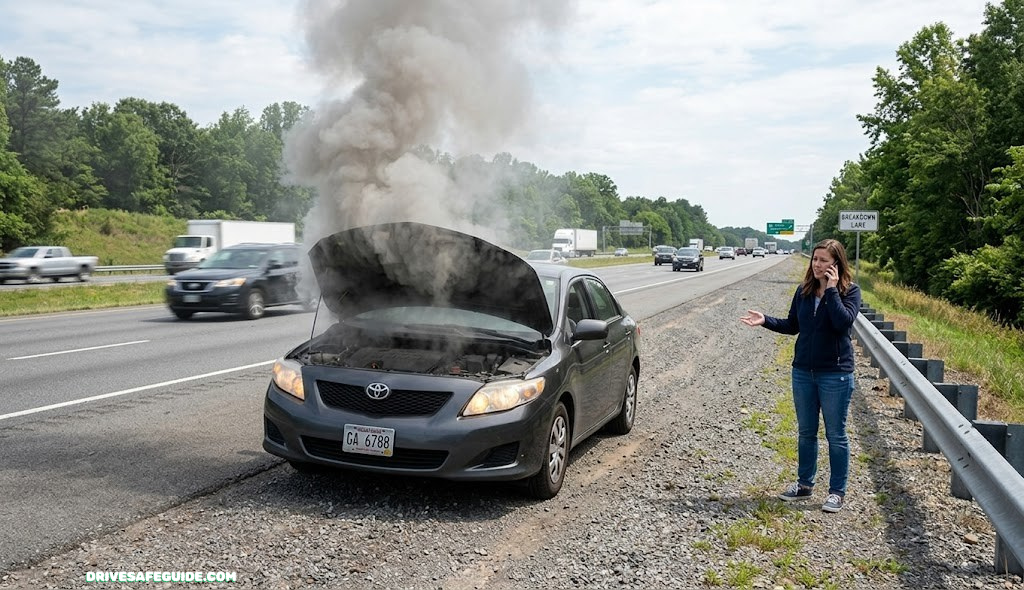
How to Respond to an Engine Fire: A Guide to Engine Fire Extinguishing
What to do in the first ten seconds, how to extinguish a small fire safely, and when to stop trying and simply get away from the vehicle.
The Response Window
Most drivers rehearse what they’d do for a flat tire or a dead battery. Almost nobody rehearses what they’d do if smoke started curling out from under the hood at 65 mph. That gap matters, because an engine fire is one of the few roadside emergencies where the difference between a five-figure repair bill and a totaled, potentially injurious event comes down to what you do in the first thirty seconds — not what a mechanic does an hour later.
This guide walks through that window step by step: how to recognize trouble before you see open flame, how to get your vehicle and everyone in it to safety, when it’s reasonable to fight a small fire yourself, and when the only correct move is distance. It also covers extinguisher selection, prevention, and what happens after the flames are out, since an engine fire rarely ends when the smoke clears.
None of what follows requires special training or expensive equipment. It requires a plan you’ve thought through before the moment arrives, an extinguisher you’ve actually checked rather than assumed is fine, and the discipline to prioritize people over the vehicle every single time. Read it once now, and the sequence below will already feel familiar if you ever need it — that familiarity, more than any single piece of gear, is what keeps a bad ten seconds from turning into a worse ten minutes.
Why Engine Fires Start
An engine compartment is, on a normal day, a controlled arrangement of heat, fuel, oil, and electricity kept safely apart by hoses, gaskets, insulation, and wiring loom. A fire starts when one of those barriers fails and two of those ingredients meet somewhere they shouldn’t. Understanding the common failure points helps you recognize trouble earlier, and it’s also the foundation of the prevention checklist later in this guide.
Fluid leaks meeting hot surfaces
The exhaust manifold routinely runs hot enough to ignite oil or fuel on contact. A worn valve cover gasket, a cracked oil line, or a loose fuel injector fitting can drip fluid directly onto that surface. This is one of the most common engine fire causes on record, and it’s also one of the most preventable — a slow oil leak rarely becomes a fire overnight, it becomes one after months of “I’ll get to it.”
Electrical faults and chafed wiring
Vibration, heat cycling, and age wear through the insulation on wiring harnesses, especially where a harness rubs against a metal bracket. A bare wire touching a grounded surface can arc, and that arc can ignite nearby insulation, fluid residue, or debris like leaves and rodent nesting material. Aftermarket electrical add-ons — remote starters, stereo amplifiers, auxiliary lighting — installed without correct fusing are a disproportionately common source of these fires.
Overheating from cooling system failure
A coolant leak or failed water pump lets the engine run hotter than its components were designed for, which can warp a gasket, crack a hose under pressure, or ignite residual oil baked onto hot metal. If your dashboard has been flagging a temperature warning, don’t wait — a guide to spotting a coolant leak early can save you the entire chain of events that follows.
Debris accumulation
Dry leaves, pine needles, and nesting material collect near the exhaust and intake, particularly on vehicles parked outdoors or under trees. This debris is highly combustible and sits directly against one of the hottest components in the compartment. A five-minute visual check under the hood every season catches this before it becomes a problem.
Recalls and known defect patterns
Manufacturers occasionally identify a specific fire-risk defect across a model range — a wiring harness that chafes against a bracket in a known location, a fuel line prone to cracking at a certain age, or a turbocharger oil feed line that fails predictably. If your vehicle has an open recall, resolving it is not optional paperwork; it’s frequently the single highest-leverage fire-prevention step available to you, and it’s free. A quick VIN lookup with the manufacturer or the National Highway Traffic Safety Administration takes a few minutes.
Aftermarket modifications done without proper safeguards
Performance modifications that increase heat output — a more aggressive tune, an aftermarket turbo, or a modified exhaust — shift the margins that were designed into the stock engine bay. A modified exhaust that runs hotter than stock, positioned closer to a plastic component than the factory setup anticipated, is a common contributor. If you’ve had exhaust work done, it’s worth understanding the legal and safety considerations around modified exhaust systems before assuming the shop accounted for every clearance.
Almost every engine fire is a smaller mechanical problem that was deferred. If you’ve been driving with a dashboard light on, an oil spot on the driveway, or a faint burning smell “that’s probably nothing,” that’s the moment to act — not after smoke appears.

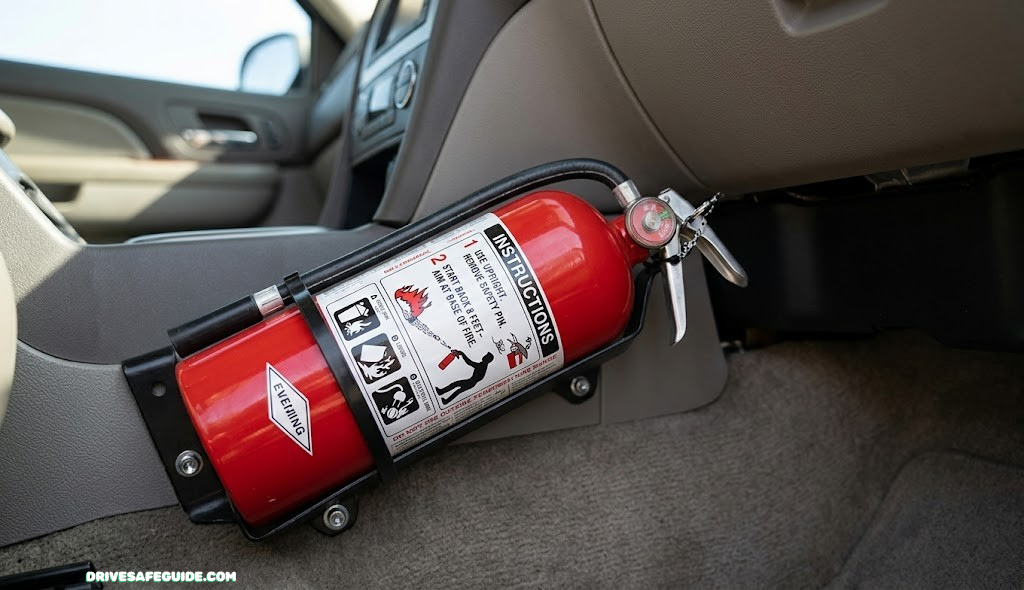
Vehicle-Rated Dry Chemical Extinguisher
A compact ABC-rated unit sized to store under a seat or in a trunk bracket, rated for both flammable-liquid and electrical fires.
Check Price on AmazonWarning Signs Before Flames Appear
Fires rarely start with visible flame. There’s almost always a window of smoke, smell, or sound beforehand, and that window is the best possible time to act because your options are still wide open. Treat any of the following as a reason to pull over immediately, not at the next exit or the next light.
- A burning-plastic or burning-oil smell entering the cabin, especially if it gets stronger rather than fading.
- Visible smoke from under the hood, from the wheel wells, or from the dashboard vents.
- A sudden temperature gauge spike paired with any smell or smoke, which suggests a cooling failure feeding a hot spot.
- Popping, hissing, or crackling sounds from the engine bay that weren’t there before.
- Dimming or flickering dashboard lights combined with an odd electrical smell, which can indicate a wiring fault under load.
- Visible sparking near the wheel wells or under the hood at night.
None of these guarantee a fire is imminent. But every one of them is cheap to check and expensive to ignore, and pulling onto the shoulder to look costs you two minutes. If you’re already uneasy about a dashboard warning light you’ve been driving with, this is also a good moment to review the difference between a solid and flashing check engine light — a flashing light in particular can indicate active engine damage that raises fire risk.
Signs that are easy to miss at night or in bad weather
Smoke is harder to see against a dark sky, and a burning smell can get masked by rain, a heater running on recirculate, or a car full of passengers talking. In these conditions, lean more heavily on smell and sound than sight — a faint acrid note under the normal cabin smell, or a new mechanical noise you can’t place, is worth pulling over for even if you can’t visually confirm smoke in your mirrors. If visibility is already poor, review general night driving safety habits so you’re not managing two hazards — reduced visibility and a possible fire — at once.
Cold starts and short trips
A fire risk that shows up specifically on cold starts — a puff of smoke from the tailpipe or engine bay that clears after a minute — deserves attention rather than a shrug, even if it seems to resolve itself. It often points to oil seeping onto a hot surface during the first few seconds of ignition, which is the same mechanism behind many fully developed engine fires, just at a smaller scale.
The First Response: Pulling Over Safely
The moment you notice smoke, smell, or any warning sign above, your job shifts from “driver” to “incident manager.” The goal of this phase isn’t to assess or fix anything — it’s to get the vehicle stopped somewhere safe and get every person out and clear. Everything else can wait.
Signal, decelerate, and move fully onto the shoulder
Turn on your hazard lights the instant you notice a warning sign, then work your way to the right shoulder or a wide, open area away from traffic, dry grass, and other vehicles. Avoid stopping under an overpass, near a gas station, or beside dry brush if you have any choice in the matter — you want open space around the vehicle, not fuel for the fire to spread into.
Shift to park and shut off the ignition
Once stopped, put the vehicle in park (or neutral with the parking brake set for a manual), and turn the engine off completely. Cutting the ignition stops fuel flow from the pump in most vehicles and removes one active ignition source. Leave the key in a position where the wheel doesn’t lock if you may need to move the car again, but don’t restart it for any reason.
Get everyone out and at least 30 feet away
Unbuckle, exit through doors facing away from traffic when possible, and move every occupant well clear of the vehicle — a rough rule used by many fire departments is at least 100 feet for a vehicle already showing flame, and a minimum of 30 feet for smoke without visible fire. Do not go back in for bags, phones, or anything else. If a child safety seat is involved, prioritize getting the child out before anything else in the cabin.
Once everyone is out, no one goes back in for any reason — not a phone, not a bag, not a pet carrier left on the seat. If a pet is still inside and it’s safe to open a door from outside without exposing yourself to smoke or flame, do that; otherwise, wait for responders.
If you’re carrying passengers who need extra time
A young child in a car seat, an older passenger, or anyone with mobility limitations takes longer to get clear, so build that into how quickly you decide to stop — don’t wait for smoke to thicken before you act if someone in the vehicle will need more time to exit. Unbuckle the people who need the most help first, even if it means the driver is last one out. If you regularly drive with a passenger who has a condition that affects how quickly they can exit or process an emergency, it’s worth having a specific, practiced plan for this scenario rather than improvising it under stress; the same applies to any driver managing their own health condition behind the wheel, where a resource like strategies for drivers managing attention or processing differences can help build calmer default responses to any sudden roadside event, not just fire.
How to Extinguish an Engine Fire
Once everyone is safely clear, you’ve reached the decision point: fight a small, contained fire, or back away and wait for the fire department. This section assumes you’ve decided the fire is small enough to attempt — a modest amount of smoke or a small visible flame confined to one area, not a compartment fully engulfed. If you have any hesitation, skip straight to calling emergency services and keep your distance.
Call 911 before you do anything else
Even if you plan to try extinguishing the fire yourself, call first. Fires can flare unpredictably, and having responders already en route means help arrives faster if your attempt doesn’t fully put it out. Give your location, direction of travel, and a description of what you’re seeing.
Discharge through the hood gap — don’t fully open it
Fully raising the hood introduces a rush of fresh oxygen that can cause flames to flare up toward your face and arms. If your hood has a release that allows a small gap, or if flames are visible through the grille or wheel well, aim your extinguisher there first. Only raise the hood the rest of the way once the visible flame has noticeably died down, and stand to the side while you do it, not directly in front.
Use the PASS technique
Nearly every dry chemical extinguisher follows the same four-part motion, commonly remembered as PASS: Pull the safety pin, Aim low at the base of the flame rather than at the smoke or the top of the fire, Squeeze the handle steadily, and Sweep side to side across the base of the flame until it’s out. Keep a clear escape path behind you the entire time, and never let the fire get between you and your way out.
If the fire grows instead of shrinking after a few seconds of discharge, if your extinguisher runs empty and flames remain, or if you hear a hissing sound that could indicate a fuel line under pressure, stop immediately and move to a safe distance. An extinguisher buys you a chance at a small fire — it is not a guarantee, and it’s not worth pushing past the point where retreat is still easy.
If you don’t have an extinguisher on hand
If you’re without a rated extinguisher, your options narrow considerably, and that’s fine — the honest answer is that you’re no longer in the fire-fighting business, you’re in the waiting-at-a-safe-distance business. Don’t improvise with water. A dry sand or dirt covering can sometimes smother a very small, low flame if it’s immediately available and you can apply it without leaning over the fire, but this is a poor substitute for a proper extinguisher and shouldn’t be attempted on anything beyond a flicker. In almost every case without an extinguisher, the correct move is simply distance and a call to 911, then watching from well clear while you wait.

Compact Emergency Fire Blanket
A fiberglass fire blanket smothers small flames without the mess of a discharged extinguisher and doubles as an emergency wrap.
Check Price on AmazonWhat Not to Do
In a stressful moment, instinct can push you toward the wrong response. These are the mistakes that most often turn a manageable situation into a dangerous one.
Avoid
- Fully throwing the hood open on a fire you haven’t assessed
- Using water on a fuel or electrical fire
- Continuing to drive to “get somewhere safer”
- Standing directly in front of the engine bay while discharging an extinguisher
- Going back into the vehicle for belongings
- Assuming a fire is out just because visible flame has stopped
Do Instead
- Assess through the hood gap or grille first
- Use a dry chemical (ABC/BC) extinguisher only
- Stop and shut off the engine immediately
- Approach from the side with an exit path behind you
- Treat people, then pets, as the only things worth retrieving
- Let the fire department confirm it’s fully out
If you’re navigating any other sudden mechanical failure alongside the fire risk — a brake pedal that’s gone soft, an accelerator that won’t release, or steering that’s suddenly heavy — those each have their own protocol. See brake failure emergency procedures, how to respond to a stuck accelerator, and handling a power steering failure for those specific situations.
It’s worth naming the psychology behind most of these mistakes: they all come from wanting to do something productive immediately, whether that’s seeing the problem clearly by opening the hood, salvaging the trip by continuing to drive, or grabbing a bag on the way out because leaving empty-handed feels wrong. Every one of those impulses is understandable and every one of them adds risk without adding safety. The productive action, almost always, is stop, get clear, and call for help — everything past that is optional and situational.
Choosing the Right Extinguisher
Not every extinguisher sold at a hardware store is a good fit for a vehicle. Engine fires typically involve a mix of flammable liquid (fuel, oil, brake fluid) and electrical components, which puts them squarely in Class B and Class C territory. A multipurpose dry chemical unit rated ABC or BC is the standard recommendation, since it handles both without requiring you to diagnose the exact source mid-emergency.
Size and mounting
A 1-2 lb unit is easy to store but empties in seconds; a 5 lb unit gives you meaningfully more discharge time but takes up more space. Many drivers land on a 2.5-5 lb unit mounted somewhere reachable without leaning across the cabin. For a deeper walkthrough of sizing and where to mount one in different vehicle types, see choosing a car fire extinguisher by class and mounting position.
Check it like you’d check a spare tire
An extinguisher that’s been sitting in a hot trunk for years may have lost pressure even if it looks intact. Check the pressure gauge every few months, replace it after any use even partial, and avoid leaving it somewhere that bakes in direct sun, like a rear dashboard shelf.
If you manage more than one vehicle
Households with multiple drivers or vehicles sometimes assume “we have one in the garage” is coverage enough, but an extinguisher does no good in a vehicle that isn’t carrying it. Each vehicle that regularly leaves the driveway should have its own unit, and it’s worth making a quick habit of confirming placement whenever you swap cars for a trip — the two minutes it takes to check is nothing compared to discovering the gap after smoke has already started.
Extinguisher Class Comparison
Fire extinguishers are rated by the type of fuel they’re designed to fight, and the letters printed on the label aren’t marketing — they describe exactly which fires a given unit was tested against. Grabbing whatever extinguisher happens to be in the garage without checking the rating is a common mistake, since a unit built for kitchen grease fires or ordinary combustibles may do very little against a fuel or wiring fire under the hood. Here’s how the classes relevant to vehicle fires compare.
| Class | Fights | Good For Engine Fires? | Notes |
|---|---|---|---|
| Class B | Flammable liquids — gasoline, oil, brake fluid | Yes | Core rating needed for fuel or oil fires under the hood |
| Class C | Live electrical equipment | Yes | Important for wiring, alternator, or fuse box fires |
| Class A | Ordinary combustibles — paper, fabric, upholstery | Partially | Relevant only if fire has spread to cabin materials |
| Class D | Combustible metals | Rarely | Not a standard vehicle-fire rating; niche industrial use |
| ABC (multipurpose) | A, B, and C combined | Best overall choice | Recommended default for most vehicles |
If you’re cross-shopping units, the practical takeaway is simple: look for “ABC” or at minimum “BC” printed on the label. A unit that only lists “A” is built for paper and fabric, not fuel or wiring, and isn’t a safe substitute.
After the Fire
Once flames are out — whether by your extinguisher or the fire department’s — the incident isn’t over. Hidden hot spots inside the engine bay, wiring insulation, or trim panels can smolder and reignite well after visible fire stops.
Keep your distance until it’s confirmed out
Even if the flame looks fully extinguished, stay back until a responder confirms it, or wait a substantial period and watch for any renewed smoke before anyone approaches. Don’t attempt to restart the vehicle under any circumstances.
Don’t drive it — arrange a tow
A vehicle that’s had an engine fire has unknown damage to wiring, fuel lines, and structural components near the fire’s origin, regardless of how it looks from outside. Have it towed rather than driven, even if it appears to start normally.
Document and file a claim
Photograph the damage once it’s safe to do so, request a written incident report from the fire department if one is available, and contact your insurer promptly. Comprehensive coverage typically applies to vehicle fires, though the details vary by policy, so it’s worth reviewing your specific coverage rather than assuming.
Get a proper cause diagnosis before repairs begin
Even after a fire is contained to a small area, heat and smoke can travel further into the wiring harness and fuel system than what’s visible from outside. A qualified shop should trace the cause rather than simply replacing the visibly burned parts, since an undiagnosed root cause — a chafe point, a failed sensor, a wiring fault elsewhere in the loom — can lead to a repeat incident. This is not the moment to accept a quick patch job to get back on the road faster.
Preventing Engine Fires
Prevention is unglamorous, which is exactly why it works — most engine fires are the final step in a chain that started with a small, ignorable problem. A short seasonal habit closes most of the gap.
- Address leaks immediately. An oil spot on the driveway or a sweet smell suggesting coolant isn’t cosmetic — see how to spot a coolant leak before it becomes an overheating risk.
- Watch belt and hose condition. A cracked or glazed serpentine belt can fail and cause secondary damage; here’s how to recognize serpentine belt wear before it fails.
- Keep an eye on the alternator. Electrical faults tied to a failing alternator are a common precursor; review the early symptoms of alternator failure.
- Have aftermarket electronics installed properly. Amplifiers, remote starters, and auxiliary lighting should be correctly fused by a qualified installer, not spliced in without protection.
- Clear debris. Leaves and nesting material near the exhaust manifold are simple to remove and easy to forget.
- Stay current on fluid and filter service. Old oil and a clogged fuel system put more strain on components that run hot regardless. A primer on engine oil viscosity grades helps you keep the right fluid in the system.
- Don’t ignore a fuel smell or a rough-running engine. Both can point toward a fuel delivery issue; see the warning signs of a failing fuel pump.
None of these guarantee a fire will never happen — mechanical failure is always possible — but together they close off the majority of preventable causes, and they’re the same habits that keep a vehicle reliable overall.
Put it on a schedule, not on memory
The habits above only work if they happen consistently, and consistency is easier with a fixed schedule than with good intentions. A simple approach: do a five-minute visual check under the hood every time you change your wiper fluid or check your tires, and treat any new smell, sound, or dashboard light as same-week business rather than something to monitor for a while first. If your maintenance habits have slipped, reviewing your service intervals and catching up on anything overdue is a reasonable place to restart.

Bluetooth OBD2 Diagnostic Scanner
Catch overheating, misfires, and electrical faults early by monitoring live sensor data from your phone.
Check Price on AmazonEVs, Highways & Tunnels
Electric and hybrid vehicles
A lithium-ion battery pack fire behaves differently from a gasoline engine fire. It burns hotter, is much harder to extinguish with a standard dry chemical unit, and can reignite hours later as internal cells continue to react. If you suspect the fire involves the battery pack rather than the small combustion-adjacent components in a hybrid, don’t attempt to fight it — evacuate immediately, call 911, and specifically tell dispatch it’s an electric vehicle fire so they bring the right equipment. If you’re weighing an EV or hybrid purchase and want the fuller maintenance picture, see hybrid vehicle maintenance basics and notes on managing EV battery health.
Highway shoulders
Getting the vehicle fully onto the shoulder and everyone well clear of the traffic lane is as important as the fire itself — a stopped vehicle on a live shoulder carries its own collision risk. Keep occupants on the side away from traffic, not the roadside door, when it’s safe to choose.
Tunnels
If a fire starts inside a tunnel, prioritize getting the vehicle to the nearest emergency pull-off or the tunnel exit if it’s close, since smoke accumulates quickly in an enclosed space. Use any tunnel emergency phone or call box to alert operators immediately — tunnels typically have dedicated fire suppression and ventilation systems that activate faster with an early alert.
Remote or rural roads
Farther from responders, the calculation shifts slightly: your own extinguisher matters more because help is further away, but the fundamentals don’t change — evacuate first, call for help even knowing the response time will be longer, and never let the wait for responders talk you into re-approaching a fire that’s still active. If you frequently drive remote routes, pairing your fire kit with the broader supplies covered in desert and remote breakdown preparedness closes a related gap — a fire that strands you somewhere without cell service creates a second emergency layered on top of the first.
Border crossings and unfamiliar vehicles
If you’re driving a rental or a vehicle you don’t know well — including one crossing a border, where you may be less familiar with its specific hood release and battery location — take thirty seconds when you first get in to locate the hood release, the extinguisher if one is provided, and the ignition. The same due-diligence habit applies at border crossing vehicle inspections, where you’re already reviewing the vehicle’s condition and paperwork.
Building a Fire-Ready Safety Kit
A fire extinguisher is the centerpiece, but a handful of supporting items make a real difference in an emergency.
Core Items
- ABC-rated dry chemical extinguisher, mounted for quick reach
- Heat-resistant gloves
- LED road flares or reflective triangles
- Seatbelt cutter / window breaker tool
Good Additions
- Fire blanket for smothering small, contained flames
- First aid kit
- Portable phone charger for the 911 call
- Flashlight with a magnetic base for hands-free light
For a full breakdown of what belongs in a general roadside kit alongside fire-specific gear, see the complete car emergency kit checklist and durable LED road flares for visibility once you’re safely away from the vehicle.
Where placement beats quantity
A kit that’s comprehensive but stashed somewhere hard to reach loses most of its value the moment you actually need it under pressure. Prioritize placement over completeness: a single extinguisher you can grab in three seconds beats an elaborate kit buried under luggage. If you’re setting up a kit for a specific trip type, whether that’s a winter drive where cold complicates everything or a long highway haul, the underlying placement principle stays the same — closest, not most.
Seasonal review
Twice a year, pull everything out, check the extinguisher gauge, replace anything expired, and confirm batteries in a flashlight still work. This is the same rhythm many drivers already use for a winter emergency kit refresh, and folding fire-readiness into that existing habit means it’s far less likely to get skipped.
Common Mistakes & Myths
“If I can’t see flame, it’s not serious”
Smoke without visible flame can still indicate an active fire hidden inside the compartment. Treat smoke with the same urgency as flame — pull over and shut off the engine either way.
“Baking soda or a blanket from the trunk will do the job”
Improvised smothering can work on very small, contained flames but is unreliable on anything larger, and a regular blanket (not a rated fire blanket) can itself ignite. A properly rated extinguisher is a better bet in almost every case.
“It’s fine to keep driving to the next exit”
Airflow from driving can feed a fire and spread it further into the compartment. Stop as soon as it’s safe to do so, not at a more convenient location.
“Popping the hood right away helps me see what’s happening”
It can also feed the fire more oxygen and cause a flare-up toward your face. Assess through a gap first, as covered in Step 5 above.
“Modern cars are too well-engineered to catch fire”
Modern vehicles are meaningfully safer than older ones, with better-routed wiring and more heat shielding, but “safer” isn’t “immune.” Age, deferred maintenance, and aftermarket modifications can erode those built-in margins on any vehicle regardless of how recent it is.
“A fire extinguisher in the trunk is the same as one within reach”
An extinguisher buried under cargo in the trunk costs you precious seconds exactly when seconds matter most. Mounting or storing it somewhere genuinely quick to reach is part of what makes it useful, not an optional convenience.
Requirements for Certain Vehicles and Drivers
Personal vehicles generally aren’t legally required to carry a fire extinguisher in most places, which is exactly why so many go without one — nothing forces the habit. Commercial vehicles are a different story: many commercial trucking regulations mandate a rated extinguisher of a specific size be carried and inspected on a schedule, and rideshare or livery vehicles in some jurisdictions face similar rules. If you drive for work, it’s worth confirming what applies to your specific vehicle class rather than assuming your personal-vehicle habits are sufficient.
Even where it isn’t required, treat a fire extinguisher the way you’d treat a spare tire: not because a law demands it, but because the day you need one and don’t have it is a genuinely bad day to learn that lesson. Pair it with the broader habit of defensive driving practices that reduce overall risk, since the same mindset — anticipate, prepare, don’t wait for the emergency to start thinking about it — applies to fire response just as much as it applies to collision avoidance.
Frequently Asked Questions
Should I try to put out an engine fire myself?
Only if it’s small and contained, you have a rated extinguisher on hand, and everyone else is already out at a safe distance. If it’s spreading or you have any doubt, back away and let firefighters handle it.
How long do I have before an engine fire becomes dangerous to approach?
There’s no fixed number — it depends on proximity to the fuel line. Treat anything beyond about a minute of unchecked growth as a fire you no longer approach, and err toward distance rather than timing it.
Is it safe to open the hood during an engine fire?
Fully opening it can flare the fire toward you. Discharge through the gap or grille first, and only raise it once flames have visibly died down.
What type of fire extinguisher works on an engine fire?
A dry chemical extinguisher rated ABC or BC, since engine fires typically span both flammable-liquid and electrical categories.
Can I use water on an engine fire?
No. Water can spread burning fuel and creates a shock hazard around live electrical components. Use a rated extinguisher, or evacuate and wait for responders.
Why do engine fires start in the first place?
Common causes include fluid leaks hitting the hot exhaust manifold, chafed wiring, cooling system failures, and debris buildup near hot components — often after a smaller problem was left unaddressed.
What are the warning signs before flames appear?
A burning smell, smoke from the hood or vents, a temperature spike, unusual electrical smells, or popping and hissing sounds — any of these justify pulling over right away.
Should I disconnect the battery during an engine fire?
Only if you can reach the terminal quickly and safely after everyone is already out. If it means exposing yourself to fire or smoke, skip it.
Do electric and hybrid vehicles catch fire the same way as gas vehicles?
No. A battery pack fire burns hotter and can reignite later. If you suspect a battery fire, evacuate, call 911, and specify it’s an EV fire rather than attempting to fight it.
How do I stop an engine fire from happening in the first place?
Keep up with routine maintenance, address leaks and smells immediately, have aftermarket electronics installed properly, and clear debris from the engine bay seasonally.
What should I do after the fire is out?
Keep your distance until it’s confirmed fully out, arrange a tow rather than driving the vehicle, and contact your insurer with documentation and any available incident report.
Where should I mount a fire extinguisher in my car?
Somewhere reachable in seconds — under the driver’s seat, a footwell bracket, or near the trunk access point — and out of direct sun that could degrade its pressure over time.
Be Ready Before You Need To Be
An engine fire is rare enough that most drivers never face one, and common enough that it’s worth thirty minutes of preparation now rather than improvising later. Know the warning signs, know the sequence — pull over, shut off, evacuate, call, assess, act or retreat — and keep a rated extinguisher within reach rather than buried in the trunk. The goal isn’t to be a firefighter. It’s to buy yourself and everyone in the vehicle a clean exit, every time.
Come back to this page before a long trip, share it with anyone who regularly drives your vehicle, and treat the extinguisher check as routine as topping off washer fluid. Preparation like this rarely feels necessary right up until the one time it’s the only thing that mattered.
Pair this guide with a broader roadside safety kit so you’re not assembling one from scratch on the day it matters.
Shop Vehicle Fire ExtinguishersThis guide is for general informational purposes and is not a substitute for training from a certified fire safety instructor or the guidance of local emergency responders. In any active emergency, call 911 first.
🛡️ Be Prepared
Every Car Needs an Emergency Kit
Breakdowns happen without warning. A well-stocked car emergency kit can keep you safe until help arrives — don’t drive without one.
🏗 Shop Emergency Kits on AmazonAffiliate link — we earn a small commission that keeps DriveSafeGuide running. Thank you!