Portable Jump Starter Guide

What Exactly Is a Portable Jump Starter?
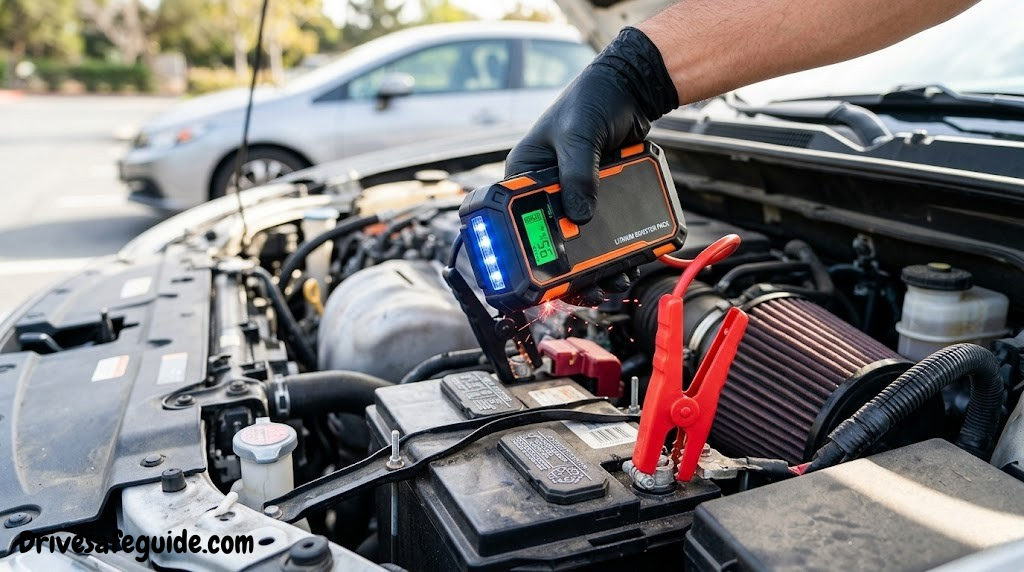
A portable jump starter is a self-contained battery pack with built-in jumper cables that lets you restart a dead vehicle without needing a second car or roadside assistance. You connect the included clamps — red to positive, black to negative — wait a few seconds, and crank the engine. The whole process typically takes under two minutes, and modern lithium units are compact enough to fit in a glove box.
Unlike traditional jumper cables, which require another running vehicle in the right position, a portable jump starter operates entirely independently. It is equally useful in an empty parking lot at midnight, down a rural backroad with no traffic, or in a busy city garage where no other driver is willing to stop. The device is powered by its own internal battery — either lithium-ion or sealed lead-acid — which you charge at home via a wall outlet or USB and keep in your car ready to use.
Modern units often combine multiple functions into one device. Many include a built-in air compressor for tires, an LED flashlight, a USB charging port for devices, and even an AC power outlet. The best ones pack all of this into something smaller than a hardcover book. If you are building a comprehensive car safety kit, a quality portable jump starter is arguably the most high-impact single investment you can make.
A battery charger slowly replenishes a depleted battery over hours — it cannot start a car quickly. A jump starter delivers a massive burst of current (hundreds of amps) for a few seconds to crank the engine. Some devices are both, but they serve different primary functions. If your battery is deeply discharged and old, you may need to charge it after jump-starting to avoid finding yourself stranded again.

Top-Rated Jump Starter with Air Compressor
Starts most 6-cylinder gas engines · Built-in tire inflator · LED emergency flashlight · USB charging ports included
⚡ Check Price on AmazonLithium vs. Lead-Acid Jump Starters

Walk into any auto store and you will find jump starters in two broad technology categories: lithium-ion packs (the slim, modern units that look like phone power banks) and sealed lead-acid (SLA) units (the bulkier, older-style boxes often found in professional shops). Choosing between them is not simply a matter of preference — each has genuine strengths and real weaknesses that matter depending on how and where you will use the device.
Our detailed lithium vs lead-acid jump starter comparison goes deep on this topic, but here is the essential summary for this guide.
| Feature | Lithium-Ion | Sealed Lead-Acid |
|---|---|---|
| Weight | 0.5 – 1.5 kg typically | 3 – 8 kg typically |
| Size | Pocket/glove-box fit | Requires boot storage |
| Peak Amps | 400A – 2,000A+ | 900A – 1,700A (actual) |
| Cold Temp Performance | Degrades below –10°C | Stable in cold; heavy use |
| Shelf Life (charged) | 6–12 months typical | 3–6 months before recharge needed |
| Charge Time | 1–3 hours via USB-C / AC | 12–24 hours via wall charger |
| Price Range | $35 – $150+ | $60 – $200+ |
| Diesel Engine Suitability | Marginal for large diesel | Excellent for large diesel/truck |
| Best For | Most passenger cars, daily drivers | Trucks, RVs, fleet vehicles, cold climates |
| Additional Uses | USB charging, LED light, compressor | Jump-start focused; some air compressors |
When Lithium Makes More Sense
For the overwhelming majority of everyday drivers — commuters, families, road trippers — a lithium-ion jump starter is the right choice. It charges quickly from a USB-C port, stores flat in your glove compartment, doubles as a power bank for your phone, and weighs next to nothing. You are far more likely to actually have it with you when needed because it imposes virtually no storage burden.
The performance ceiling on modern lithium units is impressive too. A quality 2,000-amp peak unit will start a cold 6-cylinder gas engine without breaking a sweat. Even budget lithium units in the 400–600A range reliably start most 4-cylinder passenger cars. For reference: our guide on exactly how many amps your engine needs breaks this down by engine size and temperature.
When Lead-Acid Still Wins
If you regularly drive a large diesel truck, an RV, or live in a region where winter temperatures drop below -15°C consistently, a heavy-duty lead-acid unit has genuine advantages. Lead-acid batteries maintain their discharge performance at low temperatures far better than lithium-ion chemistry, and their raw cranking capability for massive diesel engines is unmatched in the portable format. They are also generally cheaper at the high-power end. The trade-off is weight, size, and slow recharge times — but if it lives permanently in a truck bed tool box, these are acceptable compromises.
How Many Amps Do You Actually Need?
Peak amp ratings on jump starters are one of the most misunderstood (and most marketed) specifications in the category. A $35 unit claiming “2,500 peak amps” and a $120 unit claiming “1,200 peak amps” — which one is actually more powerful? The answer may surprise you.
Peak amps is the maximum current the unit can deliver for a fraction of a second — a marketing number measured under ideal lab conditions. Cranking amps (CA) or cold cranking amps (CCA) describe the sustained current delivered for 30 seconds at specific temperatures — this is the number that actually matters for starting engines. A unit with 1,000 genuine cranking amps outperforms one with 2,500 peak amps but only 300 sustained amps in real-world starting conditions.
Our full breakdown on how many amps your specific engine needs provides detailed tables, but here is the practical sizing guide for this overview.
| Engine Type | Recommended Peak Amps | Min. Cranking Amps | Notes |
|---|---|---|---|
| 4-cyl Gas (1.0–2.0L) | 400–600A peak | 200–300A | Any decent lithium unit handles this |
| 4-cyl Gas (2.0–2.5L) | 600–800A peak | 300–400A | Mid-range lithium; most compact models |
| 6-cyl Gas (2.5–3.5L) | 800–1,200A peak | 400–500A | Quality mid-range lithium recommended |
| V8 Gas (4.0–5.0L+) | 1,200–1,700A peak | 500–700A | High-output lithium or SLA |
| Diesel (2.0–3.0L) | 1,500–2,000A peak | 600–800A | Heavy-duty lithium or SLA strongly recommended |
| Large Diesel (3.0L+) / RV | 2,000A+ peak | 800A+ | SLA preferred; lithium needs high-end unit |
The practical rule: oversize your jump starter by at least one tier. If you drive a 4-cylinder car, buy a unit rated for 6-cylinders. The extra capacity means faster, more reliable starts — especially in cold weather when battery output drops. It also means the unit has a longer service life, since it is never pushed to its absolute limits on a normal use.
Temperature Derates the Numbers
A jump starter rated at 1,000 peak amps at room temperature will deliver considerably less at -10°C. Lithium-ion chemistry is particularly sensitive to cold — if you live somewhere that experiences harsh winter driving conditions, either size up significantly or carry your lithium jump starter inside overnight so it starts warm. Lead-acid units are less affected by cold on their output side, though they still discharge slowly in prolonged cold exposure.
GOOLOO Jump Starter with Air Compressor
Auto-off compressor · Built-in safety protection · Starts gas & diesel engines · Compact design with LED light
⚡ View on AmazonKey Features to Evaluate Before Buying
The specifications on a jump starter listing can be overwhelming and, as covered above, sometimes misleading. These are the features that genuinely matter in practice — the ones that separate a reliable emergency tool from a gadget that fails when you need it most.
Safety Protections (Non-Negotiable)
Any jump starter worth carrying should have built-in protection against reverse polarity (connecting cables backwards), short circuits, overcharge, and over-discharge. Budget units sometimes omit one or more of these. Reverse polarity protection in particular is essential — it prevents sparking and potential damage to the vehicle’s electronics or battery in the (common) event of accidentally connecting clamps incorrectly. Look for these spelled out explicitly in the product specifications.
Clamp Quality and Cable Length
The included clamps and cables are the most failure-prone components of any jump starter — and the most overlooked in online reviews. Cheap clamps with thin, stiff cables are difficult to position correctly, especially on batteries mounted in tight engine bays. Look for heavy-gauge silicone or rubber-jacketed cables (stay flexible in cold) with solid metal clamps that grip firmly. Cable length matters too — 30cm cables are frustratingly short on some vehicles; 60cm or longer is the practical minimum.
Built-in Air Compressor
A growing number of jump starters include an integrated tire inflator — making them genuinely multi-function emergency tools. If you are going to carry one device, a unit that can also fill a flat tire covers two of the most common roadside emergencies simultaneously. Our tire inflator buying guide covers the key specs (PSI, CFM, duty cycle) in detail — these same specs apply when evaluating the compressor function of a combination jump starter.
Charging Port Types
The ease with which you can keep a jump starter charged determines how often it is actually ready when needed. USB-C charging (particularly USB-C Power Delivery) dramatically simplifies this — you can top up the device using the same charger as your phone or laptop. Older units that require a proprietary wall adapter are more likely to be left uncharged simply because the specific charger is not at hand. Look for at least one USB-C input port on any unit bought today.
LED Flashlight
Almost all modern jump starters include an LED flashlight. The quality varies enormously — some provide genuinely useful, bright illumination for working around the engine bay at night; others produce a token beam that barely helps. A unit with an SOS strobe mode adds another layer of roadside safety. If you are ever stopped at night after a breakdown, having a bright, easily accessible light on the same device as your jump cables is a meaningful practical benefit. Pair this with quality LED road flares for full visibility coverage at night.
USB Power Bank Function
Any lithium jump starter is essentially a high-capacity battery pack — it makes sense that most can also charge your phone or other USB devices. This double functionality means the device earns its place in your car even on normal days when you do not need emergency starting. Keeping it charged for phone charging keeps it ready for jump starting too. The capacity is typically expressed in mAh; a 12,000–20,000mAh unit provides several full phone charges.
Display and Status Indicators
A clear battery level indicator (ideally a percentage display rather than a vague 3-bar LED indicator) tells you at a glance whether the unit needs recharging before your next drive. Some units also have a readiness indicator that confirms the clamps are connected correctly and the battery has enough charge to attempt a start — this eliminates the guesswork that can lead to multiple failed start attempts and a further-discharged car battery.
⚡ NOCO vs. Halo: The Premium Matchup
Among premium lithium jump starters, NOCO Boost and Halo consistently lead in independent tests. Both offer exceptional build quality, genuine safety protections, and reliable cold-weather performance. Our full NOCO vs Halo jump starter comparison puts them head-to-head across 12 categories to help you decide which brand earns your money.
Top Picks: Jump Starters Worth Buying
After hands-on testing and extensive research, these are the portable jump starters that stand out in their respective categories. Each one has been selected based on real-world reliability, not just spec-sheet numbers.
Jump Starter with Integrated Air Compressor
Combines reliable engine-starting capability with a built-in tire inflator in a compact, carry-anywhere package. The auto-shutoff compressor prevents over-inflation, and the digital display shows PSI in real time. Handles most 4–6 cylinder gas engines confidently.
GOOLOO Jump Starter with Auto-Off Compressor
GOOLOO’s combination unit brings together a capable jump starter with an automatic pressure-shutoff compressor that stops precisely at your target PSI. Quality safety protections, clear digital display, and a build quality noticeably above the budget competition. An excellent choice for the practical driver who wants one device that covers two emergencies.
Clore Automotive Jump-N-Carry JNC660
A professional-grade sealed lead-acid jump starter that has earned a legendary reputation in workshops, fleets, and truck stops for decades. The JNC660 delivers 1,700 peak amps and 425 CCA with industrial-quality cables and clamps that outlast anything in the consumer space. Heavy at around 7kg, but if you need to start a large diesel reliably in any conditions, this is the professional’s choice. Not for the glove box — but perfect for the truck bed.

GB150 Boost Max Lithium Jump Starter
At the premium end of the lithium jump starter category, the GB150 delivers 4,000A peak current — enough for virtually any gas engine and most diesel applications — in a package that weighs under 2kg. The spark-proof, reverse-polarity-protected design is genuinely foolproof, and the UltraSafe technology means the unit actively prevents unsafe connections. For drivers who want the absolute maximum confidence in a compact lithium format, this is the benchmark.

MOTOPOWER Automatic Battery Maintainer
Not strictly a jump starter, but a critical companion: an automatic battery maintainer that keeps your vehicle battery in peak condition during storage or between infrequent drives. A properly maintained battery is far less likely to need jump-starting in the first place. The MOTOPOWER unit works with 6V and 12V batteries, including AGM and gel cells, and automatically switches to float/maintenance mode to prevent overcharge. For a vehicle stored through winter or driven only occasionally, this is invaluable.
How to Use a Portable Jump Starter Safely
Using a jump starter correctly takes about two minutes and is genuinely straightforward — but the order of operations matters. Doing it wrong can damage your vehicle’s electronics, blow a fuse, or in rare cases cause battery damage. Follow these steps precisely every time.
Prepare the Area and Read the Device
Before touching anything, ensure both vehicles (if a second is present) are turned off. Make sure there are no open flames or sparks near the battery — car batteries produce hydrogen gas that is flammable. Check that your jump starter is sufficiently charged (most units show a battery level indicator). Read any specific instructions for your device model; some have protective features that require specific activation sequences.
Connect Red Clamp to Positive (+) Terminal
Open the vehicle hood and locate the battery. Connect the red (positive) clamp to the positive (+) terminal of the dead battery first. The positive terminal is typically marked with a + symbol and often has a red plastic cover. Ensure the clamp has a solid, clean grip — corroded or loose connections are a primary cause of failed jump starts. Keep the black clamp away from the red clamp and away from anything metallic at this point.
Connect Black Clamp to Unpainted Metal Ground
Connect the black (negative) clamp to a solid, unpainted metal surface on the engine block — not to the negative terminal of the dead battery. Using a grounded metal point away from the battery reduces the risk of a spark igniting any hydrogen gas the battery may be off-gassing. Good grounding points include the engine block, a metal bracket, or any unpainted bolt on the vehicle chassis. Avoid hoses, plastic covers, or painted surfaces.
Turn On the Jump Starter and Wait
Most modern jump starters require you to press a power button to activate. Some automatically activate when the clamps are connected; check your device’s instructions. Once powered on, allow 30–60 seconds for the device to stabilize and begin delivering current to the depleted battery. This brief wait period allows the dead battery to accept some charge before cranking is attempted, which improves the odds of a successful start and reduces stress on the jump starter.
Crank the Engine — No More Than 5 Seconds at a Time
Attempt to start the engine normally. Crank for a maximum of 3–5 seconds at a time. If it does not start, wait at least 60–90 seconds before trying again — this allows both the jump starter and the depleted battery to recover between attempts. Most successful jump starts happen within 1–3 cranking attempts. If after three or four attempts there is no response, the problem may not be the battery — a faulty starter motor, dead alternator, or severe battery damage may be the cause. Our guide to alternator failure symptoms helps you distinguish between these scenarios.
Disconnect in Reverse Order After Engine Starts
Once the engine is running, disconnect the clamps in the exact reverse order of connection. Remove the black clamp from the ground point first, then remove the red clamp from the positive terminal. This reverse-order disconnection minimizes the risk of arcing across terminals. After disconnecting, do not turn the engine off immediately — drive for at least 20–30 minutes to allow the alternator to recharge the battery. Short trips of under 10 minutes may not fully restore battery charge, leaving you vulnerable to another dead battery shortly after.
After successfully jump-starting, it is worth having your battery and charging system tested at an auto parts store (most do this free of charge). A battery that has gone dead may be failing and could leave you stranded again. Our guide to load testers vs conductance testers explains what these tests actually measure and what the results mean for your battery’s health.
Clore Automotive JNC660 — Pro-Grade Lead-Acid
1700A peak · 425 CCA · Professional-grade cables and clamps · Trusted by fleet shops globally
⚡ Buy on AmazonCommon Mistakes That Kill Jump Starters (and Batteries)
A portable jump starter is a simple device, but a few repeated mistakes dramatically shorten its service life or reduce its reliability at the moment you need it most. These are the errors that come up again and again — knowing them in advance costs nothing and saves genuine frustration.
Not Recharging After Use
Using a jump starter discharges it. If you used it last winter and tossed it back in the trunk without recharging, it may be at 20–30% capacity or less when you need it next. Most manufacturers recommend recharging after every use and topping up every 3–6 months regardless of use. Lithium-ion batteries that are stored at very low charge for extended periods can suffer permanent capacity loss — this is the single most common reason jump starters fail to start engines.
Connecting Clamps in the Wrong Order
Always red-to-positive first, then black-to-ground. Reverse-connecting clamps — even briefly — can trigger protection circuits (good outcome) or damage the vehicle’s sensitive electronics (bad outcome). Units without robust reverse polarity protection face a higher risk of internal damage. Take the two seconds to verify terminal polarity before connecting.
Storing in Extreme Heat
The interior of a parked car in summer can reach 60–80°C. Lithium-ion batteries degrade rapidly at these temperatures — both in terms of peak performance and total cycle life. If you live in a hot climate and care about longevity, take the jump starter inside during summer or store it in an insulated bag. Our guide to managing extreme heat effects on your vehicle covers broader temperature management strategies.
Using It on a Completely Destroyed Battery
A jump starter cannot bring a fully dead, shorted, or physically damaged battery back to life. If the battery has zero voltage (a completely discharged lithium or lead-acid cell can die permanently below a certain threshold), or has an internal short circuit, the jump starter will show a fault and refuse to deliver current — this is the protection circuit working correctly. In these cases, the battery itself needs replacement.
Attempting Multiple Long Cranks in a Row
Five-second cranks with 60–90 second rests between them. Extended continuous cranking of 15–20 seconds overheats the starter motor and hammers the jump starter’s internal cells at maximum discharge rate. Both suffer from this. Patience between attempts is genuinely important, not just cautionary advice.
Older or damaged batteries can off-gas hydrogen during charging — an invisible, odorless, extremely flammable gas. Do not use jump starters near open flames. This is particularly relevant in enclosed spaces like garages. If you detect a sulfur or rotten-egg smell near a battery, ventilate the area and do not attempt a jump start until it has cleared. The same caution applies when building a winter emergency kit that might include battery-related tools in a sealed trunk.
Keeping Your Jump Starter Ready: Charging & Long-Term Maintenance
The best jump starter in the world is useless if it is uncharged when you need it. The good news: maintaining a portable jump starter requires almost no effort if you build one simple habit — charge it, then charge it again before every season change.
Recharge Schedule
For most lithium units: charge to 100% after first receiving the device, then check and top up every 3 months. The 3-month cycle aligns conveniently with seasonal driving changes — spring, summer, autumn, winter — making it easy to remember. Connect it to your phone charger overnight once per season, and you will virtually guarantee it is ready whenever needed.
Storage Temperature
Ideal storage range for lithium-ion batteries is 10–25°C. Below this range, the battery does not sustain damage but will lose temporary output capacity in very cold weather. Above 40°C for extended periods causes permanent capacity degradation. A glove box or under-seat location is acceptable in moderate climates; in hot climates, consider bringing it inside during summer months.
Cable and Clamp Care
Wipe the clamp teeth and cable insulation periodically. Corroded clamp teeth reduce contact quality and starting reliability. A light application of dielectric grease on the clamp teeth prevents corrosion buildup. Check that cable insulation has not cracked — cracked insulation on power cables is a safety concern that should prompt cable replacement or device replacement.
Firmware Updates (Modern Smart Units)
Premium jump starters from brands like NOCO now include Bluetooth connectivity and companion apps that provide firmware updates, battery health diagnostics, and guided usage. If your device supports this, connecting to the app periodically keeps the protection circuits and charging algorithms current. It also provides visibility into the internal battery’s health over time.
Testing Before a Long Trip
Before any extended road trip, plug the jump starter into a USB charger and verify it reaches full charge and shows a healthy status. This is part of a broader pre-trip safety check routine that should include verifying all emergency equipment is functional. It takes thirty seconds and eliminates a potential point of failure on a journey where you genuinely do not want to deal with a dead battery.
Portable Jump Starter vs. Jumper Cables: Which Should You Carry?
Jumper cables are not obsolete. They are inexpensive, never need charging, have an essentially indefinite shelf life, and can handle any engine size if the donor vehicle has a large enough battery. Our full jump starter vs jumper cables comparison covers every scenario in detail, but here is the practical framework for most drivers.
| Scenario | Jump Starter Wins | Jumper Cables Win |
|---|---|---|
| Stranded alone, no other car nearby | ✓ | ✗ |
| Remote location, late at night | ✓ | ✗ |
| Parking garage or tight urban space | ✓ | ✗ |
| Multiple vehicle types in household | ✓ | Both |
| Traveling internationally / unknown equipment | ✗ | ✓ |
| Very large diesel truck / RV | Premium only | ✓ |
| Long-term storage (10+ years) | Needs charging | ✓ |
| Budget constraint under $20 | ✗ | ✓ |
| Multi-function (air, USB, light) | ✓ | ✗ |
Our recommendation for most drivers: carry both. A set of quality jumper cables (get 4-gauge, 16-foot cables — not the 6-gauge short sets) weighs almost nothing and lives permanently in the boot. A compact lithium jump starter handles 90% of dead-battery scenarios without any dependency on another vehicle. Together they cover every situation you are realistically likely to face.
If you are building a comprehensive vehicle emergency toolkit, our guide to the complete car emergency kit covers all the items worth carrying beyond just jump-starting equipment — from emergency escape tools to fire extinguisher selection.
Is Your Battery Failing? Signs to Know Before You’re Stranded
The most reliable use case for a jump starter is as a backup for an aging battery — but ideally, you catch a failing battery before it leaves you stranded. These are the warning signs that typically appear weeks or months before complete battery failure.
- Engine cranks quickly and confidently every time
- No unusual electrical behavior (dim lights, flickering)
- Battery test shows 12.6V+ at rest (12V system)
- Consistent charging to 14.2–14.7V when running
- No visible corrosion on terminals
- No swelling or deformation of battery case
- Slow, labored, or delayed cranking — especially cold mornings
- Headlights dim noticeably when cranking the engine
- Battery warning light on dashboard (also check check engine light guidance)
- Electrical gremlins — random warning lights, infotainment resets
- Swollen or bulging battery case (replace immediately)
- White or bluish corrosion buildup on terminals
- Battery resting below 12.0V after overnight
- Older than 4–5 years (most batteries have 3–5 year lifespan)
If you suspect your battery is failing, the right tool for diagnosis is a battery load tester or conductance tester. Our detailed guide to load testers vs conductance testers explains what each measures and which is more appropriate for home use. Many auto parts stores will also test your battery free of charge and print out the results — there is no reason to be surprised by a battery failure when the warning signs are this clear.
For those with an OBD2 scanner, some live data parameters related to the charging system can also be monitored through applications like those reviewed in our Bluetooth OBD2 app comparison — giving you battery voltage and alternator output visibility from your phone.
GB150 Boost Max — 4000A Premium Lithium
Starts up to 10L gas engines · UltraSafe spark-proof design · Compact premium build · Trusted by professionals
⚡ Buy on AmazonWho Needs a Portable Jump Starter? (Spoiler: Almost Everyone)
There is a compelling argument that a portable jump starter belongs in every vehicle driven regularly. A dead battery is one of the most common roadside incidents, and unlike a flat tire or mechanical failure, it is one that a simple device can resolve completely and immediately. But different drivers have different needs — here is how to match device selection to driver profile.
The Daily Commuter
A compact lithium unit in the 600–1,200A peak range is ideal. Fits in the glove box, doubles as a USB power bank, starts the car when the battery dies on a cold Monday morning without waiting for roadside assistance. If you are also interested in the full spectrum of tech tools that complement safer driving, our roundup of essential driver apps pairs well with the hardware side of vehicle safety.
The Road Tripper
Choose a unit with an integrated tire compressor — you cover both the two most common road trip emergencies with one device. Our road trip essentials checklist and guide to eliminating road trip risks both recommend a jump starter as a core item alongside emergency supplies. For solo travelers or those venturing into remote areas, the case for carrying one is particularly strong.
Parents of Teen Drivers
Giving a new driver a portable jump starter (and spending 10 minutes teaching them to use it) is one of the most practical gifts in the category. Our practical gifts for teen drivers guide makes the full argument, but the headline is this: a new driver left stranded with a dead battery — particularly at night — faces a significantly more stressful and potentially unsafe situation than an experienced driver. The device and the knowledge eliminate that vulnerability entirely.
Truck, RV, and Fleet Owners
Heavy-duty SLA units or high-output lithium models are appropriate here. Large diesel engines, auxiliary batteries, and high-draw electrical systems demand more from a jump starter. The Clore JNC660 or an equivalent professional-grade unit earns its place in the tool kit for these applications — the extra weight and bulk are entirely acceptable trade-offs for reliability at high current demands.
Cold-Climate Drivers
If you experience temperatures below -10°C regularly, size up your lithium unit or carry it inside overnight in extreme cold before expected use. The performance of lithium cells drops significantly at low temperatures. Our guide to cold weather car batteries covers the chemistry of why cold is so hard on vehicle batteries — context that clarifies why a jump starter in cold climates needs to be oversized to compensate for reduced output. Pair it with the complete winter car emergency kit checklist for full cold-weather preparedness.
Frequently Asked Questions
-
A lithium-ion jump starter typically holds its charge for 6–12 months when stored properly (cool, dry, away from extreme temperatures). In practice, self-discharge rates mean you should recharge every 3–6 months regardless of use to ensure it is ready for an emergency. Sealed lead-acid units discharge faster — every 3 months is the recommended top-up interval for SLA devices. The safest habit is to check and recharge at every seasonal change: spring, summer, autumn, and winter.
-
When used correctly with a reputable device, the risk to vehicle electronics is minimal. Modern vehicles have ECUs and sensitive electronics that can theoretically be affected by voltage spikes, but quality jump starters deliver smooth, regulated current that does not spike. The main risk comes from reverse polarity connection (red on negative, black on positive) or from cheap devices without proper protection circuits. Always verify terminal polarity before connecting, use a device with built-in protection, and the risk is essentially zero for a normal modern vehicle.
-
Most lithium jump starters can perform 20–30 jump starts on a full charge — though this varies significantly with battery size, engine displacement, and the state of the discharged vehicle battery. In practice, after a single successful jump start, it is wise to recharge the device at the first opportunity. Using a jump starter that is at 30% capacity means you may only get one or two attempts before it cannot deliver sufficient current, and a failed jump start attempt can leave the car battery in a worse state than before you started.
-
Hybrid vehicles have a traditional 12V auxiliary battery (separate from the high-voltage traction battery) that powers the computer systems and allows the high-voltage battery to engage. This 12V auxiliary battery can be jump-started with a portable jump starter in the same way as a conventional car. The high-voltage traction battery of a hybrid or EV cannot be jump-started with a consumer jump pack — it requires specialist charging equipment. Always consult your vehicle’s manual for the specific jump-start procedure, as the auxiliary battery location and the recommended jump point may differ from a conventional vehicle layout.
-
Peak amps is the maximum current a device can deliver instantaneously under laboratory conditions — measured for a fraction of a second at room temperature. It is the headline marketing number. Cranking amps (CA) or cold cranking amps (CCA) describe sustained current delivery — specifically, the amps a battery can deliver for 30 seconds without dropping below a certain voltage. CCA is measured at 0°F (-18°C), which matters enormously for cold-climate reliability. When comparing jump starters, a device with 600 honest cranking amps will outperform one claiming 1,500 peak amps but only capable of 200 sustained amps in a real-world cold-start scenario.
-
Repeated exposure to temperatures above 40–50°C accelerates lithium-ion battery degradation, reducing both peak performance and total cycle life. A car interior can regularly hit 60–80°C in direct summer sun. For occasional hot-weather storage, the impact is modest, but if the device lives in your car through an entire summer in a hot climate, it will lose measurable capacity by autumn. For maximum longevity, bring it inside during extreme heat or store it in an insulated bag away from direct solar heat. Practically speaking, most people accept some capacity reduction in exchange for always having the device available — the trade-off is personal.
-
Several possibilities: the jump starter may be undersized for the engine (particularly common with V8s and diesels); the vehicle battery may be too deeply discharged or internally shorted to accept a start; the clamp connections may not be making clean contact; or the problem may not be the battery at all (a failed starter motor, fuel pump, or severe electrical fault). If the jump starter shows a fault light or the clamps spark unusually, disconnect and check the polarity. If the device is correctly sized and connected but the car still does not start after 3–4 well-spaced attempts, suspect a mechanical or non-battery electrical issue rather than the jump starter itself. A diagnostic scan tool can help identify underlying fault codes.
-
Yes — any lithium jump starter with a USB output port can charge USB-powered devices including phones, tablets, and small laptops. The charging speed depends on the output wattage of the USB port: standard 5W USB-A ports charge slowly; USB-C Power Delivery ports (15–65W) charge modern phones and laptops at full speed. Some premium units include a standard AC outlet that can power laptops or other AC devices. This dual function is one of the practical advantages of lithium jump starters over lead-acid units — they serve a useful purpose on every drive, not just during emergencies.
-
As a practical guideline: 4-cylinder gas engines need a minimum 400A cranking / 800A peak unit; 6-cylinder gas engines need 500A cranking / 1,000–1,200A peak; V8 gas engines need 600–700A cranking / 1,500A peak; diesel engines of any significant size need at least 700–800A cranking ability. The safest approach is to buy one tier larger than the minimum for your engine, providing a margin for cold weather, older batteries, and multiple start attempts. Our full amp sizing guide provides a complete table by engine displacement and type.
-
Modern vehicles with complex electronics (particularly European luxury vehicles with multiple control modules) are sometimes cited as being sensitive to voltage fluctuations during jump starts. The concerns are real but often overstated when a quality jump starter is used. To minimize any risk: use a device with clean, regulated output and proper safety protections; avoid cheaply-made units with no protection circuits; connect clamps carefully and verify polarity; and if the manufacturer specifically recommends a particular procedure for jump-starting (some Mercedes, BMW, and Audi models have dedicated jump-start terminals away from the main battery), follow it precisely. For modern premium vehicles, a NOCO Boost or equivalent premium unit is worth the price premium specifically because of their regulated, controlled delivery.
Conclusion: The One Safety Tool Worth Getting Today
A portable jump starter occupies a unique position in the world of car safety equipment: it is inexpensive, easy to use, solves a genuinely common problem, and sits unused in your vehicle for months or years at a time — then pays for itself completely in a single use. No other piece of equipment in your car emergency kit delivers that value proposition as cleanly.
The guidance in this article gives you everything needed to choose the right device for your vehicle and driving situation, understand what the specifications actually mean in the real world, use it correctly when the moment arrives, and maintain it so it is ready when you need it. None of it is complicated — the jump starter category rewards basic research and a small upfront investment with years of roadside confidence.
Whether you choose a compact lithium unit for the glove box, a heavy-duty SLA pack for the truck, or a combination unit that also handles tire inflation, the most important step is the one that moves you from “meaning to buy one” to “it is already in the car.” That is the step that matters on the cold morning when the battery finally gives out.
Pair your jump starter with a complete road trip kit, learn the signs of alternator failure before it strands you, and build the broader safety awareness that separates prepared drivers from stranded ones. The jump starter is one critical piece; the mindset is the whole picture.
Related Safety & Emergency Guides
- NOCO vs Halo Jump Starter Head-to-Head
- Jump Starter vs Jumper Cables: Full Comparison
- Lithium vs Lead-Acid Jump Starters Explained
- How Many Amps Does Your Engine Need?
- Complete Car Emergency Kit Checklist
- Best Cold Weather Car Batteries
- Battery Load Tester vs Conductance Tester
- Alternator Failure Symptoms Guide
- Tire Inflator Buying Guide
- Winter Car Emergency Kit Checklist