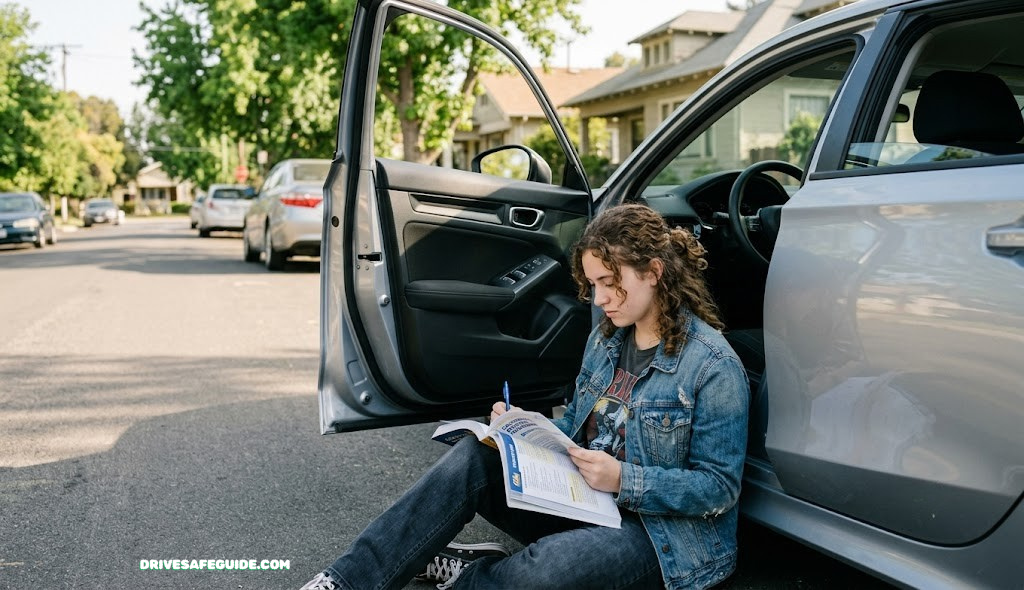
Mastering the Permit Test: Essential Practice Questions and Tips
Everything you need to walk into the DMV, sit down at that computer terminal, and pass your learner’s permit exam with confidence — on the first attempt.
Understanding the Permit Test
The learner’s permit exam is the first real checkpoint on the road to independent driving, and it trips up more people than you’d expect — not because the material is complicated, but because most applicants underestimate how specific the questions get. It isn’t a test of common sense alone. It’s a test of whether you’ve actually read your state’s driver handbook, cover to cover, and can apply those rules to scenarios you haven’t seen phrased quite that way before.
Every state administers some version of a written knowledge test, usually delivered as multiple-choice questions on a computer terminal at the DMV, though a growing number of states now offer remote or online testing options for eligible applicants. The test typically draws from four broad categories: traffic laws, road signs and signals, safe driving practices, and situational judgment. Some states blend these into a single exam; others separate signs into their own section with a stricter individual pass threshold.
What makes this test different from a typical school exam is the format of the questions themselves. Rather than asking you to define a term, the DMV presents a scenario — a car approaching a four-way stop, a school bus with flashing lights, a driver signaling a lane change — and asks what the correct response is. That’s why rote memorization only gets you partway there. You need pattern recognition, and pattern recognition comes from repetition with varied practice questions, not from reading the handbook once and hoping it sticks.
If you’re studying alongside a parent or guardian, it’s worth reviewing our guide on how parents can effectively coach teen drivers, since the habits you build studying together often carry directly into the supervised driving hours that follow.
It’s also worth noting that the permit test isn’t designed to be adversarial. State DMVs publish their handbooks specifically so applicants can prepare, and the question banks are drawn directly from that published material rather than from obscure trivia. The applicants who struggle most are usually the ones who studied a generic national guide instead of their own state’s current handbook, only to discover that a rule they memorized — say, a right-on-red exception or a specific following-distance recommendation — doesn’t match what their state actually requires. Always treat your state’s official handbook as the primary source, and use outside study guides, including this one, as supplementary reinforcement rather than a replacement.
Another detail worth understanding early: many states differentiate between a “learner’s permit” test for minors and an “instruction permit” test for adult first-time applicants, and the age-related requirements — required study hours, parental sign-off, minimum age to test — can differ substantially between the two tracks. If you’re an adult applicant, don’t assume the teen-focused requirements you’ve heard about from friends or family apply to you; check your state’s adult licensing pathway directly, since the written exam content is usually similar but the surrounding paperwork often isn’t.

Study Smarter With a Physical Practice Book
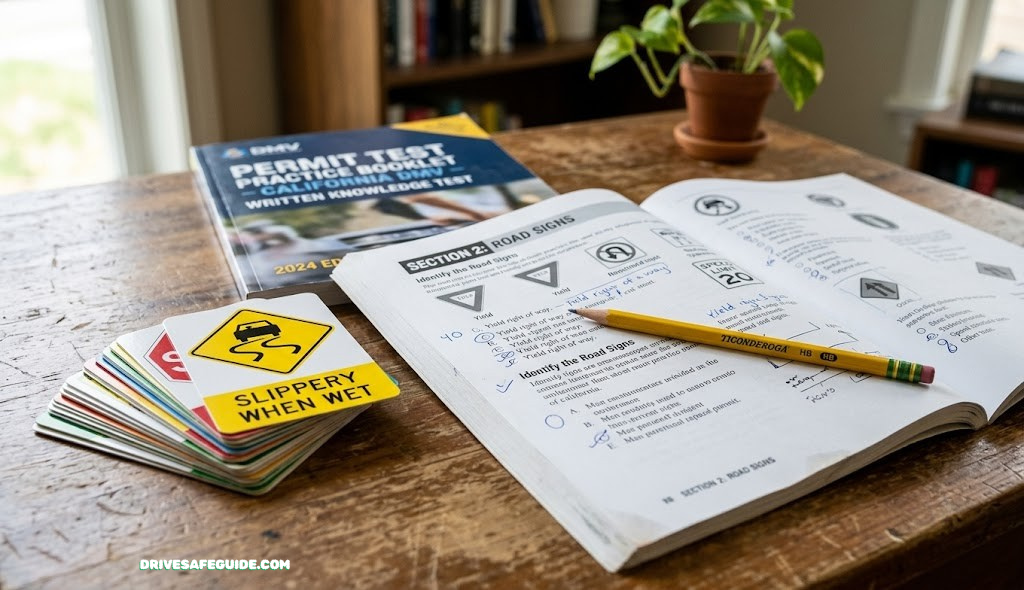
Digital tests are great for repetition, but many learners retain sign shapes and rules better with a printed handbook they can annotate and flip through offline.
Shop Permit Study GuidesHow Scoring and Pass Rates Work
Most states require applicants to answer somewhere between 70 and 85 percent of questions correctly, with 80 percent being the most common threshold nationally. A typical exam runs 25 to 50 questions, meaning you can usually afford to miss somewhere between four and ten questions depending on your state’s specific formula. That margin matters — it means perfection isn’t the goal, consistency is.
Some states use a fixed question bank that rotates a set pool of items, while others pull from a much larger database so that no two test-takers see an identical exam. This is part of why memorizing answer patterns from outdated online quizzes can backfire: the specific wording and order change, but the underlying concept being tested does not. Study for concepts, not for a sequence of memorized answers.
| Component | Typical Range | Why It Varies |
|---|---|---|
| Total questions | 25–50 | State DMV policy and applicant age |
| Passing score | 70%–85% | Some states raise the bar for repeat failures |
| Sign section | Often separate | Some states require passing signs independently |
| Retake wait time | Same day–14 days | Varies significantly by state DMV rules |
| Test format | Computer or paper | Depends on DMV office and state technology |
Because these details differ so much by location, always confirm the exact figures on your own state DMV’s website before test day. Treat any number in a general guide, including this one, as a planning benchmark rather than gospel.
It’s also useful to understand how the test is graded behind the scenes. Most computer-based systems calculate your score as a running percentage and will often display an on-screen result immediately after your final answer, sometimes even before you’ve had time to review which specific questions you missed. If your state provides a printed or digital breakdown afterward, request it — reviewing exactly which categories you struggled with is far more useful for a retake than simply knowing your overall percentage. A borderline pass is still a pass, but it’s also a signal that a particular category, often right-of-way or sign recognition, deserves more attention before you move on to behind-the-wheel training.
Some states also weight certain question categories more heavily than others, meaning a handful of missed sign questions might not sink your score the way several missed right-of-way questions would. This weighting isn’t always publicly disclosed in detail, which is one more reason to aim for genuine understanding across every category rather than optimizing your study time around a guess at which section “counts more.”
Building a Study Plan That Sticks
The single biggest predictor of permit test success isn’t intelligence — it’s spaced repetition. Learners who study in short, frequent sessions over one to two weeks consistently outperform those who try to absorb the entire handbook in one long night. Your brain needs sleep cycles between study sessions to actually consolidate the material into long-term memory.
A Realistic Two-Week Framework
- Days 1–3: Read the full state handbook once, straight through, without trying to memorize anything. You’re building a mental map of what’s covered.
- Days 4–7: Take a practice test daily. Review every missed question immediately, and reread the handbook section it came from.
- Days 8–11: Focus specifically on your weak categories — usually right-of-way and sign recognition for most people.
- Days 12–13: Take full-length timed practice tests under real conditions, no notes, no pausing.
- Day 14: Light review only. Skim your notes, get a full night’s sleep, and avoid last-minute cramming.
If your schedule is tighter, compress this into a week by doubling up study sessions, but don’t skip the review-of-mistakes step. Answering the same question wrong twice without understanding why is wasted repetition.
It also helps to build broader safe driving habits alongside the bookwork — reviewing defensive driving habits that reduce collision risk gives real-world context to the rules you’re memorizing, which makes them easier to recall under test pressure.
Studying for Different Learning Styles
Not every learner absorbs a dense legal handbook the same way, and recognizing your own study style early can save you a lot of frustration. Visual learners tend to benefit most from sign flashcards and diagrams, since the shape-and-color system used on road signs is inherently visual and doesn’t translate well to plain text review. Auditory learners often do better reading the handbook aloud, or having a parent quiz them verbally using scenario-based questions rather than silently rereading pages. Kinesthetic learners — people who learn by doing — sometimes benefit from writing out their own practice questions by hand after reading each handbook section, since the act of constructing a question forces a deeper level of engagement than passively answering one.
Whichever style fits you best, resist the temptation to rely entirely on one method. Combining reading, active recall through practice questions, and visual sign drills consistently produces better retention than any single method used in isolation, according to general findings in cognitive learning research on spaced repetition and interleaved practice.
Handling Test Anxiety
A meaningful percentage of first-attempt failures aren’t caused by a knowledge gap at all — they’re caused by anxiety that leads to careless misreading of otherwise familiar questions. If test anxiety is a concern, a few practical adjustments help: arrive early enough that you’re not rushed, do a short physical warm-up like a walk around the block before your appointment to burn off nervous energy, and remind yourself that most states allow retakes without serious consequence. Treating the first attempt as high-stakes rather than as one data point in a learning process tends to increase the very mistakes you’re trying to avoid.
If you tend to freeze on multiple-choice formats specifically, practice under timed conditions in the days leading up to your test so the format itself feels familiar rather than novel on test day. Familiarity with the format reduces cognitive load, leaving more mental bandwidth for the actual content of each question.
Road Sign Recognition Drills
Sign identification questions test two things simultaneously: shape and color recognition, and your understanding of what the sign requires you to do. Most state tests separate signs into three functional categories — regulatory, warning, and guide signs — and each category has a consistent visual language once you learn to spot it.
Octagon, red = full stop required
Yellow diamond = warning ahead
Circle, yellow = railroad crossing
Green rectangle = guide/direction info
Downward triangle = yield right-of-way
Pentagon, orange = school zone
Notice the pattern: shape often communicates urgency before you even read the text. An octagon always means stop, regardless of the language printed on it, which is why the shape-color system exists in the first place — it’s designed to be understood even at highway speed or in low visibility.
- A. A railroad crossing ahead
- B. A school zone or school crossing
- C. A construction detour
- D. A hospital nearby
Reveal Answer
B — Orange is reserved almost exclusively for temporary conditions and school zones in most state systems, and the pentagon shape is unique to school signage.
The Logic Behind Sign Colors
Once you understand why each color was chosen, the whole system becomes far easier to retain. Red is reserved for the most restrictive instructions — stop, yield, do not enter — because red draws the eye fastest and signals urgency across nearly every culture and language. Yellow indicates caution or a change in road conditions ahead, from curves to merging traffic to pedestrian crossings, and its high visibility against most backgrounds makes it ideal for a “pay attention” signal that isn’t quite as severe as red. Orange is deliberately distinct from both, reserved for temporary conditions like construction zones and school areas, so drivers immediately recognize it as situational rather than permanent. Green and blue are informational rather than instructional — green for directional guide signs like exits and mile markers, blue for services like hospitals, gas, and rest areas.
White signs with black text or symbols are almost always regulatory — speed limits, one-way streets, parking restrictions — because they’re meant to convey a precise legal instruction rather than a general warning. Once this color logic clicks, sign questions stop feeling like memorization and start feeling like straightforward pattern recognition, which is exactly how the DMV designed the system to work in the first place.
- A. A distance marker to the next town
- B. A posted speed limit
- C. A route or highway number
- D. A temporary construction zone limit
Reveal Answer
B — White rectangular signs with black text are regulatory, and a standalone number in this format is almost always a posted speed limit.
Right-of-Way Practice Questions
If there’s one category that decides whether most applicants pass or fail, it’s right-of-way. These questions test your ability to sequence decisions correctly at intersections, and the DMV loves testing the uncontrolled four-way stop specifically because it has no traffic light to simplify the decision for you.
The Core Rule to Memorize
At an uncontrolled four-way stop, the vehicle that arrives first goes first. If two vehicles arrive at the same time, the vehicle on the right typically has the right-of-way. If you’re turning left and a vehicle is approaching from the opposite direction going straight, that oncoming vehicle has the right-of-way unless it’s also turning.
- A. You, because you saw them first
- B. The car to your right
- C. Whoever honks first
- D. Neither — you must wait for a signal
Reveal Answer
B — The vehicle to your right has the right-of-way when both vehicles arrive simultaneously at an uncontrolled intersection.
- A. Proceed, since you have the green light
- B. Stop and let the pedestrian finish crossing
- C. Honk and continue turning
- D. Reverse back to your original lane
Reveal Answer
B — Pedestrians in a crosswalk have the right-of-way over turning vehicles, even when the driver has a green light.
Right-of-way questions extend well beyond intersections, too — they show up in scenarios involving emergency vehicles, roundabouts, and construction zones. For a broader look at how these judgment calls play out in real driving, our piece on roundabout navigation rules is worth reviewing before test day.
T-Intersections and Unmarked Roads
A second right-of-way pattern the test loves involves T-intersections, where one road ends at another rather than crossing it. The general rule: traffic on the through road has the right-of-way over traffic approaching from the terminating road, regardless of stop signs, unless signage indicates otherwise. This trips up applicants who assume the vehicle that “got there first” always wins — at a T-intersection, road geometry, not arrival order, typically determines priority.
- A. The vehicle on the terminating road
- B. The vehicle on the continuous through road
- C. Whichever vehicle is turning left
- D. Whichever vehicle arrived first, regardless of road type
Reveal Answer
B — Traffic on the continuous through road generally has the right-of-way at an unmarked T-intersection.
Right-of-way logic also applies to merging and lane-ending scenarios on highways, where the vehicle in the continuing lane typically has priority over a vehicle merging from an ending lane, provided both are traveling at reasonably matched speeds. Applicants sometimes assume merging is a “first come” situation the same way a four-way stop is, but highway merging follows a different logic centered on maintaining consistent traffic flow rather than strict arrival order.
Following Distance and Speed Questions
Following distance questions test whether you understand that stopping a vehicle takes time and space, not just intention. The standard baseline taught in nearly every handbook is the three-second rule under normal, dry conditions — increasing to four or more seconds in rain, and considerably longer in snow or ice.
| Condition | Recommended Following Distance |
|---|---|
| Dry pavement, normal speed | 3 seconds |
| Rain or wet roads | 4–5 seconds |
| Snow or icy roads | 8–10 seconds or more |
| Following a large truck | 4+ seconds (limited visibility) |
| Heavy fog | Significantly reduced speed, increased gap |
- A. One second
- B. Three seconds
- C. Ten car lengths
- D. There is no standard recommendation
Reveal Answer
B — Three seconds is the widely taught baseline under normal, dry driving conditions.
These questions frequently overlap with weather-specific scenarios. If you want a deeper dive into how following distance and braking change in poor conditions, our guides on driving in heavy rain and winter driving safety and traction cover the real-world mechanics behind the test answers.

Pair Test Prep With Real Vehicle Familiarity
Understanding braking distance is easier once you’ve physically checked your tire condition and pressure — a quick habit worth building before your supervised hours begin.
Shop Tire Pressure GaugesSignals, Lane Changes, and Roundabouts
Signal and lane-change questions test timing as much as mechanics. The handbook standard is to signal at least 100 feet before a turn or lane change in most conditions, and earlier at higher speeds. The test will often present a scenario and ask what the driver did wrong — usually signaling too late, changing lanes without checking a blind spot, or failing to signal at all when merging.
Roundabout Logic
Roundabouts confuse new drivers because they replace stop-and-go decision-making with continuous yielding. The rule tested most often: vehicles already in the roundabout have the right-of-way over vehicles entering it. You yield on entry, you don’t stop unless traffic inside requires it, and you signal when exiting, not when entering.
- A. Yield to traffic already circulating in the roundabout
- B. Always come to a complete stop before entering
- C. Proceed if no other cars are directly in front of you
- D. Signal your entry and proceed regardless of traffic
Reveal Answer
A — Vehicles already circulating inside the roundabout have the right-of-way; you yield before entering.
Merging etiquette questions are closely related and show up often on tests in states with dense highway systems. Our breakdown of zipper merge etiquette and highway merging strategies explains the reasoning the test expects you to apply.
Lane Changes and Blind Spots
Lane-change questions typically test a three-step sequence: check your mirrors, signal your intent, then physically check your blind spot before moving. The test often presents a scenario where a driver relies solely on their mirrors and asks what they missed — the answer is almost always the blind spot check, since mirrors alone can’t reliably show a vehicle traveling in your adjacent lane’s blind zone. This sequence matters just as much in real driving as it does on the exam, which is part of why blind-spot-related crashes remain common among new drivers who skip the physical head-check out of habit or overconfidence.
- A. Signal, change lanes, then check mirrors
- B. Check mirrors, signal, check blind spot, then change lanes
- C. Check blind spot only, no signal needed if the lane appears clear
- D. Change lanes gradually without signaling to avoid startling other drivers
Reveal Answer
B — Mirror check, signal, blind spot check, then the lane change itself, in that order.
Alcohol, Drugs, and Legal Limits
Every state handbook devotes a section to impaired driving law, and the permit test reliably includes several questions here because these rules carry the heaviest real-world consequences. The standard adult blood alcohol concentration (BAC) limit is 0.08 percent in most states, but many states apply a much stricter “zero tolerance” standard — often 0.01 or 0.02 percent — for drivers under 21.
- A. 0.02%
- B. 0.05%
- C. 0.08%
- D. 0.10%
Reveal Answer
C — 0.08% is the standard limit in the large majority of states, though penalties and secondary limits vary.
Open container laws and passenger consumption rules are frequently tested alongside BAC questions. If you want the full state-by-state context, see our guides on open container laws by state and passenger alcohol consumption laws.
Special Situations Every Test Covers
Beyond the core categories, permit tests reliably include a handful of “special situation” scenarios that trip up applicants specifically because they don’t come up in everyday driving conversation. These deserve dedicated review time.
School Buses
When a school bus stops with flashing red lights and an extended stop arm, traffic in both directions on most undivided roads must stop — not just the cars behind it. The exceptions and distances vary by state, which is why we cover this in detail in our school bus stopping laws guide.
Emergency Vehicles
“Move over” laws require drivers to change lanes away from a stopped emergency vehicle when possible, or slow significantly when a lane change isn’t safe. This is one of the most frequently updated areas of state law, so review our move-over law requirements resource for current specifics.
Railroad Crossings
Never stop on the tracks, never attempt to beat a lowering gate, and maintain enough following distance approaching a crossing that you’re never forced to stop on top of it, even in stopped traffic.
- A. Slow down but continue past carefully
- B. Stop, regardless of which direction you’re traveling
- C. Only stop if you are directly behind the bus
- D. Proceed if no children are visible
Reveal Answer
B — On most undivided roads, traffic in both directions must stop for a school bus with an extended stop arm and flashing red lights.
Construction Zones
Construction zone questions test whether you understand that posted work-zone speed limits are legally binding, not suggestions, and that fines for speeding through an active work zone are frequently doubled compared to standard fines. The test may also ask about proper lane-merging behavior when a work zone closes a lane, where the general expectation is to merge early and smoothly rather than driving to the closure point and forcing your way in, even though highway engineering research on zipper-merge patterns suggests late, alternating merges actually reduce congestion in heavy traffic — a nuance worth understanding for real driving even if the exam favors the simpler “merge early” answer.
Roadside Emergency Vehicles
Beyond marked police, fire, and ambulance vehicles, many states now extend move-over protections to tow trucks, utility vehicles, and even disabled vehicles with hazard lights activated on the shoulder. The test increasingly reflects these expanded protections, so don’t assume “emergency vehicle” questions only apply to vehicles with sirens.
Common Mistakes That Sink First-Timers
After reviewing patterns across thousands of first-attempt permit test failures, a few recurring mistakes show up again and again — and nearly all of them are avoidable with the right preparation approach.
What Sinks Most Applicants
- Relying only on outdated online quizzes instead of the current state handbook
- Skimming right-of-way sections because they “feel intuitive”
- Studying the night before instead of spacing sessions over a week or two
- Ignoring sign shape and color patterns in favor of memorizing individual signs
- Not reviewing state-specific rules that differ from what friends in other states describe
What Actually Works
- Reading the official current-year handbook from your specific state DMV
- Taking multiple practice tests and reviewing every wrong answer immediately
- Drilling sign shapes and colors as a visual pattern, not a memorized list
- Studying in short daily sessions rather than one long cram session
- Getting a full night’s sleep before the test appointment
It’s also worth understanding what “instant fail” actually refers to, since applicants often confuse the written knowledge test with the behind-the-wheel road test. Instant-fail criteria — running a red light, failing to yield in a dangerous situation, ignoring examiner instructions — apply almost exclusively to the road test, not the multiple-choice knowledge exam. For the full breakdown, see our guide on driving test failures and instant-fail mistakes.
Why “Almost Right” Answers Are the Real Trap
Permit test writers frequently include one answer choice that’s almost correct but wrong in one specific, deliberate detail. This is by design — it filters out applicants who recognize the general shape of a correct answer without fully understanding the underlying rule. A classic example: a question about following distance in rain might offer “three seconds” as a tempting wrong answer, since three seconds is the correct baseline for dry conditions, but the actual correct answer for rain is longer. Applicants who skim rather than read closely tend to select the first plausible-sounding option instead of comparing all four choices carefully.
The fix is simple but requires discipline: read every answer choice before selecting one, even after you’ve spotted what looks like the obvious correct answer. In a 30-to-45-minute exam window, this costs you only a few extra seconds per question, and it eliminates a meaningful share of the errors that come from careless reading rather than genuine knowledge gaps.
Learning From a Missed Practice Question
When you get a practice question wrong, resist the urge to simply note the correct answer and move on. Instead, identify why the wrong answer you chose was wrong, and reread the handbook section the question is drawn from. This extra step — closing the loop between a mistake and the underlying rule — is what separates applicants who plateau around 70 percent on practice tests from those who climb steadily into the 90s before test day. A wrong answer you understand is more valuable to your preparation than three correct answers you got right by guessing.
Online Practice Tests vs. the Handbook
There’s ongoing debate among new drivers about whether online practice platforms or the printed handbook is the better primary study tool. In practice, the two work best together rather than as substitutes for each other.
| Method | Best For | Limitation |
|---|---|---|
| Official state handbook | Accurate, current, state-specific rules | Dense reading, less interactive |
| Online practice quizzes | Repetition, immediate feedback, timing practice | Quality varies; some sites are outdated |
| Flashcard apps | Sign recognition, quick daily review | Doesn’t cover situational judgment well |
| Drivers ed courses (online/in-person) | Structured pacing, instructor guidance | Can cost more; scheduling constraints |
If you’re weighing whether to enroll in a structured course versus self-studying with the handbook and practice tests, our detailed comparison of online drivers ed platforms breaks down cost, pacing, and completion certificate requirements by provider.
Evaluating a Practice Test Site Before You Trust It
Not all online permit practice tests are created equal, and a surprising number circulating online are years out of date or written for a different state entirely. Before relying heavily on any single practice platform, check a few signals of quality: does it clearly state which state’s handbook the questions are sourced from, does it cite or link back to an official DMV resource, and does it explain the correct answer rather than just marking your response right or wrong? A practice test that only tells you “incorrect” without explaining why teaches you almost nothing — you’ll need to cross-reference the missed question against your handbook manually, which defeats much of the time-saving purpose of using a quiz platform in the first place.
It’s also worth rotating between two or three different practice test sources rather than relying on just one. Different platforms tend to phrase the same underlying rule in different ways, and exposure to that variation builds the kind of flexible understanding that helps you handle unfamiliar phrasing on the actual DMV exam, rather than a narrow pattern-matching skill that only works on one specific quiz bank’s exact wording.
Test Day: What to Expect and Bring
Test day logistics trip up more applicants than the actual content of the exam. Arriving without the right paperwork, or without understanding the format, adds stress that makes an otherwise well-prepared applicant second-guess themselves.
- Identification: A government-issued ID or birth certificate, depending on your state’s requirements.
- Proof of residency: Some states require a utility bill or lease agreement matching your application address.
- Parental consent: Minors typically need a parent or guardian to sign consent forms, sometimes in person at the DMV.
- Payment: Fees vary widely by state; check whether cash, card, or check is accepted at your specific office.
- Appointment confirmation: Many DMV offices now require scheduled appointments rather than accepting walk-ins.
On the exam itself, most computer-based tests let you skip and return to questions, and some show your score immediately upon submission. Read every question fully before selecting an answer — many wrong answers come from applicants who recognize a familiar phrase and select a response before reading the full scenario, missing a key qualifying detail like “unless otherwise posted” or “except during school hours.”
Vision and Hearing Screenings
Many DMV offices bundle a basic vision screening into the same appointment as the written test, and occasionally a hearing check as well, particularly for older applicants. If you wear corrective lenses, bring them to the appointment even if you don’t always wear them day-to-day, since failing a vision screening can delay your permit issuance even after a passing written score. If you already know your vision correction has changed since your last checkup, it’s worth scheduling an updated eye exam before your DMV appointment rather than risking an on-the-spot failure.
What Happens If You’re Running Late
Appointment-based DMV systems are often strict about arrival windows, sometimes requiring you to rebook entirely if you arrive more than a few minutes past your scheduled slot. Build in extra travel time, factor in parking and security screening at busier offices, and confirm your appointment time the day before if your state’s system allows online confirmation. Losing your appointment slot due to traffic is an entirely avoidable source of delay that has nothing to do with your actual test readiness.

Getting Ready for Supervised Driving Hours
Once your permit is in hand, the next milestone is logging supervised hours safely. A basic roadside kit is a smart addition to the car before those first drives.
Shop Car Safety KitsAfter You Pass: What Comes Next
Passing the written test is the first milestone, not the finish line. Nearly every state operates under a graduated driver licensing (GDL) system, which places restrictions on your permit — typically requiring a set number of supervised hours, limiting nighttime driving, and restricting the number of passengers you can carry before advancing to an intermediate or full license.
These restrictions exist because crash risk for new drivers drops sharply with supervised experience and rises again under specific conditions like driving with multiple teen passengers or during late-night hours. Understanding your state’s exact GDL timeline now saves confusion later — our guide on graduated licensing restrictions lays out the stages clearly.
This is also the right time to start building the practical skills that don’t show up on a written test at all — parking, hill starts, and basic maneuvering. Our step-by-step resources on parallel parking, three-point turns, and hill starts without rollback are worth reviewing before your first supervised session, since your permit holder or instructor will expect you to attempt these early.
If you’re learning on a manual transmission specifically, hill starts and stop-and-go traffic introduce a stalling risk that automatic drivers never encounter. Our guide on fixing manual transmission stalling covers the clutch-and-throttle coordination that takes most new drivers a few sessions to internalize.
Finally, if you’re planning your first longer supervised trips once you’re road test ready, it’s worth reading through a road trip essentials checklist so the car itself is in good shape before you rack up highway miles, and reviewing basic safe driving habits that will carry you from supervised hours into your first solo drives.
Tracking Your Supervised Hours
Most GDL programs require a signed log of supervised driving hours, often broken down into daytime and nighttime minimums, before you’re eligible to schedule your road test. Keep this log updated after every drive rather than trying to reconstruct it from memory later — DMV offices in many states will reject applications with incomplete or clearly estimated hour logs, which can delay your road test scheduling by weeks. A simple notebook kept in the glove compartment, or a shared notes app between you and your supervising driver, works fine; the format matters far less than the consistency.
Frequently Asked Questions
How many questions are on the permit test?
Most states use a written test with 25 to 50 multiple-choice questions. You typically need to answer roughly 80 percent correctly to pass, though the exact pass threshold and question count vary by state DMV.
What percentage do you need to pass the permit test?
Passing scores usually fall between 70 and 85 percent, with 80 percent being the most common benchmark. Check your state DMV handbook for the exact number, since a few states require a stricter score for younger applicants.
What are the most commonly failed permit test questions?
Right-of-way scenarios at uncontrolled intersections, proper following distance, railroad crossing procedures, and identifying regulatory versus warning signs are consistently the categories new drivers miss most often.
How long should I study before taking the permit test?
Most first-time applicants benefit from one to two weeks of focused study, spending 20 to 30 minutes a day reviewing the handbook and taking timed practice tests, rather than cramming everything the night before.
Can I retake the permit test if I fail?
Yes. Nearly every state allows retakes, though many require a waiting period of one day to two weeks between attempts, and some charge a re-testing fee after a set number of failed tries.
Is the permit test the same in every state?
No. While the core rules of the road are similar nationwide, each state writes its own handbook and question bank, and details like right-on-red rules, move-over laws, and graduated licensing restrictions differ by state.
Do I need to study road signs separately from the handbook?
It helps. Road sign identification is often tested as a standalone section with shape and color recognition questions, so drilling signs with flashcards in addition to reading the handbook narrative improves recall significantly.
What should I bring to my permit test appointment?
Bring government-issued identification, proof of residency if required, any parental consent forms for minors, and payment for the applicable fee. Requirements vary by state DMV, so confirm the checklist before your visit.
Are online practice tests accurate representations of the real test?
Reputable practice tests that source questions directly from your state’s official handbook tend to closely mirror the real exam’s format and difficulty, though the exact questions on test day will differ.
What happens if I get an instant-fail question wrong?
Written knowledge tests generally don’t have single instant-fail questions the way road tests do; instead they use a cumulative score. Instant-fail rules are more relevant to the behind-the-wheel driving test.
Should I take the permit test online or in person?
Some states offer online knowledge testing for permits, while others require an in-person visit to a DMV office or testing center. Availability depends on your state and, in some cases, your age.
How soon can I drive after passing the permit test?
Once you pass and your permit is issued, you can typically begin supervised driving immediately, subject to your state’s graduated licensing restrictions on hours, passengers, and nighttime driving.
Ready to Walk In Prepared?
The permit test rewards preparation over luck. Build a study routine, drill the categories that trip up most first-timers — right-of-way, following distance, and sign recognition — and treat the handbook as your primary source of truth. Everything else, including a good practice guide, is there to reinforce what the handbook already tells you.
Get a Permit Test Study Guide🏆 Recommended Course
Take a Defensive Driving Course Online
Reduce your insurance premium, dismiss a traffic ticket, or simply become a safer driver — all from home, at your own pace.
💻 Start Your Course — From $24.95Affiliate link — we earn a small commission that keeps DriveSafeGuide running. Thank you!