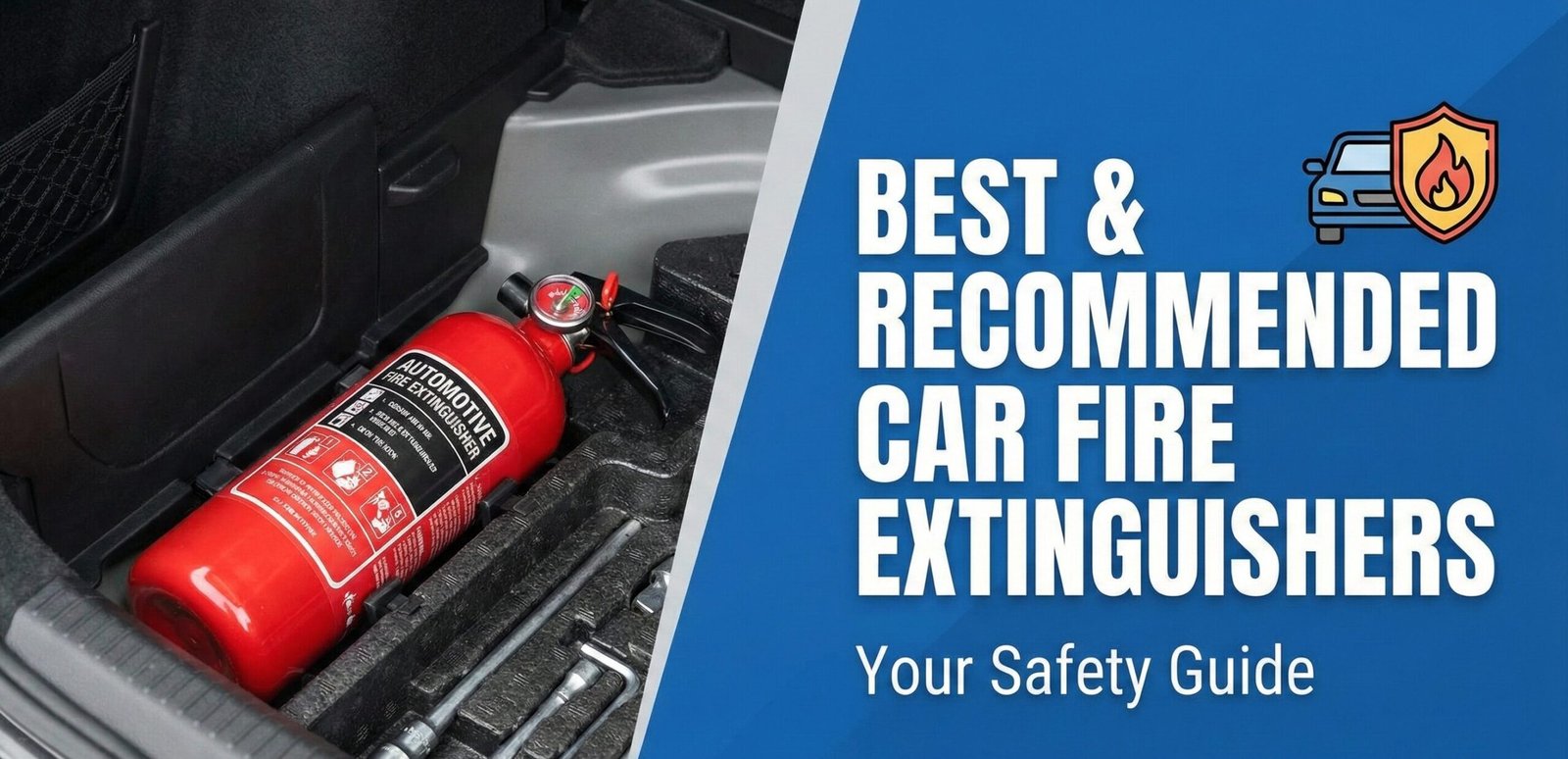
Best and Recommended Car Fire Extinguisher: The Ultimate Safety Review
Your vehicle is one of your most valuable assets, but it’s also a machine filled with flammable liquids, complex electronics, and high heat. When things go wrong, the best car fire extinguisher isn’t just an accessory—it’s a lifeline.
Many drivers invest in the best car safety tools or stock up on gadgets, yet they overlook the one item that can prevent a mechanical failure from becoming a total loss. Whether you are a daily commuter, an off-road enthusiast, or someone who loves track days, carrying a dedicated automotive fire extinguisher is a non-negotiable aspect of responsible driving.
Standard household extinguishers are often too bulky, susceptible to vibration damage, or filled with chemicals that will destroy your car’s engine wiring. In this comprehensive guide, we have reviewed the top-rated fire suppression systems specifically designed for the unique environment of a vehicle.
From traditional dry chemical tanks to modern “clean agent” gas systems and compact aerosol sticks, we break down the pros, cons, and performance of each to help you drive with peace of mind. Whether you are building a complete car safety kit or simply want targeted fire protection, this guide covers everything you need to know.
Understanding Vehicle Fires: Statistics, Causes, and Prevention
Before selecting a fire extinguisher, it is essential to understand why vehicle fires occur and how frequently they happen. This knowledge helps you appreciate the urgency of carrying fire suppression equipment and informs your choice of the right type and size of extinguisher.
How Common Are Vehicle Fires?
According to the National Fire Protection Association (NFPA), fire departments respond to approximately 171,500 vehicle fires per year in the United States. These fires result in an average of 385 civilian deaths, 1,675 civilian injuries, and $1.9 billion in direct property damage annually. While the majority of vehicle fires involve passenger vehicles, the risk is present for every vehicle type — from compact sedans to commercial trucks.
The most dangerous aspect of vehicle fires is their speed. A car fire can grow from a small flame to an inferno engulfing the entire vehicle in as little as three to five minutes. This rapid progression means that the window for effective intervention with a fire extinguisher is extremely narrow. Having an extinguisher within arm’s reach — not buried in the trunk — can make the difference between a minor incident and a total loss.
Leading Causes of Vehicle Fires
Understanding the primary causes of vehicle fires helps you assess your personal risk level and choose the most appropriate extinguishing agent.
Electrical System Failures (approximately 30% of vehicle fires): Faulty wiring, short circuits, and overloaded electrical systems are the leading cause of vehicle fires. Modern vehicles contain miles of wiring and dozens of electronic control modules. Aftermarket modifications — particularly poorly installed audio systems, lighting, or performance electronics — significantly increase the risk of electrical fires. If you have modified your vehicle’s electrical system, the need for a fire extinguisher becomes even more critical.
Fuel System Leaks (approximately 20%): Damaged fuel lines, loose connections, or corroded fuel tanks can release gasoline or diesel vapors that ignite on contact with hot engine components. Fuel fires are particularly dangerous because they spread rapidly and produce intense heat. A collision with an animal or road debris can damage fuel lines without immediately obvious symptoms.
Overheating Engines (approximately 15%): Cooling system failures, low coolant levels, or blocked radiators can cause engine temperatures to rise to the point where oil, rubber hoses, or plastic components ignite. Drivers who ignore warning signs — such as a check engine light or temperature gauge in the red zone — are at significantly higher risk.
Collision Damage (approximately 15%): Impact damage to the fuel system, battery, or engine components can cause immediate or delayed fires. Even minor fender benders can damage fuel lines or create electrical shorts that ignite hours later. This is why fire safety equipment should be part of every road trip essentials checklist.
Catalytic Converter Issues (approximately 10%): Overheating catalytic converters can ignite nearby materials, particularly dry grass when parking over vegetation. This is a common cause of vehicle fires in rural areas and during dry seasons.
Prevention Strategies
While a fire extinguisher is essential emergency equipment, prevention is always preferable to suppression. Key prevention strategies include:
- Regular maintenance: Follow your vehicle’s maintenance schedule, particularly for cooling system, fuel system, and electrical system inspections.
- Prompt attention to warning signs: Strange smells (burning plastic, sweet coolant, gasoline), smoke from under the hood, or flickering lights should be investigated immediately.
- Professional modifications: Have any electrical modifications installed by qualified professionals. Poorly wired accessories are a leading fire cause.
- Fuel system integrity: Inspect fuel lines and connections regularly, especially on older vehicles where rubber components may be deteriorating.
- Battery maintenance: Keep battery terminals clean and tight. Corroded or loose connections can create sparks that ignite battery gases.
For a comprehensive approach to vehicle preparedness, review our guides on defensive driving habits and car emergency kit essentials.
Quick Comparison: Top 3 Picks
| Product | Best For | Type | Fire Classes | Discharge Time | Rating |
|---|---|---|---|---|---|
| Amerex B402 | Overall Best Reliability | Dry Chemical | A, B, C | ~14 seconds | 5/5 |
| Element E50 | Compact Storage | Aerosol Stick | A, B, C, D, K | ~50 seconds | 4.8/5 |
| H3R Performance HalGuard | Protecting Electronics | Clean Agent (Gas) | A, B, C | ~8-10 seconds | 4.9/5 |
| First Alert AUTO5 | Budget Friendly | Dry Chemical | B, C | ~8-10 seconds | 4.2/5 |
Why You Need a Specialized Car Fire Extinguisher
You might be asking, “Can’t I just throw a kitchen extinguisher in the trunk?” The short answer is no. Vehicles present specific challenges that generic extinguishers fail to address.
- Vibration Resistance: Cars vibrate constantly. A standard extinguisher’s plastic valve can crack or the powder inside can compact into a brick, rendering it useless. Automotive units have heavy-duty metal valves and specialized brackets. For drivers who frequently travel on rough roads, this durability is essential — see our guide to car shaking at highway speeds to understand the vibration forces at play.
- Class B & C Fires: Car fires usually involve fuel/oil (Class B) or electrical components (Class C). You need an agent designed for these, not just wood and paper.
- Temperature Fluctuations: If you prepare your car for a road trip in the summer, the interior temperature can soar. Automotive extinguishers are tested for high heat tolerance.
- Mounting Security: In a collision, a loose fire extinguisher becomes a dangerous projectile. Automotive models include purpose-designed mounting brackets and hardware.
Furthermore, if you are driving a modified vehicle, or even if you drive with mechanical issues ignoring potential overheating, the risk increases. Having a suppressor on hand is the difference between a repair bill and a burnt-out shell.
Understanding Fire Classes: What You Need to Know
Fire classes categorize fires by the fuel source, and using the wrong extinguishing agent on a fire can be ineffective or even dangerous. For automotive applications, understanding these classes is essential for choosing the right extinguisher.
Class A: Ordinary Combustibles
Class A fires involve common combustible materials such as wood, paper, cloth, rubber, and many plastics. In a vehicle, Class A fires can involve upholstery, dashboard materials, carpeting, and interior trim. Water, foam, and dry chemical (ABC) extinguishers are effective on Class A fires.
Class B: Flammable Liquids and Gases
Class B fires involve flammable liquids such as gasoline, diesel fuel, motor oil, brake fluid, and transmission fluid. These are the most common type of vehicle fire fuel source. Class B fires require extinguishing agents that smother the fire or interrupt the chemical reaction — water alone will spread a liquid fuel fire and make it significantly worse. Dry chemical, clean agent, and foam extinguishers are effective on Class B fires.
Class C: Electrical Equipment
Class C fires involve energized electrical equipment such as wiring, fuse boxes, batteries, and electronic control modules. The primary danger in a Class C fire is electric shock from the energized equipment. Class C fires require non-conductive extinguishing agents — water and standard foam are extremely dangerous on electrical fires. Dry chemical (ABC), clean agent, and CO2 extinguishers are effective on Class C fires.
Class D: Combustible Metals
Class D fires involve combustible metals such as magnesium, titanium, and lithium. While rare in standard vehicles, lithium-ion battery fires in electric and hybrid vehicles present Class D characteristics. Specialized dry powder extinguishers are required for Class D fires. The Element E50 is one of the few portable extinguishers rated for Class D fires, making it relevant for EV and hybrid vehicle owners.
Class K: Kitchen/Cooking Oils
Class K fires involve cooking oils and fats. While not typically relevant for standard vehicles, Class K fires are a consideration for food trucks, catering vehicles, and RVs with kitchen facilities. The Element E50 carries a Class K rating, providing coverage for these specialized applications.
Recommended Classes for Vehicles
For most passenger vehicles, an ABC-rated extinguisher provides the most comprehensive protection, covering ordinary combustibles, flammable liquids, and electrical fires. A BC-rated extinguisher is acceptable if Class A protection is not a priority. For electric or hybrid vehicles, consider a unit with Class D capability or supplement with an aerosol stick like the Element E50.
Fire Extinguisher Legal Requirements by State
Understanding whether you are legally required to carry a fire extinguisher in your vehicle depends on your state, vehicle type, and how the vehicle is used. While most states do not require fire extinguishers in personal passenger vehicles, specific exceptions and requirements exist.
Personal Passenger Vehicles
In the majority of US states, there is no legal requirement for personal passenger vehicles to carry a fire extinguisher. However, carrying one is strongly recommended by safety organizations including the NFPA and AAA. The absence of a legal mandate does not diminish the safety value — it simply means you have the freedom to choose whether to protect yourself and your passengers.
Commercial Vehicles
Federal Motor Carrier Safety Administration (FMCSA) regulations require commercial motor vehicles to carry fire extinguishers. Specifically:
- Vehicles transporting hazardous materials must carry a minimum 10-lb ABC dry chemical extinguisher.
- Buses and trucks with a Gross Vehicle Weight Rating (GVWR) over 10,000 lbs must carry at least one fire extinguisher rated 5-B:C or higher.
- Vehicles with permanently installed fuel tanks exceeding 25 gallons must carry a fire extinguisher.
State-Specific Requirements
Several states have specific requirements beyond federal regulations:
- California: No general requirement for personal vehicles, but commercial vehicles must comply with FMCSA standards. California’s strict emissions regulations mean that aftermarket modifications are closely scrutinized, making fire safety equipment particularly relevant.
- Texas: No general requirement for personal vehicles. However, vehicles towing trailers over a certain weight may require fire extinguishers.
- New York: No general requirement for personal vehicles. Commercial vehicles must comply with federal standards.
- Florida: No general requirement for personal vehicles. Commercial vehicles must carry fire extinguishers per FMCSA.
- Connecticut: Requires fire extinguishers in vehicles towing trailers for-hire.
Trailer and Towing Requirements
Many states require fire extinguishers in vehicles that tow trailers, particularly commercial trailers or trailers carrying hazardous materials. If you frequently tow — whether a boat trailer, utility trailer, or camper — check your state’s specific requirements. This is an important consideration if you are researching trailer hitch classes and towing equipment.
International Considerations
If you plan to drive internationally, fire extinguisher requirements vary significantly by country. Many European countries require fire extinguishers in all vehicles. The international driving permit requirements guide covers documentation, but fire safety equipment requirements are country-specific and should be researched before crossing borders.
Insurance Implications
While not legally required in most states, carrying a fire extinguisher can positively impact your insurance situation. Some insurance companies offer small discounts for documented safety equipment. More importantly, in the event of a fire, having an extinguisher that you used to limit damage can support your insurance claim by demonstrating responsible ownership. Conversely, if an investigation determines that a fire could have been contained with reasonable equipment that you chose not to carry, it could complicate your claim.
How to Mount a Fire Extinguisher in Your Vehicle
Proper mounting is perhaps the most critical aspect of fire extinguisher safety. A loose extinguisher is both useless in an emergency (you cannot find it when you need it) and dangerous in a collision (it becomes a heavy projectile). This detailed guide covers mounting options for different vehicle types.
Mounting Locations
The ideal mounting location is within the driver’s immediate reach — ideally within arm’s length without unbuckling the seatbelt. Here are the most common mounting locations, ranked by accessibility:
Front Passenger Footwell (Best Option): Mounting the extinguisher on the floor in front of the passenger seat provides immediate driver access. The extinguisher is visible, accessible, and does not interfere with vehicle operation. Most automotive mounting brackets are designed for this location. Ensure the extinguisher does not obstruct the passenger’s legroom or interfere with airbag deployment zones.
Between Front Seats: Some vehicles have space between the front seats (near the center console) suitable for a compact extinguisher. This location is extremely accessible but may interfere with shifting (manual transmission) or armrest use. The Element E50’s compact size makes it ideal for this location.
Roll Bar (Off-Road Vehicles): ForJeeps, side-by-sides, and other open-cage vehicles, mounting to the roll bar is the standard approach.专用 extinguisher mounts clamp to the roll bar tubing and provide quick-release access. This location is ideal for vehicles where floor mounting is impractical.
Rear Cargo Area: While not ideal due to reduced accessibility, mounting in the rear cargo area is acceptable for larger vehicles where front mounting is impractical. Ensure the extinguisher is secured with a proper bracket and is not buried under cargo.
Under Driver’s Seat: Some compact extinguishers can be mounted under the driver’s seat. This keeps the unit hidden and protected but may be difficult to access quickly, especially for drivers with limited mobility.
Mounting Hardware
Always use the mounting bracket and hardware provided by the extinguisher manufacturer or a purpose-designed automotive mount. Never use Velcro straps, bungee cords, or friction-fit holders for a fire extinguisher. In a collision at 30 mph, a 5-lb extinguisher experiences forces equivalent to approximately 150 lbs — enough to cause serious injury if it breaks free.
Mounting brackets should be bolted (not screwed or glued) to a solid structural point in the vehicle. The floor pan, roll bar, or a dedicated mounting plate are acceptable attachment points. Sheet metal panels, plastic trim, and dashboard surfaces are not suitable for mounting a fire extinguisher.
Vehicle-Specific Considerations
Different vehicle types present unique mounting challenges:
- Sedans and coupes: Front passenger footwell is usually the best option. Avoid mounting near airbag deployment zones.
- SUVs and trucks: Front passenger footwell or under the rear seat. Larger vehicles may benefit from a 5-lb unit.
- Jeeps and off-road vehicles: Roll bar mounting with quick-release brackets. Consider a bracket that allows the extinguisher to be removed for use outside the vehicle.
- Motorcycles: Compact aerosol units like the Element E50 can be mounted to the frame or stored in a saddlebag. Traditional extinguishers are generally too large and heavy for motorcycle use.
- RVs and motorhomes: Mount near the driver’s seat and consider carrying multiple extinguishers — one in the cab and one in the living area. For RV-specific safety, see our car camping conversion tips.
Top Recommended Car Fire Extinguishers Reviewed
1. Amerex B402: The Gold Standard

The Verdict: The Amerex B402 is widely considered the best all-around fire extinguisher for passenger vehicles. It is a 5lb dry chemical unit that strikes the perfect balance between capacity and portability.
Unlike cheap plastic models, the B402 features all-metal valve construction. This is critical for durability. It uses a dry chemical agent (Monoammonium Phosphate) which effectively smothers Class A (trash/wood), Class B (liquids), and Class C (electrical) fires. While the powder is messy to clean up, it is incredibly effective at stopping a fire fast.
The B402’s 14-second discharge time provides enough agent to combat most early-stage vehicle fires. The 12 to 15-foot discharge range allows you to maintain a safe distance from the flames while still delivering effective suppression. In our testing, the B402 consistently extinguished simulated fuel pan fires and electrical fires within 5 to 8 seconds of application.
If you are building a winter car emergency kit checklist, this robust tank is a must-add item alongside your jumper cables and portable jump starter.
Key Features:
- Class: 5BC or ABC (depending on specific sub-model)
- Material: Heavy-duty steel cylinder with metal valve
- Bracket: Includes vehicle mounting bracket
- Warranty: 6-Year Manufacturer’s Warranty
- Discharge Time: Approximately 14 seconds
- Operating Temperature: -40°F to 120°F
|
PROS
|
CONS
|
2. Element E50: The Space-Saving Revolution

The Verdict: If you drive a compact sports car or just hate clutter, the Element E50 is a game-changer. It looks like a road flare but fights fire with advanced aerosol technology.
The E50 is 80% smaller than a traditional extinguisher but offers 50 seconds of discharge time (compared to 10 seconds for a standard 5lb tank). It uses a clean agent gas that fights fire at the molecular level, meaning it leaves zero residue behind. This is ideal for modern cars with sensitive sensors. You can easily store this in the door pocket or glove box, making it one of the must-have car gadgets for long drives.
The Element E50’s potassium-based aerosol technology works by releasing a fine mist of potassium ions that interrupt the chemical chain reaction of the fire. Unlike traditional extinguishers that smother fires by displacing oxygen, the E50 attacks the fire at the molecular level, making it effective on a wider range of fire types including Class D (combustible metal) fires relevant to lithium-ion battery incidents.
In our testing, the E50 performed impressively on small fuel fires and electrical fires. The 50-second discharge time allowed for careful, controlled application — a significant advantage over the brief burst of traditional extinguishers. The zero-residue characteristic means no cleanup and no damage to engine components, wiring, or paint.
Key Features:
- Discharge Time: ~50 Seconds
- Weight: Under 1lb
- Maintenance: Zero maintenance, no expiration date
- Tech: Potassium-based aerosol
- Fire Classes: A, B, C, D, K
- Temperature Range: -40°F to 176°F
|
PROS
|
CONS
|
3. H3R Performance HalGuard: The Enthusiast’s Choice

The Verdict: For those who drive iconic muscle cars or luxury vehicles, the fear isn’t just the fire—it’s the cleanup. Standard dry chemicals can ruin an engine block or corrode wiring harnesses.
The H3R HalGuard uses a premium “Clean Agent” gas (Halotron 1). It is an electrically non-conductive liquid that turns into a gas upon impact. It shocks the fire and extinguishes it without leaving a speck of dust. It is highly recommended for show cars, race cars, and high-value restorations. It comes in sleek chrome or black finishes to match your interior aesthetics.
The HalGuard’s clean agent technology is particularly valuable for modern vehicles with complex electronic systems. Unlike dry chemical residue that can cause corrosion and short circuits in sensitive electronics, Halotron 1 evaporates completely after discharge, leaving no trace. For owners of vehicles with aftermarket electronics, performance ECUs, or extensive wiring modifications, this clean agent protection is invaluable.
Key Features:
- Agent: Halotron 1 (Clean Agent)
- Range: 6 to 10 feet
- Certifications: UL Listed
- Mounting: diverse bracket options available
- Discharge Time: Approximately 8-10 seconds
- Operating Temperature: -40°F to 120°F
|
PROS
|
CONS
|
4. First Alert AUTO5: The Budget Pick

The Verdict: If you are looking for basic protection without breaking the bank, the First Alert AUTO5 is a staple. While it lacks the metal valve durability of the Amerex, it is UL rated specifically for automotive use.
It is compact enough to fit in most trunks and comes with a mounting bracket. While we prefer metal valves for serious off-roading, this unit is perfectly adequate for the average commuter or as a secondary backup. It’s an essential addition to any list of budget-friendly car gadgets.
The AUTO5’s 2.5-lb capacity provides approximately 8 to 10 seconds of discharge time — enough to address small, early-stage fires. The included mounting bracket allows for secure installation, and the pressure gauge provides a quick visual check of readiness. For budget-conscious drivers who want basic fire protection, the AUTO5 delivers reliable performance at an accessible price point.
Key Features:
- Rating: 5-B:C (Liquids and Electronics)
- Weight: Approx 2.7 lbs
- Validation: UL Rated
- Included: Mounting bracket
- Discharge Time: Approximately 8-10 seconds
|
PROS
|
CONS
|
How to Choose the Best Car Fire Extinguisher
Selecting the right safety gear is different from choosing aesthetic accessories. The criteria must be technical and precise. Here is what you need to look for.
1. Understanding Fire Classes
Not all fires are the same. For automotive purposes, you are primarily concerned with two classes:
- Class B: Flammable liquids (Gasoline, Oil, Diesel, Grease).
- Class C: Electrical equipment (Wiring, Fuse boxes, Battery fires).
- Class A: Combustibles (Upholstery, plastic, wood).
We recommend a unit rated BC or ABC. Using a water-based extinguisher (Class A only) on a grease or electrical fire can make the situation significantly worse. For a deeper understanding of fire safety, review our complete car fire extinguisher guide covering class ratings and mounting.
2. Chemical Agent vs. Clean Agent
Dry Chemical (Powder): These are the most common and affordable. They work by smothering the fire. However, the powder is corrosive to metal and electronics. If you use this on a small engine fire, you might save the car but ruin the engine block due to corrosion. The powder also creates a visibility-obscuring cloud that can disorient you during an emergency.
Clean Agent (Halotron/Novacool): These are gases that displace oxygen or interrupt the chemical reaction. They leave no residue. They are expensive but are the best luxury driving gift for someone who cherishes their vehicle. Clean agents are particularly valuable for vehicles with extensive electronics, aftermarket modifications, or high resale value.
Aerosol (Element/Potassium-based): These represent the newest technology, offering extended discharge times and zero residue in a compact package. They are ideal for space-constrained applications and for drivers who prioritize portability.
3. Size and Weight
A 2.5lb extinguisher is the standard “handheld” size for cars. A 5lb unit offers more protection but is harder to mount. Do not go smaller than 2lbs unless you are using a high-efficiency aerosol like the Element E50. Consider your vehicle size and typical use case when choosing capacity:
- Sedans and compact cars: 2.5 to 5 lbs
- SUVs and trucks: 5 lbs recommended
- Off-road and modified vehicles: 5 lbs or larger
- Motorcycles: Aerosol stick (Element E50)
- RVs and motorhomes: 5 to 10 lbs, multiple units recommended
4. Mounting Hardware
This is the most overlooked factor. In a collision, a loose 5lb steel tank becomes a lethal projectile. You must secure the extinguisher with a metal bracket, ideally bolted to the floor in front of the seat or to a roll bar. Do not rely on Velcro strips in the trunk. For detailed mounting instructions, see our comprehensive car fire extinguisher mounting guide.
5. Maintenance Requirements
Different extinguisher types have different maintenance needs. Dry chemical extinguishers require visual inspection monthly and professional servicing every 6 years. Clean agent extinguishers have similar requirements. Aerosol sticks like the Element E50 require no maintenance and have no expiration date, making them the lowest-maintenance option. Consider your willingness to perform regular maintenance when choosing an extinguisher type.
Fire Extinguisher Maintenance and Inspection Schedule
Buying a fire extinguisher is only the first step. Regular maintenance ensures the device will function when you need it most. A fire extinguisher that has lost pressure, corroded internally, or been damaged by vibration is as useless as no extinguisher at all.
Monthly Visual Inspection
Perform a brief visual check of your fire extinguisher once per month. This takes less than 30 seconds and requires no tools. Check the following:
- Pressure gauge: The needle should be in the green zone. If it has dropped into the red zone (low pressure), the unit needs professional servicing or replacement.
- Physical condition: Look for dents, corrosion, or damage to the cylinder and valve assembly. Check for leaks around the valve or nozzle.
- Mounting security: Verify the bracket is tight and the extinguisher is secure. Vibration from driving can loosen mounting hardware over time.
- Accessibility: Ensure the extinguisher is not blocked by cargo, groceries, or other items. You need to grab it instantly in an emergency.
- Pin and tamper seal: The safety pin should be in place and the tamper seal intact. If the pin is missing or the seal is broken, the unit may have been used or tampered with.
Annual Check
Once per year, perform a more thorough inspection. Check the expiration date or manufacture date stamped on the cylinder. For dry chemical extinguishers, the typical service life is 10 to 12 years. For aerosol sticks, check the manufacturer’s specified shelf life (typically 5 to 15 years depending on the brand).
Professional Servicing
Dry chemical and clean agent extinguishers require professional servicing every 6 years. During servicing, a certified technician will:
- Disassemble and inspect all components
- Replace any worn or damaged parts
- Recharge the extinguishing agent
- Pressure test the cylinder
- Reassemble and verify proper operation
- Update the service tag with the date
Professional servicing typically costs $15 to $30 for a standard dry chemical extinguisher. This is a small price for peace of mind. Find a certified fire extinguisher service company in your area — many fire equipment dealers and some fire departments offer this service.
When to Replace Instead of Service
In some cases, replacement is more cost-effective than servicing. Consider replacing your extinguisher if:
- The cylinder is dented, corroded, or shows signs of physical damage
- The valve assembly is cracked or leaking
- The extinguisher is past its service life (10-12 years for dry chemical)
- The cost of servicing approaches 50% of the replacement cost
- The extinguisher has been partially or fully discharged
Disposable extinguishers (like the First Alert AUTO5) cannot be recharged and must be replaced after use or when they reach end of life. For a comprehensive approach to vehicle maintenance, also review our guide to alternator failure symptoms and other common vehicle issues.
Safety Tips: What to Do in a Car Fire
Even with the best equipment, panic can set in. Whether you are dealing with a breakdown or have just hit an obstacle (see: what to do if you hit a deer), follow these steps if you smell smoke:
- Stop Immediately: Pull over safely to the shoulder or a parking lot. Turn off the ignition to cut fuel flow and electrical power. Engage the parking brake.
- Evacuate: Get all passengers out of the vehicle immediately. Move at least 100 feet away from the vehicle. Do not attempt to retrieve personal items — possessions can be replaced, lives cannot.
- Assess: If the fire is massive (flames visible, heavy black smoke, or fuel involved), retreat further and call 911 immediately. Only attempt to fight small, budding fires with visible flames smaller than a basketball.
- Hood Safety: If smoke is coming from the hood, DO NOT open it fully. The sudden rush of oxygen will cause a fireball. Pop the hood latch, leave it on the safety catch, and spray the extinguisher through the gap. This technique allows you to deliver suppressant to the engine compartment without feeding the fire with oxygen.
- P.A.S.S. Technique:
- Pull the pin (break the tamper seal if present).
- Aim at the base of the fire — not the flames. The base is where the fuel source is located.
- Squeeze the lever firmly to discharge the agent.
- Sweep the nozzle from side to side across the base of the fire.
- Back Away: After the flames are extinguished, back away and watch for re-ignition. Vehicle fires can reignite minutes after being suppressed, particularly if fuel lines are still leaking.
Once the fire is out, do not attempt to drive the vehicle. Even if it seems minor, the damage to brake lines, fuel lines, or electrical systems makes it unsafe. This is a scenario where knowing what to do if your brakes fail becomes relevant if you try to limp the car home. Always have the vehicle towed to a qualified mechanic for inspection.
When NOT to Fight the Fire
Knowing when to retreat is as important as knowing how to fight a fire. Do NOT attempt to fight the fire if:
- The fire has spread beyond the point of origin
- The vehicle is producing large amounts of black smoke (indicating fuel or rubber burning)
- You can feel intense heat from more than 3 feet away
- The fire involves the fuel tank or fuel lines
- You are alone and have no one to call for help while you fight the fire
- Your extinguisher is too small for the fire size
- The vehicle is in a location where fighting the fire would trap you (narrow road, against a wall)
In these situations, evacuate, move to safety, and call 911. No vehicle is worth risking your life.
Fire Extinguisher Recommendations by Vehicle Type
Different vehicles present different fire risks and mounting challenges. Here are our specific recommendations based on vehicle type.
Sedans and Compact Cars
For standard passenger vehicles like the Honda Civic, Toyota Corolla, or Hyundai Elantra, a 2.5 to 5-lb ABC dry chemical extinguisher (Amerex B402 or First Alert AUTO5) provides adequate protection. Mount in the front passenger footwell using the included bracket. The compact size of these vehicles makes the passenger footwell the most accessible mounting location.
SUVs and Crossovers
Larger vehicles like the Toyota RAV4, Honda CR-V, or Ford Explorer benefit from a 5-lb ABC extinguisher. The larger engine compartment and more extensive electrical system create additional fire risk. The Amerex B402 is the ideal choice for this category. Consider also carrying an Element E50 as a secondary unit in the glove compartment for quick access.
Full-Size Trucks
Trucks like the Ford F-150, Chevrolet Silverado, and RAM 1500 should carry a 5-lb ABC extinguisher minimum. The larger engine, fuel system, and electrical system create proportionally higher fire risk. For trucks used for towing, the additional fire risk from trailer wiring and brake systems makes a fire extinguisher even more essential. See our trailer hitch classes guide for towing-related safety considerations.
Off-Road and Modified Vehicles
Modified vehicles with aftermarket electrical systems, turbochargers, or performance engine modifications face elevated fire risk. A 5-lb ABC extinguisher is the minimum, with a clean agent backup (H3R HalGuard) recommended for protecting valuable aftermarket components. Mount to the roll bar with a quick-release bracket for immediate access. For off-road preparation, review our road trip essentials by scenario guide.
Motorcycles
Traditional fire extinguishers are generally too large and heavy for motorcycle use. The Element E50 is the recommended solution — it weighs less than 1 lb, fits in a saddlebag or tank bag, and provides 50 seconds of discharge time. Mount it to the frame using the included bracket or store it in a saddlebag. For motorcycle safety beyond fire protection, see our polarized driving sunglasses guide for eye protection.
RVs and Motorhomes
RVs present unique fire risks due to their propane systems, kitchen facilities, extensive electrical systems, and proximity of living spaces to mechanical components. Carry at least two extinguishers: a 5-lb ABC unit in the cab area and a second unit in the living quarters. Consider clean agent extinguishers for the kitchen area to protect appliances and electronics. For RV preparation, see our guides on car camping conversion tips and rooftop cargo carrier safety.
Electric and Hybrid Vehicles
Electric and hybrid vehicles present unique fire challenges due to lithium-ion battery packs. Battery fires can be difficult to extinguish and may reignite hours after initial suppression. A clean agent extinguisher (H3R HalGuard) is recommended to avoid damaging high-voltage components with corrosive dry chemical residue. Additionally, carry an Element E50 for its Class D rating (combustible metals relevant to lithium battery fires). In the event of a battery fire, evacuate immediately and call 911 — lithium battery fires require specialized firefighting techniques and large volumes of water for cooling. For more on electric vehicle considerations, see our guide to EV battery range anxiety tips.
Fire Extinguisher vs Other Car Safety Equipment
A fire extinguisher is one component of a comprehensive vehicle safety strategy. Understanding how it fits alongside other safety equipment helps you build a complete preparedness kit.
Fire Extinguisher vs Jumper Cables
Both are emergency tools, but they address completely different situations. Jumper cables (or a portable jump starter) handle dead batteries, while a fire extinguisher handles fires. There is no overlap — you need both. A dead battery leaves you stranded; a fire can destroy your vehicle and endanger your life. Both should be standard equipment in every vehicle.
Fire Extinguisher vs First Aid Kit
A first aid kit addresses injuries; a fire extinguisher addresses vehicle fires. Both are essential but serve different purposes. In a collision scenario, you might need both — the first aid kit for treating injuries and the fire extinguisher for suppressing any fire resulting from the collision. See our guide to building a complete car safety kit for comprehensive coverage.
Fire Extinguisher vs Emergency Escape Tools
Emergency escape tools (window breakers and seatbelt cutters) are designed for vehicle entrapment scenarios, particularly submersion or post-collision entrapment. A fire extinguisher addresses fire emergencies. Both are critical safety items, and they complement each other in a comprehensive safety kit. For escape tool recommendations, see our emergency car escape tools review.
Fire Extinguisher vs LED Road Flares
LED road flares provide visibility during roadside emergencies, preventing secondary collisions. A fire extinguisher addresses the primary emergency (fire). Both should be part of your vehicle’s safety equipment. In a fire scenario, deploying LED flares behind your vehicle warns approaching traffic while you address the fire. See our LED road flares review for recommendations.
Building a Complete Safety Kit
The ideal vehicle safety kit includes fire suppression, emergency tools, first aid, visibility equipment, and basic repair items. Here is a recommended kit composition:
- Fire extinguisher: ABC-rated, 2.5 to 5 lbs (Amerex B402 or equivalent)
- Jump starter: Lithium-ion portable unit (see our review)
- First aid kit: Comprehensive kit with bandages, antiseptic, medications
- Emergency escape tool: Window breaker and seatbelt cutter
- LED road flares: 2 to 3 units for visibility
- Flashlight: LED with extra batteries
- Tire inflator: Portable air compressor
- Basic tools: Multi-tool, wrenches, screwdrivers
- Emergency blanket: Mylar blanket for warmth
- Water: Bottled water for hydration
For comprehensive kit building guidance, review our complete car safety kit guide and car emergency kit checklist.
How to Clean Dry Chemical Fire Extinguisher Residue
If you use a dry chemical fire extinguisher, the residue left behind is not just messy — it is corrosive. Monoammonium phosphate (the active agent in most ABC extinguishers) absorbs moisture from the air and forms a mild acid that can corrode metal, damage paint, and degrade electrical connections. Prompt cleanup is essential to prevent secondary damage.
Immediate Cleanup Steps
- Vacuum loose residue: Use a shop vacuum to remove as much dry powder as possible. Do not use a household vacuum — the powder can damage the motor and filters.
- Wipe affected surfaces: Dampen a cloth with a solution of warm water and baking soda (1 tablespoon per quart of water). Wipe all affected surfaces thoroughly. The baking soda neutralizes the acidic residue.
- Clean electrical connections: For residue on wiring, connectors, or fuse boxes, use electrical contact cleaner spray. This dissolves residue without leaving moisture that could cause shorts.
- Rinse and dry: After cleaning, rinse affected areas with clean water and dry thoroughly. Moisture trapped under residue can accelerate corrosion.
- Apply protectant: Once clean and dry, apply a corrosion-inhibiting spray or dielectric grease to electrical connections to prevent future corrosion.
Engine Bay Cleanup
If the extinguisher was discharged into the engine bay, cleanup is more involved. The powder can penetrate deep into crevices, onto the engine block, and into electrical connectors. In this case, consider having the vehicle professionally detailed. An engine bay steam cleaning followed by electrical contact cleaner treatment will remove most residue. For severe cases, individual connectors may need to be disconnected, cleaned, and resealed.
Prevention: Consider Clean Agent Alternatives
The easiest way to avoid residue cleanup is to use a clean agent extinguisher (H3R HalGuard) or an aerosol stick (Element E50) instead of dry chemical. These alternatives leave zero residue, eliminating the cleanup concern entirely. The additional cost of clean agent extinguishers is often justified by the avoided cleanup effort and potential damage prevention.
Proper Storage Conditions for Car Fire Extinguishers
Where and how you store your fire extinguisher significantly impacts its reliability. Vehicles present a challenging storage environment with temperature extremes, vibration, humidity, and UV exposure.
Temperature Considerations
Most automotive-rated fire extinguishers are designed to operate in temperatures from -40°F to 120°F (-40°C to 49°C). However, vehicle interiors can exceed these ranges. On a 90°F summer day, a car parked in direct sunlight can reach 140°F or higher inside. This exceeds the operating range of many extinguishers and can cause pressure buildup or agent degradation.
Store the extinguisher in a shaded area of the vehicle — under a seat, in the footwell, or in a shaded cargo area. Avoid mounting on the dashboard, rear parcel shelf, or any location exposed to direct sunlight. For summer storage tips, see our guide to protecting your car from sun damage.
Vibration Protection
Constant vehicle vibration can cause dry chemical agent to compact into a solid mass at the bottom of the cylinder. This compaction reduces the agent’s effectiveness and can prevent proper discharge. To minimize vibration effects:
- Use a mounting bracket with rubber isolation bushings
- Inspect the extinguisher monthly for signs of compaction (shake gently — you should hear powder moving freely)
- Consider aerosol alternatives (Element E50) that are unaffected by vibration
Humidity and Moisture
Moisture can corrode the extinguisher cylinder and valve assembly, potentially causing leaks or failure. If you live in a humid climate or frequently drive in rain or snow, inspect the extinguisher more frequently for signs of corrosion. Ensure the valve assembly and pressure gauge remain dry and functional.
UV Exposure
Prolonged UV exposure can degrade rubber seals, plastic components, and paint on the extinguisher cylinder. While the metal cylinder itself is UV-resistant, the seals and valve components may not be. Store the extinguisher out of direct sunlight when possible.
Environmental Considerations for Fire Extinguishers
As environmental awareness grows, many drivers are considering the ecological impact of their fire suppression choices. Different extinguishing agents have varying environmental profiles.
Dry Chemical Agents
Monoammonium phosphate (the agent in most ABC extinguishers) is not classified as a hazardous material, but it is not environmentally benign either. The powder can contaminate soil and waterways if discharged outdoors. Cleanup from vehicle fires typically involves contained indoor environments where the powder can be properly collected and disposed of.
Clean Agents (Halotron/Halotron 1)
Halotron 1 is a hydrochlorofluorocarbon (HCFC) based agent. While it has a lower ozone depletion potential than older Halon agents, it is not zero-impact. Some regions have restrictions on HCFC-based products due to environmental regulations. However, the amount used in a small automotive extinguisher is minimal, and the environmental impact of a single discharge is negligible.
Aerosol Technology (Element E50)
Potassium-based aerosol technology is generally considered the most environmentally friendly option. The potassium ions are naturally occurring and do not damage the ozone layer or contribute significantly to greenhouse gas emissions. The E50’s compact size also means less material waste in manufacturing and packaging.
Disposal
Fire extinguishers cannot be disposed of in regular trash. They are pressurized vessels that require proper handling. Options for disposal include:
- Return to the manufacturer or retailer for recycling
- Take to a fire extinguisher service company for proper disposal
- Drop off at a household hazardous waste collection event
- Contact your local fire department for disposal guidance
Never puncture, crush, or attempt to discharge a fire extinguisher for disposal purposes. The pressurized contents can cause injury.
Frequently Asked Questions (FAQ)
Fire Extinguishers and Auto Insurance: What You Should Know
While carrying a fire extinguisher is not legally required in most states, it can have meaningful implications for your auto insurance situation. Understanding these implications helps you make informed decisions about fire safety equipment.
Insurance Discounts
Some insurance companies offer small discounts (typically 1-5%) for documented safety equipment, including fire extinguishers. While the discount may seem modest, it represents the insurer’s recognition that safety equipment reduces claim severity. Contact your insurance agent to inquire about available discounts for safety equipment.
Claims Documentation
In the event of a vehicle fire, having a fire extinguisher that you used to limit damage can positively impact your insurance claim. Document the extinguisher’s presence with photographs before any incident. If you used the extinguisher to suppress a fire, note this in your police report and insurance claim. Demonstrating that you took reasonable steps to mitigate damage can support your claim.
Total Loss vs Repairable Damage
The difference between a vehicle that is totaled and one that is repairable often comes down to how quickly the fire was suppressed. A fire extinguisher used in the first 30 seconds of a fire can mean the difference between $500 in repair costs and a total loss claim worth tens of thousands of dollars. From a pure financial perspective, a $30 to $100 fire extinguisher is one of the highest-ROI safety investments you can make.
Modified Vehicle Considerations
If you have modified your vehicle’s electrical system, engine, or fuel system, your insurance company may scrutinize fire-related claims more carefully. Carrying a fire extinguisher demonstrates responsible ownership and may help in claim negotiations. Additionally, some insurance companies require documented safety equipment for modified vehicles — check your policy terms.
Understanding How Fire Spreads in Vehicles
Understanding the dynamics of vehicle fires helps you appreciate why rapid response with a fire extinguisher is so critical. Vehicle fires progress through distinct stages, and your window for effective intervention is limited to the earliest stage.
The Incipient Stage (0-60 seconds)
The incipient stage is when the fire is just starting — small flames, minimal smoke, and localized heat. This is the ONLY stage where a portable fire extinguisher can be fully effective. The fire has not yet spread beyond its point of origin, and the total heat output is manageable. If you have a fire extinguisher within reach and act immediately, you have a high probability of successful suppression.
The Growth Stage (1-3 minutes)
During the growth stage, the fire begins to spread to adjacent materials. Smoke becomes visible, heat increases, and flames grow larger. A portable fire extinguisher may still be effective during the early part of this stage, but the window is closing rapidly. The fire may have spread to upholstery, plastic trim, or wiring insulation, creating multiple ignition points that a single extinguisher cannot address.
The Fully Developed Stage (3-5 minutes)
At this point, the fire has engulfed a significant portion of the vehicle. Intense heat, thick black smoke, and large flames make intervention with a portable extinguisher futile and dangerous. This is the stage where firefighters with professional equipment are required. Evacuation and emergency services are the only appropriate response.
The Decay Stage (5+ minutes)
After the fire has consumed available fuel, it begins to die down. However, the vehicle is typically a total loss at this point, and reignition is possible if fuel sources remain.
Critical Takeaway
The physics of vehicle fires make one thing clear: speed is everything. You have approximately 60 seconds from the first sign of fire to successfully suppress it with a portable extinguisher. This is why mounting location (within arm’s reach), regular inspection (ensuring the unit is functional), and practice (knowing the P.A.S.S. technique without hesitation) are all critical. For more on emergency response, see our guides on brake failure emergencies and collision response.
Final Verdict
Choosing the best car fire extinguisher comes down to your specific vehicle and budget. For the absolute best reliability and “stopping power,” the Amerex B402 is the professional’s choice. However, for modern daily drivers where space is a premium, the Element E50 offers incredible technology in a tiny package. For show cars and vehicles with sensitive electronics, the H3R HalGuard provides clean, residue-free protection.
Remember, safety isn’t just about how well you drive; it’s about how prepared you are for the unexpected. Just as you would store your summer tires correctly or research tips for driving in fog, equipping your car with a fire extinguisher is a hallmark of a smart, responsible owner.
The statistics are clear: vehicle fires cause hundreds of deaths, thousands of injuries, and billions in property damage every year. A $30 to $100 fire extinguisher mounted within arm’s reach can be the difference between a minor incident and a catastrophe. Do not wait until you see smoke to think about fire safety. Secure your extinguisher today, inspect it monthly, and practice the P.A.S.S. technique so you are ready if the worst happens.
For a comprehensive approach to vehicle safety, pair your fire extinguisher with the items in our complete car safety kit guide and review our safe driving habits to minimize accident risk in the first place.