Detecting Coolant Leaks for a Safer Drive
A slow drip under your car is easy to ignore — until it isn’t. Here’s how to catch a coolant leak early, understand what it’s telling you, and keep a small problem from turning into a roadside breakdown.

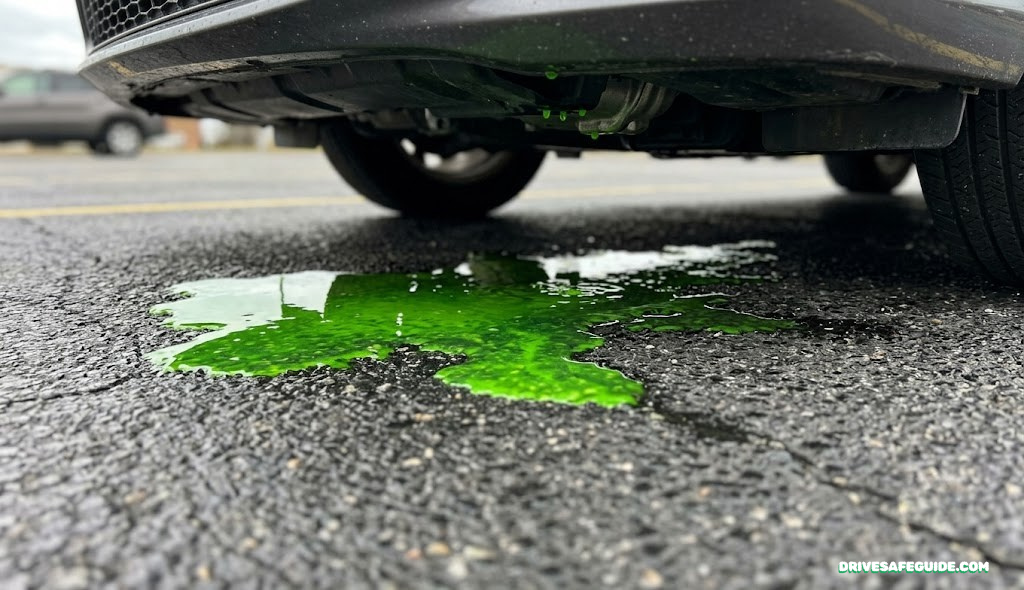
A puddle like this is often the very first clue — the color and location can tell you more than you’d expect.
Coolant leaks rarely announce themselves loudly. They start as a faint smell, a small stain on the driveway, or a temperature needle that creeps a little higher than usual — and by the time the dashboard warning light comes on, the problem has often been building for weeks. This guide walks through exactly what to look for, what your senses are telling you, and which checks you can run yourself before a minor drip becomes an expensive tow.
Why Coolant Leaks Deserve Your Full Attention
It’s tempting to treat a coolant leak the way you’d treat a squeaky door hinge — annoying, but not urgent. That assumption is where a lot of expensive engine damage begins. Coolant, sometimes called antifreeze, does more than keep your engine from freezing in cold weather. It’s the fluid responsible for pulling heat away from the combustion process and moving it to the radiator, where outside air can carry it off. Without enough of it circulating at the right pressure, your engine has no reliable way to shed the heat it generates every time you turn the key.
A coolant leak is also one of the few mechanical problems that can escalate from “minor inconvenience” to “stranded on the shoulder” within a single drive. Unlike a slow oil leak, which an engine can often tolerate for a surprisingly long time, a cooling system that loses too much fluid can push engine temperatures into the danger zone in a matter of minutes, especially in stop-and-go traffic, on a long uphill grade, or during a hot afternoon commute. That’s part of why understanding how extreme heat affects your engine matters just as much as understanding the leak itself.
There’s also a safety dimension that’s easy to overlook. An engine that overheats unexpectedly can lose power steering assist, trigger warning lights that distract you at the worst possible moment, or in rare cases, stall in the middle of an intersection or highway merge. None of those outcomes are catastrophic on their own, but stacked together with heavy traffic, poor visibility, or an unfamiliar road, they raise your risk in ways a five-minute inspection could have prevented. Treating leak detection as routine — the same way you’d treat checking your tire pressure or your headlights — is one of the simplest habits that pays for itself many times over.
Finally, coolant leaks tend to get cheaper to fix the earlier they’re caught. A worn hose clamp or a cracked reservoir tank is a low-cost, low-drama repair. Left alone, the same leak can starve the water pump of lubrication, warp a cylinder head from repeated heat cycles, or blow a head gasket — repairs that cost dramatically more and can sideline your car for days. Early detection isn’t just about safety; it’s one of the most effective forms of cost control available to any driver.

Coolant System Pressure Tester Kit
A basic pressure tester lets you find slow leaks before they show up as a puddle. Handy for a five-minute driveway check.
Check Price on AmazonHow the Cooling System Works (A Quick Primer)
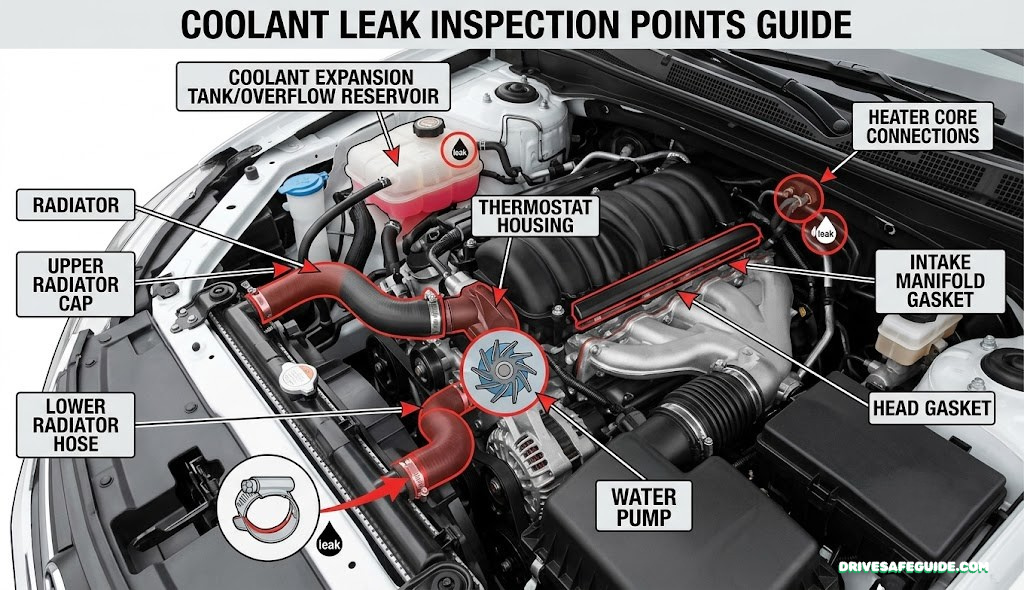
You don’t need to be a mechanic to spot a leak, but knowing the basic path coolant travels makes it much easier to figure out where a problem is coming from. Coolant starts in the radiator, gets pulled through the engine block by the water pump, absorbs heat as it passes through channels surrounding the cylinders, and then returns to the radiator to release that heat into the air moving past the fins. A thermostat regulates when coolant is allowed to flow to the radiator versus recirculating within the engine, which is why your car takes a few minutes to warm up before the heater blows hot air.
Rubber and silicone hoses connect all of these components, held in place with clamps that can loosen or crack over time. A pressurized cap on the radiator or the coolant reservoir keeps the whole system running above atmospheric pressure, which raises the boiling point of the coolant and lets it absorb more heat without turning to steam. That pressure is also exactly why a small crack or a worn seal can turn into a spraying leak once the engine reaches operating temperature — the system is working against real internal pressure, not just gravity.
The Overflow Reservoir
Most modern vehicles route excess coolant into a translucent overflow tank rather than venting it straight to the ground. This reservoir has “low” and “full” markings, and it’s the single easiest place to notice a leak developing — if the level keeps dropping between fill-ups with no obvious external puddle, that’s a strong clue that coolant is escaping somewhere less visible, or evaporating internally.
Why the System Needs to Stay Sealed
Air pockets in the cooling system are almost as dangerous as low coolant itself, because trapped air prevents proper circulation and creates hot spots. This is one reason a leak — even a slow one — can cause symptoms that seem to come and go: as air works its way through the system, temperature readings and heater performance can fluctuate before settling into a more obvious pattern of overheating.
Early Warning Signs You Can Spot From the Driver’s Seat
Long before you ever pop the hood, your dashboard and your own senses will usually give you a heads-up. Learning to recognize these signals means you can act while the fix is still simple.
- Temperature gauge creeping upward: A needle that sits slightly higher than its usual spot, especially in traffic or on hills, is often the first measurable sign of coolant loss.
- Heater blowing cool or lukewarm air: Since cabin heat comes from hot coolant passing through a small heater core, reduced coolant volume or trapped air can make the heater noticeably weaker.
- A sweet smell inside or outside the cabin: Most coolant formulations contain ethylene glycol, which has a distinctly sweet odor when it heats up or burns off a hot surface.
- Low coolant warning light: Many newer vehicles have a dedicated sensor in the reservoir that triggers a dashboard alert once fluid drops below a safe threshold — don’t dismiss this as a false alarm.
- Steam from under the hood: Visible steam, especially after stopping, usually means coolant is contacting a very hot surface, which can indicate an active leak under pressure.
- Unusual engine noise: A worn water pump — often the eventual result of a long-term slow leak — can produce a grinding or whining noise as its bearing degrades.
If you notice more than one of these signs at once, it’s worth pulling over safely rather than continuing on to your destination. Similarly, if your check engine light comes on alongside any of these symptoms, understanding the difference between a solid and a flashing check engine light can help you judge how urgently you need to stop.
Visual Clues Under the Hood
Once you suspect a leak, a calm, methodical look under the hood — with the engine cool — can often narrow things down without any special tools. Start at the top and work your way down, since gravity means coolant almost always travels lower than its actual source.
What to Look For
- Crusty, chalky residue: As coolant evaporates, it can leave a white, pink, or greenish crust along a hose, clamp, or seam — a strong sign of a slow, repeating leak.
- Damp or glossy hoses: Run a clean cloth or paper towel along visible hoses; any tinted residue picked up on the towel points to a nearby leak source.
- Bulging or cracked hoses: Rubber hoses degrade with age and heat cycling. A hose that looks swollen at one section or shows surface cracking is a likely failure point, even if it isn’t actively leaking yet.
- Corrosion on metal fittings: Coolant leaking around a metal connector, like a hose fitting or a heater core line, often leaves greenish or white corrosion behind.
- Stains on the underside of the radiator: A leak at the radiator’s seams or a small stress crack often shows up as dried streaks running down the radiator’s face.
Where to Check First
The most common leak points, roughly in order of frequency, are the radiator hoses and their clamps, the radiator itself, the water pump, the heater core hoses, and the reservoir tank or its cap. Working through these in that order before assuming the worst — like a head gasket failure — will save you time and, often, unnecessary worry.
Coolant Color Guide: What the Puddle Color Tells You
Coolant is dyed to help manufacturers and drivers tell formulations apart, and while color alone doesn’t tell you the exact chemistry, it’s a useful starting point once you spot a puddle.
| Puddle Color | Likely Fluid | Notes |
|---|---|---|
| Green | Traditional IAT coolant | Common in older vehicles; typically needs more frequent changes. |
| Orange / Red | OAT (long-life) coolant | Common in many modern vehicles; not chemically compatible with all green formulas. |
| Yellow / Gold | HOAT or hybrid coolant | Often used by specific manufacturers; check owner’s manual before topping off. |
| Pink / Blue | Manufacturer-specific formulas | Common in some Asian and European makes; color varies by brand. |
| Clear with oily sheen | Possibly not coolant | Could indicate power steering fluid or transmission fluid; confirm before assuming it’s coolant. |
| Rust-brown | Degraded or contaminated coolant | May indicate internal corrosion or coolant mixing with oil; worth a professional look. |
If you’re topping off coolant yourself, always match the type already in your system, or fully flush and replace it if you’re unsure. Mixing incompatible formulas can cause a gel-like reaction that clogs narrow passages in the radiator and heater core — turning a simple top-off into a much bigger repair.
Smell, Sound, and Other Sensory Clues
Not every leak leaves an obvious puddle. Sometimes your nose and ears will notice a problem before your eyes do.
The Sweet Smell
Ethylene glycol-based coolant has a faintly sweet, almost syrupy smell that’s distinct from gasoline, oil, or exhaust. If you notice this smell with the windows down, especially right after the engine has been running hard, it’s worth investigating even if you can’t immediately find a puddle.
Gurgling or Bubbling Sounds
A gurgling noise from the dashboard area or under the hood, particularly after shutting the engine off, often means air has entered the cooling system — a byproduct of coolant loss somewhere in the loop.
White Smoke From the Exhaust
Thick white smoke from the tailpipe, especially if it smells sweet and persists after the engine warms up, can indicate coolant entering the combustion chamber — a sign of a more serious internal leak, possibly involving the head gasket. This is different from the light, temporary white vapor that’s normal on a cold morning.
Milky Residue on the Oil Dipstick
If coolant is mixing with engine oil, the oil can take on a milky, frothy appearance rather than its usual clear amber or brown color. This is one of the clearest signs of an internal leak and warrants an immediate visit to a mechanic rather than a DIY approach.
Any of these sensory clues, on their own, might have an innocent explanation. But when they show up alongside a temperature gauge that’s trending high or a coolant level that keeps dropping, they add up to a pattern worth acting on.
Common Leak Points and What Each One Costs to Fix
Knowing roughly where a leak is likely coming from — and what kind of repair it typically requires — helps you have an informed conversation with a mechanic and avoid surprises.
| Leak Source | Typical Cause | Relative Repair Cost |
|---|---|---|
| Radiator hose | Age, heat cycling, loose clamp | Low |
| Reservoir tank / cap | Cracked plastic, worn gasket | Low |
| Radiator core | Corrosion, stress fracture, road debris impact | Moderate |
| Water pump | Worn seal or bearing | Moderate to High |
| Heater core | Internal corrosion, age | Moderate to High (labor-intensive access) |
| Head gasket | Overheating history, age, manufacturing defect | High |
Notice the pattern: the closer a leak is to the surface and easy to access, the cheaper it usually is to fix. The moment a leak involves internal engine components, cost and complexity climb quickly — which is exactly why catching a leak at the hose-and-clamp stage is so valuable. This same logic applies broadly across vehicle maintenance; for example, understanding early signs of serpentine belt wear or alternator failure symptoms follows the same principle of cheap-if-early, expensive-if-ignored.

UV Dye Coolant Leak Detection Kit
Add the dye, run the engine, then scan with the included UV light to trace even the slowest, hardest-to-spot leaks.
Check Price on AmazonExternal vs Internal Coolant Leaks
Not all coolant loss ends up on your driveway. Understanding the difference between external and internal leaks changes both how urgently you should respond and what kind of repair to expect.
External Leaks
- Usually visible as a puddle, stain, or crust
- Often traceable to a hose, clamp, or seam
- Generally cheaper and faster to diagnose
- Can often be safely driven a short distance if minor and monitored
Internal Leaks
- No visible exterior puddle in many cases
- May show up as milky oil or white exhaust smoke
- Often linked to head gasket or internal cracks
- Typically more expensive and urgent to address
If you suspect an internal leak — particularly if you’ve noticed milky oil, sweet-smelling white exhaust smoke, or coolant that disappears with no visible external trace — it’s worth getting a compression test or a block test at a shop rather than trying to diagnose it entirely yourself. This is also a scenario where knowing whether it’s still reasonably safe to keep driving matters; our guide on driving with a blown head gasket covers that decision in more detail.
DIY Detection Methods You Can Try This Weekend
You don’t need a professional shop to run a solid first-pass diagnosis. Here are the most reliable at-home methods, roughly in order of simplicity.
1. The Cardboard Test
Park your car overnight on a clean sheet of cardboard or plain paper. In the morning, check for any spots, noting their color and location relative to the front, middle, or rear of the vehicle — this alone can narrow down whether you’re dealing with coolant, oil, transmission fluid, or simple condensation.
2. Visual and Touch Inspection
With the engine completely cool, run a clean paper towel along all visible hoses, the radiator’s lower edge, and the water pump area. Any tinted residue picked up tells you a leak is nearby, even if it’s too small to see with the naked eye.
3. Reservoir Level Tracking
Mark the coolant level in the reservoir with a piece of tape and check it every few days without adding fluid. Steady, measurable drops confirm an active leak rather than a one-time low reading.
4. UV Dye Testing
Adding a UV-reactive dye to the coolant system, running the engine for a normal drive cycle, and then scanning the engine bay with a UV flashlight in the dark is one of the most effective ways to catch slow or intermittent leaks that don’t show up during a simple visual check.
5. Pressure Testing
A hand-pump pressure tester attaches to the radiator or reservoir opening and lets you pressurize the system without running the engine, then watch for a pressure drop or listen for a hiss near the leak source. This method is especially useful for catching leaks that only appear once the system is under pressure.
Good Candidates for DIY
- Loose hose clamps
- Cracked reservoir tanks
- Worn radiator cap seals
- Visible surface hose cracks
Better Left to a Mechanic
- Suspected head gasket failure
- Water pump replacement
- Heater core leaks (deep in the dash)
- Internal leaks with no visible source
Tools and Products That Make Detection Easier
A small toolkit can turn coolant leak detection from guesswork into a repeatable, five-minute check. None of these require special training, and most fit easily in a glovebox or garage shelf.
- UV flashlight and dye kit: Pairs with any coolant system for tracing slow or hidden leaks.
- Cooling system pressure tester: Lets you find leaks proactively, before they show up as a puddle.
- Digital infrared thermometer: Useful for spot-checking hose and radiator surface temperatures to confirm even heat distribution.
- OBD2 scanner with live data: Many scanners can display real-time coolant temperature readings, which is especially useful for catching a gradual overheating trend. Our guide to OBD2 scan tools and real-time monitoring covers a few options worth considering.
- Basic mechanic’s mirror and headlamp: Helps you inspect awkward angles behind the engine or under the radiator without needing to lift the car.
Keeping a few of these tools alongside the rest of your car safety kit means you’re never caught without a way to diagnose a warning sign the moment it appears, rather than waiting for a scheduled shop visit days later.

OBD2 Scanner With Live Temperature Data
Watch real-time coolant temperature trends on your phone and catch a slow overheating pattern before it becomes an emergency.
Check Price on AmazonWhat Happens If You Ignore a Coolant Leak
It’s worth walking through the actual chain of events, because it explains why mechanics treat coolant leaks with more urgency than many other minor issues.
As coolant level drops, the system loses its ability to maintain even temperatures throughout the engine block. Certain areas — often around the cylinder head — start running hotter than the rest, creating what’s known as a hot spot. Sustained hot spots cause metal to expand unevenly, which is exactly the kind of stress that leads to warped cylinder heads or a failed head gasket over time.
Once coolant drops low enough, the water pump itself can begin running dry or nearly dry, which strips away the lubrication its internal seal depends on. A water pump that fails from this kind of cumulative wear often does so suddenly, sometimes without much additional warning beyond a growing whine.
If the engine does overheat significantly, the risk moves beyond the cooling system entirely. Extreme heat can cause piston rings to lose their seal, cause oil to break down faster than normal, and in severe cases, cause enough warping that the engine needs a partial or full rebuild. None of this happens with the very first small drip — but repeated cycles of low coolant, each one seemingly minor on its own, build toward exactly this outcome.
There’s a practical, everyday version of this risk too: an engine that overheats on the highway doesn’t always give you much warning before losing power steering assist or, in rarer cases, stalling. That’s a genuinely dangerous scenario if it happens while merging or navigating heavy traffic, which is one more reason coolant leak detection belongs on the same list as everyday defensive driving habits rather than being treated as a once-a-year afterthought.
Prevention, Maintenance, and Knowing When to Call a Mechanic
Most coolant leaks are preventable, or at least catchable at their cheapest stage, with a handful of simple habits.
A Simple Monthly Routine
- Check the coolant reservoir level while the engine is cold, and top off if needed with the correct fluid type.
- Glance under the car after it’s been parked overnight for any new stains.
- Visually inspect visible hoses for cracking, bulging, or soft spots every few months.
- Have the cooling system pressure-tested during routine service, especially once your vehicle passes the manufacturer’s recommended coolant service interval.
When to Handle It Yourself
Loose clamps, a cracked reservoir cap, or a minor top-off of the correct coolant type are all reasonable DIY tasks for a driver comfortable working under the hood. Keeping a jug of the correct coolant type in your road trip essentials kit means you’re never stuck improvising with the wrong fluid in an emergency.
When to Call a Professional
Any suspected internal leak, water pump failure, head gasket issue, or a leak you simply can’t locate after a reasonable effort is worth handing to a professional. A shop has access to block testing, dye systems, and pressure equipment that can confirm a diagnosis far faster than repeated guesswork — and catching a small issue at the shop is still dramatically cheaper than waiting for a full breakdown.
If you’re preparing for a longer trip, folding a cooling-system check into your broader routine — alongside pre-road-trip safety checks — is one of the most efficient ways to make sure a hidden leak doesn’t turn a vacation into a breakdown story.

Universal Long-Life Coolant / Antifreeze
Keep a spare jug of compatible coolant in the trunk so a small top-off never turns into an emergency call.
Check Price on AmazonCoolant Leak FAQs
How can I tell if my car is leaking coolant or just condensation from the AC?
AC condensation is clear, odorless, and typically appears only near the middle of the vehicle after the air conditioning has been running on a humid day. Coolant is usually tinted and carries a faintly sweet smell, so any colored or scented puddle should be treated as coolant until proven otherwise.
Is it safe to keep driving with a small coolant leak?
A very minor seep you’re actively monitoring might get you through a short trip, but it’s not a habit worth building. Leaks rarely stay the same size, and a slow weep today can progress quickly once the coolant level drops far enough to affect engine temperature.
What color is coolant supposed to be, and does the color matter?
Coolant color depends on its formulation, with green, orange, pink, yellow, and blue all common. Color doesn’t indicate quality, but it helps you confirm you’re topping off with a compatible fluid rather than mixing incompatible types.
Why does my car only leak coolant when it’s parked, not while driving?
Many small leaks become visible once the engine cools and components contract, or once residual system pressure pushes fluid past a loose seam while the car sits still. A leak that only appears at rest is generally just as real as one visible while driving.
Can a coolant leak cause my check engine light to come on?
Yes — a drop in coolant level or an overheating condition can trigger temperature-related sensors, and in some vehicles this illuminates the check engine light directly. Whether the light is solid or flashing changes how urgently you should respond.
What does it mean if I smell a sweet odor but see no puddle under my car?
This often points to an internal leak, a leak that only appears under driving heat and pressure, or coolant burning off a hot component before ever reaching the ground. It’s worth a proper inspection rather than a wait-and-see approach.
How much does it typically cost to fix a coolant leak?
Cost depends heavily on the source. A worn hose clamp or cracked overflow tank is usually a low-cost fix, while a leaking radiator, water pump, or head gasket involves considerably more labor and parts.
What is the difference between an external and an internal coolant leak?
An external leak lets coolant escape outside the engine, typically visible as a puddle or stain. An internal leak allows coolant into a part of the engine where it doesn’t belong, often without any visible exterior sign, and is generally the more serious of the two.
Can I use UV dye to find a coolant leak myself?
Yes. Adding a UV-reactive dye to the system and later scanning the engine bay with a UV flashlight is a widely used method for tracing slow or intermittent leaks that are otherwise difficult to pin down.
How often should I check my coolant level to catch a leak early?
Checking the reservoir once a month, plus before any long trip, is enough to catch most leaks early. Pairing that with an occasional glance at the ground where your car is parked overnight makes it even easier to catch a problem while it’s still cheap to fix.
Will low coolant damage my engine even if it doesn’t overheat right away?
Yes. Running consistently low on coolant creates hot spots and extra strain on the water pump and head gasket even before the temperature gauge shows an obvious problem, and this cumulative wear can shorten component life over time.
The Bottom Line: Catch It Early, Drive With Confidence
A coolant leak is rarely dramatic in its opening act. It’s a faint smell, a small stain, a needle that sits a little higher than usual — small signals that are easy to explain away in the middle of a busy week. But those same small signals are exactly what makes early detection so effective: a five-minute check today can prevent a multi-day repair, or a genuinely unsafe breakdown, down the road.
Make coolant checks part of your regular routine, keep a basic detection toolkit on hand, and don’t hesitate to get a professional opinion the moment you suspect an internal leak. Your engine — and your peace of mind on every drive — will be better for it.
Shop Coolant Leak Detection Kits on Amazon