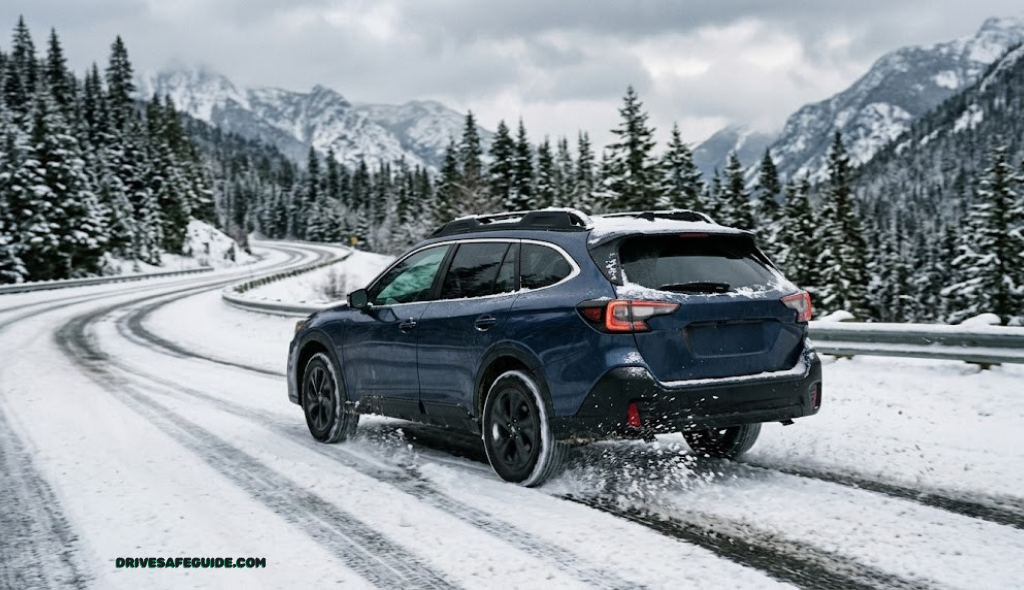
Mastering the Art of Driving in Snow Without Chains
The traction, braking, and steering techniques that let you handle snow-covered roads confidently — even when chains aren’t legal, available, or practical.
Snow driving is a skill, not luck — and most of it comes down to how you manage traction, not what’s wrapped around your tires.
Chains aren’t always the answer — and understanding why changes everything about how you approach a snowy commute.
Every winter, drivers assume that tire chains are the only real defense against snow-covered roads. In practice, chains are illegal on many highways once pavement is clear, awkward to install in a parking lot with numb fingers, and unnecessary for the vast majority of snow conditions that ordinary commuters actually face. What separates a confident snow driver from a nervous one usually has nothing to do with hardware bolted onto the tires — it comes down to how the driver manages weight transfer, throttle input, and following distance.
This guide is built around that reality. You’ll learn how snow changes the physics of driving, how to choose and maintain tires that do most of the work chains would otherwise do, and how to adjust your inputs — steering, braking, and acceleration — so the vehicle stays predictable even when the road isn’t. If you’re the type of driver who wants a documented plan rather than a vague sense of “just go slow,” this is that plan.
It’s worth pairing this guide with our broader winter driving safety guide, which covers traction, braking, and handling fundamentals across every kind of winter road, not just snow without chains specifically.
Think of chains as a tool for extreme, narrow conditions and everything in this guide as the actual foundation of safe snow driving. Tools can help at the margins, but a driver who understands weight transfer, braking behavior, and steering correction will handle 95% of winter roads confidently with nothing more than a properly equipped vehicle and the right habits.
How Tires Lose Grip on Snow and Ice
Snow driving problems almost always trace back to one thing: a loss of the friction coefficient between rubber and road. On dry asphalt, a typical tire might generate a coefficient of friction near 0.8–1.0. On packed snow, that number can fall to 0.2–0.3. On black ice, it can drop below 0.1 — closer to the friction of a hockey puck on ice than a car tire on a road. Every technique in this guide exists because of that shrinking number.
Why Speed Matters More Than It Feels Like It Does
Stopping distance doesn’t increase in a straight line as friction drops — it increases exponentially relative to speed. A car that stops in 130 feet at 40 mph on dry pavement might need over 400 feet on packed snow at the same speed. Most snow-related collisions happen not because a driver was reckless, but because they were driving at a speed that felt normal on a road that no longer behaved normally.
Tread Design vs. Tread Depth
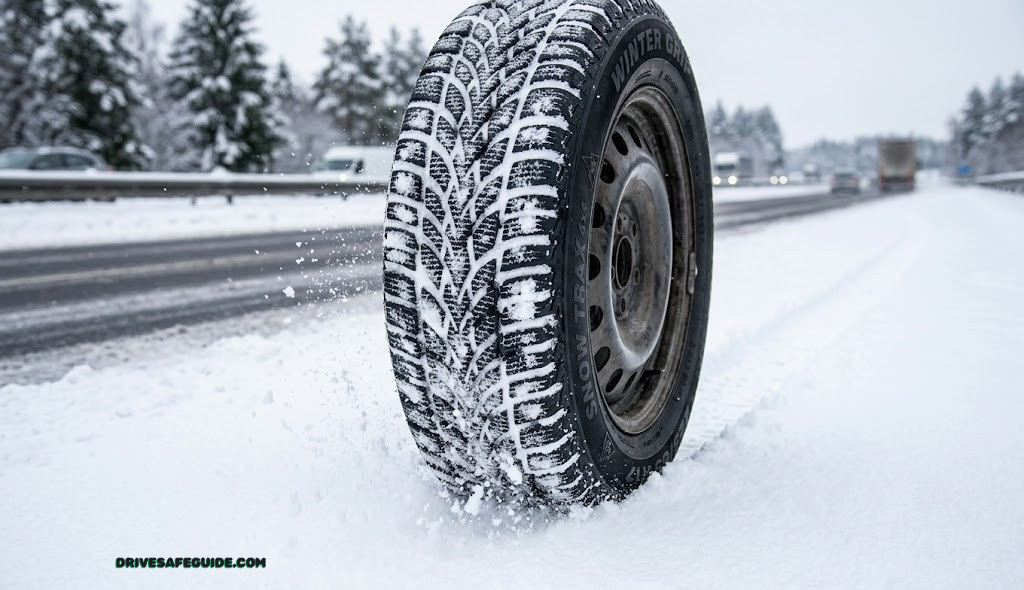
Tread depth gets most of the attention, but tread pattern matters just as much in snow. Winter-specific tread blocks are cut with thousands of small slits called sipes, which bite into loose snow and expel it as the tire rotates. All-season tires have shallower, more closed tread patterns optimized for a broader range of temperatures, which means they pack snow into the grooves instead of clearing it — reducing the very grip you need.
Rubber Compound and Temperature
Standard all-season and summer tire compounds are formulated to stay firm at moderate and warm temperatures, which is exactly the opposite of what snow traction needs. Below roughly 45°F, these compounds begin to stiffen, and a stiff tire can’t flex into the microscopic texture of a road surface the way a softer compound can. Winter-specific compounds are engineered to stay pliable well below freezing, which is a large part of why winter tires outperform all-season tires even on days without fresh snowfall — the temperature alone is enough to matter.
Weight Transfer and Contact Patch
A tire’s contact patch — the small area actually touching the road — shifts size and shape every time weight moves forward under braking or backward under acceleration. On dry pavement, these shifts are barely noticeable. On snow, where total available grip is already reduced, an aggressive weight transfer can be the difference between a tire that holds and one that breaks loose. This is the underlying reason nearly every technique in this guide asks for smoother, more gradual inputs — it’s about protecting the contact patch, not just being cautious for its own sake.
Choosing the Right Tires for Chain-Free Snow Driving
If chains are off the table, your tire choice becomes the single most important safety decision you’ll make before winter starts. The differences between tire categories are larger than most drivers expect, and the wrong choice can leave a vehicle with barely more grip than bald summer rubber.
| Tire Type | Snow Traction | Ice Traction | Best For | Trade-Off |
|---|---|---|---|---|
| Winter / Snow Tires | Excellent | Very Good | Regular snowfall, cold climates | Faster wear above 45°F |
| All-Season Tires | Fair | Poor | Mild, mixed climates | Struggles below freezing |
| All-Terrain Tires | Good | Fair | Trucks, SUVs, unplowed roads | Louder, less precise on dry pavement |
| Studded Winter Tires | Excellent | Excellent | Frequent ice, rural routes | Restricted or banned in some states |
For most drivers who face snow more than a handful of times per winter, a dedicated winter tire set outperforms every alternative discussed in this guide, including chains, because it works on every mile of the drive rather than only where chains are legally installed.
If you’re weighing whether your current setup is even appropriate for winter, our front-wheel-drive winter safety checklist and summer tire vs. all-season comparison both help clarify what your current tires can and can’t handle.
When to Swap Tires Before Winter Actually Arrives
Because winter tire compounds work best below roughly 45°F, the ideal swap window is earlier than most drivers assume — often weeks before the first real snowfall. Waiting for the first storm to install winter tires means driving on compromised all-season rubber through some of the coldest, least predictable early-season conditions, when black ice and unexpected flurries are common but drivers haven’t yet adjusted their habits for winter.
Tire Pressure Monitoring Through the Season
Once winter tires are installed, pressure still needs regular attention, since temperature swings throughout the season continue to affect it. A dashboard tire pressure warning that clears up once you’ve been driving for a few minutes is a classic sign of cold-morning pressure loss rather than a slow leak — though it’s still worth confirming with a manual gauge. Our TPMS sensor guide covers what to do if warnings persist even after pressure looks correct.
Pre-Drive Preparation: Vehicle Checks Before You Head Into Snow
A five-minute check before you leave the driveway prevents most of the problems that turn a snowy commute into a roadside emergency. Skipping this step is the single most common mistake among drivers who otherwise know good snow-driving technique.
Tire Pressure and Tread
Cold temperatures reduce tire pressure by roughly 1 PSI for every 10°F drop. Underinflated tires distort their contact patch and reduce the sipe engagement that gives winter tires their grip advantage. Check pressure against the door-jamb sticker, not the tire sidewall, and verify tread depth with a quarter — if Washington’s head is fully visible when inserted upside down, tread is too shallow for reliable snow traction.
Visibility Systems
Clear every window, mirror, and light — not just a peephole on the windshield. Snow-caked headlights and taillights make you invisible to other drivers exactly when visibility already matters most. Pair this with our night driving safety checklist if your commute overlaps with early sunsets.
Fluids and Battery
Cold weather is the top cause of unexpected battery failure, since low temperatures both increase the current needed to start an engine and reduce a battery’s chemical output. If your battery is more than three years old, review our guide to the best cold-weather car batteries before the first real storm, not during it.
Route Planning Before You Leave
Snow changes which route is actually the safest one, not just the fastest. A road with more traffic often stays clearer than a quiet back route that never gets plowed. Checking conditions before departure — rather than discovering them mid-drive — gives you the option to delay, reroute, or add extra time. Our driver app guide covers tools that layer live road-condition data on top of standard navigation, which is especially useful for mountain or rural commutes.

Check Pressure the Right Way
A digital gauge removes the guesswork cold weather adds to tire pressure readings.
Compare Tire Gauges →Mastering Acceleration and Momentum Control in Snow
Snow driving punishes sudden inputs. Every technique in this section is built around one principle: smooth, gradual transitions keep a tire’s contact patch working with you instead of against you.
Starting From a Stop
Apply throttle slowly enough that you can’t feel the engine “surge.” If your tires break traction the moment you press the accelerator, you’re already asking for more grip than the road can supply. On a slick start, begin in second gear if your vehicle allows manual gear selection, or use a dedicated “snow” or “winter” drive mode if equipped — both reduce the torque delivered at low speed and make wheel spin far less likely.
Maintaining Momentum on Grades
Build speed before a hill rather than trying to accelerate mid-climb. Snow tires lose grip faster under load, so a burst of throttle partway up a grade is far more likely to spin a wheel than the same input on flat ground. Once moving, resist the urge to lift off the throttle abruptly — a sudden lift can transfer weight forward and unweight the drive wheels at the worst possible moment.
Following Distance
Triple your normal following distance in snow. If you’d leave three seconds of gap on dry pavement, leave nine in snow. This isn’t overly cautious advice — it’s the actual multiplier needed to offset the increase in stopping distance discussed earlier in this guide. Our safe following distance guide breaks down the math in more detail.
Merging and Lane Changes in Snow
Merges and lane changes deserve extra planning in snow because they combine two demanding inputs — steering and speed adjustment — at the same time. Signal earlier than usual, check mirrors and blind spots well before the merge point, and avoid making the lateral move while simultaneously accelerating or braking. Our highway merging guide and zipper merge etiquette guide both apply directly here, with the added caveat that every input should be gentler and slower than it would be on dry pavement.
Defensive Positioning
In snow, defensive driving isn’t just about your own inputs — it’s about where you position the vehicle relative to others. Avoid driving directly behind large trucks, which can kick up snow spray that reduces visibility instantly, and avoid lingering beside other vehicles in adjacent lanes any longer than necessary, since a slide from either car can turn into a multi-vehicle event. Our full defensive driving habits guide expands on positioning strategies that apply well beyond snow season.
Braking Techniques Without Chains
Braking is where most snow-related loss of control actually begins, and it’s also where chain-free drivers have the most techniques available to compensate for reduced grip.
Threshold Braking
If your vehicle has anti-lock brakes (nearly all vehicles built in the last two decades do), apply firm, steady pressure and let the ABS system pulse the brakes for you. You may feel a pulsing sensation through the pedal — that’s the system working correctly, not a malfunction. Don’t pump the pedal yourself; that actually interferes with how ABS modulates pressure.
Cadence Braking (No ABS)
In older vehicles without ABS, manually pump the brakes in short, rhythmic bursts rather than holding steady pressure, which would lock the wheels and eliminate steering control entirely. This technique is less relevant today but still worth knowing if you drive an older vehicle in winter conditions.
Engine Braking
Downshifting to use engine compression as a braking aid reduces reliance on the brake pedal and lowers the chance of a skid, particularly on downhill grades. This works in both manual and automatic vehicles with selectable gear ranges.
| Braking Method | Best For | Key Risk If Done Wrong |
|---|---|---|
| Threshold (ABS) | Modern vehicles, most conditions | Pumping the pedal fights the system |
| Cadence (manual) | Older, non-ABS vehicles | Holding pressure locks wheels |
| Engine braking | Downhill grades, gradual slowing | Downshifting too aggressively on ice |
For a deeper look at what happens when braking fails entirely rather than just losing grip, see our guide on brake fade vs. hydraulic failure. It’s also worth having your brake pads inspected before winter starts — our brake pad wear indicators guide explains what to look and listen for if you’re not sure your pads have enough life left for a demanding winter season.
Steering and Skid Recovery Without Chains
Steering inputs need to be smaller and slower in snow than they would be on dry pavement — this is one of the hardest adjustments for experienced drivers, because it goes against years of muscle memory built on grippy roads.
Counter-Steering Into a Skid
If the rear of the vehicle begins to slide, steer gently in the direction the rear is sliding toward, not away from it. This keeps the front tires aligned with the direction the car is actually traveling, which helps regain traction faster than fighting the slide. Avoid the instinct to steer sharply back toward your original lane — that’s the input most likely to send a car into a second, opposite-direction skid.
Recognizing Understeer vs. Oversteer
Understeer (front tires losing grip first) feels like the car continuing straight despite steering input — ease off the throttle and avoid sudden steering corrections until grip returns. Oversteer (rear tires losing grip first) feels like the back end swinging wide — this is where counter-steering applies most directly.
For related black-ice specific guidance, which behaves differently from packed snow, see our black ice survival guide and our dedicated skid control techniques article.
Hand Position and Steering Precision
A firm, low hand position — commonly taught as nine-and-three on the wheel — gives more precise, controlled steering input than a loose or high-handed grip. Precision matters more in snow than on dry roads, since the smaller, smoother corrections this guide recommends are hard to execute consistently with an imprecise grip. Keep your arms relaxed enough to feel small changes in resistance through the wheel, which is often the earliest warning sign that a tire is nearing the edge of available grip.
Reading the Road: Snow, Slush, and Hidden Ice
Not all winter road surfaces behave the same way, and treating them identically is a common mistake among drivers who’ve only practiced on one type of snow.
Fresh Powder vs. Packed Snow
Fresh, dry snow often provides more grip than it looks like it should, because tires can dig through it to find pavement underneath. Packed, compressed snow — especially where other vehicles have driven repeatedly — becomes smooth and glassy, closer in behavior to ice than to loose snow.
Slush and Melt-Refreeze Cycles
Slush hides two dangers: reduced grip similar to wet ice, and the risk of hydroplaning at moderate speeds if slush pools deeply enough. Watch for pavement that looks wet but darker than surrounding areas late in the day — that’s often the sign of a melt-refreeze cycle forming a thin ice layer as temperatures drop after sunset.
Bridges and Shaded Areas
Bridges freeze before the surrounding road because cold air circulates both above and below the deck. Shaded curves, underpasses, and tree-covered stretches hold ice long after open, sun-exposed roads have cleared. Treat these zones as icy by default, regardless of how the rest of your route looks.
Learn more about the specific risk profile of these zones in our freezing rain vs. sleet driving guide.
Reduced Visibility From Blowing Snow
Wind-driven snow can cut visibility to near zero in open, unshielded stretches of highway, even when the storm itself is relatively light. Slow down before entering these zones rather than reacting once visibility drops, keep headlights on low beam to avoid reflecting glare back off the falling snow, and increase following distance further still, since a sudden whiteout gives almost no warning before a vehicle ahead appears. Our fog and low-visibility driving strategies guide covers overlapping techniques that apply just as well to blowing snow.
Deer and Wildlife in Snowy Conditions
Snow pushes wildlife toward roads and tree lines in search of easier terrain, and reduced visibility means less warning before an animal enters your path. Resist the instinct to swerve hard around an animal in snow — a sudden steering input on a low-grip surface is often more dangerous than the collision itself. Our deer collision safety guide explains why controlled braking almost always beats swerving, a principle that applies with even more force once snow is involved.

Clear Every Surface, Every Time
A long-handled scraper reaches windshields, mirrors, and roof snow without you climbing on the car.
Shop Ice Scrapers →Driving Uphill and Downhill in Snow Without Chains
Grades amplify every mistake in this guide. A technique that’s forgiving on flat ground can trigger a slide almost immediately on a hill, which is exactly why hill driving deserves its own dedicated approach.
Climbing a Snowy Grade
Build a small amount of extra speed before the base of the hill, then hold a steady, moderate throttle input all the way up. Avoid downshifting or accelerating hard partway up — both actions increase the torque sent to the drive wheels at the exact moment grip is already reduced by the incline.
Descending a Snowy Grade
Slow down before the hill starts, not during the descent. Use engine braking and light, steady brake pressure rather than a single hard stop, and increase following distance well beyond your flat-road buffer, since a vehicle ahead of you on a downhill grade can slide unpredictably.
What to Do If You Lose Momentum Mid-Climb
If wheels begin spinning and forward progress stalls, ease off the throttle rather than pressing harder — additional throttle usually digs the tires deeper rather than restoring grip. If the vehicle stops entirely, it’s often safer to carefully back down the hill using the same low, steady throttle technique than to keep spinning wheels in place.
Parking Safely on a Snowy Grade
If you must park on an incline in snow, turn the wheels toward the curb when facing downhill and away from the curb when facing uphill, so the vehicle would roll into the curb rather than into traffic if the parking brake or transmission lock failed to hold. In an automatic vehicle, apply the parking brake before shifting into park, which reduces strain on the parking pawl in cold conditions and makes it easier to shift out of park later if ice has formed around the wheels.
When Chains Aren’t an Option: Alternative Traction Aids
Sometimes chains are illegal on your route, unavailable for your tire size, or simply impractical for a daily commute. These alternatives fill that gap without the installation hassle chains require.
✔ What Works Well
- Textile snow socks — quick to install, legal in most areas where chains are restricted
- Portable traction mats — reusable, ideal for getting unstuck rather than continuous driving
- Quality winter tires — the most effective long-term alternative to chains
✘ Where They Fall Short
- Snow socks wear out faster than chains on long, abrasive drives
- Traction mats aren’t a substitute for sustained highway driving
- None of these fully replace studded tires on solid ice
| Traction Aid | Install Time | Best Use Case |
|---|---|---|
| Snow Socks (Textile) | Under 5 minutes | Occasional snow, chain-restricted roads |
| Traction Mats | 1–2 minutes | Getting unstuck from ice or mud |
| Cable Chains | 10–15 minutes | Legal-required chain zones |
| Dedicated Winter Tires | Seasonal swap | Regular snowfall throughout winter |
If your vehicle regularly faces snow but chains aren’t practical, pairing winter tires with a compact traction mat kept in the trunk covers the overwhelming majority of situations you’ll encounter, including the rare moment you actually get stuck.
Storage and Upkeep of Traction Aids
Snow socks and cable chains both need to dry out completely before long-term storage, since trapped moisture leads to mildew in fabric socks and rust in metal cables. Keep either item in a labeled bag near your emergency kit rather than buried under other trunk contents — the moment you actually need a traction aid is rarely the moment you have time to dig for it. Inspect cable chains at the start of each season for broken links or worn tensioners, since a failed chain at highway speed can cause body damage or a sudden loss of control.
Cost Comparison Over a Full Season
Chains and snow socks have a lower upfront cost than a full winter tire set, but that comparison changes once you factor in how often each option actually gets used. Chains and socks are typically reserved for the worst conditions of the season, while winter tires work every single drive from install to removal — meaning the effective cost per mile of protection is usually far lower for a quality winter tire set over a full season of regular use.
Emergency Scenarios: If You Get Stuck or Start Sliding
Even with strong technique and the right tires, snow can still catch a driver off guard. Knowing what to do in the first few seconds of an emergency prevents a manageable situation from becoming a dangerous one.
If You Start Sliding
Stay off the brakes initially — braking mid-slide often extends it rather than stopping it. Steer smoothly in the direction you want the front of the car to go, ease off the throttle, and wait for the tires to regain contact before making any further corrections.
If You Get Stuck
Avoid spinning the wheels, which digs a deeper rut and packs snow into ice under the tire. Clear snow away from all four wheels, place a traction mat or even floor mats under the drive wheels, and use slow, steady throttle rather than a sudden burst of power.
If You’re Stranded
Stay with your vehicle unless help is clearly visible nearby, run the engine intermittently for warmth while keeping the exhaust pipe clear of snow, and use your phone or a reflective marker to signal your location. Review our blizzard stranded survival guide for a complete plan if you drive rural winter routes regularly.
Fatigue Is an Underrated Snow-Driving Risk
Snow driving demands sustained concentration, and that mental load adds up faster than drivers expect, especially on long trips. A driver who’s normally alert can lose sharpness after an hour of constant micro-corrections and hazard-scanning in a storm. If you notice your reaction times slowing or your attention drifting, treat it the same way you’d treat any drowsy-driving warning sign. Our drowsy driving checklist is written for exactly this kind of situation — knowing when you’re within a safe distance of a rest stop before fatigue becomes a real hazard.
Planning for a Multi-Hour Delay
Severe storms can close roads for hours at a time, occasionally stranding drivers well beyond what a typical emergency kit anticipates. If your route regularly crosses remote or mountain terrain, treat the possibility of a multi-hour delay as a real scenario rather than a worst-case exception — pack accordingly, tell someone your route and expected arrival time, and keep your phone charged rather than running navigation continuously in the background.
Be Ready Before You Need To Be
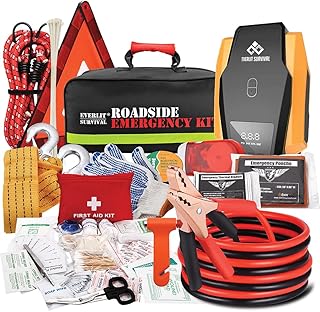
A compact jump starter and emergency kit turns a stranded moment into a five-minute delay.
Shop Emergency Kits →Building Your Snow-Ready Vehicle Kit
The techniques in this guide work best when paired with a vehicle that’s actually equipped for winter. A well-stocked kit turns most snow-related problems into minor delays instead of emergencies.
Core Items Worth Keeping in the Trunk
- Ice scraper and snow brush — a long handle reaches roof snow without climbing on the vehicle
- Portable traction mats — for the moment tires spin without moving
- Jump starter or jumper cables — cold weather is the top cause of unexpected battery failure
- Tire inflator — cold air contracts, and slow leaks show up fastest in winter
- Blanket, gloves, and extra layers — for any stranded-vehicle scenario
- Reflective triangles or flares — visibility in low-light, snow-obscured conditions
For a complete, categorized checklist, see our winter car emergency kit checklist and our broader guide to building a full car safety kit. If you’re comparing specific gear, our jump starter buying guide and tire inflator buying guide go deeper on individual categories.
Maintenance Items That Matter More in Winter
A handful of maintenance issues become far more urgent once snow enters the picture. A serpentine belt already showing wear is more likely to fail in cold-start conditions — see the signs of a failing serpentine belt if you’ve noticed unusual noise on cold mornings. Weak alternators also tend to reveal themselves in winter, when headlights, defrosters, and heated seats all draw power simultaneously; our alternator failure symptoms guide covers the early warning signs. And if you store a second set of wheels seasonally, our tire storage checklist helps prevent dry rot and uneven wear between seasons.
Chain Laws: When You Legally Need Them
One reason drivers end up learning to handle snow without chains isn’t preference — it’s law. Many mountain highways restrict chain use to designated “chain control” periods, and some urban and suburban routes prohibit chains entirely once roads are mostly clear, because metal links can gouge pavement and damage road markings.
How Chain Control Zones Work
Most states that see regular mountain snowfall post active signage during storms, typically broken into tiers: chains optional but recommended, chains required except for 4WD/AWD vehicles with adequate tread, and chains required for all vehicles regardless of drivetrain. These tiers shift throughout a single storm as conditions change, which is exactly why relying on chains as a fixed strategy can leave you unprepared the moment regulations tighten or loosen.
Why This Guide Still Matters Even Where Chains Are Legal
Even in a mandatory chain-control zone, the techniques in this guide don’t become irrelevant — they become more important. Chains restore lost traction, but they don’t fix poor throttle control, harsh braking, or aggressive steering. A driver who understands smooth inputs will still outperform one who assumes chains alone guarantee control.
If your commute regularly passes through mountain corridors, cross-reference local chain requirements before each trip and pair that information with our pre-trip vehicle safety checklist so nothing gets missed in the rush to leave.
Snow Driving by Vehicle Type
The techniques in this guide apply broadly, but how they play out depends heavily on what’s under the hood — and where the power actually goes.
Front-Wheel Drive (FWD)
FWD vehicles put engine weight directly over the drive wheels, which generally helps acceleration traction in snow. The trade-off shows up in cornering, where the front tires are asked to steer and drive at the same time — a demanding combination on low-grip surfaces. Smooth, early steering inputs matter more in FWD vehicles than almost any other setup. Our FWD winter safety checklist covers this in more depth.
Rear-Wheel Drive (RWD)
RWD vehicles are the most prone to oversteer in snow, since the rear tires both propel the car and have less weight pressing down on them than the engine-heavy front end. Extra caution during acceleration and a lighter throttle foot make a meaningful difference here.
All-Wheel Drive (AWD) and Four-Wheel Drive (4WD)
AWD and 4WD systems distribute power to more wheels, improving traction when accelerating from a stop or climbing a grade. As covered earlier in this guide, none of that extra traction helps with braking or cornering — a mistake that leads many AWD drivers to overestimate their vehicle’s actual limits in snow.
Electric Vehicles
EVs deliver near-instant torque, which can translate into wheel spin faster than a comparable gas vehicle if throttle inputs aren’t managed carefully. Most EVs offer adjustable regenerative braking, and lowering that setting in snow can prevent the rear wheels from locking up during regen-heavy deceleration. Review our EV winter range guide if cold-weather battery performance is also a concern on longer snow-season trips.
Common Snow-Driving Myths
Some of the most persistent snow-driving advice is outdated, oversimplified, or simply wrong. Clearing up a few of these misconceptions prevents bad habits from undoing good technique.
“Bigger tires always mean better snow traction.”
Tire size matters far less than tread design, compound, and condition. A worn, wide all-season tire will consistently underperform a properly sized winter tire with fresh tread.
“You should let air out of your tires for better grip.”
This can help temporarily on soft, deep snow or sand for off-road use, but on paved roads it distorts the contact patch, increases wear, and reduces control — the opposite of what most daily drivers need.
“Chains are always better than winter tires.”
Chains outperform winter tires only in extreme, deep-snow conditions and only while installed, which is often limited to certain road types and speeds. For the vast majority of a typical snow season, a quality winter tire outperforms chains across more miles and more conditions.
“You can’t get stuck if you have four-wheel drive.”
4WD improves acceleration traction but does nothing to prevent a vehicle from sliding on ice, losing control while braking, or getting stuck in deep, unpacked snow beyond a certain depth. Ground clearance and tire choice matter just as much as drivetrain.
Frequently Asked Questions
Is it actually safe to drive in snow without chains?
Yes, for the majority of everyday snow conditions, as long as your vehicle has appropriate tires, you reduce speed, and you apply the smoother acceleration, braking, and steering techniques covered throughout this guide. Chains are typically required only for extreme conditions or legally mandated chain-control zones.
Do I need winter tires if I only see snow a few times a year?
If temperatures regularly drop below about 45°F, winter tires still outperform all-season tires even without heavy snowfall, because rubber compounds designed for cold temperatures stay flexible and grip better regardless of precipitation.
What’s the biggest mistake drivers make in snow?
Sudden inputs — hard braking, quick steering corrections, or aggressive throttle — are the most common cause of lost control. Smooth, gradual movements consistently outperform quick reactions on low-traction surfaces.
Should I use cruise control in snow?
No. Cruise control removes the fine throttle control needed to respond to shifting traction and can delay your reaction if the vehicle begins to slide. Keep manual control of the accelerator in any snow or ice conditions.
Is all-wheel drive enough to skip winter tires?
No. All-wheel drive improves acceleration traction but does nothing to improve braking or cornering grip, both of which depend entirely on the tires. Many all-wheel-drive vehicles on all-season tires still struggle to stop or turn safely in snow.
How much should I slow down in snow compared to dry roads?
A common guideline is reducing speed by roughly a third to a half compared to posted dry-road limits, then adjusting further based on visibility, traffic, and how the vehicle actually feels as you drive.
What should I do if my anti-lock brakes activate on snow?
Keep steady, firm pressure on the brake pedal and let the system pulse on its own. Pumping the brake pedal yourself interferes with how ABS modulates pressure and typically increases stopping distance.
Are snow socks a good substitute for chains?
For light-to-moderate snow and short distances, textile snow socks are a practical, quick-install alternative. They wear faster than chains over long or abrasive drives and aren’t rated for the same extreme conditions as certified chains.
Why does my car slide more on bridges than on regular roads?
Bridges lose heat from both the top and bottom surfaces, so they cool and freeze faster than road sections built directly on the ground. Treat bridges as icy even when the surrounding pavement looks clear.
What’s the safest way to recover from a skid?
Ease off the throttle, avoid braking during the initial slide, and steer gently in the direction the rear of the vehicle is sliding toward. Small, deliberate corrections recover a skid; large or panicked steering inputs typically cause a second skid in the opposite direction.
Do chain-control laws apply even to AWD or 4WD vehicles?
Sometimes. Many chain-control tiers exempt AWD and 4WD vehicles only if they’re carrying adequate winter tread and meet a minimum tire depth requirement. During the most severe tier of chain control, chains can be required for every vehicle regardless of drivetrain, so it’s worth checking current signage or state transportation alerts before a mountain trip.
Is it better to keep the gas tank full during winter driving?
Yes. A fuller tank reduces the risk of fuel line freeze in extreme cold, adds ballast weight that can slightly improve traction on some vehicles, and ensures more running time for heat if you become stranded waiting for help.
Confidence in Snow Comes From Skill, Not Chains
Chains have their place, but for the overwhelming majority of snowy commutes, the real safety advantage comes from good tires, smooth inputs, and a driver who reads the road rather than reacting to it. Apply the techniques in this guide consistently, and snow stops being a hazard you brace for and becomes just another condition you know how to handle.
Before your next storm, take five minutes to review your tire tread, top off your emergency kit, and bookmark this guide for a refresher when the forecast turns white again. None of these steps take long, but together they’re what separate a driver who dreads the first snowfall from one who barely notices it’s changed the drive at all.
Shop Winter Driving Essentials →