Highway Behavior & Traffic Flow
Mastering Zipper Merge Etiquette for Safer Highways
Why the two lanes that stay full until the very last cone move traffic faster than the lane that empties out early — and how to merge like you mean it, without becoming the driver everyone honks at.
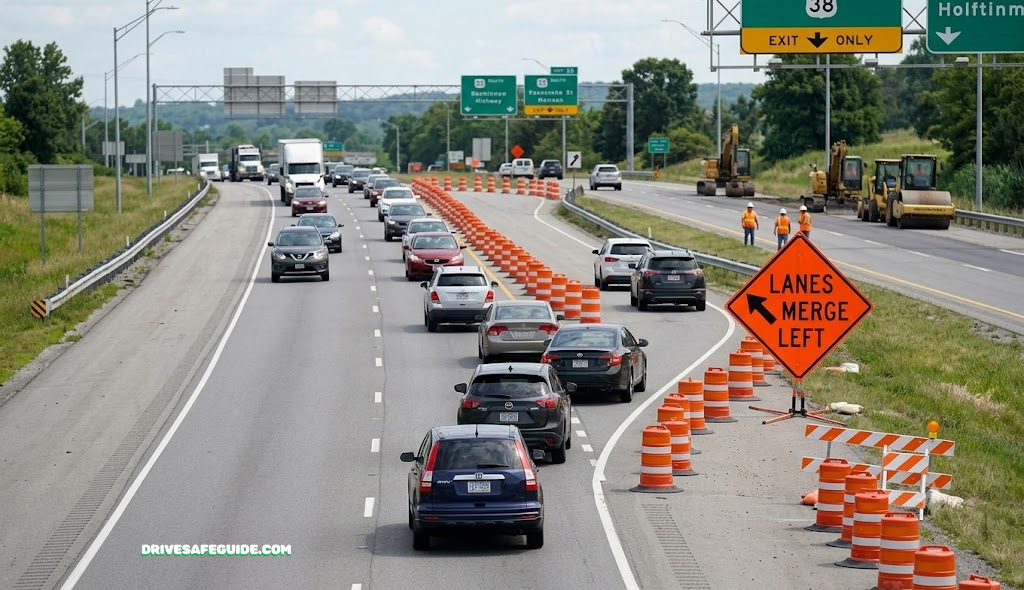
What a Zipper Merge Actually Is
A zipper merge sounds like a piece of sewing terminology that wandered onto the interstate, but it describes something every driver has lived through: two lanes narrowing into one, and the exact moment a stranger in a pickup truck either lets you in or doesn’t.
Formally, a zipper merge is a lane-closure technique in which drivers in both lanes use the full length of the open lane, all the way up to the marked merge point, and then take turns entering the single remaining lane — one vehicle from the left, one from the right, back and forth, the way two rows of teeth interlock when you pull up a zipper. Traffic engineers sometimes call it a “late merge,” and state departments of transportation increasingly post signage that says exactly that: use both lanes to merge point, take turns.
What makes the concept counterintuitive is that it asks drivers to do the opposite of what feels polite. Most of us were taught that merging early, the moment we spot an orange sign, is the considerate thing to do. It clears the lane, it avoids the appearance of cutting in line, and it lets you settle into the correct lane at a relaxed pace. The zipper merge throws that instinct out the window. It asks you to keep driving in the lane that’s about to close, right up to the cones, and then merge at the very last responsible moment.
That single behavioral shift, backed by highway safety research from multiple state transportation departments, is responsible for measurable reductions in the length of backups at lane closures. It is not a shortcut, and it is not cutting the line. It’s a system, and like any system, it only works when enough people understand the rules and follow them together.

Recommended Gear
A dash cam won’t stop a bad merge, but it will settle any dispute about who actually had the right of way when the lane closed.
View Dash Cams on AmazonThe Traffic Science Behind It
Lane closures create what traffic engineers call a “bottleneck,” and bottlenecks have a fixed capacity no matter how the vehicles approaching them behave. The number of cars that can pass through a single open lane per minute doesn’t change based on merging style. What does change is how efficiently the space leading up to that bottleneck gets used.
When most drivers merge early, the closing lane empties out for hundreds of yards or more before the actual closure point, while the open lane fills up and slows to a crawl carrying all the traffic alone. That unused stretch of empty lane is wasted road capacity. Every car sitting in the single overloaded lane represents queue length that didn’t need to exist. The zipper merge reclaims that wasted space by using both lanes for their full length, which shortens the overall backup, sometimes dramatically, in a way that studies from several state DOTs, including work published by the Minnesota and Missouri departments of transportation, have shown can shrink queue length by 35 to 50 percent in moderate-to-heavy traffic conditions.
There’s a second, less obvious benefit: a shorter overall queue means fewer vehicles are stopped or moving at low speed on the approach to the work zone. Rear-end collisions are one of the most common crash types in construction zones, and they cluster at the tail end of backups where drivers are least expecting to suddenly hit the brakes. By compressing the length of that slow zone, zipper merging reduces the amount of roadway where a distracted or following-too-close driver can rear-end the car ahead.
This is also why zipper merging tends to work better as traffic density increases. In light traffic, it barely matters how people merge because there’s plenty of gap and plenty of time. In heavy, near-capacity traffic, the difference between a lane that’s used to its full length and one that empties out early becomes the difference between a two-mile backup and a half-mile one.
For more on how traffic behavior compounds into collision risk more broadly, see our guide to defensive driving habits that reduce collision risk.
The math behind the shorter backup
It helps to think about a lane closure the way a plumber thinks about a pipe. If a two-lane pipe narrows into a one-lane pipe, the narrow section can only pass so much water per second no matter what happens upstream. What determines how much water backs up behind that narrow point is how efficiently the wider section upstream is used to hold flow before it funnels down. A queue that uses only one of the two available lanes for most of its length is, in effect, running that upstream stretch at half capacity, even though a second full lane sits mostly empty right next to it.
This is why simulations run by transportation researchers consistently show that queue length, not throughput at the bottleneck itself, is the variable most affected by merge behavior. The bottleneck will always be a bottleneck. But a queue that’s twice as wide for twice the distance takes up dramatically less real estate on the highway, which in practical terms means less time spent by every driver sitting in stopped or slow-moving traffic, less idling fuel burned, and fewer vehicles exposed to the elevated rear-end collision risk that comes with dense, slow-moving lines of cars.
There’s also a downstream effect worth mentioning: shorter backups are less likely to spill onto ramps, intersections, or adjacent interchanges. A queue that stretches far enough upstream can back traffic up onto an off-ramp or even a connecting freeway, creating a secondary bottleneck unrelated to the original lane closure. Keeping the queue compact by using both lanes fully reduces the odds of that kind of cascading congestion.
Early Merge vs. Late Merge: The Psychology of Lane Anxiety
The resistance to zipper merging isn’t really about traffic flow, it’s about fairness. Drivers who merge early, sometimes a mile or more before the actual closure, often feel a jolt of frustration watching cars blow past them in the “empty” lane, only to cut in near the cones. It looks like queue-jumping. It feels like someone is getting away with something. That emotional response is exactly what keeps early-merge habits so persistent, even where signage explicitly asks drivers to use both lanes.
The two approaches produce genuinely different driving experiences, and it’s worth laying them out side by side.
| Factor | Early Merge | Late (Zipper) Merge |
|---|---|---|
| Lane usage | Closing lane empties out well before the taper | Both lanes used to the full length of the taper |
| Overall queue length | Longer, since only one lane carries traffic for most of the approach | Shorter, since both lanes share the load until the merge point |
| Driver stress | Lower stress for the merging driver, higher resentment toward late mergers | Higher stress at the merge point, but shorter time spent in traffic overall |
| Speed differential at merge | Can be high — merging drivers may be moving faster than the queue they’re joining | Lower, since both lanes are moving at similar, often slower, speeds |
| Rear-end crash exposure | Elevated across a longer stretch of slow traffic | Concentrated in a shorter stretch, reducing total exposure |
| Signage alignment | Matches older, informal driver habit | Matches current DOT-recommended signage in many states |
Neither approach is a moral failing on the part of the driver using it. Most people who merge early genuinely believe they’re doing the courteous thing. The problem is a coordination problem, not a character problem: when half the drivers merge early and half merge late, you get the worst of both patterns — resentment, brake-checking, and unpredictable gaps. The fix isn’t convincing every individual driver to feel differently about fairness; it’s normalizing the zipper pattern widely enough that using the full lane length stops looking like cutting and starts looking like, simply, how the road works here.
Why the fairness instinct misfires here
Humans are generally good at spotting queue-jumping, because in most lines we stand in, whether at a coffee shop or an airport security checkpoint, the physical space is fixed and shared. Cutting ahead of someone in that kind of line genuinely does cost them time. A highway lane closure looks similar on the surface, but the underlying resource isn’t the same. The “line” isn’t one shared queue, it’s two parallel lanes of pavement, and the person driving in the lane that’s about to close hasn’t skipped ahead of you at all — they’ve simply been using a resource that was always available to both of you, right up until the point where the two of you were always going to need to share the last lane anyway.
This distinction is subtle enough that even drivers who intellectually understand the traffic engineering rationale often still feel a flash of irritation in the moment. That’s normal, and it fades with repeated exposure. Drivers in regions where late-merge signage has been standard for years report far less friction at closures than drivers encountering explicit “use both lanes” instructions for the first time, largely because the local norm has shifted and the behavior no longer reads as rule-breaking.
How to Execute a Zipper Merge, Step by Step
Here is the sequence, broken into the same steps a traffic engineer would use to describe it, with a simple diagram for each stage.
Step 1 — Spot the closure early, but don’t act on it yet
The first orange “lane closed ahead” sign is your cue to check mirrors, note your speed, and start watching the vehicles around you — not your cue to merge. Signal isn’t needed yet; awareness is.
Step 2 — Hold your lane and your speed to the posted taper
Continue in your current lane at a speed matched to surrounding traffic, all the way to where the taper actually narrows. This is the part that feels wrong and isn’t — you are using the road the way it was designed to be used during a closure.
Step 3 — Signal and take your turn, one vehicle at a time
At the taper, drivers alternate: one car from the closing lane, then one car from the through lane, repeating. Signal your intent, leave a consistent single-car gap, and merge at a smooth, steady pace rather than darting in.
Step 4 — Settle into the single lane and resume a steady pace
Once merged, avoid immediately accelerating away or riding the brakes. A consistent following distance through the work zone keeps the new single-file line stable for everyone behind you.
Knowing When the Zipper Merge Applies
Not every lane reduction calls for the same technique, and misreading the situation is where a lot of confusion starts. Zipper merging is intended specifically for temporary, high-volume bottlenecks — construction zones, incident scenes, or a permanent lane drop where a highway simply narrows — where traffic is moving slowly enough that both lanes can safely be used to the taper.
Look for explicit signage. Many states now post signs that directly instruct drivers to “use both lanes to merge point” or “take turns,” which is the clearest possible signal that a zipper merge is intended. In the absence of that signage, a general rule of thumb holds: if traffic is moving at highway speed with light congestion, merge as soon as it’s safe and convenient, since there’s no queue to shorten and little benefit to waiting. If traffic is already backed up and crawling, use both lanes to the taper.
There’s also a safety ceiling on this technique. Zipper merging assumes low relative speeds at the merge point. If you’re approaching a closure at highway speed with no congestion yet, don’t wait until the last second to merge purely to follow “the rule” — that’s a recipe for a high-speed, low-visibility conflict rather than the slow, cooperative alternating pattern the technique depends on. Read the situation, not just the sign.
Distinguishing a lane closure from a lane ending
It’s worth separating two situations that look similar from behind the wheel but call for slightly different judgment. A temporary lane closure, marked by cones and typically tied to construction or an incident, is exactly the scenario zipper merge guidance is built for, since the closure will reopen once work is finished and the goal is purely to minimize the backup while it’s active. A permanent lane drop, where a highway genuinely narrows from three lanes to two as a fixed feature of the road design, behaves the same way mechanically, but drivers tend to be more familiar with it and merge earlier out of habit, since there’s no orange-cone visual cue prompting the “hold your lane” instinct. The same logic still applies in both cases: in heavy traffic, use the full lane length before merging.
A third scenario worth flagging separately is an incident-driven closure, where a lane is blocked by a crash, disabled vehicle, or emergency response rather than planned construction. These closures often appear with little advance warning and minimal signage, which makes the “read the situation” instruction especially important. Slow down earlier than you think you need to, watch for brake lights and hazard flashers rather than official signage, and be prepared for the merge point to be less predictable than a planned work zone taper.
The Unwritten Etiquette Code
Beyond the mechanics, there’s a social layer to merging well that no sign can fully capture. A few habits separate a driver who merges smoothly from one who generates a wave of brake lights behind them.
Do
- Signal early and hold the signal through the merge, not just for a flash
- Match the speed of the lane you’re merging into before you move over
- Leave one consistent car-length gap, then take it — don’t wait for a huge opening
- Let exactly one vehicle in when it’s your turn, then close the gap normally
- Make eye contact or a small hand acknowledgment when someone lets you in
Don’t
- Straddle the lane line to physically block the merge lane from filling
- Speed up to close gaps and prevent anyone from merging ahead of you
- Merge in a sudden diagonal dart across both lanes at once
- Brake-check a driver who merged later than you think they should have
- Merge, then immediately slam the brakes once you’re in the lane
Straddling the lane line deserves special mention because it’s the single most common form of merge sabotage, and it’s also one of the most dangerous. A driver who spreads their vehicle across both lanes to physically block others from using the closing lane isn’t enforcing fairness, they’re creating exactly the kind of unpredictable obstacle that leads to sideswipe collisions. If you feel the urge to do this, that’s a signal to review strategies for preventing road rage incidents instead.
The small signals that keep the whole system polite
A surprising amount of merge etiquette comes down to legibility — how clearly your intentions read to the drivers around you. A turn signal held for a full three or four seconds before you move communicates something very different from a signal flicked on half a second before the lane change itself. The first gives the driver beside you time to adjust their speed and make room; the second gives them almost no reaction window and forces a last-second decision. The same logic applies to your positioning within the lane: drifting subtly toward the lane line as you approach your turn to merge signals your intent well before you actually cross it, which lets the driver who’s about to let you in start easing off the gas a beat earlier.
Acknowledging a driver who lets you in, a small wave, a nod, a flash of the hazards for a second, does more than express gratitude. It closes a small feedback loop that makes that driver more likely to extend the same courtesy again, to you or to someone else, later in the same traffic jam. Merge etiquette is, in a very real sense, a repeated social interaction happening between strangers who will likely never see each other again, and the entire system runs more smoothly when each interaction ends on a cooperative note rather than a resentful one.

Recommended Gear
A wide-angle blind spot mirror makes it far easier to judge the gap and timing needed for a clean, confident merge.
View Blind Spot Mirrors on AmazonCommon Mistakes That Trigger Road Rage
Most merge-related conflict traces back to a small handful of repeated errors, and recognizing them in your own driving is the fastest way to stop contributing to them.
Merging too early out of guilt
Ironically, the most “polite” habit — ducking into the through lane the instant you see a sign, even in heavy backed-up traffic — actively lengthens the queue for everyone behind you. It feels considerate and produces a worse outcome.
The last-second, high-speed lunge
Waiting until literally the last few feet of pavement, then crossing the line without matching speed or checking a mirror, is what makes late merging look reckless instead of efficient. The technique depends on a controlled, visible, gradual transition, not a surprise maneuver.
Refusing to let anyone in
Closing every gap to prevent a merge doesn’t just cause resentment, it directly increases risk, since the merging driver may attempt the move anyway with less margin for error.
Tailgating through the work zone
Once merged, many drivers immediately close up their following distance, which removes the cushion needed to react if the car ahead brakes for debris, workers, or an equipment shift. This is one of the most common contributors to the multi-car pileups that show up in construction zone crash data, and it pairs naturally with reviewing the safe following distance rule.
Phantom braking at the merge point
Even when no one actually needs to stop, a single driver tapping their brakes out of uncertainty at the taper can trigger a ripple of brake lights extending far back through the queue, sometimes stopping traffic that was previously moving steadily. This “phantom” slowdown is a well-documented phenomenon in traffic flow research, and merge points are one of the most common places for it to originate, precisely because so many drivers are making small, hesitant speed adjustments in a short stretch of road. Committing to a smooth, decisive merge, rather than repeatedly tapping the brakes while deciding when to go, helps prevent you from becoming the source of one of these chain reactions.
Treating every gap as an insult
Some drivers interpret any refusal to let them in as a personal slight, which escalates minor traffic friction into genuine road rage. In reality, a driver who doesn’t immediately open a gap may simply not have seen your signal yet, may be maintaining their own safe following distance, or may be dealing with a car on their other side. Assuming the best rather than the worst about the driver next to you, and simply waiting for the next opportunity, prevents a routine merge from turning into an aggressive encounter.
Where States Officially Recommend the Zipper Merge
Departments of transportation across the country have gradually shifted their guidance and signage toward the late-merge model, though adoption and public awareness campaigns vary widely by state. The table below summarizes the general pattern of official guidance; always defer to posted signage in the specific work zone you’re approaching, since local guidance can differ from a state’s general policy.
| Region Pattern | Typical Guidance | What to Expect |
|---|---|---|
| States with active “Use Both Lanes” campaigns | Signage explicitly instructs drivers to use both lanes to the merge point and alternate | Clear cone-and-sign setup, dynamic message boards reinforcing the message during major closures |
| States with traditional early-merge signage only | Standard “lane closed ahead, merge now” signage without explicit late-merge instruction | Mixed driver behavior; early merging remains the social default |
| Work zones with dynamic lane control | Overhead signals or barriers actively manage which lane is open at a given point | Merge point is enforced by infrastructure rather than driver judgment |
Because guidance can vary even within a single state depending on the road authority managing a given project, the safest general approach is to treat explicit “use both lanes” signage as your cue for a zipper merge, and to default to a more cautious early merge in ambiguous, high-speed situations without that signage.
Public awareness campaigns have made a measurable difference where they’ve been sustained over multiple construction seasons rather than run once and dropped. States that pair explicit signage with dynamic message boards, local news coverage, and repeated messaging across several years tend to see driver behavior shift more durably than states that post signage for a single project and stop there. If you regularly drive through a particular corridor and notice new “use both lanes” signage appearing, it’s a reasonable signal that the local authority is actively trying to shift the regional norm, and getting ahead of that shift, adopting the behavior before it feels fully normalized, helps rather than hurts.
Zipper Merging in Rain, Fog, and at Night
Reduced visibility and reduced traction both change the math on how close to the taper you should wait before merging. The technique itself doesn’t change, but your margins should.
In heavy rain, stopping distances increase substantially, and the alternating, close-following pattern of a zipper merge leaves less room for error if a vehicle ahead brakes suddenly. Increasing your following gap before you reach the merge point, and merging a bit earlier in the sequence rather than holding out for the absolute last car-length, is a reasonable adjustment. Our guide on rain driving safety at highway speeds covers the broader traction considerations at play.
At night, the taper and cone line are harder to judge, and other drivers’ merge signals are easier to miss. Reduce speed earlier than you would in daylight and rely more heavily on the vehicles’ relative position than on assuming you can read a turn signal from a distance. If fog is present, the same logic compounds; see our dedicated fog driving strategies for visibility guide for specifics on following distance and headlight use in low-visibility merges.
In winter conditions, an already-cautious zipper merge becomes more so. Reduced traction means the “smooth, steady” merge described in Step 3 above should be executed at noticeably lower relative speed, with more space allotted between vehicles. If you’re driving a front-wheel-drive vehicle through a winter work zone, it’s worth reviewing whether your front-wheel-drive setup is winter-ready before you’re relying on it to merge smoothly on a slick taper.
Black ice deserves its own mention, since it’s most likely to form in exactly the shaded, slow-moving stretches that a work zone taper often creates, particularly overnight or in early morning hours when pavement temperature drops fastest. A merge that would be perfectly smooth on dry pavement can turn into a loss of traction if a driver applies steering input while crossing an icy patch mid-merge. If conditions suggest black ice is possible, slow down well before the taper and avoid combining braking, steering, and lane changes into a single motion; separate them out and complete each one deliberately. Our dedicated black ice driving survival guide covers how to recognize and react to this specific hazard in more detail.

Recommended Gear
Polarized driving sunglasses cut glare from wet pavement and low sun angles, both common in construction zone merges.
View Driving Sunglasses on AmazonGear That Makes Merging Safer
None of these are required to merge well, but each one removes a specific piece of guesswork that tends to make merging riskier than it needs to be.
Wide-angle mirrors for judging the gap
A significant share of merge-related near-misses come down to a driver simply not seeing a vehicle in the lane they’re merging toward. A convex or wide-angle add-on mirror shrinks the blind spot that standard factory mirrors leave uncovered, particularly on trucks and SUVs. See our full breakdown of blind spot mirrors for trucks and SUVs.
Dash cams for documentation
Construction zone merges are a common site for minor sideswipe disputes, and having continuous footage removes the ambiguity of a he-said-she-said claim. A dash cam with good low-light performance matters here, since many closures are managed at night. Our guide to 4K dash cams for night driving covers sensor quality specifically relevant to work-zone footage.
Reflective safety gear if you ever need to stop in one
If you experience a mechanical issue inside an active work zone, visibility becomes a safety issue in a different sense entirely. Keeping durable LED road flares in your vehicle, alongside a broader car safety kit, is a sensible precaution for anyone who spends significant time in highway construction corridors.
Tire pressure and traction margin
Merging smoothly depends on predictable handling, and predictable handling depends in part on something as unglamorous as correct tire pressure. Underinflated tires increase stopping distance and reduce cornering stability, both of which matter more in the tighter, lower-speed maneuvering of a work zone merge than they do on open highway. A quick check with a reliable gauge before a long drive through known construction corridors is a small habit that pays off disproportionately in exactly these situations.
Similarly, drivers navigating a merge in a taller vehicle, an SUV or pickup, benefit from paying particular attention to blind spot coverage, since the physical size of the vehicle creates a larger area that factory mirrors alone don’t fully resolve. Combining a wide-angle mirror with a deliberate shoulder check before every lane change closes that gap more reliably than either habit alone.
Teaching New Drivers the Zipper Merge
New drivers tend to inherit whatever merging habit their instructor or parent modeled, which means the zipper merge is one of the more teachable moments available in a lesson plan, precisely because it runs against instinct. The clearest way to teach it is to explain the “why” before the “how” — a student who understands that using the full lane length shortens the total backup is far less likely to panic-merge early out of guilt the first time they try it for real.
It helps to practice the concept away from an actual work zone first, using a diagram or a low-stakes empty parking lot exercise to build the alternating rhythm described in Step 3 above, before asking a new driver to execute it in live, high-consequence traffic. Parents working through this kind of structured lesson plan may find our guide on parents teaching teen drivers useful for sequencing more advanced maneuvers like this one after the basics are solid.
It’s also worth flagging explicitly that a zipper merge, done correctly, can look and feel like assertive driving to a nervous new driver, since it involves holding a lane that appears to be “running out.” Reassure them that holding the lane to the posted taper is the correct behavior, not a risky one, provided speed is matched and the merge itself is smooth rather than sudden.
Consider narrating your own merges out loud the first several times a new driver rides along as a passenger, before they’re behind the wheel themselves. Pointing out the moment you spot the closure sign, the decision to hold your lane, and the exact instant you choose to merge turns an abstract rule into a concrete, observed sequence they can later reproduce. New drivers absorb far more from watching a calm, talked-through example than from a one-time verbal explanation delivered before the drive even starts.
What the Law Actually Says
Zipper merging is not, in most jurisdictions, a separate legal requirement distinct from ordinary merging law. What changes is the guidance and signage a state chooses to post, not the underlying rules of the road, which generally require yielding to a vehicle already established in the lane you’re entering, signaling before a lane change, and merging only when it can be done safely.
Where things can get legally murky is around the behavior on both sides of the merge. Deliberately blocking a lane by straddling the line can, in some states, be treated as an improper lane use violation. On the other side, an aggressive, unsignaled last-second merge that forces another driver to brake abruptly can be cited as unsafe lane change or following too closely, depending on how the incident unfolds. Neither party in a merge dispute is automatically in the right or the wrong; fault typically comes down to whether each driver’s specific actions met the basic standard of care, which is where dash cam footage tends to become relevant.
If a merge-related collision does happen, understanding roadside procedure matters just as much as the merge itself. Reviewing what to do to stay safe if you need to stop roadside and keeping a documented, calm process for exchanging information after any collision reduces the secondary risk that so often follows a minor merge fender-bender: getting out of the vehicle in an active traffic lane.
Work zones and elevated penalties
Many states apply enhanced penalties for moving violations committed inside an active work zone, separate from any rules about merging specifically. Speeding, following too closely, or careless driving inside a marked construction zone can carry higher fines, and in some jurisdictions additional license points, than the same violation elsewhere. This is worth keeping in mind at a lane closure even beyond the merge itself, since the entire stretch of roadway around a taper is typically classified as a work zone for enforcement purposes, not just the area immediately next to workers or equipment.
None of this changes the core guidance: use the full lane, signal your intent, take turns, and keep a safe following distance once merged. The elevated penalty structure is simply another reason the smooth, gradual version of the zipper merge described earlier in this guide is the safer choice over an aggressive, high-speed version of the same basic idea.
The Merge Is a Team Sport
A zipper merge only works as well as the theory suggests when enough drivers understand it and commit to it together. Holding your lane to the taper isn’t queue-jumping, and letting one car in at your turn isn’t a favor, it’s the system functioning as designed. The next time you approach a lane closure, use the full length of the open lane, signal your intent clearly, take your turn, and give the driver next to you the same courtesy you’d want extended to you.
Build the rest of your highway readiness alongside this one habit — our road trip essentials checklist and defensive driving habits guide are natural next stops.
Shop Car Safety Essentials on AmazonFrequently Asked Questions
Is zipper merging actually legal, or is it just cutting in line?
It’s legal in every state, and it’s the officially recommended technique in a growing number of them. Using the full length of an open lane before merging at the posted point isn’t cutting in line, it’s using the road as it’s designed to be used during a closure.
Why does zipper merging feel so uncomfortable the first few times?
Most drivers were taught that merging early is the polite behavior, so holding a “disappearing” lane feels like breaking a social rule even though it’s the more efficient choice. That discomfort tends to fade once you’ve seen the shorter backup it produces a few times.
What should I do if another driver won’t let me merge at the taper?
Signal clearly, match speed, and wait for the next gap rather than forcing the move. If a driver is consistently blocking every gap, slow slightly to look for an opening a car or two further back rather than escalating the interaction.
Should I zipper merge even if there’s no traffic backup yet?
No. The technique is meant for congested, slow-moving situations. If traffic is flowing freely at normal speed, merge as soon as it’s safe and convenient rather than holding the lane purely on principle.
Is it rude to pass cars in the lane that’s about to close?
Not if you’re doing it at a matched, reasonable speed and traffic is congested. Passing at a significant speed differential right before a merge point, however, is genuinely risky and should be avoided regardless of which lane you’re in.
What’s the difference between a zipper merge and a “courtesy merge”?
A courtesy merge usually refers to voluntarily letting a single driver in as a one-off gesture, often outside a formal lane closure. A zipper merge is a structured, repeated alternating pattern specifically used at lane closures and bottlenecks.
Does zipper merging work the same way at highway speeds as it does in stop-and-go traffic?
The core idea, using both lanes to the taper, applies at any speed, but the execution should be more conservative at higher speeds, since the alternating pattern depends on low relative speed differences between merging vehicles.
Can I get a ticket for straddling the lane line to block a merge?
In many states, deliberately occupying both lanes to prevent other vehicles from merging can be cited as improper lane use, though enforcement varies widely by jurisdiction and officer discretion.
How do I know which lane is closing if signage isn’t clear?
Watch for cone patterns, changes in pavement markings, and brake lights ahead of you. When signage is ambiguous, slow down earlier and give yourself extra time to read the taper rather than guessing.
Does zipper merging apply to on-ramp merges too, or just lane closures?
The term is generally reserved for lane-closure and bottleneck situations. On-ramp merges follow standard merge etiquette, matching speed and yielding appropriately, rather than a formal alternating pattern.
What’s the biggest mistake drivers make even after learning the zipper merge technique?
Reverting to early merging out of habit or social pressure during their very next drive. The technique only produces results when it’s applied consistently, not just understood in theory.
Are there apps that help identify where zipper merge zones are ahead of time?
Several navigation and traffic apps flag upcoming construction and lane closures in real time, giving you advance notice to plan your merge before you’re already in the taper. Our roundup of apps every driver should use covers a few worth having installed.