Using an Escape Ramp to Stop a Runaway Truck: Safety Tips and Techniques
What every driver — commercial or not — needs to know about the gravel arrester beds built into mountain highways, and exactly what to do if your brakes ever fail on a downgrade.
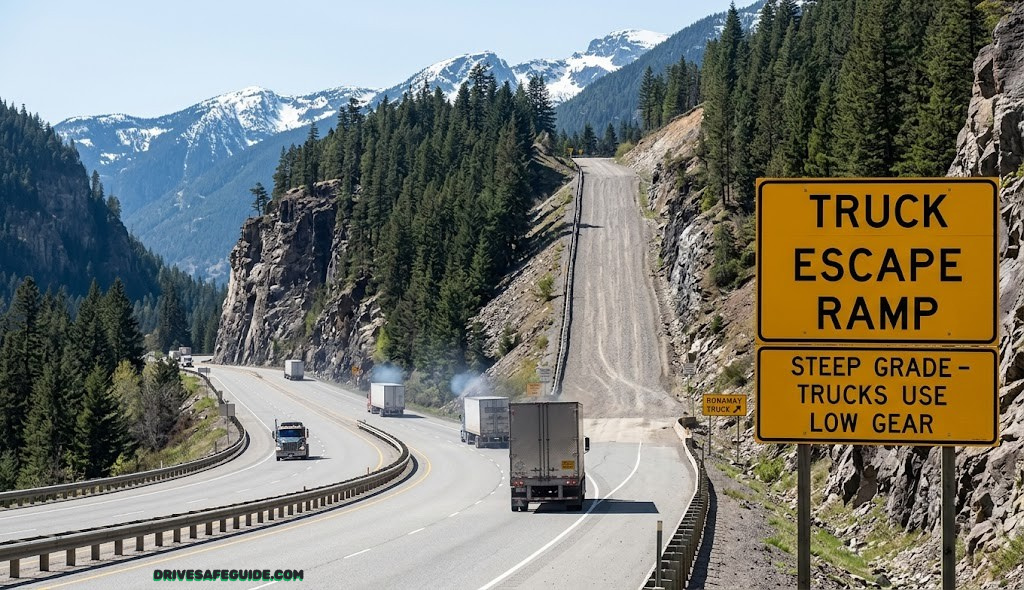
A runaway truck ramp isn’t a backup lane — it’s an engineered last resort, built to trade a controlled crash of momentum against gravel and gravity for the alternative: a truck with no brakes barreling into traffic below. Knowing how these ramps work, and how to use one, can be the difference between a rough afternoon and a fatal pileup.
What Is a Runaway Truck Ramp?
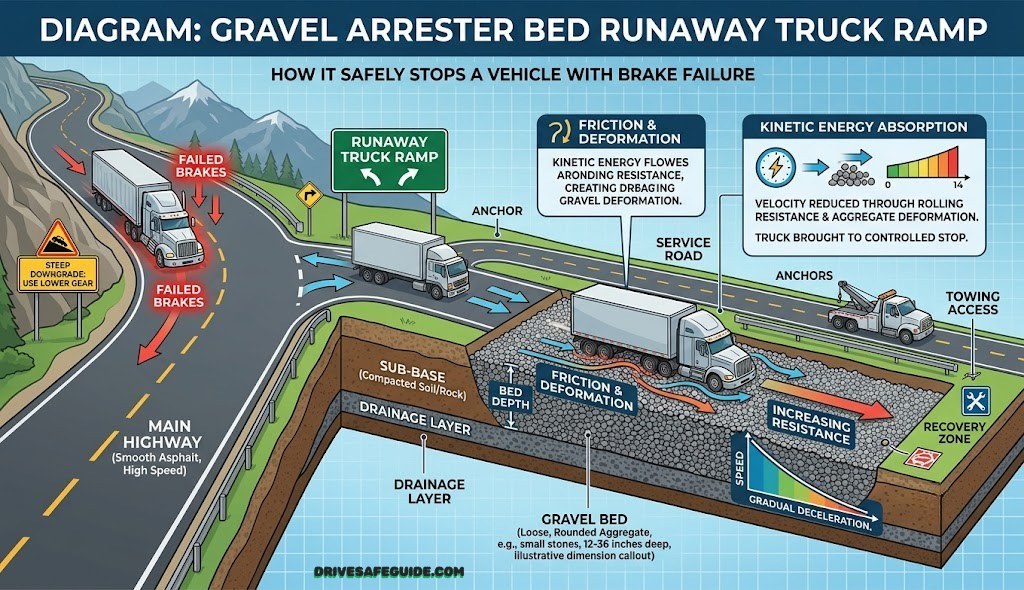
A runaway truck ramp — also called an escape ramp, arrester bed, or emergency truck ramp — is a dedicated stretch of road built alongside a steep, sustained downgrade, designed to give a driver with failing or failed brakes somewhere to go besides the travel lanes. Instead of pavement, most ramps are filled with several feet of loose, uncompacted gravel or sand. As a truck’s tires sink into that material, rolling resistance skyrockets, and the vehicle sheds speed dramatically over a relatively short distance, often coming to a full stop within a few hundred feet.
These ramps are almost always found on mountain passes and long grades where trucks descend for miles at a time, building heat in the brake drums or discs faster than that heat can dissipate. You’ll usually see them signed well in advance, with a countdown of mile markers reminding drivers of the distance remaining, and a distinctive ramp cut into the shoulder or median just before the road levels out or curves sharply.
It’s worth being clear about what a ramp is not. It is not a rest area, not a place to pull over and check a phone, and not a lane to use just because a truck is running a little hot. It exists for a single, narrow purpose: to arrest a vehicle that can no longer be stopped through normal braking. Understanding that distinction is the first step toward using — or more importantly, avoiding — one safely. For a broader look at how brake systems fail during long descents, our guide on brake fade versus hydraulic failure breaks down the mechanical side in more depth.
Why Truck Brakes Fail on Long Descents
Most runaway truck incidents don’t start with a single dramatic failure — they build gradually, often unnoticed, over several miles of descent. Understanding the mechanism helps explain why escape ramps exist in the first place, and why they’re placed where they are.
Brake Fade From Heat Buildup
Every time a driver presses the brake pedal on a downgrade, friction material converts the truck’s kinetic energy into heat. On flat ground, that heat dissipates between applications. On a sustained grade, there isn’t enough time between applications for drums, rotors, and linings to cool. Temperatures can climb past the point where the friction material stays effective, a phenomenon known as brake fade. Once fade sets in, pedal pressure that used to slow the truck barely does anything at all.
Riding the Brakes Instead of Gearing Down
Commercial drivers are trained to descend grades primarily using engine braking and a low gear, applying the service brakes only in short, firm snubs to control speed. Drivers who instead “ride” the brake pedal continuously — common among less experienced operators, or in vehicles with a malfunctioning jake brake — generate far more heat than the system can handle, and fade sets in faster than they expect.
Overloaded or Poorly Maintained Trucks
A truck loaded beyond its rated weight, or running on brakes that were already worn, glazed, or out of adjustment, has far less margin for error. What might be a manageable descent for a properly loaded, well-maintained rig can overwhelm a truck that started the grade with compromised braking capacity.
| Failure Mode | What Happens | Typical Warning Sign |
|---|---|---|
| Brake Fade (heat) | Friction material loses effectiveness as temperature rises | Pedal feels normal but stopping power drops |
| Hydraulic/Air Loss | Fluid boils or air pressure drops below usable threshold | Pedal goes soft, low air pressure alarm sounds |
| Mechanical Wear | Linings worn to metal, drums out of round | Grinding noise, pulling to one side |
| Overheated Tires | Excess heat transfers into wheel components | Burning rubber smell, visible smoke |
Drivers who’ve experienced a soft or unresponsive pedal on flatter roads often assume it’s a one-off issue, but the same underlying problems — worn linings, contaminated fluid, or a failing master cylinder — become far more dangerous on a sustained grade. If you’ve noticed warning lights before a trip, it’s worth reading about what a solid versus flashing check engine light actually means before you head into mountain terrain.

Digital Brake Fluid Tester
A five-second test tells you if moisture contamination is quietly lowering your fluid’s boiling point — one of the leading hidden causes of fade on long grades.
Check Price on AmazonHow Escape Ramps Are Engineered to Stop a Truck
Escape ramps look simple — a strip of loose material off to the side of the highway — but the design behind them is deliberate, drawing on decades of transportation research into how to bleed off the enormous kinetic energy of a loaded truck safely.
The Arrester Bed
The most common design uses a bed of round, uncrushed aggregate (often called “pea gravel”) laid several feet deep. Round stones, rather than crushed angular ones, are chosen deliberately: they don’t compact into a hard surface the way crushed stone can, so they keep offering high rolling resistance even under repeated use. As a truck’s tires plow into the bed, the wheels sink, and rolling resistance can exceed 25–30% of the vehicle’s weight — several times what a truck experiences on pavement.
The Upward Grade
Many ramps are also built on a slight to moderate upward slope, sometimes 3–10%, so gravity works against the runaway vehicle in addition to the gravel’s resistance. This combination — deep, soft material plus an uphill fight against gravity — is what allows most ramps to stop a fully loaded truck within a few hundred feet, even from a downhill speed of 60 mph or more.
What Makes a Ramp Effective
- Adequate length for worst-case entry speed
- Deep, well-maintained loose aggregate
- Clear, high-visibility approach signage
- Anchor or vehicle-arresting net at ramp end (on some designs)
What Reduces a Ramp’s Effectiveness
- Gravel compacted by weather, snowplows, or age
- Debris, ice, or standing water in the bed
- A truck entering too fast or off-center
- Poor maintenance in remote, low-traffic areas
Mechanical Arrestor Systems
A smaller number of ramps, and some entirely separate emergency systems, use net barriers, cable arrestors, or “sand pile” designs on shorter approaches where there isn’t room for a full gravel bed. These systems are engineered for the specific speed and weight profiles expected on that stretch of road, which is part of why drivers should never assume every truck route has one available. Highway departments typically install ramps only where geometry and terrain both allow for one and where crash data shows a real need.
Types of Runaway Ramps: How They Compare
Not every escape ramp is built the same way. Depending on terrain, available land, and expected traffic, highway engineers choose from a handful of proven designs. Recognizing which type you’re approaching can help you understand what to expect the moment your tires leave the pavement.
| Ramp Type | Stopping Mechanism | Typical Length | Best Suited For |
|---|---|---|---|
| Gravity/Arrester Bed | Loose deep gravel + uphill slope | 300–800 ft | Long mountain descents with room to build a bed |
| Sand Pile | Mounded loose sand at ramp’s end | 150–400 ft | Shorter approaches, tighter terrain |
| Descending Grade Ramp | Gravel bed angled slightly downhill, longer runout | 500–1000+ ft | Areas without room for an uphill ramp |
| Mechanical Net/Cable | Engineered net or cable barrier | Under 200 ft | Very limited space, lower speed approaches |
Whichever design a given mountain pass uses, the underlying advice to drivers is the same: treat every posted ramp as a genuine safety device, not a suggestion, and never assume the next one down the road will be more convenient to reach.
Recognizing the Warning Signs You Need the Ramp
The single biggest factor in a successful escape ramp outcome is how early the driver recognizes trouble. Waiting until the pedal goes completely to the floor removes options that were available minutes — sometimes seconds — earlier.
Early Signs of Brake Fade
- The pedal feels normal but the truck isn’t slowing as expected for the pressure applied
- A burning smell, often described as hot resin or scorched dust, coming from the wheels
- Visible haze or smoke near the wheel wells
- Speed creeping upward even with steady, consistent brake application
- An audible hiss or unusual air pressure drop on air-braked commercial vehicles
Signs You’re Already in a Critical Failure
- The pedal sinks to the floor with little to no resistance
- No perceptible deceleration at all, regardless of pressure applied
- An air pressure warning buzzer or low-air light activating continuously
Being alert to these signs matters most in the exact conditions where distraction is common — long, monotonous descents. The same vigilance that helps you catch black ice before you’re already sliding applies here: notice the small signal before it becomes the only signal.
Steps to Take the Moment Your Brakes Start Failing
If you feel brakes fading on a downgrade, the sequence of actions in the next 15–30 seconds matters enormously. These steps apply broadly to both commercial trucks and passenger vehicles descending a steep grade, with commercial-specific notes where relevant.
Ease Off the Brake Pedal Briefly, Then Downshift
Counterintuitively, continuing to mash a fading brake pedal only adds more heat. Ease off for a moment, drop into the lowest safe gear for your speed, and let engine compression do the work of slowing the vehicle instead of the friction brakes.
Apply Brakes in Firm, Short Snubs — Not Constant Pressure
If some braking power remains, use it in controlled bursts: firm pressure for a few seconds, then release to let heat dissipate, then reapply. This “snub braking” technique buys time compared to continuous pressure, which accelerates fade.
Use the Horn, Hazards, and Headlights to Warn Traffic
The moment you know braking power is compromised, alert everyone around you. Hazard lights, repeated horn blasts, and high beams give other drivers a chance to clear a path, especially critical if you’re approaching slower traffic before reaching a ramp.
Look Ahead for the Nearest Ramp — Commit Early
Escape ramps are signed well before their entrance, typically with mile-marker countdowns. The earlier you commit to the decision, the more room you have to line up your approach rather than making a last-second, high-risk swerve.
If No Ramp Exists, Use a Runaway Shoulder or Scrape a Guardrail
On roads without a purpose-built ramp, look for wide gravel shoulders, uphill side roads, or as an absolute last resort, gently sideswiping a guardrail to shed speed through controlled friction — far preferable to a head-on collision with other traffic.
Avoid Turning the Wheel Sharply or Jumping Out
At speed, a sharp steering input can cause a rollover, and abandoning a moving vehicle is far more dangerous than staying with it while it decelerates. Keep both hands on the wheel and make gradual corrections only.

Compact CB Radio for Commercial Cabs
Instant channel-19 access to warn nearby drivers of a runaway situation before you’re anywhere near an escape ramp.
Check Price on AmazonUsing the Escape Ramp Correctly
Reaching the ramp is only half the job. The way you enter and behave once inside the arrester bed materially affects both how safely you stop and how the vehicle behaves in the final seconds.
Aim for the Center
Ramps are widest and deepest near the middle. Entering off-center risks clipping the edge berm or missing the deepest section of gravel, which reduces the stopping effect exactly when you need it most.
Straighten the Wheel Immediately on Entry
The gravel will pull hard on the steering the instant the tires sink in. Grip the wheel firmly, keep it straight, and resist the urge to fight the sudden drag — the resistance is doing exactly what it’s designed to do.
Do Not Attempt to Reverse or Exit Once Stopped
Once the truck has come to rest, stay in the vehicle with hazards on, and do not attempt to back out under your own power — most ramps require towing assistance to safely extract a vehicle, and reversing loose gravel under power can dig the wheels in further or cause instability on a sloped bed.
Watch for a Following Vehicle
If you’re driving behind a truck that visibly enters an escape ramp, slow down and give it a wide berth — debris, gravel spray, and an unpredictable stopping distance are all possible, and the driver may need the full width of the ramp to come to a controlled stop.
After You’ve Stopped: What Happens Next
Coming to rest in the gravel bed is the end of the emergency, but not the end of the process. A few clear steps make the aftermath safer and smoother.
- Stay put and turn on hazards. Most ramps have call boxes or are monitored; wait for highway assistance rather than attempting to self-extract.
- Check for injuries and call for help. Even a controlled stop can involve sudden deceleration forces; a basic check-in with passengers matters before anything else.
- Do not attempt to drive out under your own power. Deep gravel and a sloped bed are specifically designed to resist that; most vehicles need a tow truck equipped for the terrain.
- Report the ramp condition if it seemed poorly maintained. Compacted gravel, standing water, or debris in the bed reduces effectiveness for the next driver who needs it.
- Have the braking system inspected before returning to the road. Whatever caused the failure needs a full diagnosis, not a quick reset, before you continue the trip.
If your vehicle’s braking issue turns out to be tied to something like a stuck caliper or a failing master cylinder, it’s worth understanding what similar sudden failures look like elsewhere in the vehicle — our guide on responding to a stuck accelerator covers a related category of sudden mechanical failure using much of the same calm, procedural mindset.
Common Mistakes Drivers Make With Escape Ramps
| Mistake | Why It’s Dangerous | Better Approach |
|---|---|---|
| Waiting too long to react to fade | Removes the option to use a ramp calmly and early | Treat the first warning sign as the deadline for action |
| Continuous hard braking instead of snubbing | Accelerates heat buildup and total failure | Use short, firm pulses with cooling gaps |
| Swerving sharply into the ramp at the last second | Can cause rollover or missed entry | Commit early and merge gradually |
| Trying to reverse out of the gravel bed | Can destabilize the vehicle or dig wheels in deeper | Wait for professional towing assistance |
| Assuming every mountain grade has a ramp | Not all roads have one; false sense of security | Check route maps and grade warnings in advance |
| Ignoring early smell or smoke from brakes | Mistaking early fade for something minor | Pull over immediately to let brakes cool if possible |
How to Prevent Brake Failure Before It Ever Starts
The best relationship most drivers ever have with a runaway truck ramp is never needing to use one. Preventing brake failure is almost always more about preparation and habit than luck.
Pre-Trip Brake Inspection
Before any descent-heavy route, check pad and lining thickness, look for fluid leaks or contamination, and confirm air pressure builds correctly on commercial vehicles. A five-minute check at a rest stop before a grade can catch a problem while it’s still cheap and easy to fix.
Descend in a Low Gear From the Start
Selecting the correct low gear before the descent begins — rather than partway down once speed has already built — keeps engine braking doing most of the work and minimizes reliance on the service brakes altogether.
Respect Weight Limits
Overloading increases stopping distances and heat generation dramatically. Staying within rated gross vehicle weight isn’t just a compliance issue; it’s a direct safety margin on every grade you drive.
Build a Habit of Route Awareness
Knowing in advance which stretches of a planned route include long descents lets you mentally and mechanically prepare — checking brakes, choosing rest stops, and pacing your trip accordingly. Building this kind of habit fits naturally alongside other defensive driving habits that reduce collision risk across every type of trip, not just mountain routes.
Habits That Reduce Risk
- Checking brake temperature indicators if equipped
- Slowing well before a grade begins, not during it
- Scheduling cooling stops on long descents
- Keeping tires properly inflated for better heat management
Habits That Increase Risk
- Descending in a high gear “to save fuel”
- Ignoring a spongy or fading pedal on flat ground beforehand
- Skipping pre-trip inspections on familiar routes
- Following too closely, reducing reaction time if brakes fade
Following distance matters even more when braking power is uncertain — our breakdown of the safe following distance rule is a useful companion read for anyone regularly driving grades with heavy traffic below.

Heavy-Duty Semi-Truck Brake Pads
Higher-temperature friction compounds designed specifically to resist fade during extended mountain descents.
Check Price on AmazonEscape Ramps vs. Other Safety Measures: How They Stack Up
Escape ramps are one tool in a much larger safety system built into mountain highways. Seeing how they compare to other measures helps explain why they remain necessary even alongside modern vehicle technology.
| Safety Measure | Purpose | Limitation |
|---|---|---|
| Escape Ramp | Physically arrests a vehicle with no functional brakes | Only available at specific, engineered locations |
| Engine/Jake Brake | Reduces reliance on service brakes during descent | Requires correct gear selection and driver training |
| Grade Warning Signage | Alerts drivers to prepare before the descent begins | Only effective if drivers actually slow and downshift in response |
| Brake Temperature Monitors | Gives early warning of dangerous heat buildup | Aftermarket installation required on many trucks |
| Runaway Ramp Advisory Radio | Broadcasts real-time warnings on some routes | Limited to specific corridors with the infrastructure installed |
None of these measures work in isolation — a well-maintained truck, a driver trained in proper descent technique, and a functioning ramp as the final backstop all work together. Removing any one layer increases risk for everyone on the road below the grade.
Tools and Technology That Help
Beyond driver technique, a handful of tools consistently reduce the odds of ever needing an escape ramp in the first place, or improve outcomes if you do.
Brake Temperature Sensors
Aftermarket wheel-end temperature sensors give commercial drivers real-time alerts well before fade becomes noticeable through the pedal, offering critical extra minutes to react.
Dash Cameras for Documentation
In the event of a brake-related incident, footage from a dash cam can clarify exactly what happened, which matters for insurance, fleet review, and post-incident training. If you’re shopping for one, our comparison of the best 4K dash cams for night driving covers models suited to low-light mountain routes.
GPS Systems With Grade and Truck Routing
Truck-specific GPS units flag steep grades, weight restrictions, and known escape ramp locations in advance, letting drivers mentally prepare rather than discovering a 7% grade with no warning.
| Tool | Primary Benefit | Best For |
|---|---|---|
| Wheel-end temp sensor | Early fade warning | Fleet trucks on regular mountain routes |
| Truck GPS with grade data | Advance route awareness | Long-haul and unfamiliar routes |
| Dash cam | Incident documentation | All drivers, especially commercial |
| CB radio | Real-time warning to nearby traffic | Commercial drivers on shared corridors |
Preparation extends beyond the cab, too — a well-stocked kit matters if you’re stopped roadside afterward for any length of time. See our guide on how to build a complete car safety kit for a practical checklist that applies to commercial and passenger vehicles alike.
Frequently Asked Questions
What exactly is a runaway truck ramp made of?
How fast can a truck be going and still stop safely on a ramp?
Can a passenger car use an escape ramp too?
What should I do if I see a truck using a ramp ahead of me?
Is it illegal to use a runaway ramp if you don’t actually need it?
How do I get my truck out of the gravel after stopping?
Why don’t all mountain roads have an escape ramp?
What’s the difference between brake fade and complete brake failure?
Should I downshift or brake first if I feel my brakes fading?
Do escape ramps work the same way in winter conditions?
Can trailer brakes fail separately from the tractor’s brakes?
What’s the very first thing I should do if I realize my brakes have failed?
The Bottom Line
Runaway truck ramps exist because brake failure on a long grade is a survivable emergency — but only when a driver recognizes the warning signs early, reacts with the right technique, and commits to the ramp without hesitation. The gravel, the uphill slope, and the engineering behind every ramp are all designed around one goal: giving a truck with no brakes somewhere safer to go than the traffic below. Pair that knowledge with solid pre-trip habits, and the ramp becomes a safety net you’re prepared for but hopefully never have to use.
For more practical, no-nonsense driving safety guides, explore our full library of safe driving habits and emergency response breakdowns built for real-world situations on the road.
Browse the Road Trip Safety Checklist