Understanding Engine Oil Viscosity Grades for Safe Driving
Two numbers and a letter on a bottle decide how well your engine is protected on a freezing morning start and a hundred-degree highway climb. Here is what they actually mean, and how to stop guessing.
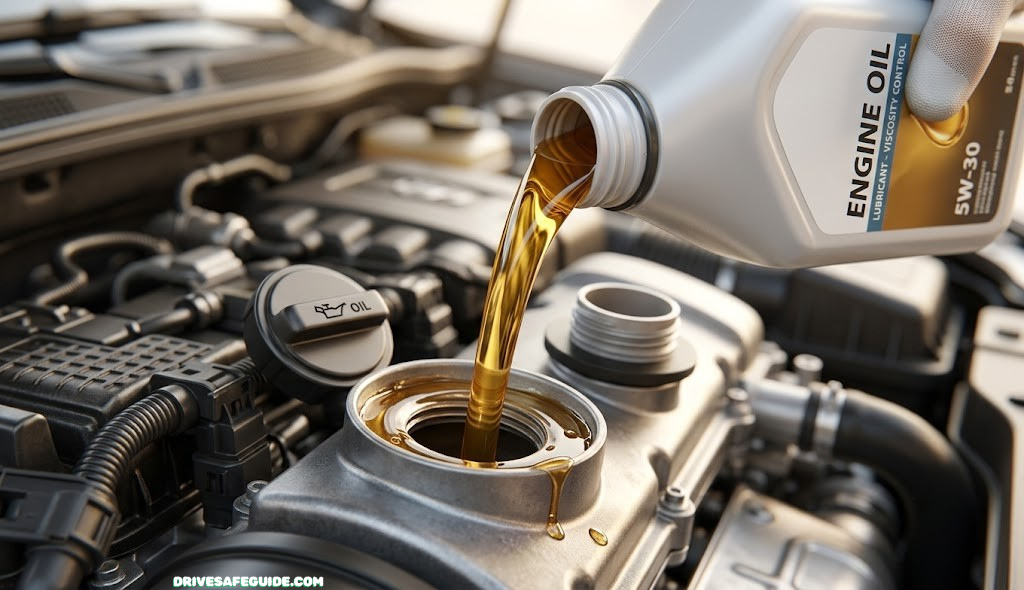
Most drivers can quote their tire pressure from memory but couldn’t tell you what the numbers on their oil bottle mean beyond “it’s the oil the manual says to use.” That gap matters more than it seems. Viscosity grade is not a marketing detail; it is the single spec that determines whether your engine’s moving parts are actually separated by a protective film of oil during the two moments that do the most damage — the first few seconds after a cold start, and the moment temperatures spike under load. This guide walks through what those grade numbers mean, how they are tested, and how to choose correctly for your engine, climate, and driving pattern, so that “safe driving” starts under the hood before it ever starts on the road.
None of this requires a background in chemistry. By the end, a code like 5W-30 or 0W-20 should read less like a serial number and more like a small technical sentence you can interpret at a glance — one that tells you exactly how that oil will behave the next time you turn the key on a cold morning, and again three hours later on the highway in the middle of summer. If your engine has ever felt sluggish before it warms up, or you’ve wondered whether that oil-change shop upsold you into the wrong bottle, this is the page that settles it.
We’ll move through this in the same order an engineer would think about it: what viscosity is and why it matters, how to actually read the grade printed on a bottle, what each half of that grade controls, how the whole system is tested and verified, how oil formulation and base-stock choice interact with the grade, and finally how to translate all of it into a confident purchase the next time you’re standing in front of a shelf of nearly identical bottles.
What Viscosity Actually MeasuresFUNDAMENTALS
Viscosity is simply a measurement of a fluid’s resistance to flow. Honey is viscous; water is not. Motor oil sits somewhere in between, and where exactly it sits changes constantly as the oil heats and cools inside a running engine. A viscosity grade is the manufacturer’s way of publishing, in a standardized shorthand, how thick or thin that particular oil behaves across a temperature range — from a garage floor at freezing point to metal surfaces inside a combustion chamber running well past the boiling point of water.
Engine oil has one job above all others: keep metal from touching metal. Pistons, bearings, camshafts, and crankshafts move against each other thousands of times a minute, and the only thing preventing metal-on-metal contact is a microscopically thin film of oil. If that film is too thin, it shears away under load and parts wear directly against one another. If it’s too thick, the oil can’t circulate fast enough to reach every surface before damage occurs, particularly in the first seconds after startup when oil pressure is still building. Viscosity grade exists to communicate, in two numbers, whether an oil will hold that protective film at both extremes your engine will actually see.
It helps to think of viscosity less as a fixed property and more as a curve. Every oil has a viscosity at any given temperature, and that curve is exactly what the grade code is trying to summarize. This is also why a single number was never enough — a grade needs to describe the shape of that curve, not just one point on it, which is exactly why modern oils carry two numbers separated by a “W.”
Boundary Lubrication vs. Hydrodynamic Lubrication
Engineers describe two distinct lubrication states inside a running engine, and viscosity grade is chosen to manage the transition between them. In hydrodynamic lubrication, moving surfaces are fully separated by a continuous oil film, and viscosity mainly affects friction and pumping losses rather than wear. In boundary lubrication, the film is thin enough that microscopic surface peaks occasionally make contact, which is exactly what happens for a brief moment at startup, at very low RPM, or under extreme load. Additive packages, not viscosity grade alone, are what protect metal surfaces during boundary lubrication moments, which is why two oils with the same viscosity number can still perform differently under identical stress.
A related figure, the Viscosity Index (VI), describes how much an oil’s viscosity changes with temperature — a higher VI means a flatter, more stable curve. Multi-grade oils rely on additives specifically engineered to raise VI, which is a large part of why a modern 0W-20 can meet both a demanding cold-start target and a stable hot-temperature target from the same fill, something a mono-grade oil from decades ago simply could not achieve.
Why This Matters for Safety, Not Just Engine Longevity
It’s tempting to file viscosity under “maintenance trivia,” but a fuel system, braking system, and lubrication system all share one trait: they only protect you as long as they function as designed. An engine that loses oil pressure or suffers a bearing failure at highway speed can lose power steering assist and, in some configurations, vacuum-assisted braking simultaneously. Drivers already thinking about whether it’s safe to keep driving with a blown head gasket or watching for a solid versus flashing check engine light are really asking the same underlying question this guide answers: is my engine’s internal protection intact right now. Correct viscosity is the quiet, upstream answer to a lot of those downstream warning signs.
A correctly graded, API-rated synthetic oil is one of the cheapest insurance policies your engine gets. Compare current options and reviews on Amazon.
Shop Synthetic Engine Oils →Reading an Oil Label: 5W-30 DecodedLABEL LITERACY
Take the most common grade on the market, 5W-30, and break it into its three parts. The “5W” describes cold-weather flow. The “W” stands for Winter, not weight, and it is graded specifically to describe how the oil behaves at low temperatures. The “30” describes the oil’s viscosity once the engine has reached full operating temperature. Everything else on the bottle — API service category, ILSAC certification, manufacturer approvals — sits around this core two-part code, but the grade itself is what most directly affects daily performance.
This two-number format is defined by SAE J300, the industry standard maintained by SAE International that every major oil brand follows regardless of country of origin or price point. That standardization is precisely why a 5W-30 from one brand behaves within a tightly regulated range of a 5W-30 from a competitor, even if the base oils and additive packages differ. The grade is a performance promise, not a brand claim.
| Label Segment | What It Describes | Tested At |
|---|---|---|
| First number + “W” | Cold-flow and cold cranking behavior | Sub-zero temperatures, simulated cold start |
| Second number | Viscosity at full operating temperature | 100°C (212°F), kinematic viscosity |
| API category (e.g. SP) | Chemical performance and emissions-system compatibility | Engine dynamometer and bench tests |
| ILSAC rating (e.g. GF-6) | Fuel economy and engine protection standard for gasoline engines | Standardized industry test suite |
Mono-grade oils, by contrast, show only a single number with no “W” — something like SAE 30. That single figure only describes viscosity at operating temperature and says nothing about cold-flow behavior, which is why mono-grades have largely disappeared from daily-driver use and are covered in more depth further down this page.
The Symbols Sitting Next to the Grade Number
Look just below or beside the viscosity grade on most bottles and you’ll typically find one or two circular symbols. The API “donut” symbol displays the service category (letters like SP for the newest gasoline standard, or CK-4 for certain diesel applications) along with the viscosity grade repeated inside it. The ILSAC “starburst” symbol, used only for gasoline engine oils meeting the most current fuel-economy and emissions-protection standard, indicates the oil has passed an additional layer of industry testing beyond the base API requirement. European manufacturers often reference ACEA sequences instead, such as ACEA A3/B4 or C3, which map to a related but not identical set of performance requirements — worth checking specifically for European-brand vehicles, since an ACEA specification can matter as much as the SAE viscosity grade itself for warranty compliance.
The “W” Number: Cold-Start ProtectionWINTER RATING
The number before the “W” is arguably the more consequential figure for engine wear over the life of the vehicle, because roughly 75 percent of engine wear from lubrication issues happens in the first few seconds after a cold start, before oil pressure has fully built and oil has reached every bearing surface. A lower “W” number means the oil stays thinner at low temperatures, flows faster on startup, and reaches critical components sooner.
The scale runs from 0W (flows easily even in extreme cold) through 5W, 10W, 15W, 20W, and 25W (progressively thicker at low temperature, and correspondingly slower to circulate on a cold start). A 0W oil is not “weaker” than a 15W oil — it is formulated with different base oils and viscosity modifiers so that it remains fluid at temperatures where a 15W oil would already be sluggish, sometimes dangerously so for the first few seconds of oil circulation.
| Grade | Approx. Cold-Flow Limit | Typical Climate Fit |
|---|---|---|
| 0W | -40°C / -40°F | Extreme cold, arctic conditions |
| 5W | -35°C / -31°F | Cold winters, most northern regions |
| 10W | -30°C / -22°F | Moderate winters |
| 15W | -25°C / -13°F | Mild winters, warm climates |
| 20W | -20°C / -4°F | Hot climates, older engines |
This is also the number that most directly relates to another safety-critical topic: winter driving safety around traction and braking. An engine that struggles to circulate oil on a subzero morning isn’t just wearing faster — in marginal cases it can hesitate or stall at the worst possible moment, such as merging into traffic on an icy on-ramp.
Why Modern Variable Valve Timing Systems Are Especially Sensitive
Variable valve timing (VVT) systems, now standard on the vast majority of gasoline engines, rely on oil pressure itself as a hydraulic actuator to advance or retard cam timing on the fly. That means VVT solenoids and phasers are not just lubricated by engine oil — they are directly operated by it. An oil that is too slow to build pressure on a cold start can delay VVT response, which drivers sometimes notice as a faint rattle or hesitation from the timing chain area in the first minute after startup. This is one more reason a manufacturer’s specified “W” number is not a suggestion so much as a functional requirement baked into how the valvetrain itself operates. Choosing a lower “W” number than specified rarely helps here either, since the rest of the oil’s properties, including hot-temperature film strength, are calibrated as a package rather than independent variables a driver can freely mix and match.
Block heaters, garage parking, and pre-warming habits common in genuinely cold climates all exist to reduce the burden on this exact system. A block heater plugged in overnight doesn’t change the oil’s viscosity grade, but it raises the starting temperature the oil is working from, which shortens the window during which the engine is running on a partially-built oil film. For drivers without garage access, simply allowing the engine to idle for thirty to sixty seconds before pulling away accomplishes something similar, giving the pump time to fully prime the system before the engine is placed under load.
The Second Number: Protection at Operating HeatHOT-FLOW RATING
The number after the dash — the “30” in 5W-30 — describes kinematic viscosity at 100°C, the temperature oil reaches once an engine is fully warmed up. Unlike the cold-flow number, higher here means thicker, and thicker generally means a more durable oil film under load, heat, and mechanical stress, at the cost of slightly more internal friction and marginally reduced fuel economy.
This is the number engineers tune most carefully against a specific engine’s bearing clearances. Modern engines with tighter tolerances are increasingly specified for thinner high-temperature grades like 20 or even 16, chasing fuel economy gains, while older engines, high-performance engines, and anything operating under sustained heavy load or towing often call for a 40 or higher to guarantee the film holds up.
Thicker Hot-Grade (40, 50)
- Stronger film strength under sustained load and high heat
- Better suited to towing, track use, and worn or high-mileage engines
- More forgiving of extended oil-change intervals in harsh conditions
Thinner Hot-Grade (16, 20)
- Slightly reduced fuel economy versus manufacturer-specified thin grades
- Can fall outside emissions-system warranty specifications if substituted
- Not adequate film strength for engines designed around thicker oil
Going thicker than specified is not automatically “safer.” An engine’s oil pump, oil passages, and bearing clearances are engineered around a target viscosity. Oil that is too thick for that design can starve fast-moving components of oil during rapid RPM changes because it simply can’t move through narrow galleries quickly enough — a subtle but real failure mode that surprises drivers who assume thicker always equals more protection.
Turbochargers Raise the Stakes on Film Strength
Turbocharged engines add a component that spins far faster and runs far hotter than anything else in the lubrication system: the turbo center bearing, which can rotate well over one hundred thousand RPM and glow with residual heat long after the engine is shut off. That bearing depends entirely on oil film strength to survive, and HTHS viscosity, mentioned earlier, becomes especially relevant here, since it reflects how well the oil resists shearing apart under exactly the kind of extreme mechanical stress a turbo bearing generates. Diesel engines, which typically run higher compression and heavier loads than gasoline counterparts, similarly favor formulations with proven HTHS performance, which is part of why diesel-rated oils are usually held to a distinct API category (the “C” series, such as CK-4) separate from gasoline’s “S” series, even when the numeric viscosity grade looks similar on the shelf.
Switching viscosity grades is a good moment to replace the filter too. Browse top-rated filters compatible with most engines.
Shop Oil Filters →How Viscosity Grades Are Actually TestedSAE J300
The “W” rating comes from two lab measurements: Cold Cranking Simulator (CCS) testing, which measures apparent viscosity at low temperature under conditions meant to simulate an engine turning over on startup, and Mini-Rotary Viscometer (MRV) testing, which measures whether the oil can still be pumped at very low temperatures without forming a gel-like structure that starves the pump. Both are measured in centipoise (cP), a unit describing dynamic viscosity.
The hot-temperature number comes from kinematic viscosity testing at 100°C, measured in centistokes (cSt), alongside a High-Temperature High-Shear (HTHS) test that measures viscosity under the mechanical shear stress an oil experiences between a piston ring and cylinder wall at speed. HTHS values matter more than most drivers realize, because two oils sharing the same SAE grade can have meaningfully different HTHS performance depending on their additive package — which is part of why “just buy the cheapest oil with the right two numbers” isn’t quite sound advice.
- CCS test — simulates a cold-engine crank; sets the “W” ceiling.
- MRV test — confirms the oil can still be pumped, not just cranked, at low temperature.
- Kinematic viscosity at 100°C — sets the base “hot number” grade.
- HTHS viscosity — confirms film strength survives real mechanical shear, not just heat.
None of this testing is optional or self-reported — SAE J300 requires certified lab procedures, and API and ILSAC licensing (the “starburst” and donut-shaped symbols on a bottle) require third-party verification before a brand can display those marks. If a bottle carries a verified API or ILSAC symbol, the viscosity grade printed alongside it has passed all of the above.
One More Test Worth Knowing: NOACK Volatility
A related but separate test, NOACK volatility, measures how much of an oil evaporates when held at high temperature for a fixed period. This matters for viscosity indirectly: an oil that evaporates lighter molecular components under heat effectively thickens in place, drifting away from its rated grade purely through evaporation rather than oxidation or shear. Higher-quality base oils, particularly Group III and full synthetic Group IV and V oils, generally show lower NOACK volatility than lower-grade conventional base stocks, which is one more reason base oil quality and viscosity grade selection aren’t fully separable decisions — a bargain oil at the correct viscosity grade can still drift out of spec faster than a premium oil at the same starting number.
Multi-Grade vs. Mono-Grade OilsFORMULATION
A mono-grade oil, such as SAE 30, only meets one viscosity target at one temperature. Multi-grade oils, like 5W-30, are engineered with viscosity index improvers — polymer additives that expand as temperature rises, counteracting the natural tendency of oil to thin out when hot. The result is an oil that behaves like a thin 5-weight oil when cold and a thicker 30-weight oil once warmed, all from a single fill.
| Property | Mono-Grade (e.g. SAE 30) | Multi-Grade (e.g. 5W-30) |
|---|---|---|
| Cold-start flow | Poor; thick and slow to circulate when cold | Strong; flows like a much thinner oil when cold |
| Hot-temperature protection | Adequate, single fixed target | Matched to the same target via additives |
| Typical modern use | Small engines, lawn equipment, some vintage engines | Nearly all modern passenger vehicles |
| Additive dependency | Minimal viscosity-index additive load | Relies on viscosity-index improvers over time |
The tradeoff with multi-grade oil is that viscosity-index improvers can shear down mechanically over long intervals, gradually pulling a 5W-30 back toward something closer to a straight 20-weight oil in real-world viscosity — one of the reasons oil-change intervals exist even for oils that still look and smell fine.
Why Mono-Grade Oil Used to Be the Norm
Before viscosity-index improver chemistry matured, multi-grade formulations were either unavailable or unreliable, so drivers commonly switched between a thinner mono-grade oil in winter and a thicker one in summer, sometimes twice a year, to keep viscosity roughly in the right range for the season. That practice has almost entirely disappeared for daily-driver gasoline engines, but it persists in a few specific niches: small air-cooled engines, certain classic and vintage vehicles built before modern multi-grade oils existed, and some outdoor power equipment where manufacturers still specify a straight SAE 30 for simplicity rather than performance. Anyone maintaining an older or specialty vehicle alongside a modern daily driver should treat these as two entirely separate viscosity decisions rather than assuming one bottle serves both.
Synthetic, Conventional, and Blend FormulationsBASE OIL
Viscosity grade describes performance across temperature; base oil type describes what the oil is made from, and the two interact directly. Full synthetic oils, built on chemically engineered base molecules rather than refined crude, hold a viscosity-index curve far more consistently across temperature extremes than conventional oils, which is why the widest cold-flow spans — 0W and 5W grades in particular — are almost always synthetic or synthetic-blend formulations rather than conventional oil.
Full Synthetic
- Most stable viscosity curve across temperature extremes
- Better resistance to shear and viscosity breakdown over time
- Typically supports longer service intervals
Conventional / Blend
- Narrower practical grade range, especially in cold-flow numbers
- Faster viscosity-index improver breakdown under heat cycling
- Usually requires shorter change intervals for equivalent protection
High-mileage formulations, meanwhile, are not a separate viscosity category — they are typically a standard grade with added seal conditioners to address the small leaks and seepage common in older engines. A driver troubleshooting shaking at highway speed or unusual behavior from the transmission should rule out fluid-related causes methodically rather than assuming a single fix — viscosity and fluid type are one input among several.
API Base Oil Groups, in Plain Terms
The American Petroleum Institute sorts base oils into five groups, and understanding roughly where a bottle falls helps explain price and performance differences that aren’t visible from the viscosity grade alone. Groups I and II are conventionally refined mineral oils, with Group II representing a meaningfully cleaner refining process than Group I. Group III oils are severely hydrocracked mineral oils refined to a purity level that many regulators allow to be marketed as “synthetic” in the United States, despite not being chemically synthesized from scratch. Group IV covers true synthesized hydrocarbons (PAO), and Group V covers everything else, including esters, often blended into synthetic formulations in small amounts to improve seal compatibility and detergency. None of this changes the viscosity grade printed on the label, but it does explain why two 5W-30 oils marketed as “synthetic” can differ meaningfully in price and in how well they hold their rated viscosity over a full service interval.
Avoid spills and cross-contamination between viscosity grades with a dedicated funnel.
Shop Oil Funnels →Matching Viscosity to Your VehicleMANUFACTURER SPEC
The single most reliable source for the correct viscosity grade is the vehicle owner’s manual, followed by the oil fill cap itself, which frequently prints the recommended grade directly. Manufacturers arrive at that specification through extensive engine-specific testing — bearing clearances, oil pump capacity, piston ring tolerances, and even emissions-system compatibility are all designed around a target viscosity, which is why “close enough” substitutions can quietly undermine engine protection, fuel economy, and in some cases warranty coverage.
Many manufacturers now list a primary recommended grade alongside an approved alternate for specific conditions — commonly a slightly thicker hot-number option for sustained high heat, heavy towing, or track use. Reading past the headline grade into that fine print is worth the two minutes it takes, particularly for anyone regularly building out a car safety kit or preparing for demanding trips.
- Check the fill cap first — many engines print the grade directly on or near the oil fill point.
- Cross-reference the owner’s manual — look for climate-specific alternate grades, not just the single default.
- Confirm API/ILSAC category — the grade number alone doesn’t confirm chemical compatibility with your engine’s emissions hardware.
- Note any turbocharger or direct-injection notes — these systems are often more sensitive to deposit control additives than to the grade number itself.
Climate and Seasonal SelectionREGIONAL FIT
Modern multi-grade oils are formulated to handle a wide seasonal range without swapping grades twice a year, which used to be common practice with mono-grade oils. Even so, climate still matters at the margins — particularly for drivers in regions with genuine seasonal extremes rather than mild year-round weather.
| Climate Pattern | Cold-Flow Priority | Common Grade Choices |
|---|---|---|
| Arctic / sub-zero winters | Very high — fastest possible cold circulation | 0W-20, 0W-30 |
| Cold winters, moderate summers | High | 5W-30, 5W-20 |
| Mild, four-season climate | Moderate | 5W-30, 10W-30 |
| Hot, arid, or desert climate | Low; hot-number film strength prioritized | 10W-40, 20W-50 (older engines) |
Drivers who split time between climates — snowbirds, long-haul travelers, or anyone planning road-trip safety across multiple regions in one trip — should default to the manufacturer’s cold-weather grade recommendation rather than a warm-climate one, since a correctly rated multi-grade oil already handles heat well; it’s the cold-start side that has the narrower margin for error.
On the opposite extreme, sustained desert heat and stop-and-go traffic under direct sun raise average operating temperature well above typical highway conditions, accelerating oxidation and shortening the effective life of a given oil change even when the mileage looks low. Drivers in these regions benefit from reading through extreme-heat engine care guidance alongside viscosity selection, since shorter change intervals and a slightly heavier hot-number grade are both reasonable adjustments where the manufacturer allows an approved alternate.
What Happens When the Grade Is WrongRISK
Using the wrong viscosity grade rarely causes dramatic, immediate failure — which is exactly what makes it dangerous. The damage is cumulative and easy to miss until symptoms surface as something else entirely, often mistaken for an unrelated issue.
Too Thin for the Application
An oil thinner than specified may not maintain adequate film strength under heat or load, leading to accelerated bearing wear, increased metal-to-metal contact under high RPM, and in more severe cases, a measurable drop in oil pressure that can trigger a warning light or, in older analog gauge vehicles, a visibly low pressure reading.
Too Thick for the Application
An oil thicker than specified can struggle to reach fast-moving components quickly enough during rapid throttle changes, increases internal friction and fuel consumption, and places extra load on the oil pump itself. In cold climates specifically, an overly thick grade can be genuinely dangerous on startup, since the delay in oil reaching upper-engine components is stretched out precisely when engine speed is already elevated from a cold idle.
Warning Signs of Grade Mismatch
- Louder valvetrain “tick” on cold start that fades as the engine warms
- Lower-than-normal oil pressure reading at idle
- Noticeable drop in fuel economy after a recent oil change
- Oil consumption increasing between changes
What Correct Grade Selection Prevents
- Accelerated bearing and cam wear from thin-film starvation
- Pump strain and cold-start lag from an overly thick fill
- Warranty disputes tied to non-specified fluids
- Compounding wear that shortens engine life well below its design target
A common real-world pattern looks something like this: a driver has an oil change done at a quick-service shop that defaults to whatever grade is already loaded in the bulk dispensing system, rather than the grade specific to that vehicle. Nothing goes wrong immediately, and the car drives normally for weeks or months. Slowly, though, oil pressure at idle trends a little lower, cold starts get a little noisier, and fuel economy drifts down by a mile or two per gallon — none of it dramatic enough on its own to prompt a shop visit, until a more serious symptom, like a knocking noise or a warning light, eventually appears. Reviewing the invoice from the last service and confirming the actual grade used, not just assuming it matched the request, is a simple habit that closes this gap.
This is also where viscosity intersects with broader vehicle safety habits. A driver already thinking carefully about defensive driving habits that reduce collision risk is, by extension, someone who benefits from an engine that isn’t quietly degrading in the background — mechanical reliability and situational awareness both reduce risk, just at different layers of the same trip.
A digital oil-life and pressure monitor can flag problems before they become expensive.
Shop OBD2 Monitors →Why Viscosity Changes as Oil AgesDEGRADATION
Even the correctly chosen viscosity grade doesn’t stay fixed for the life of an oil change. Two competing degradation paths pull viscosity in opposite directions over the service interval, and the balance between them is exactly why oil-change intervals exist.
Mechanical shear breaks down the long-chain polymer viscosity-index improvers that give multi-grade oil its wide temperature range, gradually pulling the oil’s real-world hot-temperature viscosity down below its rated grade — in effect, a 5W-30 slowly drifting toward a thinner oil in practice, even though the bottle it came from still said 30.
Oxidation and contamination pull in the opposite direction. Heat cycling, combustion byproducts, and moisture intrusion cause oil to oxidize, forming sludge and increasing viscosity over time, sometimes enough to push an aging oil noticeably thicker than its rated grade toward the end of a service interval.
Which of these two effects dominates depends heavily on driving pattern. Short-trip, stop-and-go driving that never fully burns off condensation tends to favor oxidation and thickening; extended high-RPM or high-heat use tends to favor shear-driven thinning. Neither outcome is something a driver can see by eye, which is the practical argument for following the manufacturer’s stated interval rather than judging oil condition purely by color or smell.
Total Base Number: The Other Number Quietly Declining
Alongside viscosity drift, oil carries a Total Base Number (TBN) rating that measures its remaining ability to neutralize acidic combustion byproducts before they contribute to corrosion and sludge formation. TBN declines steadily over a service interval as detergent and dispersant additives are consumed, and a sharp drop in TBN often precedes a noticeable shift in viscosity, since the same oxidation process that depletes TBN also drives viscosity upward through sludge formation. Commercial and fleet operators sometimes send oil samples for lab analysis specifically to track TBN and viscosity together, but for most personal vehicles, simply respecting the manufacturer’s mileage or time-based interval, whichever comes first, accomplishes the same goal without the added step.
Choosing and Buying the Right OilBUYER’S GUIDE
With the fundamentals covered, choosing an actual bottle comes down to matching three things: the manufacturer-specified grade, an appropriate API/ILSAC certification for your engine’s model year and emissions hardware, and a base-oil type that fits your driving pattern and climate.
| Common Grade | Typical Fit | Notes |
|---|---|---|
| 0W-20 / 0W-16 | Newer fuel-economy-focused engines | Full synthetic only; tight factory spec, don’t substitute a thicker grade without checking the manual |
| 5W-30 | Most common daily-driver spec | Wide availability across synthetic, blend, and conventional formulations |
| 5W-20 | Many domestic gasoline engines | Prioritizes fuel economy and cold-flow |
| 10W-40 | Older engines, hot climates, some diesels | Higher film strength at operating temperature |
| 20W-50 | High-performance and vintage engines | Rare in modern daily drivers; check before use |
Weighing Cost Against Long-Term Value
Full synthetic oil at the correct grade typically costs more per change than a conventional equivalent, but the comparison looks different once service intervals are factored in. A synthetic formulation that reliably runs twice as long between changes, while holding its rated viscosity more consistently across that interval, can end up costing a similar amount per mile of driving while delivering measurably better protection during the highest-wear moments — cold starts and sustained high-load driving. Framing the decision around cost per mile rather than cost per bottle tends to produce a more defensible choice, particularly for anyone who puts significant highway mileage on a vehicle each year.
A Simple Buying Checklist
- Match the full grade code exactly — not just the hot number, and not just the cold number.
- Confirm API and, for gasoline engines, ILSAC certification marks are present on the bottle.
- Choose full synthetic where the manual allows it, especially for wide-span cold-flow grades.
- Keep the receipt or record of the grade and date for warranty and service history purposes.
- Pair with a compatible OBD2 scan tool for real-time sensor monitoring if you want ongoing visibility into oil-related sensor data between changes.
Beyond the engine bay, treating fluid maintenance as one part of a broader readiness habit pairs naturally with keeping a car emergency kit checklist current and revisiting pre-road-trip safety checks before any long drive, since a correctly lubricated engine is only one layer of a vehicle that’s genuinely ready to go.
Turbocharged and Direct-Injection EnginesMODERN SPEC NOTES
Small-displacement turbocharged and direct-injection engines, now common across nearly every manufacturer’s lineup, introduced a failure mode called low-speed pre-ignition (LSPI) that older naturally-aspirated engines rarely encountered. LSPI is an abnormal combustion event that can occur at low RPM under heavy load, and industry testing found that certain oil additive formulations, independent of viscosity grade, could make an engine more or less prone to it. That discovery led directly to the current ILSAC GF-6 and API SP standards, which specifically test and control for LSPI resistance.
The practical takeaway is that on a modern turbocharged engine, the viscosity grade and the certification standard are equally non-negotiable. A correctly graded oil that predates the current API SP or ILSAC GF-6 standard may still be the right thickness at every temperature and still be a poor match for that specific engine’s combustion characteristics. Checking the fill cap or manual for both the viscosity grade and the required certification letter is the only way to be certain both boxes are checked.
Buying in bulk for two or three future changes is often the better value.
Shop Multi-Quart Packs →Frequently Asked QuestionsFAQ
What does the “W” in a viscosity grade like 5W-30 stand for?
It stands for Winter, describing how the oil flows in cold temperatures rather than describing its weight. A lower number before the “W” means the oil stays fluid at lower temperatures and circulates faster on a cold start.
Can I use 5W-30 instead of 5W-20 if the manual specifies 5W-20?
Occasional short-term use rarely causes immediate damage, but manufacturers tune bearing clearances and oil pump output around the specified grade, so routine substitution can affect fuel economy and long-term wear. Follow the specified grade unless the manufacturer explicitly lists an approved alternate.
Is a thicker oil always better protection for an older engine?
Not automatically. A moderately thicker hot-number grade can help compensate for worn clearances in some older engines, but going too thick can starve fast-moving components during cold starts and increase pump strain. Check for a manufacturer-approved alternate grade before assuming thicker is safer.
Do full synthetic oils really outperform conventional oils at the same grade?
At the same labeled grade, full synthetic oils generally maintain a more stable viscosity curve across temperature extremes and resist shear-related thinning better over the service interval, which is why the widest cold-flow spans, like 0W grades, are almost always synthetic formulations.
How often should viscosity grade be reconsidered, not just the oil itself?
Most drivers should stick with the manufacturer’s specified grade for the life of the engine unless conditions change meaningfully — a move to a much colder or hotter climate, sustained towing use, or a documented manufacturer update to the recommended spec.
Does viscosity grade affect fuel economy?
Yes. Thinner grades, particularly on the hot-number side, reduce internal friction and generally improve fuel economy slightly, which is part of why many newer engines are specified for thinner grades like 0W-16 or 0W-20.
What is the difference between viscosity grade and API service category?
Viscosity grade describes flow behavior across temperature. API service category describes chemical performance standards, including emissions-system compatibility and additive requirements. Both should match your vehicle’s specification, and they are independent of one another.
Why does my engine sound louder right after a cold start?
A brief tick or tap on cold start that fades as the engine warms is often related to oil not yet having reached every component — normal to a degree in cold weather, but worth investigating if it persists well past warm-up or has grown noticeably louder over time.
Can mixing two different viscosity grades of oil damage an engine?
Topping off with a different but compatible grade in an emergency is generally not harmful in small amounts, but it dilutes the properties of the primary fill and should be corrected at the next full oil change rather than treated as a long-term solution.
Does a high-mileage oil have a different viscosity grade?
Not usually. High-mileage oils typically carry the same viscosity grade as standard formulations but include additional seal conditioners and detergents aimed at reducing leaks and deposits common in older engines.
How does towing or heavy load affect the ideal viscosity grade?
Sustained towing and heavy load increase operating temperature and mechanical stress on the oil film, which is why many manufacturers list a thicker approved alternate grade specifically for towing or high-load conditions, even when a thinner grade is the everyday default.
Is it safe to drive immediately after starting a cold engine?
Modern oils and engines tolerate light driving almost immediately, but a brief 30 to 60 second idle before moving, especially in cold weather, gives oil pressure a moment to build and reduces the load on components during the highest-wear moment of the entire drive cycle.
The Bottom Line
Viscosity grade is one of the few maintenance decisions that costs nothing extra to get right and quietly compounds if you get it wrong. The correct bottle is almost always printed on the fill cap or in the owner’s manual, and matching it exactly — cold number, hot number, and certification marks alike — is the simplest way to protect the parts of your engine you’ll never see turning.
Treat your next oil change as a small audit: confirm the specified grade, check the API and ILSAC marks on the bottle, and consider full synthetic if your engine allows it. It’s a five-minute check that protects a machine you rely on every single day.
And if you’re already in the habit of thinking this carefully about what’s happening under the hood, it’s worth extending that same attention outward — to tire condition, to the contents of your emergency kit, and to the small daily habits that keep both car and driver in good working order for the long haul.
Shop Verified Viscosity-Grade Oils →🔧 Recommended Tool
Read Your Car’s Fault Codes at Home
An OBD2 scanner lets you diagnose check engine lights, clear fault codes, and monitor your car’s health — without paying a mechanic every time.
🔧 Shop OBD2 Scanners on AmazonAffiliate link — we earn a small commission that keeps DriveSafeGuide running. Thank you!