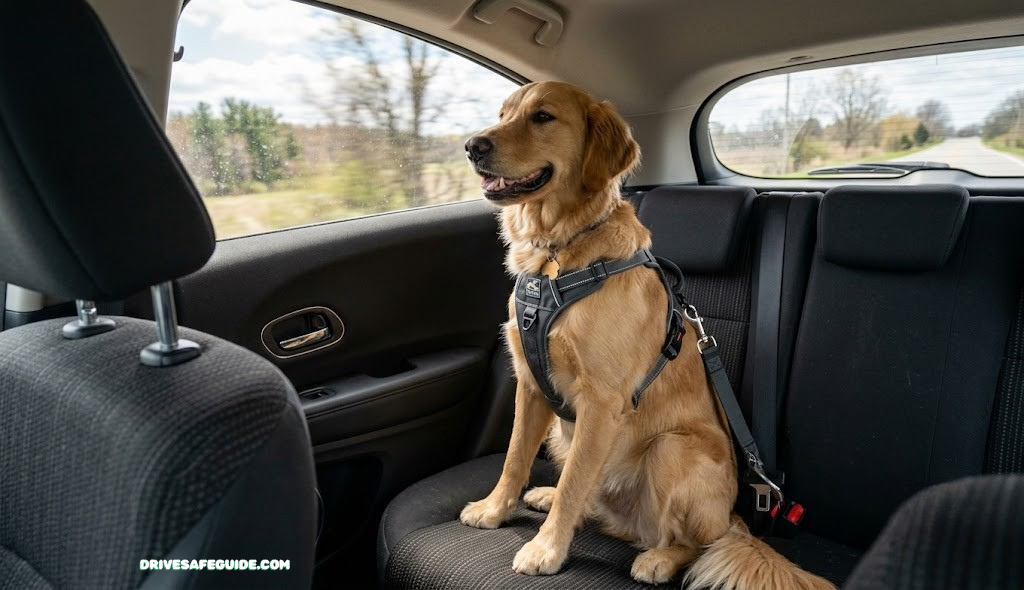
Pet Restraint Crash Test Ratings: Keeping Your Furry Friends Safe on the Road
What the ratings actually measure, which harnesses and carriers hold up in a real collision, and how to pick restraint gear your dog won’t outgrow — or outlive its usefulness in an accident.
If you’ve ever driven with a dog loose in the back seat, you already know the scramble: a sudden stop and forty pounds of golden retriever slides into the console, or worse, into the front seat. Most pet owners buy a harness or carrier assuming “crash tested” on the packaging means something. Often, it doesn’t. Only a small handful of products on the market have ever been independently crash tested against a real safety protocol, and fewer still have passed.
This guide breaks down exactly what pet restraint crash test ratings mean, who is actually doing the testing, which products have earned certification, which have failed catastrophically in testing, and how to choose the right restraint for your dog’s size and your vehicle. We’ll also cover the broader picture of driving safely with a dog in the car, since restraint gear is only one part of the equation.
Whether you’re outfitting a puppy for its first car ride, upgrading gear after a close call, or simply researching before a long road trip, the goal here is the same: replace guesswork and marketing copy with the actual, published evidence behind each product, so the decision you make is grounded in data rather than a confident-sounding label.
What “Crash Tested” Actually Means (And What It Doesn’t)
The phrase “crash tested” gets stamped on pet harness packaging with almost no oversight. There’s no federal regulation in the United States requiring pet restraint manufacturers to test their products before selling them, and there’s no legal definition of what “crash tested” has to mean. A company can run its harness through a single low-speed sled test in a private lab, see it survive, and legally print “crash tested” on the box — even if the same product would fail catastrophically at highway speed with a real dog-shaped test mannequin.
This matters because a car crash is one of the more common ways pets are seriously injured or killed while traveling. An unrestrained 60-pound dog in a 35 mph collision can generate forces equivalent to roughly 2,700 pounds of impact force — enough to seriously injure the dog and become a projectile that injures human passengers in the front seat. A harness that isn’t built to absorb and distribute that force doesn’t just fail to protect the dog; it can make the outcome worse.
The takeaway: “crash tested” language on a label is marketing, not proof. What actually matters is whether the product has been tested against a documented, repeatable protocol by an independent third party — and whether it passed or failed by that protocol’s own defined thresholds. Treat the label the way you’d treat any unverified safety claim: interesting, but not something to act on until you’ve confirmed it against an independent source.
Who Actually Tests Pet Restraints
The most credible name in this space is the Center for Pet Safety (CPS), a nonprofit that has spent over a decade running dynamic crash tests on dog harnesses, carriers, and crates. CPS runs its own laboratory testing program and publishes results — including failures — publicly rather than only promoting the products that pass. That transparency is rare in an industry where most safety claims come directly from the manufacturers themselves.
A second reference point is Calspan, an independent test facility that some manufacturers contract directly for dynamic sled testing under the same general framework used for child restraint systems (FMVSS 213). A product tested at Calspan isn’t automatically the same as being CPS-certified, but it does mean the product went through real dynamic crash testing rather than an in-house evaluation designed by the company selling it.
Everything else — university studies commissioned by a single brand, “our team tested it” claims, or vague references to “meets safety standards” — falls into a gray area. It’s not necessarily worthless, but it’s not the same tier of evidence as an independent, published, repeatable protocol.
| Testing Source | Independence | Results Published Publicly | Reliability Tier |
|---|---|---|---|
| Center for Pet Safety (CPS) | Fully independent nonprofit | Yes, including failures | Highest |
| Calspan dynamic sled testing | Independent test facility, manufacturer-commissioned | Sometimes, via manufacturer | High |
| University-commissioned studies | Partially independent | Varies | Moderate |
| Manufacturer’s own in-house testing | Not independent | Rarely full data | Low |
| No testing, “crash tested” on label only | None | No | Not credible |
How the Crash Test Protocol Actually Works
CPS built its harness testing protocol around the same federal standard used to evaluate child car seats, FMVSS 213, adapted for a dog-shaped test dummy. That means the harness or carrier is installed on a canine crash test mannequin, secured to a standard vehicle bench seat, and subjected to a dynamic frontal-impact sled test that mimics a real-world collision at approximately 30 mph — a speed chosen because it reflects a common, survivable crash severity rather than a worst-case scenario.
During the test, engineers measure several things simultaneously:
- Excursion distance — how far the test dog’s body and head travel forward during impact, measured from its starting position to the furthest point it reaches. This is the single biggest factor in whether a dog would strike the seatback in front of it, the console, or the windshield.
- Hardware and webbing migration — whether buckles, D-rings, or straps shift, twist, or loosen during the crash, which can compromise the restraint even if it technically holds.
- Structural integrity — whether stitching tears, straps snap, or the harness deforms in a way that would release the dog.
- Seat retention — whether the dog stays connected to the vehicle’s seat or anchor points throughout the impact, rather than being flung free.
There are defined thresholds for passing: excursion generally needs to stay within roughly 32 inches for small and medium dogs and 36 inches for large and extra-large dogs. Go beyond that, and the dog is considered to be at meaningful risk of striking something hard inside the cabin. A test that shows total structural failure — a harness ripping apart, a dog fully launching off the seat — is classified as a catastrophic failure, regardless of how the product performed on paper.
It’s also worth understanding what the test dummies themselves represent. Rather than using a single generic mannequin, testing programs typically use several weighted, dog-shaped test dummies calibrated to different size classes — roughly matching small, medium, large, and extra-large dogs — so that a harness rated for a 60-pound dog is actually validated against a dummy built to that approximate mass and proportion, not just extrapolated from results on a differently sized dummy. That’s a meaningful distinction, because a harness that performs well on a compact, dense body shape won’t necessarily perform the same way on a longer, leaner one of similar weight.
How to Read a Crash Test Rating
Once a product goes through CPS testing, it’s placed into a rating tier based on how it performed. Understanding these tiers is the fastest way to cut through marketing language and see what a product’s rating actually says about it.
| Rating | What It Means | Real-World Interpretation |
|---|---|---|
| ★★★★★ 5-Star | Exceptional performance; minimal excursion, no structural failure, low risk to pet and human occupants | The strongest evidence available that a product will hold up in a real collision |
| ★★★★ 4-Star | Very good performance, acceptable risk levels, minor deficiencies | Solid option, though not flawless under test conditions |
| Not Recommended | Failed to meet minimum performance requirements | Do not rely on this product to protect your dog in a crash |
| Catastrophic Failure | Structural failure, dog launched or fully released from restraint | Actively unsafe; some tested products have performed worse than no restraint at all |
One detail that trips people up: a product being labeled “crash tested” is not the same as it being “CPS Certified.” A harness can be dynamically tested and still fail to meet the certification thresholds — plenty have. Certification specifically means the product met CPS’s defined performance standard, not just that it went through the process.
It’s also worth knowing this space is small. As of the most recent published results, only a handful of dog harnesses on the entire market have earned CPS certification, and the number of certified travel crates and carriers is similarly limited. If a product doesn’t appear on CPS’s published certified list, that’s meaningful information on its own — it likely hasn’t been through independent dynamic testing, or it was tested and didn’t pass.
Harness vs. Carrier vs. Crate: Which Restraint Type Fits Your Dog?
Not every dog belongs in the same type of restraint. The right choice depends heavily on size, temperament, and how much cargo space your vehicle offers.
Harnesses — Best For
- Medium to large dogs that ride on the back seat
- Owners who also want a walking harness for use outside the car
- Vehicles without room for a crate
Harnesses — Watch Out For
- Only a few models are actually certified for larger, heavier breeds
- Fit is critical — a loose harness increases excursion distance dramatically
- Not a great fit for narrow-chested, lean breeds like greyhounds
Crates — Best For
- Any dog, especially anxious or narrow-bodied breeds
- Owners with SUVs or wagons with secured cargo areas
- Dogs that chew or otherwise can’t be trusted loose
Crates — Watch Out For
- Bulky; needs to be properly anchored, not just placed in the trunk
- Only certain crate models have passed dynamic crash testing
- Takes up significant cargo space
Carriers — Best For
- Small dogs and cats
- Trips that also involve air travel or vet visits
Carriers — Watch Out For
- Must be secured with a seatbelt through reinforced anchor points, not just set on the seat
- Soft-sided carriers generally perform worse in crash testing than hard-sided, certified models
If you regularly travel long distances with your dog, it’s worth reading through our broader road trip essentials checklist, which covers restraint gear alongside the rest of what belongs in the vehicle for a multi-hour drive.
Whichever category you land on, remember that the restraint type itself is only half the equation — a certified harness on the wrong dog, or a crate that isn’t properly anchored, gives up most of the protective benefit the testing was meant to provide. The category decision and the fit-and-installation decision both need to be right.
Products That Have Actually Passed Independent Crash Testing
Given how few products go through full independent dynamic testing, the list of genuinely certified options is short — and that’s useful information in itself. As of the most recent published CPS results, the Sleepypod Clickit Sport and Clickit Terrain harnesses are among the only dog harnesses to hold a 5-star CPS certification, tested to protect dogs up to roughly 110 pounds depending on size. Both use a three-point-of-contact design intended to spread crash forces across the dog’s chest and shoulders rather than concentrating them at a single strap or the neck.
On the crate side, the Gunner G1 has earned five-star ratings in both CPS’s crate and carrier testing categories, making it one of the few enclosed options with genuine dynamic crash test backing rather than just marketing language about “heavy-duty” construction.
It’s worth noting that certification is voluntary and expensive, so the absence of a product from this list doesn’t automatically mean it’s dangerous — but it does mean there’s no independent evidence either way. If a manufacturer wanted proof its product could hold up in a real crash, submitting it for CPS testing is how that proof gets generated.

Shop Independently Crash-Tested Dog Car Harnesses
Compare current pricing and availability on Amazon.
Check Price on AmazonRed Flags: What Failure Actually Looks Like
CPS has published results from harness studies going back over a decade, and the pattern across failed products is consistent. Common failure modes include stitching tearing at the connection point, hardware deforming under load, and — in the more severe cases — the test dog fully launching off the seat during impact, which meets CPS’s definition of a catastrophic failure.
One instructive case involved a harness that, in its original configuration, allowed a test dog to travel over 70 inches during a size-large test — more than double the acceptable excursion threshold — and was classified as a failure. After the manufacturer modified how the harness connected to the seatbelt system and shortened the tether, follow-up testing showed meaningful improvement, though it still didn’t meet full certification thresholds. That case is a useful reminder that harness design details most owners never think about — tether length, connection point height, webbing routing — can be the difference between a product that holds and one that doesn’t.
Warning Signs on Packaging
- “Crash tested” with no named testing organization or protocol
- No published excursion data or star rating
- Vague claims like “veterinarian approved” used as a substitute for crash data
- A harness marketed for both walking and car restraint with no car-specific reinforcement
Signs of a Legitimate Product
- Named third-party tester (CPS, Calspan)
- Published star rating or pass/fail result you can look up independently
- Specific weight range tied to the tested configuration
- Reinforced, load-rated hardware at the seatbelt connection point
If you’re the type of driver who already runs a full safety check before a road trip, treating restraint gear with the same scrutiny is a natural extension of that habit.
Why Independent Pet Crash Testing Even Exists
Pet crash test ratings didn’t emerge because regulators demanded them. They exist because a handful of researchers noticed a gap: millions of households drive with dogs regularly, yet there was no independent verification process for the harnesses and carriers sold to keep those dogs safe. Early testing efforts in the pet safety space started with informal comparisons — filming how different harnesses behaved during hard braking — before evolving into the dynamic sled-testing protocols used today.
What pushed the testing toward a rigorous, repeatable standard was the realization that manufacturer claims and actual performance were often disconnected. Products marketed as heavy-duty or “vet recommended” sometimes failed within the first test cycle, while unassuming, simply designed harnesses occasionally outperformed expensive competitors. That gap between marketing and measured performance is exactly why an independent testing body matters: it removes the incentive to grade your own homework.
It also explains why the pool of tested products stays small. Submitting a harness for full dynamic testing means risking a public failure result, and testing itself is expensive and destructive — every unit used in a test is destroyed in the process, with no guarantee the design will pass. Manufacturers with genuinely well-engineered products have an incentive to test because certification becomes a differentiator; manufacturers without confidence in their design often skip the process entirely and rely on softer language instead.
How Vehicle Type Changes Your Restraint Strategy
The right restraint setup isn’t just about your dog — it’s also about the vehicle you’re driving. A sedan’s back seat, an SUV’s cargo area, and a pickup truck’s cab all create different constraints.
Sedans and Smaller Cars
Back-seat harness setups tend to work best here, since there’s rarely a separate secured cargo area. Make sure the harness tether is short enough that the dog can’t reach the front seats or footwells, and confirm the rear seatbelt buckles are actually rated for the load — some rear-center belts are lighter-duty than the outboard positions.
SUVs and Wagons
These offer the most flexibility: a secured crate in the cargo area, kept well behind the rear seats and anchored using cargo tie-downs rated for the crate’s weight, is often the strongest option, particularly for large or narrow-chested dogs. If you’re loading additional gear alongside the crate, treat the crate itself the same way you’d treat any other heavy item — a topic we cover in more detail in our guide to securing rooftop and cargo-area loads safely.
Trucks and Cab-Limited Vehicles
A dog riding loose in a truck bed is exposed to an entirely different risk category — ejection risk alone makes this one of the more dangerous ways to transport a pet, separate from crash forces altogether. If cab space allows, a properly fitted harness in the back seat is far safer than bed transport, even with a tie-down system in the bed.
Common Myths About Pet Restraint Safety
| Myth | Reality |
|---|---|
| “My dog is calm, so restraint isn’t necessary.” | Restraint protects against crash forces, not behavior. A calm dog is just as exposed to excursion injury as an anxious one. |
| “A thick, padded harness is automatically stronger.” | Padding improves comfort, not crash performance. Strength comes from stitching quality, webbing rating, and hardware design — factors that testing measures directly. |
| “Any harness is better than none.” | Mostly true, but not always. Some tested products performed worse than an unrestrained dog in specific failure modes, such as increasing the risk of a secondary impact after launch. |
| “If it’s sold at a major pet retailer, it’s been tested.” | Retail availability has no bearing on whether a product has been independently crash tested. |
| “A dog seatbelt clip alone is enough.” | A basic clip-on tether without a harness distributing force across the body concentrates all crash load on the collar or a single strap — a design that has performed poorly in testing. |
Cutting through myths like these is really an extension of the same skepticism drivers are encouraged to apply elsewhere — the same instinct that helps you sort real advice from noise when researching things like which driving apps are actually useful versus which ones just look convincing in an app store listing.
Side-by-Side: How Top Certified Products Compare
Once you narrow your search to genuinely certified products, the differences between them come down to design philosophy rather than whether they’re safe at all. Some prioritize a wide, padded vest that spreads pressure across more surface area, which tends to be more comfortable for dogs on longer trips. Others use a narrower, more minimalist strap layout that’s easier to fit precisely but concentrates force over a smaller area of the body — still within tested safety limits, but a different comfort trade-off.
| Design Factor | Wide-Vest Style | Minimalist Strap Style |
|---|---|---|
| Comfort on long trips | Generally higher, more even pressure distribution | Can feel less bulky, but pressure is more concentrated |
| Ease of putting on | More adjustment points, slightly slower to fit | Fewer straps, faster to fit |
| Dual-use as walking harness | Common | Common, often lighter for daily walks |
| Best suited for | Dogs that ride frequently or for long stretches | Dogs that need quick, simple in-and-out fitting |
Crate design follows a similar pattern. Aluminum and reinforced composite crates tend to hold their structural shape better under crash loading than lighter plastic kennels, which is part of why the certified crate options on the market tend to be heavier and pricier than a standard airline-style plastic kennel. That added weight and cost is directly tied to the reinforcement needed to pass dynamic testing, not just marketing positioning.
When you’re comparing two certified options that both passed testing, the deciding factor usually comes down to your dog’s tolerance for the fit, your budget, and how often the harness or crate will double as everyday gear versus car-only equipment.
Emergency Preparedness With a Pet in the Car
Restraint gear addresses the moment of impact, but preparedness for what happens immediately afterward matters just as much. If you’re ever in a collision with a restrained pet, resist the instinct to immediately release the harness before assessing the scene — a frightened, possibly injured dog that’s suddenly free in an active roadway is its own hazard. Keep the restraint on, check for visible injury, and only move the dog if it’s safe to do so and necessary to get clear of traffic.
It’s worth keeping a few pet-specific items alongside the rest of your winter car emergency kit or general roadside kit: a spare leash, a muzzle if your dog might bite when frightened or in pain, a copy of vaccination records, and contact information for a vet near your route on longer trips. None of this replaces proper restraint, but it rounds out a genuinely prepared setup rather than one that only accounts for the drive itself.
This kind of layered preparation mirrors the same logic behind broader defensive driving habits — maintaining a safe following distance reduces the odds you’re ever in a collision in the first place, while proper restraint and a stocked emergency kit reduce the consequences if you are. Neither substitutes for the other; they work together.
Choosing Restraint by Dog Size and Breed
Restraint choice isn’t one-size-fits-all, and body shape matters as much as weight.
Small Dogs (under 25 lbs.)
A certified small-dog harness or a secured hard-sided carrier both work well. Carriers are often the safer default for very small or anxious dogs, since they limit movement entirely rather than relying on a strap-based system.
Medium to Large Dogs (25–90 lbs.)
This is where certified harnesses like the Clickit Sport and Terrain have the strongest track record. A properly fitted, certified harness clipped to the rear seatbelt system on a short tether is currently the best-evidenced option for this size range.
Extra-Large Dogs (90+ lbs.)
Fewer certified options exist at this weight, and a secured crash-tested crate in a cargo area is often the more reliable choice than stretching a harness beyond its tested weight range.
Narrow-Chested and Slender Breeds (Greyhounds, Whippets, Salukis)
This is a genuine gap in the market. Harnesses generally rely on chest and shoulder geometry that doesn’t fit narrow, deep-chested breeds well, and there currently isn’t a widely available harness with strong independent crash test backing sized specifically for this body type. A secured, crash-tested travel crate is the more defensible option until the market catches up. In the meantime, keeping the dog in the back seat, using the best-fitting harness available, and driving conservatively meaningfully reduces risk even without a perfect certified fit.
Installation and Fit Tips That Actually Matter
A certified harness installed incorrectly performs like an uncertified one. A few details make an outsized difference:
- Back seat only. A restrained dog in the front seat is still exposed to airbag deployment forces the restraint wasn’t designed around.
- Short tether, high connection point. Excursion distance increases dramatically with tether length. The connection point should sit high on the dog’s back, not low, to limit forward pitch.
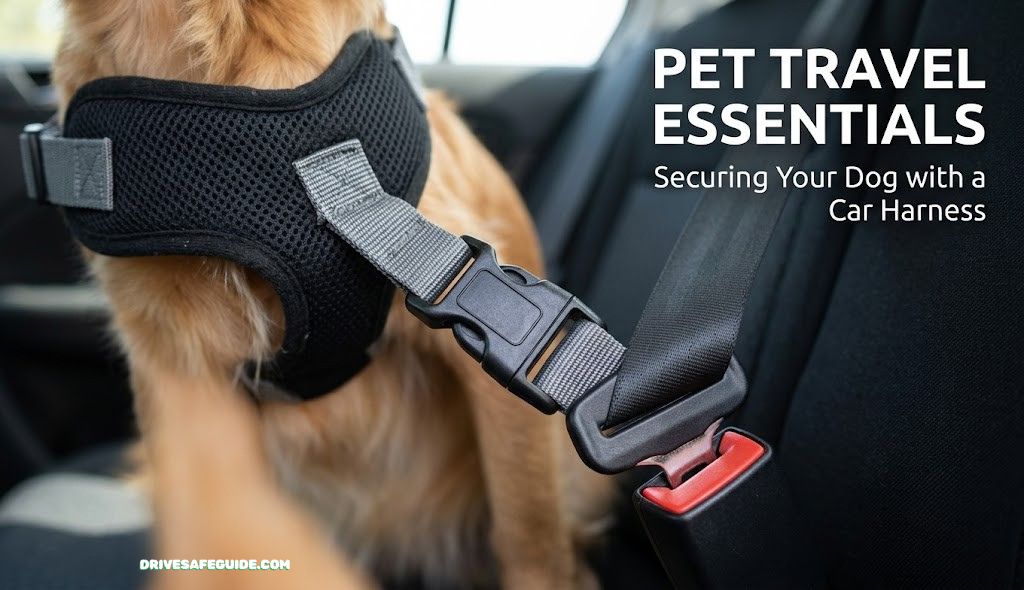
- Snug, not loose. You should be able to fit two fingers under the harness, not a full hand. A loose harness adds inches of excursion before the restraint even engages.
- Use the actual seatbelt, not a cargo hook. Certified testing is done using the vehicle’s seatbelt system for a reason — it’s rated for occupant restraint loads in a way most cargo tie-down points aren’t.
- Re-check fit as your dog’s weight changes. Harnesses are tested at specific weight ranges; a dog that’s grown or lost weight since fitting may no longer match the tested configuration.
These fit fundamentals matter just as much as the certification itself, and they’re worth revisiting any time you’re doing a broader safety pass on the vehicle — the same way you’d check tire pressure or wiper condition before a trip, as covered in our pre-departure risk checklist.
It also helps to do a quick “sudden stop” test in a safe, empty parking lot before a real trip: with the harness fitted and the dog secured, brake firmly at low speed and watch how much the dog shifts. A properly fitted, certified harness should keep movement minimal and controlled. If the dog slides noticeably or the harness rides up toward the neck, that’s a sign the fit needs adjustment before you rely on it at highway speed.

Shop Crash-Tested Travel Crates for Larger Dogs
See current options and pricing on Amazon.
Check Price on AmazonCommon Mistakes Pet Owners Make
| Mistake | Why It Matters |
|---|---|
| Using a walking harness for car restraint | Not designed or reinforced to absorb crash-level forces |
| Clipping into a cargo hook instead of the seatbelt | Cargo anchors aren’t load-rated for restraining a moving body in a collision |
| Letting the dog ride in the front seat | Airbag deployment forces can seriously injure a restrained pet |
| Buying based on “crash tested” label language alone | No independent verification behind the claim in most cases |
| Leaving too much slack in the tether | Directly increases excursion distance and injury risk |
| Assuming a carrier on the seat is enough without a belt | An unsecured carrier becomes a projectile itself in a crash |
Most of these mistakes come from reasonable assumptions — most people simply don’t know that pet restraint testing is largely unregulated. Once you know what to look for, avoiding them is straightforward. It’s the same logic behind building good defensive driving habits generally: small, informed adjustments compound into meaningfully lower risk.
The Legal Landscape for Pet Restraints
Pet restraint laws vary significantly by state, and most U.S. states don’t have a specific law mandating restrained pets in passenger vehicles the way they do for child car seats. A smaller number of states have passed laws addressing unrestrained pets, usually framed around distracted driving or animal cruelty rather than a dedicated “pet seatbelt law.” Even where no law exists, a loose pet in the car can factor into a distracted driving citation if it’s judged to have contributed to unsafe driving.
Because the legal requirements are inconsistent and don’t necessarily reflect actual crash safety, the smarter approach is to treat CPS certification — not local law — as your baseline standard. A state having no pet restraint law doesn’t mean restraint is optional from a safety standpoint; it just means the legal system hasn’t caught up to the crash test data yet.
If you’re planning a trip that crosses state lines, it’s worth pairing your restraint setup with a broader look at trip readiness, including our cross-country driving checklist for longer multi-day routes.
| Legal Pattern | Typical Requirement | How Common |
|---|---|---|
| No specific pet restraint law | No direct requirement, though distracted driving statutes may still apply | Most common pattern nationally |
| Distraction-focused restriction | Prohibits driving with a pet on the driver’s lap or otherwise obstructing control of the vehicle | Present in a growing number of states |
| Dedicated restraint requirement | Specifically requires pets to be secured while the vehicle is in motion | Least common, found in a small number of jurisdictions |
Because these patterns shift as legislatures revisit distracted driving rules, it’s worth checking your specific state’s current statute before assuming either extreme — that restraint is mandatory everywhere, or that it isn’t required anywhere. Either way, the safety case for a tested restraint stands on its own, independent of what your state currently requires.
What Veterinary and Behavior Professionals Generally Recommend
Beyond the crash test data itself, veterinary and animal behavior professionals tend to converge on a few consistent recommendations for car travel. Dogs generally travel calmer when they’re restrained in a way that limits excessive movement, since unrestricted freedom in a moving vehicle can actually increase anxiety for some dogs rather than reduce it. A properly fitted harness or crate gives the dog a defined, stable space, which many dogs settle into more easily than an open back seat.
Motion sickness is another factor worth considering alongside restraint choice. Dogs prone to car sickness sometimes do better in a forward-facing harness position with a clear view out the window versus an enclosed crate, while others are calmer in the enclosed, den-like environment of a crate. There’s no universal answer here — it often takes a short trial period to see which setup your individual dog tolerates best, ideally on short local drives before a longer trip.
For dogs that are new to car restraint entirely, a gradual introduction — short trips first, treats and calm praise associated with the harness or crate, and avoiding the first experience being a long highway drive — tends to produce a dog that accepts restraint far more readily than forcing it into a full-length trip on day one.
Buying Guide: What to Check Before You Buy
- Is it CPS Certified, or at minimum, independently dynamically tested (not just internally tested by the brand)?
- What star rating did it earn, and at what weight range?
- Does the published excursion data fall within the accepted threshold for your dog’s size class?
- Is the connection hardware metal and load-rated, not just plastic clips?
- Does it attach to the vehicle seatbelt system, not a cargo anchor?
- Is the tether length short enough to limit forward excursion?
- Does the sizing chart match your dog’s actual chest girth and weight, not just breed averages?
| Restraint Type | Best Dog Size | Independent Testing Available? | Relative Cost |
|---|---|---|---|
| Certified 5-star harness | Medium–Large | Yes | $$ |
| Certified crash-tested crate | Any, especially XL and narrow-chested | Yes (limited models) | $$$ |
| Secured hard-sided carrier | Small | Sometimes | $$ |
| Uncertified harness | N/A | Rarely | $ |
Restraint gear is just one piece of a broader safe-travel setup. Many owners pair it with the rest of a road trip essentials checklist and a properly stocked car safety kit, so the vehicle itself is ready for the unexpected in addition to the dog being properly secured.

Shop Secure, Belt-Compatible Pet Carriers
Browse current options for small dogs and cats.
Check Price on AmazonFrequently Asked Questions
Does “crash tested” on a harness label mean it’s actually safe?
Not necessarily. There’s no legal requirement behind the phrase, and it can describe anything from a rigorous independent test to a single informal in-house trial. Look for a named testing organization and a published rating instead of relying on the label alone.
What organization does the most credible pet restraint crash testing?
The Center for Pet Safety (CPS) is the most established independent nonprofit conducting and publishing dynamic crash test results on dog harnesses, carriers, and crates, including products that failed.
How fast are pet restraints actually crash tested?
Dynamic testing is generally conducted at speeds around 30 mph, using a protocol adapted from the federal child restraint testing standard, FMVSS 213.
Are any dog harnesses actually CPS certified?
Yes, but the list is short. As of the most recent published results, the Sleepypod Clickit Sport and Clickit Terrain are among the only harnesses to hold a 5-star CPS certification across a range of dog sizes.
Is a crate safer than a harness?
It depends on the dog and the crate. A properly secured, independently crash-tested crate can be very safe, especially for anxious dogs or narrow-chested breeds that don’t fit harnesses well. An unsecured crate simply placed in the trunk offers little protection.
What does “excursion distance” mean in a crash test?
It’s how far the test dog’s body and head travel forward from its starting position during a simulated collision. Lower excursion generally means lower risk of striking part of the vehicle interior.
Can my dog ride in the front seat if it’s restrained?
It’s not recommended. Even a well-restrained dog in the front seat is exposed to airbag deployment forces that the restraint wasn’t designed around. The back seat is the safer position.
My dog is a greyhound — what’s the safest option?
Narrow-chested breeds like greyhounds don’t fit most harnesses well, and there currently isn’t a widely available harness with strong independent testing sized specifically for that body type. A secured, crash-tested crate is generally the more defensible choice.
Is it legal to drive with an unrestrained pet?
It varies by state. Most states don’t have a dedicated pet restraint law, though an unrestrained pet can sometimes factor into distracted driving enforcement. Legal requirements don’t necessarily reflect actual crash safety, so it’s worth using CPS certification as your standard regardless of local law.
How tight should a dog car harness fit?
Snug enough that you can fit two fingers under the straps, not a full hand. Excess slack increases the distance your dog travels forward before the restraint engages during a sudden stop.
Should I clip the harness to a cargo hook or the seatbelt?
Use the vehicle’s seatbelt system. Cargo anchor points generally aren’t rated for the dynamic loads involved in restraining a moving body during a collision.
Do soft-sided carriers perform as well as hard-sided ones in testing?
Generally no. Hard-sided, certified carriers have tended to outperform soft-sided ones in independent crash testing, since rigid structure helps maintain shape and containment during impact.
How often should I replace a dog car harness?
Inspect webbing, stitching, and hardware regularly, and replace the harness if you see fraying, stretched webbing, or hardware that no longer locks securely. Even a certified harness only performs as tested if it’s still in the same structural condition it was in when it passed testing.
Is it worth crash-testing gear for a dog that only rides occasionally?
Yes. Crash risk isn’t tied to how often you drive with your dog — it’s tied to whatever trip you happen to be on when a collision occurs. An occasional rider benefits from tested restraint exactly as much as a dog that travels daily.
The Bottom Line
Most pet restraint products on the market have never been through genuine independent crash testing, and the marketing language on the packaging isn’t a reliable substitute for actual data. If protecting your dog — and everyone else in the vehicle — in a real collision matters to you, look specifically for CPS certification, check the published star rating and excursion data, and match the product to your dog’s actual size and body shape rather than general breed assumptions.
None of this needs to be complicated. Once you know to look past the phrase “crash tested” and check for an actual named testing organization, a published rating, and a weight range that matches your dog, the decision narrows itself down quickly. From there, correct installation — back seat, seatbelt connection, short tether, snug fit — does as much work as the product itself.
For the rest of your setup, pair a properly fitted, tested restraint with the fundamentals covered in our road trip safety guide and safe driving habits resources, so both your dog and everyone else on the road are better protected.
Shop CPS-Certified Restraint Gear on Amazon🌟 Recommended for Comfort
Drive More Comfortably Every Day
From lumbar supports to seat cushions, the right accessories can transform long drives from painful to comfortable. Browse our top picks on Amazon.
📯 Shop Comfort AccessoriesAffiliate link — we earn a small commission that keeps DriveSafeGuide running. Thank you!