The Hidden Danger of Sun Glare Behind the Wheel
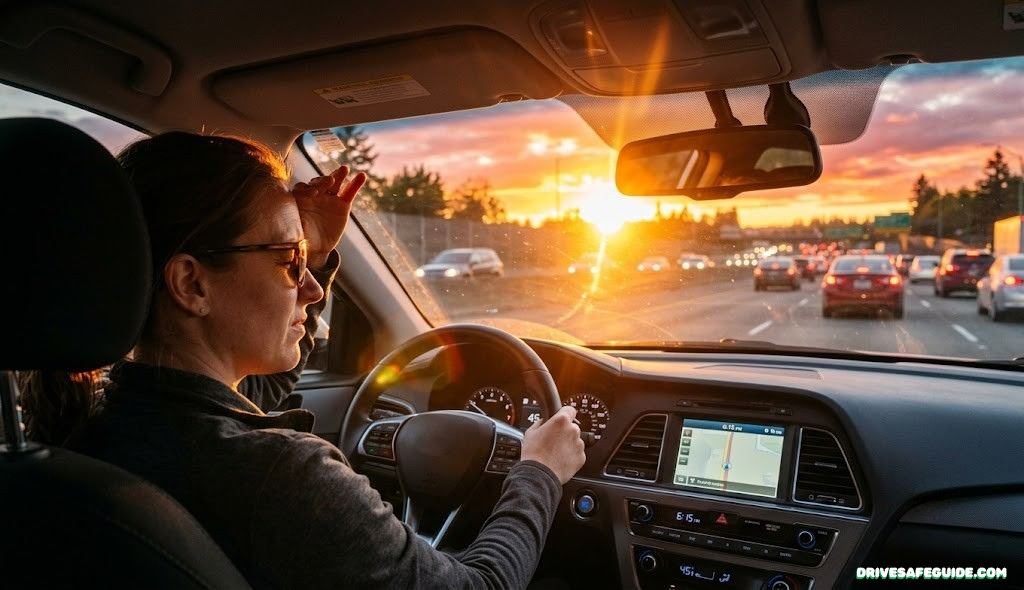
Every driver knows the stomach-tightening moment when the sun drops to exactly the wrong angle and the road ahead vanishes in a blinding wall of white light. It lasts only a few seconds. But at 65 mph, a few seconds covers nearly 200 feet — more than half the length of a football field driven completely blind.
Sun glare is not a minor inconvenience. It is a measurable, documented contributing factor in thousands of crashes annually. Research from the AAA Foundation for Traffic Safety consistently links low-sun conditions to elevated collision rates, particularly at sunrise and sunset windows. Unlike fog or rain, solar glare strikes suddenly and can overwhelm a driver’s eyes before they even register the light source has shifted.
The physics are straightforward. When direct sunlight enters the eye at an angle below the pupil’s ability to adjust its aperture, the retina becomes temporarily overwhelmed. Reaction time degrades, depth perception flattens, and peripheral awareness narrows. This is the same mechanism that makes staring at a flashlight in a dark room temporarily ruin your vision — except you’re traveling at highway speed with two tons of steel around you. Understanding this risk is the first step to protecting yourself. The second step is choosing the right tools from a wide and genuinely effective menu of solutions — and that’s exactly what this guide is designed to help you do.
Good visibility protection is also part of a broader set of defensive driving habits that reduce collision risk. Addressing glare proactively belongs in the same mindset as safe following distances and lane discipline.
Low-Angle Solar Glare
The most dangerous type — sun sits 10–20° above the horizon and enters directly through the windshield or driver’s side window.
Reflected Glare
Light bouncing off hoods, other vehicles, wet pavement, or guardrails that enters at unpredictable angles.
Haze-Scattered Glare
Thin cloud cover or smog diffuses sunlight into a broad wash, making it harder to identify and block a single source.
Altitude Glare
Driving at high elevation reduces atmospheric filtering, intensifying UV and visible light intensity significantly.

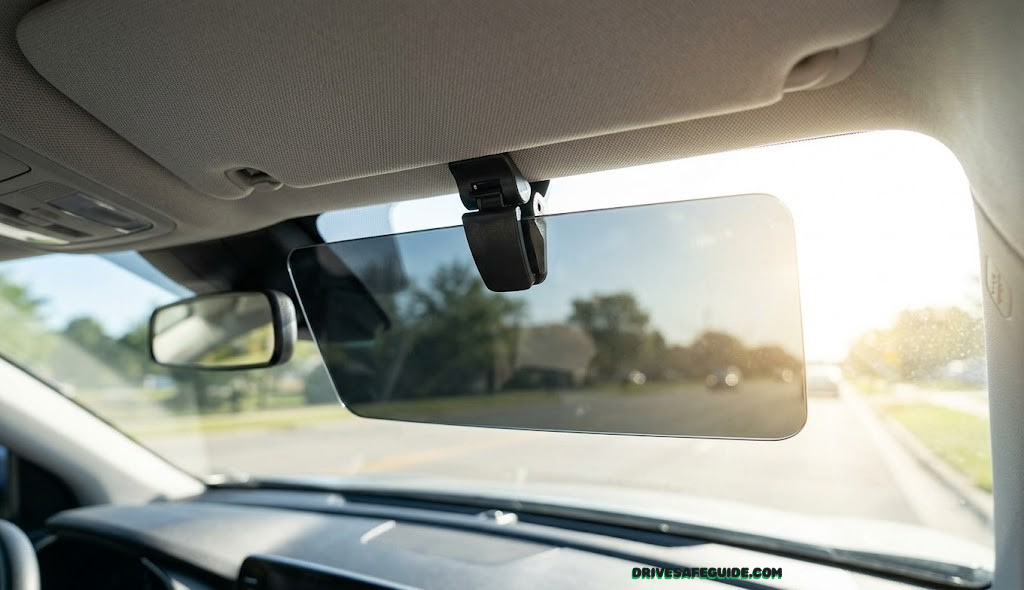
Polarized Car Sun Visor Extender — Blocks Low-Angle Glare
Large polarized panel with adjustable clip mechanism. Attaches to factory visor in seconds — no tools needed. Works for sunrise, sunset, and overhead sun.
Check Price on AmazonUnderstanding Your Factory Sun Visor: Strengths, Gaps, and Limits
Every vehicle sold in the United States comes equipped with at least one driver-side sun visor as standard equipment. Most include a passenger-side unit as well. These padded or rigid flip panels fold down from the headliner to block sunlight entering through the upper windshield — and within their design parameters, they do exactly what they were engineered to do.
The problem is that those design parameters are narrow. Standard OEM visors were sized and positioned to satisfy the broadest regulatory baseline across every vehicle class, body style, and driver height. They were not engineered to cover every dangerous solar angle a driver encounters in real-world conditions.
What a Factory Visor Does Well
- Overhead and high-angle sun: When the sun is directly in front and reasonably high, a factory visor positioned at the correct angle completely shades the windshield zone in front of the driver’s eyes.
- Blocking interior roof light: Visors prevent sunlight that penetrates the sunroof or moonroof from washing out the driver’s forward view.
- Side pivot function: Most factory visors can swing 90° to cover the side window, offering useful (if incomplete) side protection.
- Vanity integration: The built-in mirror, while not a safety feature, is a practical addition that doesn’t compromise the visor’s core function.
The Critical Coverage Gaps
Factory visors universally leave several dangerous exposure zones unaddressed:
- Immediate deployment — no installation
- Sturdy, factory-fitted friction mechanism
- Zero cost — included at purchase
- Adjustable angle on most vehicles
- Side-swing covers door glass zone
- Leaves A-pillar gap uncovered
- Too short for low-angle sunrise/sunset sun
- No polarization or glare filtration
- Standard size fits average driver, not all
- Cannot block simultaneous windshield + side glare
The gap between the deployed visor’s lower edge and the dashboard is where most glare enters during critical low-sun driving. This is precisely the zone where aftermarket extenders earn their keep — and where polarized glasses pick up the slack that no rigid panel can fully address.
Visor Extenders: How They Work and What to Look For
Aftermarket sun visor extenders are one of the most cost-effective and immediately impactful upgrades any driver can make. A good extender clips onto the factory visor and extends coverage downward, sideways, or both — filling the precise zones where factory panels fall short.
How Visor Extenders Are Constructed
Most quality extenders use one of three panel materials, each with distinct advantages:
| Panel Type | Glare Reduction | View Through Panel | Best For | Approx. Cost |
|---|---|---|---|---|
| Polarized Transparent Film | ★★★★★ | Yes — tinted view | Low-angle, reflective road glare | $15–$40 |
| Opaque Padded Fabric | ★★★☆☆ | No — full block | Overhead sun, privacy | $10–$25 |
| Mesh / Perforated Film | ★★★★☆ | Partial — darkened | General glare, side windows | $12–$30 |
| Rigid Tinted Polycarbonate | ★★★★☆ | Yes — strong tint | Durability, truck/SUV use | $25–$65 |
Key Features to Evaluate Before Buying
Panel Coverage Area
Larger is better up to a point. Look for at least 200 sq cm of coverage. Too large and the extender may intrude on your driving line of sight.
Attachment Mechanism
Sliding clip rails outperform simple hook clips in stability. The connection must survive highway vibration and daily temperature swings without loosening.
Adjustable Tilt
A tiltable panel lets you angle coverage independently from the factory visor — critical for addressing low-angle sun that’s below the visor’s lower edge.
Polarization Quality
Not all “polarized” labels indicate high-quality filtering. Look for products that specify their polarization efficiency percentage (ideally 95%+).
Installation and Correct Positioning
Most clip-style visor extenders install in under 60 seconds. Slide the rail clip over the factory visor’s lower edge until it seats firmly. Then adjust the panel angle so it covers the gap between the factory visor and the dashboard — typically an angle 10–15° steeper than the factory panel. Always check that the extender does not restrict your forward view below your natural driving sight line before pulling out of the driveway.
Adjustable Polarized Visor Extender — Clip-On, No Tools
Fits all standard visors. Tilts independently for low-sun angle coverage. Polarized panel reduces reflected road glare. Folds flat when not needed.
View on AmazonPolarized Sunglasses: The Most Versatile Anti-Glare Tool
No visor-based solution — factory or aftermarket — can protect your eyes from light that enters from the sides, below, or at unexpected angles from reflective surfaces. That’s where polarized sunglasses become an irreplaceable part of any serious driver’s glare defense. They move with your eyes regardless of where you look, blocking polarized light waves that cause the specific kind of blinding scatter responsible for road glare.
A pair of quality polarized driving sunglasses is arguably the single most impactful investment any driver can make for sun glare safety. Here’s why.
How Polarization Works
Glare from flat surfaces — road surfaces, hoods, water, other vehicle panels — is almost entirely horizontally polarized light. A polarized lens is manufactured with a vertical filter layer that physically blocks horizontal light waves while allowing all other wavelengths through. The result is dramatically reduced reflected glare with minimal reduction in overall visibility.
Lens Color Guide for Drivers
| Lens Color | Best Condition | Color Accuracy | Glare Reduction | Signal Visibility |
|---|---|---|---|---|
| Gray | Bright direct sun | ✔ True | ★★★★★ | ✔ Excellent |
| Amber / Yellow | Low light, overcast, haze | Warm shift | ★★★★☆ | ✔ Enhanced |
| Copper / Brown | Varied conditions | Slight warm shift | ★★★★☆ | ✔ Good |
| Green | General daytime use | Near true | ★★★☆☆ | ✔ Good |
| Blue / Mirrored | Style — not recommended for driving | ✘ Distorts | ★★☆☆☆ | ✘ Poor |
What “Category” Rating Means
European CE-marked driving sunglasses carry a lens category rating from 0 to 4. For driving, Category 2 (18–43% light transmission) and Category 3 (8–18% light transmission) are appropriate for most conditions. Category 4 lenses are too dark for safe driving and are prohibited for use behind the wheel in most jurisdictions.

Wraparound Polarized Driving Sunglasses — UV400 + Anti-Glare
Wraparound frame eliminates peripheral glare. Polarized gray lens maintains true color and traffic signal accuracy. Lightweight for all-day comfort.
Shop on AmazonAnti-Glare Windshield Film: A Permanent, Elegant Solution
For drivers who want a hands-free, always-present layer of glare protection without managing physical visors or remembering to put on sunglasses, anti-glare windshield film offers a compelling option. These thin, optically engineered films are applied to the glass and work continuously without any driver action.
The most common application zone is the windshield’s upper band — the area above the AS-1 line (also called the “visor strip”), typically the top 4–6 inches of glass. This is the region where most regulations permit window tinting even in states with strict overall tint laws, and it corresponds directly to the zone where low-angle solar glare enters most aggressively.
Types of Anti-Glare Films for Windshields
Ceramic Tint Film
Blocks up to 50% of total solar energy and 99% of UV rays without metallic content. Does not interfere with GPS, satellite radio, or cell signals. Premium cost, premium performance.
Carbon Film
Provides strong infrared and UV rejection. Matte finish reduces interior reflections. Does not interfere with electronics. Mid-range cost with excellent longevity.
Reflective / Metallic Film
Highly effective at blocking heat and direct sunlight. Can interfere with some in-vehicle electronics. Most cost-effective option but check signal impact before installing.
Anti-Reflective (AR) Coating
Applied to the interior surface. Reduces haze from instrument reflections and dashboard scatter. Often combined with another film type for dual-layer protection.
Legal Considerations by Location
Window tint laws vary significantly by state. While the upper AS-1 visor strip is almost universally permitted in the U.S., regulations on the front windshield’s total visible light transmission (VLT%) differ. As a general rule, always choose a film rated at 70% VLT or higher for the main windshield and verify your state’s current regulations before installation.
For a broader look at how window regulations affect driving, it’s worth reviewing the rules around window tint darkness limits in your state before committing to any film application.

Ceramic Window Tint Film — 99% UV Block, No Signal Interference
Professional-grade ceramic tint. Cuts solar heat, eliminates UV, reduces glare in the visor strip zone. Self-adhesive installation with squeegee tool included.
Find It on AmazonDashboard Reflection Control: The Overlooked Glare Source
Ask most drivers about sun glare and they’ll point to the windshield or sun visor. Few consider the dashboard directly beneath the windshield — yet a high-gloss or light-colored dash can act as a secondary reflector, bouncing light from the windshield’s interior surface directly into the driver’s eyes. In some vehicles, particularly those with light-colored or shiny dashboard trims, this reflected glare is nearly as severe as direct solar glare.
Identifying Dashboard Glare
You likely have a dashboard glare problem if you notice a bright wash of light across the lower portion of your windshield — not from outside, but appearing to originate from the dash itself. This is the result of sunlight entering the cabin, striking the dashboard surface, and reflecting off the inner windshield glass back into your eyes. It creates a haze rather than a sharp bright spot, making it easy to mistake for dirty glass.
Dashboard Glare Solutions
Dark Matte Dashboard Cover
A fitted dashboard mat in dark, non-reflective material eliminates surface reflection entirely. Custom-fit covers are available for virtually every vehicle make and model. This is the most effective permanent solution.
Anti-Glare Dashboard Spray/Conditioner
Matte-finish interior detailer sprays reduce the sheen on plastic dashboard surfaces, lowering their reflectivity without altering color or appearance significantly. A simple, inexpensive interim fix.
Clean the Interior Windshield Glass
A hazy windshield dramatically amplifies dashboard reflection. Cleaning the interior glass surface removes the residue film that scatters light, cutting both reflected glare and haze simultaneously.
Anti-Reflective Interior Window Film
Applied to the inside of the windshield, AR film reduces interior reflections from the dash and instrument panel without affecting outward visibility or VLT compliance.
Mastering Low-Angle Sun Glare: The Hardest Problem to Solve
Overhead sun is manageable. Side sun is controllable. But low-angle sun — the kind that sits 5–15° above the horizon and shoots directly through the windshield at driver’s eye level — is the scenario that kills. It’s the condition responsible for the worst outcomes because it combines maximum glare intensity with no easy mechanical solution. No factory visor reaches low enough. No simple film blocks sun that comes in nearly horizontally.
Solving low-angle glare requires a combination of tools, positioned deliberately, and a set of behavioral adjustments that every commuter and road tripper should have in their toolkit. This situation also connects to broader conditions like fog driving visibility challenges, where the solution similarly involves layered approaches rather than a single fix.
The Physics of Low-Angle Glare
When the sun is at or near the horizon, its light travels through the maximum amount of atmospheric distance — which should theoretically scatter and reduce its intensity. But that scattering is uneven. The direct beam remains remarkably intense, and the haze it creates around the solar disk actually widens the zone of damaging light rather than containing it. Polarized light from road surfaces also peaks during low-sun conditions because the reflection angle aligns optimally with the horizontal polarization plane.
Best Defense Strategy for Low-Angle Glare
| Strategy | Effectiveness | Cost | Works Alone? |
|---|---|---|---|
| Polarized extender (steeply angled) | ★★★★☆ | $15–$50 | Partially |
| Polarized sunglasses (gray or amber) | ★★★★★ | $20–$150 | Yes for most angles |
| Windshield visor strip film | ★★★☆☆ | $30–$120 | Partially — only top zone |
| Visor extender + polarized glasses (combined) | ★★★★★ | $35–$190 | Yes — most complete |
| Adjusting departure time (avoid peak glare windows) | ★★★★★ | Free | Yes — most effective of all |
Behavioral solutions — shifting departure times by even 15–20 minutes — can eliminate the worst glare windows entirely. For longer commutes where timing is flexible, this strategy costs nothing and works better than any hardware solution. When combined with good equipment, it forms the most complete low-angle glare defense possible.
For night driving glare from oncoming headlights, which presents a related but distinct challenge, the night driving safety checklist offers complementary strategies worth reading.
Full Solution Comparison: Every Glare Defense Tool Evaluated
The market for sun glare solutions spans a wide range of price points, installation complexity levels, and effectiveness profiles. This comparison table brings every major category together so you can make informed choices based on your specific needs.
| Solution | Overhead Glare | Low-Angle Glare | Side Glare | Reflective Road Glare | Installation | Legal Notes |
|---|---|---|---|---|---|---|
| Factory OEM Visor | ✔ Good | ✘ Limited | Partial (swings) | ✘ None | Already fitted | No issues |
| Clip-On Visor Extender | ✔ Excellent | ✔ Good | Partial | Partial (if polarized) | Seconds, no tools | No issues |
| Polarized Driving Glasses | ✔ Excellent | ✔ Excellent | ✔ Excellent | ✔ Excellent | Wear — none | No issues (Cat 2–3) |
| Visor Strip Tint Film | ✔ Good | ✔ Good | ✘ None | ✘ None | DIY or professional | Verify state tint law |
| Ceramic Window Film | ✔ Excellent | ✔ Good | ✔ Excellent (side windows) | Partial | Professional best | Verify VLT by state |
| Dashboard Cover (matte) | ✘ None — indirect | ✘ None — indirect | ✘ None | ✘ None direct | Clip-in, 5 minutes | No issues |
| Anti-Reflective Windshield Coating | Partial | Partial | ✘ None | Partial | Professional | Generally permitted |
The Layered Glare Defense System: Building Your Complete Setup
Experienced drivers rarely rely on a single glare solution. Like any safety system — seatbelts, airbags, antilock brakes — the best approach involves multiple layers that catch what each other misses. Here’s how to build a layered glare defense system that addresses every exposure scenario.
Layer 1: Passive — Clean Glass and Quality Tint
Start with your vehicle’s glass surfaces. A clean windshield (inside and out) eliminates the haze layer that multiplies glare from any source. Add a quality visor strip film to the upper windshield zone and, where legal, a ceramic tint to front door windows. This layer works 24/7 with zero driver action required.
Layer 2: Active — On-Demand Gear
When glare conditions appear, engage your active layer. Deploy the visor extender (already clipped to the factory visor, ready to swing down). Put on your polarized sunglasses. Adjust the factory visor angle. This layer takes seconds to activate and dramatically expands coverage beyond what the passive layer provides.
Layer 3: Behavioral — The Zero-Cost Solution
Behavioral adjustments are the most underrated glare defense. Leave 10 minutes earlier so you’re on the road before the sunrise glare window opens. Choose alternate routes that travel north-south rather than east-west during peak glare windows. Reduce speed when glare is severe — you can’t react to what you can’t see, and the stopping distance calculation only works if you can perceive the hazard in time. This principle connects directly to maintaining a safe following distance, which becomes even more critical when visibility is compromised.

Custom-Fit Non-Slip Matte Dashboard Cover — Eliminates Reflection
Precision-cut for your vehicle’s dash profile. Non-reflective suede-like surface. Protects your dash from UV fade while eliminating interior windshield reflection.
Browse on AmazonGlare in Special Driving Conditions: Rain, Snow, Fog, and More
Sun glare doesn’t only occur under clear skies. Some of the most dangerous glare scenarios happen when sunlight interacts with precipitation, wet pavement, or atmospheric haze — conditions that also compromise road visibility in other ways simultaneously. Being prepared for these compounded scenarios is essential for any driver who spends significant time on the road.
Post-Rain Glare
Wet pavement is one of the most effective natural mirrors for horizontal polarized light. After rain, even a relatively low sun angle can create blinding reflections from road surfaces extending hundreds of feet ahead. Polarized sunglasses are particularly effective here — the horizontal polarization filter cuts virtually all road surface glare, dramatically improving road definition and lane marking visibility in wet conditions. For more strategies on wet-road driving, review the guide on driving safely in rain.
Snow and Winter Glare
Fresh snow reflects up to 90% of incoming sunlight, creating full-sky glare rather than a single directional source. In snowy conditions, standard polarized glasses may need to be supplemented by a visor that blocks overhead bright zones as well as forward glare. The combination of polarized lenses and a physical visor becomes particularly important here, as does reducing driving speed to compensate for reduced contrast between snow-covered road and road markings.
Winter driving glare is particularly severe in the hours around noon when the sun is at its highest reflection angle off horizontal snow surfaces. The full range of winter driving safety strategies should be reviewed for anyone in snow country.
Fog and Haze Glare
Thin fog or atmospheric haze diffuses sunlight into a broad, directionless glow that can’t be blocked by a directional visor or even polarized lenses. In foggy glare conditions, reducing speed, using low beams rather than high beams, and keeping a large following distance are the primary defenses. For foggy conditions more broadly, the fog driving visibility strategies guide provides a comprehensive approach.
Wildfire Smoke Glare
Wildfire smoke creates atmospheric scattering that can intensify the apparent brightness of the sun while reducing visibility simultaneously. Smoke particles in the air scatter shorter wavelengths, creating an orange-amber hue that can distort the apparent brightness of traffic signals. Amber-tinted polarized glasses are particularly effective in smoke conditions as they enhance contrast while cutting scattered glare. For a full protocol, see the guide on driving through wildfire smoke.
After Rain
Polarized glasses are the single best tool. They cut horizontal road surface reflections almost entirely.
Snow / Ice
Combine polarized glasses with visor. Full-sky reflection requires blocking overhead glare as well as forward glare.
Fog / Haze
Speed reduction and increased following distance are the primary tools. Visors and glasses provide limited help in directionless haze.
Wildfire Smoke
Amber polarized lenses enhance contrast in smoke-orange light. Reduce speed and increase following distance significantly.

Amber Polarized Driving Glasses — Low Light, Rain & Smoke Optimized
Contrast-enhancing amber lens with full polarization. UV400 protection. Designed specifically for low-light driving, wet roads, and smoky conditions.
Check on AmazonTop Product Picks by Category: What to Buy for Your Situation
With the full landscape of solutions mapped out, here’s a practical buying guide organized by driver need. Every recommendation below is selected for the best combination of effectiveness, value, and user experience in its category.
For the Daily Commuter (Budget Under $50)
The commuter’s kit is simple and highly effective: a polarized visor extender ($15–$30) plus a pair of quality polarized driving sunglasses ($20–$40). These two tools address 90% of daily commute glare scenarios. The extender clips on before you pull out of the driveway; the glasses go on as you enter sunlit road. Combined cost under $70, combined effectiveness is excellent for standard conditions.
For the Road Tripper and Long-Haul Driver
Road trips and long-haul driving introduce more varied terrain, sun angles, and weather conditions. The road tripper needs: polarized driving glasses (premium, with wraparound frame), a wide-coverage visor extender, and a fitted matte dashboard cover. For truly comprehensive road trip preparation, see the road trip essentials checklist for the full picture of what to bring.
For the Truck and SUV Driver
Higher seating positions in trucks and SUVs change the glare geometry significantly. The driver sits taller relative to surrounding vehicle hoods, which reduces reflective glare from other vehicles but increases exposure to direct sun from side windows at high angles. Side window ceramic tinting (where legal) combined with extra-wide polarized sunglasses addresses this profile effectively.
For Drivers Who Wear Prescription Glasses
Options include prescription polarized sunglasses (custom-made by an optician), clip-on polarized adapters for existing frames, or fit-over polarized sunglasses that sit over prescription frames. The fit-over option is the most immediately available and typically the most affordable. Quality varies significantly — look for brands that specify optical-grade polarization rather than just tinted film.
For Seniors and Drivers with Light Sensitivity
Aging eyes often lose the ability to constrict the pupil quickly in response to glare, making every glare scenario more dangerous for older drivers. Higher-transmission polarized lenses (Category 2, 18–43% light transmission) perform better than very dark lenses in this context, as they reduce glare without excessively darkening the field of view. Large-frame lenses that cover more of the visual field also offer more comprehensive protection. This consideration links to the broader topic of senior driver refresher courses that address the full range of age-related driving adaptations.
| Driver Type | Priority Solution | Secondary Solution | Budget Range |
|---|---|---|---|
| Daily commuter | Polarized sunglasses (gray) | Clip-on visor extender | $30–$80 |
| Road tripper / long-haul | Premium wraparound polarized glasses | Wide visor extender + dash cover | $60–$200 |
| Truck / SUV driver | Ceramic side window tint | Large-frame polarized glasses | $150–$500 |
| Prescription glass wearer | Rx polarized lenses or fit-over | Clip-on visor extender | $50–$350 |
| Senior / light-sensitive driver | Category 2 polarized (large frame) | Matte dash cover + clean windshield | $30–$100 |

Fit-Over Polarized Driving Sunglasses — Wear Over Your Rx Frames
Designed to fit over standard prescription glasses. Full polarization eliminates road glare. Side shield coverage. Lightweight with UV400 protection.
See Options on AmazonQuick Care Tip: Keeping Your Glare Solutions Working
Any glare protection is only as good as its maintenance. Clean polarized lenses with a microfiber cloth and lens-safe cleaner — never dry-wipe, which scratches the polarization film. Check visor extender clip tension monthly. Replace any film with delamination bubbles promptly, as bubbles scatter rather than filter light. And return to the most fundamental maintenance: clean the inside of your windshield every two weeks. A dirty windshield can negate the benefit of everything else on this list.
Frequently Asked Questions
Why is sun glare so dangerous while driving?
Sun glare causes temporary blindness by overwhelming the eye’s photoreceptors. Even a fraction of a second of vision loss at highway speed covers the length of a football field, making it one of the leading environmental causes of daytime crashes. Unlike bad weather, which builds gradually, solar glare can appear instantly as a driver rounds a curve or crests a hill — leaving no time to compensate.
Do factory sun visors actually block glare effectively?
Standard OEM visors block direct overhead sun adequately but leave significant coverage gaps on the sides, at low sun angles, and near the A-pillar. They are a starting point for glare management, not a complete solution — particularly for sunrise and sunset commuting when the sun is near the horizon.
What is the best sun visor extender for driving?
The best extenders combine a large polarized panel with a sliding or clip mechanism that attaches to your existing visor. Look for models with at least 200–250 sq cm of coverage and adjustable tilt so you can position them against low-angle sunrise or sunset glare. The tilt adjustment is often the most important feature — a fixed-angle panel can’t address the specific geometry of low-sun conditions.
Are polarized sunglasses better than a sun visor for driving?
Polarized sunglasses and a quality sun visor serve different functions. Glasses handle glare from all directions including reflective road surfaces, while visors handle direct overhead or windshield-angle solar light. Both tools cover each other’s blind spots — using both together provides the most complete protection and is the approach recommended by driving safety experts.
Can anti-glare windshield films reduce sun glare legally?
Yes — anti-glare films applied to the upper windshield band (typically the top 5–6 inches, sometimes called the AS-1 or visor strip) are legal in most U.S. states and reduce glare without obstructing the primary driving view. Always verify your state’s specific tint laws before applying. The window tint darkness limits guide is a good starting resource for understanding state-level regulations.
How do I stop glare from the driver’s side window?
Side-window sun glare is best addressed with a combination of polarized sunglasses, a visor extender that swings to cover the side window, and — if legal in your state — a light ceramic or carbon window tint film on the front door glass. Repositioning your seat or adjusting your driving schedule to avoid peak glare windows can also help significantly.
What sun visor solution works best for low-angle sunrise or sunset driving?
Low-angle solar glare is the hardest scenario to solve with a standard visor alone. A large polarized extender panel combined with high-quality polarized sunglasses rated for driving (Category 2–3) gives the best coverage. Anti-reflective coatings on glasses further reduce residual scatter. Behavioral adjustments — shifting departure times to avoid the worst windows — remain the most effective low-cost strategy.
Are clip-on sun visor extenders safe for driving?
Yes, provided the extender is properly secured and does not obstruct the windshield area below the visor strip. A loose or poorly mounted extender can become a projectile in a collision. Always follow the manufacturer’s installation instructions and check the clip tension before driving. If the extender slides or rotates during normal driving vibration, it needs to be replaced or re-secured.
Can I use a GPS or phone mount with a sun visor extender?
Most visor extenders are not designed to carry the weight of GPS or phone devices and should be used for glare coverage only. Adding device weight can cause extenders to slip or lose positioning mid-drive. Mount navigation devices independently to the dashboard or windshield using a purpose-built mount. For guidance on phone and GPS mounts, see the resources on safe driving car phone mounts.
What lens color is best for anti-glare driving sunglasses?
Amber/yellow lenses enhance contrast in low-light and overcast conditions. Gray lenses maintain true color perception and are ideal for bright, direct sun. Copper/brown lenses are a versatile middle ground suitable for most conditions. All three should be polarized for maximum glare reduction while driving. Avoid blue or mirrored lenses, which can distort traffic signal colors and reduce overall road visibility.
Does dashboard sun glare affect driving safety?
Yes — light-colored or shiny dashboards reflect sunlight directly into a driver’s eyes through the windshield, reducing visibility of the road ahead. Dark, matte dashboard covers or fitted dash mats are a simple and inexpensive way to eliminate this reflected glare source. Cleaning the inside of the windshield also significantly reduces this effect.
How often should I clean my windshield to reduce glare?
A dirty windshield can multiply glare severity dramatically by scattering light across its hazy surface film. Clean the inside of your windshield at least every two weeks, and always before a long sunrise or sunset drive. Use a streak-free glass cleaner and a microfiber cloth — paper towels leave residue that worsens glare. The outside of the windshield should be cleaned whenever you fill up with fuel.
Related Safety Guides
Night Driving Safety Checklist
Headlights, glare, and fatigue management for after-dark driving.
Rain Driving Safety
Why cruise control is dangerous in rain and how to handle wet-road glare.
Black Ice Survival Guide
What to do when traction disappears and visibility is compromised.
Deer Collision Safety
Why swerving is the wrong instinct and what to do instead.