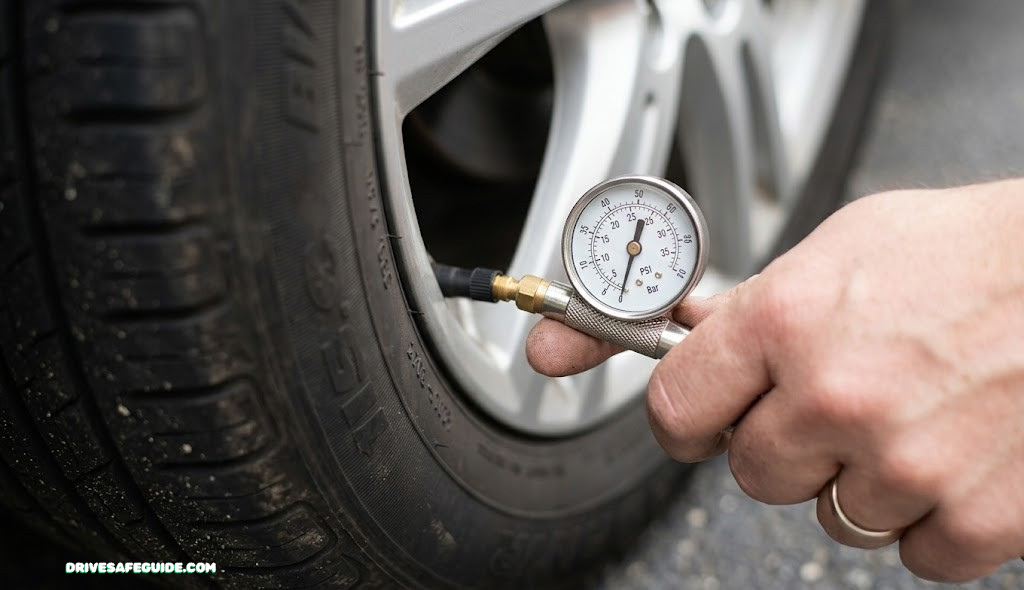
Digital vs Analog Tire Gauge: Which One Actually Keeps You Safer?
Two readings, two philosophies, one valve stem. Here’s how to pick the gauge that won’t lie to you when it matters.
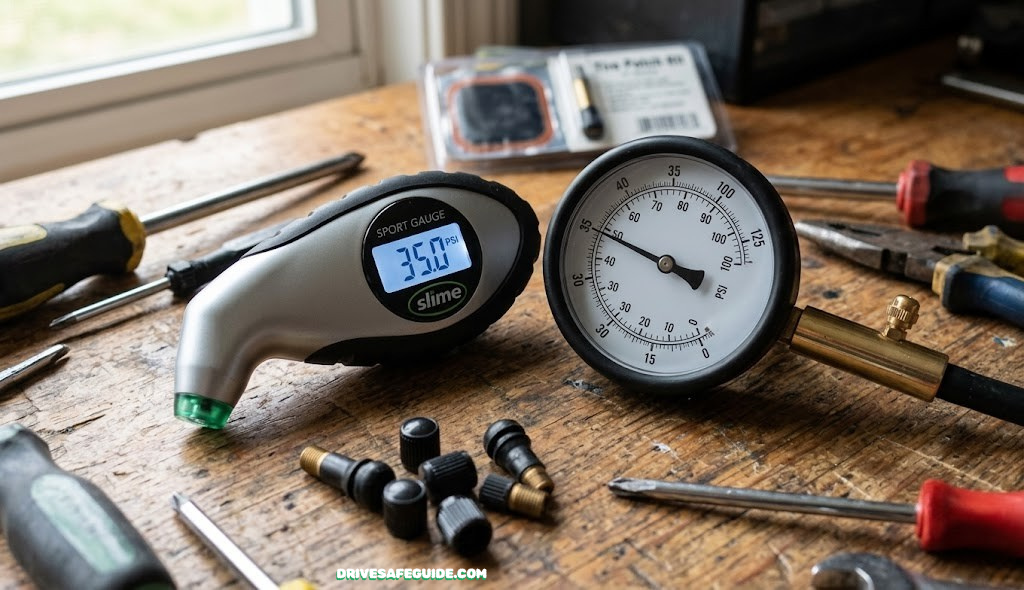
Why Tire Pressure Accuracy Matters More Than You Think
A tire that looks fine can still be dangerously underinflated. That gap between “looks okay” and “is okay” is exactly why the tool you use to check pressure matters as much as the habit of checking it at all.
Most drivers treat tire pressure as a once-in-a-while chore, something to glance at when a warning light flickers on the dash. But pressure affects nearly everything about how a car behaves: how it grips in a panic stop, how evenly the tread wears, how much fuel it burns, and how it responds when you have to swerve around something in the road. A tire running even 15% below its recommended pressure can lose a meaningful chunk of its braking performance and generate far more heat on the highway, which is one of the leading contributors to blowouts on long trips.
That’s the backdrop for the digital vs analog tire gauge debate. It’s not really about which gadget looks more modern sitting in your glovebox. It’s about which one gives you a number you can trust, every single time, in the driveway, at a gas station, or kneeling on gravel on the shoulder of a highway. If you’ve ever felt your car shaking at highway speeds and wondered whether it was a balance issue or something pressure-related, you already know how much tires influence the way a car feels underneath you.
Before we get into the mechanics of each gauge type, it’s worth being clear about what “accuracy” really means here, because both analog and digital gauges can be accurate, and both can be wrong, depending on build quality, calibration, and how they’re used. The type of gauge is only half the story; the other half is the specific unit you buy and how well you maintain it.
There’s also a psychological factor that rarely gets discussed: the easier a gauge is to use correctly, the more likely you are to actually use it regularly. A gauge that’s awkward to read in the driveway, or that requires squinting at a tiny scale, quietly discourages the habit of checking pressure at all. Over months and years, that small friction adds up to a lot of skipped checks, which is often how minor underinflation turns into a slow-motion tire failure nobody saw coming.
It’s also worth separating two related but distinct ideas: precision and accuracy. Precision is how finely a gauge can distinguish between two close values, like the difference between 31.8 and 32.1 PSI. Accuracy is whether the number it shows actually reflects the true pressure inside the tire. A gauge can be extremely precise and still be inaccurate if it’s poorly calibrated, and a gauge with coarser increments can still be accurate within its resolution. Keeping this distinction in mind makes the rest of this comparison much easier to follow, because digital and analog gauges tend to trade off differently on these two qualities.
A Quick History: How Tire Gauges Evolved
Tire gauges have been around for roughly as long as pneumatic tires have needed inflation, and the earliest versions were simple mechanical stick gauges: a spring-loaded rod inside a barrel that pushed a marked slide out when pressed against a valve stem. That basic pencil-style design is still sold today, largely unchanged, because it’s cheap, simple, and works.
Dial-face analog gauges came later, borrowing the same Bourdon-tube technology used in shop air compressors and industrial pressure gauges. The larger, easier-to-read face made them popular with mechanics and eventually with everyday drivers who wanted something more legible than a pencil gauge.
Digital gauges are the newest arrival, riding on the same wave of miniaturized pressure sensors that made things like digital kitchen scales and blood pressure monitors affordable for home use. As sensor costs dropped, digital tire gauges went from a niche professional tool to a common item on hardware store shelves, often at prices close to mid-range analog models.
Understanding this lineage helps explain why analog gauges still dominate professional shop environments, mechanics have trusted mechanical gauges for decades, and a tool that doesn’t need charging or new batteries fits naturally into a workflow built around hundreds of quick checks a day. Digital gauges, meanwhile, have found their niche with everyday drivers who value speed and clarity over that long-standing shop tradition.

Want a gauge that takes the guesswork out of every reading? A quality digital tire gauge gives you a clean, backlit number in under two seconds.
Check Digital Gauge Prices →How Analog (Dial) Tire Gauges Work
An analog tire gauge is a purely mechanical device, and that’s both its charm and its limitation. Press the gauge onto the valve stem, and air pressure pushes against an internal piston or a coiled Bourdon tube, which physically rotates a needle across a printed dial. There are no batteries, no chips, and nothing to charge. What you see is a direct mechanical translation of pressure into needle position.
Because there’s no electronics involved, analog gauges are remarkably durable. Drop one on a garage floor, leave it in a hot glovebox all summer, and it will typically still work. Many quality dial gauges also come with a protective rubber boot around the housing, which absorbs shocks that would rattle a more delicate instrument out of calibration.
The trade-off is precision and readability. Most dial gauges are marked in 2 PSI increments, which means reading the exact pressure requires interpreting where the needle sits between two lines. In low light, or if the dial face is scratched or fogged from age, that interpretation gets harder. It’s a tool built for durability first and fine-grained precision second.
How Digital Tire Gauges Work
Digital tire gauges use a small pressure sensor, usually a piezoresistive or capacitive sensor, that converts air pressure into an electrical signal. A microchip inside the gauge processes that signal and displays the reading as a number on an LCD screen, often to a tenth of a PSI.
The obvious advantage is precision and clarity: there’s no needle to squint at and no line to estimate between. Many digital gauges also add convenience features like backlit screens for reading in the dark, auto shut-off to preserve battery life, and memory functions that hold the last reading on screen even after you’ve pulled the gauge off the valve stem.
The trade-off is dependency on a battery and electronics. A digital gauge with a dead battery is just dead weight in your glovebox, and extreme cold has been known to cause temporary lag or dimming on cheaper LCD screens. If you’ve ever dealt with an OBD2 scan tool acting up in freezing weather, you already know how temperature can mess with small electronics.

Prefer something that never needs a battery? A rugged analog dial gauge is built to survive years of glovebox abuse.
Check Analog Gauge Prices →Accuracy Face-Off: Digital vs Analog
Independent lab testing on consumer tire gauges has generally shown that both types can land within a couple PSI of a lab-grade reference gauge, but digital models tend to have a slight edge in consistency between readings on the same tire. That consistency matters more than most people realize; if you check the same tire three times and get three slightly different numbers, you can’t fully trust any of them.
A well-made dial gauge, calibrated correctly, can be just as accurate as a mid-range digital one. Where digital pulls ahead is in resolution: reading to a tenth of a PSI instead of estimating between 2 PSI hash marks. For most passenger car tires, that extra resolution is a nice-to-have rather than a necessity. But for performance vehicles, track use, or anyone chasing very specific pressure targets for handling balance, that finer resolution becomes genuinely useful.
Where analog gauges tend to lose ground is age and abuse. A dial gauge that’s been dropped repeatedly or exposed to years of temperature swings can drift out of calibration without any obvious sign, since the needle still moves smoothly, it’s just moving to the wrong number. Digital gauges can drift too, but many mid-range and higher-end models include a self-check or calibration reset feature that makes this easier to catch and correct.
It’s also worth noting that the seal at the nozzle matters just as much as the internal mechanism, for both gauge types. A worn or dirty rubber gasket at the tip of either a digital or analog gauge will let a small amount of air escape during the reading, producing a falsely low number regardless of how good the internal sensor or dial movement is. If you’ve owned a gauge for several years and its readings feel off, checking or replacing that nozzle seal is often a cheaper fix than replacing the whole tool.
Common Reading Mistakes That Skew Results
A surprising number of “gauge accuracy” complaints actually trace back to user technique rather than the tool itself. These mistakes affect digital and analog gauges equally, and knowing them helps you get a trustworthy reading no matter which type you own.
Not holding the gauge perpendicular to the valve stem
Pressing the gauge on at an angle creates a partial seal, which lets air hiss out during the measurement and produces an artificially low reading. This is one of the most common mistakes, especially in tight wheel wells where a straight-on approach is awkward.
Releasing pressure too quickly after reading
On analog gauges especially, pulling the gauge off too fast can cause the needle to bounce slightly before you get a clean read. A brief, steady press, followed by a calm read of the number, produces far more consistent results.
Checking pressure right after driving
Friction and heat build up in a tire during driving, raising the internal pressure temporarily. Checking right after a drive, especially a highway stretch, will show a higher number than the tire’s true “cold” pressure, which is the number manufacturers actually base their recommendations on.
Ignoring valve cap condition
A missing or damaged valve cap allows dirt and moisture into the valve stem itself, which can interfere with a clean seal when you press the gauge on, again producing inconsistent readings that have nothing to do with the gauge’s internal accuracy.
Digital vs Analog Tire Gauge: Full Comparison Table
| Feature | Digital Gauge | Analog (Dial) Gauge |
|---|---|---|
| Reading precision | To 0.1 PSI | Typically 1–2 PSI increments |
| Readability in low light | Excellent (backlit screens common) | Poor without external light |
| Power source | Battery required | None required |
| Cold weather reliability | Can lag or dim in extreme cold | Unaffected by temperature |
| Durability from drops | Moderate; electronics can fail | High; fully mechanical |
| Long-term calibration drift | Rare on quality models | Possible with age or impact |
| Typical price range | Slightly higher | Generally lower |
| Best for | Precision-focused drivers, night checks | Simplicity, longevity, harsh environments |
Neither column here is objectively “better” across the board. The right pick depends on where and how you’ll actually use the gauge, which is exactly what the next few sections dig into.
Ease of Use & Reading Speed
In terms of pure convenience, digital gauges usually win. Press the nozzle onto the valve stem, hear the hiss, and a number appears almost instantly. There’s no interpretation required, no squinting, no mental rounding. For someone checking pressure in a dim garage or on a cloudy morning before a road trip, that clarity saves real time and reduces the chance of misreading the number.
Analog gauges require a bit more practice. You have to hold the gauge at an angle where you can actually see the dial face, and on pencil-style analog gauges (the slide-out stick type), you’re reading a small ruler-like scale that can be genuinely difficult to interpret precisely, especially for anyone with less-than-perfect close-up vision. Dial-face analog gauges are considerably easier to read than pencil styles, closer to reading a car’s speedometer than trying to decode a tiny ruler.
If you’re the kind of driver who checks tires as part of a broader habit, alongside things like pre-road-trip safety checks, speed and clarity matter because you’re often doing this quickly before heading out the door.
Durability in the Real World
This is where analog gauges genuinely shine. Because there’s no circuit board, no battery contact points to corrode, and no screen to crack, a well-built dial gauge can survive years of being tossed into a glovebox, dropped on concrete, or left in a hot trunk through summer without missing a beat. Many are rated for basic water resistance and come in rubber-armored housings specifically designed to shrug off shop-floor abuse.
Digital gauges are more sensitive to their environment. Extreme heat can shorten battery life and, in rare cases, warp plastic housings. Moisture is the bigger concern, most consumer digital gauges aren’t fully sealed, so repeated exposure to rain or a leaking cooler in the trunk can eventually cause corrosion on the internal contacts. That said, higher-end digital gauges marketed for mechanics and off-roaders often include IP-rated water and dust resistance that closes much of this gap.
If your gauge lives in a dedicated car safety kit rather than loose in a glovebox, durability concerns for either type shrink considerably, since it’s protected from the worst of the temperature swings and impacts.
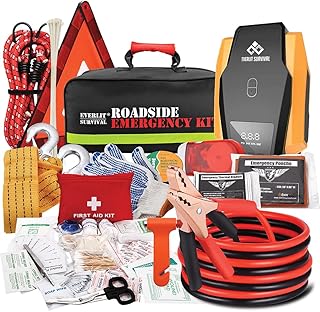
Keep your gauge protected and ready with a dedicated roadside kit built for glovebox storage.
Shop Car Safety Kits →Battery Life, Calibration & Upkeep
A digital gauge’s biggest ongoing responsibility is battery management. Most use small coin-cell batteries that last anywhere from one to several years depending on usage frequency and whether the gauge has an auto-shutoff feature. It’s worth keeping a spare battery in your car kit specifically for this reason, because there’s nothing more frustrating than needing a pressure reading and finding a dead screen.
Calibration is where the two types diverge most. Digital gauges from reputable brands are calibrated at the factory and generally hold that calibration well over their lifespan, assuming the sensor isn’t damaged. Some higher-end models let you verify accuracy against a certified reference, which is useful if you’re using the gauge for anything performance-critical.
Analog gauges, by contrast, have no digital memory of their factory calibration, they simply rely on the mechanical integrity of the internal piston or Bourdon tube. Dropping the gauge, especially onto its face, is the most common cause of calibration drift. Periodically checking your analog gauge against a known-accurate source, like the gauge at a trusted service station or a second gauge, is a smart habit if you rely on it regularly.
Either way, treating your tire gauge with the same care you’d give other diagnostic tools, like an OBD2 scanner or a TPMS sensor, pays off in reliability when you actually need an accurate number.
Precision Across Different PSI Ranges
Not every vehicle needs the same level of pressure precision, and this is a genuinely underrated factor in the digital vs analog decision.
Passenger cars and small SUVs (28–36 PSI)
This is the most common use case, and honestly, either gauge type handles it well. The difference between 32 and 33 PSI rarely changes how a daily driver feels or performs, so the 2 PSI resolution of a quality analog gauge is more than adequate for most drivers in this category.
Trucks, vans, and towing setups (50–80 PSI)
Higher pressure ranges amplify small measurement errors into bigger real-world consequences, since load capacity is directly tied to pressure at these levels. A digital gauge’s finer resolution becomes more valuable here, particularly if you’re regularly adjusting pressure based on cargo or trailer weight.
Motorcycles (28–42 PSI, narrower tolerance)
Motorcycle tires have a much smaller margin for error because the contact patch is so much smaller than a car’s. A couple PSI off can noticeably change handling feel and tire wear pattern. This is one of the strongest cases for a digital gauge’s added precision.
Bicycles and specialty low-pressure tires
This is outside the scope of most tire gauge discussions, but worth mentioning: extremely low-pressure applications need specialized gauges (digital or analog) designed for that specific range, since standard automotive gauges lack the resolution at the low end.
Recreational vehicles and trailers
RVs and travel trailers often run pressures similar to light trucks, but with the added complication of dual rear wheels on larger rigs, where the inner tire valve can be difficult to access. In these setups, a gauge with a flexible hose extension, available in both digital and analog versions, often matters more than the gauge type itself.
Across all these categories, the general rule holds: the higher the pressure and the smaller the tire’s margin for error, the more a digital gauge’s finer resolution starts to earn its keep. For everyday passenger cars, that resolution is a comfort feature rather than a necessity.
Price & Long-Term Value
Entry-level analog dial gauges are typically the cheapest option on the shelf, and even mid-range, well-reviewed models tend to sit comfortably below their digital counterparts. Because there’s no electronics to manufacture, the cost stays low and stable over the gauge’s lifespan, there’s no recurring battery expense either.
Digital gauges cost more upfront, and factoring in occasional battery replacements adds a small ongoing cost over years of use. However, the value proposition shifts if you consider the cost of acting on a wrong reading, an inaccurate gauge that leads to chronic underinflation can shorten tire life dramatically and increase fuel consumption, costs that dwarf the price difference between gauge types over a tire’s lifespan.
| Tier | Analog Gauge | Digital Gauge |
|---|---|---|
| Budget | Basic dial, adequate for occasional checks | Simple LCD, no extra features |
| Mid-range | Rubber-armored housing, larger dial face | Backlit display, auto shut-off, memory hold |
| Premium / Professional | Certified calibration, glove-friendly grip | Multi-unit display, high-precision sensor, rugged casing |

Checking pressure is only half the job. Pair your gauge with a reliable inflator to fix low tires on the spot.
See Tire Inflators →Pros and Cons of Each
Digital Tire Gauge
Pros
- Precise, easy-to-read numeric display
- Backlighting for low-light use
- Auto shut-off and memory hold on most models
- Often supports multiple units (PSI, BAR, KPA)
Cons
- Requires a working battery
- More sensitive to moisture and extreme temperature
- Generally higher upfront cost
Analog Tire Gauge
Pros
- No battery ever needed
- Extremely durable, mechanical construction
- Lower price point
- Unaffected by cold or heat
Cons
- Harder to read precisely, especially pencil-style models
- Difficult to use in low light without a flashlight
- Can drift out of calibration if dropped
Which One Should You Actually Buy?
Rather than crowning one universal winner, it’s more useful to match the gauge to how and where you’ll actually use it.
Choose a digital gauge if:
You want the fastest, clearest reading possible, especially at night or in a dim garage. You drive a truck, tow a trailer, or ride a motorcycle where small pressure differences matter more. You don’t mind keeping a spare battery in your car emergency kit just in case.
Choose an analog gauge if:
You want something that will simply never fail from a dead battery. You store your gauge in a place exposed to temperature extremes, like an unheated garage or a truck bed toolbox. You value simplicity and a lower price point over decimal-point precision.
Consider owning both
Many experienced drivers and mechanics actually keep one of each: a digital gauge for quick, precise daily checks, and a rugged analog gauge as a battery-free backup living in a winter emergency kit or trunk toolbox. That redundancy means you’re never stuck without a way to check pressure, regardless of battery life or weather.
Pro Tips for Getting Accurate Readings Every Time
- Check pressure when tires are cold. Driving even a mile or two heats the air inside the tire and raises the reading artificially, so check first thing in the morning or after the car has sat for a few hours.
- Press straight and firm onto the valve stem. An angled or loose seal causes a hiss of escaping air and an inaccurate low reading, regardless of gauge type.
- Take two readings and compare. If they differ by more than a PSI or two, something’s off, either with your technique or the gauge itself.
- Store your gauge properly. Keep it in a dedicated pouch or case rather than loose in a glovebox full of other tools, this alone prevents a huge share of physical damage.
- Recheck after temperature swings. Every 10°F drop in outside temperature can lower tire pressure by roughly 1 PSI, so seasonal changes are a good reminder to recheck.
- Cross-reference against your car’s door-jamb sticker, not the number printed on the tire’s sidewall, which is the tire’s maximum rating, not the recommended pressure for your vehicle.
These habits matter more than the type of gauge you own. A perfect digital gauge used carelessly will still give you a bad reading, while a cheap analog gauge used correctly can serve you reliably for years. If tire pressure issues have ever contributed to something like a car shaking at highway speed, a consistent checking habit is often the simplest fix available.

Want real-time monitoring instead of manual checks? Pair a hand-held gauge with a TPMS-compatible system for continuous peace of mind.
Explore TPMS Options →Frequently Asked Questions
Are digital tire gauges more accurate than analog ones?
Digital gauges typically offer finer resolution, reading to a tenth of a PSI, but a well-maintained, quality analog gauge can be just as accurate within its 1–2 PSI increments. Accuracy depends more on build quality and calibration than on the gauge type alone.
How often should I check my tire pressure?
Most manufacturers recommend checking at least once a month and before any long road trip, since tires can lose roughly 1 PSI per month even without a leak, and pressure shifts with outside temperature.
Do analog tire gauges need calibration?
They can drift out of calibration over time, especially after being dropped, though there’s no built-in way to detect this. Periodically comparing your reading against a trusted reference gauge is a good habit.
Why does my digital gauge give a different reading than the one at the gas station?
Small discrepancies are common and usually come down to sensor tolerance, calibration age, or how firmly the gauge was pressed onto the valve stem. A difference of 1–2 PSI between two properly functioning gauges is generally not a cause for concern.
Can extreme cold affect a digital tire gauge?
Yes, very cold temperatures can slow LCD screen response time and, in rare cases, shorten battery life temporarily. This doesn’t usually affect the sensor’s accuracy, just the speed and clarity of the display.
What PSI increments do analog gauges typically show?
Most consumer dial gauges are marked in 1 or 2 PSI increments, which is precise enough for the majority of passenger car applications but less ideal for high-precision needs like motorcycles or towing setups.
Is a pencil-style gauge the same as a dial-style analog gauge?
Both are mechanical and battery-free, but pencil-style gauges use a sliding scale that’s generally harder to read precisely than a dial-style gauge with a rotating needle and printed face.
Do I need a special gauge for trucks or towing?
Not necessarily a special gauge, but you’ll want one rated for the higher PSI range trucks often require (up to 80 PSI on some models), since a standard passenger-car gauge may not read accurately that high.
Should I trust my car’s built-in TPMS instead of a hand-held gauge?
Built-in TPMS systems are useful for ongoing monitoring, but many only alert once pressure drops significantly below the recommended level. A hand-held gauge, digital or analog, still gives you the most precise, on-demand check.
How much does a good tire gauge typically cost?
Reliable analog gauges are generally available at a lower price point than digital models, while mid-range digital gauges with backlighting and memory features cost somewhat more but rarely represent a significant expense either way.
Final Verdict: Which Tire Gauge Wins?
There isn’t a single correct answer here, and that’s genuinely fine. A digital tire gauge earns its keep through precision, readability, and speed, especially valuable for trucks, motorcycles, and anyone checking pressure in low light. An analog gauge earns its keep through pure, battery-free reliability that shrugs off years of glovebox abuse.
If you only want one gauge and mostly drive a standard passenger vehicle, a quality digital gauge is the easier daily-use choice. If you want a dependable backup that will never die on you, a rugged analog gauge belongs in your trunk regardless of what else you carry. Many drivers land on the simplest solution of all: own both, and let each one cover the other’s weak spot.
Compare Top-Rated Tire Gauges →