Sunshade UV Protection Rating: A Guide to Safe Driving
Not every sunshade blocks the same amount of ultraviolet light, even when they look identical on a store shelf. Here’s how to read the rating, why it matters more than most drivers assume, and how to choose one that actually protects your skin, your eyes, and your dashboard.
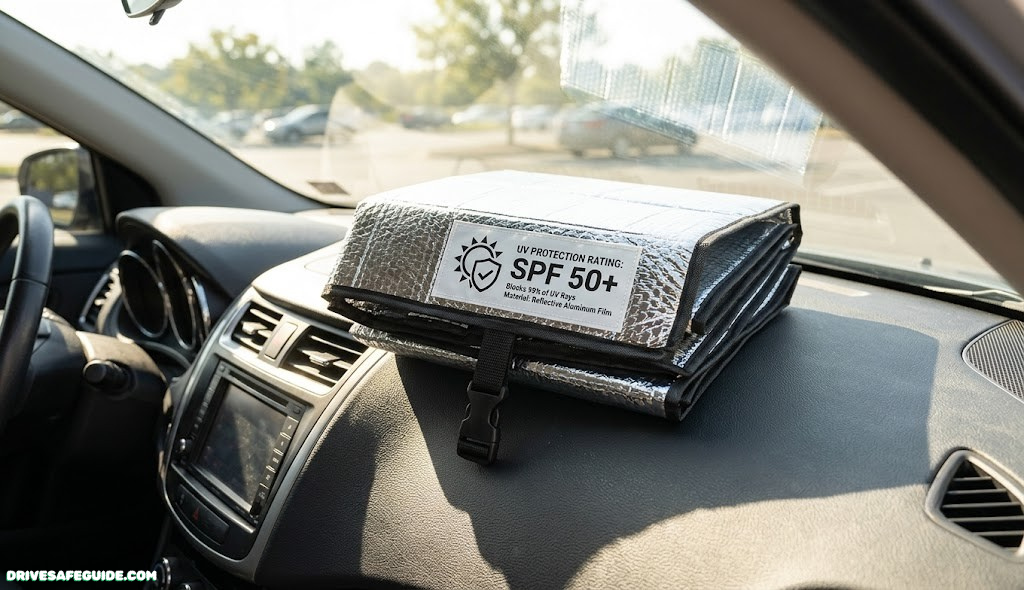
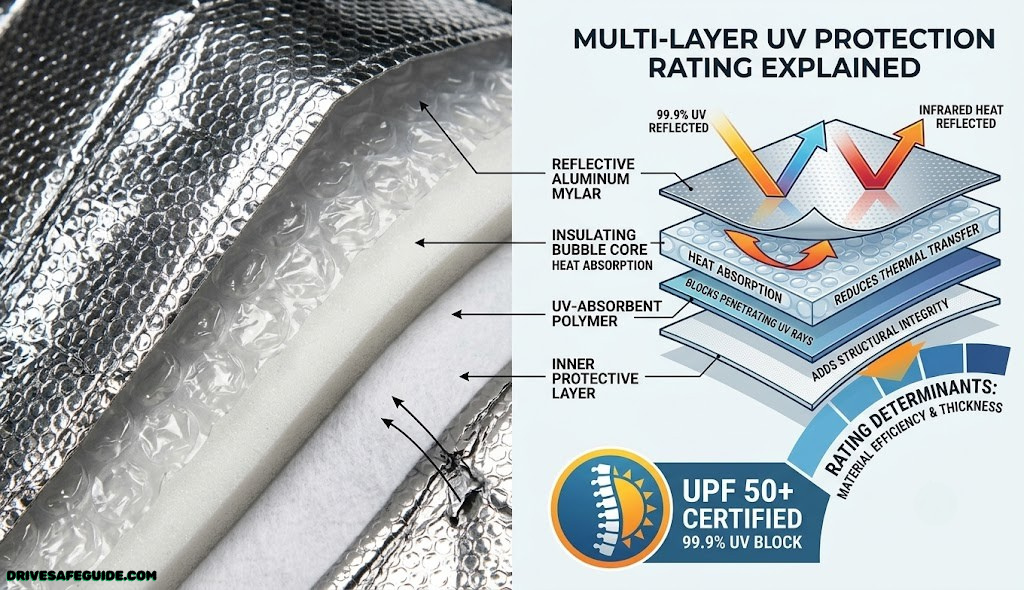
Most people buy a sunshade for one reason: to keep the steering wheel from turning into a branding iron. But the actual job of a sunshade goes further than comfort. Ultraviolet radiation passes through glass, builds up inside a parked cabin, and reaches a driver’s skin and eyes every single time the car is on the road, shade or no shade. The number printed on the packaging, whether it is a UPF rating or a percentage of UV blocked, is the only real way to know whether a shade is doing that job or simply making the interior look shadier.
This guide walks through what that rating actually measures, how it is tested, which shade styles perform best, and how to shop for one without falling for marketing language that sounds protective but means very little. Along the way, we will also look at where a sunshade fits alongside other protective habits, like wearing polarized driving sunglasses or checking your window tint darkness limits, so the whole system of sun protection in your car actually works together.
It’s worth saying upfront that this is not a topic with a single “best” answer that applies to every driver. A commuter in a mild, overcast climate has a very different exposure profile than someone who parks outdoors for eight hours a day in a high-UV region. The goal of this guide is not to push one specific product, but to give you a way of reading labels, comparing constructions, and matching a shade to your own driving life so that the number on the box actually means something once the shade is sitting on your dashboard.
What a Sunshade’s UV Protection Rating Actually Means
A UV protection rating describes how much ultraviolet radiation a material stops before it reaches the other side. For sunshades, that “other side” is either your skin, your eyes, or the surfaces of your dashboard and upholstery. The rating is usually expressed in one of two ways: a UPF number, borrowed from the same scale used for sun-protective clothing, or a stated percentage such as “blocks 99% of UV rays.”
These numbers are not vague marketing claims when they come from a manufacturer that has actually tested the fabric. A UPF 50 material, for example, allows roughly 1/50th of incident UV radiation to pass through it, meaning it blocks about 98 percent. A shade with no listed rating at all may still reduce visible light and glare while doing very little against UVA wavelengths, which are the ones responsible for long-term skin damage and interior fading.
It helps to separate two things that often get bundled together in shade marketing: heat reduction and UV reduction. A thick, reflective shade can make a cabin feel noticeably cooler within minutes, which is satisfying and easy to notice. UV blocking is invisible and only shows up over months or years, in the form of sun damage to skin, fading upholstery, or a cracked dashboard. A good rating tells you the shade is handling both, not just the part you can feel immediately.
Why the two numbers get confused so often
Manufacturers are not always careful about separating heat performance from UV performance in their marketing copy, and it is easy to see why: both numbers sound impressive, and both relate broadly to “sun protection.” A shade that says it “blocks 99% of sunlight” may be describing visible light reflectivity, UV blocking, or a blend of both, depending on how the manufacturer chose to phrase it. When a specific standard like UPF or UV400 is named, you are looking at a genuine UV measurement. When the phrase is simply “sunlight” or “rays” with no standard attached, it is worth treating the claim as a general impression rather than a verified figure, and looking for a more specific number elsewhere in the listing before deciding.

Why UV Exposure Behind the Wheel Is a Bigger Risk Than Most Drivers Realize
Automotive glass filters out most UVB radiation, the wavelength responsible for sunburn, fairly effectively. What it does not filter out nearly as well is UVA radiation, which penetrates deeper into skin and is linked to premature aging and long-term skin damage. Dermatologists have repeatedly pointed to a pattern in patients: more sun damage on the left side of the face and left forearm in drivers from countries where the driver sits on the left, a mirror pattern in right-hand-drive countries, tracking directly with the side of the body closest to the window.
Unlike a beach day, driving exposure is cumulative and easy to underestimate. A commuter spending even 45 minutes a day in a car accumulates several hours of side-window UV exposure a week, every week, for years. That adds up to more lifetime UV exposure from driving than most people get from a handful of vacations. A properly rated sunshade, particularly on side windows, is one of the few low-effort habits that meaningfully reduces that long-term dose.
There is also a practical safety angle that connects directly back to defensive driving. Glare and heat both increase driver fatigue and reduce reaction time, which is part of why defensive driving habits that reduce collision risk often include basic environmental controls like shading and glare management, not just steering and braking technique. A cooler, less glare-filled cabin is a more alert cabin.
The interior damage angle
UV radiation does not stop at skin. It also breaks down the polymers in dashboards, steering wheels, and seat materials, which is why a car parked outdoors for years often shows a cracked, faded dash long before the mechanical parts show real wear. A sunshade with a strong UV rating slows that clock considerably, which pairs well with other habits drivers use to keep a car looking new in hot climates.
Eyes are exposed too, not just skin
It is easy to focus entirely on skin when talking about UV exposure, but the eyes take on a real share of the dose as well. Cumulative UV exposure to the eyes over years of driving is one of the contributing factors dermatologists and optometrists point to when explaining why certain eye conditions appear more often in people with long driving histories. A rated sunshade reduces the ambient UV bouncing around a parked cabin before a drive even starts, and pairing it with UV-blocking sunglasses once the car is moving closes the gap for the hours actually spent behind the wheel.
Why this is easy to underestimate
Part of what makes driving-related UV exposure so easy to dismiss is that there is no immediate feedback. A sunburn from a beach day shows up within hours. UV-related skin aging and interior material breakdown from years of commuting show up so slowly that most people never connect the two. By the time someone notices a lopsided pattern of sun damage on one side of their body, or a dashboard that has visibly faded compared to the rest of the interior, months or years of exposure have already accumulated. A rated sunshade used consistently is a way of addressing a risk precisely because it does not produce an obvious, immediate warning sign.
How UPF and UV-Blocking Ratings Are Tested and Certified
Legitimate UV ratings on textiles and sunshade fabrics come from standardized lab testing, not a guess based on fabric thickness. The most widely referenced standard in this space is AS/NZS 4399, originally developed for sun-protective clothing, alongside ASTM D6603 used in North America. Both use a spectrophotometer to measure how much UV radiation passes through a fabric sample across the UVA and UVB spectrum, then convert that transmission measurement into a single UPF number.
For a sunshade specifically, testing labs typically evaluate the outer reflective layer, the inner foam or fabric core, and sometimes the finished multi-layer product as a whole, since layering changes total transmission. A manufacturer that lists a UPF number sourced from one of these standards is making a claim that can be independently verified. A shade that simply states “UV protective” with no number attached has not necessarily been tested at all.
| Rating Type | What It Measures | Typical Range Seen on Sunshades |
|---|---|---|
| UPF (Ultraviolet Protection Factor) | Combined UVA + UVB transmission through fabric | UPF 15 to UPF 50+ |
| UV400 | Blocks wavelengths up to 400 nanometers, covering nearly all UVA and UVB | Pass/fail style rating, common on tinted films and shades |
| Percentage blocked | Share of total UV radiation stopped by the material | 90% to 99%+ |
| No listed rating | Untested or self-described only | Unknown, treat with caution |
When comparing two shades, it is worth checking whether the number comes from an independent lab reference or is simply a phrase written by the seller. Reputable brands are usually willing to state the testing standard used, similar to how reputable sunglasses brands disclose lens category, a habit worth carrying over when shopping for polarized driving sunglasses with real glare reduction as well.
How to spot a real claim versus a marketing phrase
A genuine lab-tested claim is usually specific and consistent across a product’s documentation: the same UPF number or blocking percentage appears in the title, the bullet points, and any linked spec sheet, and it is often accompanied by a mention of the fabric composition. A marketing-only claim tends to be vaguer and less consistent, sometimes shifting between different phrasings like “UV protective,” “blocks harmful rays,” and “sun blocking” within the same listing without ever landing on a specific number. When a listing offers no number at all, it is reasonable to assume the shade has not been through formal UV transmission testing, even if it performs reasonably well at blocking visible light and heat.
Third-party retailer listings sometimes strip out a manufacturer’s original testing details when reformatting a product page, so if a rating seems to be missing on one retail site, it is worth checking the manufacturer’s own website or packaging photos before concluding the product was never tested at all.
Types of Car Sunshades and How Their UV Performance Differs
Not all sunshades are built the same way, and construction has a direct effect on UV performance. Below is a practical rundown of the styles most commonly sold for windshields and side windows.
Accordion-fold reflective shades
These fold into a compact stack and pop open into a rigid, reflective panel. They typically combine a metallic-coated outer layer with a foam or cardboard-like core, which gives them both strong reflectivity and a reasonably high UPF rating when tested. They are the most common style sold with an explicit UV percentage on the packaging.
Roll-up or spring-coil shades
Made from a single flexible fabric layer that snaps into a compact coil, these are easy to store but generally offer a lower UPF rating than multi-layer accordion shades, since there is only one thin layer doing the blocking.
Static-cling side window shades
These adhere directly to glass using static rather than adhesive, making them popular for rear passenger windows. Because they are thin and often semi-transparent, their UV ratings vary widely and tend to sit on the lower end unless specifically marketed as UPF-rated.
Mesh or perforated shades
Popular for rear windshields, mesh designs preserve some visibility through tiny perforations. That visibility comes at a cost: mesh shades generally block less total UV than a solid reflective panel of the same size, even when a UPF number is listed, because the perforation reduces coverage area.
Magnetic frame shades
These use a rigid frame with magnetic edges that snap to the window frame, holding a solid or fine-mesh panel in place. Fit tends to be more consistent than cling shades, which matters because gaps around the edges let UV in regardless of the fabric’s own rating.
Bubble or reflective foil shades
Often the cheapest option available, these consist of a thin foil or metallic-coated bubble layer with little to no additional backing. They can reflect a surprising amount of visible heat in the short term, which is why they remain popular, but their thinness usually means a lower sustained UPF rating and a much shorter usable lifespan, since the foil layer tends to crack and separate from its backing within a season or two of regular folding.
Custom molded or vehicle-specific shades
Rather than a generic rectangle, these are cut and sometimes rigid-molded to match a specific make and model’s windshield curvature exactly. Because they eliminate the gaps that generic shades leave at the corners, a mid-range UPF rating on a custom-molded shade often outperforms a higher advertised rating on a poorly fitted universal shade in actual UV blocked per session, simply due to coverage.

Sunshade vs Window Tint vs Sun Visor: Which Actually Blocks the Most UV
These three tools are often compared as if they compete, but they solve overlapping, not identical, problems. A sunshade is a removable, parked-car solution. Window tint is a permanent film applied to the glass itself, filtering UV any time the car is in use, moving or not. A sun visor is a built-in flip-down panel that blocks direct sun for the driver’s eyes specifically, with no real UV-blocking role for the rest of the cabin.
| Solution | Works While Driving? | Typical UV Blocked | Best For |
|---|---|---|---|
| Windshield/side sunshade | No, parked use only | Up to ~99% at the windshield/window it covers | Reducing cabin heat and dash fading while parked |
| Quality window tint film | Yes | Commonly 99% UV, varies by film grade | Continuous protection for driver, passengers, and skin |
| Sun visor | Yes | Blocks direct glare, minimal measured UV rating | Eye comfort and glare control, not UV protection |
The practical takeaway is that a sunshade and window tint are complementary rather than redundant. Tint protects continuously while driving; a sunshade protects the interior and reduces heat buildup while parked, when tint alone cannot stop a hot dashboard. Many drivers who care about long-term UV exposure use both together, and check their local window tint darkness limits before installing film, since UV-blocking capability and legal tint darkness are regulated separately in most states.
Why tint alone does not replace a sunshade
It is a common assumption that once a car has quality tint installed, a sunshade becomes redundant. In practice, tint’s UV-blocking benefit only applies while the sun is passing through the glass at whatever angle the car happens to be facing at that moment, and it does nothing to reduce the buildup of trapped heat once the vehicle is parked and the windows are up. A sunshade adds a physical, reflective barrier that specifically targets that parked-car heat buildup, which is why the two are often paired rather than treated as substitutes. Tint handles continuous, low-level protection while driving; a sunshade handles the much higher, concentrated exposure that happens during long parked stretches in direct sun.
Where a sun visor fits into the picture
A built-in sun visor solves a narrower problem than either of the other two options: blocking direct sun from a driver’s eyes at a specific angle. It has essentially no role in reducing UV exposure to skin, passengers, or interior surfaces, since it only covers a small portion of the windshield directly in the driver’s line of sight. Treating a visor as glare management for the eyes, rather than as any kind of UV protection strategy, keeps expectations realistic and avoids leaving the rest of the cabin unprotected under the assumption that the visor is already handling it.
How UV Index and Season Affect the Sunshade Rating You Actually Need
UV radiation is not constant throughout the year, and treating a sunshade as a purely “summer item” misses a large part of the actual exposure window. The UV index, the standardized scale meteorologists use to describe daily ultraviolet intensity, tends to peak in late spring and summer in most regions, but it rarely drops to a genuinely negligible level even in cooler months, especially at midday. Snow and light-colored pavement can also reflect a meaningful amount of UV back upward, which is part of why winter driving does not eliminate the exposure question the way many drivers assume.
For most temperate regions, a UPF 50 or UV400-rated shade used consistently from early spring through early fall covers the highest-risk months, while a lighter or smaller shade may be sufficient in winter for drivers in areas that see genuinely low UV index readings for several months. Drivers in southern latitudes, high-altitude regions, or areas with long dry seasons generally see a much smaller seasonal dip, which makes a high-rated shade worth using close to year-round rather than seasonally.
A simple way to think about it
Rather than trying to track the UV index daily, most drivers get good practical results from a simpler rule: if direct sunlight reaches the windshield for more than 20 to 30 minutes during a parking session, a UV-rated shade is doing real, measurable work. Below that threshold, the marginal benefit is smaller, though the shade still helps prevent heat buildup and glare on the next drive.
Features Worth Paying For in a High-UV-Rating Sunshade
Once a shade clears the basic bar of having a tested, stated UV rating, a handful of other features determine whether that rating translates into real-world protection.
Look for
- A stated UPF number or UV-blocking percentage, ideally referencing a testing standard
- Multi-layer construction with a reflective outer face
- A snug, edge-to-edge fit for your specific windshield size
- Reinforced folding creases that resist cracking over time
- A storage pouch or strap that keeps the shade flat between uses
Be cautious of
- Vague claims like “blocks harmful rays” with no number attached
- Extremely thin, shiny material with no visible layering
- Universal “one size fits all” shades for oddly shaped windshields
- Cling shades with visible gaps once installed
- Packaging that emphasizes color or design far more than performance data
Fit deserves special attention because it is the single most common reason a well-rated shade underperforms. A UPF 50 shade with a two-inch gap along the top edge is, in practice, letting a meaningful strip of UV straight through. This is one more reason a properly sized shade paired with practical accessories from a road trip essentials checklist tends to outperform a generic universal shade bought purely on price.
These features rarely work in isolation from one another. A high UPF fabric mounted on a frame that does not hold its shape will still leave gaps at the edges over time, even if the fabric itself tests well in a lab. Conversely, an excellent, snug-fitting frame paired with a low-rated fabric still allows a meaningful amount of UV through, just with fewer gaps. The most consistent real-world performance comes from a shade that scores reasonably well on both dimensions at once, rather than one that is exceptional in a single area while ignoring the rest.
Weight is a smaller, often overlooked factor as well. A slightly heavier shade with reinforced backing tends to sit flatter against the glass in windy conditions, reducing the small gaps that can open up along the edges when a lightweight shade shifts or bows outward.
Decoding the Label: UPF 50+, UV400, and Other Numbers Explained
Labels on sunshade packaging borrow language from several different industries, which is part of why they can be confusing at a glance.
UPF 50+
This is the ceiling rating typically printed on consumer sun-protective products. Anything tested above UPF 50 is usually still labeled “50+” rather than a higher number, since the difference between blocking 98% and 99.5% of UV radiation is not considered meaningful enough to warrant separate marketing tiers.
UV400
Borrowed from sunglasses lens standards, UV400 indicates a material blocks essentially all radiation up to the 400-nanometer wavelength, which covers the full UVA and UVB range humans are typically exposed to. On a sunshade, this is functionally similar to a very high UPF rating, just expressed with different terminology.
Reflectivity percentage
Some manufacturers list a separate reflectivity percentage referring to visible light and infrared heat reflection rather than UV specifically. This number is useful for judging how much a shade will cool the cabin, but it should not be mistaken for a UV rating on its own.
Choosing the Right Sunshade for Your Vehicle and Climate
The right choice depends less on brand and more on three practical factors: your windshield’s shape, your climate, and how the car is typically parked.
Vehicle shape and size
Larger SUVs and trucks with steeply raked windshields need a shade sized and shaped specifically for that glass, since a shade designed for a compact sedan will leave gaps at the corners. Measuring width and height at the widest points before buying avoids most fit-related complaints.
Climate and sun exposure
Drivers in consistently sunny, high-UV regions benefit from prioritizing UPF rating above all else, while drivers in more overcast climates might weigh heat reflection and interior appearance more heavily, since UV exposure, while still present, accumulates more slowly.
Parking habits
A car parked outdoors all day at work or during long errands benefits far more from a high-rated shade than one that spends most daylight hours in a garage. If your routine already includes steps from a pre-road-trip safety check, adding a properly fitted, UV-rated shade to that routine is a natural extension of the same protective mindset.
A short checklist before you buy
Rather than comparing shades purely by star rating or photos, run through a short list of practical questions first. Does the listing state an actual UPF number, UV400 rating, or tested blocking percentage, rather than only a general phrase like “sun protective”? Are the dimensions given as exact measurements rather than a vague size like “standard” or “large”? Does the product mention the material layers used, such as a reflective outer face over a foam or fabric core? Is there a stated storage method, such as a pouch or strap, that will help the shade keep its shape between uses? A shade that answers all four questions clearly is far more likely to perform close to its advertised rating than one that answers none of them.
It also helps to read a handful of verified buyer photos rather than relying only on the manufacturer’s own product shots, since real installation photos tend to reveal fit issues, like gapping at the corners, that staged photography rarely shows.
Getting the Most Protection from Daily Use
A sunshade only performs at its rated level if it is used correctly and consistently. A few habits make a meaningful difference over time.
- Install it every time you park in direct sun, not just on the hottest days. UV exposure and interior fading happen year-round, not only in summer.
- Press it fully into the corners of the windshield rather than leaving it centered with visible glass exposed at the edges.
- Pair it with side shades for parked cars with children or pets inside briefly, since side glass often gets overlooked despite significant UV exposure.
- Remove it before driving and store it flat or in its pouch, since a shade left crumpled in a footwell develops permanent creases that eventually crack the reflective coating.
- Combine it with tinted glass where legally permitted, checking window tint darkness limits in your state first.
These habits matter just as much on short errands as long drives, and they pair naturally with broader prevention-focused thinking, similar to how drivers eliminate road trip risks before departure rather than reacting to problems after they start.
A useful mental trigger is to treat the sunshade the same way as a seatbelt: something applied automatically at the start of a parking session, not something considered only when the sun feels unusually intense. Keeping the shade within easy reach, rather than buried under other items in the trunk, removes the small friction that often leads to skipping it on quick stops, which are exactly the stops that add up the most over the course of a week.
For vehicles parked in the same direction daily, such as at a regular workplace lot, it also helps to note which side of the car receives the harshest afternoon sun and prioritize that side’s shade, whether it is the windshield or a specific side window, on days when only a partial setup is realistic.
Maintenance and Lifespan: How Long a UV Rating Actually Holds Up
A sunshade’s UV protection is not permanent. Repeated folding, prolonged sun exposure to the reflective layer itself, and rough handling all degrade the coating over time. Most quality accordion-style shades maintain close to their original rating for one to three years of regular use before performance noticeably drops, while thinner cling and roll-up shades may degrade faster due to their single-layer construction.
Signs a shade needs replacing
- Visible cracking or flaking along the fold lines
- A dull, matte appearance where the reflective layer used to look glossy
- Persistent gaps or curling at the edges that no longer hold the windshield’s shape
- Noticeably less interior cooling compared to when it was new
Cleaning also matters. Wiping the reflective side with a soft, damp cloth rather than harsh chemicals preserves the coating longer, similar to the care routine used with other exterior-facing accessories covered in a basic car cleaning kit guide. Avoid folding a wet shade, since trapped moisture between layers can accelerate coating breakdown.
Storage habits that extend usable life
How a shade is stored between uses matters almost as much as how it is cleaned. Shades left loosely tossed in a trunk or footwell tend to develop unintended creases beyond their designed fold lines, and repeated bending along those extra creases is one of the fastest ways to crack a reflective coating well before its expected lifespan. Using the shade’s own storage strap or pouch, and folding only along the manufacturer’s intended lines, keeps the coating intact noticeably longer. For roll-up and coil-style shades, letting the coil snap shut on its own rather than forcing it flat also reduces stress on the fabric.
When rating loss becomes a safety issue, not just a comfort issue
It is worth remembering that a degraded sunshade does not just look worse, it protects less. A cracked or thinned reflective layer allows more UV and heat through than the same shade did when new, even if it still looks intact from a few feet away. Treating visible cracking as a replacement trigger, rather than waiting for the shade to fail completely, keeps actual protection closer to the rating printed on the original packaging.
Common Buying Mistakes That Quietly Reduce UV Protection
Even careful shoppers make a few recurring mistakes when choosing a sunshade, often because packaging is designed to emphasize convenience over protection performance.
Mistakes to avoid
- Buying a universal shade for an unusually shaped windshield instead of a model-specific fit
- Assuming a thicker foam layer automatically means a higher UV rating
- Choosing based on color or pattern without checking the printed UPF number
- Ignoring side windows entirely while focusing only on the windshield
- Continuing to use a visibly cracked or faded shade past its effective lifespan
Better approach
- Match the shade to your exact windshield dimensions
- Confirm the UPF or UV-blocking percentage before comparing price
- Treat side window shades as a separate purchase decision, not an afterthought
- Replace shades showing cracking rather than stretching their usable life
- Store shades flat when possible to protect the reflective coating
These same “check the number, not the marketing” instincts apply broadly to car safety gear, the same way shoppers are encouraged to compare specs directly when picking durable LED road flares or other safety equipment rather than relying on packaging alone.
Another overlooked mistake is buying a sunshade once and assuming it will serve the vehicle for its entire ownership period. Windshield sizes and curvatures vary even between trims of the same model, and a shade purchased for a previous vehicle rarely transfers cleanly to a new one. Re-measuring at the time of purchase, rather than assuming a shade from an old car will fit a similar-looking new one, avoids a surprisingly common source of gapped, under-protective coverage.
Special Situations: Kids, Pets, and Long Road Trips
UV protection needs shift depending on who is in the car and how long the vehicle sits in direct sun.
Children in rear seats
Kids seated near side windows for long stretches, whether commuting or on vacation, receive concentrated UV exposure on one side of the body if a shade is not used. Pairing a rated side shade with practical planning from a child car seat guide keeps both safety and sun exposure in mind at once.
Pets left briefly in a parked car
A high-quality windshield shade meaningfully reduces peak interior temperature, which matters for short stops, though it is never a substitute for not leaving an animal in a hot car. Drivers who frequently travel with animals often reference a car ride with a dog checklist alongside their sun-protection setup.
Long road trips with extended parking stops
Multi-day trips often mean parking in unfamiliar lots with no shade trees available. Packing a compact, rated sunshade alongside other essentials from a safe road trip essentials by scenario list keeps the cabin cooler at every stop, not just at home.
Drivers with sun-sensitive skin or a history of skin conditions
Some drivers have a medical reason to be more conservative than average, whether that is a history of skin conditions, medication that increases sun sensitivity, or simply a family history of skin damage. For this group, treating side-window UV protection as seriously as windshield protection, rather than as an optional extra, is a reasonable precaution. A rated side shade combined with a physical barrier like a light jacket or arm sleeve on the side closest to the window is a simple, low-cost habit that adds up over years of regular driving.
Vehicles that sit unused for extended periods
Cars that are driven infrequently but stored outdoors, such as a second vehicle or a seasonal car, often accumulate more total UV exposure to the interior than a daily driver, simply because they spend more consecutive hours in direct sun without anyone present to reposition them into shade. A sunshade left in place during long storage periods, checked periodically for cracking, protects the interior even when the car itself is barely being used.

Frequently Asked Questions
What does a UV protection rating on a sunshade actually measure?
It measures how much ultraviolet radiation the fabric blocks before it reaches your skin or the car’s interior, usually expressed as a UPF number or a percentage of UV rays blocked.
Is UPF 50+ the highest UV protection a sunshade can offer?
UPF 50+ is the top tier used on most consumer labels because it already blocks around 98 percent of UV radiation, so higher lab numbers rarely translate into a meaningful real-world difference.
Do windshield sunshades block UVA rays, not just UVB?
Quality sunshades with a stated UPF or UV400 rating are tested against both UVA and UVB wavelengths, while cheaper unrated shades may only reduce visible glare without blocking much UVA.
Does window tint make a sunshade unnecessary?
Tint and a sunshade solve different problems: tint reduces UV coming through the glass at all times, while a sunshade adds a physical barrier and cuts cabin heat when the car is parked, so many drivers use both.
How long does a sunshade keep its UV protection rating?
Most reflective and UPF-rated shades hold close to their original rating for one to three seasons of regular outdoor use before UV exposure and folding creases start to degrade the coating.
Can a sunshade lower the interior temperature of a parked car?
A well-fitted reflective sunshade can lower peak dashboard and steering wheel surface temperatures noticeably, though it will not fully prevent a parked cabin from heating up on a hot day.
Are cling-style sunshades as effective as accordion-fold shades?
Cling shades tend to offer weaker UV ratings and looser coverage at the edges, while accordion-fold and multi-layer shades generally test higher because they combine a reflective layer with a foam or fabric core.
Is it safe to drive with a sunshade still on the windshield?
No, a windshield sunshade must be removed before driving since it blocks the driver’s forward view; it is designed only for use while the vehicle is parked.
Do side window sunshades need their own UV rating?
Yes, side window shades are tested separately from windshield shades and often carry their own UPF figure, which matters most for protecting children and pets seated near the glass.
What UV rating should I look for if I drive long distances often?
Frequent long-distance drivers generally benefit from side shades rated UPF 50 or higher combined with UV-filtering glass or tint, since side-angle sun exposure adds up over many hours behind the wheel.
Does a higher price always mean a higher UV protection rating?
Not necessarily; price often reflects fit, materials, and storage design, so it is worth checking the printed UPF or UV-blocking percentage directly rather than assuming a premium price guarantees better protection.
Final Thoughts: Treat the Rating as a Spec, Not a Slogan
A sunshade is one of the cheapest, lowest-effort upgrades available for long-term driving safety and interior care, but only if the UV rating printed on it reflects a real, tested number. Checking for a stated UPF or UV-blocking percentage, matching the shade to your exact windshield and side windows, and replacing it once it starts cracking or fading are the three habits that turn a shade from a decorative accessory into genuine protection. Combine that with proven habits like wearing polarized driving sunglasses and following a defensive driving routine, and sun exposure becomes one less thing to worry about on every drive.
None of this requires an expensive setup or a complicated routine. A single, well-fitted, properly rated windshield shade combined with a pair of side window panels covers the majority of a typical driver’s exposure, and the small habit of putting it up every time the car is parked in direct sun is what actually delivers the protection printed on the label, session after session, year after year.

🌟 Recommended for Comfort
Drive More Comfortably Every Day
From lumbar supports to seat cushions, the right accessories can transform long drives from painful to comfortable. Browse our top picks on Amazon.
📯 Shop Comfort AccessoriesAffiliate link — we earn a small commission that keeps DriveSafeGuide running. Thank you!