Can Passengers Drink Alcohol in a Car? The 50-State Guide
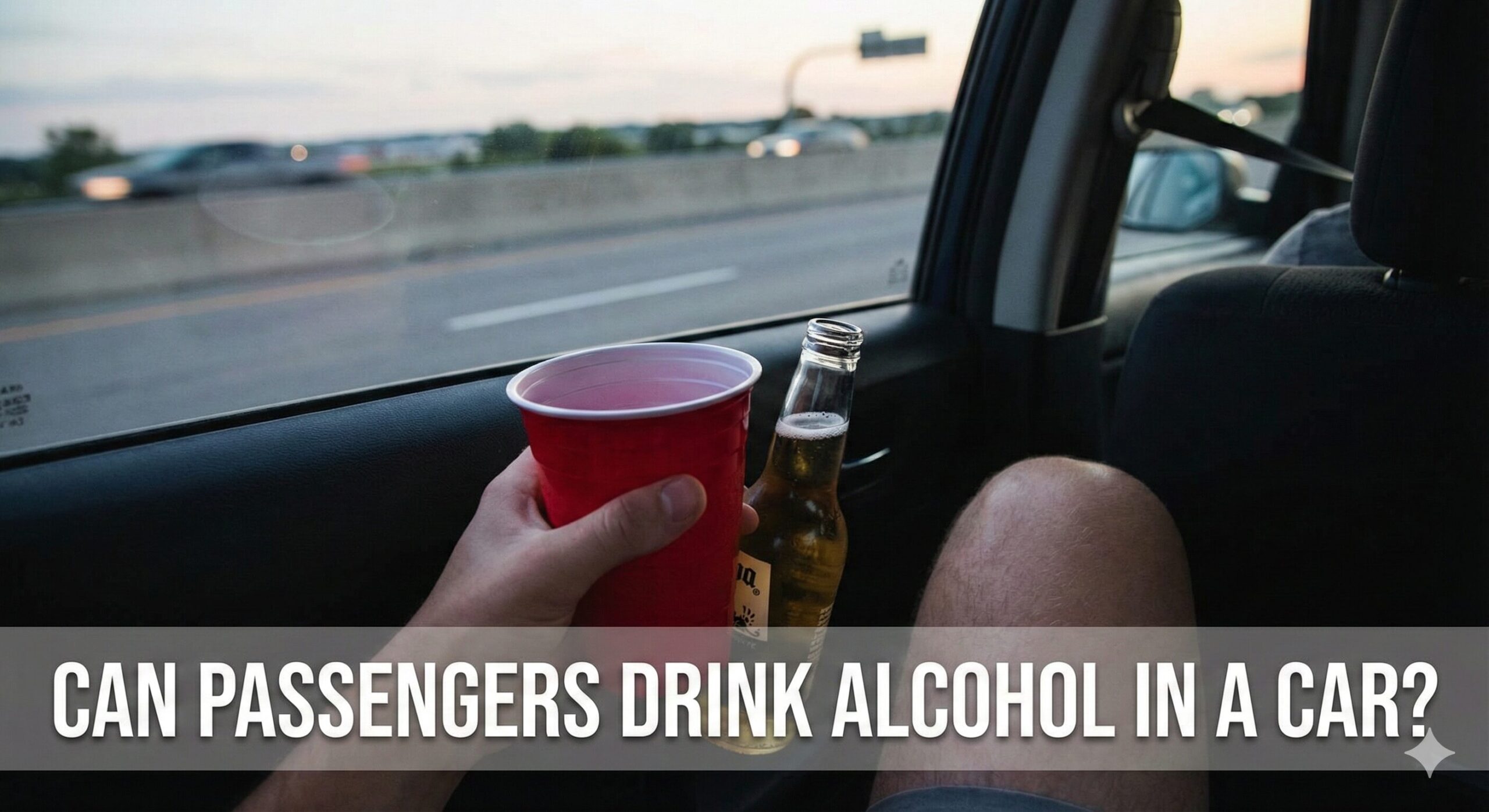
It’s a classic movie scene: a group of friends pile into a convertible for a road trip, the music blasts, and someone in the backseat cracks open a cold beer. It looks like freedom. It looks like fun. But in the real world, that simple “psshhh” sound of a can opening is often the sound of a crime being committed.
For decades, the United States has cracked down hard on drunk driving. Part of that crackdown includes Open Container Laws, which restrict not just the driver, but everyone in the vehicle from possessing an open bottle of alcohol.
However, the laws are not uniform. While 40+ states strictly forbid it, there are a handful of “outlier” states and very specific vehicle types where passengers can legally sip a cocktail while the car is in motion. This guide cuts through the confusion to keep you on the right side of the law.

The Federal Hammer: TEA-21
Why do almost all states have the same strict laws? You can thank the federal government. In 1998, Congress passed the Transportation Equity Act for the 21st Century (TEA-21).
This act didn’t make open containers illegal federally. Instead, it used bribery. The government told states: “If you want full federal highway funding, you must pass a law prohibiting the possession of any open alcoholic beverage container in the passenger area of any motor vehicle.”
To be compliant with TEA-21, a state’s law must:
- Prohibit possession of any open alcohol container.
- Apply to the entire passenger area (including the glove box).
- Apply to all vehicle occupants (driver and passengers).
- Apply to all open public roads (and shoulders).
Because most states want that highway money, they fell in line. But a few resisted.
The “Exceptions”: States Where Passengers *Might* Be Able to Drink
There are a few states that do not fully comply with the strict federal TEA-21 standards. In these jurisdictions, state law does not explicitly ban passengers from consuming alcohol, although the driver remains strictly prohibited.
Note: This list is subject to change and local interpretation.
| State | The Legal Nuance |
|---|---|
| Mississippi | The most famous exception. Mississippi has no state law against open containers for drivers or passengers, as long as the driver remains under the legal BAC limit (.08%). However, many counties and “dry” towns enforce their own bans. |
| Connecticut | State law prohibits drinking while driving, but technically does not explicitly ban passengers from possessing an open container. However, police often cite drivers for “distracted driving” if passengers are rowdy. |
| Delaware | Similar to CT, the statutes focus on the driver consuming, but carrying an open container can still lead to legal headaches. |
| Missouri | Passengers are generally permitted to possess open containers, but the driver is strictly forbidden. |
| Rhode Island | Historically allowed passenger consumption, but enforcement has tightened significantly in recent years. |
| Tennessee | State law bans the driver from consuming, but arguably permits passengers to possess alcohol. Local municipalities often close this loophole. |
| Virginia | Creates a rebuttable presumption that if an open container is in the car, the driver has been drinking. While passengers “can” drink, it puts the driver at massive risk of a DUI investigation. |
Just because you are in these states doesn’t mean you are immune to consequences. A rowdy passenger can still be cited for public intoxication or causing a disturbance. It’s similar to the risks of eating while driving—legal, but potentially dangerous.

The Big Exceptions: Limos, Buses, and RVs
Even in the strictest states (like California or New York), there are carved-out exceptions for vehicles “for hire” or vehicles designed for living.
1. Vehicles for Hire (Limos and Party Buses)
If you hire a chauffeur, you are generally allowed to drink in the passenger compartment. The logic is that professional drivers are less likely to be influenced by the passengers.
- The Barrier Rule: In many states, there must be a physical partition separating the driver from the passengers.
- The License Requirement: The vehicle must be properly licensed as a limousine or bus carrier. A friend driving a rented minivan does not count.
2. Motorhomes and RVs
Can you drink in an RV while it’s moving? Yes, but only in the living quarters.
Most states define the “passenger area” as the area designed for seating while traveling. In a motorhome, the back “living room” area is often exempt from open container laws. However, bringing a beer up to the passenger seat in the cockpit is definitely illegal.
Uber and Lyft: Can I Drink in the Backseat?
This is a common question on Friday nights. You are paying for a ride, so it feels like a limo, right? Wrong.
While state laws regarding “vehicles for hire” might technically cover ride-shares in some jurisdictions, Uber and Lyft company policies strictly ban alcohol consumption by passengers.
- The Policy: Both major platforms prohibit open containers.
- The Consequence: If a driver catches you, they can end the ride immediately and ban you from the app.
- The Driver’s Risk: Most Uber drivers use their personal vehicles. If they get pulled over with an open container, they personally face the fines and potential license suspension. Don’t put your driver in that position.

Penalties: What Happens if You Get Caught?
If you are in a standard passenger car and get stopped with an open beer, the consequences vary by state but are universally unpleasant.
- The Passenger: Usually faces a fine (infraction) ranging from $100 to $500. It typically does not add points to a driver’s license, but it is a mark on your record.
- The Driver: This is where it gets bad. In many states, the driver is held responsible for the car. A driver can be cited for allowing an open container, which can lead to points on their license and higher insurance rates.
- Probable Cause: An open container gives the officer probable cause to search the vehicle and administer a field sobriety test to the driver. Even if the driver is sober, this is a stressful and time-consuming ordeal.
Avoiding these penalties is part of general road safety, just like using safe driving apps to minimize risks.
How to Transport Alcohol Legally
You can obviously bring alcohol home from the store. The key is that it cannot be “open” and it cannot be “accessible.”
1. The “Sealed” Rule
If the factory seal is unbroken (the cap hasn’t cracked, the cork is in), it can usually be anywhere in the car. However, some states still prefer it to be out of reach.
2. The “Trunk” Rule
If a bottle has been opened (e.g., a re-corked wine bottle from dinner), it must go in the trunk. If you have an SUV or hatchback without a trunk, it must be placed behind the last row of seats—basically, as far away from the driver as possible.
3. Flasks and Cups
Pouring alcohol into a Stanley cup or a coffee mug does not fool the police. If it smells like alcohol, it is an open container. The “red solo cup” is a magnet for law enforcement attention.
Frequently Asked Questions
While sharing a drink with friends is great, the car is rarely the place to do it. For more insights on passenger safety and comfort, check out our guide on common myths about car interior lights.