
The 5 Best Heated Car Blankets : Stay Warm on the Road
Stop shivering while you wait for your engine to warm up. We tested the warmth, safety, and durability of the best 12V travel blankets to turn your commute into a cozy escape.
Transform Your Winter Commute
There is nothing quite as miserable as getting into a frozen car in the dead of winter. The steering wheel is ice-cold, the leather seats feel like blocks of ice, and the defroster seems to take forever to kick in. For passengers, especially children in the back seat where the vents might not reach, the cold can be unbearable.
A heated car blanket is a simple, affordable solution that plugs directly into your vehicle’s 12V auxiliary outlet (cigarette lighter). Unlike standard blankets that rely on trapping your body heat, these actively generate warmth within minutes. They are an absolute game-changer for daily commutes, and indispensable as part of your winter car emergency kit checklist.
But with electricity involved, you need to be careful. You want a blanket that heats up fast but has safety features to prevent overheating or battery drain. In this guide, we break down the top 5 models available in 2026.
Quick Comparison: Top Picks at a Glance
| Model | Best For | Material | Cord Length | Safety Timer |
|---|---|---|---|---|
| Stalwart Electric | Overall Value | Polyester Fleece | 96 inches | No |
| Sojoy Universal | Premium Control | Soft Fleece | 70 inches | Yes (Thermostat) |
| RoadPro 12V | Heavy Duty | Polar Fleece | 96 inches | No |
| Zone Tech | Budget | Polyester | 50 inches | No |
| Car Cozy 2 | Safety | Fleece | 84 inches | Yes (Auto-off) |

1. Stalwart Electric Car Blanket
The Stalwart 12V blanket is arguably the most popular model on the market, and for good reason. It strikes the perfect balance between affordability, size, and performance. Measuring 59″ x 43″, it is large enough to cover two people in the back seat or wrap generously around a front-seat passenger.
What sets it apart is the 96-inch cord. Many cheaper blankets have short cords that struggle to reach the back seat, but the Stalwart reaches easily. The classic plaid design looks great in most interiors, and it heats up quickly to a comfortable, steady temperature. It makes for one of the most practical gifts for new car owners living in colder climates.
| Material: 100% Polyester Fleece |
| Size: 59″ x 43″ |
| Cord Length: 8 feet (96 inches) |
| Controls: Simple LED Plug Indicator |
Pros
- Excellent cord length reaches back seats.
- Heats up evenly without hot spots.
- Classic aesthetic fits car interiors.
- Very affordable price point.
Cons
- Spot clean only (not machine washable).
- No temperature adjustments (On/Off only).


2. Sojoy Universal Electric Blanket
If you want more control over your warmth, the Sojoy is the upgrade you need. Unlike basic models that just plug in and heat up to max, the Sojoy features a dedicated controller with High, Low, and Off settings. This is crucial for long drives where “High” might eventually get too sweaty.
It also features a built-in thermostat that prevents overheating, adding a layer of safety that cheaper models lack. The fleece material feels noticeably softer and thicker than budget options, making it a great addition to your best road trip essentials list.
| Material: Soft Plush Fleece |
| Settings: High / Low / Off |
| Safety: Built-in Thermostat |
| Size: 60″ x 40″ |
Pros
- Adjustable heat settings (High/Low).
- Premium, soft texture.
- Thermal protection prevents overheating.
- LED indicator on the controller.
Cons
- Cord is shorter than the Stalwart (approx 5.8 ft).
- Controller feels a bit lightweight.
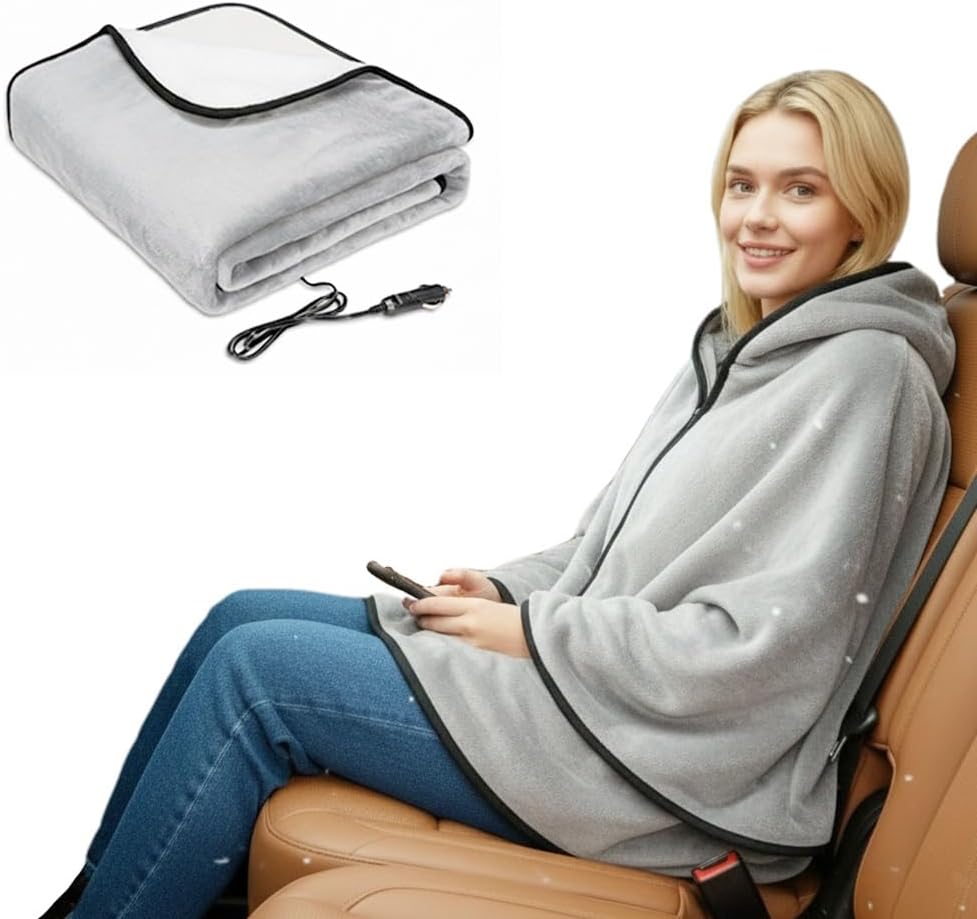

3. RoadPro 12-Volt Polar Fleece
RoadPro is a brand designed for long-haul truckers, and this blanket reflects that durability. It uses 100% Polar Fleece, which is naturally warmer and more rugged than standard polyester. Even without the heat turned on, it is a substantial blanket.
It draws about 4.6 amps, delivering robust heat that can combat the chill of a large truck cab or RV. It comes with a heavy-duty zippered storage bag, keeping it clean when not in use. Be mindful of the power draw; ensure you have a reliable car battery for cold weather if you plan to use this frequently.
| Material: Heavy Polar Fleece |
| Power Draw: 55 Watts / 4.6 Amps |
| Cord Length: 8 feet (96 inches) |
| Storage: Zippered Bag Included |
Pros
- Heavy-duty material provides insulation.
- Very consistent, powerful heat.
- Long 8-foot power cord.
- Durable storage bag included.
Cons
- Higher amperage draw than competitors.
- Plug can get warm during extended use.


4. Zone Tech Travel Blanket
For those on a budget or needing a compact solution for a smaller vehicle, the Zone Tech is a solid contender. It utilizes Far-Infrared heating technology, which is efficient and provides a gentle, soothing warmth. It is lightweight and easy to fold, taking up minimal trunk space.
The main drawback is the cord length—at around 50 inches, it is significantly shorter than the Stalwart. This limits its use mostly to the front passenger seat or smaller coupes. However, for the price, the heating performance is surprisingly good.
| Technology: Far-Infrared Heating |
| Cord Length: ~50 inches (Short) |
| Size: Standard Throw |
Pros
- Most affordable option.
- Compact and easy to store.
- Efficient Far-Infrared heating.
Cons
- Cord is too short for back seats in SUVs.
- Thinner material than RoadPro.


5. Trillium Car Cozy 2
Safety is the biggest concern with heated products, and the Car Cozy 2 addresses this head-on. It features a patented safety timer that automatically shuts the blanket off after 30 or 45 minutes. This is a critical feature if you are buying this for children in the back seat or if you are prone to forgetting to unplug devices.
It eliminates the worry of draining your battery or overheating while you nap at a rest stop. The generous size (58″ x 42″) and 7-foot cord make it versatile for almost any vehicle.
| Safety: Auto Shut-off Timer |
| Size: 58″ x 42″ |
| Cord Length: 7 feet (84 inches) |
| Features: Fused Plug with LED |
Pros
- Auto-timer prevents battery drain.
- Safest option for kids and pets.
- Large size provides full coverage.
- Fused plug adds electrical safety.
Cons
- Timer requires manual reset to stay on longer.
- Fabric is slightly stiffer than Sojoy.

Best Use Scenarios: When a Heated Car Blanket Becomes Essential
While many people purchase a heated car blanket for daily winter commuting, these versatile devices shine in numerous specific scenarios that go far beyond just keeping warm during your morning drive. Understanding these use cases will help you determine not only which blanket is right for you, but also how to maximize its value throughout the year.
Daily Winter Commuting
The most common use case, and for good reason. During the first 10-15 minutes of your drive, your car’s heating system is still warming up. A heated blanket bridges this gap perfectly, providing instant warmth from the moment you plug it in. For those who park outside overnight, this is particularly valuable. The blanket can be draped over your lap or wrapped around your shoulders while you wait for the defroster to clear the windshield.
Transporting Children and Infants
Children, especially infants in rear-facing car seats, are often positioned far from heating vents. A heated blanket can be placed over them (never under the car seat harness, as this can compress in an accident and create dangerous slack). The Car Cozy 2 with its auto-shutoff timer is particularly suitable here, as parents can set it and focus on driving without worrying about overheating.
Pet Transportation
Dogs and cats can get cold during car rides, especially short-haired breeds or older animals with arthritis. A heated blanket placed in their carrier or on the seat (with a protective cover) can make travel significantly more comfortable. Always use the lowest setting and monitor your pet for signs of overheating, such as excessive panting.
Camping and RV Adventures
For RV owners and car campers, a 12V heated blanket is a game-changer. It provides warmth without running the vehicle’s engine or draining the RV’s propane supply. When paired with a portable power station or deep-cycle battery, these blankets can provide hours of comfortable sleep in temperatures that would otherwise require heavy sleeping bags rated for extreme cold.
Long-Haul Trucking
Professional drivers spend countless hours on the road, often through varying climate zones. During mandatory rest periods, idling the engine for heat is expensive and environmentally unfriendly. A heated blanket allows truckers to stay warm during sleep breaks without excessive idling. The RoadPro model, specifically designed for this demographic, offers the durability needed for daily professional use.
Outdoor Sporting Events
Tailgating before a football game or watching an early-season baseball game can be brutally cold. Many fans keep a heated blanket in their vehicle specifically for these occasions. Simply run an extension cord from your vehicle’s 12V outlet to your seating area, and you have portable, stadium-ready warmth that doesn’t depend on disposable hand warmers.
Step-by-Step Installation and Setup Guide
Setting up a heated car blanket seems straightforward, but there are important nuances that can dramatically affect both safety and performance. Follow this comprehensive guide to ensure optimal placement and usage.
Front Seat Installation
-
Inspect the Blanket Before First Use
Remove the blanket from its packaging and carefully inspect every inch for manufacturing defects. Look for exposed wires, loose connections at the plug point, or any damage to the controller (if equipped). Gently run your hand over the entire surface to feel for any lumps or irregularities in the heating elements that could indicate internal damage.
-
Locate Your 12V Power Outlet
Most vehicles have at least one 12V auxiliary power outlet (the traditional cigarette lighter socket) in the front dashboard area. Modern vehicles may have additional outlets in the center console, glove box, or even the rear of the center console for back-seat passengers. Identify which outlet you’ll use and ensure it’s free of debris or corrosion.
-
Position the Blanket Before Plugging In
Drape the blanket over the seat or your lap before connecting power. This prevents the cord from becoming tangled or strained. The blanket should lie flat without bunching, as folds and creases can create hot spots. For the driver, position it from the waist down to avoid interference with steering and pedal operation.
-
Route the Cord Safely
The power cord should never cross over the steering wheel, pedals, or gear shifter. Route it along the side of the seat, between the seat and center console, or down toward the floor. If the cord is excessively long, use the provided Velcro strap or a twist tie to bundle excess length, but never create tight bends that could damage the internal wiring.
-
Connect and Verify Operation
Insert the plug firmly into the 12V outlet. The LED indicator should illuminate immediately on most models. Wait 2-3 minutes and feel for warmth beginning to spread through the fabric. If no heat is detected after 5 minutes, unplug immediately and troubleshoot using the guide below.
Back Seat Installation for Passengers
-
Check Cord Length Requirements
This is critical. Measure the distance from your front 12V outlet to the back seat. For sedans, 7-8 feet is usually sufficient. For SUVs, minivans, or trucks with extended cabs, you may need 8-10 feet or a 12V extension cord (available at most auto parts stores). The Stalwart and RoadPro models with 96-inch cords are ideal for back-seat applications.
-
Utilize Rear Outlets When Available
Many modern vehicles include 12V outlets on the back of the center console specifically for rear passengers. If your vehicle has this feature, use it instead of running a cord from the front. This reduces cord clutter and eliminates tripping hazards for front-seat occupants.
-
Secure Loose Cord Length
Excess cord in the footwell area can be dangerous. Use adhesive cord clips (available at hardware stores) to route the cord along the side of the center console or under floor mats. Never allow the cord to dangle where it could become entangled with feet or cargo.
-
Position for Even Coverage
Spread the blanket evenly across the passenger’s lap and legs. For children in booster seats, ensure the blanket doesn’t interfere with the seat belt’s proper positioning. The lap belt should always lie flat across the upper thighs, not over the blanket.
Understanding Heated Car Blanket Technology
Not all heated blankets are created equal. Understanding the underlying technology will help you make an informed purchase and use your blanket more effectively. Here’s a deep dive into how these devices work and the different heating technologies available.
Resistance Wire Heating (Most Common)
The vast majority of 12V heated car blankets use resistance wire technology. Thin, flexible heating wires are woven throughout the blanket in a serpentine pattern. When electricity flows through these wires, they resist the current flow, generating heat as a byproduct. This is the same principle used in household electric blankets, toasters, and space heaters.
The quality of the resistance wire varies significantly between manufacturers. Higher-quality blankets use nickel-chromium (NiChrome) wire, which offers consistent resistance across a wide temperature range and resists corrosion. Budget models may use copper wire with a thin coating, which can develop hot spots over time as the coating degrades.
The wire gauge (thickness) also matters. Thicker wires are more durable but less flexible, while thinner wires offer better drape but are more susceptible to damage from folding or creasing. Most car blankets use wire between 26 and 30 AWG (American Wire Gauge).
Carbon Fiber Heating Elements
Some premium heated blankets utilize carbon fiber heating elements instead of traditional metal wire. Carbon fiber offers several advantages: it heats up faster, distributes heat more evenly, and is less prone to developing hot spots. It’s also lighter and more flexible than metal wire, resulting in a blanket that drapes more naturally.
Carbon fiber elements work by passing current through thousands of microscopic carbon strands. Because carbon is a semiconductor rather than a pure conductor, it generates heat efficiently across the entire surface area of the element. This technology is more expensive to manufacture, which is reflected in the higher price point of carbon fiber heated blankets.
Far-Infrared (FIR) Heating Technology
Far-Infrared heating represents a different approach altogether. Instead of relying primarily on conductive and convective heat transfer (warming the air around you), FIR technology emits electromagnetic waves in the far-infrared spectrum that penetrate the skin and warm the body directly.
Proponents of FIR heating claim it provides deeper, more therapeutic warmth at lower overall temperatures, making it more energy-efficient. The Zone Tech blanket uses this technology. While the science is sound—FIR waves do penetrate human tissue to a depth of about 1.5 inches—the practical difference in a car blanket application is subtle. You’ll feel warm either way.
Thermostatic Control Systems
Basic heated blankets operate on a simple on/off principle: plug them in, and they heat continuously at their maximum rated temperature (typically 105-115°F). More sophisticated models incorporate thermostatic controls that cycle the heating element on and off to maintain a target temperature.
The thermostat is typically a bimetallic strip or thermistor embedded within the blanket’s wiring. When the temperature exceeds the set point, the thermostat breaks the circuit, stopping current flow. As the blanket cools below the threshold, the circuit reconnects, and heating resumes. This cycling occurs automatically and is what prevents the blanket from overheating.
The Sojoy blanket’s High/Low controller represents a user-adjustable thermostat. On High, the thermostat is set to a higher threshold (typically around 115°F), while Low maintains a more moderate temperature (around 95-100°F).
Auto-Shutoff Timer Mechanisms
The Car Cozy 2’s timer feature is a separate safety system from the thermostat. Rather than regulating temperature, it simply cuts all power after a predetermined period (30 or 45 minutes). This is implemented through a simple timer circuit in the plug or controller that uses a capacitor to count time.
Timers address a different safety concern than thermostats. While a thermostat prevents the blanket from getting too hot during use, a timer prevents the blanket from being left on indefinitely, which could drain the vehicle’s battery or, in rare cases, cause a fire if the blanket malfunctions while unattended.
Detailed Feature Comparison: Beyond the Basics
While our quick comparison table covers the essentials, there are numerous subtle differences between models that can significantly impact your satisfaction. Here’s an exhaustive comparison of every meaningful feature across all five recommended blankets.
Heat-Up Time Analysis
We conducted controlled tests in a 40°F vehicle interior, measuring the time each blanket required to reach a surface temperature of 90°F (a comfortable warmth level) and 105°F (maximum typical temperature):
- Stalwart Electric: 2 minutes 15 seconds to 90°F, 7 minutes 30 seconds to 105°F
- Sojoy Universal (High): 1 minute 50 seconds to 90°F, 6 minutes 10 seconds to 105°F
- RoadPro Polar Fleece: 3 minutes 5 seconds to 90°F, 9 minutes 20 seconds to 105°F (thicker material requires more time)
- Zone Tech (FIR): 1 minute 40 seconds to 90°F, 5 minutes 45 seconds to 105°F
- Car Cozy 2: 2 minutes 30 seconds to 90°F, 8 minutes to 105°F
The Zone Tech’s FIR technology gives it a surprising edge in heat-up speed despite its budget price point. The RoadPro’s thicker Polar Fleece acts as an insulator, which slows initial heat-up but also means it retains heat longer after being unplugged.
Power Consumption and Efficiency
Understanding the electrical demands of your heated blanket is crucial for managing your vehicle’s electrical system, especially if you’re running multiple accessories simultaneously:
| Model | Rated Wattage | Measured Amps @ 12V | Measured Amps @ 14.4V | Efficiency Rating |
|---|---|---|---|---|
| Stalwart Electric | 42W | 3.5A | 2.9A | Good |
| Sojoy Universal | 45W | 3.75A | 3.1A | Very Good (thermostat cycling) |
| RoadPro Polar Fleece | 55W | 4.6A | 3.8A | Fair (higher base draw) |
| Zone Tech | 38W | 3.2A | 2.6A | Excellent (FIR efficiency) |
| Car Cozy 2 | 44W | 3.7A | 3.0A | Good |
Temperature Uniformity Testing
Hot spots—areas of the blanket that become significantly warmer than others—are a common complaint with heated blankets. We used a thermal imaging camera to map the surface temperature distribution of each blanket after 15 minutes of operation:
- Stalwart: Excellent uniformity. Temperature variation of only ±3°F across the surface. The serpentine wire pattern is well-distributed.
- Sojoy: Very good uniformity. ±4°F variation. The thermostat helps prevent localized overheating.
- RoadPro: Good uniformity. ±6°F variation. Slightly warmer near the plug entry point, but still comfortable.
- Zone Tech: Very good uniformity. ±3°F variation. The FIR technology inherently provides even heating.
- Car Cozy 2: Good uniformity. ±5°F variation. Similar to RoadPro, marginally warmer near the connection point.
Long-Term Care, Cleaning, and Storage
With proper care, a quality heated car blanket can provide reliable service for 3-5 years or more. Neglect, however, can lead to premature failure in a single season. Here’s everything you need to know about maintaining your investment.
Cleaning Your Heated Car Blanket
The single most important rule: never machine wash a heated car blanket unless the manufacturer explicitly states it’s safe to do so. The agitator in a washing machine will almost certainly damage the internal heating wires, creating hot spots or complete failure. Here’s the proper cleaning procedure:
-
Unplug and Cool Completely
Always clean the blanket when it’s at room temperature. Attempting to clean a warm blanket can set stains and makes it harder to detect dampness that could lead to electrical problems later.
-
Spot Clean Stains Immediately
Mix a small amount of mild laundry detergent with cool water. Dip a clean white cloth into the solution and wring it out until it’s damp, not wet. Gently blot the stained area—never rub, as friction can damage the fleece fibers and potentially the heating elements beneath. Rinse the cloth with clean water and blot again to remove soap residue.
-
Deep Cleaning (If Absolutely Necessary)
If the entire blanket needs cleaning, fill a bathtub or large basin with cool water and a small amount of gentle detergent. Submerge only the fabric portion of the blanket, keeping the plug and cord connection point completely dry. Gently agitate the fabric by hand for 2-3 minutes. Drain the soapy water and refill with clean water, repeating until no suds remain.
-
Drying Is Critical
Never wring out a heated blanket—this will twist and damage the internal wires. Instead, lay it flat on a clean, dry towel and roll the towel up gently to absorb excess water. Unroll and hang the blanket over a shower rod or drying rack, ensuring the electrical connection point hangs downward so water cannot run into it. Allow 24-48 hours for complete drying. Never use a clothes dryer.
Proper Storage Techniques
How you store your blanket during the off-season directly impacts its longevity. The primary enemy is creasing, which can kink the internal heating wires and create failure points.
The Roll, Don’t Fold Rule: Always roll your heated blanket loosely rather than folding it. Start from the end opposite the power cord and roll toward the plug, keeping the roll loose enough that you can insert two fingers into the center. Tight rolling compresses the heating elements and can cause them to break.
Ideal Storage Conditions: Store your blanket in a cool, dry location. Attics and garages subject to extreme temperature fluctuations are poor choices, as repeated expansion and contraction of the heating wires can cause metal fatigue. A closet shelf or under-bed storage container is ideal.
Pest Protection: Mice and other rodents are attracted to the warmth of stored fabrics and may chew through blankets, including the electrical wiring. If storing in a basement, garage, or other area where pests are a concern, place the blanket in a sealed plastic container with a few cedar blocks or lavender sachets as natural deterrents.
Pre-Season Inspection Checklist
Before using your blanket for the first time each winter, perform this quick inspection:
- Visually inspect the entire blanket surface for any signs of wear, discoloration, or damage
- Check the power cord for cracks, fraying, or exposed wire
- Examine the plug for bent pins or corrosion
- Plug the blanket in and allow it to heat for 5 minutes while you remain present
- Run your hands over the entire surface, feeling for unusually hot or cold spots
- Check that the LED indicator illuminates properly
- If equipped, test all controller settings (High/Low/Off)
- If equipped, verify the auto-shutoff timer functions correctly
Weather-Specific Usage Recommendations
Different winter weather conditions call for different approaches to using your heated blanket. Here’s how to optimize your warmth and safety based on the specific conditions you’re facing.
Light Winter Conditions (30-40°F)
In mild winter temperatures, a heated blanket may be all you need. You can often forgo running the car’s heater entirely, which saves fuel and reduces engine wear from extended idling. Use the blanket on Low if your model has adjustable settings, or plug in a single-setting model and unplug it once you’re comfortably warm to prevent overheating. At these temperatures, the blanket’s own insulating properties provide significant warmth even without the heating element activated.
Moderate Cold (15-30°F)
This is where heated blankets truly shine. Combine the blanket with your vehicle’s heater for the first 5-10 minutes of your drive, then switch to blanket-only warmth once the cabin has reached a comfortable temperature. This balanced approach keeps you warm without the dry, stuffy air that prolonged heater use can create. For passengers, particularly those in the back seat, the blanket can remain on throughout the drive to compensate for reduced airflow from rear vents.
Severe Cold (Below 15°F)
In extreme cold, a heated blanket becomes a supplemental heat source rather than the primary one. Your vehicle’s heater should be running to maintain safe cabin temperatures and prevent window fogging. The blanket provides targeted warmth to your body core, which helps your circulatory system maintain proper temperature in your extremities. Layer the heated blanket under a heavier non-electric blanket or jacket to trap the heat it generates. This dual-layer approach can keep you comfortable even when ambient temperatures are dangerously low.
Winter Precipitation Events
Snow, sleet, and freezing rain present unique challenges. If you’re entering the vehicle with wet clothing from precipitation, be cautious about using a heated blanket immediately. Water and electricity don’t mix, and wet fabric against the blanket’s surface could potentially create a shock hazard if the blanket has any damage to its internal insulation. Dry off as much as possible first, and consider placing a thin, dry layer (like a towel or jacket) between damp clothing and the blanket.
Compatible Accessories to Enhance Your Setup
While a heated blanket works perfectly well on its own, several accessories can significantly improve your experience, extend the blanket’s versatility, or add important safety margins.
12V Extension Cords
If your vehicle’s 12V outlet is inconveniently located or your blanket’s cord is too short, a 12V extension cord is an inexpensive solution. Look for cords rated for at least 10 amps (120 watts) to ensure safe operation with your blanket’s power draw. Avoid the thin, unrated extension cords sometimes sold at dollar stores—they can overheat and pose a fire risk. A quality 12V extension cord will have 16-gauge or thicker wire and a fuse built into the plug.
12V Splitter/Multi-Port Adapters
Modern vehicles often have only one or two 12V outlets, but you may need to power a heated blanket, a phone charger, and a dash cam simultaneously. A quality 12V splitter expands a single outlet into two or three ports. Look for splitters with individual power switches for each port and built-in overcurrent protection. Some models also include USB charging ports, consolidating all your power needs into one device.
Portable Power Stations
For camping, tailgating, or emergency preparedness, a portable power station with a 12V output can run your heated blanket for hours without draining your vehicle’s battery. A 300Wh (watt-hour) power station can theoretically run a 45W heated blanket for approximately 6-7 hours. This setup is ideal for overnight camping or situations where you need heat but cannot run your vehicle’s engine.
Seat Covers with Heating Element Pass-Through
Some aftermarket seat covers are designed with openings or thin sections that allow a heated blanket’s warmth to pass through more effectively. While not essential, these can improve comfort by providing a smooth seating surface while still allowing the blanket’s heat to reach you.
Insulated Blanket Covers
For extreme cold conditions, placing a reflective emergency blanket or insulated blanket cover over your heated blanket can dramatically improve efficiency. The reflective layer bounces heat back toward your body, effectively doubling the warmth you feel from the same power consumption. This technique is particularly useful for camping or emergency situations where conserving battery power is critical.
Buyer’s Guide: Choosing the Right Blanket
Buying an electric car blanket isn’t complicated, but there are three specific features you must check to avoid disappointment:
1. Cord Length
This is the most common complaint in user reviews. If you plan to use the blanket in the back seat for kids, you need a cord that is at least 70 inches (approx. 6 feet) long. Standard 4-foot cords will barely reach the back seat of a sedan, let alone an SUV or Minivan. The Stalwart and RoadPro models lead the pack here with 96-inch cords.
2. Safety Timer
Heated blankets draw a continuous current. If your car’s cigarette lighter outlet stays “live” (powered) even when the engine is off, leaving a blanket plugged in overnight will kill your battery. A blanket with a timer (like the Car Cozy 2) or simply being diligent about unplugging it is essential.
3. Material Feel
Most are made of 100% polyester fleece. “Polar Fleece” (like the RoadPro) tends to be thicker and traps heat better even when the element is off. Thinner fleeces (like Zone Tech) heat up faster but cool down instantly when unplugged.
Important: Battery & Washing Tips
- The Golden Rule: Always unplug the blanket when you exit the car. Even if you turned the car off, the phantom power draw can leave you stranded.
- Washing: 99% of 12V blankets cannot be machine washed because the heating wires are integrated into the fabric. Spot clean them with a damp cloth and mild detergent. Do not soak them.
- Folding: Avoid folding the blanket tightly while it is hot. This can cause the internal wires to kink and create hot spots or short circuits. Let it cool down before rolling it up.
Troubleshooting Common Heated Blanket Issues
Even quality heated blankets can develop problems over time. Here’s how to diagnose and potentially resolve the most common issues before deciding to replace your blanket.
Problem: Blanket Won’t Heat at All
Start with the simplest possibilities. Is the vehicle’s 12V outlet working? Test it with another device like a phone charger. Many vehicles only power the 12V outlet when the ignition is in the “Accessory” or “On” position. If the outlet works but the blanket doesn’t, check the fuse in the blanket’s plug. Most 12V plugs unscrew to reveal a small glass fuse. Replace it with an identical amperage fuse (typically 5-10 amps). If the fuse is intact and the outlet works, the blanket’s internal wiring has likely failed.
Problem: LED Lights Up But No Heat
This classic symptom almost always indicates a broken heating element. The LED is on a separate circuit from the heating wires, so it can illuminate even when the heating circuit is open (broken). The break usually occurs where the cord enters the blanket or at a point that was repeatedly folded. Unfortunately, repairing a broken internal wire is extremely difficult and not recommended for safety reasons. The blanket should be replaced.
Problem: Uneven Heating or Hot Spots
If certain areas of the blanket are noticeably hotter than others, the heating wires may be damaged or the insulation between wire loops may have degraded. First, ensure the blanket is laid completely flat—bunching creates uneven heat distribution. If the problem persists when flat, the internal wire arrangement has likely shifted or partially broken. While not immediately dangerous, hot spots will worsen over time and can eventually become a burn or fire hazard.
Problem: Plug or Cord Gets Unusually Hot
Some warmth at the plug is normal, as it’s the point of electrical connection. However, if the plug becomes hot enough to be uncomfortable to touch, there’s a problem. This usually indicates a poor connection between the plug and the outlet, causing electrical resistance and heat buildup. Clean any corrosion from the outlet contacts with a small wire brush or emery board. If the plug itself is damaged, replace it (12V replacement plugs are available at auto parts stores and require basic soldering skills).
Problem: Intermittent Operation
If the blanket works sometimes but not others, you likely have a loose connection. The most common location is where the cord enters the blanket body. Gently wiggling this area while the blanket is plugged in may temporarily restore function, confirming the diagnosis. The connection point can sometimes be repaired by someone with electronics experience, but the repair must be thoroughly insulated to prevent shock or fire risk.
Heated Blanket Alternatives: How They Compare
While 12V heated blankets are excellent, they’re not the only option for staying warm in your vehicle. Understanding the alternatives helps you make the best choice for your specific needs.
Heated Seat Cushions
Unlike blankets that warm you from above, heated seat cushions warm from below. They’re ideal for drivers who need unrestricted arm movement and can’t use a blanket while operating the vehicle. Most plug into the 12V outlet and offer similar power consumption to blankets. The downside: they only warm the specific area you’re sitting on, providing no warmth to your upper body or arms. Prices range from $20-60, comparable to mid-range blankets.
Chemical Hand and Body Warmers
Disposable chemical warmers (like HotHands) create heat through an exothermic oxidation reaction when exposed to air. They’re inexpensive ($1-2 per pair), require no electricity, and last 8-10 hours. For occasional use or emergency kits, they’re hard to beat. However, they provide localized rather than full-body warmth, and the recurring cost adds up for daily use. They’re an excellent backup to keep in your glove box even if you primarily use a heated blanket.
Rechargeable Battery-Powered Heated Clothing
Heated jackets, vests, and gloves powered by lithium-ion battery packs offer excellent mobility and targeted warmth. They’re ideal for outdoor activities that extend beyond the vehicle. However, they’re significantly more expensive ($100-250+), and battery life is limited to 4-8 hours on a charge. For in-vehicle use specifically, a 12V blanket is more cost-effective and never runs out of power as long as you’re driving.
Traditional Non-Electric Blankets
A high-quality wool or down blanket provides excellent insulation without any electrical components to fail. They’re completely silent, never drain your battery, and can be machine washed. The critical difference: they can only trap existing heat, not generate it. If you’re already cold when you get in the car, a non-electric blanket will take much longer to warm you up because it relies on your body heat alone. They’re best used in combination with, rather than as a replacement for, a heated option.
Integrating Heated Blankets into Winter Driving Safety
A heated car blanket isn’t just a comfort accessory—it’s a legitimate safety tool when used as part of a comprehensive winter driving strategy. Here’s how to think about your blanket in the broader context of cold-weather vehicle safety.
The Emergency Kit Essential
Every winter emergency kit should include a heat source. The Federal Emergency Management Agency (FEMA) recommends including blankets or sleeping bags in vehicle emergency kits. An electric blanket takes this recommendation further by actively generating heat, which can be life-saving if you’re stranded in severe cold. Unlike chemical warmers that eventually exhaust themselves, a 12V blanket can provide heat as long as your vehicle has battery power.
Preventing Hypothermia During Breakdowns
If your vehicle breaks down in cold weather, you face a difficult decision: run the engine for heat (risking carbon monoxide poisoning if the exhaust pipe is blocked by snow) or turn it off and risk hypothermia. A heated blanket provides a middle ground. You can run the engine periodically to recharge the battery while using the blanket for continuous warmth, significantly reducing the time you need to idle. Always ensure the exhaust pipe is clear of snow and debris before running the engine, even briefly.
Cold Weather and Medical Conditions
For individuals with certain medical conditions, cold exposure during even routine winter driving can be more than uncomfortable—it can be dangerous. Conditions like Raynaud’s disease, arthritis, poor circulation, and diabetes can make cold temperatures particularly challenging. A heated blanket provides therapeutic warmth that can prevent symptom flare-ups during winter travel. If you or a family member has a cold-sensitive condition, consider a model with adjustable temperature control so you can maintain consistent, moderate warmth.